Categories
Articles

How to Choose Ayurvedic Supplements: DIY Research vs. Professional Guidance

The best Ayurvedic supplement isn’t necessarily the one with the most traditional-sounding name. If ingredient lists, Sanskrit terms, and bold wellness claims leave you unsure where to begin, you’re not alone. Learning how to choose ayurvedic supplements starts with looking beyond the label’s promises and asking what’s in the formula, what evidence supports its use, and whether it suits your needs.

It makes sense to want a natural option that fits your wellness routine. But what’s appropriate can change with your health, medications, and life stage, especially during pregnancy or breastfeeding, or through perimenopause and menopause. Research can help you compare ingredients, review product information, and narrow your choices. It can’t always tell you whether a supplement is right for you personally.

This guide offers a practical way to assess labels and claims, distinguish traditional use from modern research, and recognize when individualized guidance matters. You’ll also learn how to make supplement decisions thoughtfully, alongside habits such as nourishing food, movement, yoga, and meditation, as part of a steady approach to well-being.

Key Takeaways

  • To learn how to choose ayurvedic supplements, start with your wellness goal, then assess the ingredients, directions, warnings, and manufacturer information.
  • Distinguish traditional Ayurvedic use from clinical evidence, and read health claims with care.
  • Use your own research to compare options and prepare questions. Medications, health history, or life stage may call for individualized guidance.
  • Consider your needs during menstruation, pregnancy, lactation, perimenopause, or postmenopause instead of assuming one approach fits every woman.
  • Make supplement decisions as one considered part of a broader wellness routine, not as a promise of results.

How to Choose Ayurvedic Supplements Without Getting Lost in the Claims

You want a supplement choice that feels considered, not rushed, and respects tradition without treating it as a guarantee. Start by asking what you hope to support, what the product contains, and whether its claims are backed by relevant evidence. Those questions are a steadier basis for how to choose ayurvedic supplements than relying on a traditional name or a promise on the front of a bottle.

Ayurvedic supplements are products informed by Ayurveda, a traditional system of health practices and concepts that developed in India. The overview of Ayurveda describes its history and broad principles, including doshas, a traditional way of understanding individual patterns. Doshas can be meaningful within this framework, but they are not medical diagnoses. A product’s connection to Ayurveda explains its philosophical roots; it doesn’t, by itself, show that the product is clinically effective for a particular goal.

Self-research helps you understand and compare options; individualized professional guidance considers whether an option fits your health history, medications, and life stage. Both can have a place. Your goal, the formula’s ingredients, your health context, and your preferences all shape what a reasonable choice looks like. A thoughtful approach can appreciate traditional knowledge while asking what contemporary evidence does and doesn’t support.

What Ayurvedic principles can, and cannot, tell you

Ayurveda offers a traditional lens for thinking about well-being and balance. Dosha descriptions may help you explore that lens, but they shouldn’t be used to diagnose a health condition or decide that a supplement is automatically suitable. Traditional use provides context, not proof of effectiveness. Research findings also need to be considered in context: evidence about one ingredient or preparation may not apply to every product or person. Supplements aren’t substitutes for diagnosis or treatment.

Start with a clear, realistic wellness goal

Before comparing ingredients, write down one specific priority. You might want to support a general wellness routine or explore options related to digestion. A focused goal makes it easier to compare products without being drawn to formulas that promise to address everything. Keep the goal realistic: a supplement isn’t a shortcut or a guaranteed outcome.

Separate general wellness interests from symptoms that deserve individualized medical attention. New, persistent, or concerning changes in your health shouldn’t be managed through supplement research alone. This is especially relevant when your needs may be shaped by menstruation, pregnancy, breastfeeding, or menopause. A clinician can help assess symptoms and consider your personal context before you make a decision.

Build your foundation alongside any supplement research. Regular movement, nourishing meals, restorative sleep, yoga, and meditation can support a broader wellness routine. Choose practices you can sustain: a walk, a balanced meal, or a brief meditation can be a more practical starting point than trying to overhaul everything at once. The aim is a thoughtful choice that fits your life, not a promise in a bottle.

How to Evaluate Ayurvedic Supplement Ingredients, Labels, and Evidence

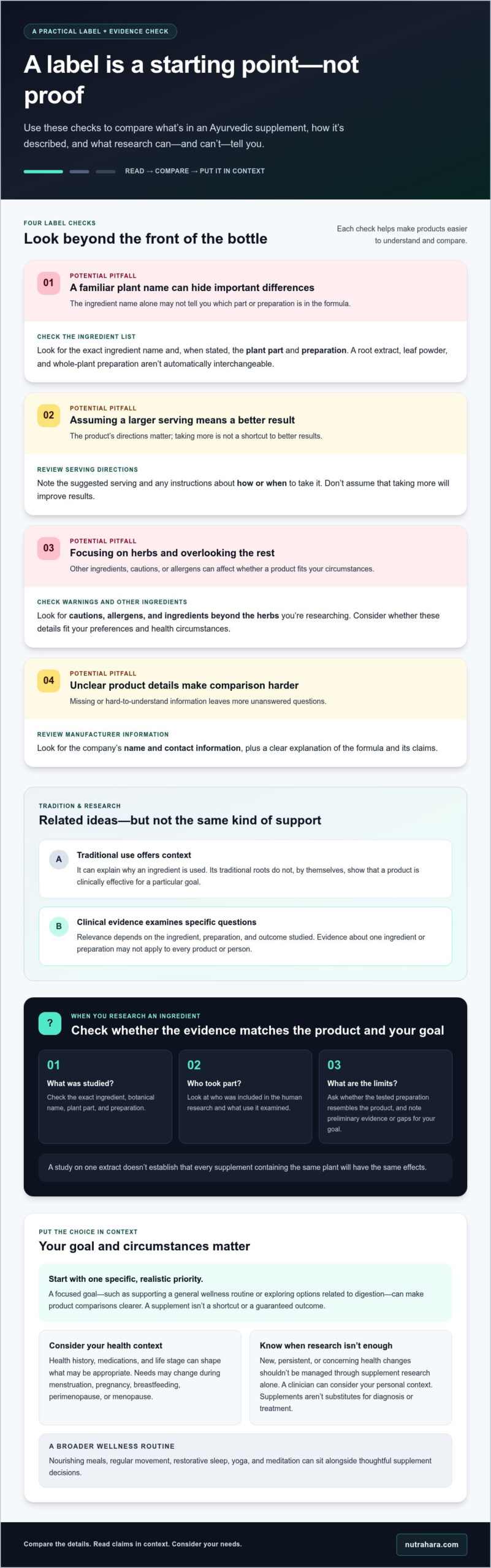
A label is a starting point for comparison, not proof that a supplement will meet your goal. Read it in a consistent order so unfamiliar botanical names or polished claims don’t distract from practical details. Clear identification helps you understand what a formula contains and compare it with ingredients discussed in research.

  1. Read the ingredient list. Look for the exact ingredient name and, when stated, the plant part and preparation. A root extract, leaf powder, and whole-plant preparation aren’t automatically interchangeable.
  2. Review serving directions. Note the suggested serving and any instructions about how or when to take it. Don’t assume that taking more will improve results.
  3. Check warnings and other ingredients. Look for cautions, allergens, and ingredients beyond the herbs you’re researching. These details may affect whether a product fits your preferences or health circumstances.
  4. Review manufacturer information. Look for the company’s name and contact information, along with a clear explanation of the formula and its claims. Missing or hard-to-understand details make products more difficult to compare.

Questions to ask when researching an Ayurvedic ingredient

Start with the exact ingredient named on the label. Search for its botanical name, plant part, and preparation, then look for human research related to your intended use. Check what the study examined, who took part, and whether the tested preparation resembles the one in the product. A study on one extract doesn’t establish that every supplement containing the same plant will have the same effects. Note limitations, including whether evidence is preliminary or doesn’t address your specific wellness goal.

Traditional use and clinical evidence are different kinds of support. Traditional knowledge can explain why an ingredient is used. Clinical evidence examines specific questions through research, and its relevance depends on the ingredient, preparation, and outcome studied.

How to read claims without overinterpreting them

Pause over claims that sound sweeping, vague, or guaranteed. Ask what the product says it supports and whether the explanation points to evidence that matches that claim. A statement about general structure or function is different from a promise to prevent, treat, or cure a disease. In the United States, the FDA does not approve dietary supplements for safety and effectiveness before they are marketed. Its dietary supplement information explains the agency’s role and the category’s oversight.

For broader context on choosing products for women’s needs, see The Ultimate Guide to Women’s Wellness Supplements. Nutrahara’s women’s health supplements combine Ayurvedic principles with modern nutritional research. Explore Nutrahara’s women’s wellness approach as another point of comparison while you read labels and assess claims.

DIY Research vs. Professional Guidance: Which Approach Fits Your Situation?

Independent research can help you become a more confident reader of supplement labels. It can explain unfamiliar terms, help you compare ingredients, and give you useful questions to bring to a healthcare professional. But it can’t account for your full medical history or determine whether a product is suitable for you personally. A thoughtful approach to how to choose ayurvedic supplements uses research to narrow options, then seeks individualized input when your circumstances call for it.

When independent research may help you narrow options

Self-directed research is a practical first step when you’re exploring general wellness options and don’t have a personal health factor that makes the decision more complex. Keep a short note for each product you’re considering:

  • The product and its stated purpose
  • The exact ingredients and any label warnings
  • What you found about those ingredients, including questions or uncertainties

Bring your notes to a conversation with a qualified healthcare professional if you’re unsure. This makes the discussion more focused than arriving with a broad question such as “Are Ayurvedic supplements safe?” The WHO perspective on traditional medicine also provides context for considering traditional approaches alongside evidence-informed healthcare. General reading alone can’t establish an individual product’s safety or suitability for you.

When individualized guidance matters more

Personalized advice is especially relevant if you’re pregnant, breastfeeding, taking medication, managing a health condition, or preparing for a planned procedure. These factors can change which questions need attention and how a supplement fits into your overall care. A clinician or pharmacist who understands your circumstances can review the product alongside your medication and health history. Don’t assume an ingredient is appropriate for every woman just because it’s plant-based or traditionally used.

If you’re experiencing symptoms that are new, persistent, or concerning, seek medical attention rather than trying to manage them with supplements. Research can help you organize your questions, but it shouldn’t delay an assessment or replace recommended care.

DIY research
Strengths: Clarifies terminology, compares labels, and helps you prepare focused questions.
Limits: Can’t assess your full health history or determine personal suitability.

Individualized professional guidance
Strengths: Can consider medications, health conditions, life stage, and other personal factors together.
Especially useful when: You’re pregnant or lactating, use medication, have a health condition, or have a planned procedure.

The aim isn’t to choose between learning for yourself and seeking support. Use research to become an informed participant, and seek individualized guidance when your health context makes a general answer insufficient.
How to Choose Ayurvedic Supplements: DIY Research vs. Professional Guidance

A Practical Safety Check for Women at Different Life Stages

A supplement decision should reflect more than the ingredient name. Menstruation, pregnancy, lactation, perimenopause, and postmenopause are different experiences, and individual health needs vary within each stage. A routine that suits one woman may not suit another. Your personal health context can change whether a supplement is appropriate.

Use this pre-use check to organize your decision. It won’t replace individualized medical advice, but it can help you identify questions for further discussion.

  1. Clarify your goal. Write down what you hope to support and whether it’s a general wellness priority or a symptom that needs assessment.
  2. Read the full label. Review ingredients, serving directions, warnings, and other listed components, not just the front-panel claims.
  3. Review your context. Consider your life stage, health conditions, medications, and any planned procedure. “Natural” describes an origin, not whether a product is suitable for you or free from possible interactions.
  4. Note your questions. Record anything unclear about the ingredients or claims, then discuss relevant concerns with a qualified healthcare professional before starting if your circumstances warrant it.

Pregnancy, lactation, medications, and health conditions

If you’re pregnant or breastfeeding, seek individualized healthcare guidance before starting a supplement. The same care is sensible if you take medication or manage a health condition. Share the product label, not only the product name, so its ingredients and warnings can be reviewed in context. No ingredient should be treated as universally suitable for every woman or every life stage. Don’t make your own dosing changes or assume an ingredient is safe alongside a medication.

Concerning or persistent symptoms deserve medical attention rather than a self-directed supplement trial. If you notice an unexpected effect after starting a product, pause and speak with a qualified professional about what to do. Keeping the label and a brief note of when you started can make that conversation clearer.

Build a routine around whole-person wellness

A supplement is one possible part of a wellness routine, not a replacement for foundational habits or care. Support your well-being with manageable practices: consistent movement, nourishing meals, restorative sleep, and yoga or meditation if they suit you. These habits don’t need to be elaborate to be sustainable.

Try keeping a simple wellness log that records your routine, the supplement and its label details, and any changes you notice. Avoid drawing quick conclusions from a single day. Use your notes to guide a grounded conversation with a qualified professional if something concerns you. If you’re comparing women’s health options, explore Nutrahara’s women’s health supplements as part of your broader research, while keeping your own health context central to the decision.

Turn Your Research Into a Thoughtful Supplement Choice

Research becomes useful when it leads to a clear, measured next step. To decide how to choose ayurvedic supplements, follow a simple process: define one wellness goal, assess the product label, review the evidence for the ingredient and intended use, then consider how your health history and life stage affect the decision. If an important question remains, pause rather than filling the gap with an assumption.

Transparent product information makes this process easier. Clear ingredient names, serving directions, warnings, and explanations of a formula help you compare options on their actual details instead of relying on broad promises. Transparency supports an informed decision, but it doesn’t establish that a product will produce a particular result or suit every person.

Apply the framework to an ingredient-led example

Ashwagandha with Black Pepper is one example you can assess using this approach. Start with the product label: identify the ingredients and preparation details provided, read the directions and warnings, and note anything you need clarified. Then look for research on the specific ingredients and intended use. Findings about an ingredient don’t necessarily describe a finished product or establish a health outcome.

Nutrahara’s formulations combine Ayurvedic principles with modern nutritional research. That pairing can be useful context as you compare products, but your decision should still rest on the information available for the specific formula and your personal circumstances. Review the Ashwagandha with Black Pepper supplement as you consider its product information. If you’re pregnant or lactating, take medication, or manage a health condition, seek individualized guidance before deciding whether it fits your routine.

Choose a measured next step

Keep your process simple. Choose one clear goal, compare one product at a time, and avoid starting several unfamiliar supplements together. Introducing multiple changes at once can make it harder to understand what you’re responding to. A small, considered step is easier to review than a complete routine overhaul.

  • Save the product name and label details you reviewed.
  • Write down your goal and any questions about ingredients, evidence, or warnings.
  • Bring those notes to a qualified healthcare professional if your health context calls for tailored advice.

Your choice can be part of a broader wellness journey, alongside habits that support your everyday well-being. Explore Nutrahara’s approach to women’s wellness as you compare options with care and curiosity.

Make Your Next Wellness Step With Confidence

Your wellness choices don’t have to be perfect to be thoughtful. Let curiosity guide your research, and give yourself permission to pause when a label or claim raises questions. The aim of learning how to choose ayurvedic supplements isn’t to find a universal answer. It’s to make a decision that feels informed and appropriate for you, then pay attention to how it fits your life and broader routine.

That routine may include movement that feels good, nourishing meals, yoga, meditation, and rest. Small, sustainable choices can help you build a sense of balance over time. If your needs shift, revisit your priorities and seek individualized guidance when your health context calls for it.

Explore Nutrahara’s approach to women’s wellness as you consider your next step. Trust yourself to move forward with care, one informed choice at a time.

Frequently Asked Questions

How do I choose an Ayurvedic supplement?

Start with one specific wellness priority, then compare products based on the exact ingredients, serving directions, warnings, and information provided about the formula. Research whether the evidence relates to your intended use, not just to the ingredient in general. When considering how to choose ayurvedic supplements, set aside products whose claims are clearer than the information explaining what’s inside or how they’re intended to be used.

Can I choose Ayurvedic supplements without a professional consultation?

You can research products independently to understand terms and compare labels, especially when exploring general wellness options. For example, note whether two products identify the same plant part or preparation and whether their labels are equally clear. Self-research isn’t a way to diagnose symptoms or confirm personal suitability. If you have health concerns, take medication, or are unsure about a product, bring its label to a qualified healthcare professional.

Are Ayurvedic supplements safe during pregnancy or breastfeeding?

Don’t assume an Ayurvedic supplement is suitable during pregnancy or breastfeeding based only on its natural origin or traditional use. Before starting one, show your pregnancy or lactation care professional the full product label, including all ingredients and serving directions. Mention other supplements you already take, such as a prenatal product, so they can consider the full picture. Evidence about an ingredient may not establish safety for a particular product or for your circumstances.

How can I tell whether an Ayurvedic supplement claim is evidence-based?

Look for evidence that addresses the same ingredient, preparation, intended use, and outcome described in the claim. A study about one form of an ingredient may not support a broad promise about every product containing it. Check whether the research is in people and what it actually measured. Be cautious if a claim promises a guaranteed result or says a supplement can prevent, treat, or cure a disease.

Can Ayurvedic supplements interact with medications?

They can, so don’t assume an herbal product is interaction-free. Prepare a complete list of prescription medicines, over-the-counter products, and other supplements you use, then share it with a clinician or pharmacist. This helps them consider the combination rather than evaluating one ingredient in isolation. Don’t stop or change a prescribed medication to make room for a supplement without guidance from the professional who manages your care.

Should I take more than one Ayurvedic supplement at a time?

Adding several unfamiliar supplements together can make it harder to identify which product may be linked to an unexpected change. Before combining products, compare their labels for ingredients that appear in more than one formula, and ask a healthcare professional to review the combination if you have health conditions or take medication. Keep a record of what you start and when. Don’t exceed a product’s serving directions in an effort to speed up results.

Article by

Nutrahara Team

We are a dedicated collective of nutrition scientists and naturopaths at Nutrahara, committed to advancing women's health through the fusion of ancient Ayurveda science and cutting-edge nutrition research. Our mission is to empower you with clean, simple, and scientifically validated wellness solutions so you can live your healthiest life. Connect with us to stay updated on the latest developments in holistic women's health and nature-based research.

Disclaimer

This article is not a substitute for medical advice. Please consult a healthcare professional before starting any supplement, especially if pregnant, nursing, taking medication, or managing health conditions.
Categories
Articles

Are Expensive Vitamins Really Better? How to Compare Quality and Value

What if a higher price reflects polished packaging rather than a better formula? It’s reasonable to ask: are expensive vitamins really better, or does the price simply add to the promise? When labels list unfamiliar ingredient forms, amounts, and claims, comparing bottles can feel harder than it should.

Your needs matter, too. A supplement that may suit you during menstruation may not be the right choice during pregnancy or lactation, or through pre-menopause and post-menopause. The best fit depends on your health needs and the formula, not just the number on the shelf.

This guide gives you a practical way to compare value. You’ll learn what price can and can’t tell you, which label details and evidence to consider, and how to weigh ingredient quality against personal fit. With a calmer, more informed approach, you can make a choice that supports your wellness routine without feeling pressured by premium pricing or persuasive marketing.

Key Takeaways

  • Are expensive vitamins really better? Price alone can’t tell you whether a supplement offers better quality or a better fit.
  • Compare products designed for the same purpose, including ingredient identity, amount per serving, and serving instructions.
  • Distinguish research on an individual ingredient from evidence about a finished product or a specific promised outcome.
  • Use your health goal, diet, life stage, activity, and existing health guidance to narrow your choices.
  • Explore how Nutrahara brings Ayurvedic principles and modern nutritional research together in women’s health supplements made with natural, clean ingredients.

Are Expensive Vitamins Really Better, or Does Price Tell Only Part of the Story?

A higher price alone doesn’t establish better quality or results. If you’re asking, “are expensive vitamins really better,” price is only one piece of the picture. A supplement’s value depends on whether its ingredients are relevant to your needs, provided in clearly stated amounts, supported by evidence, backed by meaningful quality information, and suited to your circumstances.

Price and value aren’t interchangeable. A lower-cost product isn’t automatically inferior, just as an expensive one isn’t automatically superior. Before comparing formulas, it can help to revisit What are Vitamins? and the essential roles these nutrients play. Then look for label details and supporting information that give you a clear basis for comparison.

Price alone can’t prove a vitamin is better; value comes from the formula, evidence, quality information, and fit for the person taking it.

What might a higher supplement price reflect?

A higher price may reflect ingredient sourcing, formulation choices, manufacturing processes, testing, packaging, or brand positioning. Some of these factors could matter to quality, but the price tag doesn’t verify that they’re present or meaningful. Clear information about the formula is more useful than an elevated price or a broad word such as “premium.”

Separate the formula from its presentation. Ingredient forms, amounts, and a thoughtfully designed combination may be relevant to how a supplement suits a particular need. A polished bottle, elaborate branding, or persuasive promotional language can make a product feel more valuable without showing that its contents are better. Treat price as a prompt to examine the details, not as proof of them.

Why the right choice can differ by life stage

Women’s needs and supplement considerations can change over time. Menstruation, pregnancy, and lactation each bring different considerations, while pre-menopause and post-menopause may shape what you’re looking for in your broader wellness routine. These stages don’t mean that every woman needs a supplement, or that the most expensive formula is the most suitable.

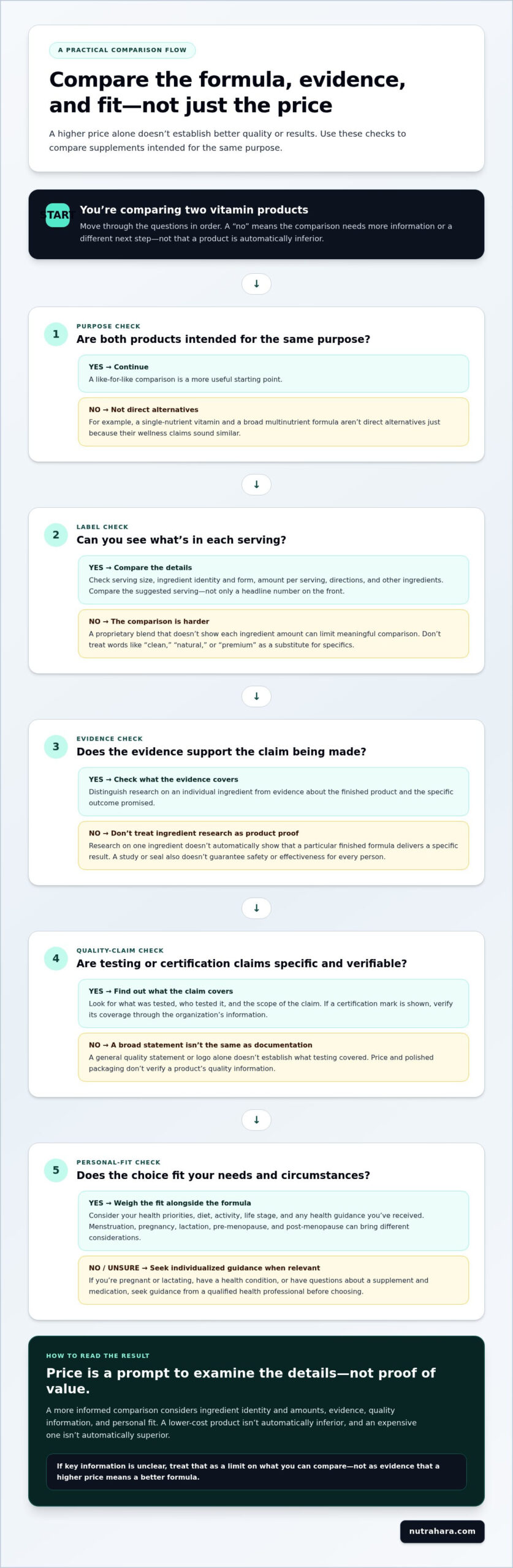
Start with your own context. Consider your diet, activity, health priorities, and any guidance you’ve received. If you’re pregnant or lactating, have a health condition, or have questions about how a supplement may relate to medication, seek individualized guidance from a qualified health professional before choosing. A clear, personal reason for taking a supplement is a stronger starting point than price or marketing pressure.

What Actually Influences Vitamin Quality, Safety, and Potential Value?

To judge a supplement, look past the front-of-bottle promise and examine what’s in each serving. Ingredient identity tells you which nutrient or form is included. The amount per serving helps you understand how much you’d take, while a transparent formula makes products easier to compare and ingredients easier to assess. These details offer a more useful starting point than a premium label or a claim that a formula is “complete.”

Make sure the evidence matches the claim. Research on an individual ingredient may help explain what has been studied, but it doesn’t automatically prove that a particular finished product delivers a specific outcome. Evidence about an ingredient is not proof that a specific supplement, in its finished formula, produces a promised result. That distinction matters whether you’re considering a product for everyday wellness, exercise recovery, or a concern related to women’s health.

How to read a supplement label beyond the front-of-bottle claims

Start with the Supplement Facts panel. Check the serving size, listed ingredients, ingredient forms, and amounts. Compare the amount in the suggested serving, not just a headline number on the front. Then read the directions and other ingredients so you understand what taking the product as labeled involves.

A proprietary blend that lists several ingredients without showing each amount can make meaningful comparison harder. Words such as “natural,” “clean,” or “premium” may describe a brand’s positioning, but they don’t tell you exactly what’s in the formula or establish its quality. Look for specific, understandable label information rather than relying on a wellness phrase alone.

What testing and evidence can, and cannot, tell you

A general statement about quality is not the same as documented, independent testing of a finished product. If a brand refers to testing or a certification, look for clear information about what was tested, by whom, and what the claim covers. USP and NSF International are examples of organizations whose marks consumers may encounter. A logo alone doesn’t establish what a particular product’s testing covered, so verify the claim through the organization’s information.

The FDA explains that dietary supplements are regulated differently from drugs, and manufacturers are responsible for ensuring their products meet applicable requirements. Its overview of FDA Regulation of Dietary Supplements can help clarify the agency’s role. Neither a seal nor a study of one ingredient guarantees safety or effectiveness for every person. If you’re comparing options and want a women’s health supplement approach informed by Ayurvedic principles and modern nutritional research, learn about Nutrahara.

How to Compare Expensive and Affordable Vitamins Side by Side

For a fair comparison, start with products intended for the same purpose. A single-nutrient vitamin and a broad multinutrient formula aren’t direct alternatives, even if both bottles make similar wellness claims. Compare each label against the need you’re considering, then focus on differences that could affect usefulness, clarity, or your daily routine.

Use this worksheet to compare details from the label and any documentation you can verify, rather than relying on front-of-bottle language.

What to compare Questions to ask
Formula Do both products contain the ingredient or nutrient relevant to your goal?
Amount Are the amounts listed clearly, and are you comparing the same serving basis?
Evidence Does the information relate to an ingredient, the finished product, or a specific outcome?
Quality documentation Are testing or sourcing statements specific and verifiable, or only broad marketing claims?
Serving instructions How many capsules, tablets, or other units make up a serving, and how often is it directed?
Total daily use What does the full recommended daily routine involve, including any other supplements you take?

A practical checklist for comparing two vitamin labels

First, match the intended ingredient and serving basis. One label may list an amount per capsule while another gives an amount per multi-unit serving, so compare like with like. Next, note whether ingredient names, amounts, and directions are clear. Finally, record documented testing or sourcing details separately from language such as “advanced” or “premium.” If a product uses a proprietary blend without individual amounts, note that it’s harder to compare rather than assuming it’s better or worse.

To compare cost, divide the package price by the number of servings it contains. If the directions call for more than one serving daily, multiply the cost per serving by the number of daily servings to estimate the daily cost. This calculation helps clarify value, but a lower cost per serving isn’t useful if the formula doesn’t suit your needs or the serving instructions don’t fit your routine.

When paying more could make sense, and when it may not

A higher price may be easier to justify when the difference is concrete, relevant to your goal, and supported by clear documentation. In specialized areas such as hair growth, for instance, brands like TRU BLOOM distinguish their value through clinically proven formulas rather than just premium packaging. If two products have similar formulas, amounts, intended use, and quality information, paying more may add little practical value. Ask yourself: what does the extra cost correspond to, and does that difference matter to me?

Personal accounts can show how a supplement fits into someone else’s routine, but an individual experience isn’t proof of a general result. When considering a testimonial, focus on what the person actually describes and whether it reflects your own circumstances. Don’t treat a persuasive story as a substitute for clear label information or relevant evidence. This principle also extends to household pet care, where providers like PetREGEN emphasize science-backed natural formulations for joint health rather than marketing hype. Ultimately, use your comparison to make a considered choice, not to chase the highest price or the most compelling claim.

Are Expensive Vitamins Really Better? How to Compare Quality and Value

How to Choose Vitamins That Fit Your Needs, Life Stage, and Routine

A supplement decision is most useful when it starts with your circumstances, not a trend or a crowded wellness shelf. Age, life stage, diet, exercise habits, and existing health guidance can all shape what’s appropriate. The question “are expensive vitamins really better” matters less once you identify what you need from a product and whether it fits your daily life.

Use this sequence to make a considered choice:

  1. Identify your goal. Clarify whether you’re addressing a specific nutritional concern or exploring general wellness. A broad wish to feel better doesn’t automatically point to a particular supplement.
  2. Review your diet and context. Consider your usual meals, activity level, age, and life stage. Menstruation, pregnancy, lactation, pre-menopause, and post-menopause may bring different considerations, but none means that every woman needs routine supplementation.
  3. Compare labels. Look for products that match your purpose, then compare their listed ingredients, amounts, serving directions, and available information about the formula.
  4. Assess the evidence. Consider whether research relates to an ingredient, a finished product, or the specific outcome being claimed. Keep your expectations aligned with what the evidence actually supports.
  5. Consider your wider health picture. If a supplement appears relevant, think about how it fits with your routine and any guidance you already follow.

Match the supplement decision to your question

There’s a difference between investigating a specific concern and adding a product simply because it promises broad support. Neither a supplement nor a balanced diet alone tells the whole story of health. Aim for nourishing meals and a routine that supports your well-being, then consider a supplement only if it makes sense for your personal context. A broader women’s wellness supplement guide can be a starting point for exploring questions to consider.

Build a thoughtful routine without adding unnecessary products

Before introducing something new, write down the supplements you already take and any relevant health guidance. This inventory can help you notice overlap and prepare focused questions for a qualified healthcare professional. Discuss supplement choices with a professional if you’re pregnant or lactating, take medication, or have a medical condition. Revisit your decision as your health needs or life stage changes.

Keep the rest of your routine steady and supportive. Regular movement, including exercise that suits your body, can sit alongside nutritious meals and restorative sleep. Yoga can make space for mindful movement, while meditation offers a way to pause and settle your attention. These practices can support general well-being, but they don’t replace individualized care or answer every nutritional question.

Choose an option with a clear purpose that feels manageable in your day. Thoughtful selection isn’t about collecting more products; it’s about making choices that reflect your needs. To explore women’s health supplements as part of that process, discover Nutrahara’s approach.

A Thoughtful Approach to Women’s Vitamins: Evidence, Tradition, and Personal Fit

Choosing a women’s health supplement can be part of a considered wellness routine, but it’s still worth weighing each option by the same standards. Nutrahara’s supplements bring Ayurvedic principles together with modern nutritional research and use natural, clean ingredients. This describes the brand’s formulation approach; it doesn’t, by itself, establish that a supplement has proven outcomes or suits every woman.

So, are expensive vitamins really better? The most confident answer comes from looking beyond price and asking whether a product’s ingredients, label information, supporting evidence, and intended use align with your needs. That applies whether you’re comparing supplements during menstruation, pregnancy, lactation, pre-menopause, or post-menopause.

How to assess a supplement through both tradition and research

Traditional principles can offer a perspective on how a formula is conceived, while modern nutritional research provides another lens for evaluating ingredients and claims. One doesn’t replace the other. Consider both in context, and look for clear information about what a supplement contains and what the evidence actually supports. Broad promises aren’t a substitute for transparent labeling or relevant research.

For example, if you’re considering a vitamin B complex supplement, assess it as you would any option: review its label, intended use, and supporting information, then consider whether it fits your personal circumstances. A familiar nutrient name or a traditional philosophy alone can’t tell you whether a particular formula is right for you.

Take a confident next step at your own pace

Before settling on any product, return to a few practical questions: Is it relevant to a need you’ve identified? Is the label clear? Is the evidence appropriate to the product or claim? Are quality statements specific and verifiable? Does it fit your diet, life stage, routine, and existing health guidance? If you’re pregnant or lactating, take medication, or have a health condition, discuss supplement choices with a qualified healthcare professional.

Testimonials can help readers understand another woman’s individual experience, but they aren’t proof of a general result. Your own decision can be quieter and more personal: choose what makes sense for your circumstances, and don’t feel pressured to add a supplement simply because it costs more or carries a persuasive promise.

Nutrahara’s women’s health supplements offer one approach to consider, informed by Ayurvedic principles and modern nutritional research. Take time to review relevant options and apply the same thoughtful criteria to each. Explore Nutrahara’s women’s health supplements.

Make Your Next Supplement Choice With Confidence

Your needs can shift as your health, routines, and priorities change. Give yourself permission to pause before buying: a supplement doesn’t have to be the most expensive, or part of every wellness routine, to be the right choice for you. If you’re still asking, “are expensive vitamins really better,” let the answer rest on fit and clear information rather than pressure or promises.

A useful next step is to write down what you hope a supplement will support and any questions you want to discuss with a qualified healthcare professional. That pause can help turn a crowded shelf into a more personal, considered decision. Wellness is built over time through choices that feel thoughtful and sustainable for your life.

Explore women’s health supplements from Nutrahara and review the options at your own pace: Explore women’s wellness supplements. Trust yourself to make an informed choice, and keep moving forward with care.

Frequently Asked Questions

Are expensive vitamins really better than cheaper ones?

Not necessarily. A higher price doesn’t guarantee a better experience or a formula that suits you. To decide whether expensive vitamins really are better for your situation, compare products intended for the same purpose and look for meaningful differences you can verify. A clearly documented feature may matter to you, while upgraded packaging may not. Choose based on your priorities, not on the assumption that cost predicts results.

Can a low-cost vitamin be as good as a more expensive one?

It can be a reasonable option, but compare the products rather than judging by price alone. Check that they’re intended for the same purpose, then compare the same ingredient forms, amounts per serving, and daily directions. Also consider whether either product has relevant, verifiable quality information. If important details differ or are hard to assess, you may not be comparing equivalent formulas, so avoid drawing a broad conclusion from cost alone.

How can I tell whether a vitamin supplement is high quality?

Look for a label that lets you identify what’s in each serving and how the product is meant to be used. Then check whether claims are supported by evidence relevant to the product, not just appealing language. Specific, verifiable information about quality processes or independent testing can add context. If the only support is a vague promise or an unexplained seal, treat it as incomplete information and keep comparing.

Is a natural vitamin automatically safer or more effective?

No. “Natural” describes how a product is presented, but the word alone doesn’t establish how it was made, how well it works, or whether it’s appropriate for you. A natural ingredient can still be unsuitable in a particular situation, and a label’s wording doesn’t replace evidence or careful review. Consider the full formula and your personal circumstances, and seek professional guidance if you’re unsure about taking it.

Should women take different vitamins at different life stages?

Supplement considerations can vary, but there isn’t one formula every woman needs at a particular age. Menstruation, pregnancy, lactation, and the transition through menopause may lead to different questions about diet and health. Your individual needs matter more than a general life-stage label. If you’re pregnant, lactating, managing a health condition, or uncertain about what’s appropriate, discuss your situation with a qualified healthcare professional.

Can I take several vitamins and supplements together?

That depends on the specific ingredients, amounts, and your health circumstances. Before adding a product, make a list of everything you take, including multivitamins and supplements included in powders or other wellness products. This can help a qualified healthcare professional review possible overlap and answer questions about your routine. Get guidance before combining supplements if you take medication, have a health condition, or are pregnant or lactating.

Do I need a supplement if I eat a balanced diet?

Not necessarily. A balanced diet can provide a foundation for nutrition, but whether a supplement is appropriate depends on your individual circumstances and health needs. Avoid starting one simply because it’s popular or marketed as essential for all women. If you have a specific concern, keep track of what you eat and the questions you have, then discuss them with a qualified healthcare professional before deciding whether a supplement makes sense.

Article by

Nutrahara Team

We are a dedicated collective of nutrition scientists and naturopaths at Nutrahara, committed to advancing women's health through the fusion of ancient Ayurveda science and cutting-edge nutrition research. Our mission is to empower you with clean, simple, and scientifically validated wellness solutions so you can live your healthiest life. Connect with us to stay updated on the latest developments in holistic women's health and nature-based research.

Disclaimer

This article is not a substitute for medical advice. Please consult a healthcare professional before starting any supplement, especially if pregnant, nursing, taking medication, or managing health conditions.

Categories
Articles

Natural Supplements for Women: A Guide to Wellness

What if the most helpful supplement choice isn’t the one making the biggest promise, but the one that fits your needs and has evidence behind it? If conflicting claims have left you unsure about the benefits of natural supplements for women, you’re not alone. Your priorities may also shift through menstruation, pregnancy, lactation, perimenopause, and post-menopause, making safety and relevance just as important as the ingredient list.

This guide explains how supplements may fit into everyday wellness without being mistaken for treatment. You’ll learn how to weigh research, product labels, and uncertainty, and how to discuss your choices with a partner in a way that respects both of your perspectives. You’ll also explore how Nutrahara brings Ayurvedic principles together with modern nutritional research, alongside practical ways to build a balanced routine with movement, yoga, meditation, and restorative practices. The goal isn’t to find a perfect formula. It’s to make informed choices that support your wellbeing over time.

Key Takeaways

  • Consider where the benefits of natural supplements for women may support everyday wellness, and remember that supplements aren’t a substitute for treatment.
  • Assess evidence for digestion, skin, hair, nails, and cognitive wellness without confusing traditional use with established findings.
  • Compare labels by ingredient, amount, purpose, and evidence. “Natural” doesn’t automatically mean safer or more effective.
  • Use thoughtful prompts to share your wellness goals with your partner, listen to concerns, and agree on next steps without pressure.
  • Explore how Nutrahara’s Ayurvedic principles and modern nutritional research can inform choices grounded in your goals and life stage.

Why women consider natural supplements for everyday wellness

Women may consider supplements as one part of a broader approach to wellbeing, alongside varied meals, regular movement, rest, and practices such as yoga or meditation. Natural supplements for women contain ingredients from natural sources and are intended to add nutrients or other dietary ingredients. But “natural” doesn’t mean risk-free, proven effective, or suitable for everyone. A supplement may support dietary intake, but it isn’t a guaranteed result or a substitute for care when a health concern needs attention.

Health goals also depend on individual circumstances. The broad field of women’s health includes physical and mental wellbeing across different ages and life stages, rather than one shared set of needs. Keeping that in mind can make supplement decisions more personal and less influenced by sweeping promises.

What women may hope supplements will support

Goals vary. One woman may want to review her overall nutrient intake; another may be interested in digestion, skin, hair, nails, or cognitive wellness. These are areas to explore, not outcomes a product can promise. Feeling tired or noticing a change in digestion, for example, doesn’t by itself show that you need a supplement or that one will address the cause.

Start with a clear question: What am I hoping to support, and what else is part of my routine? Consider your usual eating pattern, activity, sleep, and any ongoing health concerns. A simple wellness note can help you track what you experience and what changes in your routine, without assuming a product caused every difference. If a symptom is persistent or worrying, treat it as a health question rather than trying to manage it with supplements alone.

Why life stage matters when considering supplements

Needs and priorities can shift during menstruation, pregnancy, lactation, and the years before or after menopause. Diet, health context, and life stage may all influence whether a particular nutrient or ingredient is relevant. A transition can prompt useful questions, but it doesn’t automatically mean supplementation is necessary. Consider what you already get from food and other supplements, then identify a specific goal before adding anything.

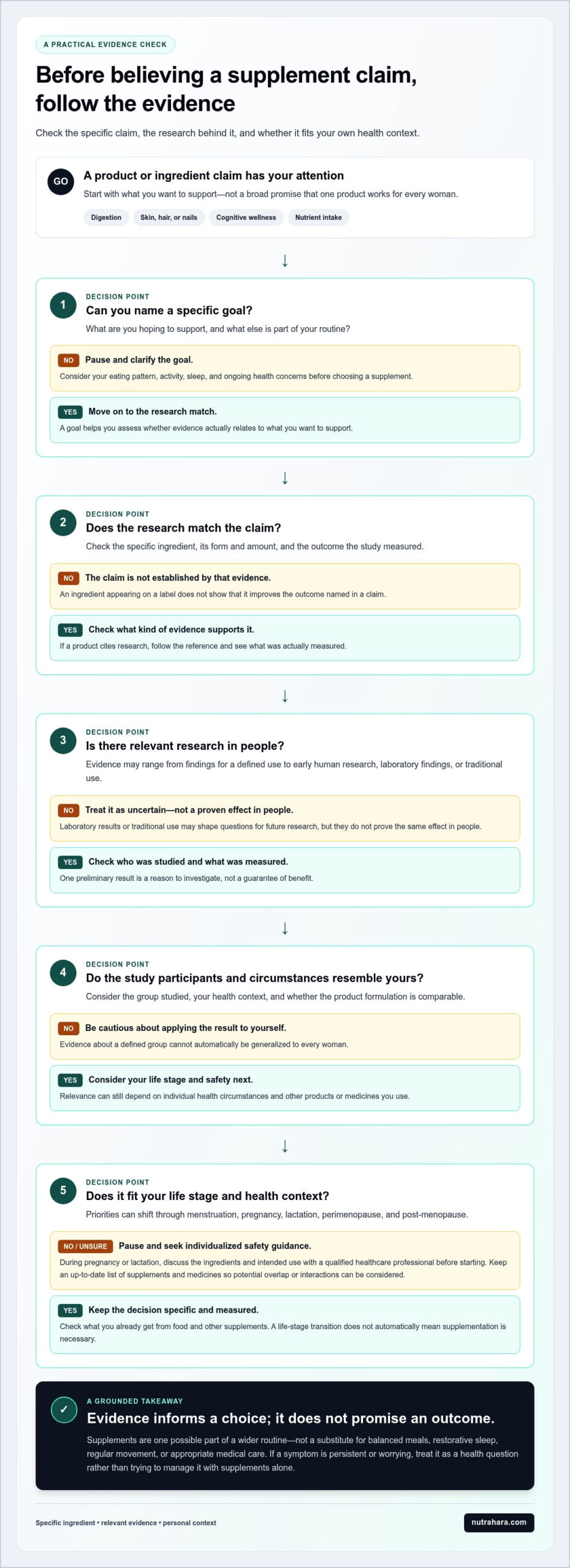
Pregnancy and lactation call for especially careful, individualized safety guidance. Ingredients that seem familiar or “natural” aren’t automatically appropriate during these stages, and personal circumstances matter. Discuss a supplement’s ingredients and intended use with a qualified healthcare professional before starting it. At any life stage, keep an up-to-date list of supplements and medicines so potential overlap or interactions can be considered.

The benefits of natural supplements for women are possibilities shaped by individual needs, not universal promises. Define your goal, account for your life stage, and keep nutrition and restorative habits at the heart of your routine.

What benefits can natural supplements offer women, and what does evidence say?

Consider potential support by health goal, not by a broad promise that one product works for every woman. Digestion, skin, hair, nails, and cognitive wellness are common areas of interest, but an ingredient’s presence on a label doesn’t establish that it improves any of them. To assess the benefits of natural supplements for women, look for research on the specific ingredient, its form and amount, the people studied, and the outcome measured.

Evidence can range from well-supported findings for a defined use to early human research, laboratory findings, or traditional use. These categories aren’t interchangeable. A result seen in cells or described in traditional practice may help shape questions for future research, but it doesn’t prove that a supplement produces the same effect in people. Similarly, an association between a nutrient and an outcome doesn’t show that taking a supplement causes that outcome.

How to read claims about ingredients and research

Match the research to the claim. Check whether it concerns the same ingredient and form, a comparable amount, and the intended outcome. Look for human studies, and consider whether participants resemble you in relevant ways. If a product claim cites research, follow the reference and see what was actually measured. One preliminary result is a reason to investigate, not a guarantee of benefit.

Evidence about a particular ingredient, amount, and outcome in a defined group can’t automatically be generalized to every woman. Individual health context and product formulation may differ. This matters across menstruation, pregnancy, lactation, and menopause, and for anyone taking medicines or managing a health concern.

  • Digestion: Check whether research measures the digestive outcome named in the claim. Different digestive concerns aren’t interchangeable.
  • Skin, hair, and nails: Distinguish studies of a specific nutrient or ingredient from broad promises about appearance or growth.
  • Cognitive wellness: Look for evidence tied to the particular mental function being discussed. A general “brain support” phrase may not describe a measured result.

These categories are questions to investigate, not established benefits of any product. Without relevant, reliable citations, a specific benefit claim should remain unasserted.

Supplements as one part of a wider wellness routine

A supplement is one possible part of a thoughtful routine, not a stand-in for balanced meals, restorative sleep, regular movement, or appropriate medical care. Build a practical foundation: eat varied foods, choose activity you can sustain, and consider yoga or meditation as ways to support a calmer daily rhythm. Then ask whether a supplement addresses a clearly identified dietary goal. For an example to assess, Nutrahara’s vitamin B complex supplement can be reviewed by its ingredients, stated purpose, and available evidence, rather than by promises alone.

Natural versus synthetic supplements: compare the label, not the promise

“Natural” and “synthetic” describe how an ingredient is sourced or produced. Neither word, by itself, tells you whether a supplement is safe, effective, or right for you. Source alone cannot establish a supplement’s safety or benefit. A naturally derived ingredient can still be unsuitable in some circumstances, while a synthetically produced ingredient isn’t automatically ineffective. The ingredient’s identity, amount, purpose, evidence, and your personal context matter more than a reassuring-sounding label.

Use the label as a starting point for questions, not as proof of a promise. Compare products by checking details you can assess:

Ingredient identity: Is each ingredient clearly named, or described only in broad terms? A recognizable source can be useful context, but it doesn’t prove a benefit.

Amount and serving information: Can you tell how much of each ingredient is included per serving and how the serving is defined? If the amount isn’t clear, it’s harder to compare a label with relevant research.

Stated purpose: Does the product explain its intended dietary role? Don’t infer additional benefits from an ingredient’s name or claims that aren’t explained on the label.

Evidence: Is there credible research on the same ingredient, form, amount, and intended outcome? A source claim or “natural” positioning isn’t a substitute for evidence.

Which label details help make an informed choice?

Read the full ingredient list and serving information, then compare them with the reason you’re considering a supplement. If a proprietary blend or broad description makes the contents or amounts difficult to understand, seek clearer information rather than assuming the product is harmful. Transparent details make it easier to assess your options. For example, when considering women’s health supplements, examine the listed information and stated purpose instead of assuming unlisted effects.

Safety questions to consider across life stages

Your health history, medicines, and other supplements can affect whether an ingredient is suitable; combinations may also matter. Keep a current list of what you take and discuss potential interactions with a qualified healthcare professional if you have questions. If you’re pregnant or breastfeeding, seek qualified guidance before using supplements. “Natural” doesn’t guarantee that an ingredient is appropriate for every person or life stage.

You don’t need to choose a product simply because it sounds more natural or more advanced. A careful label review helps you ask better questions and consider the potential benefits of natural supplements for women without treating a source label as a promise. Let clear information and your own wellness priorities guide your next step.

Natural Supplements for Women: A Guide to Wellness

How to talk with your partner about natural health choices

Different views on supplements don’t have to become a contest. A calm conversation can help you explain what matters to you, hear your partner’s concerns, and decide what information or next steps would be useful. The aim isn’t to secure automatic agreement. It’s to discuss your choices with respect while keeping your health and autonomy central.

A simple framework for a supportive conversation

Begin with your goal, such as understanding whether a supplement fits your nutrition priorities or current life stage. Explain why that goal matters to you, then share what you’ve learned, including limits or unanswered questions. Invite your partner’s perspective without assuming skepticism means they don’t care. Asking, “What would help you feel comfortable discussing this?” can open a more curious exchange.

Try this sequence:

  1. Share your aim. “I’m looking into ways to support my everyday wellbeing, and I want to make an informed choice.”
  2. Explain what you know. Summarize the evidence you found and what it doesn’t establish. Be clear if research is limited or doesn’t match your exact situation.
  3. Listen for the concern. Ask, “Is your main concern safety, cost, or whether it’s likely to help?” Reflect back what you hear before responding.
  4. Agree on a next step. You might review reliable information together, pause to learn more, or talk with a qualified healthcare professional if you have personal safety questions.

This approach keeps the discussion focused on shared understanding rather than pressure. It also makes room for uncertainty: the potential benefits of natural supplements for women depend on the specific choice and individual circumstances, so there’s no need to pretend every answer is settled.

Turn shared intentions into realistic habits

Choose one manageable practice you can enjoy together, such as a walk, gentle yoga, or a brief meditation. Agree on when it fits your routine, then notice how the habit feels without treating a change as proof that a supplement caused it. Simple personal notes about energy, sleep, or other observations can help you spot patterns, while remembering that daily wellbeing has many influences.

Shared routines can support connection, but you don’t need your partner to adopt every wellness choice you make. You might ask, “Would you like to try a short walk with me?” or, “Can we set aside time to compare what we’ve each read?” If you disagree, pause and return to the conversation later. Your partner can offer perspective, but your health decisions remain yours to make with appropriate guidance.

For example, if you’re considering a supplement because your eating habits have changed, you could explain what you hope to understand, share the label and research you’ve reviewed, and invite your partner to help you think through any questions. That keeps the conversation specific without assuming a product is necessary or that it will produce a particular result.

Thoughtful choices begin with honest questions and steady habits. If you’d like to explore options as part of your own research, explore women’s health supplements with your goals and priorities in mind.

A thoughtful path from natural wellness research to Nutrahara

Good supplement decisions start with your needs, not a trend or a promise. Nutrahara brings Ayurvedic principles together with modern nutritional research, using natural, clean ingredients in its women’s health supplements. This approach connects traditional wellness ideas with contemporary nutrition, but it isn’t proof that a supplement has been clinically shown to produce a particular outcome. Ask whether an option fits your goal, what evidence supports its use, and whether it suits your circumstances.

What a balanced supplement decision can look like

Before deciding, write down what you hope to support and what would help you assess the choice clearly.

  • State your goal: Describe the wellness priority in your own words, such as reviewing your nutrition or focusing on a specific area of wellbeing.
  • Review the evidence and label: Check whether research relates to the ingredient, form, amount, and outcome you’re considering. Compare that information with the ingredients, serving details, and stated purpose on the label.
  • Consider your context: Your life stage, health history, medicines, and other supplements may affect whether an option is suitable. Seek qualified guidance if you have personal safety questions, especially during pregnancy or breastfeeding.

A supplement is optional. It doesn’t replace nourishing food, movement, restorative sleep, yoga or meditation, or appropriate medical care. For a sustainable routine, choose manageable habits you can return to: plan movement that fits your week, make time for restful practices, and review your routine when your needs change. Small, repeatable choices can help you care for your wellbeing over time, without treating any single product or habit as a guarantee of longevity.

Nutrahara’s women’s health supplements focus on areas such as skin, hair, nails, digestion, and brain function. These are areas of focus, not guaranteed results or treatment claims. Let your goals and life stage guide what you consider, and weigh specific claims against relevant evidence rather than popularity or persuasive language.

Continue exploring women’s wellness

If this approach resonates with you, explore Nutrahara’s women’s health supplements as part of your own research. Consider the listed ingredients, stated purpose, and evidence, then decide whether an option fits alongside the habits that support your day-to-day wellbeing. You don’t need to choose something simply because it’s popular or labeled natural. Your wellness is a personal progression, shaped by changing needs and the practices you can sustain. It isn’t a test of commitment, discipline, or confidence. Choose what feels informed and appropriate for you, one considered step at a time.

Let your next wellness step be your own

Your wellness needs may shift with your routines, priorities, and life stage. Give yourself room to revisit your choices as they change. The potential benefits of natural supplements for women are worth considering with curiosity, but your choices don’t need to follow a trend or meet anyone else’s expectations. A steady practice, a thoughtful question, or deciding to wait can each be a meaningful next step.

Nutrahara combines Ayurvedic principles with modern nutritional research and focuses on women’s health supplements made with natural, clean ingredients. This philosophy can be one lens for exploring options, alongside your own goals and the evidence for any specific ingredient. Explore Nutrahara’s approach to women’s wellness, and choose only what feels relevant to your informed wellness journey. You deserve to make those choices with confidence, care, and kindness toward yourself.

Frequently Asked Questions

Do natural supplements work for women’s health?

Some supplements may help meet a specific nutritional need, but effects depend on the ingredient and the person. The benefits of natural supplements for women aren’t guaranteed, and “natural” alone doesn’t show that a product works. If you’re considering a supplement because your diet has changed, first identify the nutrient or goal you’re concerned about. A qualified healthcare professional can help you decide whether supplementation makes sense for your circumstances.

Are natural supplements safer than synthetic supplements?

Not necessarily. “Natural” and “synthetic” refer to source or production, not a safety ranking. Safety can depend on the ingredient, amount, product quality, your health, and what else you take. A botanical product, for example, can still be unsuitable for someone with a particular health condition. Compare the full ingredient information and serving directions, and seek qualified guidance if you’re uncertain about a product’s relevance to you.

Can women take supplements while pregnant or breastfeeding?

Some supplements may be appropriate during pregnancy or breastfeeding, but don’t assume a product is suitable just because it’s natural or commonly used. Before starting one, show a qualified healthcare professional the exact product label, including all ingredients and serving directions. This gives them a clearer basis to consider your individual circumstances. If you already take supplements, include those in the conversation rather than reviewing a new product in isolation.

Can natural supplements interact with medications?

Yes, some supplement ingredients can affect how medicines work or add to their effects, so check before combining them. Make a list of prescription medicines, over-the-counter products, and supplements, including how often you take each. Share it with a qualified healthcare professional or pharmacist when considering a new ingredient. Don’t stop or change a prescribed medicine to make room for a supplement without guidance from the professional who manages your care.

Do women need supplements if they eat a balanced diet?

Not always. A balanced diet may provide many nutrients, but whether it meets your needs depends on your individual health context and circumstances. A food and supplement record can help you spot patterns, such as routinely missing a food group, without diagnosing a deficiency. If you’re concerned about a possible gap, discuss it with a qualified healthcare professional. Supplements are a choice to consider, not a measure of how well you care for yourself.

How can I tell whether a supplement claim is supported by research?

Look for a clear reference to human research and check whether it studied the same ingredient, form, amount, and outcome described in the claim. Read beyond the headline: a small or early study may not establish a dependable effect. Be cautious if the claim uses sweeping language but offers no specific evidence to assess. You can take the reference or product label to a qualified healthcare professional and ask what conclusions the research supports.

Can women take more than one supplement at the same time?

Sometimes, but combining products can lead to overlapping ingredients or interactions. Before taking several, compare their labels and note ingredients that appear more than once, including those in blends. Keep the labels or clear photos together so a qualified healthcare professional or pharmacist can review the full combination, particularly if you use medicines or have a health condition. Adding products one at a time can also make it easier to notice changes or unwanted effects.

Article by

Nutrahara Team

We are a dedicated collective of nutrition scientists and naturopaths at Nutrahara, committed to advancing women's health through the fusion of ancient Ayurveda science and cutting-edge nutrition research. Our mission is to empower you with clean, simple, and scientifically validated wellness solutions so you can live your healthiest life. Connect with us to stay updated on the latest developments in holistic women's health and nature-based research.

Disclaimer

This article is not a substitute for medical advice. Please consult a healthcare professional before starting any supplement, especially if pregnant, nursing, taking medication, or managing health conditions.
Categories
Articles

Supplements for Self-Confidence: A Guide for Women

What if feeling more confident starts with supporting your well-being, not finding the perfect supplement? It’s understandable to look for help when stress, shifting energy, or changes through menstruation, pregnancy, lactation, perimenopause, or menopause affect how you feel. But supplements to boost self-confidence can’t create self-worth or guarantee a change in mood. At most, an appropriate supplement may support one part of a broader wellness routine.

This guide explains what supplements may reasonably support, how to compare product categories, and what to consider before choosing one. You’ll also find practical ways to nurture confidence through movement, yoga, meditation, and self-reflection. Nutrahara combines principles of ancient Ayurveda with modern nutritional research in its women’s health supplements. The goal isn’t to rely on a pill to feel enough. It’s to build steady foundations that help you feel supported in everyday life.

Key Takeaways

  • Compare supplements by their intended purpose, evidence, label details, and your individual needs rather than assuming products are interchangeable.
  • Consider supplements to boost self-confidence only as possible support for broader well-being, not as a direct source of self-worth.
  • Account for pregnancy, lactation, medications, health conditions, and planned procedures when considering a supplement, and seek qualified medical guidance.
  • Build a routine that fits your life with adaptable movement, restorative yoga, meditation, sleep habits, and self-reflection.
  • Explore Nutrahara’s women’s health supplements as one option within a wellness approach informed by Ayurvedic principles and modern nutritional research.

Can Supplements Boost Self-Confidence? Set Realistic Expectations First

Wanting to feel more self-assured is reasonable, especially when daily demands leave you feeling unlike yourself. But supplements to boost self-confidence shouldn’t be treated as a quick fix. Confidence develops through a mix of personal experience, relationships, social pressures, physical well-being, and emotional health. It isn’t a simple measure of whether you have enough of a particular nutrient.

Confidence is also distinct from self-esteem and self-efficacy, or your belief in your ability to do a task. Exploring understanding self-confidence can help clarify why a supplement alone can’t address every factor that shapes how you feel. A nutrient supplement may be relevant when it addresses an individual, documented nutritional need. That is different from proving that it directly increases confidence.

Evidence-qualified perspective: A supplement may support a specific aspect of wellness when appropriate, but that support doesn’t guarantee a psychological outcome such as greater confidence.

What might a supplement support, and what can’t it promise?

Think of a supplement as one possible part of a wellness plan, not a stand-in for self-trust, supportive relationships, rest, or professional care when needed. One person’s experience can be meaningful to them, but it can’t establish that the same product will work for everyone. Be cautious of claims that promise a direct confidence boost or explain one through a “happy hormone” mechanism without reliable evidence.

Before considering a supplement, name the specific need you hope to address. Then look for evidence about the ingredient and that intended purpose. Keep expectations modest: a product label or customer story doesn’t prove that a supplement will have the same effect for you.

Why confidence can feel different at different life stages

Menstruation, pregnancy, lactation, perimenopause, and postmenopause can bring different circumstances, but no two women experience them in the same way. Changes in routine, responsibilities, or how you feel physically may influence confidence without pointing to a particular deficiency or diagnosis. Life stage is a reason to consider your individual needs, not a reason to assume a supplement is necessary.

Before choosing a product, consider what has changed and what kind of support you’re seeking. If you’re pregnant or lactating, have a health condition, or take medication, discuss supplement use with a qualified healthcare professional. Your confidence journey deserves care shaped around you, not a promise that one formula can fit every woman.

Compare products by the question they’re meant to answer, not by broad promises about mood or confidence. Ingredients such as magnesium, vitamin B6, vitamin D, L-theanine, ashwagandha, and rhodiola are examples to research, not recommendations or proven confidence boosters. Evidence and safety can vary with the ingredient, dose, formulation, and your health context.

Use this framework to organize your questions. It doesn’t rate ingredients or establish that a product will produce a particular result.

Category and examples Evidence question Life-stage caution Label details to review
Vitamins and minerals, such as B vitamins, magnesium, or vitamin D Was the specific ingredient studied for the outcome the product claims to support? Needs can differ during menstruation, pregnancy, lactation, and later life. Don’t assume a life stage means you need a supplement. Ingredient amounts, serving information, other nutrients, and cautions.
Botanicals, such as ashwagandha or rhodiola Does the research concern the same plant material, preparation, and intended outcome? Check suitability for your circumstances, especially during pregnancy or lactation, with a qualified health professional. Plant part, extract or preparation details, full ingredients, and warnings.
Amino-acid ingredients, such as L-theanine Does the evidence address the formulation and outcome being promoted? Consider medications, health conditions, and life stage before use. Amount per serving, additional ingredients, directions, and cautions.

Questions to ask when comparing ingredient categories

Start with a specific wellness question. Then check whether the evidence studied the ingredient itself, the product’s formulation, and the outcome described in its claims. A study of one preparation may not apply to another. Traditional use can offer historical context, but it isn’t the same as evidence from human research. Broad phrases like “supports mood” don’t explain what outcome was measured or who was studied.

What to look for on a supplement label

Read the complete ingredient list, serving information, directions, and cautions. Check whether each ingredient’s amount is clearly stated and whether a blend makes individual amounts difficult to identify. “Natural” describes an origin, not proof of safety or effectiveness for every person. The Vitamin B Complex product page is one example of where to review product-specific information. The name alone doesn’t establish who should use it or what it will do.

When comparing women’s wellness supplements, apply the same questions to each option. Reviewing the details helps you move beyond confidence-focused marketing and make choices based on evidence, clear labeling, and your individual circumstances.

Safety Considerations for Women Choosing Supplements

A supplement’s suitability depends on its ingredients, formulation, and your personal circumstances, including life stage, health conditions, medications, and planned procedures. “Natural” doesn’t automatically mean safe or appropriate for everyone. Plant-based ingredients can still require careful consideration, and a product’s general wellness positioning isn’t a substitute for individualized guidance.

This matters whether you’re comparing supplements to boost self-confidence or considering a product for another wellness goal. Make safety part of your decision from the start, not a detail to review only after choosing.

Pregnancy, lactation, and changing health needs

Don’t assume guidance intended for adults generally applies during pregnancy or breastfeeding. If you’re pregnant, lactating, trying to conceive, or have questions related to menstruation or menopause, seek individualized advice from a qualified healthcare professional before starting a supplement. Life stage alone doesn’t determine what you need, and broad claims about hormonal balance or symptom relief shouldn’t replace personal assessment.

Medication use, side effects, and product claims

If you take prescription or over-the-counter medication, have a health condition, or are planning a medical procedure, review the product’s cautions and discuss supplement use with a qualified professional. Ask whether the ingredients are suitable for your situation and whether potential interactions or other concerns apply. Don’t change prescribed treatment based on a supplement claim.

Keep the label and product information available when you seek guidance. This makes it easier to discuss the exact formulation rather than relying on a broad ingredient name. For example, the Ashwagandha with Black Pepper product page identifies the product you’re considering. Its name alone doesn’t establish its effects or suitability for you.

Separate marketing language from evidence by asking what a claim refers to. A product-level statement may not show that the specific ingredient, formulation, or amount has been studied for the promised outcome. Look for clear product information and be cautious about claims that imply a supplement treats a condition or reliably changes mood or confidence.

Before deciding, use this simple check:

  • Personal context: Note pregnancy, breastfeeding, medications, health conditions, allergies, and planned procedures.
  • Product details: Review the complete ingredient list, serving information, directions, and warnings.
  • Evidence: Ask whether research supports the specific ingredient and outcome being claimed.
  • Guidance: Discuss personal safety questions with a qualified healthcare professional, especially when your health circumstances change.

These steps can make a choice feel more manageable. They keep your decision grounded in your individual needs rather than a one-size-fits-all promise.

Build Confidence Alongside Supplements: Practical Habits That Fit Real Life

Confidence can grow through small experiences of caring for yourself and noticing what you can do. Supplements to boost self-confidence can’t replace those foundations. A flexible routine can make room for movement, rest, and reflection without turning wellness into another standard you have to meet.

Try this simple sequence as a starting point, then adapt it to your ability, schedule, comfort, and life stage. Pregnancy, recovery after birth, changing energy, or a busy workweek may call for a gentler version.

  1. Choose movement you enjoy. Plan a walk, swim, strength session, or another activity that feels appropriate for your current ability. Shorter sessions or everyday movement count when that’s what fits.
  2. Add restorative yoga. Choose comfortable poses or gentle stretching, and pause if a movement doesn’t feel right. Yoga can offer mindful movement without requiring flexibility or performance goals.
  3. Make space for meditation. Sit comfortably and notice your breath for a few quiet moments. If sitting still feels difficult, try a mindful walk instead.
  4. Create a wind-down cue. Choose a repeatable signal that helps you prepare for sleep, such as dimming the lights or putting your phone aside. Keep it realistic for your routine.
  5. Reflect without judging. Write down one strength you used or one meaningful action you took that day. It might be asking for help, showing up to exercise, or making time to rest.

Small practices for a steadier sense of self

Begin with a brief daily pause rather than aiming for a perfect meditation streak. Take a few comfortable breaths and let your attention return to them when it wanders. At day’s end, ask: “What did I handle today that deserves recognition?” Name one specific action, even if it was simply making space to recover.

Movement, yoga, and sustainable wellness

Enjoyment and comfort matter. Choose movement that meets you where you are, and give yourself permission to scale it down or rest. Restorative yoga may be a gentle option; meditation can be practiced seated, lying down, or while walking. These habits support general well-being, but they aren’t substitutes for healthcare when you need it.

There’s no single weekly template that suits every woman. You might alternate walks, yoga, and strength-focused movement, or begin with one activity you can repeat consistently. If your energy or circumstances change, adjust the plan instead of treating that as failure. A sustainable practice is one you can return to.

For a wellness routine that includes women’s supplements alongside everyday habits, explore Nutrahara’s wellness offerings.

Supplements for Self-Confidence: A Guide for Women

Explore Nutrahara Supplements as One Part of Your Wellness Journey

Choosing a supplement is a personal decision shaped by your needs, health context, and the information available about a product. Nutrahara combines principles of ancient Ayurveda with modern nutritional research in its women’s health supplements. That approach informs the products, but it isn’t a promise that a supplement will create confidence or reliably change how you feel.

Think of a product as one possible part of a broader routine. Sleep, nourishing meals, movement, yoga, meditation, supportive relationships, and appropriate healthcare all have a place in personal well-being. The right combination will look different for a woman who menstruates, is pregnant or lactating, is navigating perimenopause, or is postmenopausal. Your needs may also shift over time.

A thoughtful approach to choosing a Nutrahara product

If you’re considering a Nutrahara supplement, use its product information as a starting point for careful review, not as evidence of a particular effect or a recommendation for your circumstances. Compare the product information with your wellness goals, life stage, and any safety questions you have. If you take medication, have a health condition, or are pregnant or breastfeeding, seek individualized guidance from a qualified healthcare professional before adding a supplement.

A few useful questions can keep the decision grounded:

  • Does the product information clearly identify what the product contains?
  • Does any claim address a specific, understandable wellness goal?
  • Is the information relevant to your personal circumstances, or does it make a broad promise?
  • Have you considered whether a supplement fits alongside your existing routine and care?

These questions help separate a product description from evidence about a specific ingredient and outcome. They also leave room for the possibility that a supplement may not be the support you need right now. No product should be treated as a substitute for mental health care, and no supplement can guarantee greater confidence.

A measured next step for your wellness journey

The central distinction is simple: a supplement may support a specific aspect of wellness when appropriate, but that is not the same as directly producing self-confidence. Confidence develops within a wider life, through personal experience, emotional well-being, physical health, and relationships. If you’re exploring supplements to boost self-confidence, keep that broader picture in view and let evidence, personal needs, and safety guide your choices.

Nutrahara’s women’s health supplements bring Ayurvedic principles together with modern nutritional research. Review the product information alongside your own goals, and choose a next step that feels informed and right for you. Your wellness journey belongs to you, and it can grow through thoughtful choices rather than quick promises.

Let Your Next Wellness Choice Reflect What Matters to You

Confidence doesn’t need to arrive as a dramatic transformation. It can take shape in the choices you make with care, the boundaries you honor, and the way you recognize your progress. As you move forward, choose a personal sign of growth that matters to you. Perhaps it’s speaking up in a meeting, returning to an activity you enjoy, or feeling more at ease in your daily routine.

If you’re considering supplements to boost self-confidence, let your goals guide your questions rather than letting a product promise define success. Notice how your needs and priorities change over time, and give yourself permission to revise your approach. A thoughtful wellness journey is built through informed choices, patience, and care for the whole person.

Explore Nutrahara’s women’s health supplements at your own pace, and consider how their product information fits your priorities and broader routine. Explore Nutrahara’s women’s health supplements.

There’s no single right path to feeling more like yourself. Keep choosing what supports your well-being, one considered step at a time.

Frequently Asked Questions

Can supplements directly increase self-confidence?

No supplement can be relied on to directly or consistently increase self-confidence. A supplement may be considered for a specific nutritional need, but that is different from showing it builds confidence. If you’re weighing supplements to boost self-confidence, look beyond the product promise: identify the wellness goal, review what evidence supports the claim, and notice whether your confidence changes in particular situations, such as work or social settings.

Is there scientific evidence that supplements boost self-esteem?

Evidence that a particular ingredient supports a defined health outcome doesn’t automatically show that it increases self-esteem. These are different outcomes, and research on one ingredient or formulation may not apply to another product. Be cautious with claims that use broad terms such as “confidence” without explaining what was studied. A testimonial can describe one person’s experience, but it can’t establish a reliable effect for others.

Can stress or low energy affect how confident I feel?

Yes. Feeling worn down or under pressure may make it harder to speak up, take on a challenge, or feel comfortable in situations that usually feel manageable. That doesn’t mean stress or low energy explains every change in confidence. Consider noting when the feeling appears and what else is happening, such as workload, sleep disruption, or a change in routine. If it persists, discuss it with a healthcare professional.

Are supplements for confidence safe during pregnancy or breastfeeding?

Don’t assume a product is suitable during pregnancy or breastfeeding because it’s marketed for general wellness or made with natural ingredients. Safety depends on the specific product and your circumstances. Before starting or continuing a supplement, bring its full label to a qualified healthcare professional and ask for guidance tailored to you. This is especially useful when comparing a supplement with other products you already take.

Can I take confidence-related supplements with prescription medication?

Possibly, but don’t assume a supplement and prescription medication are compatible. Show your prescriber or pharmacist the complete label, including blends and serving information, and ask whether the specific product is appropriate alongside your medication and health conditions. Keep a current list of everything you take, including nonprescription products. Don’t stop, replace, or adjust prescribed medication on the basis of a supplement claim.

How can yoga and meditation support a confidence-building routine?

Yoga and meditation can create regular moments to notice your comfort, attention, and responses without judging yourself. Choose a gentle pose or movement that feels accessible, then pause to observe what feels steady or uncertain. A short meditation can focus on breathing or sounds around you. These practices aren’t confidence guarantees; they offer ways to make room for self-awareness and intentional choices in everyday life.

What should I do if low confidence is affecting my daily life?

If low confidence is making it difficult to work, maintain relationships, or take care of yourself, consider talking with a qualified healthcare or mental health professional. You can prepare by noting what feels difficult, when it began, and what you’ve already tried. Ask someone you trust for support if that feels comfortable. You deserve help suited to the full picture, not pressure to solve everything on your own.

Article by

Nutrahara Team

We are a dedicated collective of nutrition scientists and naturopaths at Nutrahara, committed to advancing women's health through the fusion of ancient Ayurveda science and cutting-edge nutrition research. Our mission is to empower you with clean, simple, and scientifically validated wellness solutions so you can live your healthiest life. Connect with us to stay updated on the latest developments in holistic women's health and nature-based research.

Disclaimer

This article is not a substitute for medical advice. Please consult a healthcare professional before starting any supplement, especially if pregnant, nursing, taking medication, or managing health conditions.

Categories
Articles

Digestive Enzymes for Women: A Guide to Choosing Wisely

What if an enzyme marketed for bloating doesn’t address your particular digestive concern? Digestive enzymes for women can sound like a simple fix, especially when symptoms shift around menstruation, pregnancy, or menopause. It’s understandable to want clear answers, but enzymes act on specific nutrients. A supplement isn’t a universal solution for every digestive symptom.

Knowing the difference can help you make a more informed choice. This guide explains how enzymes help break down food, what evidence can and can’t tell us about over-the-counter supplements, and why new or persistent digestive changes deserve attention. You’ll also find practical points to consider before using a supplement, including during pregnancy or lactation or while taking medication. Everyday habits, from balanced meals to movement and stress-relieving practices such as yoga or meditation, can also support overall wellness. The aim isn’t to chase a quick fix, but to understand your body and choose a next step with confidence.

Key Takeaways

  • Understand how digestive enzymes break down food and why supplements are a separate consideration from the enzymes your body produces.
  • Learn why being a woman or experiencing a life-stage change doesn’t, by itself, establish a need for digestive enzymes for women.
  • Compare the roles of enzyme supplements, everyday food-based habits, and clinician assessment. Enzymes and probiotics are not substitutes for one another.
  • Use a thoughtful decision sequence: define your concern, consider your health context, seek qualified guidance when appropriate, and reassess.
  • Notice symptom patterns, support your routine with movement and stress relief, and seek advice when needed.

What Are Digestive Enzymes, and What Role Do They Play?

Digestive enzymes are proteins that help break food components into smaller substances the body can absorb. Your body makes them as part of digestion, releasing different enzymes in places such as the mouth, stomach, and small intestine. Enzymes do not work alone: chewing, stomach movement, digestive fluids, and the coordinated activity of the digestive tract all contribute.

This distinction matters if you’re considering digestive enzymes for women. Enzymes your body produces naturally are not the same as enzyme supplements. A supplement may contain particular enzymes for particular food components, but that doesn’t mean everyone needs extra enzymes or that a blend can address every kind of digestive discomfort. The Digestive enzyme overview describes enzyme types and their roles in digestion.

How do enzymes help break down food?

Different enzymes act on different components of food, helping break larger molecules into smaller pieces that can be absorbed through the digestive tract. Digestion is a sequence of coordinated steps, not a single action triggered by one capsule. The body’s enzymes have specific roles in that process, and increasing enzyme activity isn’t automatically the same as improving digestion.

What do amylase, protease, and lipase do?

These names describe different enzyme functions, not interchangeable ingredients. Amylase helps digest carbohydrates, including starches, into smaller sugar units. Protease helps break proteins into smaller peptides and amino acids. Lipase helps break fats into components the body can absorb. Because meals contain a mix of nutrients, digestion involves more than one enzyme acting on a single kind of food.

  • Amylase: Acts on carbohydrates such as starches found in foods like bread or potatoes.
  • Protease: Acts on proteins found in foods such as beans, eggs, and fish.
  • Lipase: Acts on fats present in foods such as nuts, oils, and avocado.

Lactase is another distinct enzyme. It helps digest lactose, the natural sugar in milk and some dairy foods. It isn’t a substitute for amylase, protease, or lipase; each enzyme has a different target.

As a practical first step, note what you ate and when symptoms appeared instead of assuming one enzyme explains them. Portion size, eating pace, food combinations, and your individual health context may all be relevant. A brief food and symptom journal can help you describe patterns if you seek guidance. Knowing the roles of different enzymes also makes it easier to read supplement labels without treating a longer ingredient list as proof that a product is a better fit.

Digestive Enzymes for Women: What Life Stage Can, and Cannot, Tell You

Being a woman, by itself, doesn’t establish a need for enzyme supplements. Enzymes have specific roles in digestion, but a claim that women need extra enzymes because of sex, hormones, or age is a separate claim that needs evidence of its own. Enzymes help break down particular food components; it has not been established that women as a group need over-the-counter enzyme supplements to support digestion.

That distinction can be useful during life changes. Some women notice digestive patterns shift around menstruation, pregnancy, lactation, perimenopause, or menopause. Those experiences are real, but they don’t show that enzyme levels are the cause or that supplements will resolve symptoms. Changes in routine, diet, stress, health conditions, and other factors may also play a role. When symptoms occur can offer context, but it does not provide a diagnosis.

Can hormones or life stages affect digestive experiences?

Hormonal shifts may coincide with changes in bowel habits or digestive comfort, but experiences vary. Pregnancy and postpartum life can bring changes in eating patterns, activity, and daily routines. Menopause can overlap with other changes in health and lifestyle. None of these stages, on its own, identifies an enzyme problem. Note when symptoms occur, what else has changed, and whether they affect your daily life.

If symptoms are new, persistent, or disruptive, discuss them with a qualified clinician instead of assuming they are a normal part of a life stage. This is particularly useful if symptoms are changing or you’re considering a supplement alongside other health needs. Notes on timing, meals, and symptoms can make that conversation more specific.

What does the evidence say about enzyme supplements?

Some enzyme therapies have specific uses under professional guidance for diagnosed conditions involving digestion. That differs from broad wellness marketing that suggests an over-the-counter blend will help everyone with bloating, IBS, hormone-related symptoms, or weight concerns. Major gastroenterology guidance does not recommend over-the-counter enzyme supplements for general digestive wellness across the population. A discussion of Digestive Enzyme Supplements also highlights why claims and evidence deserve careful attention.

Before considering a supplement, ask what specific concern it is meant to address and whether that use is supported for your situation. Take your life stage and health context into account, and seek personalized professional guidance if you’re pregnant, lactating, managing a medical condition, or taking medication. A product being available or labeled for women does not, by itself, show that it is appropriate for you.

Digestive enzymes for women are not a separate need simply because the person considering them is female. The more useful question is whether a specific enzyme has a relevant role in a specific, understood context. Keeping that in mind can help you respond to digestive changes with curiosity and care, without blaming yourself or rushing toward a one-size-fits-all answer.

Digestive Enzymes vs. Other Gut-Health Approaches: Compare the Purpose

Different approaches serve different purposes. A supplement, everyday eating habits, and a clinician’s assessment aren’t competing answers to the same question, and no single option suits every symptom. Use the comparison below to understand what each may contribute and where its limits lie.

Approach Purpose Limit
Enzyme supplements Provide specific enzymes that act on particular food components. They aren’t a universal response to digestive symptoms, and a broad blend may not address the cause of a concern.
Food-based habits Support regular nourishment and help you notice how eating patterns relate to your comfort. Routine changes can’t diagnose or resolve every underlying cause.
Clinician assessment Help evaluate symptoms in the context of your health, medications, and life stage. It takes an individualized look; general online advice can’t replace that assessment.

How are enzymes different from probiotics?

Enzymes help break down food components. Probiotics are live microorganisms. The terms describe different things with different functions, so probiotics aren’t a substitute for enzymes, and enzymes aren’t a substitute for probiotics. Neither category is automatically necessary for every woman. Before choosing a supplement, consider the question you’re trying to answer instead of assuming that products described as supporting “gut health” are interchangeable.

When is a food-first or clinical approach more appropriate?

For a practical starting point, take time for meals and stay hydrated in a way that fits your needs. Notice whether symptoms seem to follow particular foods, meal timing, or changes in your routine. A brief symptom diary can help organize your observations for you and a clinician, but it can’t identify a diagnosis on its own.

Seek qualified evaluation instead of self-treating indefinitely if symptoms persist, feel severe, or concern you. This applies whether you’re menstruating, pregnant, lactating, or going through menopause; life stage alone doesn’t explain every digestive change. Bring notes about what you experience and when to help make the conversation more useful.

Claims about digestive enzymes for women can also blur into claims about weight loss. Enzymes aren’t a weight-loss shortcut, and a supplement should not replace sustainable habits such as balanced meals, movement you enjoy, and restorative practices like yoga or meditation. Choose an approach based on your specific concern, not on a promise that one product can do everything.

How to Consider Digestive Enzyme Supplements Safely

Start with the concern, not the bottle. A supplement may be unnecessary, may not match your symptoms, or may need professional review in light of your health and medications. Use this sequence to make a more deliberate decision:

  • Define the concern: Describe what you’re experiencing, when it happens, and how it affects daily life.
  • Review your context: Consider your life stage, health conditions, medicines, and any other supplements you use.
  • Seek qualified advice: Discuss a possible supplement with a clinician or pharmacist when your circumstances call for personalized guidance.
  • Reassess: If you and a qualified professional decide to try it, follow the label and review whether it remains appropriate.

What should you consider before trying an enzyme supplement?

Before speaking with a clinician or pharmacist, write down your symptoms, when they occur, relevant meals, and any changes in your health or routine. A clear account keeps the discussion focused on your experience rather than a broad product claim. If you’re pregnant or lactating, have a medical condition, or take medication, seek personalized advice before starting a supplement. These factors can affect whether an ingredient is suitable or whether it might interact with your care.

Read the full ingredient label, including other active and inactive ingredients, and follow the product directions. “Natural” doesn’t mean risk-free, and a label can’t establish that a product is right for you. In the United States, dietary supplements are regulated as a category of food and aren’t FDA-approved for safety and effectiveness before they’re marketed. If you experience a concerning reaction, stop using the supplement and seek advice from a qualified professional.

What everyday habits support digestive wellness?

Simple routines can support overall well-being without promising to treat a symptom. When possible, sit down for meals, slow your pace, and pay attention to hunger and fullness. Drink fluids regularly in a way that suits your health needs. Gentle movement, such as a walk after a meal if comfortable, can fit naturally into an active routine. Yoga and meditation may support relaxation and mindful habits, but they aren’t enzyme therapies.

Keep brief notes on meals, symptoms, sleep, stress, and activity to help you notice patterns over time. Look for useful observations rather than proof that one food or life-stage change is the cause. Avoid eliminating whole food groups based only on a diary; restrictive changes can make balanced nourishment harder and may obscure what’s happening. If symptoms persist or interfere with daily life, take your notes to a qualified clinician instead of continuing to self-treat.

For a broader perspective on thoughtful supplement choices, explore Nutrahara’s women’s wellness supplements. The same steady approach applies to digestive enzymes for women: start with your needs, consider your full health context, and make changes with informed guidance.

Digestive Enzymes for Women: A Guide to Choosing Wisely

A More Empowered Approach to Women’s Digestive Wellness

Digestive symptoms deserve curiosity, not self-blame. They don’t mean you’ve failed at eating well or need to find a perfect routine. Your body’s needs can shift across menstruation, pregnancy, lactation, perimenopause, and menopause, and one person’s experience won’t necessarily explain another’s. A thoughtful next step is to observe what’s happening and respond with patience instead of reaching for a quick fix.

How can women build sustainable wellness routines?

Choose manageable practices that fit your real life, including your energy, schedule, health, and life stage. Your routine might include making time for meals, choosing movement you enjoy, or protecting a regular wind-down period. Yoga and meditation are optional ways to bring mindful movement or calm into your day. They don’t need to be elaborate to feel worthwhile, and they aren’t treatments for digestive symptoms.

Consistency matters more than perfection. If a habit is hard to maintain, make it smaller or adapt it. A brief stretch after a long day or a few quiet breaths before a meal may feel more realistic than a complete lifestyle overhaul. Let your routine support confidence and well-being, rather than become another standard you feel you must meet.

When should you seek personalized guidance?

Consider speaking with a qualified clinician if digestive symptoms persist, worsen, or interfere with daily activities. Pregnancy and lactation are also reasons to seek individualized guidance before using supplements, since general wellness advice can’t determine what’s appropriate for your specific circumstances. You deserve support that considers the whole picture, not just one symptom or ingredient.

Keep a simple record to help you prepare: note when symptoms occur, relevant meals or routine changes, and how symptoms affect you. Use those observations to start a conversation, not to diagnose yourself or impose restrictive rules. If you’re considering digestive enzymes for women, let the specific reason, your health context, and qualified advice guide the decision.

A gentle checklist can make the next step feel manageable:

  • Observe: Notice patterns in symptoms, meals, routines, and life-stage changes.
  • Support: Choose nourishing habits and movement that feel sustainable for you.
  • Seek guidance: Ask a qualified professional for help when symptoms persist or supplement questions involve pregnancy, lactation, a health condition, or medication.

Rather than comparing your experience with someone else’s, use your own observations to decide what support may be useful. A note about when symptoms arise or what has changed in your routine can be a practical starting point for a conversation with a qualified professional.

Nutrahara’s approach to women’s wellness draws on Ayurvedic principles alongside modern nutritional research as general wellness context, not as evidence that digestive enzymes produce a particular result. Let your own needs lead, and consider Nutrahara’s broader wellness perspective as one part of a personal, informed health journey.

Let Your Next Step Begin With Self-Trust

Your digestive wellness doesn’t need to follow someone else’s formula. Give yourself room to notice what your body is communicating, make thoughtful choices, and seek personalized guidance when you need it. If you’re considering digestive enzymes for women, let a specific concern and your individual health context guide the conversation, not pressure to try every new wellness trend.

Small, sustainable habits can be a meaningful foundation: nourish yourself consistently, choose movement that feels good, and make space for rest. Yoga or meditation may help you build moments of mindful calm if they suit your routine. Progress doesn’t have to be perfect to count. Confidence can grow as you learn what supports your well-being over time.

Nutrahara’s women’s wellness supplements focus on natural, clean ingredients. Explore that wider approach to self-care with Nutrahara’s women’s wellness approach.

Frequently Asked Questions

What do digestive enzymes do in the body?

Digestive enzymes help the body process food so nutrients can be absorbed. Your body makes these enzymes naturally: amylase acts on carbohydrates, protease on proteins, and lipase on fats. They work as part of a larger digestive process, not as a stand-alone fix. Occasional digestive discomfort alone doesn’t show that you need a supplement; consider the pattern and context before deciding what to do next.

Are digestive enzymes safe for women during pregnancy or breastfeeding?

There isn’t one safety answer for every pregnant or breastfeeding person. Suitability depends on the product’s specific ingredients and your health circumstances, so don’t assume “natural” means risk-free. Before using an enzyme supplement, review the label and discuss it with a qualified healthcare professional who knows your pregnancy or lactation context. Seek guidance for persistent or concerning symptoms rather than relying on a supplement to manage them.

Can digestive enzymes help with bloating?

Bloating can have different causes, and the symptom alone doesn’t establish that enzymes are needed. A specific enzyme may have a role in digesting a particular food component, but that doesn’t support a broad promise to relieve bloating. Notice whether the sensation follows a certain meal, eating pace, or routine change. If it persists, worsens, becomes painful, or disrupts daily activities, seek qualified advice.

Do women need digestive enzyme supplements as they get older?

No. Age or gender alone doesn’t establish a need for digestive enzymes for women. If your digestion changes with age or around menopause, consider the full picture instead of assuming a supplement is the answer. Note when the change began, any new medications or health concerns, and how symptoms affect daily life. A qualified clinician can help consider these details and whether further evaluation is appropriate.

What is the difference between digestive enzymes and probiotics?

Enzymes help break down food components, while probiotics are live microorganisms. They have different roles and aren’t interchangeable, so choosing one doesn’t automatically meet the purpose of the other. Neither type of supplement is essential for every person. For example, a product labeled for “gut health” may contain one category or the other, so check the ingredient panel and consider what specific need you’re trying to address.

Can yoga or meditation improve digestion?

Yoga and meditation can support a mindful wellness routine, but they aren’t treatments for digestive conditions or ways to increase enzyme activity. You might use gentle movement to stay active or take a few quiet breaths before eating to slow down and focus on your meal. Choose practices that feel comfortable for your body. If symptoms continue or interfere with everyday activities, seek qualified guidance rather than relying on these practices alone.

When should I talk to a healthcare professional about digestive symptoms?

Seek personalized advice if symptoms persist, worsen, recur, or interfere with everyday life. A clinician can consider your health history, medicines, eating patterns, and life stage instead of assuming one cause. It’s also wise to discuss a planned supplement if you’re pregnant, breastfeeding, managing a health condition, or taking medication. Bring notes about symptom timing and recent changes to help make the conversation more useful.

Article by

Nutrahara Team

We are a dedicated collective of nutrition scientists and naturopaths at Nutrahara, committed to advancing women's health through the fusion of ancient Ayurveda science and cutting-edge nutrition research. Our mission is to empower you with clean, simple, and scientifically validated wellness solutions so you can live your healthiest life. Connect with us to stay updated on the latest developments in holistic women's health and nature-based research.

Disclaimer

This article is not a substitute for medical advice. Please consult a healthcare professional before starting any supplement, especially if pregnant, nursing, taking medication, or managing health conditions.
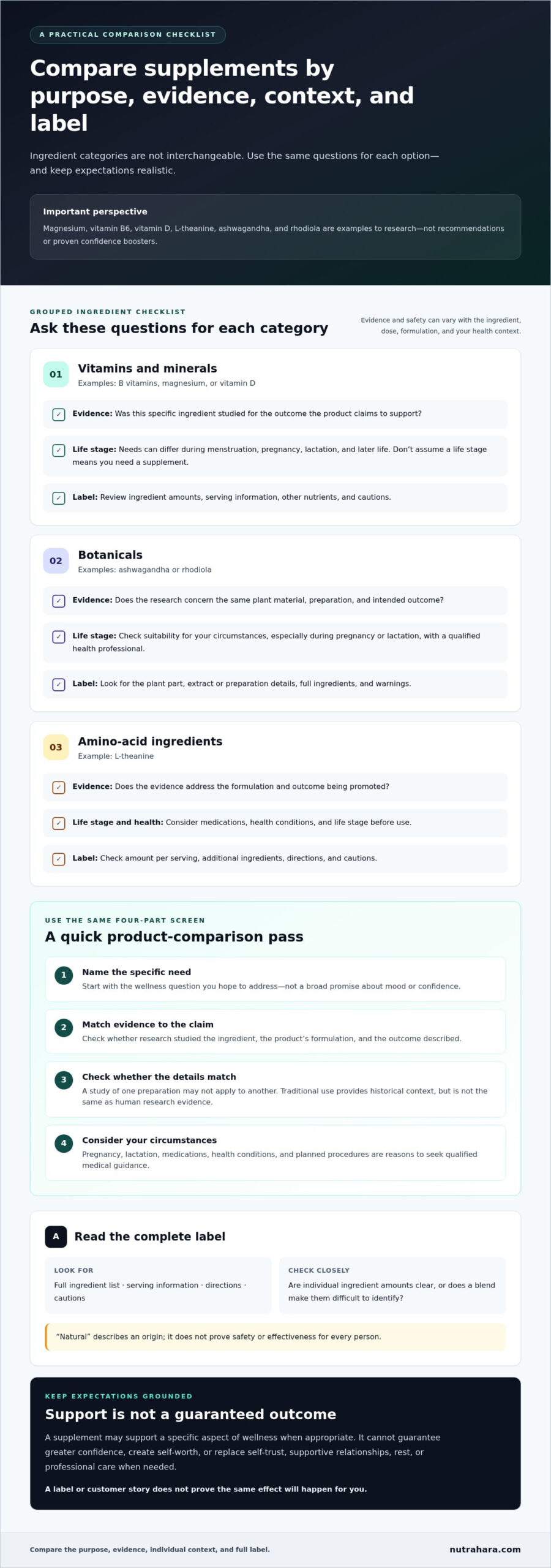
Categories
Articles

Do Cranberry Supplements Work? What the Evidence Says

What if cranberry supplements may help lower the chance of some repeat urinary tract infections, but aren’t a way to treat symptoms once they begin? Conflicting claims can make cranberry supplements effectiveness difficult to judge, especially when labels use broad language and studies examine different products and groups of people. The useful question isn’t simply whether cranberry “works,” but what outcome has been studied and whether that evidence applies to you.

For women balancing work, exercise, family life, and changing health needs, a supplement decision should fit the bigger picture. Menstruation, pregnancy, breastfeeding, perimenopause, and postmenopause can all shape the questions you bring to a healthcare professional, though no life stage alone determines what’s right for you. Research reviews have found potential preventive benefit in some groups, while evidence doesn’t support using cranberry to treat an active urinary infection.

This article explains how researchers assess cranberry products, which label details may help you compare options, and how capsules, juice, and cranberries as food differ. You’ll also find a practical way to weigh evidence, product information, and personal context without expecting a guaranteed result. The aim is to help you make an informed choice that feels appropriate for your wellness routine.

Key Takeaways

  • Assess cranberry supplements effectiveness by focusing on the outcome studied and who may benefit, not broad wellness promises.
  • Learn why proanthocyanidins (PACs) appear on some labels, and why a listed amount alone doesn’t prove a product will work.
  • Compare capsules, juice, and cranberry foods by convenience, label clarity, and the limits of the available evidence.
  • Consider your life stage, medications, and health history when weighing supplement safety, especially during pregnancy or breastfeeding.
  • Use a simple decision framework to set a realistic goal, review product information, and reassess whether a supplement fits your routine.

Do cranberry supplements work? Start with what they may support

Short answer: cranberry supplements may help reduce the risk of recurrent urinary tract infections (UTIs) for some people, but they don’t treat an active infection. Research has focused on prevention, not on easing symptoms after a UTI begins. If you have symptoms such as pain or burning when urinating, seek medical care rather than relying on a supplement.

Cranberry supplements are products made with cranberry fruit ingredients, such as powders or extracts, and are studied for outcomes including UTI recurrence. Much of the research concerns the North American cranberry, Vaccinium macrocarpon, though species and preparations can vary between products. For botanical background, see Cranberry – Wikipedia. A 2023 Cochrane review of 50 studies involving 8,857 participants found cranberry products helped reduce symptomatic, culture-verified UTIs in some groups, including women with recurrent UTIs. That result doesn’t establish that every supplement works equally well.

What does cranberry supplement effectiveness mean?

For cranberry supplements effectiveness to mean something useful, the outcome needs to be clear. A study might measure whether participants experience another confirmed UTI over a set period. That’s different from asking whether cranberry relieves current discomfort or supports general wellness. Results can depend on the participants, the cranberry formulation, and the question researchers set out to answer. Evidence for one preparation can’t automatically be applied to every product on a shelf.

Cranberry supplements and urinary health are not the same as vaginal pH

The urinary tract and vagina are separate parts of the body, with different functions and health considerations. Evidence about cranberry and UTI prevention doesn’t show that cranberry supplements restore vaginal pH or treat vaginal symptoms or conditions. If you’re looking for information about that separate topic, read our guide to vaginal pH balance. Keeping these questions distinct helps you focus on support that matches your concern.

How cranberry supplements may work, and what research actually measures

Cranberry research looks at more than whether someone takes a capsule. Researchers also consider who takes it, how the cranberry ingredient is prepared, how long it’s used, and what outcome is measured. These details help explain why a result from one study may not predict what another woman will experience.

One proposed mechanism is that certain cranberry compounds may make it harder for some bacteria, particularly E. coli, to adhere to the urinary tract lining. This explanation is under study; it doesn’t prove that a supplement will prevent an infection for any individual. The 2023 Cochrane review discusses cranberry products in the context of UTI prevention, with evidence tied to the populations and products studied. Read the Cochrane review.

What are proanthocyanidins, and why do supplement labels mention them?

Proanthocyanidins, often shortened to PACs, are compounds found in cranberries and other plants. Cranberry research has focused in particular on A-type PACs and their possible role in bacterial adhesion. A label that lists PAC content gives you more information about a formula, but a number alone doesn’t show that the product matches a clinical study or will produce a specific result. Check whether the label states the amount per serving and explains how it’s measured.

Why cranberry study results can differ

Study results are easier to interpret when you look at the design, not just the headline. Check what kind of cranberry product was tested and whether it was compared with a placebo or another approach. Consider:

  • Participants: Were they women with a history of recurrent UTIs, or a broader group?
  • Duration: How long did the study track use and outcomes?
  • Outcome: Did researchers count symptomatic, confirmed infections, or measure something else?

Products can differ in cranberry species, processing, and PAC content, so findings for one preparation can’t automatically establish the effectiveness of another. Study duration and comparison groups matter too: a short trial may answer a different question from a longer prevention study. Together, these factors shape what cranberry supplements effectiveness means in practice. Evidence can inform a considered choice, but it can’t promise an individual result.

Cranberry supplements vs. juice: how to compare the options

Capsules, juice, and whole cranberries aren’t interchangeable. They differ in serving format, ingredient concentration, and how easily you can assess what you’re consuming. The FDA’s qualified health claim for cranberry juice applies to a specific beverage serving and describes the evidence as limited and inconsistent. That claim doesn’t establish that every juice or supplement offers the same benefit.

Option Convenience and serving What to check Evidence limitation
Supplement capsules Compact, pre-portioned format Cranberry ingredient, serving details, and any PAC information Formulas vary; a label amount doesn’t prove the product matches a studied preparation.
Cranberry juice Drinkable, but requires a pour and a serving Percentage of cranberry juice, serving size, and Nutrition Facts, including Added Sugars Juices and juice cocktails differ in composition; evidence for juice is limited and inconsistent.
Whole or dried cranberries Easy to add to meals or snacks Whether the product is sweetened and how it fits your dietary needs Eating cranberries isn’t automatically equivalent to taking a studied supplement or juice.

Which details on a cranberry supplement label deserve attention?

Look for a clearly named cranberry ingredient and an understandable serving size. If the label lists proanthocyanidins (PACs), check whether it states the amount per serving and explains what that measure refers to. A front-label phrase such as “urinary support” isn’t evidence of a particular outcome. If a brand mentions third-party testing, look for specifics about what was tested. Testing may speak to product quality, but it doesn’t by itself show that the supplement prevents UTIs.

When might juice or whole cranberries suit someone better?

Juice may suit you if you prefer a drink, while whole or dried cranberries can fit into meals and snacks. Check juice labels because cranberry beverages vary, and some contain added sugars. The FDA requires Added Sugars to appear on Nutrition Facts labels, so compare the serving information with your dietary priorities. Whole fruit can be a food choice, but it shouldn’t be treated as a guaranteed preventive measure.

There’s no universally best format. Consider which option fits your routine, what its label tells you, and what outcome the evidence studied. For a broader framework for choosing supplements as part of women’s wellness, explore this women’s wellness supplements guide.

Safety, life stages, and when cranberry supplements are not enough

Your health needs can change across menstruation, pregnancy, breastfeeding, perimenopause, and postmenopause. Those stages don’t automatically determine whether cranberry is appropriate, but they make personal context important. Evidence about cranberry supplements effectiveness doesn’t establish that every woman will benefit or that every formulation is suitable for her.

A practical step is to keep a brief record of urinary symptoms, any supplements you take, and when you take them. Note changes and questions to discuss with a qualified healthcare professional. This can make a conversation more useful, especially if you’re managing a health condition or taking medication.

What should women consider during pregnancy, lactation, or medication use?

If you’re pregnant, trying to conceive, or breastfeeding, seek individualized professional guidance before starting a cranberry supplement. The 2023 Cochrane review did not find evidence supporting cranberry use to prevent UTIs in pregnant women. That finding concerns evidence of benefit, not a blanket safety verdict. Medication questions also depend on your circumstances and the specific product, so review the label with a qualified healthcare professional rather than assuming a supplement is risk-free or unsuitable for everyone.

Menstruation, perimenopause, and postmenopause also don’t create one uniform need for cranberry. Consider your symptoms and overall health rather than treating life stage alone as a reason to start or avoid a supplement.

When should urinary symptoms prompt medical care?

Cranberry supplements aren’t a substitute for assessment or treatment of a urinary infection. Seek prompt medical evaluation for urinary symptoms such as pain or burning during urination, frequent or urgent need to urinate, or symptoms that are severe or getting worse. Don’t wait to see whether a supplement helps. A healthcare professional can assess what’s happening and advise on appropriate care.

Keep your notes brief: record when symptoms began, how they change, and any supplements or medicines you use. This isn’t a way to diagnose yourself; it’s a practical aid for sharing clear information during care. Supplement decisions are one part of wellbeing, alongside habits such as movement, nourishing meals, and restorative practices. Explore Nutrahara’s women’s wellness approach.

Do Cranberry Supplements Work? What the Evidence Says

A grounded way to decide whether cranberry supplements fit your wellness routine

A thoughtful decision starts with your goal, not a bold promise on a bottle. Use this framework to assess cranberry supplements effectiveness in the context of your health and routine:

  • Define your goal. Are you considering prevention because you experience recurrent UTIs, or hoping to ease symptoms you have now? Supplements aren’t a treatment for an active infection.
  • Review the evidence. Check whether research studied the outcome and population relevant to you. Findings for one cranberry preparation don’t automatically apply to every product.
  • Assess label clarity. Look for clear ingredient and serving information. Vague promises or a listed PAC amount alone can’t guarantee a clinical benefit.
  • Consider your personal context. Your health history, life stage, and medicines matter. Discuss personal safety questions with a qualified healthcare professional.

Reassess from time to time. Keep a brief note of what you take and any changes in your symptoms or routine so you can discuss them with a healthcare professional. A supplement decision can change as your needs do.

Support whole-person wellness without overstating cranberry’s role

Small, repeatable habits can make wellness feel more manageable. Try a gentle yoga stretch after a walk, or set aside a quiet moment to focus on your breathing. Choose movement, balanced meals, and restorative sleep in ways that fit your life. Yoga and meditation can support general wellbeing, but they aren’t treatments for urinary infections or proven alternatives to medical care.

Personal stories can offer connection, but they aren’t clinical evidence. Use testimonials only when a woman’s account is verified and shared with her permission. For a practical example, if you’re comparing two labels, note the cranberry ingredient, serving details, and any PAC information, then discuss the product with a qualified healthcare professional if you have safety questions. Nutrahara’s approach to women’s wellness brings Ayurvedic principles together with modern nutritional research. Explore the women’s wellness supplement guide as you make informed choices for your health.

Make your next wellness choice with confidence

Cranberry supplements may help reduce the risk of recurrent UTIs for some women, but the evidence is limited and doesn’t mean every product will work the same way. The clearest way to assess cranberry supplements effectiveness is to look at the outcome studied, the formulation, and whether the research applies to your circumstances. Cranberry isn’t a treatment for urinary symptoms, and personal safety questions deserve guidance from a qualified healthcare professional.

Choose thoughtfully: clarify your goal, read the label beyond its front-facing claims, and consider your health history and life stage. Sustainable habits such as regular movement, restorative sleep, balanced nutrition, yoga, and meditation can also support overall wellbeing, though they don’t treat infections.

Nutrahara focuses on women’s health supplements, combining Ayurvedic principles with modern nutritional research. Explore Nutrahara’s approach to women’s wellness and build a routine grounded in care, curiosity, and confidence.

Frequently Asked Questions

Do cranberry supplements really help prevent urinary tract infections?

Cranberry products may help reduce the risk of recurrent UTIs in some groups, including women with recurrent infections, but the evidence is limited and results aren’t guaranteed. A 2023 Cochrane review found a preventive benefit for certain populations. The phrase cranberry supplements effectiveness should be understood in that context: research examines prevention in studied groups, not a promise that every supplement will work for every woman.

Are cranberry pills more effective than cranberry juice?

There isn’t enough evidence to say that pills are universally more effective than juice. The FDA’s qualified health claim for cranberry juice describes the evidence as limited and inconsistent. Claims about different product formats aren’t proof from a direct comparison that one is best. Formulation and serving information matter, so compare labels rather than assuming the options are interchangeable.

How much cranberry supplement should I take?

There isn’t one dose established as right for everyone. The FDA’s qualified health claim for cranberry dietary supplements is based on a daily intake of 500 mg, but that figure relates to the claim’s evidence and isn’t personalized dosing advice or a guarantee of benefit. Products may differ in ingredients and formulation. Follow the product label, and ask a qualified healthcare professional what’s appropriate for your health context.

Can cranberry supplements treat a urinary tract infection?

No. Cranberry supplements haven’t been established as a treatment for an active UTI, and they shouldn’t replace medical assessment or treatment. If you notice pain or burning when urinating, frequent or urgent urination, or symptoms that are severe or worsening, seek prompt medical care. Don’t wait to see whether cranberry helps. A healthcare professional can assess your symptoms and advise you on appropriate next steps.

Are cranberry supplements safe during pregnancy or breastfeeding?

Ask a qualified healthcare professional before using cranberry supplements during pregnancy or breastfeeding. The 2023 Cochrane review did not find evidence supporting cranberry products for UTI prevention in pregnant women; this is not the same as proving universal harm or safety. Individual health circumstances and product formulations vary. Bring the product label and a list of other supplements or medicines to your discussion so you can receive guidance tailored to you.

Can cranberry supplements interact with medications?

Whether a cranberry supplement is suitable alongside your medication depends on your personal circumstances and the specific product. Don’t assume a supplement is interaction-free because it contains a natural ingredient. Before starting it, show the full label to a qualified healthcare professional or pharmacist and ask about your medicines and health history. If the formula combines cranberry with other ingredients, include those in the discussion too.

Do cranberry supplements help with vaginal pH or vaginal health?

There isn’t established evidence here that cranberry supplements restore vaginal pH or treat vaginal conditions. Research on cranberry has focused on urinary tract outcomes, which are distinct from vaginal health. If you’re concerned about vaginal symptoms or pH, seek advice from a qualified healthcare professional rather than trying to address them with a cranberry supplement. Keeping urinary and vaginal health questions separate can help guide the right next step.

Article by

Nutrahara Team

We are a dedicated collective of nutrition scientists and naturopaths at Nutrahara, committed to advancing women's health through the fusion of ancient Ayurveda science and cutting-edge nutrition research. Our mission is to empower you with clean, simple, and scientifically validated wellness solutions so you can live your healthiest life. Connect with us to stay updated on the latest developments in holistic women's health and nature-based research.

Disclaimer

This article is not a substitute for medical advice. Please consult a healthcare professional before starting any supplement, especially if pregnant, nursing, taking medication, or managing health conditions.

Categories
Articles

Probiotics for Vaginal Health: What the Evidence Says

What if the word “probiotic” tells you less than the strain, the study, and the health question behind it? It’s understandable to consider probiotics for vaginal health when wellness claims conflict and symptoms are uncomfortable or hard to discuss. But a supplement’s promise isn’t proof, and vaginal symptoms can have different causes.

The evidence is nuanced. Research explores specific strains and outcomes, but it doesn’t establish that every supplement can prevent or treat vaginal conditions. This guide explains what studies can and can’t show, why strain and context matter, and when symptoms call for clinical evaluation instead of self-treatment. You’ll also find gentle ways to support overall wellbeing, including movement, yoga, and mindfulness, while making informed choices for your health and life stage.

Key Takeaways

  • Assess probiotics for vaginal health by the specific strain and outcome studied, not by the word “probiotic” alone.
  • Find out why findings about bacterial vaginosis don’t automatically apply to yeast infections or general vaginal wellness.
  • Compare a product’s strain, research population, and delivery method with the study behind its claims.
  • Use gentle movement, yoga, and meditation to support overall wellbeing, not as treatments for vaginal symptoms.
  • Keep track of concerns and seek clinical evaluation when symptoms warrant it rather than relying on supplements to self-diagnose.

What probiotics for vaginal health are, and what they are not

Probiotics are live microorganisms that may provide a health benefit when used in a suitable amount, but their effects depend on the specific strain and the outcome being studied. That means “probiotic” on a label isn’t proof that a product will benefit the vagina. Research on one strain or formulation can’t automatically be applied to every supplement.

The vaginal microbiome is the community of microorganisms living in and around the vagina. It is distinct from the gut microbiome, even though some probiotics are taken by mouth and researchers study how they may relate to vaginal bacteria. Evidence about digestive health alone doesn’t establish a vaginal benefit. A probiotic supplement also can’t diagnose or treat an infection. Symptoms need appropriate clinical evaluation.

How the vaginal microbiome relates to Lactobacillus

Lactobacillus species are commonly discussed in vaginal-microbiome research. These bacteria are associated with vaginal environments, but a person’s microbiome can vary, including across menstrual cycles and life stages such as pregnancy or menopause. Learn more about Lactobacillus in the vaginal microbiota. A microbiome test offers a snapshot, not a complete assessment of someone’s health or an explanation for every symptom.

Why a probiotic label does not establish vaginal benefit

Strain names matter. Two probiotics may contain bacteria from the same species but different strains, and findings about one strain don’t prove that another works the same way. Look for research that matches the product’s strain and intended outcome, rather than relying on broad claims about “women’s health.”

Route matters, too. Oral probiotics are swallowed; products designed for vaginal use are a different formulation and aren’t interchangeable. Studies of one route don’t automatically support claims for the other. Neither route should replace evaluation or established care when symptoms suggest infection.

Keep pH and microbiome claims in perspective

Vaginal pH is one part of the picture, not a stand-alone measure of vaginal health. It can vary, and a pH result alone can’t identify the cause of symptoms. For foundational context, a vaginal pH balance guide can help explain what pH does and why it shouldn’t be used to self-diagnose. A clear, strain-specific claim is more informative than a promise to “balance” the entire microbiome.

What research says about probiotics and vaginal health

The evidence is not a blanket endorsement of probiotics. Results depend on the strain, who took part in a study, whether the probiotic was oral or vaginal, and what researchers measured. A finding about bacterial vaginosis (BV) recurrence, for example, doesn’t establish a benefit for yeast infections or everyday vaginal wellness.

Probiotics studied alongside bacterial vaginosis care

A 2025 systematic review of 16 trials identified Lactobacillus rhamnosus TOM 22.8 among the strains studied for vaginal pH, microbiota composition, and BV recurrence. The review reported a promising regimen, but its findings apply to that strain and research context, not to probiotics generally. A separate clinical trial of vaginally delivered Lactobacillus crispatus CTV-05, known as Lactin-V, examined recurrence after standard antibiotic treatment and reported lower recurrence than placebo.

These studies explore specific approaches, often alongside or after standard care. They don’t show that a supplement can replace evaluation or prescribed treatment for active BV. The American College of Obstetricians and Gynecologists’ Practice Bulletin No. 215, published in 2019, states that probiotics aren’t recommended to treat or prevent vaginitis, including BV. Differences in strains, delivery, study populations, and protocols also limit how confidently results can be applied to other products.

What evidence does, and does not, show for yeast infections

Yeast infections involve Candida, commonly Candida albicans, rather than the bacterial imbalance studied in BV research. Findings about a probiotic’s effect on BV therefore can’t be used to claim it prevents or cures yeast infections. Evidence for probiotics as a reliable yeast-infection treatment or preventive approach remains insufficient to support that promise. If symptoms are new, persistent, or recurring, seek clinical evaluation rather than trying to identify the cause with a supplement.

In brief: Research offers strain-specific signals, particularly around BV recurrence and use alongside standard care, but it doesn’t establish that probiotics for vaginal health broadly prevent or treat infections. For context on vaginal pH, see the vaginal health and pH balance guide. Remember that pH alone can’t diagnose the cause of symptoms.

How to assess vaginal probiotic claims without overpromising

A confident label can sound persuasive, but a useful claim should be traceable to research on the same strain, formulation, route, and intended outcome. A study result is evidence to consider, not a promise that you’ll get the same result. This distinction matters because vaginal odor, discharge, irritation, and pH can change for different reasons. A probiotic can’t correct every change or identify its cause.

Strain-specific evidence matters more than a broad probiotic claim because research findings apply to the exact microbes, product format, and outcome studied, not automatically to a whole category. Use this framework to assess claims about probiotics for vaginal health:

What to check What to look for Evidence limit
Strain Is the full strain name given, not just the species? Another strain of the same species may not have the same effect.
Outcome Did the study assess BV recurrence, symptoms, or another specific measure? One measured outcome doesn’t prove broad vaginal-health benefits.
Population Who took part, and does the group resemble your life stage or circumstances? Findings may not apply equally across pregnancy, menopause, or other contexts.
Formulation and route Was the studied product oral or intended for vaginal use? A study of one product or route doesn’t validate another.

Questions that make a claim easier to evaluate

Before trusting a claim, look for the study it cites and ask: Which exact strain was studied? What outcome did researchers measure? Who participated, and how was the probiotic used? Then compare those details with the product claim. A result from a defined study group can inform your understanding, but it can’t guarantee an individual response.

Be cautious if a claim promises to “balance” the microbiome, eliminate odor, or normalize pH without explaining what was measured. A pH reading alone can’t diagnose the cause of symptoms, and a broad promise doesn’t establish prevention or treatment of infection.

When symptoms need clinical evaluation instead

Unusual or persistent odor or discharge, irritation, and pain can have several causes that need different care. Seek clinical evaluation if symptoms are persistent, recurring, severe, or concerning. If you’re pregnant and develop symptoms, or have fever or pelvic pain, contact a healthcare professional promptly. Supplements shouldn’t delay assessment or replace care for a suspected infection.

Practical habits for vaginal and whole-body wellness

Wellbeing is built through steady, sustainable choices, not a perfect routine. Everyday habits can support how you feel overall, but they shouldn’t be treated as ways to prevent or cure vaginal infections. Choose comfortable clothing and gentle external cleansing that suits you, and avoid products that cause irritation. Vaginal symptoms aren’t a sign that you’ve failed to keep yourself clean.

A gentle routine that supports overall wellbeing

Choose habits that fit your energy, schedule, and body. A walk, stretching, or another comfortable form of movement can help you stay active. Drink fluids according to your needs, and make room for rest when possible. Yoga or meditation may offer a calming pause, but neither is a treatment for vaginal symptoms.

Try a brief reset: sit comfortably, relax your shoulders, and take a few slow, unforced breaths. If a pose or movement feels uncomfortable, skip it. You can also keep a private note of symptoms, when they occur, and any changes you notice. That record may help you describe concerns clearly during a clinical conversation.

How life stage can shape questions about supplements

Menstruation, pregnancy, lactation, and menopause can bring different questions about body changes and supplement use. There’s no single routine that fits every woman. If you’re pregnant or lactating, take medication, or have a health condition, discuss supplements with a qualified healthcare professional before starting them. This can help you consider the specific product and your personal circumstances.

Changes in discharge, comfort, or other symptoms can feel personal, but they’re valid reasons to seek guidance. You don’t need to diagnose yourself or blame your hygiene habits. Note what you’ve noticed and ask a healthcare professional about appropriate next steps. A steady wellness practice can include informed choices and support when you need it.

For a research-informed perspective on women’s wellness, explore Nutrahara’s approach to women’s health.

Probiotics for Vaginal Health: What the Evidence Says

A thoughtful next step for your vaginal-health journey

The clearest takeaway is simple: probiotic evidence is strain-specific, and no supplement should be used to self-diagnose an infection. Research on a particular strain or outcome doesn’t establish that every product will help, or that a change in odor, discharge, or comfort has the same cause for every woman.

Choose an informed next step, not a quick promise

Use this short sequence to turn uncertainty into a practical plan:

  • Note your concern. Write down what you’ve noticed, when it began, and whether it has changed or returned.
  • Review the evidence. Look for the exact strain, the outcome studied, who took part, and whether the study used the same type of product you’re considering.
  • Seek care when symptoms warrant it. Persistent, recurring, severe, or concerning symptoms deserve clinical evaluation rather than supplement-based guesswork.

General wellness learning can help you ask informed questions, but it isn’t a substitute for care when symptoms are active or keep returning. For broader supplement-literacy context, a women’s wellness supplements guide can help you think through evidence and product claims beyond probiotics for vaginal health. If you’re pregnant or lactating, take medication, or have a health condition, discuss supplement use with a qualified healthcare professional.

Continue your wellness journey with confidence

It’s reasonable to ask questions about intimate health. You don’t need to feel embarrassed or blame yourself for symptoms. If you speak with a healthcare professional, share what you’ve noticed, whether symptoms have recurred, and any supplements or medications you use. Pregnancy, lactation, and other health circumstances are useful context for that conversation.

Nutrahara brings Ayurvedic principles into conversation with modern nutritional research as part of a broader perspective on women’s wellness, not as a treatment for vaginal symptoms. Let curiosity guide your next step while keeping evidence and appropriate care in view.

Explore Nutrahara’s holistic wellness approach.

Make your next step evidence-informed

Research on probiotics for vaginal health depends on the specific strain, how it’s used, and the outcome studied. A promising finding for one formulation doesn’t prove that every probiotic can prevent or treat vaginal symptoms. Read claims with care, and don’t use supplements to self-diagnose. Persistent, recurring, or concerning symptoms deserve clinical evaluation.

Keep your next step simple: note what you’ve noticed, look for evidence that matches a product’s exact strain and intended benefit, and seek professional guidance when symptoms or personal circumstances call for it. Your questions are a practical part of caring for your health, whatever life stage you’re in.

Nutrahara brings Ayurvedic principles together with modern nutritional research, with a focus on women’s health supplements and natural, clean ingredients. Explore that broader approach to wellness at your own pace.

Explore Nutrahara’s women’s wellness supplements and continue building confidence in the choices that support your wellbeing.

Frequently Asked Questions

Can probiotics help with vaginal health?

Some specific probiotic strains are being studied for particular vaginal-health outcomes, especially in relation to bacterial vaginosis (BV). That doesn’t mean all probiotics for vaginal health have the same effects, or that supplements can resolve every symptom. Research findings depend on the strain, formulation, route, and outcome measured. If you have symptoms, don’t use a supplement to diagnose their cause or as a substitute for appropriate clinical care.

Are probiotics proven to prevent or treat bacterial vaginosis?

No. The American College of Obstetricians and Gynecologists’ Practice Bulletin No. 215 states that probiotics aren’t recommended to treat or prevent vaginitis, including BV. Researchers have studied certain strains as additions to or after standard treatment, including for recurrence, but those findings don’t establish probiotics as a replacement for evaluation or prescribed care. If BV is suspected or symptoms return, seek clinical advice about appropriate treatment.

Can probiotics prevent yeast infections?

Probiotics haven’t been established as a reliable way to prevent or cure yeast infections. Yeast infections involve Candida, while much vaginal-probiotic research focuses on bacterial vaginosis, so findings about BV can’t be assumed to apply to yeast. Itching, irritation, or discharge can have different causes. If symptoms are new, persistent, or recurring, seek clinical evaluation instead of relying on a supplement to identify or treat them.

How long do probiotics take to affect vaginal health?

There isn’t one established timeframe for probiotics to affect vaginal health. Studies examine different strains, routes, populations, and outcomes, so results from one trial can’t predict when or whether a particular person will notice a change. Don’t use a lack of improvement as a reason to keep self-treating symptoms. If you’re concerned or symptoms persist or recur, arrange clinical evaluation rather than waiting for a supplement to work.

Are oral probiotics the same as vaginal probiotics?

No. Oral probiotics are swallowed, while vaginal probiotics are formulated for vaginal use. They differ in route, and research on one type doesn’t automatically show that the other has the same effects. Check whether a study matches the product’s exact strain and route, and don’t assume a general probiotic label establishes vaginal benefit. Don’t use either type instead of clinical evaluation or treatment for suspected infection.

Should I take probiotics while pregnant or breastfeeding?

Ask a qualified healthcare professional before starting a probiotic while pregnant or breastfeeding. The appropriate advice can depend on your health, the product’s specific strains and ingredients, and your individual circumstances. Share the product label and mention any medications or health conditions, so you can discuss whether it’s suitable for you. If you have vaginal symptoms during pregnancy or while breastfeeding, seek professional advice rather than self-treating.

Article by

Nutrahara Team

We are a dedicated collective of nutrition scientists and naturopaths at Nutrahara, committed to advancing women's health through the fusion of ancient Ayurveda science and cutting-edge nutrition research. Our mission is to empower you with clean, simple, and scientifically validated wellness solutions so you can live your healthiest life. Connect with us to stay updated on the latest developments in holistic women's health and nature-based research.

Disclaimer

This article is not a substitute for medical advice. Please consult a healthcare professional before starting any supplement, especially if pregnant, nursing, taking medication, or managing health conditions.
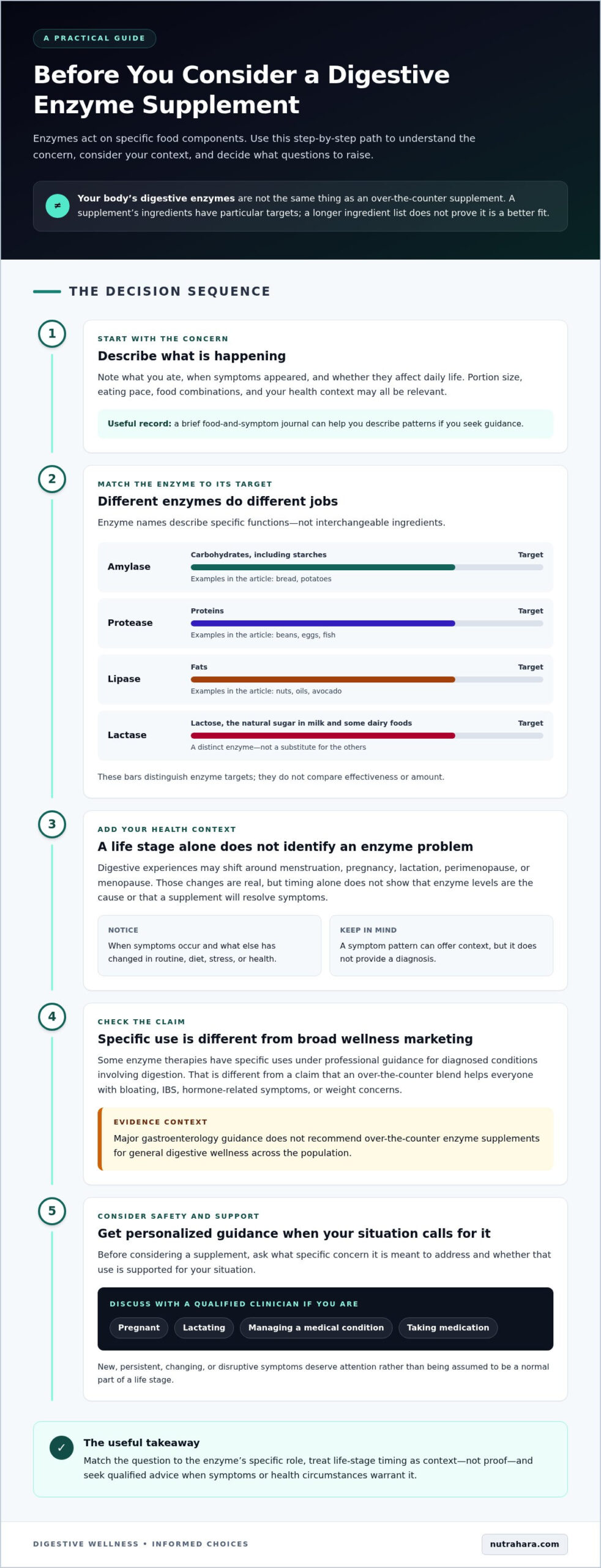
Categories
Articles

Best Vitamin D Supplement: How to Choose the Right One in 2026

The most popular bottle isn’t automatically the best vitamin D supplement for you. A high dose, a familiar form, or a long list of added ingredients may look reassuring, but the right choice depends on your needs, life stage, and what the label actually says.

Serving sizes, vitamin D2 and D3, and quality seals can be difficult to compare. Generic rankings may also leave unanswered questions if you’re pregnant, breastfeeding, approaching menopause, or managing a health condition. A thoughtful choice starts with clear information, not big promises.

This guide explains how to compare supplement forms, serving amounts, ingredients, and quality claims. It also covers when to ask a clinician about testing or supplementation. Use the label to assess the product, and individual guidance to consider whether it suits you. That distinction can make the decision clearer and more relevant to your routine.

Key Takeaways

  • The best vitamin d supplement is a personal fit, not simply the most popular or highest-dose option.
  • Learn how to distinguish a product’s serving amount from the amount that may suit your individual needs.
  • Use a consistent checklist to compare supplement forms, clear labeling, and quality evidence.
  • Consider your life stage and health context, and ask a qualified clinician whether testing or supplementation is appropriate.
  • Nutrahara offers women’s health supplements, but its available product information does not identify a vitamin D-specific product.

What makes the best vitamin D supplement a good fit for you?

The best vitamin D supplement is one that fits your personal needs, has a clear label, and provides quality information you can check. First, separate two decisions: whether to take a supplement and which product to choose. A bottle can tell you what it contains, but it can’t determine whether supplementation is appropriate for you or diagnose a deficiency.

Your food choices, sun exposure, health history, and medications may be useful topics to discuss with a qualified clinician. For example, describing how much time you typically spend outdoors and which foods you regularly eat can help frame the conversation, but those details don’t replace an individual assessment. A product roundup can help compare labels; it can’t provide a diagnosis or personalized medical advice.

Vitamin D supplements: what the label can and cannot tell you

Vitamin D supplements come in different forms, including D2 and D3. For background on these forms and vitamin D’s role in the body, see Vitamin D forms and supplement labels. A label describes the product, not your blood vitamin D level or personal requirement.

Check the full Supplement Facts panel and directions. Note the amount per serving and how many tablets, capsules, or gummies make up that serving. Don’t assume the listed amount is the amount you personally need. Recommended intake can vary by age and life stage, while individual decisions may depend on circumstances a label can’t assess.

Why women’s needs and circumstances are not all the same

Menstruation, perimenopause, and postmenopause are distinct life stages, but none alone determines whether you should supplement. Pregnancy and lactation, certain medications, and health conditions are reasons to seek individualized professional guidance. Bring the product label and a list of medicines or other supplements to help your clinician consider the details in context.

You can ask why supplementation is being suggested, whether testing is relevant to your situation, and how to avoid overlapping products. These are practical questions, not reasons for alarm. Yoga, meditation, balanced meals, and regular movement can support general wellbeing, but they don’t diagnose or treat vitamin D deficiency. Start by considering your own circumstances, then read the label carefully.

Vitamin D forms and supplement labels: what should you compare?

When comparing products, look beyond the front-of-bottle claims. Vitamin D supplements may contain D2 (ergocalciferol) or D3 (cholecalciferol), and they come in formats such as tablets, capsules, softgels, liquids, and gummies. The NIH Office of Dietary Supplements notes that D3 may raise blood vitamin D levels higher and for longer than D2. That comparison alone, however, can’t tell you which product or amount suits you. Its Vitamin D fact sheet offers evidence-based background.

How to read the Supplement Facts panel

Start with the Supplement Facts panel rather than the front label. Find the vitamin D amount per serving, serving size, and directions. Review the other listed ingredients, including the source of vitamin D if it’s stated. A serving may require more than one capsule or gummy, so compare products using the same serving basis rather than assuming one unit equals one serving.

The serving amount tells you what the product provides when used as directed. It is not a personalized recommendation. Don’t select an amount simply because it appears in a popular product or the label calls it “high potency.” If you’re unsure how a product fits with your diet, other supplements, or health circumstances, ask a qualified clinician.

What quality testing and certifications can establish

A quality seal can be useful, but check what it covers. Organizations such as USP and NSF have verification programs. Look up the organization’s current program details and confirm whether the specific product appears in its listings. Verification may address defined quality criteria, but it doesn’t establish that a supplement is right for you or prove every health claim on its packaging.

Don’t assume a product has been independently tested just because its label says “tested” or “verified.” Look for product-specific evidence and check what was assessed. If clear documentation isn’t available, treat the claim as unconfirmed, not as proof of poor quality.

Be cautious about promises to treat or prevent disease, guarantee results, or support a sweeping range of unrelated wellness outcomes. Clear ingredient information and specific, measured claims make comparison easier. The best vitamin d supplement for your shortlist is one whose form, serving details, and quality evidence you can assess. Keep questions about personal dosing separate from product marketing.

How to compare vitamin D supplements without relying on popularity alone

A bestseller label tells you a product is popular, not whether its ingredients, serving information, or quality evidence suit your needs. Apply the same checks to each option, and separate facts on the label from your judgment about whether the format fits your routine. Without current product details and product-specific evidence, it wouldn’t be responsible to name a vitamin D product as a top pick.

A practical checklist for evaluating a supplement

Compare complete labels, not just front-of-bottle claims. Check the vitamin D form, amount per serving, serving size, directions, other ingredients, and manufacturer details. Then verify any quality claim against evidence for that specific product. A capsule may fit one person’s routine better than a liquid or gummy, but convenience alone doesn’t establish effectiveness or quality.

What to compare Objective check How to interpret it
Form Does the label identify D2 or D3 and the delivery format? Consider preference and routine; don’t treat format as proof of superiority.
Serving clarity Are serving size, vitamin D amount, and directions easy to find? Compare amounts on the same serving basis. This is product information, not personal dosing advice.
Quality evidence Can you confirm a stated certification or test for this exact product? Give more weight to verifiable, product-specific information than to broad “tested” claims.
Cautions Are ingredients and warnings disclosed, and are claims specific? Pause over disease-treatment promises or guaranteed results; seek qualified guidance for personal concerns.

How to interpret rankings, reviews, and testimonials

Ask how a ranking was created. Was it based on independent product testing, expert review, label review, or sales popularity? Each method answers a different question, so an editorial pick should explain its criteria and limits. Consumer reviews can describe taste, packaging, or ease of use, but personal experiences aren’t proof of clinical benefits. Women’s testimonials should be authentic, permissioned, and supported; without those safeguards, it’s better to omit them.

For personal safety questions, Mayo Clinic’s guide can help you choose and use vitamin D supplements safely, but it doesn’t replace advice tailored to your circumstances. A useful comparison is transparent about what has been verified and what remains unknown. Nutrahara offers women’s health supplements, but there is no confirmed vitamin D-specific product to present as a vitamin D pick.

How to choose and use vitamin D supplements safely at different life stages

Start with your circumstances, not a one-size-fits-all dose. Use this sequence to prepare for a product comparison or a conversation with a clinician:

  • Review your context. Consider your life stage, diet, sun exposure, health conditions, medications, and any supplements you already take.
  • Check the label. Confirm the vitamin D form, amount per serving, serving size, other ingredients, and directions.
  • Ask a qualified clinician. Discuss whether testing or supplementation makes sense for you, especially if you’re pregnant, breastfeeding, taking medication, or managing a health condition.
  • Follow the guidance you receive. Use a product according to its directions and the clinician’s advice, rather than adding extra servings or combining products without checking.

This process helps you consider the best vitamin d supplement for your situation without assuming a popular product or general recommendation applies to every woman.

When should women ask a clinician about vitamin D?

Pregnancy and lactation bring specific nutritional questions, while medications and some health conditions may affect what’s appropriate. Ask a clinician to review your circumstances and any product label before starting or changing a supplement. Symptoms alone can’t confirm vitamin D deficiency, and a general article can’t determine whether you need a blood test. Testing decisions and timing should be based on your individual situation, not a universal schedule.

How to build a supportive, sustainable wellness routine

Keep your approach simple. If supplementation is recommended, follow the clinician’s instructions and the product label. Check whether other supplements already contain vitamin D before combining them, and ask if you’re unsure. Linking a reminder to an established daily habit, such as breakfast, may make directions easier to follow.

Balanced nutrition and regular movement can support overall wellbeing. Yoga and meditation may also help you make space for mindful, restorative routines. These practices can be part of a broader wellness plan, but they don’t replace vitamin D or treat a deficiency. Aim for a routine that feels realistic and supportive, not like another source of pressure. A clinician can help you adjust it as your needs change through menstruation, perimenopause, menopause, pregnancy, or breastfeeding.

Best Vitamin D Supplement: How to Choose the Right One in 2026

Choosing a vitamin D supplement in 2026: make an evidence-led next move

A confident choice doesn’t require a complicated ranking. It requires clear product details, a transparent label, and professional guidance when your health context calls for it. Before buying, check what’s actually verified instead of relying on popularity or broad wellness promises.

A final checklist before you buy

  • Confirm the current label. Review the vitamin D form, amount per serving, serving size, directions, and full ingredient list. Check the manufacturer’s product information too, so you’re comparing complete details.
  • Verify quality claims. If a product mentions testing or certification, look for current evidence that applies to that specific product. A general claim is not the same as verifiable product-specific information.
  • Consider your circumstances. Pregnancy, breastfeeding, medication use, and health conditions may raise questions that a product label can’t answer. Ask a qualified clinician whether testing or supplementation is appropriate for you.

These checks help distinguish what a product states from what you personally may need. Your shortlist should reflect transparent information and fit your routine, not promise a particular health outcome. The best vitamin d supplement for one woman may not be right for another.

Where Nutrahara fits, and where it does not

Nutrahara is an e-commerce company specializing in women’s health supplements. Its products combine principles of ancient Ayurveda science with modern nutritional research and use natural, clean ingredients. Its offerings include supplements designed to support areas such as skin, hair, nails, digestion, and brain function. No vitamin D-specific product is identified, so Nutrahara can’t be ranked or recommended here as a vitamin D option. Its broader women’s wellness products are not a substitute for vitamin D or individualized clinical guidance.

If you’re exploring Nutrahara’s women’s health supplements, review the available product information with the same care: check the ingredients, serving directions, and evidence behind any claims. This article doesn’t verify a vitamin D product or suggest that another supplement can meet a vitamin D need. Let your health context, clear product information, and clinician guidance shape that decision.

Make your next vitamin D choice with confidence

The best vitamin d supplement isn’t defined by popularity alone. Look for a clear, current label and product-specific quality information, then consider whether the product fits your needs and routine. Serving details describe the product, not your personal requirements.

Your life stage and health history matter. If you’re pregnant or breastfeeding, take medication, or have a health condition, discuss testing or supplementation with a qualified clinician. That conversation can help you make a choice based on your circumstances rather than a generic ranking.

Nutrahara focuses on women’s health supplements and combines Ayurvedic principles with modern nutritional research. No vitamin D-specific product is identified, so Nutrahara shouldn’t be treated as a vitamin D recommendation. For broader women’s wellness resources, explore Nutrahara’s women’s wellness resources.

For your next step, compare labels carefully and ask a clinician about questions specific to your health. If you’re looking for broader women’s wellness support, explore Nutrahara’s women’s wellness resources.

Frequently Asked Questions

What is the best vitamin D supplement to take?

The best vitamin D supplement is one that matches your needs and routine, with a clear label and quality claims you can verify. Compare the form, serving size, amount per serving, ingredients, and directions rather than choosing by popularity or high potency alone. A product label can’t tell you whether you personally need supplementation or what amount is appropriate. Ask a qualified clinician if your health history or life stage raises questions.

Is vitamin D3 better than vitamin D2?

Vitamin D3 may raise and maintain blood vitamin D levels more effectively than D2, but that doesn’t automatically make every D3 product the right choice for you. D2 and D3 are different forms of vitamin D, and labels should identify which form a product contains. Consider serving details, other ingredients, and your circumstances too. If you’re unsure which form to choose, discuss your options with a qualified clinician.

How do I know if I need a vitamin D supplement?

You can’t reliably confirm a vitamin D deficiency from symptoms alone. A clinician can consider your health history, diet, sun exposure, medications, and whether a blood test is appropriate. Testing and supplementation decisions are individualized, so don’t use a general product roundup to diagnose yourself or select a dose. If you have concerns, write down your questions and bring a list of your current supplements and medications to your appointment.

Can I take vitamin D while pregnant or breastfeeding?

Vitamin D is an essential nutrient, and the recommended dietary allowance for pregnant and breastfeeding women is 600 IU (15 mcg) per day, according to the National Academies’ recommendations provided for this article. That figure isn’t a personal prescription or necessarily a supplement dose. Check whether your prenatal or other supplements already contain vitamin D, and ask your pregnancy care clinician what is appropriate for you.

What should I look for on a vitamin D supplement label?

Check the Supplement Facts panel for the vitamin D form, amount per serving, serving size, and directions. Review the full ingredient list, including other active ingredients, and confirm how many tablets, capsules, or gummies make up a serving. Compare products using the same serving basis. The listed amount describes the product, not your individual requirement, so ask a clinician if you need help deciding whether to supplement or how much is suitable.

How can I tell whether a vitamin D supplement has been third-party tested?

Look for a named organization or specific testing claim, then confirm that the exact product appears in the organization’s current verification records. USP and NSF are examples of organizations with programs, but a logo or general “tested” statement isn’t enough to establish what was assessed. Check the program’s scope and current status. Verification can support defined quality claims; it doesn’t prove that a product will deliver a particular health benefit or suit your needs.

Can I take vitamin D with other supplements or medications?

Possibly, but check with a qualified clinician or pharmacist before combining vitamin D with medications or other supplements. Products may overlap in their ingredients, and medicines or health conditions can affect whether supplementation is suitable. Bring the labels or a written list of everything you take, including prenatal vitamins and multivitamins. Don’t add extra servings or change a clinician’s instructions based on advice from a general article or product label alone.

Article by

Nutrahara Team

We are a dedicated collective of nutrition scientists and naturopaths at Nutrahara, committed to advancing women's health through the fusion of ancient Ayurveda science and cutting-edge nutrition research. Our mission is to empower you with clean, simple, and scientifically validated wellness solutions so you can live your healthiest life. Connect with us to stay updated on the latest developments in holistic women's health and nature-based research.

Disclaimer

This article is not a substitute for medical advice. Please consult a healthcare professional before starting any supplement, especially if pregnant, nursing, taking medication, or managing health conditions.

Categories
Articles

Turmeric for Chronic Inflammation: What the Evidence Can, and Cannot, Tell You

Could a golden spice meaningfully ease chronic inflammation, or are supplement claims getting ahead of the evidence? If persistent discomfort is disrupting your workouts, sleep, or everyday routines, it’s understandable to look for options like turmeric for chronic inflammation. Curcumin, a compound in turmeric, is studied for its possible effects on inflammation. But promising mechanisms and early findings don’t prove that a supplement will improve your symptoms.

This guide separates what research suggests from what it can’t yet tell us, including why results from food and concentrated supplements may differ. You’ll learn how to assess product claims and what to discuss with a healthcare professional, especially if you’re pregnant, breastfeeding, taking medication, or moving through menopause. We’ll also consider steady habits, such as movement, yoga, meditation, and nourishing meals, that can support general wellbeing without promising a cure. The goal is to help you make informed choices, not to dismiss your experience or offer a quick fix.

Key Takeaways

  • Symptoms alone can’t confirm chronic inflammation or reveal its cause. Note your concerns and discuss them with a qualified health professional.
  • Separate proposed curcumin mechanisms from human research and established clinical recommendations when weighing potential benefits.
  • Turmeric for chronic inflammation is not a guaranteed solution. Supplement effects may depend on the formulation and individual context.
  • Before considering a supplement, review its label and ask a clinician or pharmacist about medications, pregnancy, trying to conceive, or lactation.
  • Use a simple decision checklist: clarify your concern, assess the evidence, consider safety, and seek qualified advice.

Turmeric for Chronic Inflammation: What Does the Term Really Mean?

Inflammation is part of the body’s normal response to injury or infection. In the short term, it helps coordinate a response to a trigger, then generally settles as the body recovers. Chronic inflammation broadly refers to an inflammatory response that persists or continues inappropriately. It isn’t a diagnosis that can be confirmed from a symptom list, and the term alone doesn’t reveal what may be causing someone’s health concerns.

That distinction matters when evaluating turmeric for chronic inflammation. Turmeric is a plant-derived spice with a long history of culinary and traditional use. Curcumin is one of its compounds studied by researchers. They’re related, but not interchangeable. Research into a compound or biological mechanism doesn’t, on its own, show that eating turmeric or taking a supplement improves a health condition. The Turmeric overview provides background on the plant and summarizes the limits of medical evidence.

How is chronic inflammation different from short-term inflammation?

Short-term inflammation is typically connected to a specific trigger, such as an injury, while chronic inflammation describes a response that persists. Aches after exercise, fatigue, and digestive discomfort can have many possible explanations. They don’t establish that chronic inflammation is present or identify its cause. If a symptom persists, worsens, or concerns you, seek an individual medical assessment rather than trying to diagnose it from how you feel.

What is the difference between turmeric and curcumin?

Turmeric is the spice made from a plant’s rhizome, often used in cooking. Curcumin is one of its naturally occurring compounds, not another name for the whole spice. Foods containing turmeric and concentrated supplements aren’t automatically equivalent: the form, amount, and other ingredients may differ. Don’t assume a product contains a standardized amount of curcumin unless its label clearly verifies that information.

A useful starting point is to separate what a substance is from what research has shown it to do. This keeps traditional use, laboratory research, and demonstrated effects in people from being blurred together, and makes product claims easier to assess.

How Might Curcumin Affect Inflammation, and What Does Human Research Show?

Curcumin is studied for possible effects on processes related to inflammation and oxidative stress. Researchers ask whether it influences signaling pathways or other biological activity involved in the body’s response. These proposed mechanisms can help guide research, but they don’t establish that curcumin will ease symptoms or change the course of a health condition.

Promising biological mechanisms do not prove that a treatment is effective for people. Laboratory findings can show what happens in cells or other experimental models, while human studies examine outcomes in people. Evidence from one level can’t automatically stand in for another. The National Center for Complementary and Integrative Health offers an overview of the evidence for turmeric, including research limitations and safety considerations.

What do studies on curcumin and inflammation actually measure?

Some studies track biomarkers associated with inflammation; others measure symptoms or outcomes tied to a particular condition. A change in a biomarker doesn’t necessarily mean a person feels better or functions differently. To interpret a result, check who took part, what formulation was used, how long it was studied, and what outcomes researchers measured. Findings for one condition or preparation shouldn’t be generalized to all uses of turmeric for chronic inflammation.

Research has explored curcumin in areas such as osteoarthritis, metabolic health, and exercise-related muscle soreness. These are distinct research questions, not proof of a broad effect on chronic inflammation. Results may differ across studies, and evidence for a specific use doesn’t replace established clinical recommendations or individualized care.

Why can turmeric supplement findings differ from food use?

Turmeric in a meal and a concentrated supplement may differ in the amount and form of curcumin, as well as how the body absorbs it. Products can also vary in formulation, so evidence about one preparation doesn’t confirm the effects of another. Piperine, a compound found in black pepper, is sometimes included in supplements as an absorption-related formulation consideration. Its presence doesn’t guarantee a benefit or make every product equivalent.

For a fair comparison, check the product’s stated ingredients and formulation, then consider whether the research studied a similar preparation and population. Don’t assume that a supplement claim applies to your circumstances based on a proposed mechanism or a study in a different group. Weigh any potential benefit alongside practical limits and safety considerations.

Turmeric Supplements for Chronic Inflammation: Benefits, Limits, and Common Claims

Traditional use and scientific evidence answer different questions. A history of use can explain why turmeric interests researchers, but it doesn’t establish that a supplement is effective for every condition described as inflammatory. Likewise, findings about curcumin or one study product can’t automatically be applied to every retail supplement. Johns Hopkins Medicine discusses Curcumin’s anti-inflammatory properties alongside potential benefits and safety considerations.

Evidence lens What it may tell you What remains uncertain
Traditional use How turmeric has been used in food and wellness traditions. Traditional use alone doesn’t establish a clinical benefit.
Proposed mechanisms How curcumin might interact with biological processes studied in inflammation research. A plausible mechanism doesn’t prove an effect on symptoms or disease.
Human evidence What researchers observed with a particular formulation, population, and outcome. Results may not apply to other conditions, people, or products.

“Natural” doesn’t automatically mean effective, suitable, or risk-free. Broad marketing language can make distinct conditions sound as if they share one cause and one supplement solution. They don’t. Research on a specific condition is not proof of benefit for every inflammatory condition, and persistent symptoms deserve assessment by a qualified professional.

How can readers assess turmeric supplement claims?

Use the label as a starting point, not proof of effectiveness. Check whether it clearly states the ingredients and serving information. Then ask whether the claim refers to human research on a relevant condition and a similar formulation, and whether it explains the limits of that evidence. Be cautious about promises to “cure” a condition, guaranteed results, or benefits said to apply to everyone.

Study products can differ from retail products in formulation and composition. Even when a label is transparent, that doesn’t establish that a product matches one used in research or will produce the same outcome. Apply the same questions to each product: What does the label say? What evidence supports the specific claim? Does that evidence fit the condition and formulation being discussed?

Turmeric for Chronic Inflammation: What the Evidence Can, and Cannot, Tell You

Using Turmeric Thoughtfully: Safety Questions and Everyday Wellness Steps

Choosing whether to use a turmeric supplement is a personal decision, not a test of how committed you are to your wellbeing. Before considering turmeric for chronic inflammation, read the label, take stock of your health circumstances, and ask a qualified healthcare professional or pharmacist to review the product with you.

What should women consider before taking a turmeric supplement?

Check the ingredient list and serving information, then note your medications, health conditions, and other supplements. Don’t assume a plant-derived product is right for everyone. If you’re pregnant, trying to conceive, or breastfeeding, seek individualized advice before using a turmeric supplement.

Your life stage and symptoms can help shape the conversation. If you menstruate, you might keep a brief record of cycle timing and symptoms you want to discuss. During perimenopause or after menopause, note new or changing concerns and any care or medications you use. These notes don’t identify a cause, but they can help a clinician or pharmacist understand your circumstances and consider supplement safety. There isn’t a universal dose or product that can be assumed appropriate for every woman.

Bring the product label and a list of medications and supplements to your discussion. If you’re tracking symptoms, include when they occur and whether they change over time.

What daily habits can support general wellbeing?

Small, repeatable choices can support wellbeing alongside appropriate care. Adapt activity to your ability, energy, and circumstances. A comfortable walk or manageable strength activity can be a starting point. Build consistency gradually rather than pushing through pain or exhaustion. If movement causes concern, ask a healthcare professional what may be appropriate for you.

Gentle yoga can offer mindful movement, while meditation or a few quiet breaths may create a calming pause. These are optional wellbeing practices, not treatments for inflammation. Make space for rest after activity and a regular wind-down routine where possible. Choose habits you can return to as your needs and routines change.

Nutrahara offers women’s health supplements intended to support aspects of wellness such as skin, hair, nails, digestion, and brain function. Its approach combines principles of ancient Ayurveda with modern nutritional research. Explore Nutrahara’s women’s wellness supplements for product information, while remembering that it can’t replace advice tailored to your health and life stage.

A Balanced Next Step: Make an Informed Choice About Turmeric

Curcumin research offers questions worth exploring, not a guarantee that turmeric supplements will ease chronic symptoms. The evidence depends on the condition and formulation, while turmeric as a food is not automatically equivalent to a concentrated supplement. If you’re considering turmeric for chronic inflammation, clarify your concern, review the evidence, and discuss personal safety questions with a qualified healthcare professional, especially as your health needs change through pregnancy, lactation, or menopause.

Use a practical checklist before deciding: identify the concern you want to address, check whether the evidence relates to that concern and a similar formulation, read the product label, and ask a clinician or pharmacist about your circumstances. Keep established care in the conversation rather than treating a supplement as a substitute. Sustainable movement, restorative sleep, and practices such as yoga or meditation can support general wellness, but they don’t replace medical care.

Nutrahara’s Joints & Knees Kit is positioned around joint health and mobility. That product description does not establish that it contains turmeric or that it treats chronic inflammation. If you’re exploring women’s health supplements, review Nutrahara’s product information and discuss any questions about suitability with a qualified healthcare professional.

Take Your Next Wellness Step with Confidence

There’s no need to make a supplement decision based on a broad promise. Start with your specific concern, the evidence for the particular formulation, and advice that accounts for your health and life stage. If persistent symptoms are affecting your daily routine, discuss them with a qualified healthcare professional rather than relying on a supplement to identify or resolve the cause.

Nutrahara offers women’s health supplements developed around principles of Ayurveda and modern nutritional research, along with wellness e-books. Explore Nutrahara wellness resources to learn about its offerings, then make choices that fit your needs with the support of a qualified professional when appropriate.

Frequently Asked Questions

Is turmeric good for chronic inflammation?

Turmeric isn’t a proven solution for chronic inflammation. Curcumin, one compound in turmeric, has plausible biological mechanisms and is studied in people, but findings depend on the condition and the formulation researchers examined. They don’t show that turmeric treats every cause of persistent symptoms or replaces medical care. If symptoms continue or concern you, talk with a qualified healthcare professional about possible causes and suitable treatment options.

Can turmeric reduce inflammation in the body?

It’s possible that curcumin affects processes related to inflammation, but a proposed mechanism or change in a study measure doesn’t prove a meaningful benefit for every person. Research findings can’t be applied automatically across different conditions, turmeric-containing foods, and supplements. If you’re considering a concentrated supplement, review your personal health circumstances and the product with a clinician or pharmacist before starting.

How much turmeric should I take for chronic inflammation?

There isn’t a universal dose for turmeric for chronic inflammation. Products and formulations vary, and research findings don’t establish a suitable amount for every person or condition. Ask a qualified healthcare professional or pharmacist for guidance, and follow product directions only after the supplement has been reviewed for your circumstances. Turmeric used in food isn’t equivalent to a concentrated supplement. Pregnancy, lactation, medications, or health conditions call for individualized advice.

Is turmeric safe to take every day?

Daily turmeric supplement use can’t be assumed suitable for everyone. A concentrated product may differ from turmeric used in cooking, and ingredients and formulations vary. Read the label, then discuss the product with a qualified healthcare professional or pharmacist, particularly if you take medication, have a health condition, are pregnant, or are breastfeeding. They can help consider your circumstances; no general statement can guarantee a supplement is safe for you.

Can I take turmeric while pregnant or breastfeeding?

Turmeric used as a food ingredient isn’t the same as taking a concentrated supplement. If you’re pregnant or breastfeeding, seek individualized advice from your obstetric or other qualified healthcare professional before using a turmeric supplement. Don’t assume a product is safe or choose a dose based on general online guidance. Share the label and any other supplements or medications you use so your healthcare professional can consider your specific circumstances.

Can yoga and meditation help with chronic inflammation?

Yoga and meditation can be optional practices that support general wellbeing, gentle movement, relaxation, or stress management. They aren’t established cures for chronic inflammation and shouldn’t replace medical assessment or care. Choose a form of movement that feels accessible for your health and ability, and adapt it as needed. If movement causes pain or concern, ask a qualified healthcare professional what activities may be appropriate for you.

Article by

Nutrahara Team

We are a dedicated collective of nutrition scientists and naturopaths at Nutrahara, committed to advancing women's health through the fusion of ancient Ayurveda science and cutting-edge nutrition research. Our mission is to empower you with clean, simple, and scientifically validated wellness solutions so you can live your healthiest life. Connect with us to stay updated on the latest developments in holistic women's health and nature-based research.

Disclaimer

This article is not a substitute for medical advice. Please consult a healthcare professional before starting any supplement, especially if pregnant, nursing, taking medication, or managing health conditions.