Categories
Articles

Tips for Remembering to Take Vitamins: Build a Routine That Lasts

What if the reason your vitamin routine keeps slipping isn’t a lack of willpower, but a reminder that doesn’t fit your real day? Work, family, exercise, and changing mornings can make even a simple habit easy to miss. The most helpful tips for remembering to take vitamins start with a cue that works with your life, not a perfect schedule you have to maintain.

If you’ve forgotten a dose and then found it hard to get back on track, you’re not alone. A routine should be flexible enough to bend when the day changes and forgiving enough to restart after a missed day.

In this guide, you’ll learn how to connect vitamins to an existing habit, choose a reminder you’ll notice, and create a backup for busy or unusual days. You’ll also find simple ways to return to your routine without turning one missed reminder into a reason to give up. Small, repeatable cues can make consistency feel more natural.

Key Takeaways

  • Make your vitamin habit easier to remember by attaching it to a steady part of your day.
  • Compare alarms, calendar prompts, visual cues, and checklists to find a reminder that suits your routine.
  • Use these tips for remembering to take vitamins to create a simple plan with a backup for busy days.
  • Fit your reminder around real work, family, and fitness routines instead of aiming for a perfect schedule.
  • Let yoga, meditation, or workout preparation become a supportive part of your wellness ritual.

Why is remembering to take vitamins harder than it seems?

Forgetting a vitamin doesn’t mean you lack discipline. Often, it means the routine hasn’t found a dependable place in your day yet. Familiar activities tend to follow recognizable cues, while a new task asks you to pause, remember it, and decide what to do. That extra step can get lost among messages, household needs, work deadlines, or the rush to leave home.

This is why useful tips for remembering to take vitamins focus on the routine around the task, not on blaming yourself. A missed day can offer useful information: perhaps the reminder was tied to a moment that changes often, or it competed with a more urgent responsibility. That’s a detail you can adjust, not a verdict on your motivation.

What makes a new daily habit easy to overlook?

A routine without a clear cue can be hard to recall at the right moment. You might plan to take a vitamin with breakfast, then rush out before eating. Or lunch may shift because of a meeting, so a reminder tied to that meal no longer fits. The intention may still be there, but the situation no longer prompts the action.

Habit overviews describe how cues can prompt a routine, which may then become associated with a familiar outcome. Exploring the science of habit formation can help explain why linking a task to a recognizable moment may be easier than relying on memory alone. Instead of asking, “Why can’t I remember?”, ask, “What was happening when I expected to remember?” That question points to a practical change, such as moving a reminder away from a rushed part of the morning.

How life-stage changes can affect everyday routines

A woman’s schedule may shift across menstruation, pregnancy, lactation, perimenopause, and menopause. Changes in sleep, energy, caregiving, appointments, or daily priorities can reshape the rhythm of a day. A routine that once felt steady may become less predictable when mornings start earlier, meals happen at different times, or evenings are devoted to family responsibilities.

Rather than expecting one fixed schedule to suit every woman, notice which parts of your day remain relatively steady in this season of life. Perhaps you prepare your bag before leaving, take a break after a workout, or wind down at home in the evening. The aim isn’t to make every day identical. It’s to find a realistic moment when a reminder can reach you.

Consistency doesn’t mean maintaining a flawless streak. It means returning to your routine after a disruption and adjusting the cue when it no longer fits. If you forget, take a moment to identify what interrupted the plan, then resume according to your normal routine and the product label. A flexible approach leaves room for real life and helps your habit evolve with you.

How can you connect vitamins to a habit you already have?

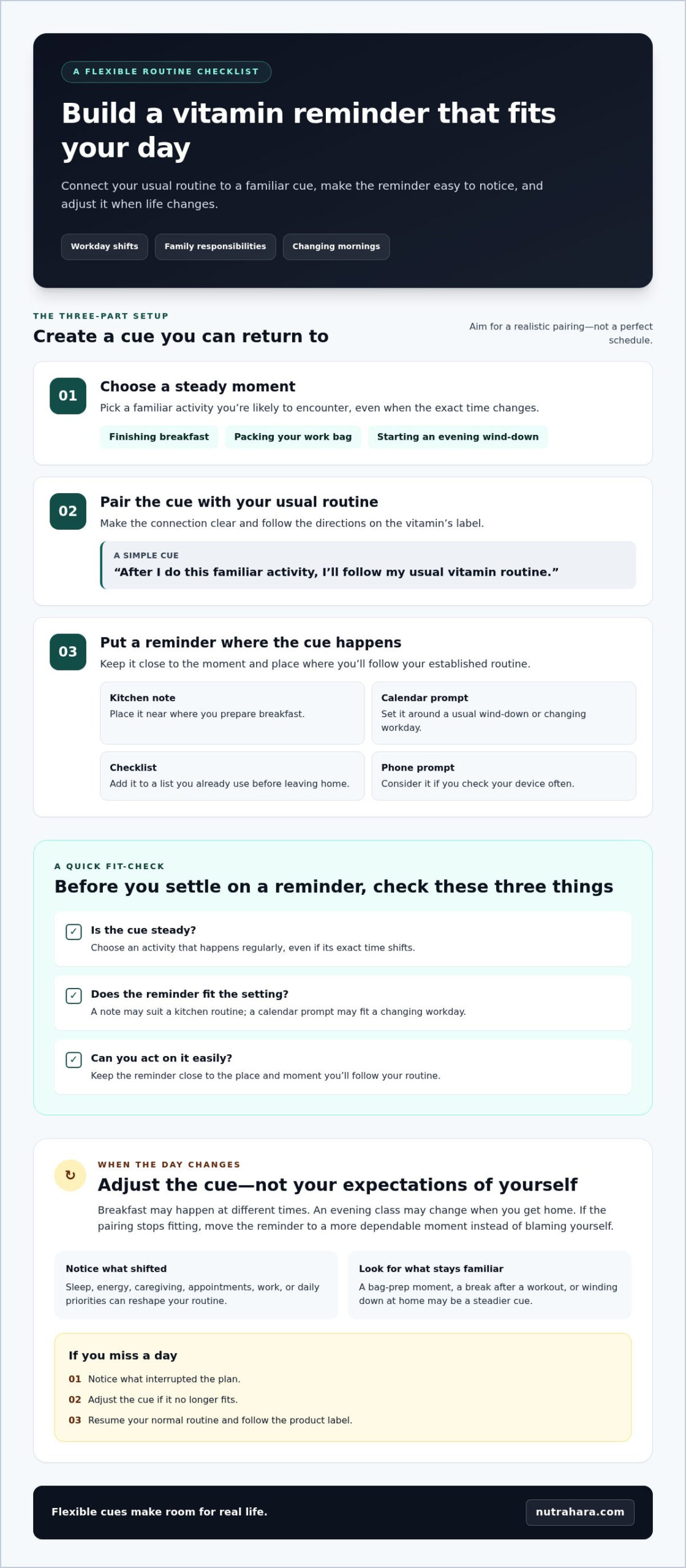
A simple cue can make a new routine easier to recall. Instead of asking yourself to remember at an arbitrary point in the day, connect the action to something you already do. Your cue might be breakfast, packing your work bag, or beginning your evening wind-down. Choose a moment that fits your actual schedule and the directions on the vitamin’s label.

Try a three-step approach: choose a stable cue, pair the routine with it, then review whether the pairing works. Give yourself room to adjust. If your mornings vary, an evening routine or another dependable moment may be a better fit. These tips for remembering to take vitamins are prompts to experiment, not rules you have to follow perfectly.

Use habit stacking to create a reliable cue

Habit stacking means pairing a new action with an everyday routine that’s already familiar. For example, you could use finishing breakfast or getting ready for the day as a prompt to follow your vitamin routine, as long as the cue fits the label directions. These examples describe a reminder strategy, not advice about when or how much to take. For individuals wanting deeper insight into their nutritional and metabolic requirements when planning a regimen, testing options from spectrum-sciences.net can help identify personal wellness needs.

Choose a cue you’re likely to encounter even on a busy day. If breakfast happens at different times, preparing your work bag might be more dependable. If evenings are calmer, your wind-down routine could be a better anchor. Keep the pairing clear: After I do this familiar activity, I’ll follow my usual vitamin routine.

Make the reminder visible and easy to act on

A reminder works best when it appears where the cue happens. Put a note near the place where you prepare breakfast, add a calendar prompt around your usual wind-down, or include the routine on a checklist you already use before leaving home. A cue that’s out of sight or buried among unrelated alerts is easy to miss.

To choose a reminder that works in practice, ask yourself:

  • Is the cue steady? Pick an activity that happens regularly, even if the exact time shifts.
  • Does the reminder fit the setting? A note may suit a kitchen routine, while a calendar prompt may work better around a changing workday.
  • Can I act on it easily? Keep the reminder close to the moment and place where you’ll follow your established routine.

After trying the pairing, notice what gets in the way. Maybe you don’t eat breakfast at home, or an evening class changes when you arrive. Move the cue rather than blaming yourself. A short note about what worked can help you choose a more realistic prompt next time.

If you’re exploring women’s wellness supplements, Nutrahara’s nutrition is manufactured in New Zealand, with formulations that combine principles of Ayurvedic science and modern nutrition research. You can explore its vitamin B complex supplement while keeping your reminder routine personal and flexible.

Which vitamin reminder works best: alarms, calendars, or visual cues?

The best reminder isn’t necessarily the most sophisticated. It’s the one you notice at the right moment and can keep using without adding stress. A phone prompt may suit you if you check your device often; a note may work better if you respond to what you see around you. Match the tool to your day, then adjust it if your schedule changes.

Phone alarm
Context: You usually have your phone nearby when you plan to follow your routine. Convenience: It’s quick to set and easy to move. Possible friction: You may dismiss it or lose it among other alerts.

Calendar prompt
Context: Your routine fits a planned point in the day, or you already rely on a calendar. Convenience: You can shift the prompt when appointments change. Possible friction: It may be easy to overlook if you don’t check your calendar regularly.

Visible cue
Context: You notice objects and notes in the place where your routine happens. Convenience: It’s a simple, at-a-glance reminder. Possible friction: A note can blend into its surroundings or get moved.

Written checklist
Context: You already use a list to organize your morning, evening, or workout preparation. Convenience: It makes the routine easy to mark as complete. Possible friction: It only helps if you look at the list.

When a phone alarm or calendar reminder may help

Digital prompts can be useful if checking your phone or calendar is already part of your day. Choose a clear label and a realistic time that fits the product’s directions. If a meeting, school run, or workout shifts your schedule, move the prompt to a more workable moment rather than letting it become background noise.

When a visual cue or portable reminder may fit better

A written note or checklist can be a natural fit if you respond to your surroundings. Place it where you’ll see it as part of your usual routine. For days away from home, plan a portable reminder, such as a checklist on your phone or a note in your bag, and follow the label directions for the supplement you’ve chosen.

If you already take a vitamin B complex, you might use a calendar alert at home and a checklist when travelling. This is an example of choosing a reminder, not a recommendation that this supplement is right for everyone.

Try one tool first. If you keep missing its prompt, work out why: perhaps you silence alarms, skip calendar checks, or don’t see the note. Then choose a different cue. These tips for remembering to take vitamins are most useful when they fit your real routine, including days away from home.
Tips for Remembering to Take Vitamins: Build a Routine That Lasts

How to build a simple vitamin reminder plan for busy days

A reminder plan should be simple enough to keep using when work runs late, a workout moves, or home life needs your attention. Start with one cue for an ordinary day and one backup for times your usual routine is disrupted. A clear fallback is easier to return to than a string of alarms competing for your attention.

  1. Choose one main cue. Pick a regular moment that fits the label directions, such as a familiar part of your morning or evening routine.
  2. Set one reminder. Use a phone prompt, calendar entry, note, or checklist that you’ll notice at that moment.
  3. Prepare one backup. Decide what will prompt you if the usual cue isn’t available, such as a calendar reminder on a travel day or a checklist for a changed schedule.

Create a routine that can adapt to changing schedules

Test the plan against the week you really have, not an ideal version of it. If you exercise before work, consider whether your routine still fits on early workout days. If caregiving or changing shifts make mornings unpredictable, an evening cue may be steadier. For travel, decide in advance which portable reminder you’ll use while away from home.

Keep the system light. One main cue and one backup are often easier to remember than several prompts scattered through the day. If the routine becomes another source of pressure, simplify it. During a weekly review, ask: Did I notice the cue? Was it easy to act on? Did a particular day disrupt it? Keep what works and change only the part that doesn’t.

Reset gently after you forget

A missed day doesn’t require a new system or a perfect restart. Return to your next planned routine and follow the directions on the product label. Don’t add extra reminders as a form of punishment or change the serving instructions to compensate. If you’re unsure what to do after missing a dose, follow the product’s guidance or seek advice from an appropriate health professional.

Use the interruption as feedback. Perhaps the reminder arrived while you were commuting, or your usual cue shifted because of family responsibilities. Move the cue to a more realistic moment, then continue. Consistency grows from a plan that can bend and resume, not from expecting yourself never to have a busy day.

For a thoughtful, personal approach to wellness, you can explore Nutrahara’s women’s wellness supplements. Nutrahara’s nutrition is manufactured in New Zealand.

Make remembering vitamins part of a supportive wellness ritual

A reminder can support your wellbeing without becoming a measure of your willpower. Let it fit alongside practices that already feel meaningful, such as movement, rest, or a quiet pause. For broader inspiration on pairing daily habits with supportive health, fitness, and recovery products, platforms such as Weightloss and Wellness offer helpful ideas. Your routine can be personal and flexible, shaped by the season of life you’re in rather than an idealized schedule.

Keep wellness practices encouraging, not all-or-nothing

Choose a small ritual that feels welcoming. You might unroll your yoga mat, take a few quiet breaths before meditation, or prepare for a workout. If it fits the product’s directions, that familiar moment can help cue your usual routine. Keep the ritual simple enough to adapt on full days. Returning after an interruption is part of caring for yourself, not a reason to judge your progress.

Explore supplement information at your own pace

If you’re considering women’s wellness supplements, take time to explore the information and decide what aligns with your approach. Nutrahara’s nutrition is manufactured in New Zealand, and its formulations combine Ayurvedic principles with modern nutrition research. The brand describes its products as clean and simple, without artificial additives. These details can inform your exploration, but they aren’t a promise of a particular outcome.

Choose a practice that helps you feel supported, and let it evolve as your life does. To explore options, visit Nutrahara’s women’s wellness supplements at your own pace. One gentle, realistic step is enough to begin.

Let your routine grow with you

Your wellness routine doesn’t have to look the same in every season of life. Work, family, movement, and rest all shift, and your reminder can shift with them. Choose one small cue to begin with, then adapt it as your days change. Flexibility is part of building a practice you can return to, not a sign that you’ve failed.

The most useful tips for remembering to take vitamins are the ones that help you feel supported, not judged. Let your routine sit alongside the ways you already care for yourself, whether that means a quiet pause, time on your yoga mat, or getting ready for a workout. Progress can be gentle and still be meaningful.

If you’re exploring women’s wellness supplements as part of your personal approach, explore women’s wellness supplements and find information about Nutrahara’s products. Keep choosing what feels thoughtful and sustainable for you. Your routine can begin with one small step today.

Frequently Asked Questions

What should I do if I forget to take my vitamins one day?

Return to your usual routine and follow the product label. One missed reminder doesn’t erase the effort you’ve already made. Don’t take extra or change the directions to compensate. If you’re unsure what the label says about a missed dose, follow its instructions rather than guessing. You can also note what interrupted your routine, such as an early appointment, and adjust your reminder if that would make it easier to notice next time.

Should I set a reminder to take vitamins in the morning or at night?

Choose the time that fits your day and the product’s label directions. A morning prompt may suit you if you have a steady start, while an evening cue might fit better if mornings are rushed. Try attaching the reminder to an activity you already do at that time. If you repeatedly miss it, move the cue to a more reliable moment instead of assuming one time works best for everyone.

Can I use a pill organizer to remember my vitamins?

Yes, a pill organizer can be a useful visual planning aid if it suits your routine and the product directions. For example, checking it as part of an existing morning checklist may help you see whether you’ve completed that step. An organizer is optional, not a requirement for building a reminder. Choose an approach that feels practical for the products you use, and follow their labels.

How can I remember vitamins when I travel or work irregular hours?

Choose a reminder that can move with you, such as a phone calendar prompt or a brief note in a travel checklist. If your work hours vary, connect the cue to an activity that stays familiar across locations, like preparing for a shift or settling in after exercise. Planning an alternative for travel days can keep your routine flexible. Keep the timing and use aligned with the product directions.

Do I need to take vitamins with food to remember them?

No, food doesn’t have to be your reminder cue unless the product’s directions call for taking it with food. A regular meal can still act as a useful prompt when it fits the label. For instance, you might place a calendar notification near your usual lunch break, then follow the product’s instructions. Keep the memory strategy separate from assumptions about food, absorption, or how a supplement works.

How long does it take to build a habit of taking vitamins?

There isn’t one fixed timeline that applies to every person or routine. Your schedule, the strength of the cue, and changes in daily life can all affect how familiar the habit feels. Start with a repeatable reminder and check whether it works in practice. If it doesn’t, adjust it. These tips for remembering to take vitamins are about creating a routine you can resume, including after a missed day.

Article by

Nutrahara Team

We are a dedicated collective of nutrition scientists and naturopaths at Nutrahara, committed to advancing women's health through the fusion of ancient Ayurveda science and cutting-edge nutrition research. Our mission is to empower you with clean, simple, and scientifically validated wellness solutions so you can live your healthiest life. Connect with us to stay updated on the latest developments in holistic women's health and nature-based research.

Disclaimer

This article is not a substitute for medical advice. Please consult a healthcare professional before starting any supplement, especially if pregnant, nursing, taking medication, or managing health conditions.

Categories
Articles

What Happens When You Stop Taking Multivitamins? What to Expect

What if stopping your multivitamin doesn’t make you feel different at all? It’s natural to wonder what happens when you stop taking multivitamins, especially if you’ve used one for years or your needs are changing through menstruation, pregnancy, breastfeeding, perimenopause, or menopause. In most cases, stopping a routine multivitamin doesn’t cause a withdrawal reaction. It does mean you’re no longer getting the nutrients it supplied.

Whether you notice a change depends on your usual diet, nutrient status, and reason for taking it. Your meals may already provide the nutrients in the supplement, while a diagnosed deficiency or specific need could make stopping more consequential. You don’t need to assume you’ll suddenly develop a deficiency, and not everyone needs to taper.

This guide explains what may change, why people’s experiences differ, and how to review a multivitamin alongside your diet and life stage. You’ll also learn when it may be helpful to discuss your needs with a healthcare professional, so your next step is informed and calm rather than driven by conflicting claims or guesswork.

Key Takeaways

  • What happens when you stop taking multivitamins depends on why you took one, your diet, and your nutrient status, not on a single predictable response.
  • Stopping changes the nutrients you get from the supplement; it doesn’t automatically cause withdrawal or an energy crash.
  • Review why you started the multivitamin, what your meals provide, and whether you’ve noticed changes since stopping.
  • Your nutrient needs may shift with menstruation, pregnancy, breastfeeding, perimenopause, or postmenopause. Reassess your circumstances rather than assuming one approach fits all.
  • If you’re concerned about a specific nutrient gap or symptoms, discuss whether an individualized assessment is appropriate.

What happens when you stop taking multivitamins?

What happens depends on why you took the multivitamin and what else contributes to your nutrient intake. If you started taking one to fill a dietary gap, stopping removes that supplement as a source of those nutrients. If your meals and other supplements provide them, the change to your overall intake may be small. If it was part of a plan to address a diagnosed deficiency or a particular life-stage need, give that original reason careful consideration. The answer to “what happens when you stop taking multivitamins” is personal, not automatic.

In brief: stopping a multivitamin removes its contribution to your nutrient intake. What you notice depends on the rest of your diet and your individual needs. Missing one dose is different from stopping for the long term. One missed day doesn’t erase the nutrients you’ve eaten or establish that your nutrient status has changed. A sustained break means the supplement no longer contributes to your regular intake.

Does stopping a multivitamin cause withdrawal?

A routine multivitamin isn’t generally expected to cause a universal withdrawal syndrome when you stop taking it. Feeling tired, foggy, or different after a pause doesn’t prove that withdrawal is the cause. These symptoms can have many explanations, and a multivitamin alone can’t identify them. Formulas vary, so check your own label to see what your supplement provided. The Multivitamin overview describes the category broadly, but the product label is more useful for understanding your specific formula.

It’s also important to distinguish an ordinary multivitamin from supplements with different ingredients or purposes, and from prescribed treatments. They aren’t interchangeable, so the experience of stopping one type shouldn’t be assumed to apply to another. If your multivitamin was recommended as part of care for a specific need, consider that reason before deciding what to do next.

What changes first when a daily supplement stops?

The immediate change is straightforward: the supplement no longer contributes nutrients to your intake. That doesn’t mean your body has suddenly lost every nutrient in the formula. Foods, fortified foods, and other supplements may still supply some or all of them. For example, if the multivitamin provided a nutrient you also get from fortified foods or a varied diet, those sources remain after you stop taking it.

There isn’t one timeline for noticing an effect, and feeling no difference doesn’t prove that stopping is right for everyone. Instead, note what you stopped, why you started, and whether anything else in your routine changed. If you’re unsure what the supplement contained, read the label rather than guessing. This gives you a practical starting point for reviewing your decision without treating one missed dose or a nonspecific symptom as a verdict.

How diet and nutrient status shape the effects of stopping a multivitamin

A multivitamin is one source of nutrients, not a complete picture of your nutrient status. Your usual meals, fortified foods, other supplements, digestion and absorption, and any existing deficiency all shape what your body receives. That’s why what happens when you stop taking multivitamins can’t be predicted from the supplement alone. The same change can affect two people differently because their diets, health circumstances, and starting nutrient levels differ.

Why diet and existing nutrient levels matter

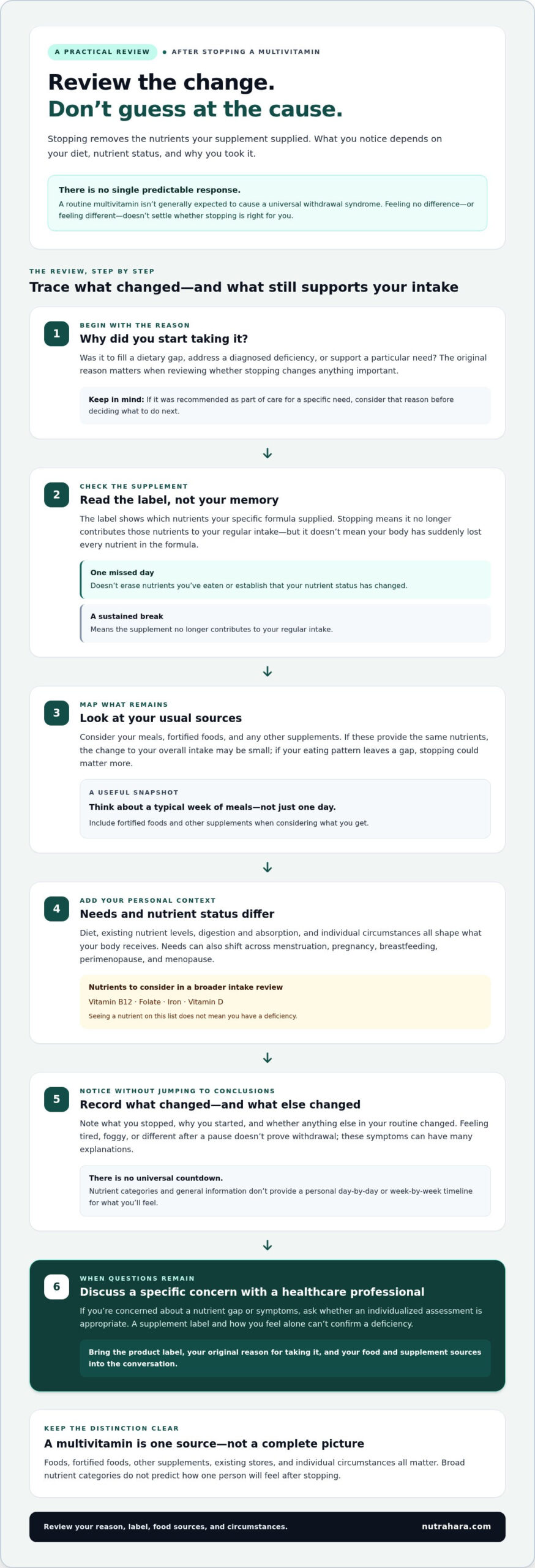
If your regular diet supplies the nutrients in your multivitamin, stopping it may make little difference to your overall intake. If your eating pattern leaves a particular gap, removing the supplement could matter more. Vitamin B12, folate, iron, and vitamin D may be worth considering as part of a broader intake review, but their presence on this list doesn’t mean you have a deficiency.

A multivitamin label tells you what the product contains, not whether you personally need those nutrients or have absorbed enough. Health factors can affect absorption, and a deficiency can’t be confirmed just by looking at your supplement routine or how you feel. Johns Hopkins Medicine offers a broader discussion in its review of multivitamin benefits.

For a practical snapshot, think about a typical week of meals rather than judging your diet from one day. Include fortified foods and any other supplements in your review. This can help you identify questions to discuss with a healthcare professional, particularly if you started taking a multivitamin for a specific reason.

Why nutrient categories don’t create a predictable timeline

Nutrients are handled differently by the body. Water-soluble vitamins, such as vitamin C and many B vitamins, generally aren’t stored in the same way as fat-soluble vitamins A, D, E, and K, which can be stored in the body. But these broad categories don’t provide a personal countdown for what you’ll feel after stopping a multivitamin.

A multivitamin contains a combination of nutrients, and your intake from food, existing stores, and individual circumstances all matter. Information about stopping a single nutrient or a different kind of supplement can’t automatically be applied to multivitamins. There’s no reliable day-by-day or week-by-week schedule that fits everyone. A change in energy or mood on its own doesn’t identify the cause.

Keep your review straightforward: check the multivitamin label, consider what you eat and any other supplements, and remember why you began taking it. If you’re exploring women’s health supplements as part of that review, you can browse Nutrahara’s women’s health supplements. Use this as one resource, without assuming a supplement is necessary or a substitute for individualized advice.

Multivitamin withdrawal: what is known and what is not

The word “withdrawal” can make stopping a routine multivitamin sound like stopping a medicine that causes a predictable reaction. That isn’t an established expectation for standard multivitamins. The clearer distinction is between a change in nutrient intake and symptoms that may have another explanation. The points below separate common claims from what can reasonably be concluded.

Claim: Everyone has an energy crash after stopping. Context: There’s no basis to expect this in everyone. Tiredness has many possible causes.

Claim: Any symptom after stopping is withdrawal. Context: A symptom may have another cause, including the issue that led someone to take a supplement in the first place.

Claim: A multivitamin must be tapered. Context: There’s no established universal taper schedule for routine multivitamins.

Claim: Everyone will notice a change on a set schedule. Context: There’s no exact symptom timeline that applies to every person.

In other words, what happens when you stop taking multivitamins isn’t a guaranteed “crash.” If a symptom you had before taking one seems to return, that may point back to the original reason for supplementation, but it doesn’t confirm the cause. A change in how you feel is worth noticing, not treating as a diagnosis by itself.

Can stopping a multivitamin make you feel tired?

You may feel tired after stopping, but timing alone can’t show that the multivitamin caused the change. Sleep, stress, a demanding exercise routine, illness, diet, and many other factors can affect energy. If you had a nutrient concern identified before starting the supplement, consider that separately rather than assuming fatigue is withdrawal. Persistent or concerning tiredness is worth discussing with a healthcare professional.

Do you need to taper off a multivitamin?

There’s no established universal taper schedule for routine multivitamins, so an exact step-down plan shouldn’t be treated as necessary for everyone. This applies to ordinary multivitamins, not every product sold as a supplement. Products with different ingredients or purposes may have different considerations. If a clinician recommended your multivitamin for a specific reason, ask them for individualized guidance before changing that plan.

For perspective, briefly note when you stopped and any changes you’ve noticed, along with other shifts in your routine. This can help you describe the situation clearly if you seek advice. Avoid attributing every fluctuation in mood or energy to the supplement, and don’t follow a precise timeline or taper schedule unless it’s appropriate to your circumstances.

What Happens When You Stop Taking Multivitamins? What to Expect

How women can reassess a multivitamin after stopping

Use a calm, practical review rather than guessing from one day’s energy or mood. To make sense of what happens when you stop taking multivitamins, trace your original reason for taking one, consider what you get from food and other supplements, and note any meaningful changes. This isn’t about judging your routine. It’s a way to make your next choice with more confidence.

  1. Recall why you started. Was the multivitamin a general wellness habit, or was it recommended for a specific concern?
  2. Review your usual intake. Consider the range of foods you eat, fortified foods, and other supplements, rather than focusing on a single meal.
  3. Note relevant changes. Write down when you stopped and any symptoms or routine changes you’ve noticed. A note is useful context, not a diagnosis.
  4. Reassess the reason. If a clinician recommended the supplement for an identified need, discuss changes with them before making a new plan.

Questions to ask about your original reason for taking one

Ask yourself: “Was I taking this out of habit, or to address a specific need?” Then consider whether your diet, health, or other supplements have changed since you began. These questions can help you decide whether your original reason still applies, without assuming a multivitamin is essential or unnecessary for everyone. For a broader framework, Nutrahara’s guide, The Ultimate Guide to Women’s Wellness Supplements, can support your reading as you review your options.

Life-stage context without one-size-fits-all advice

Nutrition questions can shift through menstruation, pregnancy, lactation, perimenopause, and postmenopause. Those stages don’t create identical needs for every woman; personal health, diet, and any clinician-identified concern matter too. If you’re pregnant, breastfeeding, experiencing a change in your menstrual cycle, or moving through menopause, consider that context when reviewing why you started the supplement. If you’re taking it for a specific need or on a clinician’s advice, discuss any change with the clinician who advised you.

Support your overall wellbeing with steady, nourishing routines. A varied, balanced eating pattern, regular movement that suits your body, and practices such as yoga or meditation can help make space for physical and mental wellbeing. These are valuable parts of a healthy lifestyle, but they don’t replace a supplement recommended for a specific reason or confirm whether you’re meeting a particular nutrient need.

If you’d like to explore women’s wellness supplements as part of your ongoing review, explore Nutrahara’s women’s health supplements. Let what you’ve learned about your own routine guide the decision, rather than feeling pressured to add or restart a multivitamin.

A thoughtful next step after stopping a multivitamin

Stopping changes what you get from the supplement, but its personal effects depend on why you used it, your usual diet, and any identified nutrient need. A useful next step is a calm review, not an automatic restart. To understand what happens when you stop taking multivitamins, revisit your original reason and consider what has changed in your life and routine since then.

  1. Recall the reason. Was it a general wellness habit, or did a clinician recommend it for a specific concern?
  2. Review your intake. Consider your usual meals, fortified foods, and any other supplements together.
  3. Notice changes. Keep a simple note of changes in energy or wellbeing, along with shifts in sleep, stress, activity, or diet. A pattern is useful context, but it doesn’t prove a cause.
  4. Choose a next step. If there’s an identified need or the supplement was recommended for a particular reason, discuss whether your plan should change.

When to pause and seek individualized guidance

If you’ve been diagnosed with a deficiency or a clinician recommended supplementation for a specific reason, get individualized guidance before changing that plan. This can also matter during pregnancy or lactation, when nutrition questions may be specific to your circumstances. You don’t need to assume harm or diagnose yourself. Bring the supplement label and your questions to the clinician who advised you.

Build a sustainable wellness routine beyond supplements

Nutrition and wellbeing are shaped by everyday patterns, not one perfect meal or workout. Choose nourishing meals that fit your life, and make movement regular and realistic, such as a walk or a fitness session you enjoy. Yoga can bring mindful movement into your routine, while meditation offers a moment to pause and check in with yourself. These habits support general wellbeing, but they don’t replace advice for a specific nutrient need.

To make your notes useful, record a change alongside its context: for example, whether your sleep, meals, stress, menstrual cycle, or exercise routine also shifted. Look for patterns without assuming the multivitamin caused them. This gentle approach can help you have a clearer conversation with a clinician if questions persist, without the pressure to interpret every fluctuation.

Wellness is a continuing process of noticing, learning, and making choices that suit you. Nutrahara combines Ayurvedic principles with modern nutritional research, and its nutrition is made in New Zealand. If you’d like to explore this nature-informed approach as you reflect on your wellness routine, discover Nutrahara’s approach to women’s wellness. Your next step can be thoughtful and gradual, guided by your own needs rather than alarm or guesswork.

Let your next wellness choice fit your life

Your supplement routine doesn’t have to be permanent to be worthwhile. It can change as your meals, priorities, and life stage change. Rather than looking for a perfect rule, give yourself permission to make a considered choice, notice how you feel, and revisit it when your circumstances shift.

The question of what happens when you stop taking multivitamins can be a starting point for a more personal approach to wellbeing. Let curiosity guide you: notice what supports your energy and daily life, and seek tailored advice when you have a specific nutrition concern. Small, thoughtful decisions can build trust in your own judgment over time.

If you’re ready to explore a nature-informed approach to women’s wellness, explore Nutrahara’s women’s wellness supplements.

Frequently Asked Questions

Is it safe to stop taking a multivitamin suddenly?

Stopping a routine multivitamin suddenly isn’t generally expected to cause a universal withdrawal reaction. Before deciding, consider why you began taking it and whether it was part of a care plan. If a clinician recommended it for a diagnosed deficiency or another specific concern, discuss a change with them. Having the product label handy can help you explain exactly what you’ve been taking.

Can stopping a multivitamin cause fatigue?

Fatigue can’t be confidently attributed to stopping a multivitamin alone. Consider other recent changes, such as sleep, stress, illness, menstrual patterns, or exercise. If you’re concerned, note when the tiredness began and what else changed, then discuss the pattern with a healthcare professional if it persists. Symptoms alone can’t establish whether a particular nutrient is low.

How long after stopping a multivitamin might you notice a difference?

There’s no single timeline that applies to everyone. Your food choices, the supplement’s ingredients, and your individual circumstances all matter. Some people notice no clear difference; others may need to revisit the reason they began taking it. Rather than relying on a specific day or week, keep a brief record of changes and consider other factors that could affect how you feel.

Do you need to taper off multivitamins?

A universal taper schedule for routine multivitamins isn’t established. Don’t assume guidance about a supplement with different ingredients or a distinct purpose applies to your multivitamin. Check the label to understand the formula, especially if it includes ingredients beyond vitamins and minerals. If it was recommended for a specific health concern, get advice from the clinician who recommended it before changing your plan.

What happens if you miss a multivitamin for a week?

Missing a week doesn’t automatically mean you’ll feel different or develop a deficiency. Consider your usual diet and the reason the supplement is part of your routine. Don’t take extra doses to compensate unless the product directions or your clinician specifically advise it. If you take it for an identified concern, use the missed doses as a reminder to revisit your plan rather than making assumptions.

Should women stop taking multivitamins during pregnancy or breastfeeding?

There isn’t one answer for every pregnant or breastfeeding woman. Individual circumstances and existing care plans matter, so don’t base your decision only on another person’s experience. Bring the product label and a list of other supplements you use to the clinician supporting your pregnancy or postpartum care. That helps keep the discussion focused on the specific formula and your needs.

Can food replace a multivitamin after you stop taking one?

Food can provide many nutrients, but whether your usual eating pattern meets your needs depends on your choices and health circumstances. To prepare for a useful review, jot down the foods and fortified products you typically have over several days. This isn’t a diagnosis, but it can help you discuss your intake with a healthcare professional, particularly if you have a known deficiency or a specific concern.

Article by

Nutrahara Team

We are a dedicated collective of nutrition scientists and naturopaths at Nutrahara, committed to advancing women's health through the fusion of ancient Ayurveda science and cutting-edge nutrition research. Our mission is to empower you with clean, simple, and scientifically validated wellness solutions so you can live your healthiest life. Connect with us to stay updated on the latest developments in holistic women's health and nature-based research.

Disclaimer

This article is not a substitute for medical advice. Please consult a healthcare professional before starting any supplement, especially if pregnant, nursing, taking medication, or managing health conditions.

Categories
Articles

Are Expensive Vitamins Really Better? How to Compare Quality and Value

What if a higher price reflects polished packaging rather than a better formula? It’s reasonable to ask: are expensive vitamins really better, or does the price simply add to the promise? When labels list unfamiliar ingredient forms, amounts, and claims, comparing bottles can feel harder than it should.

Your needs matter, too. A supplement that may suit you during menstruation may not be the right choice during pregnancy or lactation, or through pre-menopause and post-menopause. The best fit depends on your health needs and the formula, not just the number on the shelf.

This guide gives you a practical way to compare value. You’ll learn what price can and can’t tell you, which label details and evidence to consider, and how to weigh ingredient quality against personal fit. With a calmer, more informed approach, you can make a choice that supports your wellness routine without feeling pressured by premium pricing or persuasive marketing.

Key Takeaways

  • Are expensive vitamins really better? Price alone can’t tell you whether a supplement offers better quality or a better fit.
  • Compare products designed for the same purpose, including ingredient identity, amount per serving, and serving instructions.
  • Distinguish research on an individual ingredient from evidence about a finished product or a specific promised outcome.
  • Use your health goal, diet, life stage, activity, and existing health guidance to narrow your choices.
  • Explore how Nutrahara brings Ayurvedic principles and modern nutritional research together in women’s health supplements made with natural, clean ingredients.

Are Expensive Vitamins Really Better, or Does Price Tell Only Part of the Story?

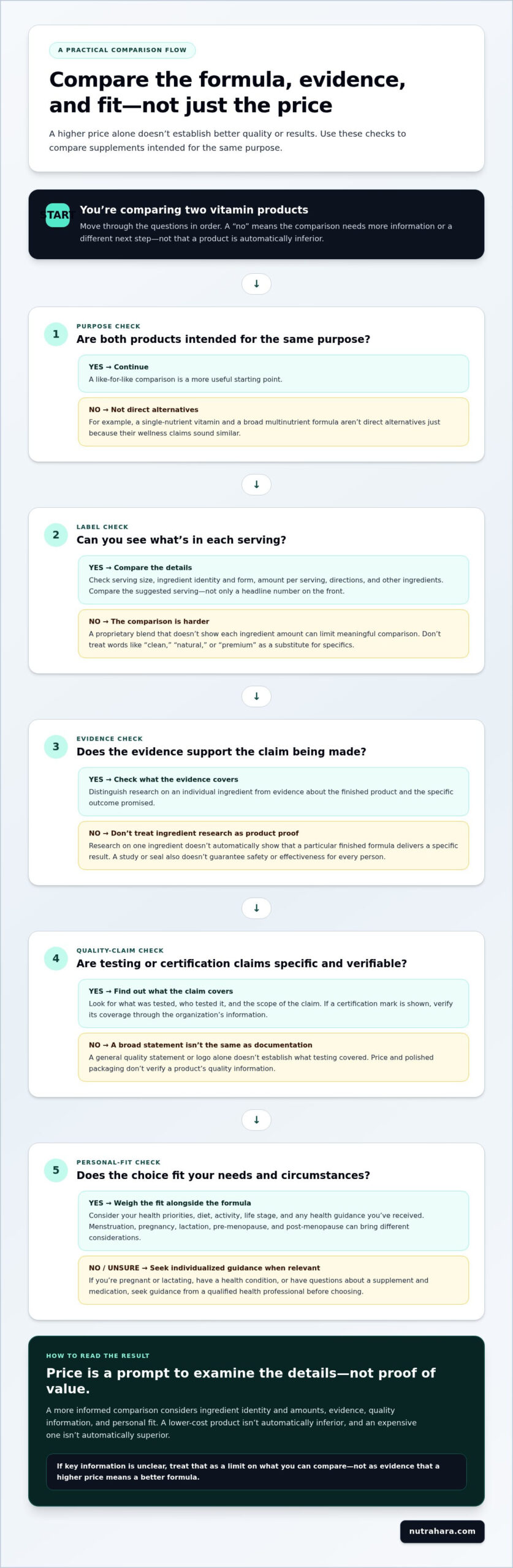
A higher price alone doesn’t establish better quality or results. If you’re asking, “are expensive vitamins really better,” price is only one piece of the picture. A supplement’s value depends on whether its ingredients are relevant to your needs, provided in clearly stated amounts, supported by evidence, backed by meaningful quality information, and suited to your circumstances.

Price and value aren’t interchangeable. A lower-cost product isn’t automatically inferior, just as an expensive one isn’t automatically superior. Before comparing formulas, it can help to revisit What are Vitamins? and the essential roles these nutrients play. Then look for label details and supporting information that give you a clear basis for comparison.

Price alone can’t prove a vitamin is better; value comes from the formula, evidence, quality information, and fit for the person taking it.

What might a higher supplement price reflect?

A higher price may reflect ingredient sourcing, formulation choices, manufacturing processes, testing, packaging, or brand positioning. Some of these factors could matter to quality, but the price tag doesn’t verify that they’re present or meaningful. Clear information about the formula is more useful than an elevated price or a broad word such as “premium.”

Separate the formula from its presentation. Ingredient forms, amounts, and a thoughtfully designed combination may be relevant to how a supplement suits a particular need. A polished bottle, elaborate branding, or persuasive promotional language can make a product feel more valuable without showing that its contents are better. Treat price as a prompt to examine the details, not as proof of them.

Why the right choice can differ by life stage

Women’s needs and supplement considerations can change over time. Menstruation, pregnancy, and lactation each bring different considerations, while pre-menopause and post-menopause may shape what you’re looking for in your broader wellness routine. These stages don’t mean that every woman needs a supplement, or that the most expensive formula is the most suitable.

Start with your own context. Consider your diet, activity, health priorities, and any guidance you’ve received. If you’re pregnant or lactating, have a health condition, or have questions about how a supplement may relate to medication, seek individualized guidance from a qualified health professional before choosing. A clear, personal reason for taking a supplement is a stronger starting point than price or marketing pressure.

What Actually Influences Vitamin Quality, Safety, and Potential Value?

To judge a supplement, look past the front-of-bottle promise and examine what’s in each serving. Ingredient identity tells you which nutrient or form is included. The amount per serving helps you understand how much you’d take, while a transparent formula makes products easier to compare and ingredients easier to assess. These details offer a more useful starting point than a premium label or a claim that a formula is “complete.”

Make sure the evidence matches the claim. Research on an individual ingredient may help explain what has been studied, but it doesn’t automatically prove that a particular finished product delivers a specific outcome. Evidence about an ingredient is not proof that a specific supplement, in its finished formula, produces a promised result. That distinction matters whether you’re considering a product for everyday wellness, exercise recovery, or a concern related to women’s health.

How to read a supplement label beyond the front-of-bottle claims

Start with the Supplement Facts panel. Check the serving size, listed ingredients, ingredient forms, and amounts. Compare the amount in the suggested serving, not just a headline number on the front. Then read the directions and other ingredients so you understand what taking the product as labeled involves.

A proprietary blend that lists several ingredients without showing each amount can make meaningful comparison harder. Words such as “natural,” “clean,” or “premium” may describe a brand’s positioning, but they don’t tell you exactly what’s in the formula or establish its quality. Look for specific, understandable label information rather than relying on a wellness phrase alone.

What testing and evidence can, and cannot, tell you

A general statement about quality is not the same as documented, independent testing of a finished product. If a brand refers to testing or a certification, look for clear information about what was tested, by whom, and what the claim covers. USP and NSF International are examples of organizations whose marks consumers may encounter. A logo alone doesn’t establish what a particular product’s testing covered, so verify the claim through the organization’s information.

The FDA explains that dietary supplements are regulated differently from drugs, and manufacturers are responsible for ensuring their products meet applicable requirements. Its overview of FDA Regulation of Dietary Supplements can help clarify the agency’s role. Neither a seal nor a study of one ingredient guarantees safety or effectiveness for every person. If you’re comparing options and want a women’s health supplement approach informed by Ayurvedic principles and modern nutritional research, learn about Nutrahara.

How to Compare Expensive and Affordable Vitamins Side by Side

For a fair comparison, start with products intended for the same purpose. A single-nutrient vitamin and a broad multinutrient formula aren’t direct alternatives, even if both bottles make similar wellness claims. Compare each label against the need you’re considering, then focus on differences that could affect usefulness, clarity, or your daily routine.

Use this worksheet to compare details from the label and any documentation you can verify, rather than relying on front-of-bottle language.

What to compare Questions to ask
Formula Do both products contain the ingredient or nutrient relevant to your goal?
Amount Are the amounts listed clearly, and are you comparing the same serving basis?
Evidence Does the information relate to an ingredient, the finished product, or a specific outcome?
Quality documentation Are testing or sourcing statements specific and verifiable, or only broad marketing claims?
Serving instructions How many capsules, tablets, or other units make up a serving, and how often is it directed?
Total daily use What does the full recommended daily routine involve, including any other supplements you take?

A practical checklist for comparing two vitamin labels

First, match the intended ingredient and serving basis. One label may list an amount per capsule while another gives an amount per multi-unit serving, so compare like with like. Next, note whether ingredient names, amounts, and directions are clear. Finally, record documented testing or sourcing details separately from language such as “advanced” or “premium.” If a product uses a proprietary blend without individual amounts, note that it’s harder to compare rather than assuming it’s better or worse.

To compare cost, divide the package price by the number of servings it contains. If the directions call for more than one serving daily, multiply the cost per serving by the number of daily servings to estimate the daily cost. This calculation helps clarify value, but a lower cost per serving isn’t useful if the formula doesn’t suit your needs or the serving instructions don’t fit your routine.

When paying more could make sense, and when it may not

A higher price may be easier to justify when the difference is concrete, relevant to your goal, and supported by clear documentation. In specialized areas such as hair growth, for instance, brands like TRU BLOOM distinguish their value through clinically proven formulas rather than just premium packaging. If two products have similar formulas, amounts, intended use, and quality information, paying more may add little practical value. Ask yourself: what does the extra cost correspond to, and does that difference matter to me?

Personal accounts can show how a supplement fits into someone else’s routine, but an individual experience isn’t proof of a general result. When considering a testimonial, focus on what the person actually describes and whether it reflects your own circumstances. Don’t treat a persuasive story as a substitute for clear label information or relevant evidence. This principle also extends to household pet care, where providers like PetREGEN emphasize science-backed natural formulations for joint health rather than marketing hype. Ultimately, use your comparison to make a considered choice, not to chase the highest price or the most compelling claim.

Are Expensive Vitamins Really Better? How to Compare Quality and Value

How to Choose Vitamins That Fit Your Needs, Life Stage, and Routine

A supplement decision is most useful when it starts with your circumstances, not a trend or a crowded wellness shelf. Age, life stage, diet, exercise habits, and existing health guidance can all shape what’s appropriate. The question “are expensive vitamins really better” matters less once you identify what you need from a product and whether it fits your daily life.

Use this sequence to make a considered choice:

  1. Identify your goal. Clarify whether you’re addressing a specific nutritional concern or exploring general wellness. A broad wish to feel better doesn’t automatically point to a particular supplement.
  2. Review your diet and context. Consider your usual meals, activity level, age, and life stage. Menstruation, pregnancy, lactation, pre-menopause, and post-menopause may bring different considerations, but none means that every woman needs routine supplementation.
  3. Compare labels. Look for products that match your purpose, then compare their listed ingredients, amounts, serving directions, and available information about the formula.
  4. Assess the evidence. Consider whether research relates to an ingredient, a finished product, or the specific outcome being claimed. Keep your expectations aligned with what the evidence actually supports.
  5. Consider your wider health picture. If a supplement appears relevant, think about how it fits with your routine and any guidance you already follow.

Match the supplement decision to your question

There’s a difference between investigating a specific concern and adding a product simply because it promises broad support. Neither a supplement nor a balanced diet alone tells the whole story of health. Aim for nourishing meals and a routine that supports your well-being, then consider a supplement only if it makes sense for your personal context. A broader women’s wellness supplement guide can be a starting point for exploring questions to consider.

Build a thoughtful routine without adding unnecessary products

Before introducing something new, write down the supplements you already take and any relevant health guidance. This inventory can help you notice overlap and prepare focused questions for a qualified healthcare professional. Discuss supplement choices with a professional if you’re pregnant or lactating, take medication, or have a medical condition. Revisit your decision as your health needs or life stage changes.

Keep the rest of your routine steady and supportive. Regular movement, including exercise that suits your body, can sit alongside nutritious meals and restorative sleep. Yoga can make space for mindful movement, while meditation offers a way to pause and settle your attention. These practices can support general well-being, but they don’t replace individualized care or answer every nutritional question.

Choose an option with a clear purpose that feels manageable in your day. Thoughtful selection isn’t about collecting more products; it’s about making choices that reflect your needs. To explore women’s health supplements as part of that process, discover Nutrahara’s approach.

A Thoughtful Approach to Women’s Vitamins: Evidence, Tradition, and Personal Fit

Choosing a women’s health supplement can be part of a considered wellness routine, but it’s still worth weighing each option by the same standards. Nutrahara’s supplements bring Ayurvedic principles together with modern nutritional research and use natural, clean ingredients. This describes the brand’s formulation approach; it doesn’t, by itself, establish that a supplement has proven outcomes or suits every woman.

So, are expensive vitamins really better? The most confident answer comes from looking beyond price and asking whether a product’s ingredients, label information, supporting evidence, and intended use align with your needs. That applies whether you’re comparing supplements during menstruation, pregnancy, lactation, pre-menopause, or post-menopause.

How to assess a supplement through both tradition and research

Traditional principles can offer a perspective on how a formula is conceived, while modern nutritional research provides another lens for evaluating ingredients and claims. One doesn’t replace the other. Consider both in context, and look for clear information about what a supplement contains and what the evidence actually supports. Broad promises aren’t a substitute for transparent labeling or relevant research.

For example, if you’re considering a vitamin B complex supplement, assess it as you would any option: review its label, intended use, and supporting information, then consider whether it fits your personal circumstances. A familiar nutrient name or a traditional philosophy alone can’t tell you whether a particular formula is right for you.

Take a confident next step at your own pace

Before settling on any product, return to a few practical questions: Is it relevant to a need you’ve identified? Is the label clear? Is the evidence appropriate to the product or claim? Are quality statements specific and verifiable? Does it fit your diet, life stage, routine, and existing health guidance? If you’re pregnant or lactating, take medication, or have a health condition, discuss supplement choices with a qualified healthcare professional.

Testimonials can help readers understand another woman’s individual experience, but they aren’t proof of a general result. Your own decision can be quieter and more personal: choose what makes sense for your circumstances, and don’t feel pressured to add a supplement simply because it costs more or carries a persuasive promise.

Nutrahara’s women’s health supplements offer one approach to consider, informed by Ayurvedic principles and modern nutritional research. Take time to review relevant options and apply the same thoughtful criteria to each. Explore Nutrahara’s women’s health supplements.

Make Your Next Supplement Choice With Confidence

Your needs can shift as your health, routines, and priorities change. Give yourself permission to pause before buying: a supplement doesn’t have to be the most expensive, or part of every wellness routine, to be the right choice for you. If you’re still asking, “are expensive vitamins really better,” let the answer rest on fit and clear information rather than pressure or promises.

A useful next step is to write down what you hope a supplement will support and any questions you want to discuss with a qualified healthcare professional. That pause can help turn a crowded shelf into a more personal, considered decision. Wellness is built over time through choices that feel thoughtful and sustainable for your life.

Explore women’s health supplements from Nutrahara and review the options at your own pace: Explore women’s wellness supplements. Trust yourself to make an informed choice, and keep moving forward with care.

Frequently Asked Questions

Are expensive vitamins really better than cheaper ones?

Not necessarily. A higher price doesn’t guarantee a better experience or a formula that suits you. To decide whether expensive vitamins really are better for your situation, compare products intended for the same purpose and look for meaningful differences you can verify. A clearly documented feature may matter to you, while upgraded packaging may not. Choose based on your priorities, not on the assumption that cost predicts results.

Can a low-cost vitamin be as good as a more expensive one?

It can be a reasonable option, but compare the products rather than judging by price alone. Check that they’re intended for the same purpose, then compare the same ingredient forms, amounts per serving, and daily directions. Also consider whether either product has relevant, verifiable quality information. If important details differ or are hard to assess, you may not be comparing equivalent formulas, so avoid drawing a broad conclusion from cost alone.

How can I tell whether a vitamin supplement is high quality?

Look for a label that lets you identify what’s in each serving and how the product is meant to be used. Then check whether claims are supported by evidence relevant to the product, not just appealing language. Specific, verifiable information about quality processes or independent testing can add context. If the only support is a vague promise or an unexplained seal, treat it as incomplete information and keep comparing.

Is a natural vitamin automatically safer or more effective?

No. “Natural” describes how a product is presented, but the word alone doesn’t establish how it was made, how well it works, or whether it’s appropriate for you. A natural ingredient can still be unsuitable in a particular situation, and a label’s wording doesn’t replace evidence or careful review. Consider the full formula and your personal circumstances, and seek professional guidance if you’re unsure about taking it.

Should women take different vitamins at different life stages?

Supplement considerations can vary, but there isn’t one formula every woman needs at a particular age. Menstruation, pregnancy, lactation, and the transition through menopause may lead to different questions about diet and health. Your individual needs matter more than a general life-stage label. If you’re pregnant, lactating, managing a health condition, or uncertain about what’s appropriate, discuss your situation with a qualified healthcare professional.

Can I take several vitamins and supplements together?

That depends on the specific ingredients, amounts, and your health circumstances. Before adding a product, make a list of everything you take, including multivitamins and supplements included in powders or other wellness products. This can help a qualified healthcare professional review possible overlap and answer questions about your routine. Get guidance before combining supplements if you take medication, have a health condition, or are pregnant or lactating.

Do I need a supplement if I eat a balanced diet?

Not necessarily. A balanced diet can provide a foundation for nutrition, but whether a supplement is appropriate depends on your individual circumstances and health needs. Avoid starting one simply because it’s popular or marketed as essential for all women. If you have a specific concern, keep track of what you eat and the questions you have, then discuss them with a qualified healthcare professional before deciding whether a supplement makes sense.

Article by

Nutrahara Team

We are a dedicated collective of nutrition scientists and naturopaths at Nutrahara, committed to advancing women's health through the fusion of ancient Ayurveda science and cutting-edge nutrition research. Our mission is to empower you with clean, simple, and scientifically validated wellness solutions so you can live your healthiest life. Connect with us to stay updated on the latest developments in holistic women's health and nature-based research.

Disclaimer

This article is not a substitute for medical advice. Please consult a healthcare professional before starting any supplement, especially if pregnant, nursing, taking medication, or managing health conditions.
Categories
Articles

Digestive Enzymes for Women: A Guide to Choosing Wisely

What if an enzyme marketed for bloating doesn’t address your particular digestive concern? Digestive enzymes for women can sound like a simple fix, especially when symptoms shift around menstruation, pregnancy, or menopause. It’s understandable to want clear answers, but enzymes act on specific nutrients. A supplement isn’t a universal solution for every digestive symptom.

Knowing the difference can help you make a more informed choice. This guide explains how enzymes help break down food, what evidence can and can’t tell us about over-the-counter supplements, and why new or persistent digestive changes deserve attention. You’ll also find practical points to consider before using a supplement, including during pregnancy or lactation or while taking medication. Everyday habits, from balanced meals to movement and stress-relieving practices such as yoga or meditation, can also support overall wellness. The aim isn’t to chase a quick fix, but to understand your body and choose a next step with confidence.

Key Takeaways

  • Understand how digestive enzymes break down food and why supplements are a separate consideration from the enzymes your body produces.
  • Learn why being a woman or experiencing a life-stage change doesn’t, by itself, establish a need for digestive enzymes for women.
  • Compare the roles of enzyme supplements, everyday food-based habits, and clinician assessment. Enzymes and probiotics are not substitutes for one another.
  • Use a thoughtful decision sequence: define your concern, consider your health context, seek qualified guidance when appropriate, and reassess.
  • Notice symptom patterns, support your routine with movement and stress relief, and seek advice when needed.

What Are Digestive Enzymes, and What Role Do They Play?

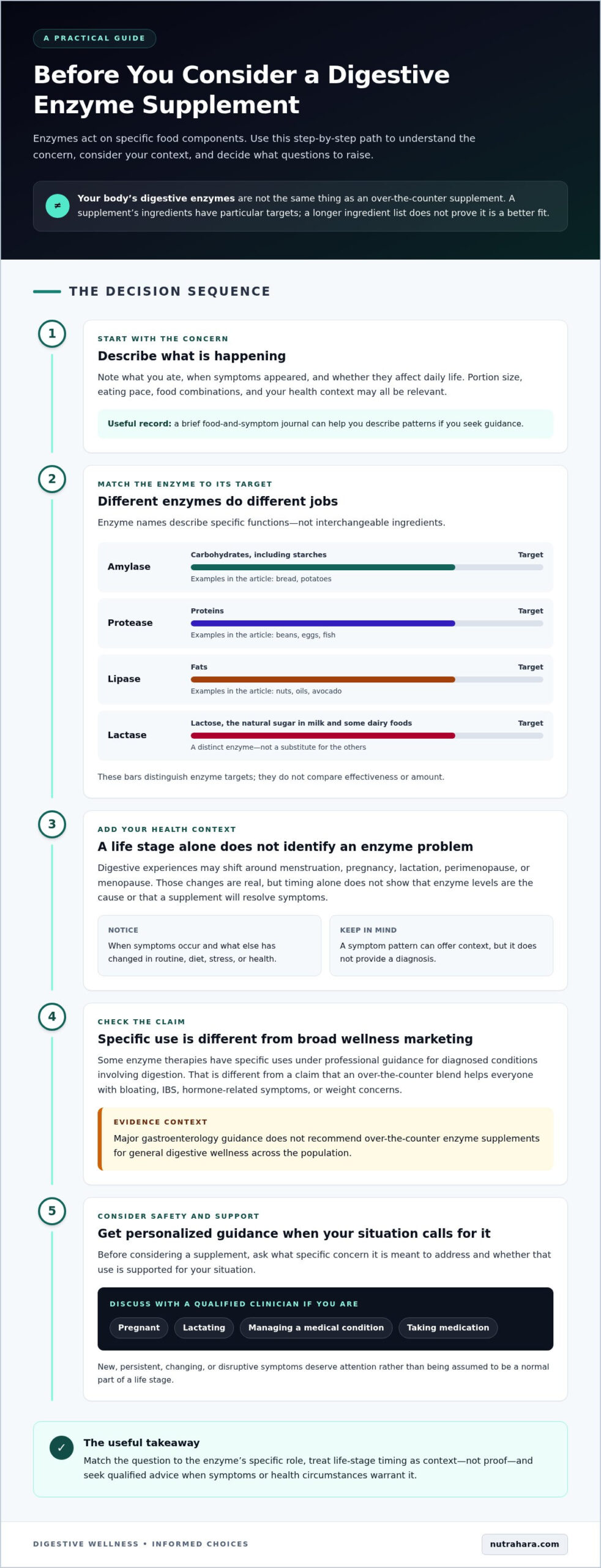
Digestive enzymes are proteins that help break food components into smaller substances the body can absorb. Your body makes them as part of digestion, releasing different enzymes in places such as the mouth, stomach, and small intestine. Enzymes do not work alone: chewing, stomach movement, digestive fluids, and the coordinated activity of the digestive tract all contribute.

This distinction matters if you’re considering digestive enzymes for women. Enzymes your body produces naturally are not the same as enzyme supplements. A supplement may contain particular enzymes for particular food components, but that doesn’t mean everyone needs extra enzymes or that a blend can address every kind of digestive discomfort. The Digestive enzyme overview describes enzyme types and their roles in digestion.

How do enzymes help break down food?

Different enzymes act on different components of food, helping break larger molecules into smaller pieces that can be absorbed through the digestive tract. Digestion is a sequence of coordinated steps, not a single action triggered by one capsule. The body’s enzymes have specific roles in that process, and increasing enzyme activity isn’t automatically the same as improving digestion.

What do amylase, protease, and lipase do?

These names describe different enzyme functions, not interchangeable ingredients. Amylase helps digest carbohydrates, including starches, into smaller sugar units. Protease helps break proteins into smaller peptides and amino acids. Lipase helps break fats into components the body can absorb. Because meals contain a mix of nutrients, digestion involves more than one enzyme acting on a single kind of food.

  • Amylase: Acts on carbohydrates such as starches found in foods like bread or potatoes.
  • Protease: Acts on proteins found in foods such as beans, eggs, and fish.
  • Lipase: Acts on fats present in foods such as nuts, oils, and avocado.

Lactase is another distinct enzyme. It helps digest lactose, the natural sugar in milk and some dairy foods. It isn’t a substitute for amylase, protease, or lipase; each enzyme has a different target.

As a practical first step, note what you ate and when symptoms appeared instead of assuming one enzyme explains them. Portion size, eating pace, food combinations, and your individual health context may all be relevant. A brief food and symptom journal can help you describe patterns if you seek guidance. Knowing the roles of different enzymes also makes it easier to read supplement labels without treating a longer ingredient list as proof that a product is a better fit.

Digestive Enzymes for Women: What Life Stage Can, and Cannot, Tell You

Being a woman, by itself, doesn’t establish a need for enzyme supplements. Enzymes have specific roles in digestion, but a claim that women need extra enzymes because of sex, hormones, or age is a separate claim that needs evidence of its own. Enzymes help break down particular food components; it has not been established that women as a group need over-the-counter enzyme supplements to support digestion.

That distinction can be useful during life changes. Some women notice digestive patterns shift around menstruation, pregnancy, lactation, perimenopause, or menopause. Those experiences are real, but they don’t show that enzyme levels are the cause or that supplements will resolve symptoms. Changes in routine, diet, stress, health conditions, and other factors may also play a role. When symptoms occur can offer context, but it does not provide a diagnosis.

Can hormones or life stages affect digestive experiences?

Hormonal shifts may coincide with changes in bowel habits or digestive comfort, but experiences vary. Pregnancy and postpartum life can bring changes in eating patterns, activity, and daily routines. Menopause can overlap with other changes in health and lifestyle. None of these stages, on its own, identifies an enzyme problem. Note when symptoms occur, what else has changed, and whether they affect your daily life.

If symptoms are new, persistent, or disruptive, discuss them with a qualified clinician instead of assuming they are a normal part of a life stage. This is particularly useful if symptoms are changing or you’re considering a supplement alongside other health needs. Notes on timing, meals, and symptoms can make that conversation more specific.

What does the evidence say about enzyme supplements?

Some enzyme therapies have specific uses under professional guidance for diagnosed conditions involving digestion. That differs from broad wellness marketing that suggests an over-the-counter blend will help everyone with bloating, IBS, hormone-related symptoms, or weight concerns. Major gastroenterology guidance does not recommend over-the-counter enzyme supplements for general digestive wellness across the population. A discussion of Digestive Enzyme Supplements also highlights why claims and evidence deserve careful attention.

Before considering a supplement, ask what specific concern it is meant to address and whether that use is supported for your situation. Take your life stage and health context into account, and seek personalized professional guidance if you’re pregnant, lactating, managing a medical condition, or taking medication. A product being available or labeled for women does not, by itself, show that it is appropriate for you.

Digestive enzymes for women are not a separate need simply because the person considering them is female. The more useful question is whether a specific enzyme has a relevant role in a specific, understood context. Keeping that in mind can help you respond to digestive changes with curiosity and care, without blaming yourself or rushing toward a one-size-fits-all answer.

Digestive Enzymes vs. Other Gut-Health Approaches: Compare the Purpose

Different approaches serve different purposes. A supplement, everyday eating habits, and a clinician’s assessment aren’t competing answers to the same question, and no single option suits every symptom. Use the comparison below to understand what each may contribute and where its limits lie.

Approach Purpose Limit
Enzyme supplements Provide specific enzymes that act on particular food components. They aren’t a universal response to digestive symptoms, and a broad blend may not address the cause of a concern.
Food-based habits Support regular nourishment and help you notice how eating patterns relate to your comfort. Routine changes can’t diagnose or resolve every underlying cause.
Clinician assessment Help evaluate symptoms in the context of your health, medications, and life stage. It takes an individualized look; general online advice can’t replace that assessment.

How are enzymes different from probiotics?

Enzymes help break down food components. Probiotics are live microorganisms. The terms describe different things with different functions, so probiotics aren’t a substitute for enzymes, and enzymes aren’t a substitute for probiotics. Neither category is automatically necessary for every woman. Before choosing a supplement, consider the question you’re trying to answer instead of assuming that products described as supporting “gut health” are interchangeable.

When is a food-first or clinical approach more appropriate?

For a practical starting point, take time for meals and stay hydrated in a way that fits your needs. Notice whether symptoms seem to follow particular foods, meal timing, or changes in your routine. A brief symptom diary can help organize your observations for you and a clinician, but it can’t identify a diagnosis on its own.

Seek qualified evaluation instead of self-treating indefinitely if symptoms persist, feel severe, or concern you. This applies whether you’re menstruating, pregnant, lactating, or going through menopause; life stage alone doesn’t explain every digestive change. Bring notes about what you experience and when to help make the conversation more useful.

Claims about digestive enzymes for women can also blur into claims about weight loss. Enzymes aren’t a weight-loss shortcut, and a supplement should not replace sustainable habits such as balanced meals, movement you enjoy, and restorative practices like yoga or meditation. Choose an approach based on your specific concern, not on a promise that one product can do everything.

How to Consider Digestive Enzyme Supplements Safely

Start with the concern, not the bottle. A supplement may be unnecessary, may not match your symptoms, or may need professional review in light of your health and medications. Use this sequence to make a more deliberate decision:

  • Define the concern: Describe what you’re experiencing, when it happens, and how it affects daily life.
  • Review your context: Consider your life stage, health conditions, medicines, and any other supplements you use.
  • Seek qualified advice: Discuss a possible supplement with a clinician or pharmacist when your circumstances call for personalized guidance.
  • Reassess: If you and a qualified professional decide to try it, follow the label and review whether it remains appropriate.

What should you consider before trying an enzyme supplement?

Before speaking with a clinician or pharmacist, write down your symptoms, when they occur, relevant meals, and any changes in your health or routine. A clear account keeps the discussion focused on your experience rather than a broad product claim. If you’re pregnant or lactating, have a medical condition, or take medication, seek personalized advice before starting a supplement. These factors can affect whether an ingredient is suitable or whether it might interact with your care.

Read the full ingredient label, including other active and inactive ingredients, and follow the product directions. “Natural” doesn’t mean risk-free, and a label can’t establish that a product is right for you. In the United States, dietary supplements are regulated as a category of food and aren’t FDA-approved for safety and effectiveness before they’re marketed. If you experience a concerning reaction, stop using the supplement and seek advice from a qualified professional.

What everyday habits support digestive wellness?

Simple routines can support overall well-being without promising to treat a symptom. When possible, sit down for meals, slow your pace, and pay attention to hunger and fullness. Drink fluids regularly in a way that suits your health needs. Gentle movement, such as a walk after a meal if comfortable, can fit naturally into an active routine. Yoga and meditation may support relaxation and mindful habits, but they aren’t enzyme therapies.

Keep brief notes on meals, symptoms, sleep, stress, and activity to help you notice patterns over time. Look for useful observations rather than proof that one food or life-stage change is the cause. Avoid eliminating whole food groups based only on a diary; restrictive changes can make balanced nourishment harder and may obscure what’s happening. If symptoms persist or interfere with daily life, take your notes to a qualified clinician instead of continuing to self-treat.

For a broader perspective on thoughtful supplement choices, explore Nutrahara’s women’s wellness supplements. The same steady approach applies to digestive enzymes for women: start with your needs, consider your full health context, and make changes with informed guidance.

Digestive Enzymes for Women: A Guide to Choosing Wisely

A More Empowered Approach to Women’s Digestive Wellness

Digestive symptoms deserve curiosity, not self-blame. They don’t mean you’ve failed at eating well or need to find a perfect routine. Your body’s needs can shift across menstruation, pregnancy, lactation, perimenopause, and menopause, and one person’s experience won’t necessarily explain another’s. A thoughtful next step is to observe what’s happening and respond with patience instead of reaching for a quick fix.

How can women build sustainable wellness routines?

Choose manageable practices that fit your real life, including your energy, schedule, health, and life stage. Your routine might include making time for meals, choosing movement you enjoy, or protecting a regular wind-down period. Yoga and meditation are optional ways to bring mindful movement or calm into your day. They don’t need to be elaborate to feel worthwhile, and they aren’t treatments for digestive symptoms.

Consistency matters more than perfection. If a habit is hard to maintain, make it smaller or adapt it. A brief stretch after a long day or a few quiet breaths before a meal may feel more realistic than a complete lifestyle overhaul. Let your routine support confidence and well-being, rather than become another standard you feel you must meet.

When should you seek personalized guidance?

Consider speaking with a qualified clinician if digestive symptoms persist, worsen, or interfere with daily activities. Pregnancy and lactation are also reasons to seek individualized guidance before using supplements, since general wellness advice can’t determine what’s appropriate for your specific circumstances. You deserve support that considers the whole picture, not just one symptom or ingredient.

Keep a simple record to help you prepare: note when symptoms occur, relevant meals or routine changes, and how symptoms affect you. Use those observations to start a conversation, not to diagnose yourself or impose restrictive rules. If you’re considering digestive enzymes for women, let the specific reason, your health context, and qualified advice guide the decision.

A gentle checklist can make the next step feel manageable:

  • Observe: Notice patterns in symptoms, meals, routines, and life-stage changes.
  • Support: Choose nourishing habits and movement that feel sustainable for you.
  • Seek guidance: Ask a qualified professional for help when symptoms persist or supplement questions involve pregnancy, lactation, a health condition, or medication.

Rather than comparing your experience with someone else’s, use your own observations to decide what support may be useful. A note about when symptoms arise or what has changed in your routine can be a practical starting point for a conversation with a qualified professional.

Nutrahara’s approach to women’s wellness draws on Ayurvedic principles alongside modern nutritional research as general wellness context, not as evidence that digestive enzymes produce a particular result. Let your own needs lead, and consider Nutrahara’s broader wellness perspective as one part of a personal, informed health journey.

Let Your Next Step Begin With Self-Trust

Your digestive wellness doesn’t need to follow someone else’s formula. Give yourself room to notice what your body is communicating, make thoughtful choices, and seek personalized guidance when you need it. If you’re considering digestive enzymes for women, let a specific concern and your individual health context guide the conversation, not pressure to try every new wellness trend.

Small, sustainable habits can be a meaningful foundation: nourish yourself consistently, choose movement that feels good, and make space for rest. Yoga or meditation may help you build moments of mindful calm if they suit your routine. Progress doesn’t have to be perfect to count. Confidence can grow as you learn what supports your well-being over time.

Nutrahara’s women’s wellness supplements focus on natural, clean ingredients. Explore that wider approach to self-care with Nutrahara’s women’s wellness approach.

Frequently Asked Questions

What do digestive enzymes do in the body?

Digestive enzymes help the body process food so nutrients can be absorbed. Your body makes these enzymes naturally: amylase acts on carbohydrates, protease on proteins, and lipase on fats. They work as part of a larger digestive process, not as a stand-alone fix. Occasional digestive discomfort alone doesn’t show that you need a supplement; consider the pattern and context before deciding what to do next.

Are digestive enzymes safe for women during pregnancy or breastfeeding?

There isn’t one safety answer for every pregnant or breastfeeding person. Suitability depends on the product’s specific ingredients and your health circumstances, so don’t assume “natural” means risk-free. Before using an enzyme supplement, review the label and discuss it with a qualified healthcare professional who knows your pregnancy or lactation context. Seek guidance for persistent or concerning symptoms rather than relying on a supplement to manage them.

Can digestive enzymes help with bloating?

Bloating can have different causes, and the symptom alone doesn’t establish that enzymes are needed. A specific enzyme may have a role in digesting a particular food component, but that doesn’t support a broad promise to relieve bloating. Notice whether the sensation follows a certain meal, eating pace, or routine change. If it persists, worsens, becomes painful, or disrupts daily activities, seek qualified advice.

Do women need digestive enzyme supplements as they get older?

No. Age or gender alone doesn’t establish a need for digestive enzymes for women. If your digestion changes with age or around menopause, consider the full picture instead of assuming a supplement is the answer. Note when the change began, any new medications or health concerns, and how symptoms affect daily life. A qualified clinician can help consider these details and whether further evaluation is appropriate.

What is the difference between digestive enzymes and probiotics?

Enzymes help break down food components, while probiotics are live microorganisms. They have different roles and aren’t interchangeable, so choosing one doesn’t automatically meet the purpose of the other. Neither type of supplement is essential for every person. For example, a product labeled for “gut health” may contain one category or the other, so check the ingredient panel and consider what specific need you’re trying to address.

Can yoga or meditation improve digestion?

Yoga and meditation can support a mindful wellness routine, but they aren’t treatments for digestive conditions or ways to increase enzyme activity. You might use gentle movement to stay active or take a few quiet breaths before eating to slow down and focus on your meal. Choose practices that feel comfortable for your body. If symptoms continue or interfere with everyday activities, seek qualified guidance rather than relying on these practices alone.

When should I talk to a healthcare professional about digestive symptoms?

Seek personalized advice if symptoms persist, worsen, recur, or interfere with everyday life. A clinician can consider your health history, medicines, eating patterns, and life stage instead of assuming one cause. It’s also wise to discuss a planned supplement if you’re pregnant, breastfeeding, managing a health condition, or taking medication. Bring notes about symptom timing and recent changes to help make the conversation more useful.

Article by

Nutrahara Team

We are a dedicated collective of nutrition scientists and naturopaths at Nutrahara, committed to advancing women's health through the fusion of ancient Ayurveda science and cutting-edge nutrition research. Our mission is to empower you with clean, simple, and scientifically validated wellness solutions so you can live your healthiest life. Connect with us to stay updated on the latest developments in holistic women's health and nature-based research.

Disclaimer

This article is not a substitute for medical advice. Please consult a healthcare professional before starting any supplement, especially if pregnant, nursing, taking medication, or managing health conditions.

Categories
Articles

Probiotics for Vaginal Health: What the Evidence Says

What if the word “probiotic” tells you less than the strain, the study, and the health question behind it? It’s understandable to consider probiotics for vaginal health when wellness claims conflict and symptoms are uncomfortable or hard to discuss. But a supplement’s promise isn’t proof, and vaginal symptoms can have different causes.

The evidence is nuanced. Research explores specific strains and outcomes, but it doesn’t establish that every supplement can prevent or treat vaginal conditions. This guide explains what studies can and can’t show, why strain and context matter, and when symptoms call for clinical evaluation instead of self-treatment. You’ll also find gentle ways to support overall wellbeing, including movement, yoga, and mindfulness, while making informed choices for your health and life stage.

Key Takeaways

  • Assess probiotics for vaginal health by the specific strain and outcome studied, not by the word “probiotic” alone.
  • Find out why findings about bacterial vaginosis don’t automatically apply to yeast infections or general vaginal wellness.
  • Compare a product’s strain, research population, and delivery method with the study behind its claims.
  • Use gentle movement, yoga, and meditation to support overall wellbeing, not as treatments for vaginal symptoms.
  • Keep track of concerns and seek clinical evaluation when symptoms warrant it rather than relying on supplements to self-diagnose.

What probiotics for vaginal health are, and what they are not

Probiotics are live microorganisms that may provide a health benefit when used in a suitable amount, but their effects depend on the specific strain and the outcome being studied. That means “probiotic” on a label isn’t proof that a product will benefit the vagina. Research on one strain or formulation can’t automatically be applied to every supplement.

The vaginal microbiome is the community of microorganisms living in and around the vagina. It is distinct from the gut microbiome, even though some probiotics are taken by mouth and researchers study how they may relate to vaginal bacteria. Evidence about digestive health alone doesn’t establish a vaginal benefit. A probiotic supplement also can’t diagnose or treat an infection. Symptoms need appropriate clinical evaluation.

How the vaginal microbiome relates to Lactobacillus

Lactobacillus species are commonly discussed in vaginal-microbiome research. These bacteria are associated with vaginal environments, but a person’s microbiome can vary, including across menstrual cycles and life stages such as pregnancy or menopause. Learn more about Lactobacillus in the vaginal microbiota. A microbiome test offers a snapshot, not a complete assessment of someone’s health or an explanation for every symptom.

Why a probiotic label does not establish vaginal benefit

Strain names matter. Two probiotics may contain bacteria from the same species but different strains, and findings about one strain don’t prove that another works the same way. Look for research that matches the product’s strain and intended outcome, rather than relying on broad claims about “women’s health.”

Route matters, too. Oral probiotics are swallowed; products designed for vaginal use are a different formulation and aren’t interchangeable. Studies of one route don’t automatically support claims for the other. Neither route should replace evaluation or established care when symptoms suggest infection.

Keep pH and microbiome claims in perspective

Vaginal pH is one part of the picture, not a stand-alone measure of vaginal health. It can vary, and a pH result alone can’t identify the cause of symptoms. For foundational context, a vaginal pH balance guide can help explain what pH does and why it shouldn’t be used to self-diagnose. A clear, strain-specific claim is more informative than a promise to “balance” the entire microbiome.

What research says about probiotics and vaginal health

The evidence is not a blanket endorsement of probiotics. Results depend on the strain, who took part in a study, whether the probiotic was oral or vaginal, and what researchers measured. A finding about bacterial vaginosis (BV) recurrence, for example, doesn’t establish a benefit for yeast infections or everyday vaginal wellness.

Probiotics studied alongside bacterial vaginosis care

A 2025 systematic review of 16 trials identified Lactobacillus rhamnosus TOM 22.8 among the strains studied for vaginal pH, microbiota composition, and BV recurrence. The review reported a promising regimen, but its findings apply to that strain and research context, not to probiotics generally. A separate clinical trial of vaginally delivered Lactobacillus crispatus CTV-05, known as Lactin-V, examined recurrence after standard antibiotic treatment and reported lower recurrence than placebo.

These studies explore specific approaches, often alongside or after standard care. They don’t show that a supplement can replace evaluation or prescribed treatment for active BV. The American College of Obstetricians and Gynecologists’ Practice Bulletin No. 215, published in 2019, states that probiotics aren’t recommended to treat or prevent vaginitis, including BV. Differences in strains, delivery, study populations, and protocols also limit how confidently results can be applied to other products.

What evidence does, and does not, show for yeast infections

Yeast infections involve Candida, commonly Candida albicans, rather than the bacterial imbalance studied in BV research. Findings about a probiotic’s effect on BV therefore can’t be used to claim it prevents or cures yeast infections. Evidence for probiotics as a reliable yeast-infection treatment or preventive approach remains insufficient to support that promise. If symptoms are new, persistent, or recurring, seek clinical evaluation rather than trying to identify the cause with a supplement.

In brief: Research offers strain-specific signals, particularly around BV recurrence and use alongside standard care, but it doesn’t establish that probiotics for vaginal health broadly prevent or treat infections. For context on vaginal pH, see the vaginal health and pH balance guide. Remember that pH alone can’t diagnose the cause of symptoms.

How to assess vaginal probiotic claims without overpromising

A confident label can sound persuasive, but a useful claim should be traceable to research on the same strain, formulation, route, and intended outcome. A study result is evidence to consider, not a promise that you’ll get the same result. This distinction matters because vaginal odor, discharge, irritation, and pH can change for different reasons. A probiotic can’t correct every change or identify its cause.

Strain-specific evidence matters more than a broad probiotic claim because research findings apply to the exact microbes, product format, and outcome studied, not automatically to a whole category. Use this framework to assess claims about probiotics for vaginal health:

What to check What to look for Evidence limit
Strain Is the full strain name given, not just the species? Another strain of the same species may not have the same effect.
Outcome Did the study assess BV recurrence, symptoms, or another specific measure? One measured outcome doesn’t prove broad vaginal-health benefits.
Population Who took part, and does the group resemble your life stage or circumstances? Findings may not apply equally across pregnancy, menopause, or other contexts.
Formulation and route Was the studied product oral or intended for vaginal use? A study of one product or route doesn’t validate another.

Questions that make a claim easier to evaluate

Before trusting a claim, look for the study it cites and ask: Which exact strain was studied? What outcome did researchers measure? Who participated, and how was the probiotic used? Then compare those details with the product claim. A result from a defined study group can inform your understanding, but it can’t guarantee an individual response.

Be cautious if a claim promises to “balance” the microbiome, eliminate odor, or normalize pH without explaining what was measured. A pH reading alone can’t diagnose the cause of symptoms, and a broad promise doesn’t establish prevention or treatment of infection.

When symptoms need clinical evaluation instead

Unusual or persistent odor or discharge, irritation, and pain can have several causes that need different care. Seek clinical evaluation if symptoms are persistent, recurring, severe, or concerning. If you’re pregnant and develop symptoms, or have fever or pelvic pain, contact a healthcare professional promptly. Supplements shouldn’t delay assessment or replace care for a suspected infection.

Practical habits for vaginal and whole-body wellness

Wellbeing is built through steady, sustainable choices, not a perfect routine. Everyday habits can support how you feel overall, but they shouldn’t be treated as ways to prevent or cure vaginal infections. Choose comfortable clothing and gentle external cleansing that suits you, and avoid products that cause irritation. Vaginal symptoms aren’t a sign that you’ve failed to keep yourself clean.

A gentle routine that supports overall wellbeing

Choose habits that fit your energy, schedule, and body. A walk, stretching, or another comfortable form of movement can help you stay active. Drink fluids according to your needs, and make room for rest when possible. Yoga or meditation may offer a calming pause, but neither is a treatment for vaginal symptoms.

Try a brief reset: sit comfortably, relax your shoulders, and take a few slow, unforced breaths. If a pose or movement feels uncomfortable, skip it. You can also keep a private note of symptoms, when they occur, and any changes you notice. That record may help you describe concerns clearly during a clinical conversation.

How life stage can shape questions about supplements

Menstruation, pregnancy, lactation, and menopause can bring different questions about body changes and supplement use. There’s no single routine that fits every woman. If you’re pregnant or lactating, take medication, or have a health condition, discuss supplements with a qualified healthcare professional before starting them. This can help you consider the specific product and your personal circumstances.

Changes in discharge, comfort, or other symptoms can feel personal, but they’re valid reasons to seek guidance. You don’t need to diagnose yourself or blame your hygiene habits. Note what you’ve noticed and ask a healthcare professional about appropriate next steps. A steady wellness practice can include informed choices and support when you need it.

For a research-informed perspective on women’s wellness, explore Nutrahara’s approach to women’s health.

Probiotics for Vaginal Health: What the Evidence Says

A thoughtful next step for your vaginal-health journey

The clearest takeaway is simple: probiotic evidence is strain-specific, and no supplement should be used to self-diagnose an infection. Research on a particular strain or outcome doesn’t establish that every product will help, or that a change in odor, discharge, or comfort has the same cause for every woman.

Choose an informed next step, not a quick promise

Use this short sequence to turn uncertainty into a practical plan:

  • Note your concern. Write down what you’ve noticed, when it began, and whether it has changed or returned.
  • Review the evidence. Look for the exact strain, the outcome studied, who took part, and whether the study used the same type of product you’re considering.
  • Seek care when symptoms warrant it. Persistent, recurring, severe, or concerning symptoms deserve clinical evaluation rather than supplement-based guesswork.

General wellness learning can help you ask informed questions, but it isn’t a substitute for care when symptoms are active or keep returning. For broader supplement-literacy context, a women’s wellness supplements guide can help you think through evidence and product claims beyond probiotics for vaginal health. If you’re pregnant or lactating, take medication, or have a health condition, discuss supplement use with a qualified healthcare professional.

Continue your wellness journey with confidence

It’s reasonable to ask questions about intimate health. You don’t need to feel embarrassed or blame yourself for symptoms. If you speak with a healthcare professional, share what you’ve noticed, whether symptoms have recurred, and any supplements or medications you use. Pregnancy, lactation, and other health circumstances are useful context for that conversation.

Nutrahara brings Ayurvedic principles into conversation with modern nutritional research as part of a broader perspective on women’s wellness, not as a treatment for vaginal symptoms. Let curiosity guide your next step while keeping evidence and appropriate care in view.

Explore Nutrahara’s holistic wellness approach.

Make your next step evidence-informed

Research on probiotics for vaginal health depends on the specific strain, how it’s used, and the outcome studied. A promising finding for one formulation doesn’t prove that every probiotic can prevent or treat vaginal symptoms. Read claims with care, and don’t use supplements to self-diagnose. Persistent, recurring, or concerning symptoms deserve clinical evaluation.

Keep your next step simple: note what you’ve noticed, look for evidence that matches a product’s exact strain and intended benefit, and seek professional guidance when symptoms or personal circumstances call for it. Your questions are a practical part of caring for your health, whatever life stage you’re in.

Nutrahara brings Ayurvedic principles together with modern nutritional research, with a focus on women’s health supplements and natural, clean ingredients. Explore that broader approach to wellness at your own pace.

Explore Nutrahara’s women’s wellness supplements and continue building confidence in the choices that support your wellbeing.

Frequently Asked Questions

Can probiotics help with vaginal health?

Some specific probiotic strains are being studied for particular vaginal-health outcomes, especially in relation to bacterial vaginosis (BV). That doesn’t mean all probiotics for vaginal health have the same effects, or that supplements can resolve every symptom. Research findings depend on the strain, formulation, route, and outcome measured. If you have symptoms, don’t use a supplement to diagnose their cause or as a substitute for appropriate clinical care.

Are probiotics proven to prevent or treat bacterial vaginosis?

No. The American College of Obstetricians and Gynecologists’ Practice Bulletin No. 215 states that probiotics aren’t recommended to treat or prevent vaginitis, including BV. Researchers have studied certain strains as additions to or after standard treatment, including for recurrence, but those findings don’t establish probiotics as a replacement for evaluation or prescribed care. If BV is suspected or symptoms return, seek clinical advice about appropriate treatment.

Can probiotics prevent yeast infections?

Probiotics haven’t been established as a reliable way to prevent or cure yeast infections. Yeast infections involve Candida, while much vaginal-probiotic research focuses on bacterial vaginosis, so findings about BV can’t be assumed to apply to yeast. Itching, irritation, or discharge can have different causes. If symptoms are new, persistent, or recurring, seek clinical evaluation instead of relying on a supplement to identify or treat them.

How long do probiotics take to affect vaginal health?

There isn’t one established timeframe for probiotics to affect vaginal health. Studies examine different strains, routes, populations, and outcomes, so results from one trial can’t predict when or whether a particular person will notice a change. Don’t use a lack of improvement as a reason to keep self-treating symptoms. If you’re concerned or symptoms persist or recur, arrange clinical evaluation rather than waiting for a supplement to work.

Are oral probiotics the same as vaginal probiotics?

No. Oral probiotics are swallowed, while vaginal probiotics are formulated for vaginal use. They differ in route, and research on one type doesn’t automatically show that the other has the same effects. Check whether a study matches the product’s exact strain and route, and don’t assume a general probiotic label establishes vaginal benefit. Don’t use either type instead of clinical evaluation or treatment for suspected infection.

Should I take probiotics while pregnant or breastfeeding?

Ask a qualified healthcare professional before starting a probiotic while pregnant or breastfeeding. The appropriate advice can depend on your health, the product’s specific strains and ingredients, and your individual circumstances. Share the product label and mention any medications or health conditions, so you can discuss whether it’s suitable for you. If you have vaginal symptoms during pregnancy or while breastfeeding, seek professional advice rather than self-treating.

Article by

Nutrahara Team

We are a dedicated collective of nutrition scientists and naturopaths at Nutrahara, committed to advancing women's health through the fusion of ancient Ayurveda science and cutting-edge nutrition research. Our mission is to empower you with clean, simple, and scientifically validated wellness solutions so you can live your healthiest life. Connect with us to stay updated on the latest developments in holistic women's health and nature-based research.

Disclaimer

This article is not a substitute for medical advice. Please consult a healthcare professional before starting any supplement, especially if pregnant, nursing, taking medication, or managing health conditions.