Categories
Articles

What Happens When You Stop Taking Multivitamins? What to Expect

What if stopping your multivitamin doesn’t make you feel different at all? It’s natural to wonder what happens when you stop taking multivitamins, especially if you’ve used one for years or your needs are changing through menstruation, pregnancy, breastfeeding, perimenopause, or menopause. In most cases, stopping a routine multivitamin doesn’t cause a withdrawal reaction. It does mean you’re no longer getting the nutrients it supplied.

Whether you notice a change depends on your usual diet, nutrient status, and reason for taking it. Your meals may already provide the nutrients in the supplement, while a diagnosed deficiency or specific need could make stopping more consequential. You don’t need to assume you’ll suddenly develop a deficiency, and not everyone needs to taper.

This guide explains what may change, why people’s experiences differ, and how to review a multivitamin alongside your diet and life stage. You’ll also learn when it may be helpful to discuss your needs with a healthcare professional, so your next step is informed and calm rather than driven by conflicting claims or guesswork.

Key Takeaways

  • What happens when you stop taking multivitamins depends on why you took one, your diet, and your nutrient status, not on a single predictable response.
  • Stopping changes the nutrients you get from the supplement; it doesn’t automatically cause withdrawal or an energy crash.
  • Review why you started the multivitamin, what your meals provide, and whether you’ve noticed changes since stopping.
  • Your nutrient needs may shift with menstruation, pregnancy, breastfeeding, perimenopause, or postmenopause. Reassess your circumstances rather than assuming one approach fits all.
  • If you’re concerned about a specific nutrient gap or symptoms, discuss whether an individualized assessment is appropriate.

What happens when you stop taking multivitamins?

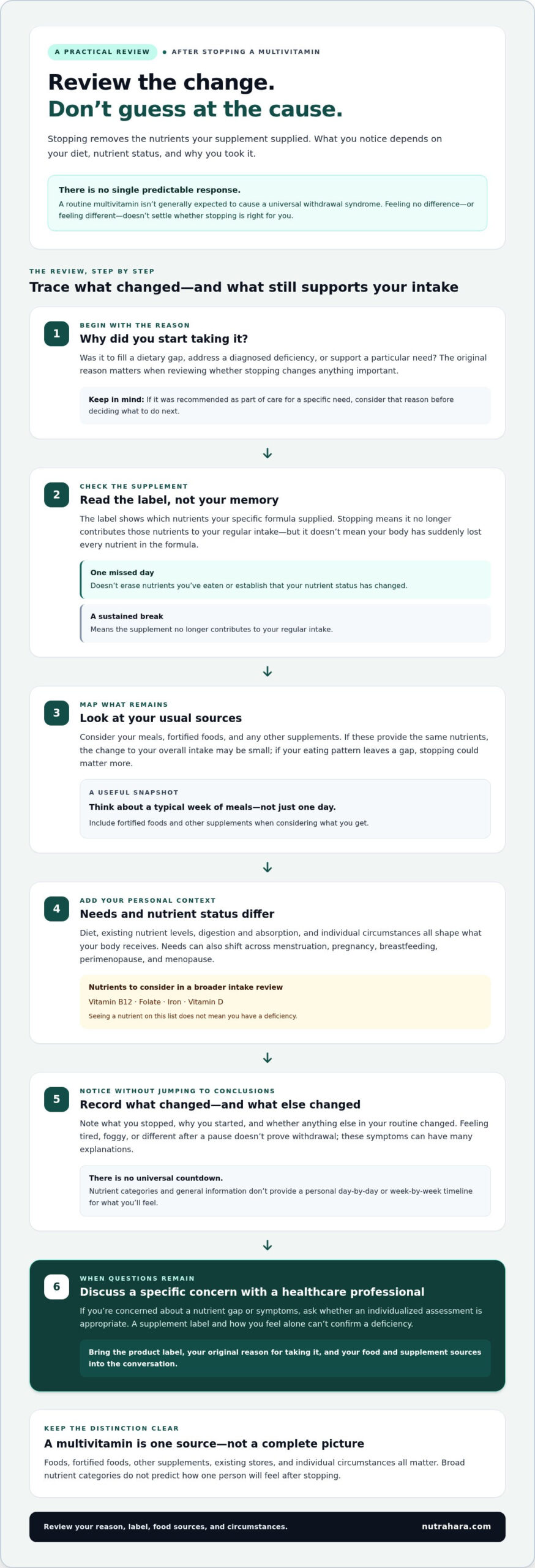
What happens depends on why you took the multivitamin and what else contributes to your nutrient intake. If you started taking one to fill a dietary gap, stopping removes that supplement as a source of those nutrients. If your meals and other supplements provide them, the change to your overall intake may be small. If it was part of a plan to address a diagnosed deficiency or a particular life-stage need, give that original reason careful consideration. The answer to “what happens when you stop taking multivitamins” is personal, not automatic.

In brief: stopping a multivitamin removes its contribution to your nutrient intake. What you notice depends on the rest of your diet and your individual needs. Missing one dose is different from stopping for the long term. One missed day doesn’t erase the nutrients you’ve eaten or establish that your nutrient status has changed. A sustained break means the supplement no longer contributes to your regular intake.

Does stopping a multivitamin cause withdrawal?

A routine multivitamin isn’t generally expected to cause a universal withdrawal syndrome when you stop taking it. Feeling tired, foggy, or different after a pause doesn’t prove that withdrawal is the cause. These symptoms can have many explanations, and a multivitamin alone can’t identify them. Formulas vary, so check your own label to see what your supplement provided. The Multivitamin overview describes the category broadly, but the product label is more useful for understanding your specific formula.

It’s also important to distinguish an ordinary multivitamin from supplements with different ingredients or purposes, and from prescribed treatments. They aren’t interchangeable, so the experience of stopping one type shouldn’t be assumed to apply to another. If your multivitamin was recommended as part of care for a specific need, consider that reason before deciding what to do next.

What changes first when a daily supplement stops?

The immediate change is straightforward: the supplement no longer contributes nutrients to your intake. That doesn’t mean your body has suddenly lost every nutrient in the formula. Foods, fortified foods, and other supplements may still supply some or all of them. For example, if the multivitamin provided a nutrient you also get from fortified foods or a varied diet, those sources remain after you stop taking it.

There isn’t one timeline for noticing an effect, and feeling no difference doesn’t prove that stopping is right for everyone. Instead, note what you stopped, why you started, and whether anything else in your routine changed. If you’re unsure what the supplement contained, read the label rather than guessing. This gives you a practical starting point for reviewing your decision without treating one missed dose or a nonspecific symptom as a verdict.

How diet and nutrient status shape the effects of stopping a multivitamin

A multivitamin is one source of nutrients, not a complete picture of your nutrient status. Your usual meals, fortified foods, other supplements, digestion and absorption, and any existing deficiency all shape what your body receives. That’s why what happens when you stop taking multivitamins can’t be predicted from the supplement alone. The same change can affect two people differently because their diets, health circumstances, and starting nutrient levels differ.

Why diet and existing nutrient levels matter

If your regular diet supplies the nutrients in your multivitamin, stopping it may make little difference to your overall intake. If your eating pattern leaves a particular gap, removing the supplement could matter more. Vitamin B12, folate, iron, and vitamin D may be worth considering as part of a broader intake review, but their presence on this list doesn’t mean you have a deficiency.

A multivitamin label tells you what the product contains, not whether you personally need those nutrients or have absorbed enough. Health factors can affect absorption, and a deficiency can’t be confirmed just by looking at your supplement routine or how you feel. Johns Hopkins Medicine offers a broader discussion in its review of multivitamin benefits.

For a practical snapshot, think about a typical week of meals rather than judging your diet from one day. Include fortified foods and any other supplements in your review. This can help you identify questions to discuss with a healthcare professional, particularly if you started taking a multivitamin for a specific reason.

Why nutrient categories don’t create a predictable timeline

Nutrients are handled differently by the body. Water-soluble vitamins, such as vitamin C and many B vitamins, generally aren’t stored in the same way as fat-soluble vitamins A, D, E, and K, which can be stored in the body. But these broad categories don’t provide a personal countdown for what you’ll feel after stopping a multivitamin.

A multivitamin contains a combination of nutrients, and your intake from food, existing stores, and individual circumstances all matter. Information about stopping a single nutrient or a different kind of supplement can’t automatically be applied to multivitamins. There’s no reliable day-by-day or week-by-week schedule that fits everyone. A change in energy or mood on its own doesn’t identify the cause.

Keep your review straightforward: check the multivitamin label, consider what you eat and any other supplements, and remember why you began taking it. If you’re exploring women’s health supplements as part of that review, you can browse Nutrahara’s women’s health supplements. Use this as one resource, without assuming a supplement is necessary or a substitute for individualized advice.

Multivitamin withdrawal: what is known and what is not

The word “withdrawal” can make stopping a routine multivitamin sound like stopping a medicine that causes a predictable reaction. That isn’t an established expectation for standard multivitamins. The clearer distinction is between a change in nutrient intake and symptoms that may have another explanation. The points below separate common claims from what can reasonably be concluded.

Claim: Everyone has an energy crash after stopping. Context: There’s no basis to expect this in everyone. Tiredness has many possible causes.

Claim: Any symptom after stopping is withdrawal. Context: A symptom may have another cause, including the issue that led someone to take a supplement in the first place.

Claim: A multivitamin must be tapered. Context: There’s no established universal taper schedule for routine multivitamins.

Claim: Everyone will notice a change on a set schedule. Context: There’s no exact symptom timeline that applies to every person.

In other words, what happens when you stop taking multivitamins isn’t a guaranteed “crash.” If a symptom you had before taking one seems to return, that may point back to the original reason for supplementation, but it doesn’t confirm the cause. A change in how you feel is worth noticing, not treating as a diagnosis by itself.

Can stopping a multivitamin make you feel tired?

You may feel tired after stopping, but timing alone can’t show that the multivitamin caused the change. Sleep, stress, a demanding exercise routine, illness, diet, and many other factors can affect energy. If you had a nutrient concern identified before starting the supplement, consider that separately rather than assuming fatigue is withdrawal. Persistent or concerning tiredness is worth discussing with a healthcare professional.

Do you need to taper off a multivitamin?

There’s no established universal taper schedule for routine multivitamins, so an exact step-down plan shouldn’t be treated as necessary for everyone. This applies to ordinary multivitamins, not every product sold as a supplement. Products with different ingredients or purposes may have different considerations. If a clinician recommended your multivitamin for a specific reason, ask them for individualized guidance before changing that plan.

For perspective, briefly note when you stopped and any changes you’ve noticed, along with other shifts in your routine. This can help you describe the situation clearly if you seek advice. Avoid attributing every fluctuation in mood or energy to the supplement, and don’t follow a precise timeline or taper schedule unless it’s appropriate to your circumstances.
What Happens When You Stop Taking Multivitamins? What to Expect

How women can reassess a multivitamin after stopping

Use a calm, practical review rather than guessing from one day’s energy or mood. To make sense of what happens when you stop taking multivitamins, trace your original reason for taking one, consider what you get from food and other supplements, and note any meaningful changes. This isn’t about judging your routine. It’s a way to make your next choice with more confidence.

  1. Recall why you started. Was the multivitamin a general wellness habit, or was it recommended for a specific concern?
  2. Review your usual intake. Consider the range of foods you eat, fortified foods, and other supplements, rather than focusing on a single meal.
  3. Note relevant changes. Write down when you stopped and any symptoms or routine changes you’ve noticed. A note is useful context, not a diagnosis.
  4. Reassess the reason. If a clinician recommended the supplement for an identified need, discuss changes with them before making a new plan.

Questions to ask about your original reason for taking one

Ask yourself: “Was I taking this out of habit, or to address a specific need?” Then consider whether your diet, health, or other supplements have changed since you began. These questions can help you decide whether your original reason still applies, without assuming a multivitamin is essential or unnecessary for everyone. For a broader framework, Nutrahara’s guide, The Ultimate Guide to Women’s Wellness Supplements, can support your reading as you review your options.

Life-stage context without one-size-fits-all advice

Nutrition questions can shift through menstruation, pregnancy, lactation, perimenopause, and postmenopause. Those stages don’t create identical needs for every woman; personal health, diet, and any clinician-identified concern matter too. If you’re pregnant, breastfeeding, experiencing a change in your menstrual cycle, or moving through menopause, consider that context when reviewing why you started the supplement. If you’re taking it for a specific need or on a clinician’s advice, discuss any change with the clinician who advised you.

Support your overall wellbeing with steady, nourishing routines. A varied, balanced eating pattern, regular movement that suits your body, and practices such as yoga or meditation can help make space for physical and mental wellbeing. These are valuable parts of a healthy lifestyle, but they don’t replace a supplement recommended for a specific reason or confirm whether you’re meeting a particular nutrient need.

If you’d like to explore women’s wellness supplements as part of your ongoing review, explore Nutrahara’s women’s health supplements. Let what you’ve learned about your own routine guide the decision, rather than feeling pressured to add or restart a multivitamin.

A thoughtful next step after stopping a multivitamin

Stopping changes what you get from the supplement, but its personal effects depend on why you used it, your usual diet, and any identified nutrient need. A useful next step is a calm review, not an automatic restart. To understand what happens when you stop taking multivitamins, revisit your original reason and consider what has changed in your life and routine since then.

  1. Recall the reason. Was it a general wellness habit, or did a clinician recommend it for a specific concern?
  2. Review your intake. Consider your usual meals, fortified foods, and any other supplements together.
  3. Notice changes. Keep a simple note of changes in energy or wellbeing, along with shifts in sleep, stress, activity, or diet. A pattern is useful context, but it doesn’t prove a cause.
  4. Choose a next step. If there’s an identified need or the supplement was recommended for a particular reason, discuss whether your plan should change.

When to pause and seek individualized guidance

If you’ve been diagnosed with a deficiency or a clinician recommended supplementation for a specific reason, get individualized guidance before changing that plan. This can also matter during pregnancy or lactation, when nutrition questions may be specific to your circumstances. You don’t need to assume harm or diagnose yourself. Bring the supplement label and your questions to the clinician who advised you.

Build a sustainable wellness routine beyond supplements

Nutrition and wellbeing are shaped by everyday patterns, not one perfect meal or workout. Choose nourishing meals that fit your life, and make movement regular and realistic, such as a walk or a fitness session you enjoy. Yoga can bring mindful movement into your routine, while meditation offers a moment to pause and check in with yourself. These habits support general wellbeing, but they don’t replace advice for a specific nutrient need.

To make your notes useful, record a change alongside its context: for example, whether your sleep, meals, stress, menstrual cycle, or exercise routine also shifted. Look for patterns without assuming the multivitamin caused them. This gentle approach can help you have a clearer conversation with a clinician if questions persist, without the pressure to interpret every fluctuation.

Wellness is a continuing process of noticing, learning, and making choices that suit you. Nutrahara combines Ayurvedic principles with modern nutritional research, and its nutrition is made in New Zealand. If you’d like to explore this nature-informed approach as you reflect on your wellness routine, discover Nutrahara’s approach to women’s wellness. Your next step can be thoughtful and gradual, guided by your own needs rather than alarm or guesswork.

Let your next wellness choice fit your life

Your supplement routine doesn’t have to be permanent to be worthwhile. It can change as your meals, priorities, and life stage change. Rather than looking for a perfect rule, give yourself permission to make a considered choice, notice how you feel, and revisit it when your circumstances shift.

The question of what happens when you stop taking multivitamins can be a starting point for a more personal approach to wellbeing. Let curiosity guide you: notice what supports your energy and daily life, and seek tailored advice when you have a specific nutrition concern. Small, thoughtful decisions can build trust in your own judgment over time.

If you’re ready to explore a nature-informed approach to women’s wellness, explore Nutrahara’s women’s wellness supplements.

Frequently Asked Questions

Is it safe to stop taking a multivitamin suddenly?

Stopping a routine multivitamin suddenly isn’t generally expected to cause a universal withdrawal reaction. Before deciding, consider why you began taking it and whether it was part of a care plan. If a clinician recommended it for a diagnosed deficiency or another specific concern, discuss a change with them. Having the product label handy can help you explain exactly what you’ve been taking.

Can stopping a multivitamin cause fatigue?

Fatigue can’t be confidently attributed to stopping a multivitamin alone. Consider other recent changes, such as sleep, stress, illness, menstrual patterns, or exercise. If you’re concerned, note when the tiredness began and what else changed, then discuss the pattern with a healthcare professional if it persists. Symptoms alone can’t establish whether a particular nutrient is low.

How long after stopping a multivitamin might you notice a difference?

There’s no single timeline that applies to everyone. Your food choices, the supplement’s ingredients, and your individual circumstances all matter. Some people notice no clear difference; others may need to revisit the reason they began taking it. Rather than relying on a specific day or week, keep a brief record of changes and consider other factors that could affect how you feel.

Do you need to taper off multivitamins?

A universal taper schedule for routine multivitamins isn’t established. Don’t assume guidance about a supplement with different ingredients or a distinct purpose applies to your multivitamin. Check the label to understand the formula, especially if it includes ingredients beyond vitamins and minerals. If it was recommended for a specific health concern, get advice from the clinician who recommended it before changing your plan.

What happens if you miss a multivitamin for a week?

Missing a week doesn’t automatically mean you’ll feel different or develop a deficiency. Consider your usual diet and the reason the supplement is part of your routine. Don’t take extra doses to compensate unless the product directions or your clinician specifically advise it. If you take it for an identified concern, use the missed doses as a reminder to revisit your plan rather than making assumptions.

Should women stop taking multivitamins during pregnancy or breastfeeding?

There isn’t one answer for every pregnant or breastfeeding woman. Individual circumstances and existing care plans matter, so don’t base your decision only on another person’s experience. Bring the product label and a list of other supplements you use to the clinician supporting your pregnancy or postpartum care. That helps keep the discussion focused on the specific formula and your needs.

Can food replace a multivitamin after you stop taking one?

Food can provide many nutrients, but whether your usual eating pattern meets your needs depends on your choices and health circumstances. To prepare for a useful review, jot down the foods and fortified products you typically have over several days. This isn’t a diagnosis, but it can help you discuss your intake with a healthcare professional, particularly if you have a known deficiency or a specific concern.

Article by

Nutrahara Team

We are a dedicated collective of nutrition scientists and naturopaths at Nutrahara, committed to advancing women's health through the fusion of ancient Ayurveda science and cutting-edge nutrition research. Our mission is to empower you with clean, simple, and scientifically validated wellness solutions so you can live your healthiest life. Connect with us to stay updated on the latest developments in holistic women's health and nature-based research.

Disclaimer

This article is not a substitute for medical advice. Please consult a healthcare professional before starting any supplement, especially if pregnant, nursing, taking medication, or managing health conditions.

Categories
Articles

Do Cranberry Supplements Work? What the Evidence Says

What if cranberry supplements may help lower the chance of some repeat urinary tract infections, but aren’t a way to treat symptoms once they begin? Conflicting claims can make cranberry supplements effectiveness difficult to judge, especially when labels use broad language and studies examine different products and groups of people. The useful question isn’t simply whether cranberry “works,” but what outcome has been studied and whether that evidence applies to you.

For women balancing work, exercise, family life, and changing health needs, a supplement decision should fit the bigger picture. Menstruation, pregnancy, breastfeeding, perimenopause, and postmenopause can all shape the questions you bring to a healthcare professional, though no life stage alone determines what’s right for you. Research reviews have found potential preventive benefit in some groups, while evidence doesn’t support using cranberry to treat an active urinary infection.

This article explains how researchers assess cranberry products, which label details may help you compare options, and how capsules, juice, and cranberries as food differ. You’ll also find a practical way to weigh evidence, product information, and personal context without expecting a guaranteed result. The aim is to help you make an informed choice that feels appropriate for your wellness routine.

Key Takeaways

  • Assess cranberry supplements effectiveness by focusing on the outcome studied and who may benefit, not broad wellness promises.
  • Learn why proanthocyanidins (PACs) appear on some labels, and why a listed amount alone doesn’t prove a product will work.
  • Compare capsules, juice, and cranberry foods by convenience, label clarity, and the limits of the available evidence.
  • Consider your life stage, medications, and health history when weighing supplement safety, especially during pregnancy or breastfeeding.
  • Use a simple decision framework to set a realistic goal, review product information, and reassess whether a supplement fits your routine.

Do cranberry supplements work? Start with what they may support

Short answer: cranberry supplements may help reduce the risk of recurrent urinary tract infections (UTIs) for some people, but they don’t treat an active infection. Research has focused on prevention, not on easing symptoms after a UTI begins. If you have symptoms such as pain or burning when urinating, seek medical care rather than relying on a supplement.

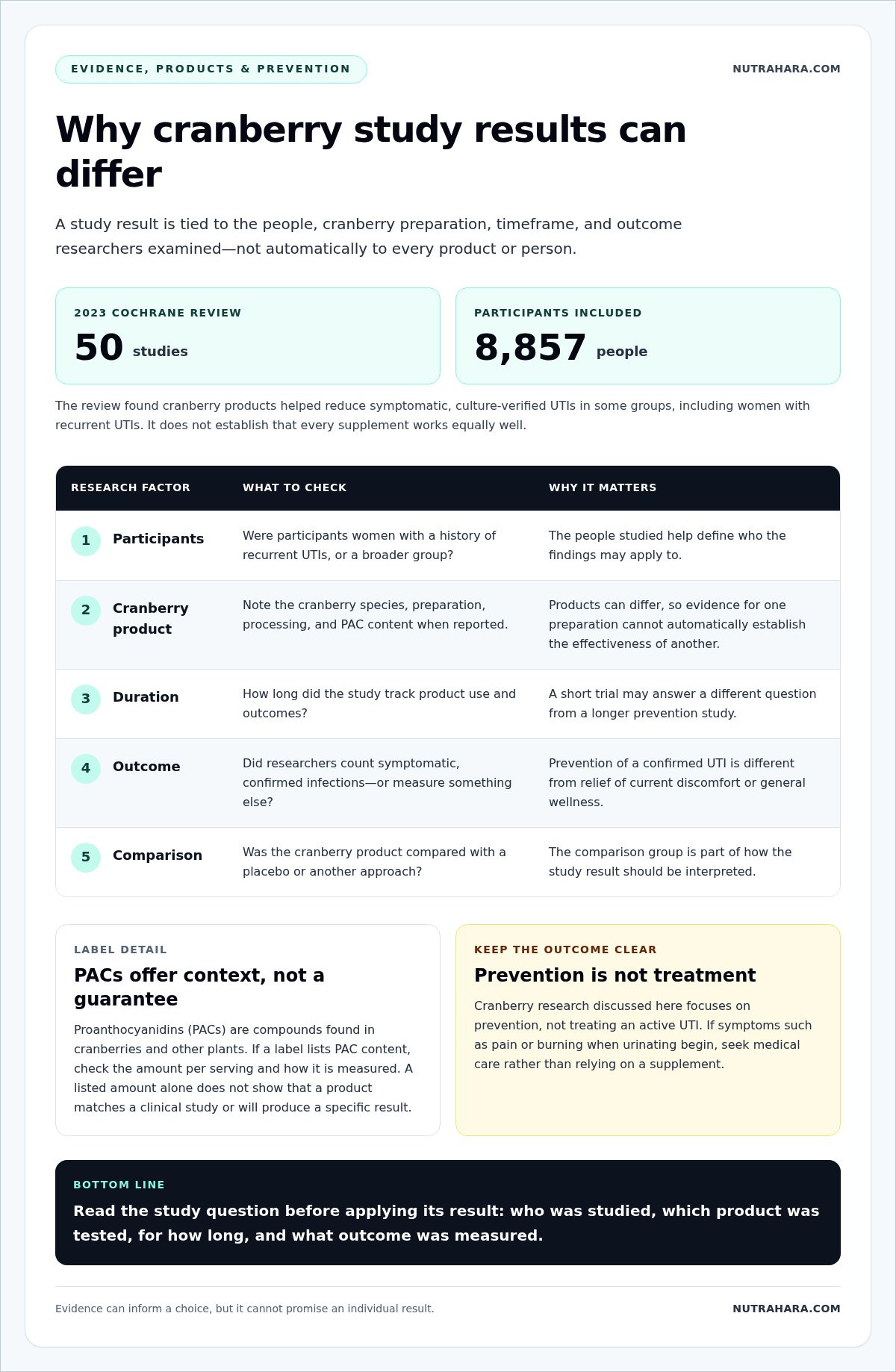
Cranberry supplements are products made with cranberry fruit ingredients, such as powders or extracts, and are studied for outcomes including UTI recurrence. Much of the research concerns the North American cranberry, Vaccinium macrocarpon, though species and preparations can vary between products. For botanical background, see Cranberry – Wikipedia. A 2023 Cochrane review of 50 studies involving 8,857 participants found cranberry products helped reduce symptomatic, culture-verified UTIs in some groups, including women with recurrent UTIs. That result doesn’t establish that every supplement works equally well.

What does cranberry supplement effectiveness mean?

For cranberry supplements effectiveness to mean something useful, the outcome needs to be clear. A study might measure whether participants experience another confirmed UTI over a set period. That’s different from asking whether cranberry relieves current discomfort or supports general wellness. Results can depend on the participants, the cranberry formulation, and the question researchers set out to answer. Evidence for one preparation can’t automatically be applied to every product on a shelf.

Cranberry supplements and urinary health are not the same as vaginal pH

The urinary tract and vagina are separate parts of the body, with different functions and health considerations. Evidence about cranberry and UTI prevention doesn’t show that cranberry supplements restore vaginal pH or treat vaginal symptoms or conditions. If you’re looking for information about that separate topic, read our guide to vaginal pH balance. Keeping these questions distinct helps you focus on support that matches your concern.

How cranberry supplements may work, and what research actually measures

Cranberry research looks at more than whether someone takes a capsule. Researchers also consider who takes it, how the cranberry ingredient is prepared, how long it’s used, and what outcome is measured. These details help explain why a result from one study may not predict what another woman will experience.

One proposed mechanism is that certain cranberry compounds may make it harder for some bacteria, particularly E. coli, to adhere to the urinary tract lining. This explanation is under study; it doesn’t prove that a supplement will prevent an infection for any individual. The 2023 Cochrane review discusses cranberry products in the context of UTI prevention, with evidence tied to the populations and products studied. Read the Cochrane review.

What are proanthocyanidins, and why do supplement labels mention them?

Proanthocyanidins, often shortened to PACs, are compounds found in cranberries and other plants. Cranberry research has focused in particular on A-type PACs and their possible role in bacterial adhesion. A label that lists PAC content gives you more information about a formula, but a number alone doesn’t show that the product matches a clinical study or will produce a specific result. Check whether the label states the amount per serving and explains how it’s measured.

Why cranberry study results can differ

Study results are easier to interpret when you look at the design, not just the headline. Check what kind of cranberry product was tested and whether it was compared with a placebo or another approach. Consider:

  • Participants: Were they women with a history of recurrent UTIs, or a broader group?
  • Duration: How long did the study track use and outcomes?
  • Outcome: Did researchers count symptomatic, confirmed infections, or measure something else?

Products can differ in cranberry species, processing, and PAC content, so findings for one preparation can’t automatically establish the effectiveness of another. Study duration and comparison groups matter too: a short trial may answer a different question from a longer prevention study. Together, these factors shape what cranberry supplements effectiveness means in practice. Evidence can inform a considered choice, but it can’t promise an individual result.

Cranberry supplements vs. juice: how to compare the options

Capsules, juice, and whole cranberries aren’t interchangeable. They differ in serving format, ingredient concentration, and how easily you can assess what you’re consuming. The FDA’s qualified health claim for cranberry juice applies to a specific beverage serving and describes the evidence as limited and inconsistent. That claim doesn’t establish that every juice or supplement offers the same benefit.

Option Convenience and serving What to check Evidence limitation
Supplement capsules Compact, pre-portioned format Cranberry ingredient, serving details, and any PAC information Formulas vary; a label amount doesn’t prove the product matches a studied preparation.
Cranberry juice Drinkable, but requires a pour and a serving Percentage of cranberry juice, serving size, and Nutrition Facts, including Added Sugars Juices and juice cocktails differ in composition; evidence for juice is limited and inconsistent.
Whole or dried cranberries Easy to add to meals or snacks Whether the product is sweetened and how it fits your dietary needs Eating cranberries isn’t automatically equivalent to taking a studied supplement or juice.

Which details on a cranberry supplement label deserve attention?

Look for a clearly named cranberry ingredient and an understandable serving size. If the label lists proanthocyanidins (PACs), check whether it states the amount per serving and explains what that measure refers to. A front-label phrase such as “urinary support” isn’t evidence of a particular outcome. If a brand mentions third-party testing, look for specifics about what was tested. Testing may speak to product quality, but it doesn’t by itself show that the supplement prevents UTIs.

When might juice or whole cranberries suit someone better?

Juice may suit you if you prefer a drink, while whole or dried cranberries can fit into meals and snacks. Check juice labels because cranberry beverages vary, and some contain added sugars. The FDA requires Added Sugars to appear on Nutrition Facts labels, so compare the serving information with your dietary priorities. Whole fruit can be a food choice, but it shouldn’t be treated as a guaranteed preventive measure.

There’s no universally best format. Consider which option fits your routine, what its label tells you, and what outcome the evidence studied. For a broader framework for choosing supplements as part of women’s wellness, explore this women’s wellness supplements guide.

Safety, life stages, and when cranberry supplements are not enough

Your health needs can change across menstruation, pregnancy, breastfeeding, perimenopause, and postmenopause. Those stages don’t automatically determine whether cranberry is appropriate, but they make personal context important. Evidence about cranberry supplements effectiveness doesn’t establish that every woman will benefit or that every formulation is suitable for her.

A practical step is to keep a brief record of urinary symptoms, any supplements you take, and when you take them. Note changes and questions to discuss with a qualified healthcare professional. This can make a conversation more useful, especially if you’re managing a health condition or taking medication.

What should women consider during pregnancy, lactation, or medication use?

If you’re pregnant, trying to conceive, or breastfeeding, seek individualized professional guidance before starting a cranberry supplement. The 2023 Cochrane review did not find evidence supporting cranberry use to prevent UTIs in pregnant women. That finding concerns evidence of benefit, not a blanket safety verdict. Medication questions also depend on your circumstances and the specific product, so review the label with a qualified healthcare professional rather than assuming a supplement is risk-free or unsuitable for everyone.

Menstruation, perimenopause, and postmenopause also don’t create one uniform need for cranberry. Consider your symptoms and overall health rather than treating life stage alone as a reason to start or avoid a supplement.

When should urinary symptoms prompt medical care?

Cranberry supplements aren’t a substitute for assessment or treatment of a urinary infection. Seek prompt medical evaluation for urinary symptoms such as pain or burning during urination, frequent or urgent need to urinate, or symptoms that are severe or getting worse. Don’t wait to see whether a supplement helps. A healthcare professional can assess what’s happening and advise on appropriate care.

Keep your notes brief: record when symptoms began, how they change, and any supplements or medicines you use. This isn’t a way to diagnose yourself; it’s a practical aid for sharing clear information during care. Supplement decisions are one part of wellbeing, alongside habits such as movement, nourishing meals, and restorative practices. Explore Nutrahara’s women’s wellness approach.

Do Cranberry Supplements Work? What the Evidence Says

A grounded way to decide whether cranberry supplements fit your wellness routine

A thoughtful decision starts with your goal, not a bold promise on a bottle. Use this framework to assess cranberry supplements effectiveness in the context of your health and routine:

  • Define your goal. Are you considering prevention because you experience recurrent UTIs, or hoping to ease symptoms you have now? Supplements aren’t a treatment for an active infection.
  • Review the evidence. Check whether research studied the outcome and population relevant to you. Findings for one cranberry preparation don’t automatically apply to every product.
  • Assess label clarity. Look for clear ingredient and serving information. Vague promises or a listed PAC amount alone can’t guarantee a clinical benefit.
  • Consider your personal context. Your health history, life stage, and medicines matter. Discuss personal safety questions with a qualified healthcare professional.

Reassess from time to time. Keep a brief note of what you take and any changes in your symptoms or routine so you can discuss them with a healthcare professional. A supplement decision can change as your needs do.

Support whole-person wellness without overstating cranberry’s role

Small, repeatable habits can make wellness feel more manageable. Try a gentle yoga stretch after a walk, or set aside a quiet moment to focus on your breathing. Choose movement, balanced meals, and restorative sleep in ways that fit your life. Yoga and meditation can support general wellbeing, but they aren’t treatments for urinary infections or proven alternatives to medical care.

Personal stories can offer connection, but they aren’t clinical evidence. Use testimonials only when a woman’s account is verified and shared with her permission. For a practical example, if you’re comparing two labels, note the cranberry ingredient, serving details, and any PAC information, then discuss the product with a qualified healthcare professional if you have safety questions. Nutrahara’s approach to women’s wellness brings Ayurvedic principles together with modern nutritional research. Explore the women’s wellness supplement guide as you make informed choices for your health.

Make your next wellness choice with confidence

Cranberry supplements may help reduce the risk of recurrent UTIs for some women, but the evidence is limited and doesn’t mean every product will work the same way. The clearest way to assess cranberry supplements effectiveness is to look at the outcome studied, the formulation, and whether the research applies to your circumstances. Cranberry isn’t a treatment for urinary symptoms, and personal safety questions deserve guidance from a qualified healthcare professional.

Choose thoughtfully: clarify your goal, read the label beyond its front-facing claims, and consider your health history and life stage. Sustainable habits such as regular movement, restorative sleep, balanced nutrition, yoga, and meditation can also support overall wellbeing, though they don’t treat infections.

Nutrahara focuses on women’s health supplements, combining Ayurvedic principles with modern nutritional research. Explore Nutrahara’s approach to women’s wellness and build a routine grounded in care, curiosity, and confidence.

Frequently Asked Questions

Do cranberry supplements really help prevent urinary tract infections?

Cranberry products may help reduce the risk of recurrent UTIs in some groups, including women with recurrent infections, but the evidence is limited and results aren’t guaranteed. A 2023 Cochrane review found a preventive benefit for certain populations. The phrase cranberry supplements effectiveness should be understood in that context: research examines prevention in studied groups, not a promise that every supplement will work for every woman.

Are cranberry pills more effective than cranberry juice?

There isn’t enough evidence to say that pills are universally more effective than juice. The FDA’s qualified health claim for cranberry juice describes the evidence as limited and inconsistent. Claims about different product formats aren’t proof from a direct comparison that one is best. Formulation and serving information matter, so compare labels rather than assuming the options are interchangeable.

How much cranberry supplement should I take?

There isn’t one dose established as right for everyone. The FDA’s qualified health claim for cranberry dietary supplements is based on a daily intake of 500 mg, but that figure relates to the claim’s evidence and isn’t personalized dosing advice or a guarantee of benefit. Products may differ in ingredients and formulation. Follow the product label, and ask a qualified healthcare professional what’s appropriate for your health context.

Can cranberry supplements treat a urinary tract infection?

No. Cranberry supplements haven’t been established as a treatment for an active UTI, and they shouldn’t replace medical assessment or treatment. If you notice pain or burning when urinating, frequent or urgent urination, or symptoms that are severe or worsening, seek prompt medical care. Don’t wait to see whether cranberry helps. A healthcare professional can assess your symptoms and advise you on appropriate next steps.

Are cranberry supplements safe during pregnancy or breastfeeding?

Ask a qualified healthcare professional before using cranberry supplements during pregnancy or breastfeeding. The 2023 Cochrane review did not find evidence supporting cranberry products for UTI prevention in pregnant women; this is not the same as proving universal harm or safety. Individual health circumstances and product formulations vary. Bring the product label and a list of other supplements or medicines to your discussion so you can receive guidance tailored to you.

Can cranberry supplements interact with medications?

Whether a cranberry supplement is suitable alongside your medication depends on your personal circumstances and the specific product. Don’t assume a supplement is interaction-free because it contains a natural ingredient. Before starting it, show the full label to a qualified healthcare professional or pharmacist and ask about your medicines and health history. If the formula combines cranberry with other ingredients, include those in the discussion too.

Do cranberry supplements help with vaginal pH or vaginal health?

There isn’t established evidence here that cranberry supplements restore vaginal pH or treat vaginal conditions. Research on cranberry has focused on urinary tract outcomes, which are distinct from vaginal health. If you’re concerned about vaginal symptoms or pH, seek advice from a qualified healthcare professional rather than trying to address them with a cranberry supplement. Keeping urinary and vaginal health questions separate can help guide the right next step.

Article by

Nutrahara Team

We are a dedicated collective of nutrition scientists and naturopaths at Nutrahara, committed to advancing women's health through the fusion of ancient Ayurveda science and cutting-edge nutrition research. Our mission is to empower you with clean, simple, and scientifically validated wellness solutions so you can live your healthiest life. Connect with us to stay updated on the latest developments in holistic women's health and nature-based research.

Disclaimer

This article is not a substitute for medical advice. Please consult a healthcare professional before starting any supplement, especially if pregnant, nursing, taking medication, or managing health conditions.
Categories
Articles

Supplements for Clear Skin and Acne: What Women Should Know

The supplement marketed for glowing skin may not be the one that helps acne. Some ingredients have limited evidence, while others, including high doses of vitamin B12, iodine, or whey protein, have been linked to worse breakouts in some people. If you’re considering supplements for clear skin and acne, it’s understandable to want clear answers, especially when breakouts change around menstrual cycles, pregnancy, or menopause.

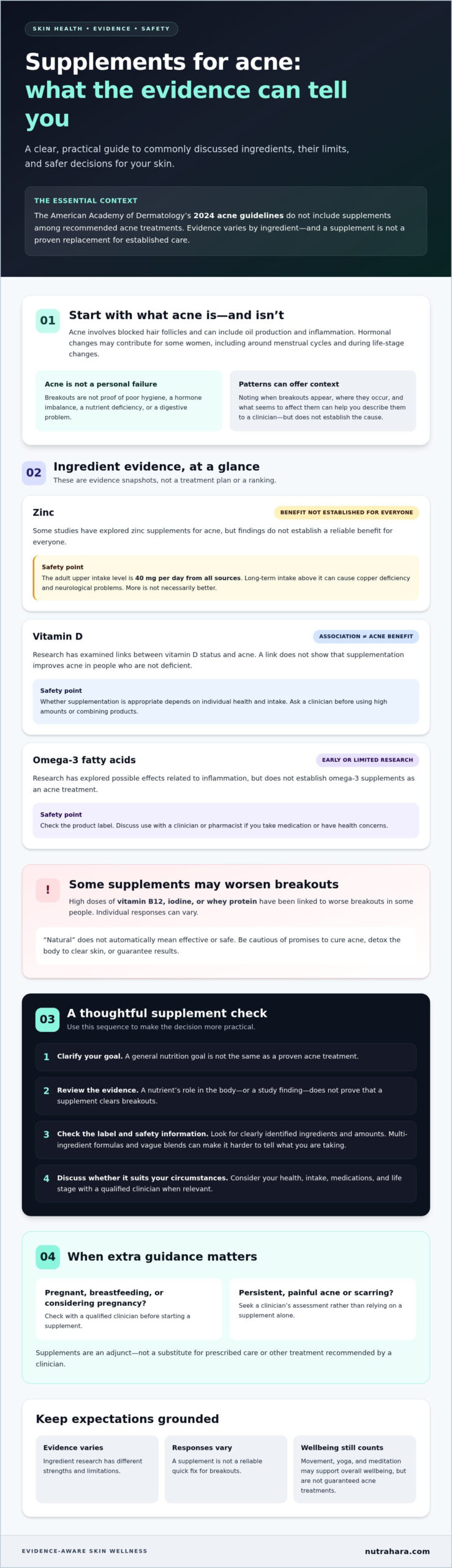
A supplement may seem like a gentle addition to your routine, but “natural” doesn’t automatically mean effective or safe. The American Academy of Dermatology’s 2024 acne guidelines don’t include supplements among their primary evidence-based treatments. That doesn’t mean every ingredient is useless; it does mean supplement claims deserve a closer look.

This guide compares commonly discussed ingredients and the strength and limits of the evidence. You’ll also learn what to check on labels, how to think about interactions and life-stage safety, and when to ask a healthcare professional before trying something new. The goal is a practical next step for your skin, not another perfect-skin promise.

Key Takeaways

  • Acne can have several contributors, including hormonal changes, and isn’t a sign of poor hygiene or personal failure.
  • Compare supplements for clear skin and acne by the evidence for each ingredient, its limitations, and relevant safety cautions.
  • Supplements aren’t a reliable quick fix or a replacement for established acne care; individual responses can vary.
  • If you’re pregnant, breastfeeding, or considering pregnancy, check with a qualified clinician before starting a supplement.
  • Use a practical decision sequence: clarify your goal, review the evidence, check the ingredient and safety information, then discuss whether it suits your circumstances.

Why adult acne happens, and what supplements for clear skin can realistically do

Recurring acne can be frustrating at any age, but it isn’t a sign that you’re unclean or doing something wrong. Acne is a skin condition, not a measure of how well you care for yourself. It can continue into adulthood or return after years of clearer skin, and the reasons aren’t always obvious. General information can help you ask better questions, but it can’t diagnose the cause of your breakouts.

Why acne can continue into adulthood

Acne, also called acne vulgaris, involves blocked hair follicles and can include oil production and inflammation. Hormonal fluctuations may contribute for some women, including around menstrual cycles and during life-stage changes. But a breakout doesn’t prove you have a hormone imbalance. Patterns and triggers differ, and acne alone doesn’t show that you have a nutrient deficiency or digestive problem.

Noting when breakouts appear, where they occur, and whether anything seems to affect them can help you describe the pattern to a clinician. These observations may provide useful context, but they can’t establish the cause on their own.

What clear-skin supplement claims should, and shouldn’t, promise

In this article, “acne supplements” means dietary supplements taken with the aim of supporting skin health or acne management. Evidence and outcomes vary by ingredient and person. A supplement may contribute to general nutrition, but that doesn’t establish it as a proven acne treatment. The phrase “supplements for clear skin and acne” describes an area of interest, not a promise that taking a product will clear breakouts.

Be cautious with claims that a supplement will cure acne, detox the body to clear skin, or guarantee results. Those promises go beyond what general wellness support can establish. Supplements should be considered an adjunct, not a substitute for prescribed care or other treatment recommended by a clinician. If acne is persistent, painful, or leaving scars, seek a clinician’s assessment rather than relying on a supplement alone. A balanced routine that supports overall wellbeing, including movement or calming practices such as yoga and meditation, may be valuable, but it isn’t a guaranteed acne treatment.

Comparing supplements for acne: ingredients, evidence, and limits

Zinc, vitamin D, and omega-3 fatty acids are often discussed in connection with acne. However, evidence that a nutrient has a role in the body isn’t the same as evidence that taking it clears skin. The American Academy of Dermatology’s 2024 acne guidelines don’t include supplements among their recommended acne treatments. The comparison below provides context, not a treatment plan.

Ingredient What the evidence suggests Limits and safety considerations
Zinc Some studies have explored zinc supplements for acne, but findings don’t establish a reliable benefit for everyone. More isn’t necessarily better. The adult upper intake level is 40 mg per day from all sources; long-term intake above it can cause copper deficiency and neurological problems.
Vitamin D Research has examined links between vitamin D status and acne. An association doesn’t show that supplementation improves acne in people who aren’t deficient. Whether supplementation is appropriate depends on individual health and intake. Ask a clinician before using high amounts or combining products.
Omega-3 fatty acids Early or limited research has explored possible effects related to inflammation, but it doesn’t establish omega-3 supplements as acne treatment. Check the product label and discuss use with a clinician or pharmacist if you take medication or have health concerns.

Read the evidence in context

A nutrient level associated with acne in a study doesn’t prove that supplements prevent or treat breakouts. Correcting a confirmed deficiency can support nutritional health, but that isn’t the same as demonstrating an acne benefit. A small or preliminary study may suggest a question worth exploring without proving a dependable result.

If you’re considering supplements for clear skin and acne, check that the label clearly identifies each ingredient and its amount. Multi-ingredient formulas can make it harder to tell what you’re taking, and vague blends may hide the amounts of individual ingredients. Be especially cautious of claims about “balancing hormones,” detoxifying the body, or clearing acne rapidly unless strong evidence supports the specific claim. A natural-sounding promise is not proof.

Keep a list of the supplements and medicines you use, and review it with a qualified clinician or pharmacist before adding anything new. This is particularly useful if you have a diagnosed deficiency, take regular medication, or are pregnant, planning pregnancy, or breastfeeding. Evidence can guide your choice, while your health circumstances help determine whether a supplement is suitable at all.

Do acne supplements work compared to other care?

A supplement may be relevant to someone’s nutrition, but the evidence doesn’t support treating supplements as a reliable quick fix for acne. A possible benefit in one study or for one person doesn’t guarantee the same outcome for you. Supplements also shouldn’t replace prescribed treatment or professional advice.

The American Academy of Dermatology’s 2024 acne guidelines recommend established options such as topical benzoyl peroxide and retinoids, and oral antibiotics such as doxycycline. Other options, including azelaic acid, salicylic acid, and hormonal therapies, are conditionally recommended for some patients. The right approach depends on individual circumstances, so this isn’t a ranking or a reason to start or stop treatment on your own.

In brief: Acne supplements may be considered an adjunct in some situations, but they aren’t guaranteed treatments and shouldn’t take the place of evidence-based care.

How to assess a supplement before considering it

For supplements for clear skin and acne, look beyond the front-label promise. Check the full ingredient list and the amount of each ingredient. Then ask whether the evidence relates to that specific ingredient and acne outcome, or only to a broader wellness claim. A proprietary blend that doesn’t disclose individual amounts makes that comparison difficult.

Keep the package or a photo of its label so you can share the ingredients with a clinician or pharmacist. This is especially helpful if you take medication or use several supplements, since a professional can help review possible interactions and overlapping ingredients.

When acne needs more than a supplement

Make an appointment with a qualified clinician if acne is ongoing, painful, leaving scars, or affecting your wellbeing. You don’t need to wait for a supplement to work before asking about care. A clinician can assess your skin, discuss treatment options, and review what you’re already taking.

Don’t stop prescribed medication or delay an assessment to try a supplement first. If you’re considering adding one, bring its label and your current medication and supplement list to the conversation. Nutrition and healthy routines can be part of thoughtful support, but persistent acne deserves care suited to your skin and circumstances.

How to choose safely across pregnancy, lactation, and changing life stages

A supplement that suits one person may not be appropriate for another. Pregnancy, breastfeeding, medications, health conditions, and other products you use can all affect what’s suitable for you. Before considering supplements for clear skin and acne, follow a practical sequence: clarify your goal, review the evidence for the ingredient, check its safety in your circumstances, then ask a qualified clinician or pharmacist whether it’s appropriate.

A simple pre-purchase safety checklist

  • Clarify your goal. Are you addressing a confirmed nutrient deficiency, or hoping to treat breakouts? Those are different aims.
  • Read the full label. Check every active ingredient and serving amount, then compare it with any vitamins or supplements you already take.
  • Review your health context. Ask a qualified clinician or pharmacist about potential interactions, existing health conditions, pregnancy, or breastfeeding.
  • Avoid stacking products. Multiple supplements can contain overlapping nutrients. Don’t combine them without professional guidance.

If you’re pregnant, planning pregnancy, or lactating, consult a qualified clinician before starting a supplement, even if it’s marketed as natural. Ingredient safety can depend on the substance and amount. For example, high intake of preformed vitamin A can cause serious birth defects. Check labels carefully and ask a clinician to review any product you’re considering rather than relying on a skin-focused claim.

Supportive routines for skin and overall wellbeing

Keep your skincare routine gentle and consistent, and avoid starting several new products or supplements at once. Changing one thing at a time can help you notice how your skin responds without assuming a single change caused every fluctuation.

Sleep, balanced meals, and regular movement can support general wellbeing, though they aren’t guaranteed acne treatments. Yoga and meditation may offer useful ways to manage stress and create a steadier daily rhythm, but they shouldn’t be presented as direct acne therapies.

A simple journal can make conversations with a clinician more useful. Note when breakouts occur, changes in your routine, supplements and medications, and relevant life-stage changes such as menstrual-cycle patterns. Treat these as observations, not proof of a cause. For broader context on choosing products thoughtfully, explore women’s wellness supplements as a general topic, while checking each product’s ingredients and suitability for your needs.

Supplements for Clear Skin and Acne: What Women Should Know

A thoughtful next step: match your skin goals with transparent wellness support

Choosing a supplement thoughtfully means considering four things together: the evidence for the ingredient and intended outcome, clear information about what the product contains, safety for your circumstances, and realistic expectations. This helps distinguish a general wellness product from a proven acne treatment. The phrase supplements for clear skin and acne doesn’t guarantee that a product has been studied for breakouts or will change your skin.

Assess the brand and the claim

Before considering a product, compare its listed ingredients and stated intended use with your goal. Ask whether the evidence relates to acne specifically, or to broader nutritional or skin-support claims. Clear ingredient information can help you make that distinction and discuss suitability with a clinician, especially if you take medication, have a health condition, or are pregnant or breastfeeding.

Nutrahara describes its approach as combining Ayurvedic principles with modern nutritional research and focuses on women’s health supplements. That is brand context, not proof that any product prevents, treats, or clears acne. No acne-specific Nutrahara product is confirmed here. For general skin-support context only, you can review the collagen supplement information; it should not be interpreted as evidence of an acne benefit.

Choose a next step that feels sustainable

If you’re interested in the brand’s broader wellness perspective, take time to review its information and decide whether it fits your priorities. Check the full ingredient list, amounts, intended use, and safety details before considering a purchase. You don’t need to choose a product simply because it promises fast results.

Persistent, painful, or scarring acne deserves assessment by a qualified clinician. So do questions about supplement safety during pregnancy, while planning pregnancy, or during lactation. Professional guidance can help you weigh skin concerns alongside your health and life stage.

Skin changes don’t follow one universal path. A measured approach, guided by evidence and your individual needs, can help you make informed choices without expecting a supplement to deliver perfect skin. Acne care can be gradual, and taking thoughtful steps is a way to support your wellbeing.

Choose your next step with care and confidence

Acne can have more than one influence, and a supplement isn’t a guaranteed solution. Weigh the evidence for the specific ingredient and skin outcome, check transparent labeling and personal safety, and keep supplements separate from proven acne care. If breakouts persist, cause pain or scarring, or if you’re pregnant or breastfeeding, a qualified clinician can help you consider appropriate next steps.

Nutrahara focuses on women’s health supplements and natural ingredients, combining Ayurvedic principles with modern nutritional research. That describes the brand’s approach, not evidence that a product treats acne. If you’d like to learn more, review the information below and decide whether it aligns with your priorities.

Your skin journey doesn’t need a perfect-skin promise. Take it one informed step at a time, with care that fits your health, life stage, and needs.

Frequently Asked Questions

Is there a supplement that clears acne?

No supplement can be promised to clear acne for everyone. Research on individual nutrients is limited or may apply to specific situations, such as correcting a confirmed deficiency, rather than proving a universal acne treatment. Supplements shouldn’t replace appropriate skin care or medical treatment. If acne is persistent, painful, or leaving scars, ask a qualified clinician about options suited to your skin and health needs.

Can zinc supplements help with acne?

Zinc has been studied in relation to acne, but the strength and relevance of the evidence depend on the study and the individual. It isn’t a guaranteed solution, and taking more isn’t automatically better. Check the amount in any product and consider zinc from other supplements too. Before starting, discuss possible interactions and your personal health needs with a clinician or pharmacist.

Can vitamin D or omega-3 supplements improve acne?

Vitamin D and omega-3s are important nutrients, but that doesn’t establish them as acne treatments. Evidence for acne-specific benefits needs careful consideration and may not apply to everyone. If you’re considering supplements for clear skin and acne, ask a clinician whether they fit your circumstances, especially if you have a health condition, use medication, or already take other supplements.

Are supplements for acne safe during pregnancy or breastfeeding?

Safety depends on the specific ingredients, amounts, and your health circumstances. A “natural” label or skin-focused marketing doesn’t confirm that a product is suitable during pregnancy or breastfeeding. If you’re pregnant, trying to conceive, or lactating, show the full product label to a qualified clinician before starting or changing a supplement. Include other supplements and medications you use so they can review the whole picture.

How long do acne supplements take to work?

There’s no reliable timeline that applies to every supplement or person, and some products may not improve acne at all. Be wary of promises of rapid results. If you and a clinician decide to try a supplement, agree on when to review it and which changes to track, such as breakouts or skin irritation. Seek advice sooner if acne becomes painful, worsens, or leaves scars.

Should I stop my acne medication when I start a supplement?

No. Don’t stop or change prescribed acne medication without speaking with the clinician who recommended it. Supplements can interact with medications, and starting several products at once can make it harder to identify what’s helping or causing a reaction. Before making changes, share a complete list of your medications and supplements with a clinician or pharmacist, including the product labels and ingredient amounts.

Can yoga or meditation help clear acne?

Yoga and meditation can support relaxation and general wellbeing, but they shouldn’t be treated as acne therapies. If they suit you, include them as part of a balanced routine alongside consistent skin care, not as a replacement for appropriate treatment. For breakouts that persist, hurt, scar, or affect your wellbeing, seek advice from a qualified clinician. You deserve support that considers both your skin and your overall health.

To explore Nutrahara’s approach to women’s wellness, visit Nutrahara and review the product information to decide what fits your priorities.

Article by

Nutrahara Team

We are a dedicated collective of nutrition scientists and naturopaths at Nutrahara, committed to advancing women's health through the fusion of ancient Ayurveda science and cutting-edge nutrition research. Our mission is to empower you with clean, simple, and scientifically validated wellness solutions so you can live your healthiest life. Connect with us to stay updated on the latest developments in holistic women's health and nature-based research.

Disclaimer

This article is not a substitute for medical advice. Please consult a healthcare professional before starting any supplement, especially if pregnant, nursing, taking medication, or managing health conditions.