

Categories
Articles

Do Cranberry Supplements Work? What the Evidence Says

What if cranberry supplements may help lower the chance of some repeat urinary tract infections, but aren’t a way to treat symptoms once they begin? Conflicting claims can make cranberry supplements effectiveness difficult to judge, especially when labels use broad language and studies examine different products and groups of people. The useful question isn’t simply whether cranberry “works,” but what outcome has been studied and whether that evidence applies to you.

For women balancing work, exercise, family life, and changing health needs, a supplement decision should fit the bigger picture. Menstruation, pregnancy, breastfeeding, perimenopause, and postmenopause can all shape the questions you bring to a healthcare professional, though no life stage alone determines what’s right for you. Research reviews have found potential preventive benefit in some groups, while evidence doesn’t support using cranberry to treat an active urinary infection.

This article explains how researchers assess cranberry products, which label details may help you compare options, and how capsules, juice, and cranberries as food differ. You’ll also find a practical way to weigh evidence, product information, and personal context without expecting a guaranteed result. The aim is to help you make an informed choice that feels appropriate for your wellness routine.

Key Takeaways

  • Assess cranberry supplements effectiveness by focusing on the outcome studied and who may benefit, not broad wellness promises.
  • Learn why proanthocyanidins (PACs) appear on some labels, and why a listed amount alone doesn’t prove a product will work.
  • Compare capsules, juice, and cranberry foods by convenience, label clarity, and the limits of the available evidence.
  • Consider your life stage, medications, and health history when weighing supplement safety, especially during pregnancy or breastfeeding.
  • Use a simple decision framework to set a realistic goal, review product information, and reassess whether a supplement fits your routine.

Do cranberry supplements work? Start with what they may support

Short answer: cranberry supplements may help reduce the risk of recurrent urinary tract infections (UTIs) for some people, but they don’t treat an active infection. Research has focused on prevention, not on easing symptoms after a UTI begins. If you have symptoms such as pain or burning when urinating, seek medical care rather than relying on a supplement.

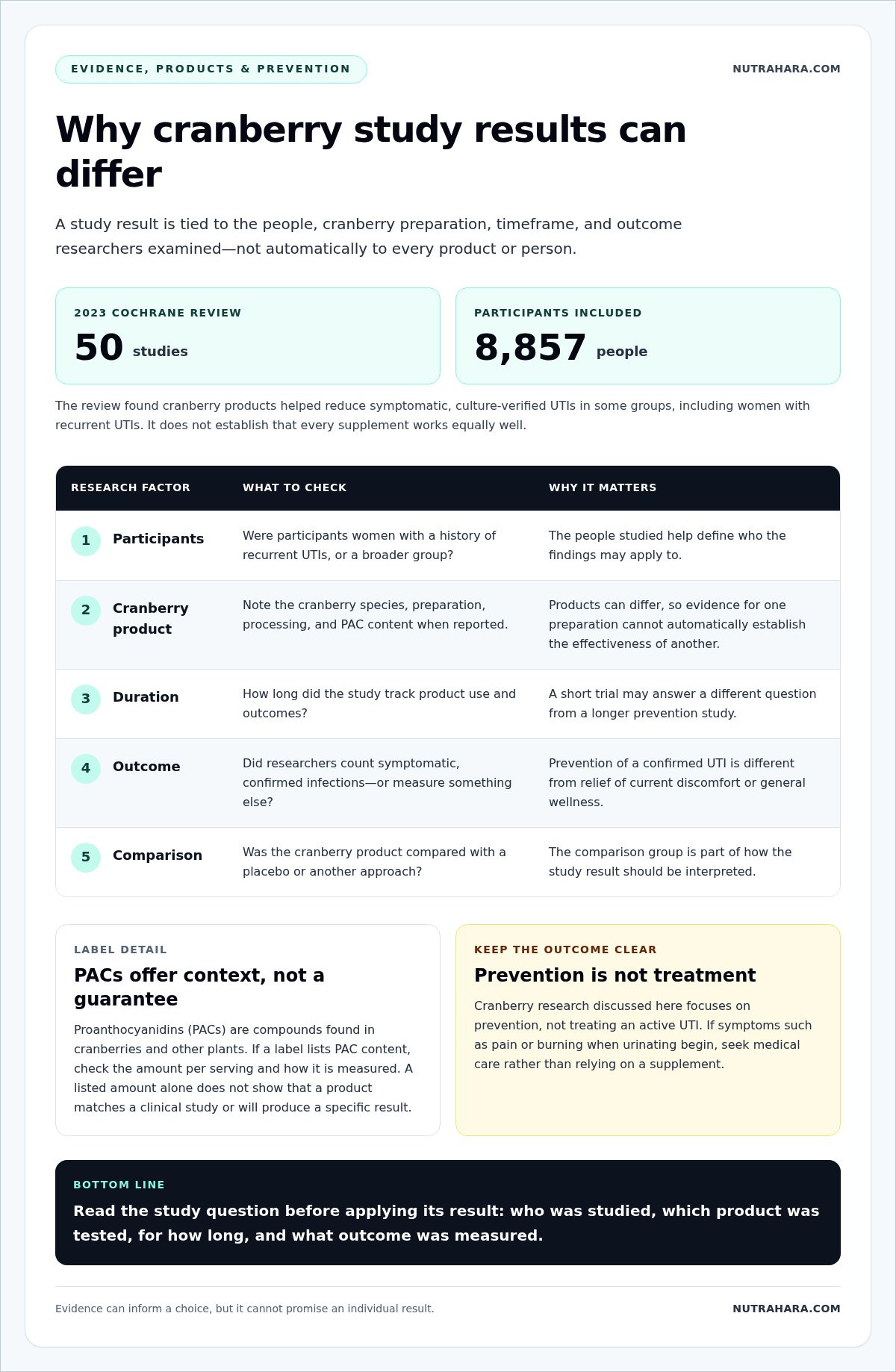
Cranberry supplements are products made with cranberry fruit ingredients, such as powders or extracts, and are studied for outcomes including UTI recurrence. Much of the research concerns the North American cranberry, Vaccinium macrocarpon, though species and preparations can vary between products. For botanical background, see Cranberry – Wikipedia. A 2023 Cochrane review of 50 studies involving 8,857 participants found cranberry products helped reduce symptomatic, culture-verified UTIs in some groups, including women with recurrent UTIs. That result doesn’t establish that every supplement works equally well.

What does cranberry supplement effectiveness mean?

For cranberry supplements effectiveness to mean something useful, the outcome needs to be clear. A study might measure whether participants experience another confirmed UTI over a set period. That’s different from asking whether cranberry relieves current discomfort or supports general wellness. Results can depend on the participants, the cranberry formulation, and the question researchers set out to answer. Evidence for one preparation can’t automatically be applied to every product on a shelf.

Cranberry supplements and urinary health are not the same as vaginal pH

The urinary tract and vagina are separate parts of the body, with different functions and health considerations. Evidence about cranberry and UTI prevention doesn’t show that cranberry supplements restore vaginal pH or treat vaginal symptoms or conditions. If you’re looking for information about that separate topic, read our guide to vaginal pH balance. Keeping these questions distinct helps you focus on support that matches your concern.

How cranberry supplements may work, and what research actually measures

Cranberry research looks at more than whether someone takes a capsule. Researchers also consider who takes it, how the cranberry ingredient is prepared, how long it’s used, and what outcome is measured. These details help explain why a result from one study may not predict what another woman will experience.

One proposed mechanism is that certain cranberry compounds may make it harder for some bacteria, particularly E. coli, to adhere to the urinary tract lining. This explanation is under study; it doesn’t prove that a supplement will prevent an infection for any individual. The 2023 Cochrane review discusses cranberry products in the context of UTI prevention, with evidence tied to the populations and products studied. Read the Cochrane review.

What are proanthocyanidins, and why do supplement labels mention them?

Proanthocyanidins, often shortened to PACs, are compounds found in cranberries and other plants. Cranberry research has focused in particular on A-type PACs and their possible role in bacterial adhesion. A label that lists PAC content gives you more information about a formula, but a number alone doesn’t show that the product matches a clinical study or will produce a specific result. Check whether the label states the amount per serving and explains how it’s measured.

Why cranberry study results can differ

Study results are easier to interpret when you look at the design, not just the headline. Check what kind of cranberry product was tested and whether it was compared with a placebo or another approach. Consider:

  • Participants: Were they women with a history of recurrent UTIs, or a broader group?
  • Duration: How long did the study track use and outcomes?
  • Outcome: Did researchers count symptomatic, confirmed infections, or measure something else?

Products can differ in cranberry species, processing, and PAC content, so findings for one preparation can’t automatically establish the effectiveness of another. Study duration and comparison groups matter too: a short trial may answer a different question from a longer prevention study. Together, these factors shape what cranberry supplements effectiveness means in practice. Evidence can inform a considered choice, but it can’t promise an individual result.

Cranberry supplements vs. juice: how to compare the options

Capsules, juice, and whole cranberries aren’t interchangeable. They differ in serving format, ingredient concentration, and how easily you can assess what you’re consuming. The FDA’s qualified health claim for cranberry juice applies to a specific beverage serving and describes the evidence as limited and inconsistent. That claim doesn’t establish that every juice or supplement offers the same benefit.

Option Convenience and serving What to check Evidence limitation
Supplement capsules Compact, pre-portioned format Cranberry ingredient, serving details, and any PAC information Formulas vary; a label amount doesn’t prove the product matches a studied preparation.
Cranberry juice Drinkable, but requires a pour and a serving Percentage of cranberry juice, serving size, and Nutrition Facts, including Added Sugars Juices and juice cocktails differ in composition; evidence for juice is limited and inconsistent.
Whole or dried cranberries Easy to add to meals or snacks Whether the product is sweetened and how it fits your dietary needs Eating cranberries isn’t automatically equivalent to taking a studied supplement or juice.

Which details on a cranberry supplement label deserve attention?

Look for a clearly named cranberry ingredient and an understandable serving size. If the label lists proanthocyanidins (PACs), check whether it states the amount per serving and explains what that measure refers to. A front-label phrase such as “urinary support” isn’t evidence of a particular outcome. If a brand mentions third-party testing, look for specifics about what was tested. Testing may speak to product quality, but it doesn’t by itself show that the supplement prevents UTIs.

When might juice or whole cranberries suit someone better?

Juice may suit you if you prefer a drink, while whole or dried cranberries can fit into meals and snacks. Check juice labels because cranberry beverages vary, and some contain added sugars. The FDA requires Added Sugars to appear on Nutrition Facts labels, so compare the serving information with your dietary priorities. Whole fruit can be a food choice, but it shouldn’t be treated as a guaranteed preventive measure.

There’s no universally best format. Consider which option fits your routine, what its label tells you, and what outcome the evidence studied. For a broader framework for choosing supplements as part of women’s wellness, explore this women’s wellness supplements guide.

Safety, life stages, and when cranberry supplements are not enough

Your health needs can change across menstruation, pregnancy, breastfeeding, perimenopause, and postmenopause. Those stages don’t automatically determine whether cranberry is appropriate, but they make personal context important. Evidence about cranberry supplements effectiveness doesn’t establish that every woman will benefit or that every formulation is suitable for her.

A practical step is to keep a brief record of urinary symptoms, any supplements you take, and when you take them. Note changes and questions to discuss with a qualified healthcare professional. This can make a conversation more useful, especially if you’re managing a health condition or taking medication.

What should women consider during pregnancy, lactation, or medication use?

If you’re pregnant, trying to conceive, or breastfeeding, seek individualized professional guidance before starting a cranberry supplement. The 2023 Cochrane review did not find evidence supporting cranberry use to prevent UTIs in pregnant women. That finding concerns evidence of benefit, not a blanket safety verdict. Medication questions also depend on your circumstances and the specific product, so review the label with a qualified healthcare professional rather than assuming a supplement is risk-free or unsuitable for everyone.

Menstruation, perimenopause, and postmenopause also don’t create one uniform need for cranberry. Consider your symptoms and overall health rather than treating life stage alone as a reason to start or avoid a supplement.

When should urinary symptoms prompt medical care?

Cranberry supplements aren’t a substitute for assessment or treatment of a urinary infection. Seek prompt medical evaluation for urinary symptoms such as pain or burning during urination, frequent or urgent need to urinate, or symptoms that are severe or getting worse. Don’t wait to see whether a supplement helps. A healthcare professional can assess what’s happening and advise on appropriate care.

Keep your notes brief: record when symptoms began, how they change, and any supplements or medicines you use. This isn’t a way to diagnose yourself; it’s a practical aid for sharing clear information during care. Supplement decisions are one part of wellbeing, alongside habits such as movement, nourishing meals, and restorative practices. Explore Nutrahara’s women’s wellness approach.
Do Cranberry Supplements Work? What the Evidence Says

A grounded way to decide whether cranberry supplements fit your wellness routine

A thoughtful decision starts with your goal, not a bold promise on a bottle. Use this framework to assess cranberry supplements effectiveness in the context of your health and routine:

  • Define your goal. Are you considering prevention because you experience recurrent UTIs, or hoping to ease symptoms you have now? Supplements aren’t a treatment for an active infection.
  • Review the evidence. Check whether research studied the outcome and population relevant to you. Findings for one cranberry preparation don’t automatically apply to every product.
  • Assess label clarity. Look for clear ingredient and serving information. Vague promises or a listed PAC amount alone can’t guarantee a clinical benefit.
  • Consider your personal context. Your health history, life stage, and medicines matter. Discuss personal safety questions with a qualified healthcare professional.

Reassess from time to time. Keep a brief note of what you take and any changes in your symptoms or routine so you can discuss them with a healthcare professional. A supplement decision can change as your needs do.

Support whole-person wellness without overstating cranberry’s role

Small, repeatable habits can make wellness feel more manageable. Try a gentle yoga stretch after a walk, or set aside a quiet moment to focus on your breathing. Choose movement, balanced meals, and restorative sleep in ways that fit your life. Yoga and meditation can support general wellbeing, but they aren’t treatments for urinary infections or proven alternatives to medical care.

Personal stories can offer connection, but they aren’t clinical evidence. Use testimonials only when a woman’s account is verified and shared with her permission. For a practical example, if you’re comparing two labels, note the cranberry ingredient, serving details, and any PAC information, then discuss the product with a qualified healthcare professional if you have safety questions. Nutrahara’s approach to women’s wellness brings Ayurvedic principles together with modern nutritional research. Explore the women’s wellness supplement guide as you make informed choices for your health.

Make your next wellness choice with confidence

Cranberry supplements may help reduce the risk of recurrent UTIs for some women, but the evidence is limited and doesn’t mean every product will work the same way. The clearest way to assess cranberry supplements effectiveness is to look at the outcome studied, the formulation, and whether the research applies to your circumstances. Cranberry isn’t a treatment for urinary symptoms, and personal safety questions deserve guidance from a qualified healthcare professional.

Choose thoughtfully: clarify your goal, read the label beyond its front-facing claims, and consider your health history and life stage. Sustainable habits such as regular movement, restorative sleep, balanced nutrition, yoga, and meditation can also support overall wellbeing, though they don’t treat infections.

Nutrahara focuses on women’s health supplements, combining Ayurvedic principles with modern nutritional research. Explore Nutrahara’s approach to women’s wellness and build a routine grounded in care, curiosity, and confidence.

Frequently Asked Questions

Do cranberry supplements really help prevent urinary tract infections?

Cranberry products may help reduce the risk of recurrent UTIs in some groups, including women with recurrent infections, but the evidence is limited and results aren’t guaranteed. A 2023 Cochrane review found a preventive benefit for certain populations. The phrase cranberry supplements effectiveness should be understood in that context: research examines prevention in studied groups, not a promise that every supplement will work for every woman.

Are cranberry pills more effective than cranberry juice?

There isn’t enough evidence to say that pills are universally more effective than juice. The FDA’s qualified health claim for cranberry juice describes the evidence as limited and inconsistent. Claims about different product formats aren’t proof from a direct comparison that one is best. Formulation and serving information matter, so compare labels rather than assuming the options are interchangeable.

How much cranberry supplement should I take?

There isn’t one dose established as right for everyone. The FDA’s qualified health claim for cranberry dietary supplements is based on a daily intake of 500 mg, but that figure relates to the claim’s evidence and isn’t personalized dosing advice or a guarantee of benefit. Products may differ in ingredients and formulation. Follow the product label, and ask a qualified healthcare professional what’s appropriate for your health context.

Can cranberry supplements treat a urinary tract infection?

No. Cranberry supplements haven’t been established as a treatment for an active UTI, and they shouldn’t replace medical assessment or treatment. If you notice pain or burning when urinating, frequent or urgent urination, or symptoms that are severe or worsening, seek prompt medical care. Don’t wait to see whether cranberry helps. A healthcare professional can assess your symptoms and advise you on appropriate next steps.

Are cranberry supplements safe during pregnancy or breastfeeding?

Ask a qualified healthcare professional before using cranberry supplements during pregnancy or breastfeeding. The 2023 Cochrane review did not find evidence supporting cranberry products for UTI prevention in pregnant women; this is not the same as proving universal harm or safety. Individual health circumstances and product formulations vary. Bring the product label and a list of other supplements or medicines to your discussion so you can receive guidance tailored to you.

Can cranberry supplements interact with medications?

Whether a cranberry supplement is suitable alongside your medication depends on your personal circumstances and the specific product. Don’t assume a supplement is interaction-free because it contains a natural ingredient. Before starting it, show the full label to a qualified healthcare professional or pharmacist and ask about your medicines and health history. If the formula combines cranberry with other ingredients, include those in the discussion too.

Do cranberry supplements help with vaginal pH or vaginal health?

There isn’t established evidence here that cranberry supplements restore vaginal pH or treat vaginal conditions. Research on cranberry has focused on urinary tract outcomes, which are distinct from vaginal health. If you’re concerned about vaginal symptoms or pH, seek advice from a qualified healthcare professional rather than trying to address them with a cranberry supplement. Keeping urinary and vaginal health questions separate can help guide the right next step.

Article by

Nutrahara Team

We are a dedicated collective of nutrition scientists and naturopaths at Nutrahara, committed to advancing women's health through the fusion of ancient Ayurveda science and cutting-edge nutrition research. Our mission is to empower you with clean, simple, and scientifically validated wellness solutions so you can live your healthiest life. Connect with us to stay updated on the latest developments in holistic women's health and nature-based research.

Disclaimer

This article is not a substitute for medical advice. Please consult a healthcare professional before starting any supplement, especially if pregnant, nursing, taking medication, or managing health conditions.

Categories
Articles

Natural Remedies for Recurrent UTIs: What Helps and What Doesn’t

The most appealing natural remedy may not be the one with the strongest evidence. If recurrent urinary symptoms are disrupting your sleep, workouts, or daily routine, it’s understandable to look for gentler ways to prevent another episode. But natural remedies for recurrent UTIs vary in how well they’re supported, and some shouldn’t replace testing or treatment.

You deserve clear guidance, not a longer list of conflicting supplement advice. The right prevention plan depends on what’s causing your symptoms, your health history, and your stage of life, including pregnancy, lactation, or menopause. Repeated symptoms can have more than one explanation, so checking in with a clinician can help you avoid unnecessary treatment or delays in care.

This guide compares practical prevention options, including cranberry, D-mannose, and probiotics, and explains where the evidence has limits. You’ll also learn when medical assessment matters, which symptoms call for prompt attention, and how to build a sustainable plan with your clinician. The goal is informed care that supports your well-being without asking you to manage recurring symptoms alone.

Key Takeaways

  • Track when symptoms occur and discuss recurring episodes with a clinician, since urinary symptoms can have causes other than infection.
  • Compare natural remedies for recurrent UTIs based on the evidence for prevention and understand where research remains uncertain.
  • Consider cranberry as a possible prevention option, not a way to treat an active infection.
  • Ask whether urine testing or culture could help clarify your symptoms and guide a prevention plan suited to your health and life stage.
  • Build practical habits around your routine, but don’t treat supplements as a substitute for diagnosis or care when symptoms arise.

Natural Remedies for Recurrent UTIs: Start With the Right Diagnosis

Repeated burning or urgency can be exhausting, especially when symptoms interrupt exercise, sleep, or a busy day. Before choosing natural remedies for recurrent UTIs, it helps to establish whether the episodes are bacterial infections. Other conditions can cause similar urinary symptoms, so prevention is most useful when it’s based on a clear picture of what’s happening.

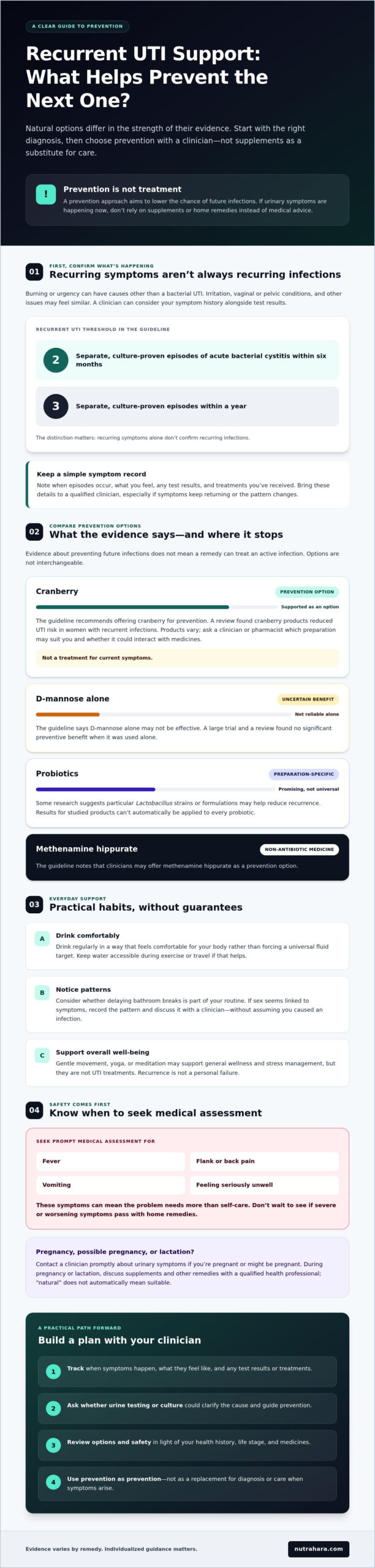
Prevention aims to lower the chance of future infections; it doesn’t diagnose or treat an active UTI. If symptoms are happening now, don’t rely on supplements or home remedies instead of medical advice.

What counts as a recurrent urinary tract infection?

The 2025 AUA/CUA/SUFU recurrent UTI guideline uses a threshold of two separate, culture-proven episodes of acute bacterial cystitis within six months, or three within a year. The distinction matters: recurring symptoms alone don’t confirm recurring infections. Irritation, vaginal or pelvic conditions, and other issues can cause similar discomfort. A clinician can assess your symptom history alongside test results.

Note when episodes occur, what symptoms you experience, any test results, and treatments you’ve received. Bring those details to a qualified clinician, especially if symptoms keep returning or the pattern changes. The overview of recurrent urinary tract infections offers general background, but it doesn’t replace individualized medical advice.

When symptoms need prompt medical attention

Seek prompt medical assessment for fever, flank or back pain, vomiting, or feeling seriously unwell. These symptoms can mean the problem needs more than self-care. Don’t manage severe or worsening symptoms with home remedies while waiting to see if they pass.

If you’re pregnant or might be pregnant, contact a clinician promptly about urinary symptoms. Pregnancy changes the care considerations, so check before using supplements or other remedies. The same applies during lactation: discuss products with a qualified health professional rather than assuming “natural” means suitable for you.

A clear diagnosis doesn’t dismiss your experience. It gives you and your clinician a safer foundation for deciding what to do during symptoms and which prevention approaches may fit your health and life stage.

Which Natural UTI Prevention Options Have the Best Evidence?

Natural remedies for recurrent UTIs aren’t interchangeable, and evidence for preventing future infections doesn’t mean a remedy can treat an active infection. The 2025 AUA/CUA/SUFU guideline recommends offering cranberry as a prevention option, says D-mannose alone may not be effective, and notes that clinicians may offer methenamine hippurate, a non-antibiotic medicine. Cranberry may help lower future UTI risk, but it isn’t a treatment for current symptoms. D-mannose alone hasn’t shown reliable preventive benefit in recent studies. Probiotics remain an option with promising but preparation-specific evidence.

Cranberry, D-mannose, and probiotics: what the evidence can say

A 2023 Cochrane review found cranberry products reduced UTI risk in women with recurrent infections. Products vary, so ask a clinician or pharmacist which preparation may suit you and whether it could interact with medicines you take. The 2025 guideline’s caution on D-mannose reflects a large 2024 trial and a 2025 review that found no significant preventive benefit when it was used alone.

Some research suggests particular Lactobacillus probiotics may help reduce recurrence, but results for studied strains or formulations can’t automatically be applied to every product. A consumer-friendly overview of natural and alternative treatments for UTIs can help you identify options to discuss, not choose a treatment on its own. Before starting a supplement, check its safety and possible interactions with a qualified clinician, especially if you’re pregnant, breastfeeding, or taking medication.

Hydration and everyday habits: useful, but not guaranteed prevention

Drink regularly in a way that feels comfortable for your body rather than forcing a universal fluid target. You might keep water accessible during exercise or travel and notice whether delaying bathroom breaks is part of your routine. If sex seems linked to symptoms, record the pattern and discuss it with a clinician without assuming you’ve caused an infection.

Habits can support general well-being, but evidence for common prevention tips varies, and recurrence isn’t a personal failure. Gentle movement, yoga, or meditation may support overall wellness and stress management, but they aren’t UTI treatments. Choose manageable habits, and seek medical guidance for recurring symptoms rather than relying on lifestyle changes or supplements alone.

Natural Remedies vs. Medical Prevention for Recurrent UTIs

Choosing a natural approach doesn’t mean avoiding medical care. A clinician-led review can help confirm whether episodes are bacterial infections, identify patterns, and weigh prevention choices that fit your health history. Treating familiar symptoms on your own repeatedly may miss another cause or delay appropriate care. Natural remedies for recurrent UTIs may be part of a prevention discussion, but they can’t replace assessment or treatment when an infection is active.

What to ask about testing and a prevention plan

Bring a concise record of symptom dates, how long they lasted, possible triggers, treatments, and previous urine test or culture results. Note whether symptoms followed sex, travel, exercise, or a change in routine. These details can make the conversation more useful and help distinguish a recurring pattern from symptoms with a different cause.

You might ask whether a urine test or culture would be helpful during an episode, how the results could affect treatment, and which prevention options suit your circumstances. Testing isn’t the same for everyone; clinicians decide which assessments and treatments are appropriate based on symptoms, history, and individual risk factors. Depending on your situation, prevention discussions may include cranberry, methenamine hippurate, or clinician-directed antibiotic strategies. Methenamine is a non-antibiotic medicine, not a natural remedy. Ask about expected benefits, possible side effects, and how to review whether a plan is helping.

Life-stage considerations, including menopause and pregnancy

Your life stage can change which options are suitable. For peri- and postmenopausal women with recurrent UTIs, the 2025 AUA/CUA/SUFU guideline recommends discussing vaginal estrogen when there are no contraindications. It’s a clinician-guided option, not an over-the-counter supplement, and your own history should shape the conversation.

Pregnancy or possible pregnancy calls for prompt clinician guidance about urinary symptoms. If you’re pregnant or lactating, check before starting supplements or changing prescribed medicines. Don’t assume a product is appropriate simply because it’s described as natural. Share everything you take, including herbal products and vitamins, so a clinician can consider potential interactions and your individual needs.

A prevention plan should support your life, not leave you choosing between wellness and evidence-based care. You can discuss your preferences and consider natural and medical options together, with a qualified clinician helping you decide what belongs in your plan.

A Practical, Safe Plan for Lowering Recurrence Risk

A steady plan can make repeated episodes easier to discuss and help you make informed choices. These steps won’t guarantee prevention, but they can support a clearer conversation with your clinician.

  1. Keep a private health log. Record symptom dates, what you noticed, urine test results, and treatments. Note timing around exercise, travel, sex, or other routine changes.
  2. Look for patterns, not proof. A symptom following a particular activity may be worth mentioning, but timing alone doesn’t confirm that the activity caused an infection.
  3. Review options and evidence. Ask what each prevention approach is intended to do, how strong the evidence is, and whether it fits your health history and life stage.
  4. Agree on next steps with a clinician. Bring your notes and discuss whether testing or a prevention plan makes sense for you.

Build small habits around your routine

Keep water accessible during workouts or travel and take bathroom breaks when practical, without forcing fluids or interrupting activities unnecessarily. If symptoms seem to follow intimacy, note the pattern and ask a clinician what steps may be appropriate. A short phone note can make tracking easier during busy weeks. These habits may support comfort and awareness, but they can’t promise to prevent infection or replace medical assessment.

Evaluate supplements with care

Before trying natural remedies for recurrent UTIs, read the full label. Check the ingredients, amounts, cautions, and suggested use, then ask a clinician or pharmacist about possible interactions with medicines or other supplements. This is especially important during pregnancy or lactation. Be cautious of products claiming to cure an active infection or replace prescribed treatment. Check that the product’s ingredients and quality information are clear, and don’t assume evidence for one preparation applies to every product.

Nutrahara sells women’s health supplements for broader wellness, but its supplements aren’t established as UTI prevention or treatment. If you’re interested in women’s wellness products, explore Nutrahara’s women’s health supplements separately from care for urinary symptoms.

Natural Remedies for Recurrent UTIs: What Helps and What Doesn’t

Choosing Your Next Step for Recurrent UTI Support

Your next step depends on what’s happening now. Sustainable habits can support general well-being, and evidence-informed prevention options are worth discussing if infections keep returning. But ongoing or new urinary symptoms deserve appropriate medical assessment. Supplements aren’t a substitute for diagnosing or treating an active infection, even if they’re marketed as natural.

A vaginal pH balance guide may offer general information about vaginal health, but it can’t diagnose or treat a UTI. If you’re unsure whether symptoms are urinary or vaginal, ask a clinician rather than trying to identify the cause through an online guide alone.

Questions to take to a clinician

Bring your episode notes and use this checklist to guide the conversation:

  • Have my repeated episodes been confirmed as UTIs, and what testing might be appropriate?
  • Could my health history, medication or supplement use, or life stage affect the prevention options available to me?
  • If I’m pregnant, might be pregnant, or am breastfeeding, what should I know before using any remedy?
  • If I’m peri- or postmenopausal, is vaginal estrogen an appropriate topic to discuss for me?
  • Which prevention approaches fit my preferences, and what are their limits or possible risks?
  • What symptoms should prompt urgent care, and what should I do if symptoms return?

Your clinician can help decide whether urine testing, culture, or a particular treatment is suitable for your situation. The goal isn’t to choose between natural care and medical care. It’s to make an informed plan that reflects your symptoms, preferences, and health needs.

Support your broader wellness without confusing it with UTI treatment

Regular movement that suits your body, restorative sleep, and stress-supporting practices such as yoga or meditation can be meaningful parts of overall wellness. They aren’t proven treatments for an active UTI and shouldn’t be presented as guaranteed prevention. Choose routines that feel sustainable, not like another demand on a busy day.

Natural remedies for recurrent UTIs should be considered with clear expectations and clinician guidance where needed. Nutrahara sells women’s health supplements, but its supplements aren’t established as UTI prevention or treatment. For broader wellness interests, explore Nutrahara’s women’s health supplements separately from care for urinary symptoms.

Take Your Next Step With Confidence

Recurring urinary symptoms deserve a plan grounded in the right diagnosis, not guesswork. Evidence for natural remedies for recurrent UTIs varies: cranberry may be worth discussing for prevention, while other supplements have important evidence limits. None should be relied on to treat an active infection. Tracking symptoms and bringing your questions to a clinician can help you choose prevention options that fit your health, medications, and life stage.

Wellness is personal, and thoughtful care can include medical guidance and habits that support your wider well-being. Nutrahara focuses on women’s health supplements made with natural ingredients, combining Ayurvedic principles with modern nutritional research. Its supplements aren’t established as UTI prevention or treatment, so keep UTI concerns in conversation with a qualified clinician.

Explore Nutrahara’s women’s wellness resources for broader wellness inspiration, separate from care for UTI symptoms.

Frequently Asked Questions

Can natural remedies prevent recurrent UTIs?

Some approaches may help lower recurrence risk, but they don’t work for everyone or guarantee prevention. The 2025 AUA/CUA/SUFU guideline recommends offering cranberry as a prevention option; evidence for other supplements varies. Natural remedies for recurrent UTIs are for prevention discussions, not treatment of an active infection. Ask a clinician whether an option suits your health history, medications, and life stage.

Does cranberry juice get rid of a UTI?

No. Cranberry products may help reduce the risk of future UTIs for some women with recurrent infections, but cranberry juice doesn’t treat an active infection. The research concerns prevention, and products can differ in their formulation. If you have urinary symptoms, contact a qualified clinician about assessment and treatment rather than relying on juice or waiting to see if symptoms resolve.

Is D-mannose effective for recurrent UTIs?

D-mannose alone may not prevent recurrent UTIs. The 2025 AUA/CUA/SUFU guideline advises clinicians to explain that it may not be effective, reflecting recent trial and review findings that didn’t show significant benefit. Evidence can change, and individual health factors matter. Before trying D-mannose, discuss its potential role, safety, and possible interactions with a clinician or pharmacist.

What should I do if UTI symptoms keep coming back?

Arrange a clinician review rather than repeatedly self-diagnosing. Keep a record of when symptoms occur, any urine test results, and treatments you’ve used. Ask whether the episodes have been confirmed as infections and whether testing or a prevention plan is appropriate. Seek prompt care for fever, flank or back pain, vomiting, or feeling seriously unwell; don’t try to manage severe or worsening symptoms at home.

Can I treat a UTI naturally while pregnant?

Don’t try to treat a suspected UTI with natural remedies alone during pregnancy. Contact a clinician promptly about urinary symptoms, and check before taking supplements or changing any prescribed treatment. “Natural” doesn’t automatically mean suitable during pregnancy, and delaying assessment can be risky. If you might be pregnant, follow the same careful approach and get individualized medical guidance.

Can menopause increase the chance of recurrent UTIs?

Perimenopause and menopause can bring changes in vaginal and urinary tissues that may contribute to UTI risk. For appropriate peri- and postmenopausal women with recurrent infections, the 2025 AUA/CUA/SUFU guideline recommends discussing vaginal estrogen when there are no contraindications. It’s a clinician-guided option, not a supplement. Ask whether it fits your health history and what alternatives may be suitable.

Are probiotics proven to prevent recurrent UTIs?

Not all probiotics are proven to prevent UTIs. Research has found promising results for some specific Lactobacillus strains and preparations, but those findings can’t be assumed to apply to every product. Probiotics aren’t a treatment for an active infection. If you’re considering one for prevention, ask a clinician or pharmacist about the studied formulation, safety, and possible interactions with your medicines.

Article by

Nutrahara Team

We are a dedicated collective of nutrition scientists and naturopaths at Nutrahara, committed to advancing women's health through the fusion of ancient Ayurveda science and cutting-edge nutrition research. Our mission is to empower you with clean, simple, and scientifically validated wellness solutions so you can live your healthiest life. Connect with us to stay updated on the latest developments in holistic women's health and nature-based research.

Disclaimer

This article is not a substitute for medical advice. Please consult a healthcare professional before starting any supplement, especially if pregnant, nursing, taking medication, or managing health conditions.