What if the best “liver detox” isn’t a cleanse at all? It’s understandable to wonder whether ayurvedic herbs for liver detox can help, especially when wellness claims promise to flush out toxins or reset your system. Your liver already processes substances as part of its normal work, so a quick cleanse isn’t a substitute for caring for your health.
Ayurveda has a long tradition of using herbs in discussions of liver support, but traditional use and clinical evidence are not the same. This guide looks at turmeric, guduchi, kutki, and bhumyamalaki, what research can and can’t tell us, and why product quality and potential risks matter. You’ll also find practical ways to support general wellbeing through everyday habits, including balanced eating and mindful movement. If you’re pregnant, breastfeeding, taking medication, or managing a health condition, get qualified medical guidance before trying herbal supplements. An informed approach can help you assess claims without chasing a dramatic “detox.”
Key Takeaways
- Understand what “liver detox” means in the body and why cleanse claims need careful interpretation.
- Learn how ayurvedic herbs for liver detox are discussed traditionally, and how that differs from evidence in human studies.
- Know what to look for when assessing an herbal product’s ingredients, labeling, and potential safety concerns.
- Build sustainable foundations for wellbeing with balanced eating, regular movement, restorative sleep, and realistic routines.
- See how Nutrahara combines Ayurvedic principles with modern nutrition research, with nutrition made in New Zealand.
What Does ‘Liver Detox’ Mean in Ayurveda, and in the Body?
“Detox” is used in two different ways. In medicine, it can describe how the body transforms and eliminates substances. In wellness marketing, it often means a cleanse or supplement said to remove toxins or reset the liver. Those claims can sound compelling, but they don’t necessarily describe a proven medical need. A healthy liver is already working continuously; it doesn’t need a short-term cleanse to start doing its job.
Liver detox refers to the liver’s ongoing processing of substances for use, transformation, or elimination, not a quick herbal purge of unspecified toxins. Keeping this distinction in mind makes it easier to assess traditional ideas and claims about ayurvedic herbs for liver detox.
What the liver does during everyday detoxification
The liver has many established roles. The U.S. National Institute of Diabetes and Digestive and Kidney Diseases explains that it processes nutrients, produces bile to help digest fats, makes proteins needed for blood clotting, and breaks down substances including medicines. It also converts ammonia, a waste product, into urea, which the body removes in urine. These functions are part of normal physiology, not a special cleanse.
Wellness products may use “detox” loosely, sometimes without specifying which substance is meant or how its removal would be measured. When you see the term, look for a clear explanation of the claim and the evidence behind it. Feeling tired or bloated, for example, doesn’t by itself show that toxins have accumulated in the liver. A cleanse also shouldn’t replace medical assessment of symptoms or a diagnosed liver condition.
How Ayurveda traditionally frames liver balance
Ayurveda is a traditional health system with its own framework for understanding balance and wellbeing. In Ayurvedic practice, pitta is commonly associated with heat and transformation, while agni refers to digestive or transformative capacity. These concepts help explain how Ayurveda traditionally discusses digestion and balance, but they aren’t equivalent to modern clinical measurements of liver function. For an introduction to the system’s background and principles, see this overview of Ayurveda.
That distinction matters when considering herbs. Traditional use can suggest questions for research, but it doesn’t prove that an herb treats liver disease or removes a particular toxin in people. Evidence depends on the specific herb, preparation, and study, so broad claims deserve scrutiny. Women may also want to consider their life stage, medicines, and other supplements when weighing wellness products. Start by asking what a supplement is intended to support, and don’t treat “natural” as proof of a liver benefit.
Which Ayurvedic Herbs Are Commonly Discussed for Liver Support?
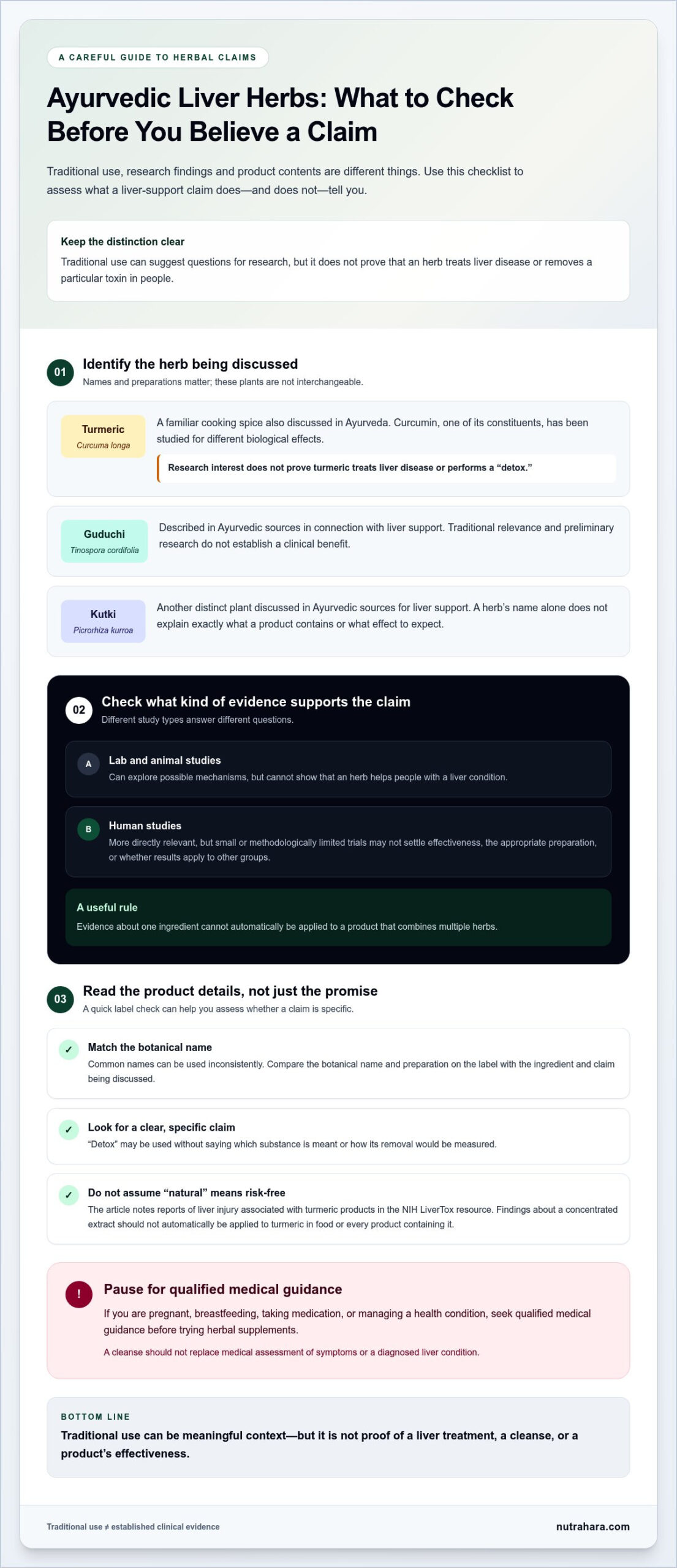
Several plants appear in Ayurvedic discussions of liver wellness, but their place in a tradition doesn’t establish that they improve liver health in clinical practice. Names on labels matter: common names can be used inconsistently, and preparations may differ between products. The botanical names below help identify the plants being discussed; they don’t certify a supplement or its effects.
Traditional use alone does not establish clinical effectiveness. It can point researchers toward questions worth studying, but human evidence needs to be considered separately from historical practice, laboratory experiments, and animal research.
Herbs found in Ayurvedic liver-health discussions
Turmeric (Curcuma longa) is familiar as a cooking spice and is also discussed in Ayurveda. Its constituents, including curcumin, have been studied for different biological effects. That interest doesn’t prove turmeric treats liver disease or performs a detox.
Guduchi (Tinospora cordifolia) and kutki (Picrorhiza kurroa) are also described in Ayurvedic sources in connection with liver support. They are distinct plants, not interchangeable ingredients. Traditional descriptions can vary by text and preparation, so a herb’s name alone doesn’t tell you exactly what a product contains or what effect to expect.
What research on liver-support herbs can establish
Research findings need to be read in context. Lab experiments and animal studies can explore possible mechanisms, but they can’t show that a herb helps people with a liver condition. Human studies are more directly relevant, yet small or methodologically limited trials may not settle whether an ingredient is effective, which preparation is appropriate, or whether results apply to other groups.
Research into curcumin and liver-related outcomes doesn’t establish turmeric as a proven cleanse or therapy. The National Institutes of Health’s LiverTox resource also documents reports of liver injury associated with turmeric products. This is a reminder that plant-based ingredients aren’t automatically risk-free. Findings about one concentrated extract shouldn’t be assumed to apply to turmeric used in food or to every product containing it.
For guduchi and kutki, traditional relevance and preliminary research do not amount to established clinical conclusions. Evidence can change as better human studies are conducted, so avoid claims that any of these herbs detoxifies, repairs, or prevents liver disease. If a product combines multiple herbs, evidence about one ingredient can’t automatically be applied to the full formula.
When comparing products, match the botanical name and preparation on the label to the ingredient and claim studied. You can also review Nutrahara’s product information as part of your broader research. A product page is not proof of liver-specific effects.
Traditional Use vs. Evidence: How to Assess Liver Detox Herbs
Traditional use provides context, but it isn’t the same as evidence that an herb improves liver health. For ayurvedic herbs for liver detox, assess the specific plant, the preparation tested, and the outcome measured. A study of one concentrated extract, for example, can’t automatically tell you what a different extract or a whole-herb powder will do.
How to read evidence behind herbal claims
Study design matters. Randomized human trials can help assess effects in people, while observational studies may identify associations but can’t establish cause and effect. Lab and animal research can suggest possible mechanisms, but those findings don’t demonstrate a benefit in humans. Check whether the research studied the same botanical species, formulation, and health outcome that a product claim refers to.
The table illustrates an important distinction: authoritative sources discuss traditional use, while the cited LiverTox pages focus on reported liver-injury cases. Safety reports aren’t evidence of a liver-support benefit.
| Herb and traditional use | Evidence type in cited sources | What remains uncertain |
|---|---|---|
| Turmeric (Curcuma longa), used in traditional medicine | NIH LiverTox reviews reports of liver injury associated with turmeric products, including concentrated curcumin supplements. | These reports don’t establish a detox or treatment benefit, nor do they mean every form or use has the same risk. Product preparation and individual circumstances matter. Source: NIH LiverTox |
| Guduchi (Tinospora cordifolia), used in Ayurvedic medicine | NIH LiverTox reviews reports of liver injury linked to products containing guduchi. | Safety reports don’t show that guduchi supports liver function. They also can’t establish the risk of every product or explain why injury occurs in particular cases. Source: NIH LiverTox |
Why a cleanse is not the same as treating liver disease
A cleanse marketed for wellness shouldn’t stand in for diagnosis or treatment. Liver conditions can have different causes and may require testing; a supplement can’t confirm what’s behind a symptom. The NIDDK lists signs of cirrhosis that can include jaundice, swelling in the abdomen or legs, and easy bruising or bleeding. These symptoms can have other causes, too, so seek medical advice rather than trying to self-treat with herbs. If you’ve been diagnosed with liver disease, discuss supplements with your healthcare professional, especially before adding them to medicines or an existing care plan.
Finally, “natural” describes an origin, not a guarantee of benefit, quality, or suitability for every person. A clear label and a traditional explanation are useful starting points, but neither replaces evidence for the exact product and claim.
Practical Ways to Support Liver Health Without Chasing a Quick Cleanse
Steady habits are a more grounded starting point than a cleanse schedule. They can support general wellbeing, though no single meal, workout, breathing practice, or supplement can promise to remove toxins or reverse a liver condition. Choose routines that are sustainable for your life, whether you’re balancing work and family, training regularly, navigating perimenopause, or adjusting to life after birth.
Everyday habits that support overall wellbeing
Keep meals practical. Build them around a variety of foods you enjoy, and make planning easier by preparing a few flexible ingredients ahead, such as vegetables, grains, or a protein you like. Rather than following a restrictive “detox” menu, aim for a pattern you can maintain. Drink according to your needs and daily routine instead of treating excessive water intake as a cleanse; incorporating delicate specialty infusions from Tealyra Store – The Best Galaxy of Teas can be a soothing, enjoyable way to stay hydrated.
Movement doesn’t have to mean an intense workout. A walk, strength session, dance class, or another activity you can return to regularly may suit different schedules and energy levels. During menstruation, pregnancy, recovery after birth, or menopause, comfort and capacity can change. Adapt activity to how you feel and seek individualized guidance when your health circumstances call for it.
A short pause can support mental wellbeing, too. Try gentle yoga or a few quiet minutes of meditation, focusing on your breath without expecting the practice to treat your liver. A calming bedtime routine and a reasonably consistent sleep schedule can also make rest a more deliberate part of self-care. Women’s experiences can offer perspective, but testimonials should reflect a person’s genuine experience and be shared with her approval.
A thoughtful checklist before considering an herbal supplement
Before adding any of the ayurvedic herbs for liver detox discussed in this guide, look beyond the word “detox.” Consider these questions:
- Does the label identify the plant by its botanical name and clearly describe the ingredients?
- Does it explain the preparation and sourcing, and does the product claim match evidence for that exact ingredient?
- Could the supplement be relevant to medicines you take or a health condition you manage?
These questions are especially important if you’re pregnant, trying to conceive, breastfeeding, or taking medication. Don’t assume that an herb is suitable because it’s natural or traditionally used. Discuss supplement use with a qualified healthcare professional in these circumstances. If you have diagnosed liver disease, follow medical advice rather than substituting a cleanse.
If you’re considering a supplement as part of a broader wellness routine, you can review Nutrahara’s product information. Use the information to understand the product, not as evidence that it supports liver function or treats a condition. A thoughtful routine is built through informed choices, not pressure to reset your body quickly.
A Thoughtful Next Step: Ayurveda, Modern Research, and Nutrahara
Your liver’s everyday work is different from a marketed cleanse. Ayurveda offers a traditional way of thinking about balance, while research into particular herbs asks narrower questions about specific ingredients and outcomes. Keeping those ideas distinct helps you appreciate traditional knowledge without treating it as proof that an herb can detoxify or treat a liver condition. The same care applies to ayurvedic herbs for liver detox: traditional use is a starting point for inquiry, not a clinical conclusion.
What Nutrahara’s approach means for informed wellness choices
Nutrahara brings Ayurvedic principles together with modern nutrition research. Its products are described as clean and simple, with natural ingredients and no artificial additives, and the company’s nutrition is made in New Zealand. This approach can sit alongside thoughtful questions about what an ingredient is, how it is prepared, and what evidence supports a particular claim. It isn’t, by itself, proof of a liver-specific effect.
Research on an ingredient also needs to match the claim being made. Evidence about a nutrient or botanical in one context can’t automatically establish an effect for another formulation or health outcome. A familiar traditional name, a wellness message, or general research on an ingredient should not be mistaken for evidence that a particular supplement improves liver function. Consider product information on its own terms and keep health claims in perspective.
Choose a sustainable next step for your own wellness journey
Your next step can be simple: keep building sustainable habits, read supplement labels with care, and make decisions that fit your health needs. If you’re pregnant, breastfeeding, taking medication, or managing a health condition, discuss herbs and supplements with a qualified healthcare professional before use. The right choice may differ across menstruating years, pregnancy, postpartum life, perimenopause, and menopause. Let your circumstances guide your decisions rather than pressure to follow a quick-fix trend.
Nutrahara’s approach offers a way to explore the meeting of Ayurvedic principles and modern nutrition research while keeping your own judgment at the centre. You can explore Nutrahara’s product information without assuming that the page or its name establishes a liver benefit. Let curiosity, evidence, and personal context shape your wellness journey, one considered choice at a time.
Choose Your Next Step with Confidence
Your wellness journey doesn’t need a dramatic reset. Notice the claims that catch your attention, look for evidence that matches the exact herb and product, and choose habits that feel realistic for your life. Your needs may shift through menstruation, pregnancy, postpartum life, perimenopause, and beyond. You’re allowed to make choices at your own pace and seek professional guidance when your health or circumstances call for it.
If you’re exploring a thoughtful blend of traditional principles and contemporary nutrition, explore Nutrahara’s wellness approach. Nutrahara combines Ayurvedic principles with modern nutrition research, and its nutrition is made in New Zealand. Keep your wellbeing rooted in informed choices, patient care, and confidence in what feels right for you.
Frequently Asked Questions
Do Ayurvedic herbs actually detox the liver?
There isn’t enough reliable human evidence to say Ayurvedic herbs detoxify the liver or remove unspecified toxins. Research on an herb may explore a specific preparation or health outcome, which is different from proving a general detox claim. If a supplement promises a rapid reset, look for the exact ingredient, the evidence behind that claim, and whether the research involved people. The phrase “ayurvedic herbs for liver detox” shouldn’t be taken as proof of a treatment effect.
Which Ayurvedic herbs are traditionally associated with liver health?
Turmeric (Curcuma longa), guduchi (Tinospora cordifolia), kutki (Picrorhiza kurroa), and bhumyamalaki (Phyllanthus niruri) are among the herbs discussed in Ayurvedic liver-health contexts. Botanical names help distinguish plants with similar common names, but they don’t establish a benefit. When comparing supplements, check whether the label identifies the species and preparation, and don’t assume evidence for one form applies to another.
Can Ayurvedic herbs reverse liver damage?
No Ayurvedic herb should be relied on to reverse liver damage. A liver condition needs assessment to identify its cause and appropriate care; self-treating with an herbal product may delay that process. If you already have a diagnosis, bring the product label or ingredient list to your healthcare professional before using a supplement. This helps them consider the specific preparation alongside your condition and current care plan.
Are Ayurvedic liver herbs safe to take with medication?
They may not be suitable with every medication, and safety can depend on the herb, preparation, and your health circumstances. Before starting one, show a qualified clinician or pharmacist the full label, including any blend ingredients, and list your prescription medicines and over-the-counter products. Don’t stop or change prescribed treatment to make room for a supplement. If you notice a new or concerning symptom after starting an herb, seek medical advice.
Can women take liver-support herbs during pregnancy or while breastfeeding?
Don’t assume a liver-support herb is safe during pregnancy or breastfeeding just because it’s traditional or plant-based. Safety information may be limited and can differ by herb and preparation. If you’re pregnant, planning pregnancy, or nursing, consult a qualified healthcare professional before using herbal supplements, and bring the product’s ingredient list. This is also a sensible step if you’re taking medication or managing a health condition during these life stages.
Does the liver need a detox cleanse to work properly?
No cleanse is needed for a healthy liver to carry out its normal functions. Restrictive cleanse plans can distract from practical care and may be unsuitable for some people, including those with health conditions or specific nutritional needs. If you’re concerned about liver health, seek appropriate medical advice rather than trying to diagnose yourself through a cleanse. A clinician can decide whether evaluation or testing is relevant to your situation.
Can yoga or meditation detox the liver?
No, yoga and meditation don’t detox the liver or remove toxins from it. They can still be valuable parts of wellbeing: gentle yoga can help you stay active, while meditation can offer a calming pause in a busy day. Choose a level of movement that feels appropriate for your body and current life stage. Treat these practices as support for general wellness, not as a substitute for medical care or liver treatment.
Disclaimer
This article is not a substitute for medical advice. Please consult a healthcare professional before starting any supplement, especially if pregnant, nursing, taking medication, or managing health conditions.