

Could a golden spice meaningfully ease chronic inflammation, or are supplement claims getting ahead of the evidence? If persistent discomfort is disrupting your workouts, sleep, or everyday routines, it’s understandable to look for options like turmeric for chronic inflammation. Curcumin, a compound in turmeric, is studied for its possible effects on inflammation. But promising mechanisms and early findings don’t prove that a supplement will improve your symptoms.
This guide separates what research suggests from what it can’t yet tell us, including why results from food and concentrated supplements may differ. You’ll learn how to assess product claims and what to discuss with a healthcare professional, especially if you’re pregnant, breastfeeding, taking medication, or moving through menopause. We’ll also consider steady habits, such as movement, yoga, meditation, and nourishing meals, that can support general wellbeing without promising a cure. The goal is to help you make informed choices, not to dismiss your experience or offer a quick fix.
Key Takeaways
- Symptoms alone can’t confirm chronic inflammation or reveal its cause. Note your concerns and discuss them with a qualified health professional.
- Separate proposed curcumin mechanisms from human research and established clinical recommendations when weighing potential benefits.
- Turmeric for chronic inflammation is not a guaranteed solution. Supplement effects may depend on the formulation and individual context.
- Before considering a supplement, review its label and ask a clinician or pharmacist about medications, pregnancy, trying to conceive, or lactation.
- Use a simple decision checklist: clarify your concern, assess the evidence, consider safety, and seek qualified advice.
Turmeric for Chronic Inflammation: What Does the Term Really Mean?
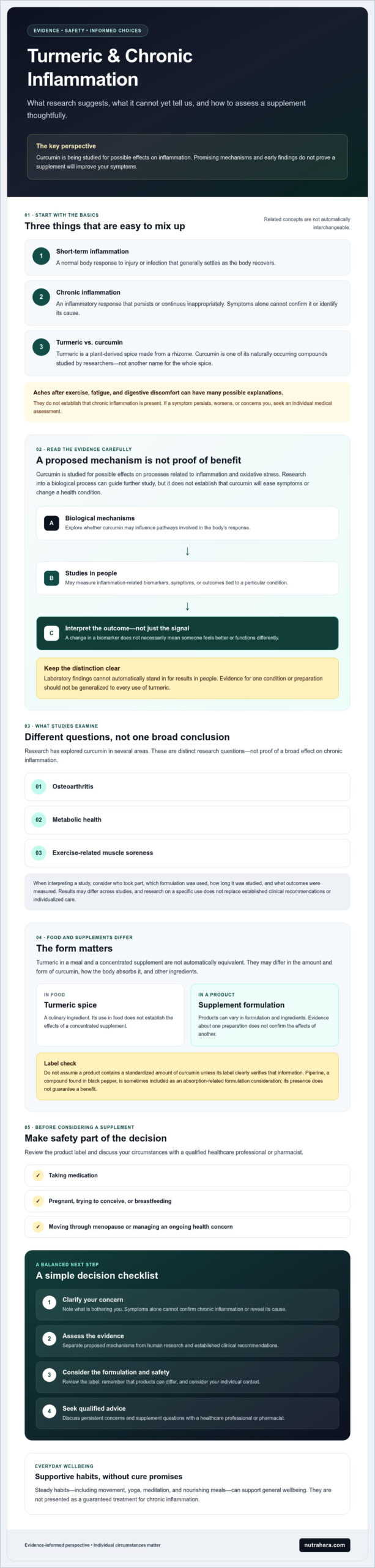
Inflammation is part of the body’s normal response to injury or infection. In the short term, it helps coordinate a response to a trigger, then generally settles as the body recovers. Chronic inflammation broadly refers to an inflammatory response that persists or continues inappropriately. It isn’t a diagnosis that can be confirmed from a symptom list, and the term alone doesn’t reveal what may be causing someone’s health concerns.
That distinction matters when evaluating turmeric for chronic inflammation. Turmeric is a plant-derived spice with a long history of culinary and traditional use. Curcumin is one of its compounds studied by researchers. They’re related, but not interchangeable. Research into a compound or biological mechanism doesn’t, on its own, show that eating turmeric or taking a supplement improves a health condition. The Turmeric overview provides background on the plant and summarizes the limits of medical evidence.
How is chronic inflammation different from short-term inflammation?
Short-term inflammation is typically connected to a specific trigger, such as an injury, while chronic inflammation describes a response that persists. Aches after exercise, fatigue, and digestive discomfort can have many possible explanations. They don’t establish that chronic inflammation is present or identify its cause. If a symptom persists, worsens, or concerns you, seek an individual medical assessment rather than trying to diagnose it from how you feel.
What is the difference between turmeric and curcumin?
Turmeric is the spice made from a plant’s rhizome, often used in cooking. Curcumin is one of its naturally occurring compounds, not another name for the whole spice. Foods containing turmeric and concentrated supplements aren’t automatically equivalent: the form, amount, and other ingredients may differ. Don’t assume a product contains a standardized amount of curcumin unless its label clearly verifies that information.
A useful starting point is to separate what a substance is from what research has shown it to do. This keeps traditional use, laboratory research, and demonstrated effects in people from being blurred together, and makes product claims easier to assess.
How Might Curcumin Affect Inflammation, and What Does Human Research Show?
Curcumin is studied for possible effects on processes related to inflammation and oxidative stress. Researchers ask whether it influences signaling pathways or other biological activity involved in the body’s response. These proposed mechanisms can help guide research, but they don’t establish that curcumin will ease symptoms or change the course of a health condition.
Promising biological mechanisms do not prove that a treatment is effective for people. Laboratory findings can show what happens in cells or other experimental models, while human studies examine outcomes in people. Evidence from one level can’t automatically stand in for another. The National Center for Complementary and Integrative Health offers an overview of the evidence for turmeric, including research limitations and safety considerations.
What do studies on curcumin and inflammation actually measure?
Some studies track biomarkers associated with inflammation; others measure symptoms or outcomes tied to a particular condition. A change in a biomarker doesn’t necessarily mean a person feels better or functions differently. To interpret a result, check who took part, what formulation was used, how long it was studied, and what outcomes researchers measured. Findings for one condition or preparation shouldn’t be generalized to all uses of turmeric for chronic inflammation.
Research has explored curcumin in areas such as osteoarthritis, metabolic health, and exercise-related muscle soreness. These are distinct research questions, not proof of a broad effect on chronic inflammation. Results may differ across studies, and evidence for a specific use doesn’t replace established clinical recommendations or individualized care.
Why can turmeric supplement findings differ from food use?
Turmeric in a meal and a concentrated supplement may differ in the amount and form of curcumin, as well as how the body absorbs it. Products can also vary in formulation, so evidence about one preparation doesn’t confirm the effects of another. Piperine, a compound found in black pepper, is sometimes included in supplements as an absorption-related formulation consideration. Its presence doesn’t guarantee a benefit or make every product equivalent.
For a fair comparison, check the product’s stated ingredients and formulation, then consider whether the research studied a similar preparation and population. Don’t assume that a supplement claim applies to your circumstances based on a proposed mechanism or a study in a different group. Weigh any potential benefit alongside practical limits and safety considerations.
Turmeric Supplements for Chronic Inflammation: Benefits, Limits, and Common Claims
Traditional use and scientific evidence answer different questions. A history of use can explain why turmeric interests researchers, but it doesn’t establish that a supplement is effective for every condition described as inflammatory. Likewise, findings about curcumin or one study product can’t automatically be applied to every retail supplement. Johns Hopkins Medicine discusses Curcumin’s anti-inflammatory properties alongside potential benefits and safety considerations.
| Evidence lens | What it may tell you | What remains uncertain |
|---|---|---|
| Traditional use | How turmeric has been used in food and wellness traditions. | Traditional use alone doesn’t establish a clinical benefit. |
| Proposed mechanisms | How curcumin might interact with biological processes studied in inflammation research. | A plausible mechanism doesn’t prove an effect on symptoms or disease. |
| Human evidence | What researchers observed with a particular formulation, population, and outcome. | Results may not apply to other conditions, people, or products. |
“Natural” doesn’t automatically mean effective, suitable, or risk-free. Broad marketing language can make distinct conditions sound as if they share one cause and one supplement solution. They don’t. Research on a specific condition is not proof of benefit for every inflammatory condition, and persistent symptoms deserve assessment by a qualified professional.
How can readers assess turmeric supplement claims?
Use the label as a starting point, not proof of effectiveness. Check whether it clearly states the ingredients and serving information. Then ask whether the claim refers to human research on a relevant condition and a similar formulation, and whether it explains the limits of that evidence. Be cautious about promises to “cure” a condition, guaranteed results, or benefits said to apply to everyone.
Study products can differ from retail products in formulation and composition. Even when a label is transparent, that doesn’t establish that a product matches one used in research or will produce the same outcome. Apply the same questions to each product: What does the label say? What evidence supports the specific claim? Does that evidence fit the condition and formulation being discussed?
Using Turmeric Thoughtfully: Safety Questions and Everyday Wellness Steps
Choosing whether to use a turmeric supplement is a personal decision, not a test of how committed you are to your wellbeing. Before considering turmeric for chronic inflammation, read the label, take stock of your health circumstances, and ask a qualified healthcare professional or pharmacist to review the product with you.
What should women consider before taking a turmeric supplement?
Check the ingredient list and serving information, then note your medications, health conditions, and other supplements. Don’t assume a plant-derived product is right for everyone. If you’re pregnant, trying to conceive, or breastfeeding, seek individualized advice before using a turmeric supplement.
Your life stage and symptoms can help shape the conversation. If you menstruate, you might keep a brief record of cycle timing and symptoms you want to discuss. During perimenopause or after menopause, note new or changing concerns and any care or medications you use. These notes don’t identify a cause, but they can help a clinician or pharmacist understand your circumstances and consider supplement safety. There isn’t a universal dose or product that can be assumed appropriate for every woman.
Bring the product label and a list of medications and supplements to your discussion. If you’re tracking symptoms, include when they occur and whether they change over time.
What daily habits can support general wellbeing?
Small, repeatable choices can support wellbeing alongside appropriate care. Adapt activity to your ability, energy, and circumstances. A comfortable walk or manageable strength activity can be a starting point. Build consistency gradually rather than pushing through pain or exhaustion. If movement causes concern, ask a healthcare professional what may be appropriate for you.
Gentle yoga can offer mindful movement, while meditation or a few quiet breaths may create a calming pause. These are optional wellbeing practices, not treatments for inflammation. Make space for rest after activity and a regular wind-down routine where possible. Choose habits you can return to as your needs and routines change.
Nutrahara offers women’s health supplements intended to support aspects of wellness such as skin, hair, nails, digestion, and brain function. Its approach combines principles of ancient Ayurveda with modern nutritional research. Explore Nutrahara’s women’s wellness supplements for product information, while remembering that it can’t replace advice tailored to your health and life stage.
A Balanced Next Step: Make an Informed Choice About Turmeric
Curcumin research offers questions worth exploring, not a guarantee that turmeric supplements will ease chronic symptoms. The evidence depends on the condition and formulation, while turmeric as a food is not automatically equivalent to a concentrated supplement. If you’re considering turmeric for chronic inflammation, clarify your concern, review the evidence, and discuss personal safety questions with a qualified healthcare professional, especially as your health needs change through pregnancy, lactation, or menopause.
Use a practical checklist before deciding: identify the concern you want to address, check whether the evidence relates to that concern and a similar formulation, read the product label, and ask a clinician or pharmacist about your circumstances. Keep established care in the conversation rather than treating a supplement as a substitute. Sustainable movement, restorative sleep, and practices such as yoga or meditation can support general wellness, but they don’t replace medical care.
Nutrahara’s Joints & Knees Kit is positioned around joint health and mobility. That product description does not establish that it contains turmeric or that it treats chronic inflammation. If you’re exploring women’s health supplements, review Nutrahara’s product information and discuss any questions about suitability with a qualified healthcare professional.
Take Your Next Wellness Step with Confidence
There’s no need to make a supplement decision based on a broad promise. Start with your specific concern, the evidence for the particular formulation, and advice that accounts for your health and life stage. If persistent symptoms are affecting your daily routine, discuss them with a qualified healthcare professional rather than relying on a supplement to identify or resolve the cause.
Nutrahara offers women’s health supplements developed around principles of Ayurveda and modern nutritional research, along with wellness e-books. Explore Nutrahara wellness resources to learn about its offerings, then make choices that fit your needs with the support of a qualified professional when appropriate.
Frequently Asked Questions
Is turmeric good for chronic inflammation?
Turmeric isn’t a proven solution for chronic inflammation. Curcumin, one compound in turmeric, has plausible biological mechanisms and is studied in people, but findings depend on the condition and the formulation researchers examined. They don’t show that turmeric treats every cause of persistent symptoms or replaces medical care. If symptoms continue or concern you, talk with a qualified healthcare professional about possible causes and suitable treatment options.
Can turmeric reduce inflammation in the body?
It’s possible that curcumin affects processes related to inflammation, but a proposed mechanism or change in a study measure doesn’t prove a meaningful benefit for every person. Research findings can’t be applied automatically across different conditions, turmeric-containing foods, and supplements. If you’re considering a concentrated supplement, review your personal health circumstances and the product with a clinician or pharmacist before starting.
How much turmeric should I take for chronic inflammation?
There isn’t a universal dose for turmeric for chronic inflammation. Products and formulations vary, and research findings don’t establish a suitable amount for every person or condition. Ask a qualified healthcare professional or pharmacist for guidance, and follow product directions only after the supplement has been reviewed for your circumstances. Turmeric used in food isn’t equivalent to a concentrated supplement. Pregnancy, lactation, medications, or health conditions call for individualized advice.
Is turmeric safe to take every day?
Daily turmeric supplement use can’t be assumed suitable for everyone. A concentrated product may differ from turmeric used in cooking, and ingredients and formulations vary. Read the label, then discuss the product with a qualified healthcare professional or pharmacist, particularly if you take medication, have a health condition, are pregnant, or are breastfeeding. They can help consider your circumstances; no general statement can guarantee a supplement is safe for you.
Can I take turmeric while pregnant or breastfeeding?
Turmeric used as a food ingredient isn’t the same as taking a concentrated supplement. If you’re pregnant or breastfeeding, seek individualized advice from your obstetric or other qualified healthcare professional before using a turmeric supplement. Don’t assume a product is safe or choose a dose based on general online guidance. Share the label and any other supplements or medications you use so your healthcare professional can consider your specific circumstances.
Can yoga and meditation help with chronic inflammation?
Yoga and meditation can be optional practices that support general wellbeing, gentle movement, relaxation, or stress management. They aren’t established cures for chronic inflammation and shouldn’t replace medical assessment or care. Choose a form of movement that feels accessible for your health and ability, and adapt it as needed. If movement causes pain or concern, ask a qualified healthcare professional what activities may be appropriate for you.
Disclaimer
This article is not a substitute for medical advice. Please consult a healthcare professional before starting any supplement, especially if pregnant, nursing, taking medication, or managing health conditions.