Categories
Articles

Tips for Remembering to Take Vitamins: Build a Routine That Lasts

What if the reason your vitamin routine keeps slipping isn’t a lack of willpower, but a reminder that doesn’t fit your real day? Work, family, exercise, and changing mornings can make even a simple habit easy to miss. The most helpful tips for remembering to take vitamins start with a cue that works with your life, not a perfect schedule you have to maintain.

If you’ve forgotten a dose and then found it hard to get back on track, you’re not alone. A routine should be flexible enough to bend when the day changes and forgiving enough to restart after a missed day.

In this guide, you’ll learn how to connect vitamins to an existing habit, choose a reminder you’ll notice, and create a backup for busy or unusual days. You’ll also find simple ways to return to your routine without turning one missed reminder into a reason to give up. Small, repeatable cues can make consistency feel more natural.

Key Takeaways

  • Make your vitamin habit easier to remember by attaching it to a steady part of your day.
  • Compare alarms, calendar prompts, visual cues, and checklists to find a reminder that suits your routine.
  • Use these tips for remembering to take vitamins to create a simple plan with a backup for busy days.
  • Fit your reminder around real work, family, and fitness routines instead of aiming for a perfect schedule.
  • Let yoga, meditation, or workout preparation become a supportive part of your wellness ritual.

Why is remembering to take vitamins harder than it seems?

Forgetting a vitamin doesn’t mean you lack discipline. Often, it means the routine hasn’t found a dependable place in your day yet. Familiar activities tend to follow recognizable cues, while a new task asks you to pause, remember it, and decide what to do. That extra step can get lost among messages, household needs, work deadlines, or the rush to leave home.

This is why useful tips for remembering to take vitamins focus on the routine around the task, not on blaming yourself. A missed day can offer useful information: perhaps the reminder was tied to a moment that changes often, or it competed with a more urgent responsibility. That’s a detail you can adjust, not a verdict on your motivation.

What makes a new daily habit easy to overlook?

A routine without a clear cue can be hard to recall at the right moment. You might plan to take a vitamin with breakfast, then rush out before eating. Or lunch may shift because of a meeting, so a reminder tied to that meal no longer fits. The intention may still be there, but the situation no longer prompts the action.

Habit overviews describe how cues can prompt a routine, which may then become associated with a familiar outcome. Exploring the science of habit formation can help explain why linking a task to a recognizable moment may be easier than relying on memory alone. Instead of asking, “Why can’t I remember?”, ask, “What was happening when I expected to remember?” That question points to a practical change, such as moving a reminder away from a rushed part of the morning.

How life-stage changes can affect everyday routines

A woman’s schedule may shift across menstruation, pregnancy, lactation, perimenopause, and menopause. Changes in sleep, energy, caregiving, appointments, or daily priorities can reshape the rhythm of a day. A routine that once felt steady may become less predictable when mornings start earlier, meals happen at different times, or evenings are devoted to family responsibilities.

Rather than expecting one fixed schedule to suit every woman, notice which parts of your day remain relatively steady in this season of life. Perhaps you prepare your bag before leaving, take a break after a workout, or wind down at home in the evening. The aim isn’t to make every day identical. It’s to find a realistic moment when a reminder can reach you.

Consistency doesn’t mean maintaining a flawless streak. It means returning to your routine after a disruption and adjusting the cue when it no longer fits. If you forget, take a moment to identify what interrupted the plan, then resume according to your normal routine and the product label. A flexible approach leaves room for real life and helps your habit evolve with you.

How can you connect vitamins to a habit you already have?

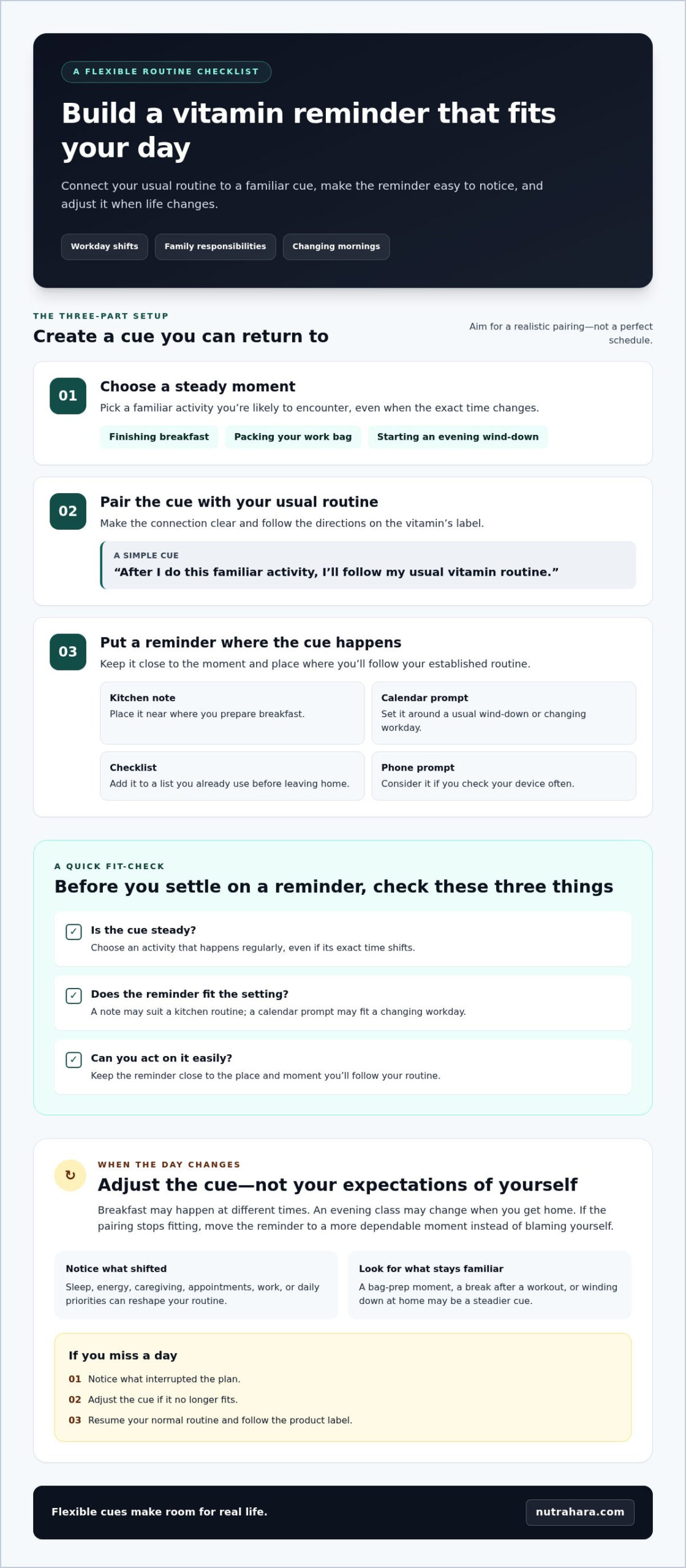
A simple cue can make a new routine easier to recall. Instead of asking yourself to remember at an arbitrary point in the day, connect the action to something you already do. Your cue might be breakfast, packing your work bag, or beginning your evening wind-down. Choose a moment that fits your actual schedule and the directions on the vitamin’s label.

Try a three-step approach: choose a stable cue, pair the routine with it, then review whether the pairing works. Give yourself room to adjust. If your mornings vary, an evening routine or another dependable moment may be a better fit. These tips for remembering to take vitamins are prompts to experiment, not rules you have to follow perfectly.

Use habit stacking to create a reliable cue

Habit stacking means pairing a new action with an everyday routine that’s already familiar. For example, you could use finishing breakfast or getting ready for the day as a prompt to follow your vitamin routine, as long as the cue fits the label directions. These examples describe a reminder strategy, not advice about when or how much to take.

Choose a cue you’re likely to encounter even on a busy day. If breakfast happens at different times, preparing your work bag might be more dependable. If evenings are calmer, your wind-down routine could be a better anchor. Keep the pairing clear: After I do this familiar activity, I’ll follow my usual vitamin routine.

Make the reminder visible and easy to act on

A reminder works best when it appears where the cue happens. Put a note near the place where you prepare breakfast, add a calendar prompt around your usual wind-down, or include the routine on a checklist you already use before leaving home. A cue that’s out of sight or buried among unrelated alerts is easy to miss.

To choose a reminder that works in practice, ask yourself:

  • Is the cue steady? Pick an activity that happens regularly, even if the exact time shifts.
  • Does the reminder fit the setting? A note may suit a kitchen routine, while a calendar prompt may work better around a changing workday.
  • Can I act on it easily? Keep the reminder close to the moment and place where you’ll follow your established routine.

After trying the pairing, notice what gets in the way. Maybe you don’t eat breakfast at home, or an evening class changes when you arrive. Move the cue rather than blaming yourself. A short note about what worked can help you choose a more realistic prompt next time.

If you’re exploring women’s wellness supplements, Nutrahara’s nutrition is manufactured in New Zealand, with formulations that combine principles of Ayurvedic science and modern nutrition research. You can explore its vitamin B complex supplement while keeping your reminder routine personal and flexible.

Which vitamin reminder works best: alarms, calendars, or visual cues?

The best reminder isn’t necessarily the most sophisticated. It’s the one you notice at the right moment and can keep using without adding stress. A phone prompt may suit you if you check your device often; a note may work better if you respond to what you see around you. Match the tool to your day, then adjust it if your schedule changes.

Phone alarm
Context: You usually have your phone nearby when you plan to follow your routine. Convenience: It’s quick to set and easy to move. Possible friction: You may dismiss it or lose it among other alerts.

Calendar prompt
Context: Your routine fits a planned point in the day, or you already rely on a calendar. Convenience: You can shift the prompt when appointments change. Possible friction: It may be easy to overlook if you don’t check your calendar regularly.

Visible cue
Context: You notice objects and notes in the place where your routine happens. Convenience: It’s a simple, at-a-glance reminder. Possible friction: A note can blend into its surroundings or get moved.

Written checklist
Context: You already use a list to organize your morning, evening, or workout preparation. Convenience: It makes the routine easy to mark as complete. Possible friction: It only helps if you look at the list.

When a phone alarm or calendar reminder may help

Digital prompts can be useful if checking your phone or calendar is already part of your day. Choose a clear label and a realistic time that fits the product’s directions. If a meeting, school run, or workout shifts your schedule, move the prompt to a more workable moment rather than letting it become background noise.

When a visual cue or portable reminder may fit better

A written note or checklist can be a natural fit if you respond to your surroundings. Place it where you’ll see it as part of your usual routine. For days away from home, plan a portable reminder, such as a checklist on your phone or a note in your bag, and follow the label directions for the supplement you’ve chosen.

If you already take a vitamin B complex, you might use a calendar alert at home and a checklist when travelling. This is an example of choosing a reminder, not a recommendation that this supplement is right for everyone.

Try one tool first. If you keep missing its prompt, work out why: perhaps you silence alarms, skip calendar checks, or don’t see the note. Then choose a different cue. These tips for remembering to take vitamins are most useful when they fit your real routine, including days away from home.
Tips for Remembering to Take Vitamins: Build a Routine That Lasts

How to build a simple vitamin reminder plan for busy days

A reminder plan should be simple enough to keep using when work runs late, a workout moves, or home life needs your attention. Start with one cue for an ordinary day and one backup for times your usual routine is disrupted. A clear fallback is easier to return to than a string of alarms competing for your attention.

  1. Choose one main cue. Pick a regular moment that fits the label directions, such as a familiar part of your morning or evening routine.
  2. Set one reminder. Use a phone prompt, calendar entry, note, or checklist that you’ll notice at that moment.
  3. Prepare one backup. Decide what will prompt you if the usual cue isn’t available, such as a calendar reminder on a travel day or a checklist for a changed schedule.

Create a routine that can adapt to changing schedules

Test the plan against the week you really have, not an ideal version of it. If you exercise before work, consider whether your routine still fits on early workout days. If caregiving or changing shifts make mornings unpredictable, an evening cue may be steadier. For travel, decide in advance which portable reminder you’ll use while away from home.

Keep the system light. One main cue and one backup are often easier to remember than several prompts scattered through the day. If the routine becomes another source of pressure, simplify it. During a weekly review, ask: Did I notice the cue? Was it easy to act on? Did a particular day disrupt it? Keep what works and change only the part that doesn’t.

Reset gently after you forget

A missed day doesn’t require a new system or a perfect restart. Return to your next planned routine and follow the directions on the product label. Don’t add extra reminders as a form of punishment or change the serving instructions to compensate. If you’re unsure what to do after missing a dose, follow the product’s guidance or seek advice from an appropriate health professional.

Use the interruption as feedback. Perhaps the reminder arrived while you were commuting, or your usual cue shifted because of family responsibilities. Move the cue to a more realistic moment, then continue. Consistency grows from a plan that can bend and resume, not from expecting yourself never to have a busy day.

For a thoughtful, personal approach to wellness, you can explore Nutrahara’s women’s wellness supplements. Nutrahara’s nutrition is manufactured in New Zealand.

Make remembering vitamins part of a supportive wellness ritual

A reminder can support your wellbeing without becoming a measure of your willpower. Let it fit alongside practices that already feel meaningful, such as movement, rest, or a quiet pause. Your routine can be personal and flexible, shaped by the season of life you’re in rather than an idealized schedule.

Keep wellness practices encouraging, not all-or-nothing

Choose a small ritual that feels welcoming. You might unroll your yoga mat, take a few quiet breaths before meditation, or prepare for a workout. If it fits the product’s directions, that familiar moment can help cue your usual routine. Keep the ritual simple enough to adapt on full days. Returning after an interruption is part of caring for yourself, not a reason to judge your progress.

Explore supplement information at your own pace

If you’re considering women’s wellness supplements, take time to explore the information and decide what aligns with your approach. Nutrahara’s nutrition is manufactured in New Zealand, and its formulations combine Ayurvedic principles with modern nutrition research. The brand describes its products as clean and simple, without artificial additives. These details can inform your exploration, but they aren’t a promise of a particular outcome.

Choose a practice that helps you feel supported, and let it evolve as your life does. To explore options, visit Nutrahara’s women’s wellness supplements at your own pace. One gentle, realistic step is enough to begin.

Let your routine grow with you

Your wellness routine doesn’t have to look the same in every season of life. Work, family, movement, and rest all shift, and your reminder can shift with them. Choose one small cue to begin with, then adapt it as your days change. Flexibility is part of building a practice you can return to, not a sign that you’ve failed.

The most useful tips for remembering to take vitamins are the ones that help you feel supported, not judged. Let your routine sit alongside the ways you already care for yourself, whether that means a quiet pause, time on your yoga mat, or getting ready for a workout. Progress can be gentle and still be meaningful.

If you’re exploring women’s wellness supplements as part of your personal approach, explore women’s wellness supplements and find information about Nutrahara’s products. Keep choosing what feels thoughtful and sustainable for you. Your routine can begin with one small step today.

Frequently Asked Questions

What should I do if I forget to take my vitamins one day?

Return to your usual routine and follow the product label. One missed reminder doesn’t erase the effort you’ve already made. Don’t take extra or change the directions to compensate. If you’re unsure what the label says about a missed dose, follow its instructions rather than guessing. You can also note what interrupted your routine, such as an early appointment, and adjust your reminder if that would make it easier to notice next time.

Should I set a reminder to take vitamins in the morning or at night?

Choose the time that fits your day and the product’s label directions. A morning prompt may suit you if you have a steady start, while an evening cue might fit better if mornings are rushed. Try attaching the reminder to an activity you already do at that time. If you repeatedly miss it, move the cue to a more reliable moment instead of assuming one time works best for everyone.

Can I use a pill organizer to remember my vitamins?

Yes, a pill organizer can be a useful visual planning aid if it suits your routine and the product directions. For example, checking it as part of an existing morning checklist may help you see whether you’ve completed that step. An organizer is optional, not a requirement for building a reminder. Choose an approach that feels practical for the products you use, and follow their labels.

How can I remember vitamins when I travel or work irregular hours?

Choose a reminder that can move with you, such as a phone calendar prompt or a brief note in a travel checklist. If your work hours vary, connect the cue to an activity that stays familiar across locations, like preparing for a shift or settling in after exercise. Planning an alternative for travel days can keep your routine flexible. Keep the timing and use aligned with the product directions.

Do I need to take vitamins with food to remember them?

No, food doesn’t have to be your reminder cue unless the product’s directions call for taking it with food. A regular meal can still act as a useful prompt when it fits the label. For instance, you might place a calendar notification near your usual lunch break, then follow the product’s instructions. Keep the memory strategy separate from assumptions about food, absorption, or how a supplement works.

How long does it take to build a habit of taking vitamins?

There isn’t one fixed timeline that applies to every person or routine. Your schedule, the strength of the cue, and changes in daily life can all affect how familiar the habit feels. Start with a repeatable reminder and check whether it works in practice. If it doesn’t, adjust it. These tips for remembering to take vitamins are about creating a routine you can resume, including after a missed day.

Article by

Nutrahara Team

We are a dedicated collective of nutrition scientists and naturopaths at Nutrahara, committed to advancing women's health through the fusion of ancient Ayurveda science and cutting-edge nutrition research. Our mission is to empower you with clean, simple, and scientifically validated wellness solutions so you can live your healthiest life. Connect with us to stay updated on the latest developments in holistic women's health and nature-based research.

Disclaimer

This article is not a substitute for medical advice. Please consult a healthcare professional before starting any supplement, especially if pregnant, nursing, taking medication, or managing health conditions.

Categories
Articles

How to Start a Supplement Routine That Fits Your Life

What if the best supplement routine is the one that starts with less, not more? If you’re wondering how to start a supplement routine, it’s understandable to feel unsure where to begin. Your needs and questions may shift with your menstrual cycle, pregnancy, breastfeeding, perimenopause, or menopause. A crowded shelf of bottles isn’t a wellness plan. Start instead with a clear personal goal and a routine you can sustain.

This guide will help you identify what matters most, read product information with care, and choose an approach that fits your everyday habits. You’ll also see how supplements can sit alongside balanced meals, movement, yoga, and meditation, rather than replace them. Before starting or changing a supplement, talk with a doctor or registered dietitian, particularly if you’re pregnant, breastfeeding, managing a health condition, or taking medication. A thoughtful, manageable routine can support your wellbeing without adding overwhelm.

Key Takeaways

  • Start with one clear wellness priority to keep your routine focused and manageable.
  • Consider how your life stage and changing needs shape the questions you want to explore.
  • Compare ingredient lists, serving directions, and stated goals before choosing a product.
  • Learn how to start a supplement routine by pairing it with a daily cue that already fits your schedule.
  • Use your original goal and personal notes to decide whether your routine still feels right.

Start a Supplement Routine by Defining What You Want to Support

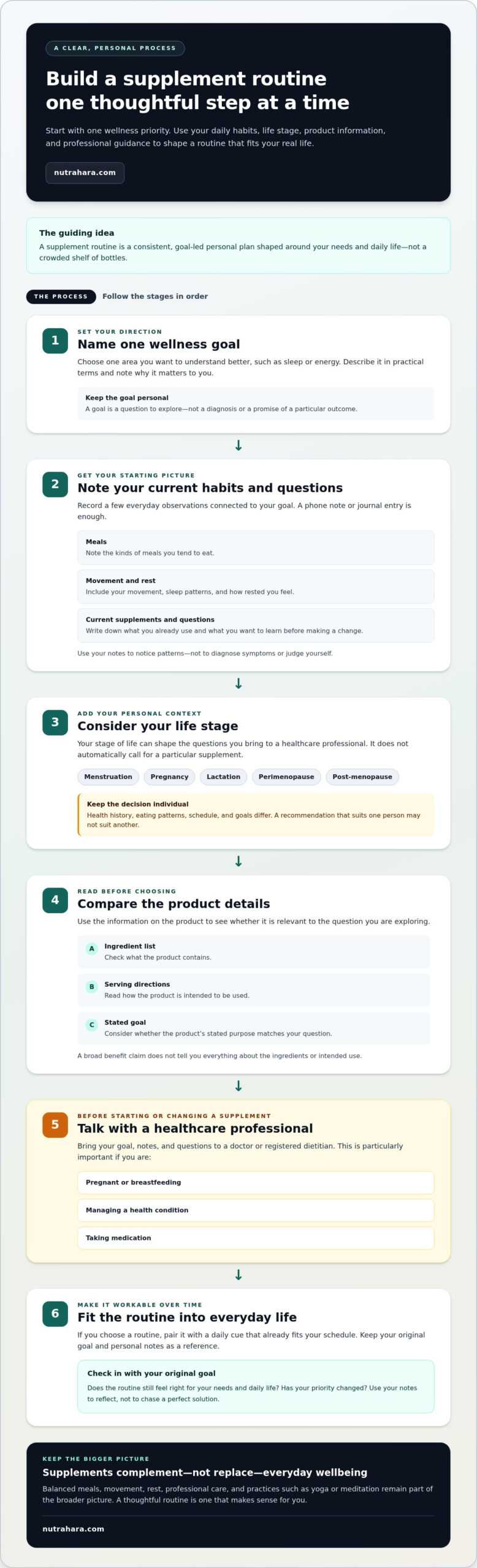
You don’t need to begin with several products or a complicated plan. Choose one area you’d like to understand better, then take stock of the habits and questions around it. Supplements are intended to complement everyday food and wellness practices, not replace meals, movement, rest, or professional care.

A supplement routine is a consistent, goal-led personal plan shaped around your needs and daily life. This simple sequence can help you get started:

  1. Name one goal. Choose an area of wellbeing you want to explore, such as sleep or energy.
  2. Note your current habits. Record your usual meals, movement, sleep patterns, and any supplements you already use.
  3. Write down your questions. Identify what you need to learn before choosing or changing a product.

These notes give you a clearer basis for considering how to start a supplement routine, without turning wellness into a search for a perfect solution.

Choose one wellness priority before browsing products

Describe your goal in practical terms: “I want to understand what may support my sleep,” or “I’d like to pay closer attention to my energy during the day.” Then add why it matters. Perhaps you want to feel more present during an evening yoga practice or stay focused through a demanding workday. That context can help you assess whether a product’s stated purpose is relevant to you.

Keep a personal goal distinct from a diagnosis or a promised outcome. Wanting to learn about sleep support doesn’t identify the cause of sleep difficulties, and a product claim can’t guarantee a particular result. If you have a health concern or a question about whether a supplement suits you, discuss it with an appropriate healthcare professional.

Create a simple baseline for your routine

Before making a change, note what your everyday pattern looks like. Include the kinds of meals you tend to eat, movement such as walking or strength training, how rested you feel, and any supplements already in your routine. Focus on a few observations connected to your goal. For example, you might note whether you felt rested on waking or had the energy for your usual activity. Use these notes to notice patterns, not to diagnose symptoms or judge yourself.

Keep the record easy to update. A note on your phone or a journal entry alongside your regular planning can be enough. If hormonal wellbeing is your priority, Nutrahara’s women’s wellness range includes products in the hormones category. Let your own goal and questions guide what you explore next.

Match Your Supplement Goals to Your Life Stage and Wellness Priorities

Your priorities can shift as your body and circumstances change. Menstruation, pregnancy, lactation, perimenopause, and post-menopause each bring a different context to wellness decisions. None automatically calls for a particular supplement. Instead, your life stage can help shape the questions you bring to a healthcare professional and the information you look for before making a change.

Life stage informs the questions to consider, not a universal supplement list. That distinction keeps your routine personal. Two women at the same stage may have different health histories, eating patterns, schedules, and goals, so a recommendation that suits one person may not suit another.

Connect life stage with the questions you bring

Consider whether anything about your current life stage changes your priorities. You might be thinking about menstrual wellbeing, navigating changes associated with perimenopause, or considering supplements during pregnancy or while lactating. Write down what you hope to understand, what you already take, and any relevant health or medication questions. Bring these notes to a doctor, registered dietitian, or another appropriate healthcare professional before choosing or changing a routine.

Rather than assuming that a certain life stage means you need a specific product, ask whether your goal is appropriate to address with a supplement and what factors matter in your individual situation. Clear questions can make a conversation more useful and help you avoid adding something simply because it is marketed for people in a similar stage.

Include movement and mental wellbeing in the bigger picture

Supplements are only one part of a broader picture of wellbeing. Regular movement, nourishing meals, restorative sleep, and stress-management practices all have a place alongside your personal goals. The right balance will vary with your energy, responsibilities, health, and preferences. A steady walk, strength session, or favorite fitness class may already be part of your week. A supplement doesn’t replace those habits.

Yoga can connect movement with mindful attention, while meditation may offer a quiet moment to check in with yourself. Try a brief reflection after a yoga session or at the end of your day: What feels supportive right now? Has your priority changed? These observations can help you keep your plan aligned with real life instead of chasing every new wellness trend.

If hormonal wellbeing is one of your priorities, explore Nutrahara’s women’s wellness supplements alongside your broader research. Keep your life stage, individual needs, and professional guidance at the center of any decision. A thoughtful routine is one that makes sense for you, not one built from assumptions about what every woman should take.

Compare Supplement Labels and Ingredients Before You Choose

Once you have a goal in mind, use the product information to see whether a supplement is relevant to the question you’re exploring. A broad benefit claim may catch your attention, but it doesn’t tell you everything about the ingredients or how the product is intended to be used. Compare the details calmly and note anything you’d like a healthcare professional to clarify.

Use this simple framework to compare options:

What to compare What to look for Question to resolve
Stated goal The area of wellness named on the product information Does this match the priority you’ve chosen?
Ingredient list Each ingredient as listed on the label Do I recognize what’s included, and are there ingredients I need to discuss?
Serving directions The instructions provided for that product Can I understand and realistically follow these directions?
Questions to resolve Anything unclear about fit, ingredients, or use Should I discuss this with a doctor or registered dietitian before deciding?

Read the label for clear, relevant information

Start with the ingredient list and serving directions. Then compare the product’s stated goal with the priority you identified earlier. If you’re exploring energy support, for instance, look for product information that clearly relates to that area rather than relying on a general promise to support overall wellness. If you’re unsure about an ingredient or how a product fits your needs, pause and seek qualified guidance.

An ingredient described as clinically studied doesn’t establish a specific outcome for every finished product that contains it. The product’s full formulation, the evidence available, and your own circumstances all matter. Treat label language as information to assess, not a guarantee. Nutrahara combines principles of ancient Ayurveda science with modern nutrition research, and its ingredients are described as clinically studied. This is useful context about the brand’s approach, not a promise of a particular result.

Keep the first routine focused and easy to understand

Evaluate one product choice at a time instead of assembling a crowded stack. Keep a list of supplements you already take, including their names and serving directions. That record gives you and a healthcare professional a clearer view of what you’re considering and can help you spot overlapping ingredients before making a change.

If you’re reviewing the vitamin B category, Nutrahara’s Vitamin B Complex page is one example of product information to examine alongside your personal goal and questions. It isn’t a recommendation for everyone. The aim is to choose thoughtfully, understand what you’re considering, and keep your routine simple enough to review.

Build a Daily Supplement Habit That Works With Your Real Schedule

A routine is easier to maintain when it fits into a day you already have, rather than relying on a perfect schedule. Keep the process simple: follow the product’s directions, attach the habit to a repeatable cue, and make a brief record. The aim is a steady, understandable practice, not another task competing with work, exercise, or family life.

Use this sequence to set up your routine:

  1. Follow the product directions. Read the label and follow the serving directions for that specific product. Don’t assume every supplement is taken in the same way.
  2. Choose a consistent cue. Pair the habit with a daily moment that already happens, such as preparing for a regular meal or setting out items for the next day. Make sure the cue works with the label directions.
  3. Record the routine. Use a simple note or checklist to see whether the habit is fitting into your life.

Use a cue that fits your day

Look for natural transitions in your day. Perhaps you review your calendar after breakfast, prepare your bag before a workout, or write a short evening to-do list. Pick a cue you can repeat without rearranging your schedule. A calendar reminder can help while the habit is new; a visible note near your usual planning spot can also serve as a gentle prompt.

Keep your checklist brief. You might record whether you followed the product directions and add a note if a change in your schedule made the routine harder. This is information, not a score. A low-pressure record can help you see what works without turning wellness into a test of willpower.

Make the routine supportive, not perfectionistic

Some days look different from others. A changed work schedule, family commitment, or shifted exercise plan may affect the cue you chose. If your routine feels awkward, adjust the reminder or select a more reliable daily moment. Don’t make a missed day a reason to double a serving or change the directions. Follow the product label, and seek guidance from a healthcare professional if you’re uncertain what to do.

Set aside a brief weekly check-in and ask: Is the cue still convenient? Am I following the directions? Does this routine feel manageable alongside the rest of my day? A few honest notes can guide small, practical adjustments. Your broader wellness rhythm can include movement you enjoy, such as a walk or strength training, as well as yoga or meditation. These practices can complement a supplement habit without being replaced by it.

For a considered next step, explore Nutrahara’s women’s wellness supplements and review the product information that fits the questions you’re working through.

How to Start a Supplement Routine That Fits Your Life

Review Your Supplement Routine and Choose a Thoughtful Next Step

A routine doesn’t need to grow to be worthwhile. Before changing anything, return to the goal you originally recorded and compare it with your notes. Did you follow the product directions consistently? Does the routine still fit your day? What have you noticed about your habits or priorities? These questions can help you decide whether to continue, learn more, or discuss a possible change.

Use your notes to decide what deserves another look

Review your notes without expecting them to prove that a supplement is or isn’t working. They can show whether your original goal still matters, whether the routine has been practical, and what questions have come up along the way. A change in work hours, for example, may make a habit harder to keep, while a shift in your priorities may mean your original goal no longer feels central.

Life stages and personal circumstances change, too. If pregnancy, lactation, perimenopause, post-menopause, a new medication, or another change raises questions about your needs, discuss them with a doctor or registered dietitian before adjusting your routine. There’s no universal review schedule or guaranteed result to aim for. Your notes are a useful starting point for a thoughtful conversation, not a substitute for individual guidance.

Explore a product category only when it matches your goal

As you consider what to look into next, stay close to the priority you chose. Nutrahara’s women’s wellness range includes products focused on hormones, sleep, and energy. Its nutrition is made in New Zealand, and its formulations combine Ayurveda principles with modern nutrition research. This describes the brand’s approach, not a promise of a particular health outcome.

If sleep remains your stated priority, explore the RestoraSleep product information as part of your research. Consider the product information alongside your questions and personal circumstances, rather than treating a product page as a personal recommendation. If sleep isn’t your goal, there’s no need to browse that category; keep your attention on what feels relevant to you.

Learning how to start a supplement routine also means knowing when to pause and reassess. Your schedule may shift, your life stage may change, or a different wellness priority may come forward. Let those changes guide the questions you ask rather than prompting you to add products automatically. A calm next step might be to review your notes, seek qualified guidance, or explore Nutrahara’s women’s wellness information when a category aligns with your goal. Let your routine evolve thoughtfully, one informed choice at a time.

Let Your Wellness Routine Grow With You

Your needs and daily rhythms may change, and your wellness routine can change with them. You don’t have to make every decision at once. Keep choosing with care, and give yourself permission to revisit what feels relevant as your priorities shift. A thoughtful approach to how to start a supplement routine is less about following a perfect plan and more about making choices that feel informed, manageable, and personal.

As you explore options, Nutrahara’s women’s wellness supplements offer clean, simple formulations without artificial additives. The nutrition is made in New Zealand, and the capsules are described as easy to swallow. Choose products that align with the questions you’re considering, and remember that a supplement routine should support your wider wellbeing, including the movement, rest, and moments of calm you value.

Explore Nutrahara’s women’s wellness supplements and take the next step at your own pace. You’re building a practice that can move with you, one considered choice at a time.

Frequently Asked Questions

What is a supplement routine?

A supplement routine is a planned way of using one or more dietary supplements in line with their label directions and your personal wellness priorities. It can be as simple as one product rather than a complex schedule. If you’re working out how to start a supplement routine, note what you take and why, so you can explain your choices clearly during a conversation with a healthcare professional.

Can supplements replace a balanced diet?

No. Supplements aren’t a replacement for the variety of foods that make up your usual eating pattern. Think of them as a possible addition to, not a substitute for, everyday meals. Taking a supplement doesn’t mean you need to skip breakfast or stop making food choices that support your energy through a busy day. If you’re concerned about your diet or nutrient needs, discuss them with a qualified healthcare professional.

How should I think about supplements during pregnancy or while breastfeeding?

Discuss any supplement you’re considering with a doctor or registered dietitian who understands your individual circumstances. Pregnancy and breastfeeding can change which questions matter, and a product that suited your routine before may not be the right choice now. Bring the product label and a list of medicines or supplements you already use to the conversation. Avoid relying on a general recommendation simply because it’s intended for women or described as natural.

Should I start several supplements at the same time?

Usually, it’s easier to understand your routine if you consider one new product choice at a time, with guidance from a healthcare professional when appropriate. Starting several together can make it harder to tell which label or ingredient relates to a question you have. Keep a current list of products and their directions. If you’re considering multiple additions, discuss the full list rather than assessing each choice in isolation.

What should I do if I forget a day in my supplement routine?

Check the product directions for advice about a missed serving, and don’t take extra to make up for it unless the label or a healthcare professional specifically directs you to. If the instructions don’t address your situation, ask a pharmacist, doctor, or registered dietitian. Then return to the routine as advised. A missed day is a reason to check the guidance, not to change the serving on your own.

Are natural supplements automatically the right choice for everyone?

No. “Natural” describes how an ingredient may be presented, but it doesn’t establish that a product suits every person or situation. People can have different health needs, allergies, medicines, and life-stage considerations. Read the full ingredient list, not only the front label, and raise any concerns with a healthcare professional. A careful choice depends on your circumstances and the product information, not on a natural claim alone.

Article by

Nutrahara Team

We are a dedicated collective of nutrition scientists and naturopaths at Nutrahara, committed to advancing women's health through the fusion of ancient Ayurveda science and cutting-edge nutrition research. Our mission is to empower you with clean, simple, and scientifically validated wellness solutions so you can live your healthiest life. Connect with us to stay updated on the latest developments in holistic women's health and nature-based research.

Disclaimer

This article is not a substitute for medical advice. Please consult a healthcare professional before starting any supplement, especially if pregnant, nursing, taking medication, or managing health conditions.

Categories
Articles

Turmeric for Chronic Inflammation: What the Evidence Can, and Cannot, Tell You

Could a golden spice meaningfully ease chronic inflammation, or are supplement claims getting ahead of the evidence? If persistent discomfort is disrupting your workouts, sleep, or everyday routines, it’s understandable to look for options like turmeric for chronic inflammation. Curcumin, a compound in turmeric, is studied for its possible effects on inflammation. But promising mechanisms and early findings don’t prove that a supplement will improve your symptoms.

This guide separates what research suggests from what it can’t yet tell us, including why results from food and concentrated supplements may differ. You’ll learn how to assess product claims and what to discuss with a healthcare professional, especially if you’re pregnant, breastfeeding, taking medication, or moving through menopause. We’ll also consider steady habits, such as movement, yoga, meditation, and nourishing meals, that can support general wellbeing without promising a cure. The goal is to help you make informed choices, not to dismiss your experience or offer a quick fix.

Key Takeaways

  • Symptoms alone can’t confirm chronic inflammation or reveal its cause. Note your concerns and discuss them with a qualified health professional.
  • Separate proposed curcumin mechanisms from human research and established clinical recommendations when weighing potential benefits.
  • Turmeric for chronic inflammation is not a guaranteed solution. Supplement effects may depend on the formulation and individual context.
  • Before considering a supplement, review its label and ask a clinician or pharmacist about medications, pregnancy, trying to conceive, or lactation.
  • Use a simple decision checklist: clarify your concern, assess the evidence, consider safety, and seek qualified advice.

Turmeric for Chronic Inflammation: What Does the Term Really Mean?

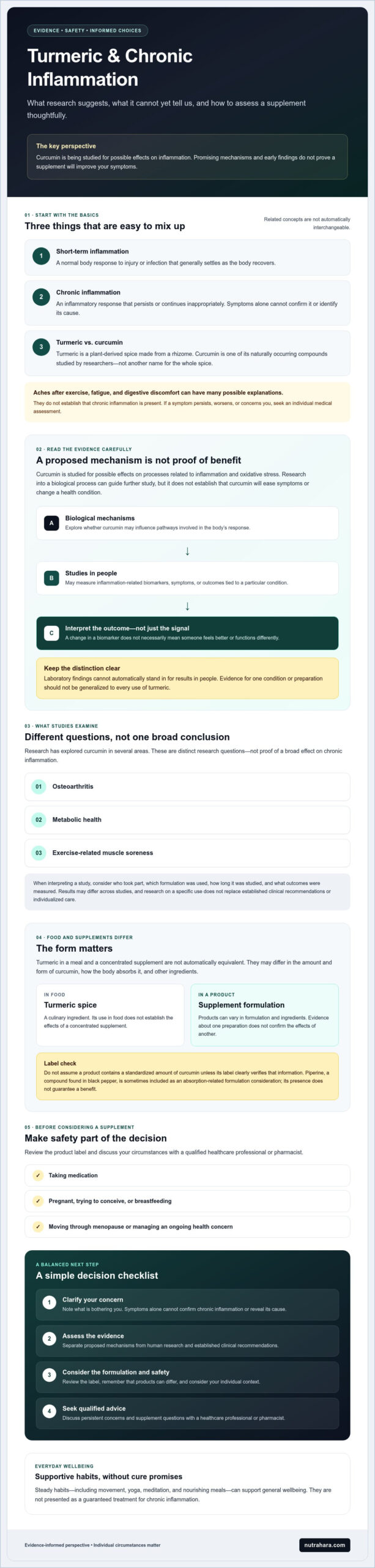
Inflammation is part of the body’s normal response to injury or infection. In the short term, it helps coordinate a response to a trigger, then generally settles as the body recovers. Chronic inflammation broadly refers to an inflammatory response that persists or continues inappropriately. It isn’t a diagnosis that can be confirmed from a symptom list, and the term alone doesn’t reveal what may be causing someone’s health concerns.

That distinction matters when evaluating turmeric for chronic inflammation. Turmeric is a plant-derived spice with a long history of culinary and traditional use. Curcumin is one of its compounds studied by researchers. They’re related, but not interchangeable. Research into a compound or biological mechanism doesn’t, on its own, show that eating turmeric or taking a supplement improves a health condition. The Turmeric overview provides background on the plant and summarizes the limits of medical evidence.

How is chronic inflammation different from short-term inflammation?

Short-term inflammation is typically connected to a specific trigger, such as an injury, while chronic inflammation describes a response that persists. Aches after exercise, fatigue, and digestive discomfort can have many possible explanations. They don’t establish that chronic inflammation is present or identify its cause. If a symptom persists, worsens, or concerns you, seek an individual medical assessment rather than trying to diagnose it from how you feel.

What is the difference between turmeric and curcumin?

Turmeric is the spice made from a plant’s rhizome, often used in cooking. Curcumin is one of its naturally occurring compounds, not another name for the whole spice. Foods containing turmeric and concentrated supplements aren’t automatically equivalent: the form, amount, and other ingredients may differ. Don’t assume a product contains a standardized amount of curcumin unless its label clearly verifies that information.

A useful starting point is to separate what a substance is from what research has shown it to do. This keeps traditional use, laboratory research, and demonstrated effects in people from being blurred together, and makes product claims easier to assess.

How Might Curcumin Affect Inflammation, and What Does Human Research Show?

Curcumin is studied for possible effects on processes related to inflammation and oxidative stress. Researchers ask whether it influences signaling pathways or other biological activity involved in the body’s response. These proposed mechanisms can help guide research, but they don’t establish that curcumin will ease symptoms or change the course of a health condition.

Promising biological mechanisms do not prove that a treatment is effective for people. Laboratory findings can show what happens in cells or other experimental models, while human studies examine outcomes in people. Evidence from one level can’t automatically stand in for another. The National Center for Complementary and Integrative Health offers an overview of the evidence for turmeric, including research limitations and safety considerations.

What do studies on curcumin and inflammation actually measure?

Some studies track biomarkers associated with inflammation; others measure symptoms or outcomes tied to a particular condition. A change in a biomarker doesn’t necessarily mean a person feels better or functions differently. To interpret a result, check who took part, what formulation was used, how long it was studied, and what outcomes researchers measured. Findings for one condition or preparation shouldn’t be generalized to all uses of turmeric for chronic inflammation.

Research has explored curcumin in areas such as osteoarthritis, metabolic health, and exercise-related muscle soreness. These are distinct research questions, not proof of a broad effect on chronic inflammation. Results may differ across studies, and evidence for a specific use doesn’t replace established clinical recommendations or individualized care.

Why can turmeric supplement findings differ from food use?

Turmeric in a meal and a concentrated supplement may differ in the amount and form of curcumin, as well as how the body absorbs it. Products can also vary in formulation, so evidence about one preparation doesn’t confirm the effects of another. Piperine, a compound found in black pepper, is sometimes included in supplements as an absorption-related formulation consideration. Its presence doesn’t guarantee a benefit or make every product equivalent.

For a fair comparison, check the product’s stated ingredients and formulation, then consider whether the research studied a similar preparation and population. Don’t assume that a supplement claim applies to your circumstances based on a proposed mechanism or a study in a different group. Weigh any potential benefit alongside practical limits and safety considerations.

Turmeric Supplements for Chronic Inflammation: Benefits, Limits, and Common Claims

Traditional use and scientific evidence answer different questions. A history of use can explain why turmeric interests researchers, but it doesn’t establish that a supplement is effective for every condition described as inflammatory. Likewise, findings about curcumin or one study product can’t automatically be applied to every retail supplement. Johns Hopkins Medicine discusses Curcumin’s anti-inflammatory properties alongside potential benefits and safety considerations.

Evidence lens What it may tell you What remains uncertain
Traditional use How turmeric has been used in food and wellness traditions. Traditional use alone doesn’t establish a clinical benefit.
Proposed mechanisms How curcumin might interact with biological processes studied in inflammation research. A plausible mechanism doesn’t prove an effect on symptoms or disease.
Human evidence What researchers observed with a particular formulation, population, and outcome. Results may not apply to other conditions, people, or products.

“Natural” doesn’t automatically mean effective, suitable, or risk-free. Broad marketing language can make distinct conditions sound as if they share one cause and one supplement solution. They don’t. Research on a specific condition is not proof of benefit for every inflammatory condition, and persistent symptoms deserve assessment by a qualified professional.

How can readers assess turmeric supplement claims?

Use the label as a starting point, not proof of effectiveness. Check whether it clearly states the ingredients and serving information. Then ask whether the claim refers to human research on a relevant condition and a similar formulation, and whether it explains the limits of that evidence. Be cautious about promises to “cure” a condition, guaranteed results, or benefits said to apply to everyone.

Study products can differ from retail products in formulation and composition. Even when a label is transparent, that doesn’t establish that a product matches one used in research or will produce the same outcome. Apply the same questions to each product: What does the label say? What evidence supports the specific claim? Does that evidence fit the condition and formulation being discussed?

Turmeric for Chronic Inflammation: What the Evidence Can, and Cannot, Tell You

Using Turmeric Thoughtfully: Safety Questions and Everyday Wellness Steps

Choosing whether to use a turmeric supplement is a personal decision, not a test of how committed you are to your wellbeing. Before considering turmeric for chronic inflammation, read the label, take stock of your health circumstances, and ask a qualified healthcare professional or pharmacist to review the product with you.

What should women consider before taking a turmeric supplement?

Check the ingredient list and serving information, then note your medications, health conditions, and other supplements. Don’t assume a plant-derived product is right for everyone. If you’re pregnant, trying to conceive, or breastfeeding, seek individualized advice before using a turmeric supplement.

Your life stage and symptoms can help shape the conversation. If you menstruate, you might keep a brief record of cycle timing and symptoms you want to discuss. During perimenopause or after menopause, note new or changing concerns and any care or medications you use. These notes don’t identify a cause, but they can help a clinician or pharmacist understand your circumstances and consider supplement safety. There isn’t a universal dose or product that can be assumed appropriate for every woman.

Bring the product label and a list of medications and supplements to your discussion. If you’re tracking symptoms, include when they occur and whether they change over time.

What daily habits can support general wellbeing?

Small, repeatable choices can support wellbeing alongside appropriate care. Adapt activity to your ability, energy, and circumstances. A comfortable walk or manageable strength activity can be a starting point. Build consistency gradually rather than pushing through pain or exhaustion. If movement causes concern, ask a healthcare professional what may be appropriate for you.

Gentle yoga can offer mindful movement, while meditation or a few quiet breaths may create a calming pause. These are optional wellbeing practices, not treatments for inflammation. Make space for rest after activity and a regular wind-down routine where possible. Choose habits you can return to as your needs and routines change.

Nutrahara offers women’s health supplements intended to support aspects of wellness such as skin, hair, nails, digestion, and brain function. Its approach combines principles of ancient Ayurveda with modern nutritional research. Explore Nutrahara’s women’s wellness supplements for product information, while remembering that it can’t replace advice tailored to your health and life stage.

A Balanced Next Step: Make an Informed Choice About Turmeric

Curcumin research offers questions worth exploring, not a guarantee that turmeric supplements will ease chronic symptoms. The evidence depends on the condition and formulation, while turmeric as a food is not automatically equivalent to a concentrated supplement. If you’re considering turmeric for chronic inflammation, clarify your concern, review the evidence, and discuss personal safety questions with a qualified healthcare professional, especially as your health needs change through pregnancy, lactation, or menopause.

Use a practical checklist before deciding: identify the concern you want to address, check whether the evidence relates to that concern and a similar formulation, read the product label, and ask a clinician or pharmacist about your circumstances. Keep established care in the conversation rather than treating a supplement as a substitute. Sustainable movement, restorative sleep, and practices such as yoga or meditation can support general wellness, but they don’t replace medical care.

Nutrahara’s Joints & Knees Kit is positioned around joint health and mobility. That product description does not establish that it contains turmeric or that it treats chronic inflammation. If you’re exploring women’s health supplements, review Nutrahara’s product information and discuss any questions about suitability with a qualified healthcare professional.

Take Your Next Wellness Step with Confidence

There’s no need to make a supplement decision based on a broad promise. Start with your specific concern, the evidence for the particular formulation, and advice that accounts for your health and life stage. If persistent symptoms are affecting your daily routine, discuss them with a qualified healthcare professional rather than relying on a supplement to identify or resolve the cause.

Nutrahara offers women’s health supplements developed around principles of Ayurveda and modern nutritional research, along with wellness e-books. Explore Nutrahara wellness resources to learn about its offerings, then make choices that fit your needs with the support of a qualified professional when appropriate.

Frequently Asked Questions

Is turmeric good for chronic inflammation?

Turmeric isn’t a proven solution for chronic inflammation. Curcumin, one compound in turmeric, has plausible biological mechanisms and is studied in people, but findings depend on the condition and the formulation researchers examined. They don’t show that turmeric treats every cause of persistent symptoms or replaces medical care. If symptoms continue or concern you, talk with a qualified healthcare professional about possible causes and suitable treatment options.

Can turmeric reduce inflammation in the body?

It’s possible that curcumin affects processes related to inflammation, but a proposed mechanism or change in a study measure doesn’t prove a meaningful benefit for every person. Research findings can’t be applied automatically across different conditions, turmeric-containing foods, and supplements. If you’re considering a concentrated supplement, review your personal health circumstances and the product with a clinician or pharmacist before starting.

How much turmeric should I take for chronic inflammation?

There isn’t a universal dose for turmeric for chronic inflammation. Products and formulations vary, and research findings don’t establish a suitable amount for every person or condition. Ask a qualified healthcare professional or pharmacist for guidance, and follow product directions only after the supplement has been reviewed for your circumstances. Turmeric used in food isn’t equivalent to a concentrated supplement. Pregnancy, lactation, medications, or health conditions call for individualized advice.

Is turmeric safe to take every day?

Daily turmeric supplement use can’t be assumed suitable for everyone. A concentrated product may differ from turmeric used in cooking, and ingredients and formulations vary. Read the label, then discuss the product with a qualified healthcare professional or pharmacist, particularly if you take medication, have a health condition, are pregnant, or are breastfeeding. They can help consider your circumstances; no general statement can guarantee a supplement is safe for you.

Can I take turmeric while pregnant or breastfeeding?

Turmeric used as a food ingredient isn’t the same as taking a concentrated supplement. If you’re pregnant or breastfeeding, seek individualized advice from your obstetric or other qualified healthcare professional before using a turmeric supplement. Don’t assume a product is safe or choose a dose based on general online guidance. Share the label and any other supplements or medications you use so your healthcare professional can consider your specific circumstances.

Can yoga and meditation help with chronic inflammation?

Yoga and meditation can be optional practices that support general wellbeing, gentle movement, relaxation, or stress management. They aren’t established cures for chronic inflammation and shouldn’t replace medical assessment or care. Choose a form of movement that feels accessible for your health and ability, and adapt it as needed. If movement causes pain or concern, ask a qualified healthcare professional what activities may be appropriate for you.

Article by

Nutrahara Team

We are a dedicated collective of nutrition scientists and naturopaths at Nutrahara, committed to advancing women's health through the fusion of ancient Ayurveda science and cutting-edge nutrition research. Our mission is to empower you with clean, simple, and scientifically validated wellness solutions so you can live your healthiest life. Connect with us to stay updated on the latest developments in holistic women's health and nature-based research.

Disclaimer

This article is not a substitute for medical advice. Please consult a healthcare professional before starting any supplement, especially if pregnant, nursing, taking medication, or managing health conditions.