Categories
Articles

How to Choose Ayurvedic Supplements: DIY Research vs. Professional Guidance

The best Ayurvedic supplement isn’t necessarily the one with the most traditional-sounding name. If ingredient lists, Sanskrit terms, and bold wellness claims leave you unsure where to begin, you’re not alone. Learning how to choose ayurvedic supplements starts with looking beyond the label’s promises and asking what’s in the formula, what evidence supports its use, and whether it suits your needs.

It makes sense to want a natural option that fits your wellness routine. But what’s appropriate can change with your health, medications, and life stage, especially during pregnancy or breastfeeding, or through perimenopause and menopause. Research can help you compare ingredients, review product information, and narrow your choices. It can’t always tell you whether a supplement is right for you personally.

This guide offers a practical way to assess labels and claims, distinguish traditional use from modern research, and recognize when individualized guidance matters. You’ll also learn how to make supplement decisions thoughtfully, alongside habits such as nourishing food, movement, yoga, and meditation, as part of a steady approach to well-being.

Key Takeaways

  • To learn how to choose ayurvedic supplements, start with your wellness goal, then assess the ingredients, directions, warnings, and manufacturer information.
  • Distinguish traditional Ayurvedic use from clinical evidence, and read health claims with care.
  • Use your own research to compare options and prepare questions. Medications, health history, or life stage may call for individualized guidance.
  • Consider your needs during menstruation, pregnancy, lactation, perimenopause, or postmenopause instead of assuming one approach fits every woman.
  • Make supplement decisions as one considered part of a broader wellness routine, not as a promise of results.

How to Choose Ayurvedic Supplements Without Getting Lost in the Claims

You want a supplement choice that feels considered, not rushed, and respects tradition without treating it as a guarantee. Start by asking what you hope to support, what the product contains, and whether its claims are backed by relevant evidence. Those questions are a steadier basis for how to choose ayurvedic supplements than relying on a traditional name or a promise on the front of a bottle.

Ayurvedic supplements are products informed by Ayurveda, a traditional system of health practices and concepts that developed in India. The overview of Ayurveda describes its history and broad principles, including doshas, a traditional way of understanding individual patterns. Doshas can be meaningful within this framework, but they are not medical diagnoses. A product’s connection to Ayurveda explains its philosophical roots; it doesn’t, by itself, show that the product is clinically effective for a particular goal.

Self-research helps you understand and compare options; individualized professional guidance considers whether an option fits your health history, medications, and life stage. Both can have a place. Your goal, the formula’s ingredients, your health context, and your preferences all shape what a reasonable choice looks like. A thoughtful approach can appreciate traditional knowledge while asking what contemporary evidence does and doesn’t support.

What Ayurvedic principles can, and cannot, tell you

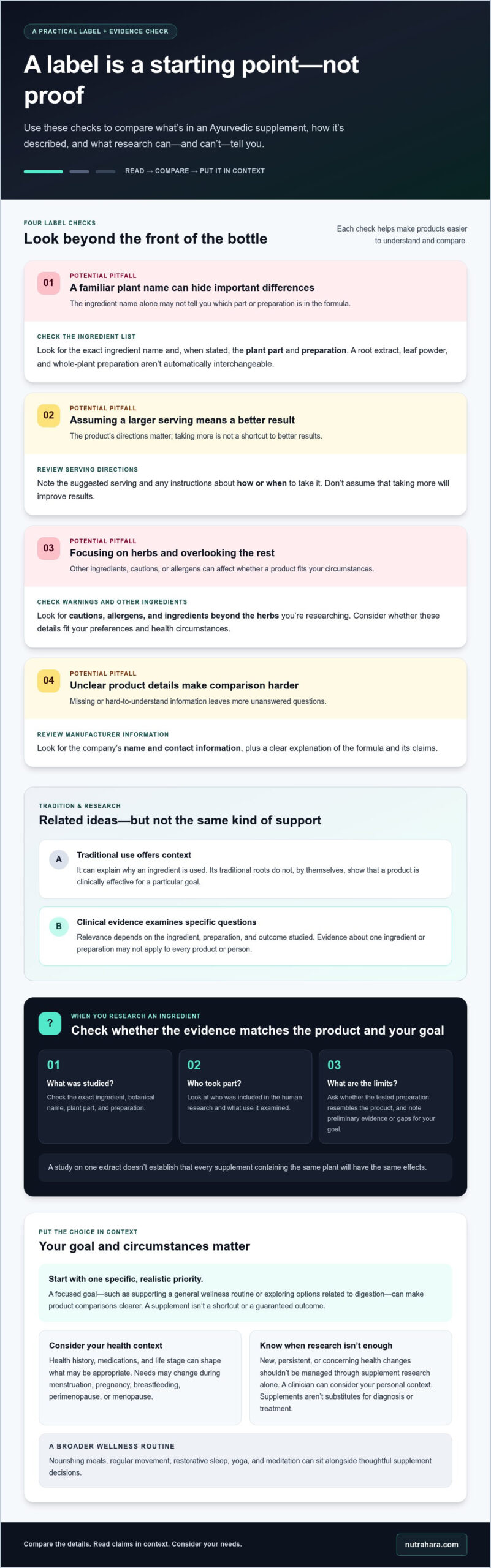
Ayurveda offers a traditional lens for thinking about well-being and balance. Dosha descriptions may help you explore that lens, but they shouldn’t be used to diagnose a health condition or decide that a supplement is automatically suitable. Traditional use provides context, not proof of effectiveness. Research findings also need to be considered in context: evidence about one ingredient or preparation may not apply to every product or person. Supplements aren’t substitutes for diagnosis or treatment.

Start with a clear, realistic wellness goal

Before comparing ingredients, write down one specific priority. You might want to support a general wellness routine or explore options related to digestion. A focused goal makes it easier to compare products without being drawn to formulas that promise to address everything. Keep the goal realistic: a supplement isn’t a shortcut or a guaranteed outcome.

Separate general wellness interests from symptoms that deserve individualized medical attention. New, persistent, or concerning changes in your health shouldn’t be managed through supplement research alone. This is especially relevant when your needs may be shaped by menstruation, pregnancy, breastfeeding, or menopause. A clinician can help assess symptoms and consider your personal context before you make a decision.

Build your foundation alongside any supplement research. Regular movement, nourishing meals, restorative sleep, yoga, and meditation can support a broader wellness routine. Choose practices you can sustain: a walk, a balanced meal, or a brief meditation can be a more practical starting point than trying to overhaul everything at once. The aim is a thoughtful choice that fits your life, not a promise in a bottle.

How to Evaluate Ayurvedic Supplement Ingredients, Labels, and Evidence

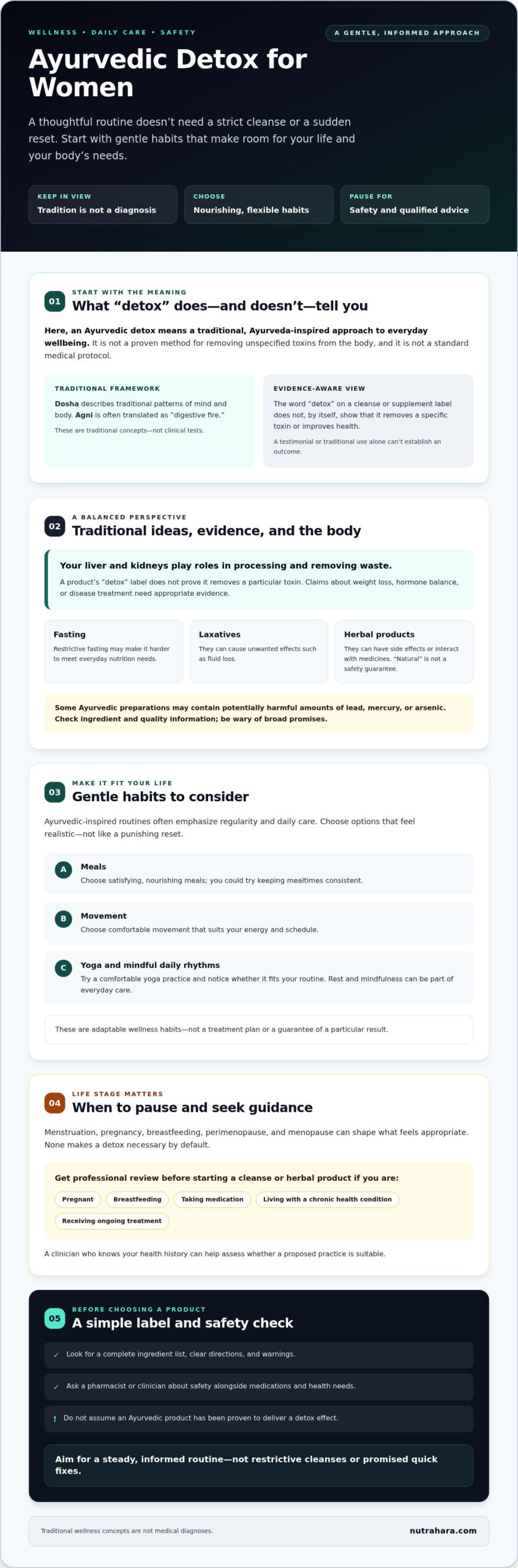
A label is a starting point for comparison, not proof that a supplement will meet your goal. Read it in a consistent order so unfamiliar botanical names or polished claims don’t distract from practical details. Clear identification helps you understand what a formula contains and compare it with ingredients discussed in research.

  1. Read the ingredient list. Look for the exact ingredient name and, when stated, the plant part and preparation. A root extract, leaf powder, and whole-plant preparation aren’t automatically interchangeable.
  2. Review serving directions. Note the suggested serving and any instructions about how or when to take it. Don’t assume that taking more will improve results.
  3. Check warnings and other ingredients. Look for cautions, allergens, and ingredients beyond the herbs you’re researching. These details may affect whether a product fits your preferences or health circumstances.
  4. Review manufacturer information. Look for the company’s name and contact information, along with a clear explanation of the formula and its claims. Missing or hard-to-understand details make products more difficult to compare.

Questions to ask when researching an Ayurvedic ingredient

Start with the exact ingredient named on the label. Search for its botanical name, plant part, and preparation, then look for human research related to your intended use. Check what the study examined, who took part, and whether the tested preparation resembles the one in the product. A study on one extract doesn’t establish that every supplement containing the same plant will have the same effects. Note limitations, including whether evidence is preliminary or doesn’t address your specific wellness goal.

Traditional use and clinical evidence are different kinds of support. Traditional knowledge can explain why an ingredient is used. Clinical evidence examines specific questions through research, and its relevance depends on the ingredient, preparation, and outcome studied.

How to read claims without overinterpreting them

Pause over claims that sound sweeping, vague, or guaranteed. Ask what the product says it supports and whether the explanation points to evidence that matches that claim. A statement about general structure or function is different from a promise to prevent, treat, or cure a disease. In the United States, the FDA does not approve dietary supplements for safety and effectiveness before they are marketed. Its dietary supplement information explains the agency’s role and the category’s oversight.

For broader context on choosing products for women’s needs, see The Ultimate Guide to Women’s Wellness Supplements. Nutrahara’s women’s health supplements combine Ayurvedic principles with modern nutritional research. Explore Nutrahara’s women’s wellness approach as another point of comparison while you read labels and assess claims.

DIY Research vs. Professional Guidance: Which Approach Fits Your Situation?

Independent research can help you become a more confident reader of supplement labels. It can explain unfamiliar terms, help you compare ingredients, and give you useful questions to bring to a healthcare professional. But it can’t account for your full medical history or determine whether a product is suitable for you personally. A thoughtful approach to how to choose ayurvedic supplements uses research to narrow options, then seeks individualized input when your circumstances call for it.

When independent research may help you narrow options

Self-directed research is a practical first step when you’re exploring general wellness options and don’t have a personal health factor that makes the decision more complex. Keep a short note for each product you’re considering:

  • The product and its stated purpose
  • The exact ingredients and any label warnings
  • What you found about those ingredients, including questions or uncertainties

Bring your notes to a conversation with a qualified healthcare professional if you’re unsure. This makes the discussion more focused than arriving with a broad question such as “Are Ayurvedic supplements safe?” The WHO perspective on traditional medicine also provides context for considering traditional approaches alongside evidence-informed healthcare. General reading alone can’t establish an individual product’s safety or suitability for you.

When individualized guidance matters more

Personalized advice is especially relevant if you’re pregnant, breastfeeding, taking medication, managing a health condition, or preparing for a planned procedure. These factors can change which questions need attention and how a supplement fits into your overall care. A clinician or pharmacist who understands your circumstances can review the product alongside your medication and health history. Don’t assume an ingredient is appropriate for every woman just because it’s plant-based or traditionally used.

If you’re experiencing symptoms that are new, persistent, or concerning, seek medical attention rather than trying to manage them with supplements. Research can help you organize your questions, but it shouldn’t delay an assessment or replace recommended care.

DIY research
Strengths: Clarifies terminology, compares labels, and helps you prepare focused questions.
Limits: Can’t assess your full health history or determine personal suitability.

Individualized professional guidance
Strengths: Can consider medications, health conditions, life stage, and other personal factors together.
Especially useful when: You’re pregnant or lactating, use medication, have a health condition, or have a planned procedure.

The aim isn’t to choose between learning for yourself and seeking support. Use research to become an informed participant, and seek individualized guidance when your health context makes a general answer insufficient.
How to Choose Ayurvedic Supplements: DIY Research vs. Professional Guidance

A Practical Safety Check for Women at Different Life Stages

A supplement decision should reflect more than the ingredient name. Menstruation, pregnancy, lactation, perimenopause, and postmenopause are different experiences, and individual health needs vary within each stage. A routine that suits one woman may not suit another. Your personal health context can change whether a supplement is appropriate.

Use this pre-use check to organize your decision. It won’t replace individualized medical advice, but it can help you identify questions for further discussion.

  1. Clarify your goal. Write down what you hope to support and whether it’s a general wellness priority or a symptom that needs assessment.
  2. Read the full label. Review ingredients, serving directions, warnings, and other listed components, not just the front-panel claims.
  3. Review your context. Consider your life stage, health conditions, medications, and any planned procedure. “Natural” describes an origin, not whether a product is suitable for you or free from possible interactions.
  4. Note your questions. Record anything unclear about the ingredients or claims, then discuss relevant concerns with a qualified healthcare professional before starting if your circumstances warrant it.

Pregnancy, lactation, medications, and health conditions

If you’re pregnant or breastfeeding, seek individualized healthcare guidance before starting a supplement. The same care is sensible if you take medication or manage a health condition. Share the product label, not only the product name, so its ingredients and warnings can be reviewed in context. No ingredient should be treated as universally suitable for every woman or every life stage. Don’t make your own dosing changes or assume an ingredient is safe alongside a medication.

Concerning or persistent symptoms deserve medical attention rather than a self-directed supplement trial. If you notice an unexpected effect after starting a product, pause and speak with a qualified professional about what to do. Keeping the label and a brief note of when you started can make that conversation clearer.

Build a routine around whole-person wellness

A supplement is one possible part of a wellness routine, not a replacement for foundational habits or care. Support your well-being with manageable practices: consistent movement, nourishing meals, restorative sleep, and yoga or meditation if they suit you. These habits don’t need to be elaborate to be sustainable.

Try keeping a simple wellness log that records your routine, the supplement and its label details, and any changes you notice. Avoid drawing quick conclusions from a single day. Use your notes to guide a grounded conversation with a qualified professional if something concerns you. If you’re comparing women’s health options, explore Nutrahara’s women’s health supplements as part of your broader research, while keeping your own health context central to the decision.

Turn Your Research Into a Thoughtful Supplement Choice

Research becomes useful when it leads to a clear, measured next step. To decide how to choose ayurvedic supplements, follow a simple process: define one wellness goal, assess the product label, review the evidence for the ingredient and intended use, then consider how your health history and life stage affect the decision. If an important question remains, pause rather than filling the gap with an assumption.

Transparent product information makes this process easier. Clear ingredient names, serving directions, warnings, and explanations of a formula help you compare options on their actual details instead of relying on broad promises. Transparency supports an informed decision, but it doesn’t establish that a product will produce a particular result or suit every person.

Apply the framework to an ingredient-led example

Ashwagandha with Black Pepper is one example you can assess using this approach. Start with the product label: identify the ingredients and preparation details provided, read the directions and warnings, and note anything you need clarified. Then look for research on the specific ingredients and intended use. Findings about an ingredient don’t necessarily describe a finished product or establish a health outcome.

Nutrahara’s formulations combine Ayurvedic principles with modern nutritional research. That pairing can be useful context as you compare products, but your decision should still rest on the information available for the specific formula and your personal circumstances. Review the Ashwagandha with Black Pepper supplement as you consider its product information. If you’re pregnant or lactating, take medication, or manage a health condition, seek individualized guidance before deciding whether it fits your routine.

Choose a measured next step

Keep your process simple. Choose one clear goal, compare one product at a time, and avoid starting several unfamiliar supplements together. Introducing multiple changes at once can make it harder to understand what you’re responding to. A small, considered step is easier to review than a complete routine overhaul.

  • Save the product name and label details you reviewed.
  • Write down your goal and any questions about ingredients, evidence, or warnings.
  • Bring those notes to a qualified healthcare professional if your health context calls for tailored advice.

Your choice can be part of a broader wellness journey, alongside habits that support your everyday well-being. Explore Nutrahara’s approach to women’s wellness as you compare options with care and curiosity.

Make Your Next Wellness Step With Confidence

Your wellness choices don’t have to be perfect to be thoughtful. Let curiosity guide your research, and give yourself permission to pause when a label or claim raises questions. The aim of learning how to choose ayurvedic supplements isn’t to find a universal answer. It’s to make a decision that feels informed and appropriate for you, then pay attention to how it fits your life and broader routine.

That routine may include movement that feels good, nourishing meals, yoga, meditation, and rest. Small, sustainable choices can help you build a sense of balance over time. If your needs shift, revisit your priorities and seek individualized guidance when your health context calls for it.

Explore Nutrahara’s approach to women’s wellness as you consider your next step. Trust yourself to move forward with care, one informed choice at a time.

Frequently Asked Questions

How do I choose an Ayurvedic supplement?

Start with one specific wellness priority, then compare products based on the exact ingredients, serving directions, warnings, and information provided about the formula. Research whether the evidence relates to your intended use, not just to the ingredient in general. When considering how to choose ayurvedic supplements, set aside products whose claims are clearer than the information explaining what’s inside or how they’re intended to be used.

Can I choose Ayurvedic supplements without a professional consultation?

You can research products independently to understand terms and compare labels, especially when exploring general wellness options. For example, note whether two products identify the same plant part or preparation and whether their labels are equally clear. Self-research isn’t a way to diagnose symptoms or confirm personal suitability. If you have health concerns, take medication, or are unsure about a product, bring its label to a qualified healthcare professional.

Are Ayurvedic supplements safe during pregnancy or breastfeeding?

Don’t assume an Ayurvedic supplement is suitable during pregnancy or breastfeeding based only on its natural origin or traditional use. Before starting one, show your pregnancy or lactation care professional the full product label, including all ingredients and serving directions. Mention other supplements you already take, such as a prenatal product, so they can consider the full picture. Evidence about an ingredient may not establish safety for a particular product or for your circumstances.

How can I tell whether an Ayurvedic supplement claim is evidence-based?

Look for evidence that addresses the same ingredient, preparation, intended use, and outcome described in the claim. A study about one form of an ingredient may not support a broad promise about every product containing it. Check whether the research is in people and what it actually measured. Be cautious if a claim promises a guaranteed result or says a supplement can prevent, treat, or cure a disease.

Can Ayurvedic supplements interact with medications?

They can, so don’t assume an herbal product is interaction-free. Prepare a complete list of prescription medicines, over-the-counter products, and other supplements you use, then share it with a clinician or pharmacist. This helps them consider the combination rather than evaluating one ingredient in isolation. Don’t stop or change a prescribed medication to make room for a supplement without guidance from the professional who manages your care.

Should I take more than one Ayurvedic supplement at a time?

Adding several unfamiliar supplements together can make it harder to identify which product may be linked to an unexpected change. Before combining products, compare their labels for ingredients that appear in more than one formula, and ask a healthcare professional to review the combination if you have health conditions or take medication. Keep a record of what you start and when. Don’t exceed a product’s serving directions in an effort to speed up results.

Article by

Nutrahara Team

We are a dedicated collective of nutrition scientists and naturopaths at Nutrahara, committed to advancing women's health through the fusion of ancient Ayurveda science and cutting-edge nutrition research. Our mission is to empower you with clean, simple, and scientifically validated wellness solutions so you can live your healthiest life. Connect with us to stay updated on the latest developments in holistic women's health and nature-based research.

Disclaimer

This article is not a substitute for medical advice. Please consult a healthcare professional before starting any supplement, especially if pregnant, nursing, taking medication, or managing health conditions.

Categories
Articles

Natural Supplements for Women: A Guide to Wellness

What if the most helpful supplement choice isn’t the one making the biggest promise, but the one that fits your needs and has evidence behind it? If conflicting claims have left you unsure about the benefits of natural supplements for women, you’re not alone. Your priorities may also shift through menstruation, pregnancy, lactation, perimenopause, and post-menopause, making safety and relevance just as important as the ingredient list.

This guide explains how supplements may fit into everyday wellness without being mistaken for treatment. You’ll learn how to weigh research, product labels, and uncertainty, and how to discuss your choices with a partner in a way that respects both of your perspectives. You’ll also explore how Nutrahara brings Ayurvedic principles together with modern nutritional research, alongside practical ways to build a balanced routine with movement, yoga, meditation, and restorative practices. The goal isn’t to find a perfect formula. It’s to make informed choices that support your wellbeing over time.

Key Takeaways

  • Consider where the benefits of natural supplements for women may support everyday wellness, and remember that supplements aren’t a substitute for treatment.
  • Assess evidence for digestion, skin, hair, nails, and cognitive wellness without confusing traditional use with established findings.
  • Compare labels by ingredient, amount, purpose, and evidence. “Natural” doesn’t automatically mean safer or more effective.
  • Use thoughtful prompts to share your wellness goals with your partner, listen to concerns, and agree on next steps without pressure.
  • Explore how Nutrahara’s Ayurvedic principles and modern nutritional research can inform choices grounded in your goals and life stage.

Why women consider natural supplements for everyday wellness

Women may consider supplements as one part of a broader approach to wellbeing, alongside varied meals, regular movement, rest, and practices such as yoga or meditation. Natural supplements for women contain ingredients from natural sources and are intended to add nutrients or other dietary ingredients. But “natural” doesn’t mean risk-free, proven effective, or suitable for everyone. A supplement may support dietary intake, but it isn’t a guaranteed result or a substitute for care when a health concern needs attention.

Health goals also depend on individual circumstances. The broad field of women’s health includes physical and mental wellbeing across different ages and life stages, rather than one shared set of needs. Keeping that in mind can make supplement decisions more personal and less influenced by sweeping promises.

What women may hope supplements will support

Goals vary. One woman may want to review her overall nutrient intake; another may be interested in digestion, skin, hair, nails, or cognitive wellness. These are areas to explore, not outcomes a product can promise. Feeling tired or noticing a change in digestion, for example, doesn’t by itself show that you need a supplement or that one will address the cause.

Start with a clear question: What am I hoping to support, and what else is part of my routine? Consider your usual eating pattern, activity, sleep, and any ongoing health concerns. A simple wellness note can help you track what you experience and what changes in your routine, without assuming a product caused every difference. If a symptom is persistent or worrying, treat it as a health question rather than trying to manage it with supplements alone.

Why life stage matters when considering supplements

Needs and priorities can shift during menstruation, pregnancy, lactation, and the years before or after menopause. Diet, health context, and life stage may all influence whether a particular nutrient or ingredient is relevant. A transition can prompt useful questions, but it doesn’t automatically mean supplementation is necessary. Consider what you already get from food and other supplements, then identify a specific goal before adding anything.

Pregnancy and lactation call for especially careful, individualized safety guidance. Ingredients that seem familiar or “natural” aren’t automatically appropriate during these stages, and personal circumstances matter. Discuss a supplement’s ingredients and intended use with a qualified healthcare professional before starting it. At any life stage, keep an up-to-date list of supplements and medicines so potential overlap or interactions can be considered.

The benefits of natural supplements for women are possibilities shaped by individual needs, not universal promises. Define your goal, account for your life stage, and keep nutrition and restorative habits at the heart of your routine.

What benefits can natural supplements offer women, and what does evidence say?

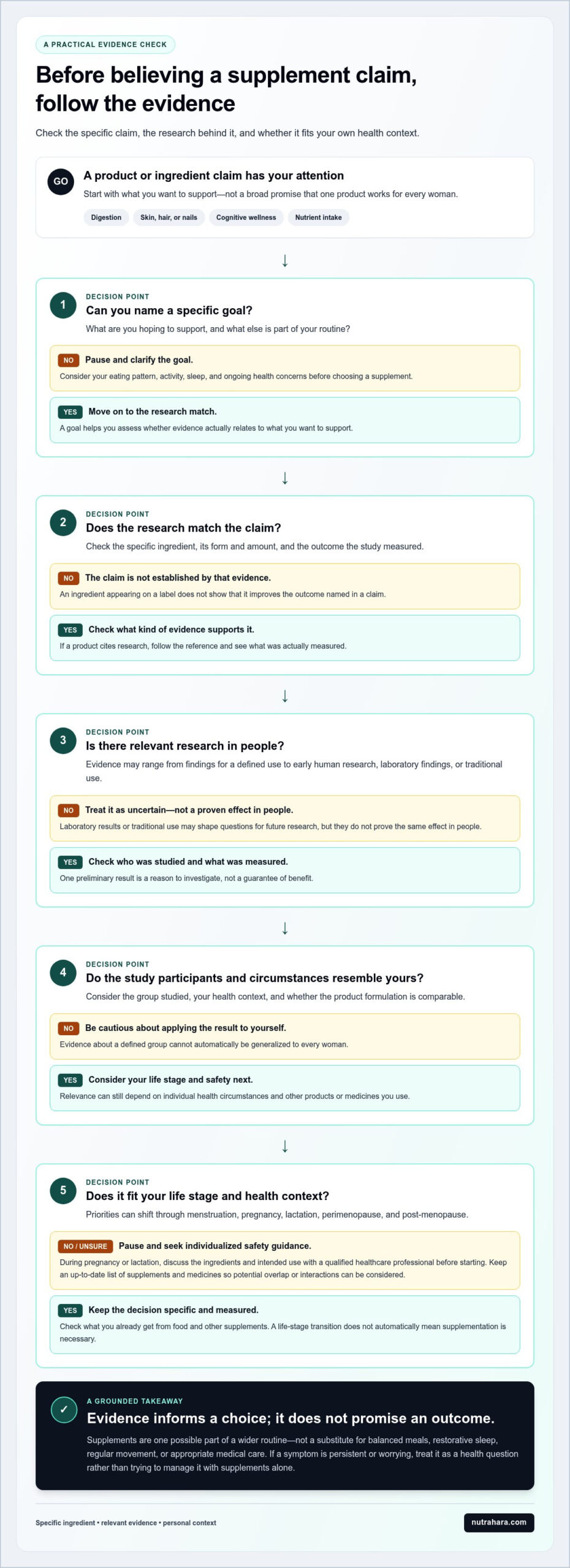
Consider potential support by health goal, not by a broad promise that one product works for every woman. Digestion, skin, hair, nails, and cognitive wellness are common areas of interest, but an ingredient’s presence on a label doesn’t establish that it improves any of them. To assess the benefits of natural supplements for women, look for research on the specific ingredient, its form and amount, the people studied, and the outcome measured.

Evidence can range from well-supported findings for a defined use to early human research, laboratory findings, or traditional use. These categories aren’t interchangeable. A result seen in cells or described in traditional practice may help shape questions for future research, but it doesn’t prove that a supplement produces the same effect in people. Similarly, an association between a nutrient and an outcome doesn’t show that taking a supplement causes that outcome.

How to read claims about ingredients and research

Match the research to the claim. Check whether it concerns the same ingredient and form, a comparable amount, and the intended outcome. Look for human studies, and consider whether participants resemble you in relevant ways. If a product claim cites research, follow the reference and see what was actually measured. One preliminary result is a reason to investigate, not a guarantee of benefit.

Evidence about a particular ingredient, amount, and outcome in a defined group can’t automatically be generalized to every woman. Individual health context and product formulation may differ. This matters across menstruation, pregnancy, lactation, and menopause, and for anyone taking medicines or managing a health concern.

  • Digestion: Check whether research measures the digestive outcome named in the claim. Different digestive concerns aren’t interchangeable.
  • Skin, hair, and nails: Distinguish studies of a specific nutrient or ingredient from broad promises about appearance or growth.
  • Cognitive wellness: Look for evidence tied to the particular mental function being discussed. A general “brain support” phrase may not describe a measured result.

These categories are questions to investigate, not established benefits of any product. Without relevant, reliable citations, a specific benefit claim should remain unasserted.

Supplements as one part of a wider wellness routine

A supplement is one possible part of a thoughtful routine, not a stand-in for balanced meals, restorative sleep, regular movement, or appropriate medical care. Build a practical foundation: eat varied foods, choose activity you can sustain, and consider yoga or meditation as ways to support a calmer daily rhythm. Then ask whether a supplement addresses a clearly identified dietary goal. For an example to assess, Nutrahara’s vitamin B complex supplement can be reviewed by its ingredients, stated purpose, and available evidence, rather than by promises alone.

Natural versus synthetic supplements: compare the label, not the promise

“Natural” and “synthetic” describe how an ingredient is sourced or produced. Neither word, by itself, tells you whether a supplement is safe, effective, or right for you. Source alone cannot establish a supplement’s safety or benefit. A naturally derived ingredient can still be unsuitable in some circumstances, while a synthetically produced ingredient isn’t automatically ineffective. The ingredient’s identity, amount, purpose, evidence, and your personal context matter more than a reassuring-sounding label.

Use the label as a starting point for questions, not as proof of a promise. Compare products by checking details you can assess:

Ingredient identity: Is each ingredient clearly named, or described only in broad terms? A recognizable source can be useful context, but it doesn’t prove a benefit.

Amount and serving information: Can you tell how much of each ingredient is included per serving and how the serving is defined? If the amount isn’t clear, it’s harder to compare a label with relevant research.

Stated purpose: Does the product explain its intended dietary role? Don’t infer additional benefits from an ingredient’s name or claims that aren’t explained on the label.

Evidence: Is there credible research on the same ingredient, form, amount, and intended outcome? A source claim or “natural” positioning isn’t a substitute for evidence.

Which label details help make an informed choice?

Read the full ingredient list and serving information, then compare them with the reason you’re considering a supplement. If a proprietary blend or broad description makes the contents or amounts difficult to understand, seek clearer information rather than assuming the product is harmful. Transparent details make it easier to assess your options. For example, when considering women’s health supplements, examine the listed information and stated purpose instead of assuming unlisted effects.

Safety questions to consider across life stages

Your health history, medicines, and other supplements can affect whether an ingredient is suitable; combinations may also matter. Keep a current list of what you take and discuss potential interactions with a qualified healthcare professional if you have questions. If you’re pregnant or breastfeeding, seek qualified guidance before using supplements. “Natural” doesn’t guarantee that an ingredient is appropriate for every person or life stage.

You don’t need to choose a product simply because it sounds more natural or more advanced. A careful label review helps you ask better questions and consider the potential benefits of natural supplements for women without treating a source label as a promise. Let clear information and your own wellness priorities guide your next step.

Natural Supplements for Women: A Guide to Wellness

How to talk with your partner about natural health choices

Different views on supplements don’t have to become a contest. A calm conversation can help you explain what matters to you, hear your partner’s concerns, and decide what information or next steps would be useful. The aim isn’t to secure automatic agreement. It’s to discuss your choices with respect while keeping your health and autonomy central.

A simple framework for a supportive conversation

Begin with your goal, such as understanding whether a supplement fits your nutrition priorities or current life stage. Explain why that goal matters to you, then share what you’ve learned, including limits or unanswered questions. Invite your partner’s perspective without assuming skepticism means they don’t care. Asking, “What would help you feel comfortable discussing this?” can open a more curious exchange.

Try this sequence:

  1. Share your aim. “I’m looking into ways to support my everyday wellbeing, and I want to make an informed choice.”
  2. Explain what you know. Summarize the evidence you found and what it doesn’t establish. Be clear if research is limited or doesn’t match your exact situation.
  3. Listen for the concern. Ask, “Is your main concern safety, cost, or whether it’s likely to help?” Reflect back what you hear before responding.
  4. Agree on a next step. You might review reliable information together, pause to learn more, or talk with a qualified healthcare professional if you have personal safety questions.

This approach keeps the discussion focused on shared understanding rather than pressure. It also makes room for uncertainty: the potential benefits of natural supplements for women depend on the specific choice and individual circumstances, so there’s no need to pretend every answer is settled.

Turn shared intentions into realistic habits

Choose one manageable practice you can enjoy together, such as a walk, gentle yoga, or a brief meditation. Agree on when it fits your routine, then notice how the habit feels without treating a change as proof that a supplement caused it. Simple personal notes about energy, sleep, or other observations can help you spot patterns, while remembering that daily wellbeing has many influences.

Shared routines can support connection, but you don’t need your partner to adopt every wellness choice you make. You might ask, “Would you like to try a short walk with me?” or, “Can we set aside time to compare what we’ve each read?” If you disagree, pause and return to the conversation later. Your partner can offer perspective, but your health decisions remain yours to make with appropriate guidance.

For example, if you’re considering a supplement because your eating habits have changed, you could explain what you hope to understand, share the label and research you’ve reviewed, and invite your partner to help you think through any questions. That keeps the conversation specific without assuming a product is necessary or that it will produce a particular result.

Thoughtful choices begin with honest questions and steady habits. If you’d like to explore options as part of your own research, explore women’s health supplements with your goals and priorities in mind.

A thoughtful path from natural wellness research to Nutrahara

Good supplement decisions start with your needs, not a trend or a promise. Nutrahara brings Ayurvedic principles together with modern nutritional research, using natural, clean ingredients in its women’s health supplements. This approach connects traditional wellness ideas with contemporary nutrition, but it isn’t proof that a supplement has been clinically shown to produce a particular outcome. Ask whether an option fits your goal, what evidence supports its use, and whether it suits your circumstances.

What a balanced supplement decision can look like

Before deciding, write down what you hope to support and what would help you assess the choice clearly.

  • State your goal: Describe the wellness priority in your own words, such as reviewing your nutrition or focusing on a specific area of wellbeing.
  • Review the evidence and label: Check whether research relates to the ingredient, form, amount, and outcome you’re considering. Compare that information with the ingredients, serving details, and stated purpose on the label.
  • Consider your context: Your life stage, health history, medicines, and other supplements may affect whether an option is suitable. Seek qualified guidance if you have personal safety questions, especially during pregnancy or breastfeeding.

A supplement is optional. It doesn’t replace nourishing food, movement, restorative sleep, yoga or meditation, or appropriate medical care. For a sustainable routine, choose manageable habits you can return to: plan movement that fits your week, make time for restful practices, and review your routine when your needs change. Small, repeatable choices can help you care for your wellbeing over time, without treating any single product or habit as a guarantee of longevity.

Nutrahara’s women’s health supplements focus on areas such as skin, hair, nails, digestion, and brain function. These are areas of focus, not guaranteed results or treatment claims. Let your goals and life stage guide what you consider, and weigh specific claims against relevant evidence rather than popularity or persuasive language.

Continue exploring women’s wellness

If this approach resonates with you, explore Nutrahara’s women’s health supplements as part of your own research. Consider the listed ingredients, stated purpose, and evidence, then decide whether an option fits alongside the habits that support your day-to-day wellbeing. You don’t need to choose something simply because it’s popular or labeled natural. Your wellness is a personal progression, shaped by changing needs and the practices you can sustain. It isn’t a test of commitment, discipline, or confidence. Choose what feels informed and appropriate for you, one considered step at a time.

Let your next wellness step be your own

Your wellness needs may shift with your routines, priorities, and life stage. Give yourself room to revisit your choices as they change. The potential benefits of natural supplements for women are worth considering with curiosity, but your choices don’t need to follow a trend or meet anyone else’s expectations. A steady practice, a thoughtful question, or deciding to wait can each be a meaningful next step.

Nutrahara combines Ayurvedic principles with modern nutritional research and focuses on women’s health supplements made with natural, clean ingredients. This philosophy can be one lens for exploring options, alongside your own goals and the evidence for any specific ingredient. Explore Nutrahara’s approach to women’s wellness, and choose only what feels relevant to your informed wellness journey. You deserve to make those choices with confidence, care, and kindness toward yourself.

Frequently Asked Questions

Do natural supplements work for women’s health?

Some supplements may help meet a specific nutritional need, but effects depend on the ingredient and the person. The benefits of natural supplements for women aren’t guaranteed, and “natural” alone doesn’t show that a product works. If you’re considering a supplement because your diet has changed, first identify the nutrient or goal you’re concerned about. A qualified healthcare professional can help you decide whether supplementation makes sense for your circumstances.

Are natural supplements safer than synthetic supplements?

Not necessarily. “Natural” and “synthetic” refer to source or production, not a safety ranking. Safety can depend on the ingredient, amount, product quality, your health, and what else you take. A botanical product, for example, can still be unsuitable for someone with a particular health condition. Compare the full ingredient information and serving directions, and seek qualified guidance if you’re uncertain about a product’s relevance to you.

Can women take supplements while pregnant or breastfeeding?

Some supplements may be appropriate during pregnancy or breastfeeding, but don’t assume a product is suitable just because it’s natural or commonly used. Before starting one, show a qualified healthcare professional the exact product label, including all ingredients and serving directions. This gives them a clearer basis to consider your individual circumstances. If you already take supplements, include those in the conversation rather than reviewing a new product in isolation.

Can natural supplements interact with medications?

Yes, some supplement ingredients can affect how medicines work or add to their effects, so check before combining them. Make a list of prescription medicines, over-the-counter products, and supplements, including how often you take each. Share it with a qualified healthcare professional or pharmacist when considering a new ingredient. Don’t stop or change a prescribed medicine to make room for a supplement without guidance from the professional who manages your care.

Do women need supplements if they eat a balanced diet?

Not always. A balanced diet may provide many nutrients, but whether it meets your needs depends on your individual health context and circumstances. A food and supplement record can help you spot patterns, such as routinely missing a food group, without diagnosing a deficiency. If you’re concerned about a possible gap, discuss it with a qualified healthcare professional. Supplements are a choice to consider, not a measure of how well you care for yourself.

How can I tell whether a supplement claim is supported by research?

Look for a clear reference to human research and check whether it studied the same ingredient, form, amount, and outcome described in the claim. Read beyond the headline: a small or early study may not establish a dependable effect. Be cautious if the claim uses sweeping language but offers no specific evidence to assess. You can take the reference or product label to a qualified healthcare professional and ask what conclusions the research supports.

Can women take more than one supplement at the same time?

Sometimes, but combining products can lead to overlapping ingredients or interactions. Before taking several, compare their labels and note ingredients that appear more than once, including those in blends. Keep the labels or clear photos together so a qualified healthcare professional or pharmacist can review the full combination, particularly if you use medicines or have a health condition. Adding products one at a time can also make it easier to notice changes or unwanted effects.

Article by

Nutrahara Team

We are a dedicated collective of nutrition scientists and naturopaths at Nutrahara, committed to advancing women's health through the fusion of ancient Ayurveda science and cutting-edge nutrition research. Our mission is to empower you with clean, simple, and scientifically validated wellness solutions so you can live your healthiest life. Connect with us to stay updated on the latest developments in holistic women's health and nature-based research.

Disclaimer

This article is not a substitute for medical advice. Please consult a healthcare professional before starting any supplement, especially if pregnant, nursing, taking medication, or managing health conditions.

Categories
Articles

Supplements for Self-Confidence: A Guide for Women

What if feeling more confident starts with supporting your well-being, not finding the perfect supplement? It’s understandable to look for help when stress, shifting energy, or changes through menstruation, pregnancy, lactation, perimenopause, or menopause affect how you feel. But supplements to boost self-confidence can’t create self-worth or guarantee a change in mood. At most, an appropriate supplement may support one part of a broader wellness routine.

This guide explains what supplements may reasonably support, how to compare product categories, and what to consider before choosing one. You’ll also find practical ways to nurture confidence through movement, yoga, meditation, and self-reflection. Nutrahara combines principles of ancient Ayurveda with modern nutritional research in its women’s health supplements. The goal isn’t to rely on a pill to feel enough. It’s to build steady foundations that help you feel supported in everyday life.

Key Takeaways

  • Compare supplements by their intended purpose, evidence, label details, and your individual needs rather than assuming products are interchangeable.
  • Consider supplements to boost self-confidence only as possible support for broader well-being, not as a direct source of self-worth.
  • Account for pregnancy, lactation, medications, health conditions, and planned procedures when considering a supplement, and seek qualified medical guidance.
  • Build a routine that fits your life with adaptable movement, restorative yoga, meditation, sleep habits, and self-reflection.
  • Explore Nutrahara’s women’s health supplements as one option within a wellness approach informed by Ayurvedic principles and modern nutritional research.

Can Supplements Boost Self-Confidence? Set Realistic Expectations First

Wanting to feel more self-assured is reasonable, especially when daily demands leave you feeling unlike yourself. But supplements to boost self-confidence shouldn’t be treated as a quick fix. Confidence develops through a mix of personal experience, relationships, social pressures, physical well-being, and emotional health. It isn’t a simple measure of whether you have enough of a particular nutrient.

Confidence is also distinct from self-esteem and self-efficacy, or your belief in your ability to do a task. Exploring understanding self-confidence can help clarify why a supplement alone can’t address every factor that shapes how you feel. A nutrient supplement may be relevant when it addresses an individual, documented nutritional need. That is different from proving that it directly increases confidence.

Evidence-qualified perspective: A supplement may support a specific aspect of wellness when appropriate, but that support doesn’t guarantee a psychological outcome such as greater confidence.

What might a supplement support, and what can’t it promise?

Think of a supplement as one possible part of a wellness plan, not a stand-in for self-trust, supportive relationships, rest, or professional care when needed. One person’s experience can be meaningful to them, but it can’t establish that the same product will work for everyone. Be cautious of claims that promise a direct confidence boost or explain one through a “happy hormone” mechanism without reliable evidence.

Before considering a supplement, name the specific need you hope to address. Then look for evidence about the ingredient and that intended purpose. Keep expectations modest: a product label or customer story doesn’t prove that a supplement will have the same effect for you.

Why confidence can feel different at different life stages

Menstruation, pregnancy, lactation, perimenopause, and postmenopause can bring different circumstances, but no two women experience them in the same way. Changes in routine, responsibilities, or how you feel physically may influence confidence without pointing to a particular deficiency or diagnosis. Life stage is a reason to consider your individual needs, not a reason to assume a supplement is necessary.

Before choosing a product, consider what has changed and what kind of support you’re seeking. If you’re pregnant or lactating, have a health condition, or take medication, discuss supplement use with a qualified healthcare professional. Your confidence journey deserves care shaped around you, not a promise that one formula can fit every woman.

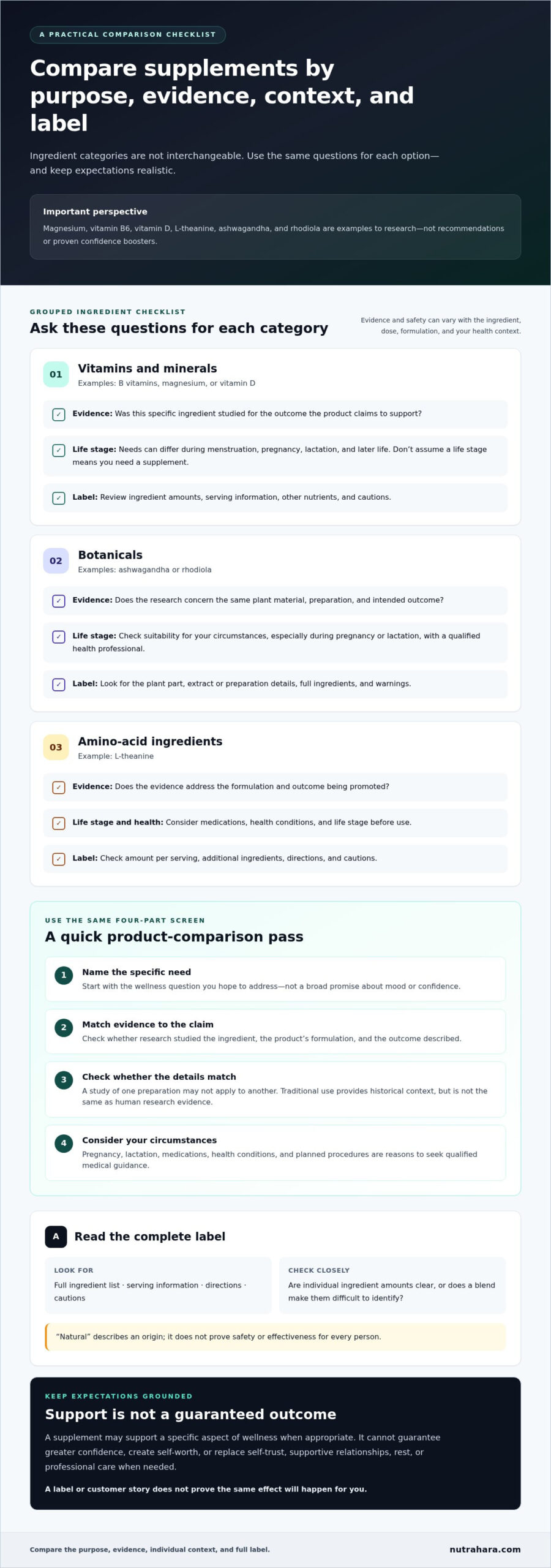
Compare products by the question they’re meant to answer, not by broad promises about mood or confidence. Ingredients such as magnesium, vitamin B6, vitamin D, L-theanine, ashwagandha, and rhodiola are examples to research, not recommendations or proven confidence boosters. Evidence and safety can vary with the ingredient, dose, formulation, and your health context.

Use this framework to organize your questions. It doesn’t rate ingredients or establish that a product will produce a particular result.

Category and examples Evidence question Life-stage caution Label details to review
Vitamins and minerals, such as B vitamins, magnesium, or vitamin D Was the specific ingredient studied for the outcome the product claims to support? Needs can differ during menstruation, pregnancy, lactation, and later life. Don’t assume a life stage means you need a supplement. Ingredient amounts, serving information, other nutrients, and cautions.
Botanicals, such as ashwagandha or rhodiola Does the research concern the same plant material, preparation, and intended outcome? Check suitability for your circumstances, especially during pregnancy or lactation, with a qualified health professional. Plant part, extract or preparation details, full ingredients, and warnings.
Amino-acid ingredients, such as L-theanine Does the evidence address the formulation and outcome being promoted? Consider medications, health conditions, and life stage before use. Amount per serving, additional ingredients, directions, and cautions.

Questions to ask when comparing ingredient categories

Start with a specific wellness question. Then check whether the evidence studied the ingredient itself, the product’s formulation, and the outcome described in its claims. A study of one preparation may not apply to another. Traditional use can offer historical context, but it isn’t the same as evidence from human research. Broad phrases like “supports mood” don’t explain what outcome was measured or who was studied.

What to look for on a supplement label

Read the complete ingredient list, serving information, directions, and cautions. Check whether each ingredient’s amount is clearly stated and whether a blend makes individual amounts difficult to identify. “Natural” describes an origin, not proof of safety or effectiveness for every person. The Vitamin B Complex product page is one example of where to review product-specific information. The name alone doesn’t establish who should use it or what it will do.

When comparing women’s wellness supplements, apply the same questions to each option. Reviewing the details helps you move beyond confidence-focused marketing and make choices based on evidence, clear labeling, and your individual circumstances.

Safety Considerations for Women Choosing Supplements

A supplement’s suitability depends on its ingredients, formulation, and your personal circumstances, including life stage, health conditions, medications, and planned procedures. “Natural” doesn’t automatically mean safe or appropriate for everyone. Plant-based ingredients can still require careful consideration, and a product’s general wellness positioning isn’t a substitute for individualized guidance.

This matters whether you’re comparing supplements to boost self-confidence or considering a product for another wellness goal. Make safety part of your decision from the start, not a detail to review only after choosing.

Pregnancy, lactation, and changing health needs

Don’t assume guidance intended for adults generally applies during pregnancy or breastfeeding. If you’re pregnant, lactating, trying to conceive, or have questions related to menstruation or menopause, seek individualized advice from a qualified healthcare professional before starting a supplement. Life stage alone doesn’t determine what you need, and broad claims about hormonal balance or symptom relief shouldn’t replace personal assessment.

Medication use, side effects, and product claims

If you take prescription or over-the-counter medication, have a health condition, or are planning a medical procedure, review the product’s cautions and discuss supplement use with a qualified professional. Ask whether the ingredients are suitable for your situation and whether potential interactions or other concerns apply. Don’t change prescribed treatment based on a supplement claim.

Keep the label and product information available when you seek guidance. This makes it easier to discuss the exact formulation rather than relying on a broad ingredient name. For example, the Ashwagandha with Black Pepper product page identifies the product you’re considering. Its name alone doesn’t establish its effects or suitability for you.

Separate marketing language from evidence by asking what a claim refers to. A product-level statement may not show that the specific ingredient, formulation, or amount has been studied for the promised outcome. Look for clear product information and be cautious about claims that imply a supplement treats a condition or reliably changes mood or confidence.

Before deciding, use this simple check:

  • Personal context: Note pregnancy, breastfeeding, medications, health conditions, allergies, and planned procedures.
  • Product details: Review the complete ingredient list, serving information, directions, and warnings.
  • Evidence: Ask whether research supports the specific ingredient and outcome being claimed.
  • Guidance: Discuss personal safety questions with a qualified healthcare professional, especially when your health circumstances change.

These steps can make a choice feel more manageable. They keep your decision grounded in your individual needs rather than a one-size-fits-all promise.

Build Confidence Alongside Supplements: Practical Habits That Fit Real Life

Confidence can grow through small experiences of caring for yourself and noticing what you can do. Supplements to boost self-confidence can’t replace those foundations. A flexible routine can make room for movement, rest, and reflection without turning wellness into another standard you have to meet.

Try this simple sequence as a starting point, then adapt it to your ability, schedule, comfort, and life stage. Pregnancy, recovery after birth, changing energy, or a busy workweek may call for a gentler version.

  1. Choose movement you enjoy. Plan a walk, swim, strength session, or another activity that feels appropriate for your current ability. Shorter sessions or everyday movement count when that’s what fits.
  2. Add restorative yoga. Choose comfortable poses or gentle stretching, and pause if a movement doesn’t feel right. Yoga can offer mindful movement without requiring flexibility or performance goals.
  3. Make space for meditation. Sit comfortably and notice your breath for a few quiet moments. If sitting still feels difficult, try a mindful walk instead.
  4. Create a wind-down cue. Choose a repeatable signal that helps you prepare for sleep, such as dimming the lights or putting your phone aside. Keep it realistic for your routine.
  5. Reflect without judging. Write down one strength you used or one meaningful action you took that day. It might be asking for help, showing up to exercise, or making time to rest.

Small practices for a steadier sense of self

Begin with a brief daily pause rather than aiming for a perfect meditation streak. Take a few comfortable breaths and let your attention return to them when it wanders. At day’s end, ask: “What did I handle today that deserves recognition?” Name one specific action, even if it was simply making space to recover.

Movement, yoga, and sustainable wellness

Enjoyment and comfort matter. Choose movement that meets you where you are, and give yourself permission to scale it down or rest. Restorative yoga may be a gentle option; meditation can be practiced seated, lying down, or while walking. These habits support general well-being, but they aren’t substitutes for healthcare when you need it.

There’s no single weekly template that suits every woman. You might alternate walks, yoga, and strength-focused movement, or begin with one activity you can repeat consistently. If your energy or circumstances change, adjust the plan instead of treating that as failure. A sustainable practice is one you can return to.

For a wellness routine that includes women’s supplements alongside everyday habits, explore Nutrahara’s wellness offerings.

Supplements for Self-Confidence: A Guide for Women

Explore Nutrahara Supplements as One Part of Your Wellness Journey

Choosing a supplement is a personal decision shaped by your needs, health context, and the information available about a product. Nutrahara combines principles of ancient Ayurveda with modern nutritional research in its women’s health supplements. That approach informs the products, but it isn’t a promise that a supplement will create confidence or reliably change how you feel.

Think of a product as one possible part of a broader routine. Sleep, nourishing meals, movement, yoga, meditation, supportive relationships, and appropriate healthcare all have a place in personal well-being. The right combination will look different for a woman who menstruates, is pregnant or lactating, is navigating perimenopause, or is postmenopausal. Your needs may also shift over time.

A thoughtful approach to choosing a Nutrahara product

If you’re considering a Nutrahara supplement, use its product information as a starting point for careful review, not as evidence of a particular effect or a recommendation for your circumstances. Compare the product information with your wellness goals, life stage, and any safety questions you have. If you take medication, have a health condition, or are pregnant or breastfeeding, seek individualized guidance from a qualified healthcare professional before adding a supplement.

A few useful questions can keep the decision grounded:

  • Does the product information clearly identify what the product contains?
  • Does any claim address a specific, understandable wellness goal?
  • Is the information relevant to your personal circumstances, or does it make a broad promise?
  • Have you considered whether a supplement fits alongside your existing routine and care?

These questions help separate a product description from evidence about a specific ingredient and outcome. They also leave room for the possibility that a supplement may not be the support you need right now. No product should be treated as a substitute for mental health care, and no supplement can guarantee greater confidence.

A measured next step for your wellness journey

The central distinction is simple: a supplement may support a specific aspect of wellness when appropriate, but that is not the same as directly producing self-confidence. Confidence develops within a wider life, through personal experience, emotional well-being, physical health, and relationships. If you’re exploring supplements to boost self-confidence, keep that broader picture in view and let evidence, personal needs, and safety guide your choices.

Nutrahara’s women’s health supplements bring Ayurvedic principles together with modern nutritional research. Review the product information alongside your own goals, and choose a next step that feels informed and right for you. Your wellness journey belongs to you, and it can grow through thoughtful choices rather than quick promises.

Let Your Next Wellness Choice Reflect What Matters to You

Confidence doesn’t need to arrive as a dramatic transformation. It can take shape in the choices you make with care, the boundaries you honor, and the way you recognize your progress. As you move forward, choose a personal sign of growth that matters to you. Perhaps it’s speaking up in a meeting, returning to an activity you enjoy, or feeling more at ease in your daily routine.

If you’re considering supplements to boost self-confidence, let your goals guide your questions rather than letting a product promise define success. Notice how your needs and priorities change over time, and give yourself permission to revise your approach. A thoughtful wellness journey is built through informed choices, patience, and care for the whole person.

Explore Nutrahara’s women’s health supplements at your own pace, and consider how their product information fits your priorities and broader routine. Explore Nutrahara’s women’s health supplements.

There’s no single right path to feeling more like yourself. Keep choosing what supports your well-being, one considered step at a time.

Frequently Asked Questions

Can supplements directly increase self-confidence?

No supplement can be relied on to directly or consistently increase self-confidence. A supplement may be considered for a specific nutritional need, but that is different from showing it builds confidence. If you’re weighing supplements to boost self-confidence, look beyond the product promise: identify the wellness goal, review what evidence supports the claim, and notice whether your confidence changes in particular situations, such as work or social settings.

Is there scientific evidence that supplements boost self-esteem?

Evidence that a particular ingredient supports a defined health outcome doesn’t automatically show that it increases self-esteem. These are different outcomes, and research on one ingredient or formulation may not apply to another product. Be cautious with claims that use broad terms such as “confidence” without explaining what was studied. A testimonial can describe one person’s experience, but it can’t establish a reliable effect for others.

Can stress or low energy affect how confident I feel?

Yes. Feeling worn down or under pressure may make it harder to speak up, take on a challenge, or feel comfortable in situations that usually feel manageable. That doesn’t mean stress or low energy explains every change in confidence. Consider noting when the feeling appears and what else is happening, such as workload, sleep disruption, or a change in routine. If it persists, discuss it with a healthcare professional.

Are supplements for confidence safe during pregnancy or breastfeeding?

Don’t assume a product is suitable during pregnancy or breastfeeding because it’s marketed for general wellness or made with natural ingredients. Safety depends on the specific product and your circumstances. Before starting or continuing a supplement, bring its full label to a qualified healthcare professional and ask for guidance tailored to you. This is especially useful when comparing a supplement with other products you already take.

Can I take confidence-related supplements with prescription medication?

Possibly, but don’t assume a supplement and prescription medication are compatible. Show your prescriber or pharmacist the complete label, including blends and serving information, and ask whether the specific product is appropriate alongside your medication and health conditions. Keep a current list of everything you take, including nonprescription products. Don’t stop, replace, or adjust prescribed medication on the basis of a supplement claim.

How can yoga and meditation support a confidence-building routine?

Yoga and meditation can create regular moments to notice your comfort, attention, and responses without judging yourself. Choose a gentle pose or movement that feels accessible, then pause to observe what feels steady or uncertain. A short meditation can focus on breathing or sounds around you. These practices aren’t confidence guarantees; they offer ways to make room for self-awareness and intentional choices in everyday life.

What should I do if low confidence is affecting my daily life?

If low confidence is making it difficult to work, maintain relationships, or take care of yourself, consider talking with a qualified healthcare or mental health professional. You can prepare by noting what feels difficult, when it began, and what you’ve already tried. Ask someone you trust for support if that feels comfortable. You deserve help suited to the full picture, not pressure to solve everything on your own.

Article by

Nutrahara Team

We are a dedicated collective of nutrition scientists and naturopaths at Nutrahara, committed to advancing women's health through the fusion of ancient Ayurveda science and cutting-edge nutrition research. Our mission is to empower you with clean, simple, and scientifically validated wellness solutions so you can live your healthiest life. Connect with us to stay updated on the latest developments in holistic women's health and nature-based research.

Disclaimer

This article is not a substitute for medical advice. Please consult a healthcare professional before starting any supplement, especially if pregnant, nursing, taking medication, or managing health conditions.
Categories
Articles

Ayurvedic Detox for Women: A Gentle, Safety-First Guide

A thoughtful ayurvedic detox for women doesn’t have to mean a strict cleanse or a sudden change to your routine. It can start with gentle, nourishing habits that leave room for work, exercise, and your body’s needs.

If conflicting online claims have left you unsure what “detox” actually means, you’re not alone. Ayurveda offers traditional ways of thinking about balance and daily care, but its concepts aren’t medical diagnoses. A detox routine shouldn’t be treated as a proven way to remove toxins or replace medical care. Restrictive cleanses and unfamiliar supplements may also be a poor fit, especially during pregnancy or breastfeeding, while taking medication, or through changing menstrual and menopausal stages.

This guide separates traditional ideas from established health evidence and offers realistic ways to think about meals, movement, yoga, meditation, and supplement labels. You’ll also find signs to pause and seek qualified medical advice. The aim is a steady, informed approach, not a punishing reset.

Key Takeaways

  • Understand what ayurvedic detox for women means in traditional wellness, without mistaking it for a proven way to remove unspecified toxins.
  • Choose gentle habits that fit your life, such as nourishing meals, comfortable movement, yoga, meditation, and rest.
  • Consider menstruation, pregnancy, breastfeeding, and menopause when deciding whether a practice or supplement is right for you.
  • Review supplement ingredients and claims carefully, and ask a qualified healthcare professional about safety alongside medications or health conditions.
  • Build a flexible routine around realistic goals, not restrictive cleanses or promised quick fixes.

What Does Ayurvedic Detox for Women Really Mean?

Curiosity about an Ayurvedic detox is understandable, especially when online advice promises a quick reset. A calmer starting point is to ask what the practice means, what it doesn’t establish, and whether the routine feels nourishing and realistic for you. The phrase can refer to different things, so it helps to separate traditional wellness ideas from medical claims.

In this article, “ayurvedic detox for women” means a traditional, Ayurveda-inspired approach to everyday wellbeing, not a proven method for removing unspecified toxins from the body. Ayurveda is a diverse traditional system with concepts and practices that have developed over time. A general overview of Ayurveda can introduce its history and ideas, but traditional explanations aren’t the same as biomedical measurements or diagnoses.

How Ayurveda describes balance, digestion, and daily rhythms

Two familiar Ayurvedic concepts are dosha and agni. Doshas are traditional ways of describing patterns of mind and body; agni is often translated as digestive fire. Neither is a clinical test. Fatigue, bloating, or a change in appetite doesn’t prove that a dosha is “out of balance” or that toxins have accumulated.

Ayurvedic-inspired routines often emphasize regularity: satisfying meals, adequate rest, gentle movement, and mindful daily rhythms. You could try keeping mealtimes consistent or choosing a comfortable yoga practice, then notice whether it fits your energy and schedule. These are adaptable wellness habits, not a treatment plan or a guarantee of a particular result.

Detox claims: what the word does and does not establish

Your body has organs, including the liver and kidneys, that play roles in processing and removing waste. The word “detox” on a cleanse, routine, or supplement label doesn’t show by itself that the product removes a specific toxin or improves health. Claims about weight loss, hormone balance, or disease treatment need appropriate evidence; traditional use or one person’s experience alone can’t establish those outcomes.

This distinction matters for women at every life stage. Menstruation, pregnancy, breastfeeding, perimenopause, and menopause can shape what feels appropriate, but none makes a detox necessary by default. If you’re reviewing a specific product, use the DetoxifyLife product page to check its current details, not as proof of a detox effect.

Ayurvedic Detox for Women: Traditions, Evidence, and Safety

Ayurvedic tradition can offer a meaningful framework for thinking about daily habits, but tradition alone doesn’t make every cleanse, herb, or supplement safe for everyone. An ayurvedic detox for women isn’t a standard medical protocol: practices and products vary, and evidence for one approach can’t automatically be applied to another.

That distinction matters if a plan involves fasting, laxatives, or multiple herbal products. Restrictive fasting may make it harder to meet everyday nutrition needs, while laxatives can cause unwanted effects such as fluid loss. Herbal products can also have side effects or interact with medicines. “Natural” describes a source, not a guarantee of safety or effectiveness.

What research can and cannot tell you

Evidence needs to be considered practice by practice, rather than inferred from Ayurveda’s long history or from one person’s experience. A testimonial may describe what someone felt, but it can’t establish that a cleanse caused a change or that others are likely to have the same result. The National Center for Complementary and Integrative Health offers a balanced overview of scientific evidence on Ayurveda’s value, including safety considerations. It notes that some Ayurvedic preparations may contain potentially harmful amounts of lead, mercury, or arsenic. Check ingredient and quality information, and be wary of broad promises to remove toxins, balance hormones, or treat disease.

For a practical label check, look for a complete ingredient list, clear directions, and any warnings. Then ask a pharmacist or clinician whether the product may be appropriate alongside your medications or health needs. Don’t assume that a product described as Ayurvedic has been proven to deliver a detox effect. Nutrahara’s DetoxifyLife product details can be reviewed as product information, not as evidence of a medical outcome.

When women should seek professional guidance first

Pregnancy, breastfeeding, ongoing treatment, chronic health conditions, and medication use all merit professional review before starting a cleanse or herbal product. A clinician who knows your health history can help you assess whether a proposed practice is suitable. This is particularly relevant during life stages when nutritional needs or treatment plans may differ.

If a practice brings on concerning symptoms, stop and seek medical advice. Don’t use a detox routine to delay care, replace prescribed treatment, or change medication on your own. A steady approach should support your wellbeing, not require you to push through feeling unwell.

Which Gentle Ayurvedic Practices Fit Different Women’s Needs?

There isn’t one routine that suits every woman, and a life stage doesn’t point to a particular “detox” need. For an ayurvedic detox for women, focus instead on habits that feel practical and nourishing. Menstruation, pregnancy, breastfeeding, perimenopause, and menopause can all be reasons to adapt a routine or ask a healthcare professional before making changes, especially if you have symptoms, a health condition, or treatment needs.

Choose movement and mindfulness that feel sustainable

Yoga and meditation can support general wellbeing, but they aren’t detox treatments. Choose movement that matches your comfort and capacity, whether that’s a gentle yoga sequence, a walk, or your usual exercise with modifications. Pause or change the activity if it feels uncomfortable. If you’re pregnant, recovering from birth, or managing a health concern, ask a clinician what movement is appropriate for you.

Mindfulness doesn’t need to become another rule. Try a few quiet breaths before a meal or a brief meditation during a break. If it feels calming, keep it; if not, choose another way to rest.

Food, hydration, and rest without restrictive rules

Build meals around your day rather than fasting or following rigid food rules. If you exercise, plan a satisfying meal or snack that fits your schedule, and keep water accessible. Regular rest matters, too. These habits can support everyday wellbeing, but they don’t promise toxin removal or specific outcomes at different life stages.

Practice Low-pressure starting point When to check with a clinician
Yoga or gentle movement Choose a comfortable session and modify poses to suit how you feel. Pregnancy, postpartum recovery, pain, injury, or a condition affecting movement.
Meditation or breathing Take a quiet pause and notice your breathing without forcing it. If it causes distress or you’re seeking support for ongoing mental health concerns.
Meals and hydration Plan nourishing meals around work, exercise, and daily commitments. Pregnancy, breastfeeding, a medical condition, or a prescribed nutrition plan.
Rest and routine Make space for a consistent wind-down habit that feels realistic. Persistent sleep difficulties or symptoms that concern you.

Use the table as a starting point, not a checklist to complete. If you’re considering a supplement, review its ingredients with a qualified professional when your life stage, medications, or health history could affect what’s appropriate.

How to Build a Gentle Ayurvedic-Inspired Routine at Home

A routine should make everyday care feel more manageable, not become another test to pass. An ayurvedic detox for women can be approached as a flexible set of wellness habits, with no strict timeline or required cleanse. Choose one small practice that suits your schedule, see how it feels, and adjust as needed.

A simple daily framework to personalize

Start with parts of your day that already have a rhythm. You might plan regular, nourishing meals around work and exercise, keep water within reach, and make room for movement that feels comfortable. A short yoga sequence or walk can be adapted to your fitness, energy, and health circumstances. If you’re pregnant, breastfeeding, managing a condition, or following a care plan, check whether a change in activity or eating habits is appropriate for you.

For mindfulness, try a quiet pause before beginning your day or a few relaxed breaths between tasks. Meditation doesn’t need to be long or formal. If it doesn’t suit you, skip it or choose another calming moment. These practices are invitations, not steps in a prescribed detox program.

Track comfort without turning it into a cleanse

Brief personal notes can help you decide whether a habit fits. After trying a change, record how your energy, mood, sleep, and general comfort feel. Treat these as observations, not proof that a detox is working. A simple note such as “felt comfortable after my walk” is enough; there’s no need to score your body or look for dramatic changes.

  • Choose one manageable practice: For example, prepare a meal ahead of a busy day or set out a yoga mat where you’ll see it.
  • Make it easy to adapt: Shorten, modify, or skip a practice when your schedule, energy, or life stage calls for it.
  • Notice how it feels: If a habit causes discomfort or conflicts with advice from your care team, change or stop it and seek guidance as appropriate.

Habits such as nourishing meals, comfortable movement, mindfulness, and rest can support general wellbeing, but they don’t replace medical care. For more women’s wellness information, explore Nutrahara’s wellness information.

Ayurvedic Detox for Women: A Gentle, Safety-First Guide

Choosing Your Next Step: Keep the Wellness Journey Personal

A thoughtful next step doesn’t need to be dramatic. Before trying a cleanse or supplement, check whether the goal is realistic, the routine feels comfortable, and the claims match the available evidence. An ayurvedic detox for women should never require you to ignore your needs or push through discomfort.

  • Set a realistic goal: Choose an everyday habit you can maintain, rather than expecting a quick reset or a guaranteed health outcome.
  • Review the routine: Ask whether it fits your meals, movement, work, rest, and current stage of life.
  • Check safety: Consider your health history, medications, and any advice from your care team.
  • Keep expectations evidence-aware: Traditional use and personal experience can be meaningful, but they don’t prove a product will detox the body or treat a condition.

Questions to ask before trying a supplement or cleanse

Supplements are optional. If you’re considering one, read the full ingredient list, directions, and warnings, and be cautious of claims that sound too broad or certain. Consider how it fits your circumstances, not just its traditional framing. If you’re pregnant, breastfeeding, receiving treatment, managing a chronic condition, or taking medication, discuss it with a qualified healthcare professional before use. Don’t change prescribed care based on a product label or online claim.

A useful question is: “What evidence supports this specific product for the outcome I’m considering?” If the answer is unclear, take time to review the information rather than feeling pressured to decide. Nutrahara describes its approach as combining Ayurvedic principles with modern nutritional research, but that approach alone doesn’t establish that any supplement provides a detox effect.

A supportive next step with Nutrahara

If you want to assess a specific product, review the DetoxifyLife product details for the information currently provided, and consider it alongside your own needs and professional advice. Product information isn’t proof of a medical benefit. You can also explore Nutrahara’s women’s wellness resources as part of a broader, evidence-aware learning journey. There’s no need to rush; choose a next step that feels informed and appropriate for you.

Choose a Gentle Next Step for Your Wellbeing

An ayurvedic detox for women doesn’t need to mean a restrictive cleanse or a promise to remove toxins. Treat it as an opportunity to explore traditional wellness ideas thoughtfully, while keeping evidence, comfort, and your individual health needs in view. Nourishing meals, movement that feels right, yoga, meditation, and rest can be adaptable parts of everyday wellbeing, not substitutes for medical care.

Supplements are optional. Review ingredients and product information carefully, and seek qualified medical advice before trying something new if you’re pregnant, breastfeeding, taking medication, or managing a health condition. Your routine can change with your life stage. Start with a realistic goal, then keep only the habits that feel supportive.

Nutrahara brings Ayurvedic principles together with modern nutritional research and offers women’s health supplements and wellness e-books. Explore Nutrahara’s women’s wellness approach for more information as you consider your next step.

Frequently Asked Questions

What is an Ayurvedic detox for women?

An Ayurvedic detox for women usually refers to wellness practices inspired by Ayurveda, such as mindful routines, food choices, movement, and rest. The term alone doesn’t prove that a program removes toxins or treats a health condition. Practices vary, and some cleanses involve fasting, laxatives, or herbs. Consider your health circumstances before making changes, and ask a qualified healthcare professional about practices or products that may affect your care.

Is an Ayurvedic detox safe during pregnancy or breastfeeding?

Safety depends on the specific practice or product and your individual circumstances. Pregnancy and breastfeeding aren’t times to assume a cleanse or herbal supplement is harmless. Before starting a restrictive routine or supplement, discuss it with a qualified healthcare professional who understands your care. This general information can’t determine whether a particular product or practice is appropriate for you, so seek personalized guidance before making a change.

Can yoga and meditation support an Ayurvedic detox routine?

Yoga and meditation can be part of a wellbeing routine, but they aren’t methods proven to remove toxins. Choose movement that suits your fitness and health, and adapt or pause if it feels uncomfortable. A brief meditation or quiet breathing practice can offer a mindful pause in your day. If you’re pregnant, recovering from birth, or managing a health condition, ask a healthcare professional about suitable activity.

What should women eat during an Ayurvedic detox?

There isn’t one meal plan that suits every woman, and a “detox” label doesn’t show that restrictive eating is beneficial. Consider regular, nourishing meals that fit your needs and preferences rather than fasting or following severe food rules. If you’re pregnant or breastfeeding, have a medical condition, or are receiving treatment, consult a qualified healthcare professional before making substantial dietary changes. Your nutrition needs are personal.

Do Ayurvedic detox supplements remove toxins?

A supplement’s traditional framing or marketing doesn’t establish that it removes toxins or treats a health condition. Your body has organs, including the liver and kidneys, that play roles in processing waste. Review the product’s ingredients, directions, and warnings. If you take medication, have a health condition, are pregnant, or are breastfeeding, ask a qualified healthcare professional to review the product with you before use.

How long should an Ayurvedic detox last?

There’s no universally appropriate duration for an Ayurvedic detox, and a longer cleanse isn’t automatically safer or more effective. Avoid rigid schedules if you don’t understand what the routine involves. Before starting a program that includes fasting, laxatives, or supplements, seek professional guidance, especially if you have health concerns or take medication. Everyday habits that fit your needs don’t have to follow a timed detox plan.

What happens if I feel unwell during a detox?

Stop the practice that may be contributing and seek appropriate medical advice, especially if symptoms are severe, persistent, or concerning. Don’t assume discomfort means toxins are leaving your body. If you’ve used a supplement or laxative, tell the healthcare professional what you took and when. Seek urgent care for symptoms that feel serious or need immediate attention, rather than trying to continue the routine.

Can an Ayurvedic detox help with weight loss or hormone balance?

The word “detox” isn’t evidence that a routine causes lasting weight loss or balances hormones. Don’t rely on cleanse claims to address unexplained weight changes, menstrual concerns, or other symptoms. A qualified healthcare professional can assess your individual concerns and discuss appropriate options. Nourishing meals, comfortable movement, sleep, and stress care may support general wellbeing, but they don’t guarantee a specific medical outcome.

Article by

Nutrahara Team

We are a dedicated collective of nutrition scientists and naturopaths at Nutrahara, committed to advancing women's health through the fusion of ancient Ayurveda science and cutting-edge nutrition research. Our mission is to empower you with clean, simple, and scientifically validated wellness solutions so you can live your healthiest life. Connect with us to stay updated on the latest developments in holistic women's health and nature-based research.

Disclaimer

This article is not a substitute for medical advice. Please consult a healthcare professional before starting any supplement, especially if pregnant, nursing, taking medication, or managing health conditions.