Categories
Articles

Vitamin D for Post-Menopausal Women: Key Benefits

Vitamin D supports bone health after menopause, but it isn’t a cure-all for menopause symptoms. The body needs it to absorb calcium, and it also has roles in muscle, immune, and nervous system health. For women considering vitamin D for post-menopausal women, the useful starting point is understanding what supplementation can support and what it can’t address.

It’s natural to wonder whether one nutrient could ease hot flashes, sleep changes, low mood, or sexual concerns. These symptoms can have different causes and may call for different approaches. Separating symptom support from bone-health goals can help you make informed choices without expecting a supplement to do everything.

This guide covers vitamin D forms, daily intake, upper limits, and potential risks. It also reviews evidence on menopause symptoms and explains how supplements can fit into a broader wellbeing routine.

Key Takeaways

  • Learn why vitamin D3 is often preferred and how calcium fits into post-menopausal bone health.
  • Understand how to think about a daily dose and the upper intake limit before adding a supplement.
  • Recognize why taking too much vitamin D can pose risks, especially when supplements are combined.
  • Separate symptoms vitamin D may help from common menopause concerns it generally doesn’t relieve.

What’s the best type of vitamin D for menopause?

When choosing vitamin D for post-menopausal women, vitamin D3, or cholecalciferol, is generally preferred over vitamin D2. It raises and maintains stable vitamin D blood levels. The nutrient helps the body absorb and use calcium, supporting bone structure. It also plays roles in muscle function and immune and nervous system health, so its contribution extends beyond bones.

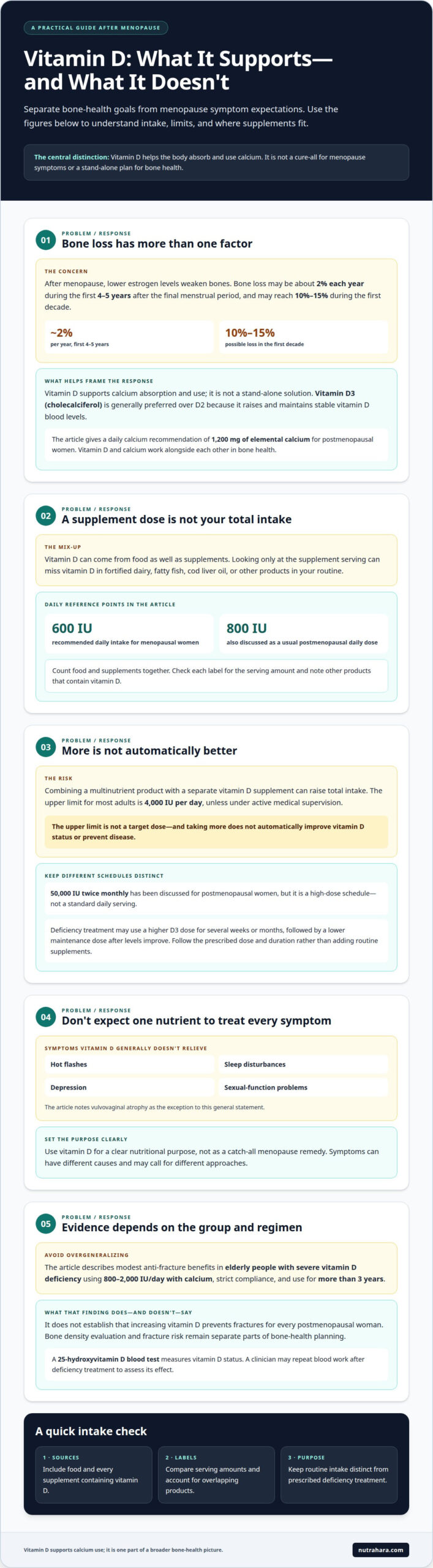
Bone health deserves attention after menopause because estrogen levels drop, weakening bones. Women may lose about 2% of bone each year during the first four to five years after their final menstrual period. Loss may reach 10% to 15% during the first decade after menopause. As bone density declines, osteoporosis and fractures become important concerns. Vitamin D supports calcium use, but it isn’t a stand-alone solution for protecting bone health.

Calcium works alongside vitamin D in this process. According to National Academies of Sciences, Engineering, and Medicine, postmenopausal women are recommended to consume 1,200 mg of elemental calcium per day. Vitamin D sources include fortified dairy products, fatty fish, and cod liver oil. Consider food and supplements together when assessing intake, since a supplement is only one part of a person’s overall nutrition.

A thoughtful approach to vitamin D for post-menopausal women starts with identifying the form and considering dietary sources. Fatty fish, for example, can provide vitamin D, while fortified dairy can provide both vitamin D and calcium. Check supplement labels for the form and serving amount, and account for other products in your routine. This helps you avoid overlapping supplements and choose an option suited to your nutritional needs.

Daily vitamin D dosage and upper intake limit

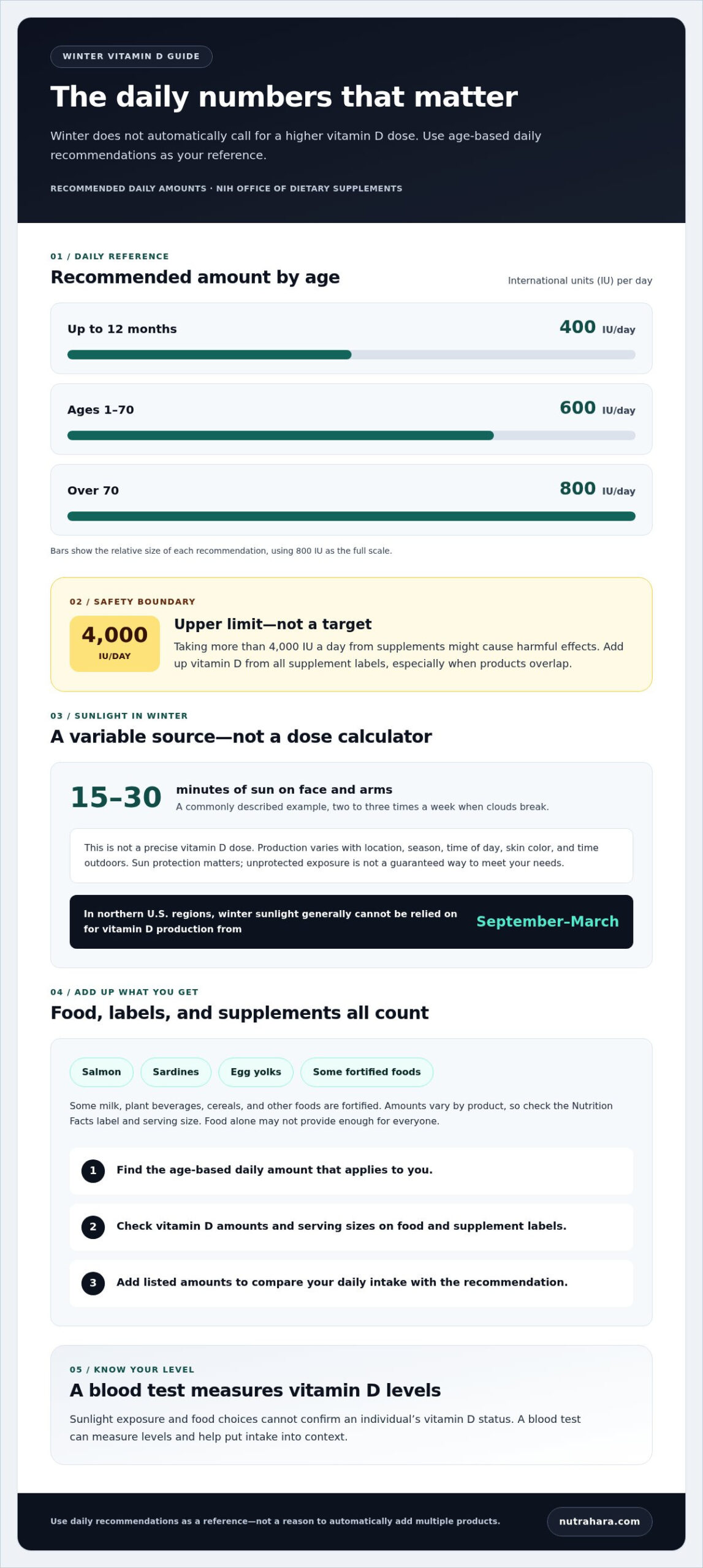
For menopausal women, the recommended intake is 600 IU of vitamin D per day; 800 IU daily is also discussed as a usual postmenopausal dose. Vitamin D comes from fortified dairy products, fatty fish, cod liver oil, and supplements; check food labels and supplement facts for the amount in each serving.

Daily Intake and Supplement Dosing

Daily intake includes vitamin D from both food and supplements, so the supplement dose isn’t the whole picture. Fortified dairy products and fatty fish are food sources, while supplement labels list vitamin D in IU or micrograms. Compare the amount with your daily target and account for any other products you take.

A regimen of 50,000 IU twice monthly has also been discussed for postmenopausal women, but it is a high-dose schedule, not a standard daily serving. Vitamin D deficiency treatment may use a higher D3 dose for several weeks or months, followed by a lower maintenance dose after levels improve. The purpose is to address deficiency, not to increase intake without a reason.

Calcium intake matters alongside vitamin D because vitamin D helps the body absorb and use calcium. Consider the calcium in meals and supplements as part of your overall intake, rather than assuming a vitamin D product also supplies calcium. This distinction helps when comparing products and planning nutrition for bone and muscle health.

Upper Intake Limits

The tolerable upper intake level for most adults is 4,000 IU of vitamin D per day, unless they’re under active medical supervision. This limit refers to total daily intake, including food and supplements. It isn’t a target dose: taking more doesn’t automatically improve vitamin D status or prevent disease.

Before adding a supplement, review its serving amount alongside other products containing vitamin D. For example, combining a multinutrient product with a separate vitamin D supplement can increase your total daily intake. Higher-dose treatment has a different purpose and schedule from routine intake, so don’t treat a twice-monthly regimen as interchangeable with a daily dose.

Use these figures to guide your choices: note the vitamin D amount on each label, include dietary sources, and compare the total with the daily intake recommendation and upper limit. If you’re receiving treatment for a deficiency, follow the prescribed dose and duration rather than adding routine supplements. This helps keep your intake deliberate and supports balanced nutrition.

Risks of excessive vitamin D supplementation

More vitamin D isn’t automatically better. For most adults, the tolerable upper intake level is 4,000 IU per day unless they’re under active medical supervision. Regularly stacking high-dose supplements with multinutrient products can push total intake above that limit. Add the amounts listed on each supplement label before combining products, and distinguish a prescribed deficiency treatment from routine daily supplementation.

Evidence for fracture prevention depends on the group and regimen. In elderly people with severe vitamin D deficiency, maintenance doses of 800 to 2,000 IU/day taken with calcium may provide modest anti-fracture benefits when used with strict compliance for more than 3 years. This finding doesn’t establish that escalating vitamin D prevents fractures for every postmenopausal woman. Bone density evaluation and fracture risk remain separate parts of bone-health planning.

Vitamin D shouldn’t be treated as a general menopause symptom treatment. Supplementation doesn’t relieve hot flashes, sleep disturbances, depression, or sexual-function problems, with vulvovaginal atrophy as the exception. Changing estrogen levels are part of the menopause transition, but vitamin D doesn’t replace therapies for estrogen-related symptoms. Use a supplement for a clear nutritional purpose, not as a catch-all remedy.

Higher-risk groups deserve a more targeted approach. Women at higher risk of deficiency may consider calcium and vitamin D, as study authors advised. The relevant factors include deficiency risk, current intake, and whether a clinician has prescribed a treatment dose. A 25-hydroxyvitamin D blood test measures vitamin D status, and a clinician may repeat blood work after deficiency treatment to assess its effect.

Claims about other health outcomes also need perspective. Vitamin D supplementation doesn’t affect cardiovascular event incidence or cancer incidence, though it modestly reduces cancer-related mortality. It may modestly decrease infection risk and COVID-19 severity. These findings don’t make high doses a way to improve muscle function or prevent disease broadly. Keep supplementation purposeful, and avoid raising the dose simply to pursue wider benefits.
Vitamin D for Post-Menopausal Women: Key Benefits

Vitamin D and menopause symptoms

Vitamin D is often considered for hot flashes, sleep changes, mood, and sexual wellbeing. Evidence draws a useful distinction: supplementation doesn’t help most menopausal symptoms, including hot flashes, sleep disturbances, depression, or sexual-function problems. Vulvovaginal atrophy is the exception described in the available findings. Vitamin D may matter for a specific concern, but it shouldn’t be treated as general menopause therapy.

Mood findings need careful interpretation. Postmenopausal women with the highest vitamin D intakes had a 20% lower risk of developing depressive symptoms after 3 years, compared with women with the lowest intakes. That is an association, not proof that vitamin D prevents depression. A review also found links between deficiency and health outcomes, while noting that causality couldn’t be established. Mood changes deserve attention in their own right.

Vulvovaginal atrophy has a more specific signal. A high-dose vitamin D supplement improved several signs after 6 weeks in postmenopausal women. Described approaches included oral doses of 40,000-60,000 IU/week and a 1000 IU/day vaginal suppository. These are high-dose regimens, not routine self-care suggestions. The route and dose matter, so don’t assume an ordinary daily supplement has the same effect.

A practical next step is to name the symptom you want to address. Note whether it involves hot flashes, disrupted sleep, low mood, or vaginal discomfort, then seek care focused on that concern. Vaginal dryness and irritation, for example, call for a different discussion from night sweats. This helps distinguish vitamin D deficiency from menopause-related changes and keeps supplement use aligned with evidence. Yoga, meditation, and regular movement can support general wellbeing, but they don’t make vitamin D a treatment for these symptoms.

Nutrahara: Women’s Health Supplements

Nutrahara offers Women’s Health Supplements for women building a thoughtful wellness routine through changing life stages. Its formulations bring together principles of ancient Ayurveda science and modern nutritional research, using clean, simple ingredients. If you’re considering supplements alongside balanced nutrition, movement, and rest, explore how Nutrahara’s approach fits your wellbeing goals.

For vitamin D decisions, focus on your specific intake and needs. A supplement should complement informed choices, not replace food sources or care for menopause symptoms. Nutrahara’s women’s health supplements offer a natural option to explore as part of your personal wellness routine.

For questions about Nutrahara’s Women’s Health Supplements, contact Nutrahara.

Make your next wellness choice with intention

Choose one small practice to support your wellbeing this week. Try a gentle yoga sequence, adapting poses to your comfort, then spend a few quiet minutes noticing your breath. For meditation, sit comfortably and return your attention to breathing whenever your mind wanders. These practices can support a steady routine alongside thoughtful choices about vitamin D for post-menopausal women.

Keep it simple: choose a time that fits your day and a practice you can repeat. Your wellness routine can grow gradually as your needs change.

Contact Nutrahara with your questions, and take your next step with confidence.

Frequently Asked Questions

What is vitamin D and why does your body need it?

Vitamin D helps your body use calcium and supports several body systems. It contributes to bone maintenance, muscle function, and immune and nervous system health. Think of it as one part of a balanced approach to wellbeing, alongside varied food choices and regular movement. To focus on your own wellbeing, consider how food choices and movement fit into your routine.

Can Low Vitamin D Cause Hot Flashes?

Low vitamin D isn’t established as a cause of hot flashes, and supplementation generally doesn’t relieve them. Hot flashes can occur during menopause, but they don’t by themselves indicate a deficiency. If they disrupt sleep or daily life, discuss the symptom and possible support options with a healthcare professional rather than increasing vitamin D on that basis alone.

How Do I Know If I’m Getting Enough Vitamin D?

A 25-hydroxyvitamin D blood test measures your vitamin D level. The U.S. Preventive Services Task Force concludes that evidence is insufficient to recommend for or against screening for vitamin D deficiency. To understand your intake, look at vitamin D from foods and supplements alongside your health circumstances. If you have questions about your intake or health circumstances, discuss them with a healthcare professional.

What are the signs of low vitamin D?

Symptoms alone can’t reliably establish whether your vitamin D is low. A blood test measures the level directly, while fatigue or aches can have many possible explanations. If symptoms persist or concern you, discuss them with a healthcare professional. You can prepare for that conversation by noting which symptoms concern you and how long they have persisted.

Why Does Low Vitamin D Appear in Midlife?

Midlife alone doesn’t mean someone has a vitamin D deficiency. Vitamin D status can reflect dietary intake and individual health circumstances, while menopause brings changes that make bone health an important part of wellbeing. A measured level provides different information from assumptions based on age or life stage. If you have concerns, ask a healthcare professional whether measuring your level is appropriate.

How much vitamin D should postmenopausal women take daily?

The discussed daily intake recommendation for menopausal women is 600 IU, while 800 IU daily is also cited as a usual postmenopausal dose. These are different recommendations, not amounts to combine. Count vitamin D from food and supplements, and read product labels carefully. A dose used to treat measured deficiency can differ from routine intake, so keep the purpose of each supplement clear.

Article by

Nutrahara Team

We are a dedicated collective of nutrition scientists and naturopaths at Nutrahara, committed to advancing women's health through the fusion of ancient Ayurveda science and cutting-edge nutrition research. Our mission is to empower you with clean, simple, and scientifically validated wellness solutions so you can live your healthiest life. Connect with us to stay updated on the latest developments in holistic women's health and nature-based research.

Disclaimer

This article is not a substitute for medical advice. Please consult a healthcare professional before starting any supplement, especially if pregnant, nursing, taking medication, or managing health conditions.

Categories
Articles

Top Supplements & Vitamins for Pre-Menopausal Women

Do supplements and vitamins for pre-menopausal women ease perimenopause symptoms, or are they mainly useful when you have a nutrient deficiency? Supplements may support specific needs, but no single option works for everyone or replaces a balanced approach to health. Choosing thoughtfully matters more than taking a long list.

It’s understandable to want practical support when changes in sleep, mood, energy, or menstrual cycles affect how you feel and exercise. This guide explains what phytoestrogens may offer, why calcium matters for bone health, and how magnesium fits into discussions about sleep and mood. It also covers what blood work can reveal about nutrient levels, and what it cannot.

You’ll find a clear, grounded way to consider each option, alongside everyday foundations such as nourishing food, regular movement, yoga, and meditation. The aim isn’t to chase a perfect routine, but to make informed choices that support your well-being through this changing stage of life.

Key Takeaways

  • Learn which foods contain phytoestrogens and why evidence for symptom relief from phytoestrogens remains unclear.
  • Understand how calcium supports bone health and what to consider before adding a supplement.
  • Explore magnesium as one possible part of a restful evening routine, alongside practices such as yoga or meditation.
  • See how blood work can help identify nutrient deficiencies and inform supplement choices.

1. Phytoestrogens in foods and supplements

Plant phytoestrogens are compounds found in soy products and some fruits and vegetables. Isoflavones, a type of phytoestrogen, occur in soybeans, other legumes, and red clover. Lignans are found in flaxseed, whole grains, and some fruits and vegetables. Menopause is the point 12 months after a woman’s last period, according to the National Institute on Aging. Symptoms can arise before that milestone, so a changing cycle alone doesn’t define when menopause has occurred.

Food sources and concentrated supplements aren’t interchangeable. Research is unclear on whether phytoestrogens from foods or supplements ease menopause symptoms or affect breast cancer risk. Flaxseed contains omega-3 fatty acids and lignans, and it may help reduce hot-flash intensity and frequency. A small study followed women who took flaxseed for three consecutive months, but that finding doesn’t establish a reliable effect for every person. Track symptoms such as hot flashes, anxiety, or changes in cognitive function rather than assuming a botanical will improve them.

For PMS and fatigue, evidence does not establish a reliable benefit from phytoestrogen supplements; calcium is more directly relevant to bone health. The right choice depends on the nutrient and concern, not a general promise to improve function or protect health. Supplements are most useful when they address a specific dietary shortfall or identified need, not simply because a symptom appears during the menopause transition.

For food sources, try soybeans or lentils for isoflavones, and ground flaxseed or whole grains for lignans. Supplements may be considered when food intake doesn’t meet a specific need, with professional guidance to assess the reason and safe use. Black cohosh is a botanical, not a phytoestrogen source; evidence is insufficient to determine whether it helps hot flashes or other menopausal symptoms. Its risks aren’t fully understood, and it can affect liver enzymes. Some studies suggest possible liver harm, so discuss herbal products with a healthcare professional before using them.

2. Calcium intake for women in their 40s

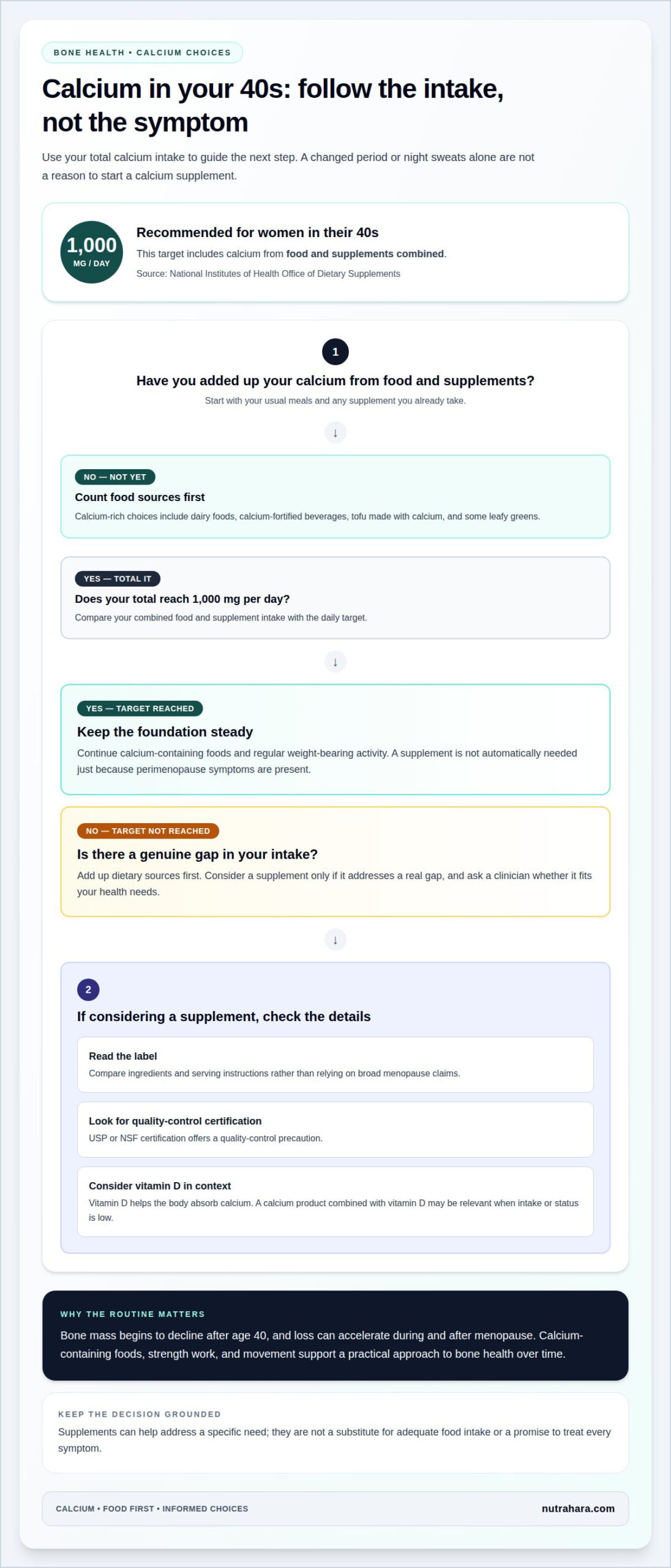
Women in their 40s are recommended to consume 1,000 mg of calcium per day, according to the National Institutes of Health Office of Dietary Supplements. This target includes calcium from food and supplements combined. Calcium-rich choices include dairy foods, calcium-fortified beverages, tofu made with calcium, and some leafy greens. Pairing varied meals with regular weight-bearing activity supports a practical approach to bone health.

Bone mass begins to decline after age 40, and loss can accelerate during and after menopause. Changing estrogen levels are part of this transition, while night sweats and disrupted sleep may affect energy for exercise. Calcium supplements can help prevent bone loss and reduce fracture risk during perimenopause, but they aren’t a substitute for adequate food intake. Add up dietary sources first, then consider whether a supplement addresses a genuine gap.

Vitamin D supports bone health and plays a role in mood regulation. It also helps the body absorb calcium, so a calcium product combined with vitamin D may be relevant when intake or status is low. Interpret supplement evidence in context: a nutrient can support normal function without treating every symptom or replacing medicine. For supplement quality, USP or NSF certification offers a quality-control precaution. Compare the label’s ingredients, serving instructions, and certification rather than choosing based on broad menopause claims.

Recommended amounts of iron, vitamin D, folate, and other nutrients depend on life stage and individual needs; the clear daily figure here is for calcium. To compare prices, assess the specific nutrient, formulation, and serving count, since products differ in these details. Don’t use night sweats or a changed period alone as a reason to start calcium. A steady routine of calcium-containing foods, strength work, and movement can support bone health over time, while a clinician can help assess whether supplements fit your health needs.

3. Magnesium for sleep and mood

Magnesium supports more than 300 enzymatic reactions, including processes involved in muscle and nerve function. During perimenopause, changing sleep patterns and daily stress can make it harder to feel balanced. Magnesium may promote relaxation and improve sleep quality, but it isn’t a stand-alone treatment for persistent insomnia, anxiety, or low mood.

Among supplements and vitamins for pre-menopausal women, magnesium is often considered for sleep support. An evening amount of 300-400 mg is often suggested. Check the amount of elemental magnesium on the supplement label, since compound weight and elemental magnesium differ. Magnesium is also found in leafy greens, nuts, seeds, beans, and whole grains. Adding these to meals can support intake while offering fiber and other nutrients.

Some people may notice sleep changes within one to two weeks, though responses vary. Keep a simple sleep log and note bedtime, waking during the night, mood, and next-day energy. This can help distinguish a possible supplement effect from changes in caffeine, exercise, or stress. Don’t increase a dose simply because sleep remains unsettled.

When reviewing supplements and vitamins for pre-menopausal women, consider your whole evening routine, not just a capsule. Try gentle evening yoga, a short meditation, and a consistent wind-down time to support relaxation. Aim for eight hours of quality sleep each night, and notice whether late workouts or screen time disrupt your rest. Magnesium supplements can also cause digestive discomfort, so pay attention to your response and discuss use with a healthcare professional, especially if you take medicine or have a health condition. Magnesium can be one part of a natural wellness plan, not a promise of significant changes in every perimenopause symptom.

4. Blood work and nutrient deficiencies

Fatigue, reduced exercise capacity, or changes in concentration can have several causes. Blood work can help identify nutrient levels that may contribute and guide a more focused supplement decision. More than one-third of women are iron deficient. Heavy periods can be relevant when discussing iron, so describe your bleeding pattern and symptoms clearly.

Vitamin D is another nutrient to discuss, especially if muscle weakness affects training or daily movement. Vitamin D levels below 29 ng/ml are linked with poor lower body function, particularly in women. An optimal serum vitamin D level is around 40-60 ng/mL for most people. These figures provide context, but one result should be considered alongside your health history and symptoms.

Iron, calcium, vitamin D, folate, and magnesium are nutrients to discuss before starting a supplement routine. The priority depends on your diet, symptoms, life stage, and existing test results. Supplements may complement nutrition or prescribed therapy, but taking more nutrients doesn’t automatically help. A targeted plan can avoid adding products that don’t address a real need.

Pregnancy, trying to conceive, and heavy periods can change which nutrients deserve attention. Tell your healthcare professional about pregnancy plans, bleeding patterns, medicines, and current supplements. These details help shape a relevant assessment rather than relying on a general formula.

Ask which blood tests could clarify suspected deficiencies, what each result means, and whether a supplement could interact with medicine. Iron and vitamin D levels may be assessed when symptoms or health history point to them. Ask how the results relate to your energy, exercise capacity, and any plan to reduce symptoms. Bring a list of supplements and note when fatigue or weakness occurs. Blood work offers useful clues; a complete review connects those levels with food, menstrual history, and overall health.

Top Supplements & Vitamins for Pre-Menopausal Women

Nutrahara: Women’s Health Supplements

Nutrahara offers Women’s Health Supplements for women seeking nutritional support as part of a thoughtful wellness routine. Its formulations bring together principles of ancient Ayurveda science and modern nutritional research, with natural, clean ingredients. If you’re considering supplements alongside nourishing food, movement, and rest, explore options with your needs and current routine in mind. Supplements can complement healthy habits, but they don’t replace blood work or individualized medical advice when symptoms or suspected deficiencies need attention. A steady approach helps you make choices that fit your personal health journey. For questions about Nutrahara’s Women’s Health Supplements, contact Nutrahara.

Build a Wellness Routine That Fits You

Your next step can be small and intentional: identify what you want support with, then choose a routine that fits daily life. Choosing supplements and vitamins for pre-menopausal women is more grounded when you consider your diet, symptoms, health history, and goals together. A simple log of sleep, energy, mood, and movement can help you spot patterns and have a clearer conversation with a healthcare professional.

Keep the foundations steady, too. Nourishing meals, strength-focused exercise, restorative yoga, and a few quiet minutes for meditation can support well-being alongside thoughtful supplement choices. You don’t need to change everything at once. Give yourself room to learn what feels sustainable, and adjust your approach as your needs evolve.

Many women find that sharing their experiences and listening to others navigating the same life stage provides reassurance and practical insights for daily wellness.

For support exploring women’s health supplements as part of your wellness routine, Contact Nutrahara for support. Your health journey is your own, and each informed step can help you move forward with confidence.

Frequently Asked Questions

Do Perimenopause Supplements Work?

Some supplements may support a specific need, but effects depend on the ingredient and symptom. To assess your routine, choose one goal, such as steadier sleep, and note what changes alongside your meals, activity, and stress. If symptoms persist or interfere with daily life, discuss other options with a healthcare professional rather than relying on supplements alone.

Are supplements safe to use?

Safety depends on the ingredients, dose, health conditions, and medicines in your routine. Read the full label, including serving directions and combined ingredients, and keep a current list of everything you take. USP or NSF certification can offer a quality-control precaution, but it doesn’t establish that a product is right for everyone. Review the label with a healthcare professional if you have concerns.

Can Vitamins Help with Perimenopause Symptoms?

Vitamins can help address a nutrient shortfall, but they don’t treat every cause of symptoms such as fatigue or mood changes. Consider the pattern: note whether tiredness follows poor sleep, heavy bleeding, a demanding workout, or a change in eating habits. Sharing that context can help a healthcare professional decide whether testing or a dietary change is more appropriate than adding a general multivitamin.

How Much Calcium Do You Need?

Use the daily intake recommendation discussed above as a guide, counting food and supplements together. Check labels on fortified drinks, yogurt, and calcium products, then total the amounts you typically consume. If you already take a multivitamin, include its calcium too. This simple tally can help you identify whether your usual meals contribute meaningfully before considering another product.

What are the risks, side effects, and upper limits of common supplements for premenopausal women?

Possible effects vary by ingredient, dose, and individual health factors. For example, black cohosh has been associated with possible liver harm, and herbal products may interact with medicines. Avoid combining products with overlapping ingredients without reviewing their total amounts. Ask a healthcare professional which upper limits apply to your supplements and what signs of an unwanted reaction should prompt you to stop and seek advice.

Can supplements interact with birth control, other medications, or pregnancy?

Yes, some supplements can interact with medicines, and pregnancy can change which nutrients are appropriate. Tell your healthcare professional about birth control, prescriptions, over-the-counter medicines, pregnancy plans, and breastfeeding. Bring the product label or a clear photo of its ingredients. This gives them the details needed to consider possible interactions and whether the supplement fits your current life stage.

Article by

Nutrahara Team

We are a dedicated collective of nutrition scientists and naturopaths at Nutrahara, committed to advancing women's health through the fusion of ancient Ayurveda science and cutting-edge nutrition research. Our mission is to empower you with clean, simple, and scientifically validated wellness solutions so you can live your healthiest life. Connect with us to stay updated on the latest developments in holistic women's health and nature-based research.

Disclaimer

This article is not a substitute for medical advice. Please consult a healthcare professional before starting any supplement, especially if pregnant, nursing, taking medication, or managing health conditions.

Categories
Articles

Vitamin D for Pre-Menopause: Key Health Benefits

Vitamin D deserves attention before menopause, not only later in life. For vitamin D for pre-menopausal women, the recommended daily intake is 600 IU. Understanding how this nutrient fits into your overall health can help you make more informed choices as your needs and routines change.

Questions about menstrual cycles and reproductive health are common. The relationship between vitamin D, hormones, and these experiences is more nuanced than a single supplement recommendation can capture. Separating established roles from areas still being studied makes the evidence easier to understand.

This article explains vitamin D’s health roles, daily recommendations, and how blood tests assess vitamin D status. It also covers what is known about menstrual and reproductive health, providing a grounded starting point for conversations about your wellbeing and next steps.

Key Takeaways

  • Understand how vitamin D supports bone, muscle, immune, and nervous system health through the years leading up to menopause.
  • Use the recommended daily intake as a starting point, and learn why taking more is not automatically better.
  • Learn what a 25-hydroxyvitamin D blood test measures and how its result helps assess vitamin D status.
  • Explore how vitamin D and estrogen relate to bone health, and what the evidence says about menstrual and reproductive health.

Vitamin D’s roles in bone, muscle, immune, and nervous system health

Vitamin D supports bone, muscle, immune, and nervous system function. These roles matter before menopause, when habits that support strength and everyday movement can contribute to long-term wellness.

Bone Density and Osteoporosis

Bone density measures the mineral content of bone, and low density can raise osteoporosis risk. Vitamin D helps the body absorb calcium, supporting the process of maintaining bone. Up to 20% of bone loss can occur after menopause. Women may lose about 2% of bone each year during the first four to five years after their final menstrual period. This makes bone health relevant before periods stop, alongside adequate calcium and other nutrients.

Muscle, Immune, and Nervous System Roles

Vitamin D contributes to muscle function, immune activity, and nervous system function. Levels below 50 nmol/L are associated with age-related muscle weakness and muscle mass loss. Levels below 29 ng/ml have been linked with poorer lower-body function, particularly in women. For an active routine, muscle function supports everyday movement, from walking to yoga. Vitamin D also plays a role in mood, but it isn’t a stand-alone mood treatment.

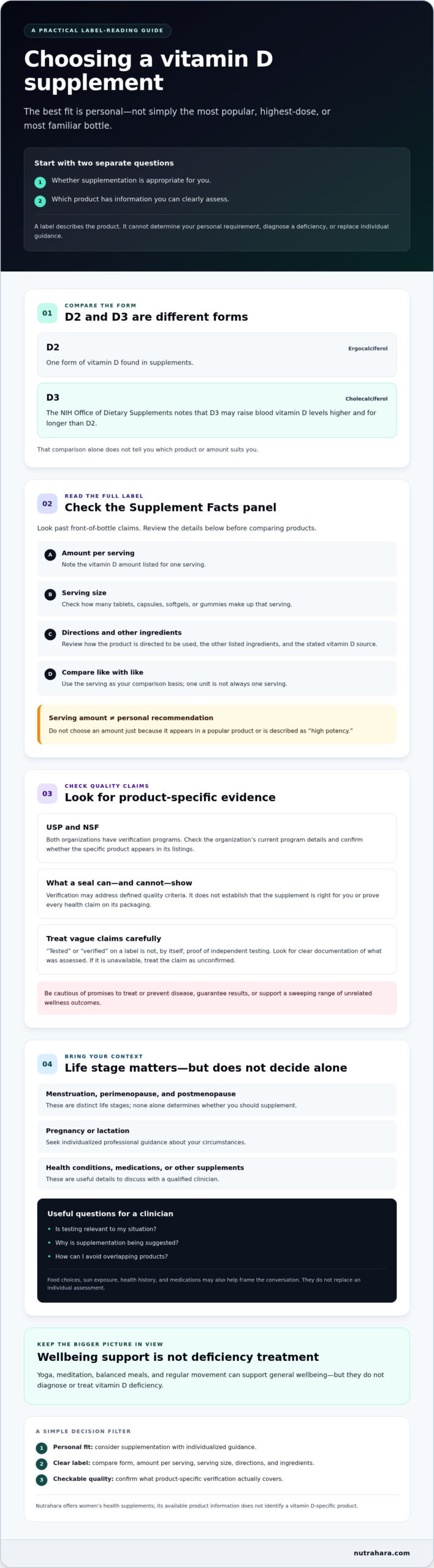
Vitamin D2 and D3 are different supplement forms; D3 is more effective at raising and maintaining stable blood levels. Take D3 with food containing fat to support absorption.

Fatty fish, egg yolks, and fortified milk or plant-based drinks can provide vitamin D. The amount varies by serving and fortification, so check the package for the quantity in a specific food.

Some medications and health conditions can affect whether supplements are suitable. A history of kidney stones is relevant when considering vitamin D with calcium, so discuss supplements with your doctor.

Daily vitamin D recommendations and upper limits

In the United States, premenopausal women should get 600 IU of vitamin D per day. This is the recommended daily intake, not a dose that every woman must take as a supplement. Food, fortified products, and supplements can all contribute. The daily target for vitamin D for pre-menopausal women is a useful reference when reviewing your overall intake.

The adult tolerable upper intake level is 4,000 IU per day unless a person is under active medical supervision. This is a ceiling, not a target. Higher doses can be detrimental to bone health, and taking more does not automatically correct a deficiency. Count vitamin D from your regular sources before adding another supplement.

Should premenopausal women take vitamin D with calcium, and how much calcium is recommended? They may take both, but supplements aren’t necessary for everyone. Premenopausal women should get 1,000 mg of elemental calcium per day. Since vitamin D helps the body absorb calcium, consider food and supplements together rather than assuming more is better.

Estrogen regulates vitamin D metabolism, and both interact in relation to bone health. This connection doesn’t mean vitamin D supplements change estrogen levels or act as hormone treatment. For vitamin D for pre-menopausal women, consider the recommended intake alongside personal circumstances and any blood-test results.

If a blood test finds low levels, a healthcare provider may prescribe a higher vitamin D3 dose for several weeks or months, then recommend a lower maintenance dose and repeat blood work. That supervised correction plan differs from routine self-supplementation. The measured level and treatment plan guide the dose, while the upper intake limit applies to adults outside active medical supervision.

For a consistent routine, read supplement labels, include fortified foods in your estimate, and avoid combining products that each contain vitamin D. This check helps keep your intake aligned with your needs without treating higher doses as a shortcut.

Testing vitamin D status with a 25-hydroxyvitamin D blood test

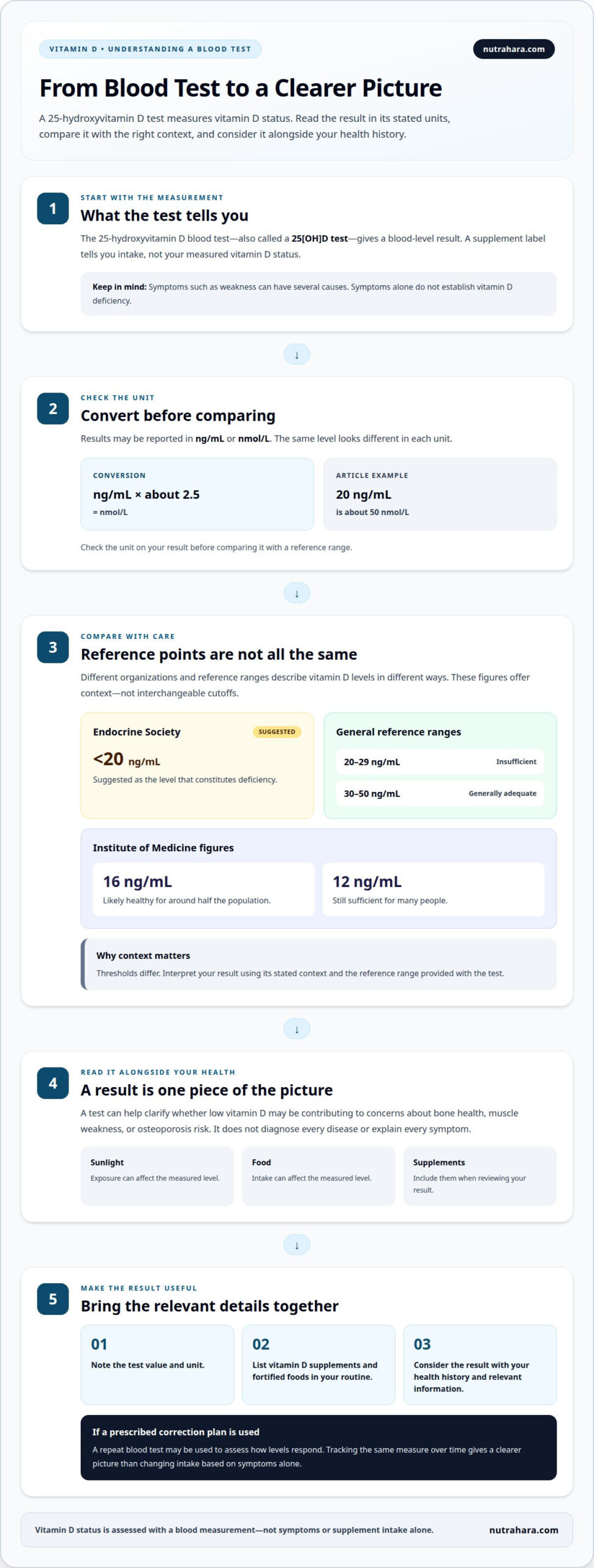
A 25-hydroxyvitamin D blood test, also called a 25[OH]D test, measures vitamin D status. It gives a blood-level result, unlike a supplement label, which records intake. During perimenopause, symptoms such as weakness can have several causes, so they don’t establish a vitamin D deficiency by themselves. The test offers a specific measurement to consider alongside health history and other relevant information.

Results may appear in ng/mL or nmol/L. To convert between them, multiply the ng/mL value by approximately 2.5 for nmol/L. For example, 20 ng/mL is about 50 nmol/L. Check the unit before comparing a result with a reference range, since the same level looks different when expressed in another unit.

Reference points can differ. The Endocrine Society has suggested that a level below 20 ng/mL constitutes deficiency. In general reference ranges, 20-29 ng/mL is considered insufficient, while 30-50 ng/mL is generally considered adequate. The Institute of Medicine’s figures offer another perspective: 16 ng/mL is likely healthy for around half the population, and 12 ng/mL is still sufficient for many people. These thresholds aren’t interchangeable, so interpret a result using its stated context.

A test result can help clarify whether low vitamin D may be contributing to concerns about bone health, muscle weakness, or osteoporosis risk. It doesn’t diagnose every disease or explain every symptom. Sunlight exposure, food intake, and supplements can all affect the measured level, so consider these factors when reviewing the result.

For a useful discussion, note the test value and unit, along with any vitamin D supplements and fortified foods in your routine. A repeat blood test may be used after a prescribed correction plan to assess how levels respond. Tracking the same measure over time gives a clearer picture than changing your intake based on symptoms alone.

Vitamin D and menstrual or reproductive health

Vitamin D and estrogen interact in relation to bone health, and estrogen regulates vitamin D metabolism. That connection matters during the years before menopause, when hormone patterns change. It doesn’t, by itself, show that vitamin D supplements regulate menstrual cycles or treat reproductive symptoms. A useful takeaway is to distinguish a biological relationship from evidence of a specific treatment effect.

Research on menopause offers a few related findings, but they address particular symptoms, not cycle regularity. A study of postmenopausal women found that high-dose vitamin D supplements improved several signs of vaginal atrophy after 6 weeks. Small studies of middle-aged women taking aromatase inhibitors for breast cancer treatment reported fewer hot flashes and other symptoms among women with vitamin D levels above 66 ng/ml. These findings don’t establish supplements as a substitute for treatment.

Mood is another area researchers have examined. In a study of postmenopausal women, those with the highest vitamin D intakes had a 20% lower risk of depressive symptoms after 3 years. This finding concerns risk, not proof that vitamin D prevents or treats depression. Vitamin D also supports immune function, but that role doesn’t establish it as a treatment for menstrual or reproductive concerns.

For a personal assessment, a 25-hydroxyvitamin D blood test measures vitamin D status. It can help identify low levels, but it doesn’t explain every change in periods, mood, or reproductive health. Note symptoms and supplement intake when discussing a result, especially if you’re receiving cancer treatment or considering a new supplement. The clearest conclusion is that estrogen and vitamin D interact in bone health, while evidence for direct menstrual-cycle benefits remains distinct from those findings.

Vitamin D for Pre-Menopause: Key Health Benefits

Nutrahara: Women’s Health Supplements

Nutrahara offers Women’s Health Supplements formulated with principles of Ayurveda and modern nutritional research. These supplements can be part of a broader wellness routine alongside nourishing food, movement, and the guidance you rely on for health decisions. Nutrahara’s nutrition is made in New Zealand.

For vitamin D, use the recommended intake and blood-test information in this article to inform your next steps. Supplements aren’t a substitute for testing or individualized medical care, especially if you’re addressing a deficiency, taking medication, or managing a health condition. Choose carefully and keep your overall needs in view.

For questions about Nutrahara’s Women’s Health Supplements, please contact Nutrahara.

Make Your Next Wellness Step Intentional

Your health needs can shift through perimenopause and beyond, so let curiosity guide your next step. Keep a simple note of questions about energy, movement, mood, or changing cycles. Bring those observations to a health professional when discussing your wellbeing, and use them to shape a routine that feels sustainable rather than overwhelming.

For vitamin D for pre-menopausal women, an informed approach means looking at the whole picture rather than treating one nutrient as a quick fix. Thoughtful nutrition, regular movement, restorative sleep, and calming practices such as yoga or meditation can all support a balanced wellness routine. Choose changes that fit your life and build on them steadily.

If you have questions about Nutrahara, contact Nutrahara with your questions. Your wellness journey is yours to shape, one considered step at a time.

Frequently Asked Questions

What is vitamin D and why does your body need it?

Vitamin D is a nutrient your body needs for processes that include absorbing calcium and supporting normal body function. It comes from foods, fortified products, and supplements. Consider it one part of your overall nutrition, not a substitute for a varied diet or a treatment for a specific health concern.

How Common Is Vitamin D Deficiency?

Low vitamin D levels are estimated to affect 50% to 80% of menopausal women. That estimate describes a group, not your individual likelihood or test result. Definitions of low status and the populations studied can differ, so a broad estimate can’t determine whether you personally have a deficiency. A blood test provides a measurement for an individual assessment.

How Do I Know If I’m Getting Enough Vitamin D?

A blood test is the direct way to assess your vitamin D status. For a useful discussion of the result, keep track of supplements, fortified foods, and recent changes in your routine. Tell your healthcare professional whether the report uses ng/mL or nmol/L. This context helps distinguish your measured blood level from the amount you consume.

What are the signs of low vitamin D?

Low vitamin D may be associated with muscle weakness, but symptoms alone can’t identify the cause. Similar concerns can arise for different reasons, so don’t treat a symptom as proof of deficiency or start a high-dose supplement based only on how you feel. Note changes in strength or daily function and discuss whether measuring your vitamin D status is appropriate.

When Is Vitamin D Level Considered Low?

A level below 20 ng/mL has been suggested as a deficiency threshold by the Endocrine Society. Results also need context: laboratories may report different units, and reference ranges can vary. Read the unit and interpretation supplied with your result rather than comparing the number alone. If a result is flagged, its meaning depends on that context and your health picture.

How much vitamin D should premenopausal women get daily in the United States?

Premenopausal women should get 600 IU of vitamin D per day. To apply this recommendation, look at the vitamin D amount on supplement labels and account for foods that are fortified. Avoid assuming that a higher dose is automatically more beneficial. The adult upper intake level is 4,000 IU per day outside active medical supervision, not a recommended target.

Article by

Nutrahara Team

We are a dedicated collective of nutrition scientists and naturopaths at Nutrahara, committed to advancing women's health through the fusion of ancient Ayurveda science and cutting-edge nutrition research. Our mission is to empower you with clean, simple, and scientifically validated wellness solutions so you can live your healthiest life. Connect with us to stay updated on the latest developments in holistic women's health and nature-based research.

Disclaimer

This article is not a substitute for medical advice. Please consult a healthcare professional before starting any supplement, especially if pregnant, nursing, taking medication, or managing health conditions.
Categories
Articles

Essential Supplements and Vitamins for Women’s Health

A multivitamin isn’t automatically the right choice for every woman. Supplements and vitamins for women can include a mix of nutrients, but needs vary with diet and life stage. Adult women generally need 2.4 mcg of vitamin B12 daily, with different needs during pregnancy and breastfeeding.

It’s understandable to wonder whether a multivitamin is enough, especially when energy, bone health, or changing routines are on your mind. A useful starting point is to identify which nutrients matter to you and when supplements and vitamins for women may be relevant.

Learn how vitamin D supports bone health, what to consider in a multivitamin after 50, and why B12 deserves attention, particularly if you eat a vegetarian diet. You’ll also find practical ways to think about supplements alongside balanced meals, movement, yoga, and meditation, so your wellness choices can feel thoughtful and sustainable.

Key Takeaways

  • Match nutrient priorities to your life stage, from menstrual years and pregnancy to menopause.
  • Learn how vitamin D and calcium work together to support bone health, and why needs can change after menopause.
  • Use a thoughtful checklist to decide whether a multivitamin after 50 fits your diet and health needs.
  • Understand when vitamin B12 may deserve extra attention, especially if you eat a vegetarian diet or take acid-blocking medication.

1. What vitamins and minerals are important for women’s health?

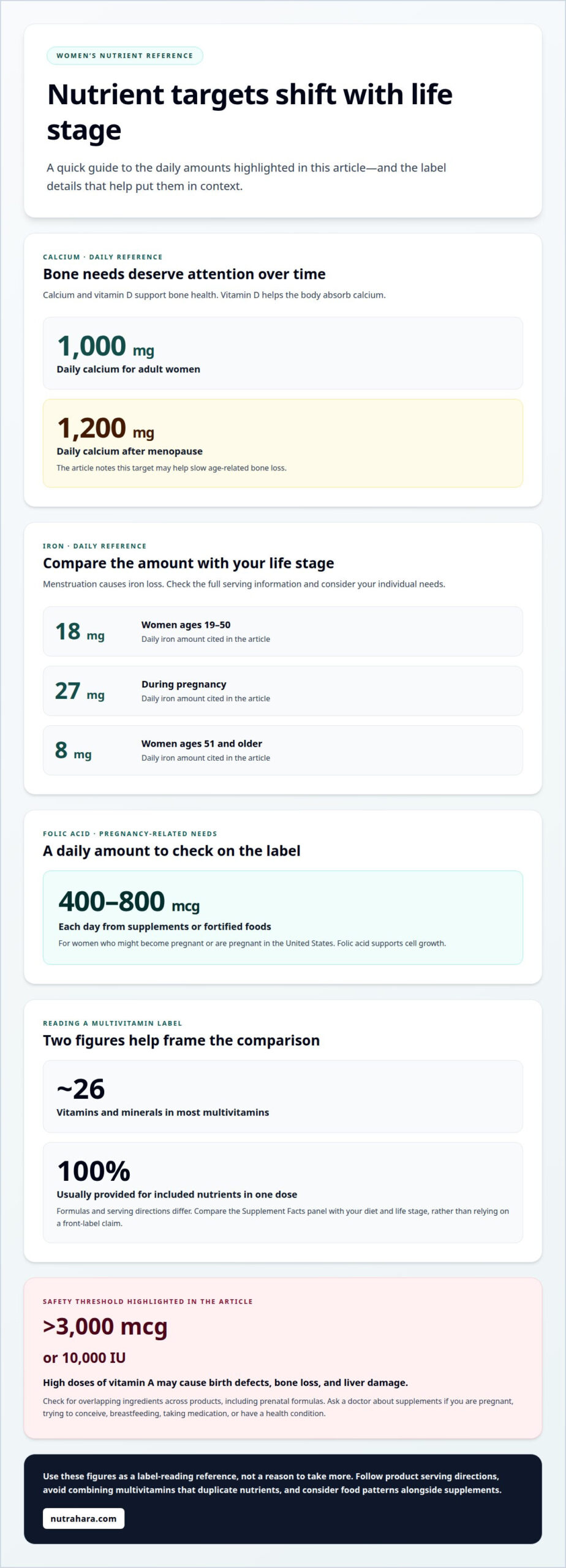
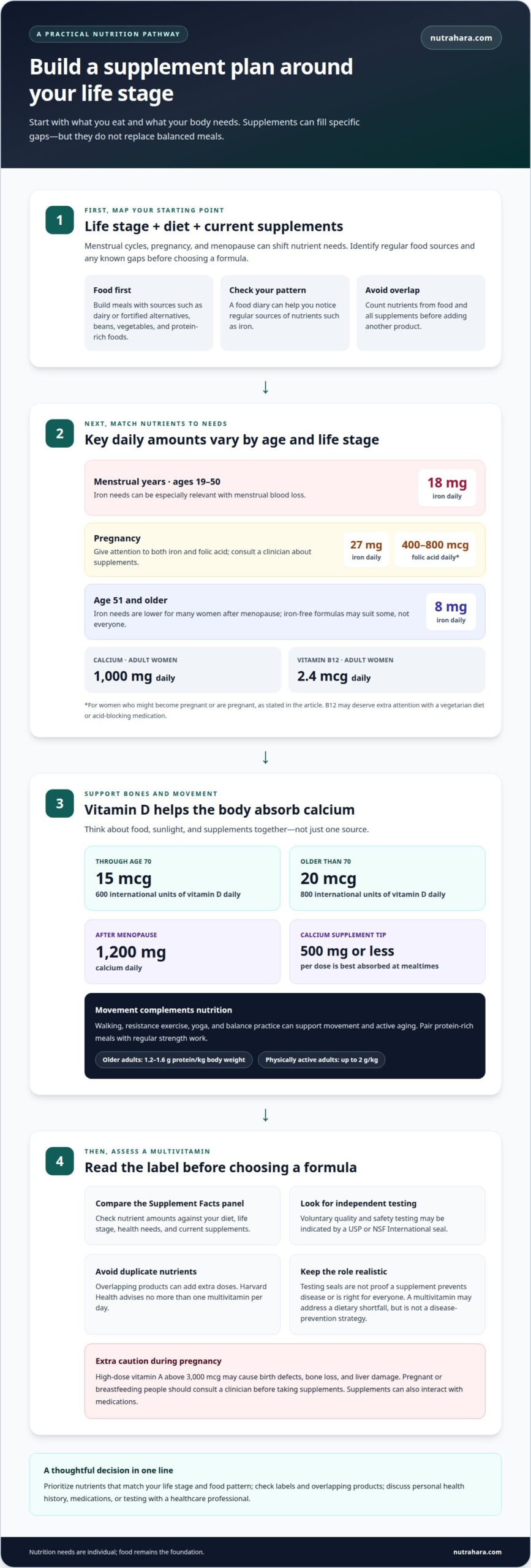
Nutrition needs shift with menstrual cycles, pregnancy, and menopause, so one formula won’t suit every woman. Adult women need 1,000 mg of calcium daily, according to the NIH Office of Dietary Supplements. Food can provide many nutrients; dairy or fortified alternatives, beans, vegetables, and protein-rich foods are practical foundations. Supplements may help fill specific gaps, but they don’t replace balanced meals. For American women, the first step is matching nutrient choices to diet and life stage.

Menstrual blood loss makes iron especially relevant before menopause. Women ages 19 to 50 need 18 mg of iron daily, according to the NIH Office of Dietary Supplements. Women who might become pregnant or are pregnant need 400–800 mcg of folic acid daily, according to the NIH Office of Dietary Supplements. During pregnancy, women need 27 mg of iron daily, according to the NIH Office of Dietary Supplements. These differences explain why an iron-containing multivitamin may fit some menstruating women, while pregnancy calls for attention to both iron and folic acid.

Iron needs change with age, too. Women ages 51 and older need 8 mg of iron daily. Some multivitamins for women over 50 are iron-free, which may suit women whose needs are lower after menopause. Still, iron-free isn’t a universal rule: consider the amount in the label alongside your diet and any known iron needs. A food diary can help identify regular sources, such as beans, leafy greens, meat, or fortified cereals.

Vitamin D and omega-3s may also factor into a woman’s nutrition plan. Women in their 20s and 30s may consider vitamin D for bone health and omega-3s for heart health. For a wider nutrient check, including vitamin B12, ask whether diet and life stage leave a likely gap; adult women generally need 2.4 mcg of B12 daily.

Food is the best way to obtain needed nutrients, and supplements are not necessary for every woman. FDA regulation and product certification are separate considerations: look for voluntary independent testing and a USP or NSF International seal. Popular women’s vitamins in the United States don’t have one standard cost; serving count, nutrient blend, and formulation affect the price. A supplement can provide iron, vitamin D, calcium, folate, or B12, but whether it’s needed depends on which nutrients your diet and life stage provide.

2. Vitamin D and bone health

Vitamin D helps the body absorb calcium, linking dietary choices with bone health. Adult women generally need 15 micrograms (600 international units) of vitamin D daily through age 70. Women older than 70 generally need 20 micrograms (800 international units) daily. Food, sunlight, and supplements contribute differently, so consider your overall routine instead of relying on one source. Choosing supplements and vitamins for women starts with your bone and muscle goals.

Calcium needs change after menopause. Women need 1,200 mg of calcium daily after menopause, according to the NIH Office of Dietary Supplements. Dairy products, fortified alternatives, and spinach can contain calcium. If using a calcium supplement, doses of 500 mg or less are best absorbed at mealtimes. Count dietary sources too, since combining products can increase total intake.

Bone and muscle health work together. Walking, resistance exercise, and yoga can build movement into a routine, while balance practice supports confident daily activity. Older adults need 1.2 to 1.6 grams of protein per kilogram of body weight to help preserve muscle mass. Physically active adults may need up to 2 grams per kilogram to support muscle repair and recovery. Pair protein-rich meals with regular strength work for active aging.

A healthcare professional can consider your diet, health history, medications, and relevant test results when discussing vitamin D or calcium. This is especially important if osteoporosis or another condition affects your bone health, or if you’re considering several supplements together. Bring a list of products and note how often you take them. A thoughtful approach to supplements and vitamins for women accounts for nutrients you already get from food and supplements, while keeping your individual health goals in view.

3. Multivitamins for women over 50

After 50, a multivitamin can help cover dietary gaps, but it isn’t a substitute for varied meals. Choose a formula based on your eating pattern, health needs, and current supplements. Compare the Supplement Facts panel for amounts of vitamins and minerals, then avoid overlapping products that duplicate nutrients. A doctor can help you interpret the label alongside medications and relevant testing.

When selecting a product, look for voluntary independent quality and safety testing, such as a USP or NSF International seal. These marks indicate testing, not proof that a supplement prevents disease or is right for everyone. If you choose a multivitamin, Harvard Health advises taking no more than one per day. Follow the label directions, and take it consistently with a meal if that works for you.

Evidence matters, too. The Women’s Health Initiative found that postmenopausal women who took multivitamins did not have a lower death rate than those who did not. They were just as likely to develop cardiovascular disease or several cancers. A multivitamin may still help address a dietary shortfall, but it should not be chosen as a disease-prevention strategy. Strength training, balanced meals, and movement support wellness in ways a pill cannot replace.

During pregnancy, folic acid and iron needs deserve attention. A prenatal supplement may be appropriate, but pregnant or breastfeeding people should consult a clinician before taking any supplement. Recommendations depend on life stage, diet, and health needs, so do not assume one formula suits both pregnancy and breastfeeding.

Extra doses can create problems, especially when products overlap. During pregnancy, high-dose vitamin A above 3,000 mcg may cause birth defects, bone loss, and liver damage. Supplements can also interact with medications. Give your doctor or pharmacist a complete list of vitamins, minerals, and medicines before combining products; report any new symptoms after starting a supplement.

Essential Supplements and Vitamins for Women's Health

4. Vitamin B12 supplementation

Vitamin B12 deserves attention if you eat a vegetarian diet or take acid-blocking medicine daily. These factors can make it harder to get enough through everyday food choices. A medical professional may consider your diet, medication use, symptoms, and test results when assessing possible deficiency. Keep a monthly note of supplements and medicines, so the list is easy to discuss at appointments.

Life stage changes the daily target. Women generally need 2.6 mcg of vitamin B12 daily during pregnancy and 2.8 mcg daily while breastfeeding. These needs can be met through food, fortified products, or supplements, depending on the person’s diet. If pregnancy is planned, include B12 in the conversation about prenatal nutrition rather than assuming every multivitamin contains the amount you need.

For strict vegetarians or people taking a daily acid blocker, Harvard Health says 1,000 micrograms of vitamin B12 per day should be more than enough. That is a specific situation, not a universal dose for every woman. Read the supplement label, note the amount per serving, and avoid stacking several products without accounting for their combined B12. A doctor can interpret test results alongside your diet and medication history.

Choose a practical routine you can follow. Pair a supplement with a regular meal or another daily habit, and record missed doses without doubling up automatically. If you notice persistent changes in energy or wellbeing, document when they began and discuss them with a healthcare professional; symptoms alone don’t establish a B12 deficiency. For women considering a B-complex option, explore the vitamin B-complex supplement as one way to review B vitamins together. The takeaway: vegetarian eating, acid-blocking medicine, pregnancy, and breastfeeding are useful prompts to assess B12 intake thoughtfully.

Nutrahara: Women’s Health Supplements

Nutrahara offers Women’s Health Supplements for women looking to make nutrition part of a thoughtful wellness routine. Its approach combines principles of ancient Ayurveda with modern nutritional research and natural ingredients. This can be a next step when you’ve identified a supplement need and want to explore options that fit your health goals. Consider your diet, life stage, and existing supplements as you decide what may complement your routine. Supplements work best as part of a broader foundation that includes nourishing meals, regular movement, and practices such as yoga or meditation. For questions about Nutrahara’s Women’s Health Supplements, contact Nutrahara.

Make your next wellness choice with intention

Your health priorities can shift as your routines, diet, and life stage change. Treat supplement choices as one part of a broader approach that includes nourishing meals, strength-building movement, and time to restore through yoga or meditation. To stay intentional, write down what you take and what you hope it supports, then revisit the list as your needs evolve.

Choosing supplements and vitamins for women is most useful when it reflects your own goals, rather than a one-size-fits-all routine. If you’re exploring options for your wellness journey, contact Nutrahara with your questions. Keep moving forward with curiosity and confidence, one thoughtful choice at a time.

Frequently Asked Questions

What are multivitamins for women?

Multivitamins combine several vitamins and minerals in one product. Formulas differ in the nutrients and amounts they contain, so “for women” does not mean a product suits everyone. Before choosing one, consider your regular meals, dietary preferences, and any other products you take. A multivitamin offers convenience, but it cannot replace a varied eating pattern.

What vitamins and minerals are important for women’s health?

Important nutrients include calcium, vitamin D, iron, folate, and vitamin B12, though priorities depend on life stage and diet. For a practical starting point, write down a typical day of meals and note fortified foods, such as enriched cereals or plant-based drinks. This can help reveal patterns in your intake and make a conversation about nutrition more specific and useful.

Are dietary supplements safe?

Safety depends on the supplement, its amount, your health, and any other products or medicines you use. Read the full label, including serving directions and all listed ingredients, rather than relying on claims on the front of the package. Keep containers or clear photos of labels available for a healthcare professional. During pregnancy or breastfeeding, discuss supplements with a clinician before starting them, since needs and safety considerations can differ.

Should you take supplements during perimenopause and menopause?

Some women may benefit from a supplement, but a life transition does not mean everyone needs the same product. Consider changes in eating habits, health history, and nutrient concerns instead of choosing based only on age. A food and supplement diary can help you notice routine changes, while a healthcare professional can interpret symptoms and relevant test results in context.

What do multivitamins help with?

Multivitamins provide several nutrients in one product, which can be convenient when addressing dietary gaps. They do not replace meals or treat health conditions. Check whether the nutrients match your needs and whether another product already provides the same ingredients. Comparing labels can help you avoid unnecessary duplication.

What’s the most effective form for supplements: capsules, tablets, chew or gummies?

No single format works best for everyone. The right choice depends on the product and whether you can comfortably follow its directions. Compare serving sizes and nutrient amounts on the labels, not just the format. If taste, texture, or swallowing affects consistency, choose an option that fits your routine. Review added ingredients, especially if you avoid particular foods or sweeteners.

Article by

Nutrahara Team

We are a dedicated collective of nutrition scientists and naturopaths at Nutrahara, committed to advancing women's health through the fusion of ancient Ayurveda science and cutting-edge nutrition research. Our mission is to empower you with clean, simple, and scientifically validated wellness solutions so you can live your healthiest life. Connect with us to stay updated on the latest developments in holistic women's health and nature-based research.

Disclaimer

This article is not a substitute for medical advice. Please consult a healthcare professional before starting any supplement, especially if pregnant, nursing, taking medication, or managing health conditions.

Categories
Articles

Vitamin D for Women: Key Health Benefits & Daily Needs

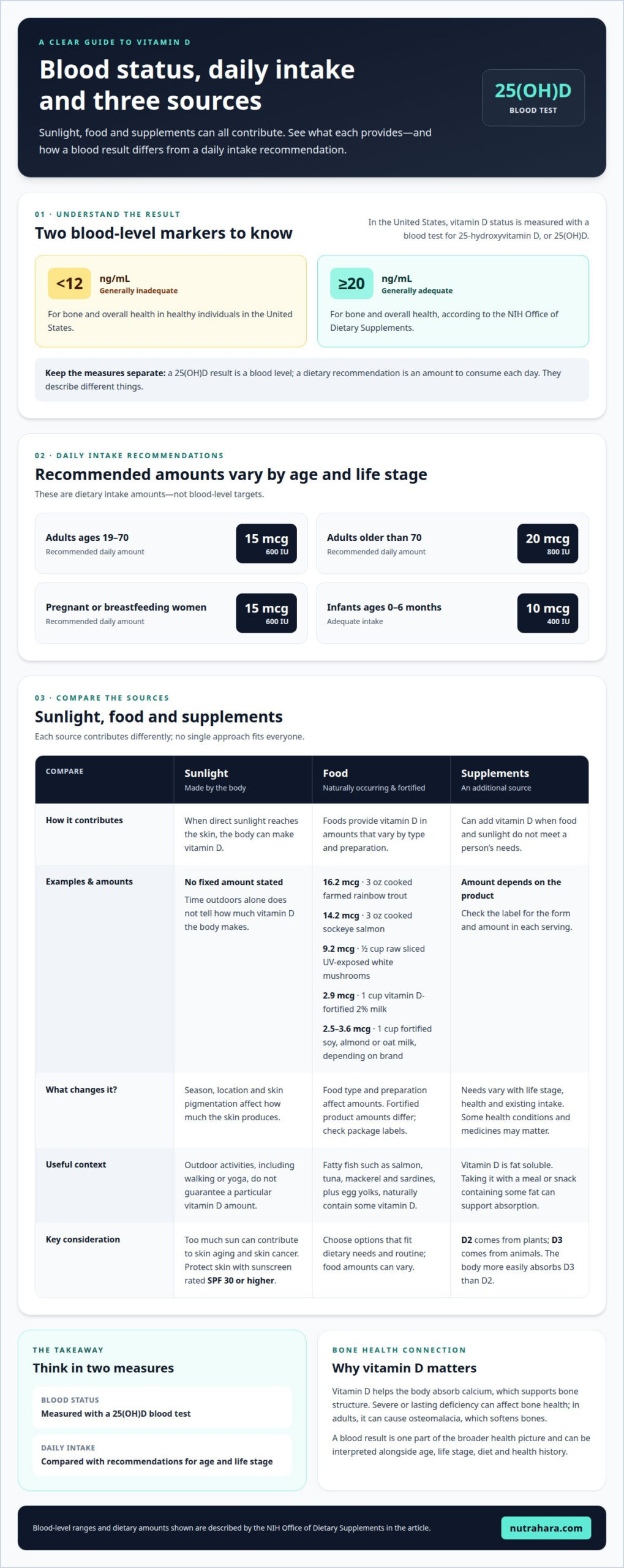
For women ages 19 to 70, the recommended daily amount of vitamin D for women is 600 IU, according to the National Institutes of Health Office of Dietary Supplements. The same daily amount applies during pregnancy and breastfeeding for women ages 19 to 50: 15 mcg (600 IU), according to the National Institutes of Health Office of Dietary Supplements. Women over 70 need 800 IU daily, according to the National Institutes of Health Office of Dietary Supplements.

It’s natural to wonder whether your vitamin D needs change at different life stages. Vitamin D helps your body absorb calcium, making it important for bone health, while pregnancy and breastfeeding bring additional nutritional considerations. This guide covers daily recommendations, vitamin D and bone health, and what to consider during pregnancy and lactation. It also explains why a standard target may not tell the whole story, and how food, sunlight, and supplements can each fit into a balanced approach to wellbeing.

Key Takeaways

  • Use your age and life stage as a starting point for understanding daily vitamin D needs, including during pregnancy and breastfeeding.
  • When considering a supplement dose, account for vitamin D from food and other supplements, and understand how blood testing can inform the discussion with a healthcare provider.
  • Learn why vitamin D and calcium work together to support bone health, and what a vitamin D blood level can indicate.
  • Discover how women’s health supplements may fit into a thoughtful wellness routine grounded in both nutritional research and holistic care.

How much vitamin D should women take?

Choosing a vitamin D3 dose starts with your current intake, health history, and reason for supplementing. A healthcare provider can review your diet, other supplements, medicines, and any blood-test results before suggesting a dose. This matters because needs differ, and taking more doesn’t automatically improve vitamin D function.

Vitamin D3 supplements come in 400 IU, 800 IU, 1,000 IU, and 2,000 IU doses. The National Institutes of Health Office of Dietary Supplements sets the tolerable upper intake level for women ages 19-50, including during pregnancy and lactation, at 100 mcg (4,000 IU) per day. That limit counts vitamin D from food and supplements. Taking more than 4,000 IU per day from supplements might cause harmful side effects.

Vitamin D is generally considered safe at typical doses, but excessive intake can be harmful. Tell your healthcare provider about any medicines you take, since some may interact with supplements or affect how your body uses vitamin D. Before combining products, add up the vitamin D in each one.

Calcium and vitamin D are sometimes sold together. Before choosing a combination supplement, consider how much calcium you get from food and other products. A healthcare provider can help assess whether the combination suits your needs, including if osteoporosis is a concern.

Vitamin D supplement costs in the United States vary by dose, formulation, and package size. Compare the amount per serving with the number of servings per package to understand what you’re buying.

Good food sources include cooked sockeye salmon, with 570 IU in a 3-ounce serving; fortified 2% milk, with 120 IU per cup; and a large scrambled egg, with 44 IU.

Sunlight-driven vitamin D production varies with skin tone, location, season, time outdoors, and sunscreen use. Guidance suggests 5 to 30 minutes in the sun at least twice a week, though exposure doesn’t provide a dependable dose.

A blood test measures vitamin D status. Testing may be useful when risk factors include darker skin, older age, obesity, or a history of gastric bypass; the National Institutes of Health Office of Dietary Supplements considers a serum 25(OH)D concentration below 12 ng/mL deficient.

How much vitamin D per day for a woman?

Age provides a practical starting point for daily vitamin D intake. The National Institutes of Health, Office of Dietary Supplements recommends 600 IU daily for people ages 1 to 70 years. The recommendation applies to adult women as well as men. The National Institutes of Health, Office of Dietary Supplements recommends 800 IU daily for people over 70 years.

Pregnancy and lactation do not change the stated intake for women ages 19-50. In the United States, the National Institutes of Health, Office of Dietary Supplements recommends 15 mcg (600 IU) daily for pregnant and lactating women in this age group. These recommended amounts refer to total intake, including food and supplements. Fortified foods can contribute vitamin D alongside other dietary sources.

There is also an upper limit, not a target to aim for. The National Institutes of Health, Office of Dietary Supplements sets the tolerable upper intake level for women ages 19-50, including during pregnancy and lactation, at 100 mcg (4,000 IU) per day. Count vitamin D from all sources when considering that limit; a larger amount does not automatically address deficiency.

Blood results offer a different measure from daily intake. According to the National Institutes of Health, Office of Dietary Supplements, a serum 25(OH)D concentration of 20 ng/mL or higher is generally considered adequate for bone and overall health in healthy individuals. A blood test measures this marker, while a recommended intake describes how much to consume. They answer related, but distinct, questions.

Sunlight affects how much vitamin D your body makes, but it doesn’t provide a fixed daily dose. Skin tone, location, season, and time outdoors all influence production. Use the age-based recommendation as a baseline, then discuss pregnancy, lactation, test results, diet, and supplements with a healthcare provider to understand how they apply to your routine.

Vitamin D and bone health

Vitamin D helps your body absorb calcium, a mineral used to build and maintain bones. Severe deficiency can cause osteomalacia, which softens adult bones. Getting enough vitamin D and calcium through food can help slow bone mineral loss and may help prevent osteoporosis and related fractures. These nutrients support bone structure, but they don’t replace treatment for an existing bone condition.

The National Institutes of Health, Office of Dietary Supplements says a serum 25(OH)D concentration of 20 ng/mL or higher is generally considered adequate for bone and overall health in healthy individuals. This result describes a blood level, not the right supplement dose for every person. A healthcare professional can interpret the result alongside diet, health history, and other relevant factors.

Vitamin D also supports muscle function, which matters for balance and everyday movement. It contributes to immune function, but a product containing this nutrient shouldn’t be taken as proof that it prevents disease or guarantees immune protection. Read health claims carefully, distinguishing general nutrient roles from specific outcomes.

Research into other health effects is still nuanced. Low vitamin D levels are associated with greater difficulty thinking and learning, but it isn’t established whether supplements help. Findings on vitamin D supplements and cancer prevention are mixed. Long-term use may lower multiple sclerosis risk, though more research is needed.

Pregnancy and breastfeeding are also times to consider your overall nutrition. Vitamin D’s role in calcium absorption is relevant to bone health, and adequate calcium intake matters too. If you use a prenatal supplement, its label can show what it contributes alongside your diet. Discuss the full picture with a healthcare professional instead of adding products without considering your total intake.

Movement can complement nutritional care. Walking, resistance exercise, and yoga can help maintain strength and balance as part of your wellness routine. Meditation may support a mindful approach to consistency, but neither movement nor meditation replaces nutrients or medical care. Sustainable activity and thoughtful nutrition offer practical ways to care for your bones over time.

Vitamin D for Women: Key Health Benefits & Daily Needs

Vitamin D needs for women, including pregnancy and breastfeeding

Pregnancy and breastfeeding add another layer to planning vitamin D intake, but they don’t create a separate recommendation for every woman. In the United States, the National Institutes of Health, Office of Dietary Supplements recommends 15 mcg (600 IU) daily for pregnant and lactating women ages 19-50. This includes vitamin D from food and supplements, so the total matters more than the amount in one capsule.

Start by reviewing your overall diet. A prenatal supplement may contain vitamin D, and fortified milk or plant-based beverages and oily fish can contribute too. Add up these sources before taking a separate product. This simple step helps prevent accidentally doubling up and gives you a clearer picture of how much vitamin D your usual routine provides.

Sun exposure can contribute to vitamin D production, but it isn’t a precise measure of intake. Season, location, skin tone, and time outdoors all affect how much your body makes. A woman who spends most days indoors or lives in a region with less sunlight may have a different pattern from someone who regularly spends time outdoors. Sun exposure alone can’t confirm blood levels.

Vitamin D levels are assessed through a blood test measuring 25(OH)D. The result can help explain whether dietary intake and supplements are meeting an individual’s needs. Pregnancy or breastfeeding, limited sun exposure, darker skin, and a history of gastric bypass are relevant context to share when discussing results and supplement use. These factors help frame the conversation without assuming every woman needs the same dose.

During breastfeeding, maternal intake and an infant’s vitamin D needs are related considerations, but they aren’t interchangeable. Bring your supplement label and prenatal details to a healthcare discussion, and describe any fortified foods you regularly eat. This gives a practical overview of your whole diet. The takeaway is simple: use the age- and life-stage recommendation as a starting point, count all sources, and consider relevant risk factors when deciding on next steps.

Nutrahara: Women’s Health Supplements

Nutrahara offers women’s health supplements for women seeking support for overall wellness and energy. Its formulations combine principles of ancient Ayurveda with modern nutritional research, using natural, clean ingredients. If you’re considering supplements as part of a balanced routine, explore Nutrahara’s range as a next step after learning how vitamin D intake relates to your age and life stage. Review your current diet and supplements to make thoughtful choices that fit your broader wellness goals. Supplements complement healthy habits; they don’t replace individualized guidance about vitamin D needs during pregnancy, breastfeeding, or other health circumstances. Explore Nutrahara’s supplements and vitamins for women to learn more.

Make your next wellness step your own

Your health routine can evolve with your life stage. Consider how daily habits fit together, from nourishing meals and movement to moments of rest. A walk, strength session, yoga practice, or quiet meditation can make wellbeing feel like a steady part of life, rather than another task to perfect.

As you shape your approach to vitamin D for women, keep your choices grounded in your own needs and priorities. Give yourself room to adjust your routines as pregnancy, breastfeeding, menopause, or changes in activity shift what feels sustainable. Small, thoughtful decisions can help you feel confident in the care you take of yourself.

If you’d like to explore Nutrahara’s approach to women’s wellness, share your questions with Nutrahara. Keep building a routine that feels informed, balanced, and truly yours.

Frequently Asked Questions

How Much Vitamin D3 Should I Take Daily?

For most adults through age 70, the recommended intake is 600 IU daily; people over 70 are recommended 800 IU daily. Consider your full routine before choosing a supplement: check the vitamin D amount on your multivitamin, prenatal, and standalone product labels. This helps you avoid overlooking overlapping servings when estimating your total intake.

What are the symptoms of vitamin D deficiency?

Vitamin D deficiency may not cause symptoms that clearly identify it. Bone discomfort or muscle weakness can have many possible causes, so symptoms alone can’t establish a deficiency. A blood test measures vitamin D status, and a healthcare professional can interpret the result alongside your health history. Don’t use symptoms as a reason to start high-dose supplementation on your own.

Which vitamin D supplement should I take?

Choose a product with a serving amount that fits your overall intake, rather than automatically selecting the highest dose. Read the Supplement Facts panel, note the amount per serving, and check whether a serving requires more than one capsule. Taking vitamin D with food that contains fat can assist absorption. If you take prescription medicines or several supplements, review the labels with a healthcare professional.

Can I buy calcium and vitamin D together?

Yes, some supplements combine calcium and vitamin D. Before choosing one, check the amounts of both nutrients per serving and compare them with those in your other supplements. For example, a multivitamin and a combination product may both contain vitamin D. Reviewing the labels helps you understand what you’d add to your routine and avoid unintentionally doubling ingredients.

Do you pee out excess vitamin D?

No. Urination isn’t a reliable way to remove excess vitamin D after taking too much. High supplemental intake can cause harmful side effects, so don’t take extra doses to compensate for a missed serving or an uncertain amount. If you think you’ve taken more than intended, contact a healthcare professional or poison control for guidance based on the product and amount involved.

Does vitamin D help you sleep?

Vitamin D supplements shouldn’t be treated as a proven sleep aid. If sleep is difficult, notice patterns such as evening caffeine, irregular bedtimes, or late screen use, and consider a calming routine with gentle yoga or meditation. These habits may support a restful wind-down, but persistent sleep problems deserve attention in their own right rather than an automatic increase in supplements.

Article by

Nutrahara Team

We are a dedicated collective of nutrition scientists and naturopaths at Nutrahara, committed to advancing women's health through the fusion of ancient Ayurveda science and cutting-edge nutrition research. Our mission is to empower you with clean, simple, and scientifically validated wellness solutions so you can live your healthiest life. Connect with us to stay updated on the latest developments in holistic women's health and nature-based research.

Disclaimer

This article is not a substitute for medical advice. Please consult a healthcare professional before starting any supplement, especially if pregnant, nursing, taking medication, or managing health conditions.
Categories
Articles

Best Supplements & Vitamins for Women’s Health

The best supplements & vitamins for women aren’t necessarily the ones with the longest ingredient list. If you choose a multivitamin, follow its serving directions and don’t exceed the recommended amount. The right choice depends on your life stage, eating patterns, and personal health priorities.

Comparing supplements can be difficult when formulas differ in ingredients, serving directions, and format. Start by deciding what you want a supplement to support and how it would fit into your everyday routine. Your approach can change as your circumstances and wellness priorities evolve.

This guide explores nutrients commonly found in women’s supplements, vitamin D’s role in bone health, and practical ways to compare products and costs. It also considers how needs may differ across menstruation, pregnancy, and menopause. Use these insights to make informed choices alongside habits such as regular movement, yoga, and meditation.

Key Takeaways

  • Choose a multivitamin based on your life stage and nutrient needs, rather than assuming one formula suits every woman.
  • Learn which nutrients to look for, and how food and supplements can work together to fill dietary gaps.
  • Understand how vitamin D helps support calcium absorption and why bone needs deserve attention after menopause.
  • Compare products by their ingredients, serving directions, and overall value, not by price alone.

What’s the best supplement for women’s health?

No single multivitamin suits every woman. Compare its nutrients with your diet, life stage, and reasons for considering a supplement.

Women’s Multivitamin Options

Most multivitamins contain about 26 vitamins and minerals, and one dose usually provides 100% of the recommended daily allowance for included nutrients. If you menstruate, consider whether iron is needed, since menstruation causes iron loss. Women who could become pregnant should look for at least 400 micrograms of folic acid. Prenatal formulas serve a different life-stage need, so compare their labels with your situation.

Gummy multivitamins offer another format. Compare serving directions and nutrient amounts with those of tablets or capsules, rather than choosing by format alone.

Who May Benefit From a Multivitamin

Most women can get needed nutrients from a healthy diet and may not need a multivitamin. A supplement may be useful when a restricted eating pattern makes it difficult to get enough of certain nutrients. For example, people following a strict vegetarian diet or taking a daily acid blocker may consider vitamin B12 supplementation. Life stage and food choices help determine which nutrients deserve attention. Learn more about essential supplements and vitamins for women and how nutrient needs can vary with diet and life stage.

A multivitamin isn’t a substitute for a varied diet, regular exercise, or other healthy routines. Consider whether a formula addresses a specific dietary gap instead of assuming a broad blend will address every concern.

Daily Use and Timing

If you choose a multivitamin, consider whether it suits your individual needs. Follow the product’s serving directions, and avoid combining multiple multivitamins, which can duplicate nutrients. A practical step is to compare each label’s nutrient amounts before adding another supplement. Choose a routine you can remember, such as pairing the dose with a regular meal, unless its directions say otherwise.

More isn’t automatically better. The goal is to address a need, not exceed the label’s serving directions.

Safety and Product Quality

In the United States, the FDA regulates dietary supplements, but its role differs from approving every formula before sale. Read the full label for ingredient amounts, serving directions, and warnings. Look for clear manufacturer details and independent quality testing. A testing seal can support quality screening, but it doesn’t prove a product will benefit you.

Ask a doctor for advice before starting supplements if you’re pregnant, trying to conceive, or breastfeeding, or if you take medication or have a health condition. Discuss blood tests if symptoms or a suspected deficiency could affect your choice. Testing can help distinguish a nutrient gap from another cause and guide a more targeted plan.

Nutrients commonly included in women’s supplements

Formulas vary, so compare their nutrient amounts with your diet and life stage. Choosing supplements & vitamins for women starts with identifying what your meals already provide.

Nutrient Coverage and Daily Values

Use the Supplement Facts panel to compare each nutrient’s amount per serving and its percentage of daily value. This makes overlapping ingredients easier to spot across products. According to the National Institutes of Health Office of Dietary Supplements, adult women need 1,000 mg of calcium daily. Women ages 19 to 50 need 18 mg of iron daily, pregnant women need 27 mg of iron daily, and women ages 51 and older need 8 mg of iron daily, according to the National Institutes of Health Office of Dietary Supplements.

Life stage affects nutrient needs. Check the full serving information, not just a front-label claim or highlighted ingredient.

Nutrients Women May Need

Calcium and vitamin D support bones, and vitamin D helps the body absorb calcium. Women who might become pregnant or are pregnant in the United States need 400-800 mcg of folic acid each day from supplements or fortified foods. Folic acid supports cell growth. Combined EPA and DHA recommendations commonly range from 250 to 500 milligrams per day; daily combined intakes of 1,000 to 1,500 milligrams may benefit long-term health and wellness.

When choosing supplements & vitamins for women, consider nutrient-dense foods alongside any product. Leafy greens, beans, dairy foods, and oily fish can contribute nutrients to a varied dietary pattern and support an active lifestyle.

Benefits and Risks of Key Supplements

Calcium and vitamin D support bone health, while folic acid supports cell growth. Omega-3 supplements provide another source of EPA and DHA. Their usefulness depends on dietary intake and the nutrients already present in other products.

Compare labels to avoid unnecessary overlap, including in prenatal formulas. According to the National Institutes of Health Office of Dietary Supplements, high doses of vitamin A, defined as more than 3,000 micrograms or 10,000 international units, may cause birth defects, bone loss, and liver damage. Discuss medical concerns or supplement use with a doctor.

Vitamin D and bone health

Bone care is a long-term practice, especially after menopause. After menopause, women need 1,200 mg of calcium each day to help slow age-related bone loss, according to the National Institutes of Health Office of Dietary Supplements. Think of that target alongside your regular meals, movement, and changing health needs, rather than as a reason to rely on a single product.

A practical first step is to note calcium-containing foods you eat on a typical day, such as yogurt, fortified alternatives, or leafy greens. Consider whether these foods feature consistently in your diet. Include vitamin D sources in your review, too. A short food-and-symptom log can help you discuss dietary patterns and bone-health concerns during a medical appointment.

Movement is an important part of a whole-body wellness routine. Add weight-bearing activities, such as walking or strength exercises, in a way that suits your fitness level. Yoga can support balance and body awareness, while meditation offers a calming practice alongside physical activity. These habits complement nutrition, but they don’t replace professional assessment of bone concerns.

Use women’s health articles and educational resources to prepare questions about menopause, changing symptoms, or screening discussions. The Office on Women’s Health covers women’s health topics, while the Menopause Society emphasizes attention to bone health after menopause. Bring specific questions about your routine to a healthcare professional, including how your food choices and supplements fit together.

Immune and heart health deserve thoughtful attention. Broad support language on a supplement label doesn’t establish that a product prevents disease. Build a balanced routine around nourishing meals, regular activity, and restorative practices, then consider supplements as one possible part of that picture. Consistent habits give you practical steps to revisit as your needs evolve.

Best Supplements & Vitamins for Women's Health

Product comparisons and costs

Compare each formula’s Supplement Facts panel, serving size, and number of servings per package. When comparing supplements & vitamins for women, focus on ingredients that match your needs rather than the length of the label. Tablets, capsules, and gummies can differ in nutrient amounts and directions, so check the full product information before weighing value.

To compare costs, divide the package price by the number of servings. Then consider whether those servings provide nutrients relevant to your dietary needs. For example, compare calcium and iron amounts across similar multivitamins instead of judging by a “complete” claim. A longer ingredient list doesn’t automatically mean a better fit.

Compare like with like. A prenatal formula and a general multivitamin may be designed for different life stages, so their ingredients and serving directions can differ. The best value depends on the nutrients you need, the amount supplied per serving, and whether the format suits your daily routine.

Format can affect how easy a supplement is to take consistently. A tablet may suit someone who prefers a familiar format, while a gummy can be an alternative for someone who dislikes swallowing pills. Check the serving directions and ingredients for either format. If you take medication, ask a doctor or pharmacist whether timing or interactions matter.

Use this checklist to compare supplements & vitamins for women thoughtfully:

  • Match the formula to a specific dietary need or life stage.
  • Compare nutrient amounts, servings, and directions on the label.
  • Look for duplicate ingredients across products in your routine.
  • Assess cost per serving alongside relevant nutrients and format.

A clear comparison helps you choose based on fit and value, not packaging or broad claims. The most useful option is one that meets your needs and fits comfortably into your routine.

Nutrahara: Women’s Health Supplements

Nutrahara offers women’s health supplements for women seeking to support their wellness with a considered daily routine. Its formulations combine principles of Ayurveda with modern nutritional research, using natural, clean ingredients.

If you’re comparing options, use what you’ve learned about life stage, dietary gaps, and ingredient labels to guide your choice. A supplement can complement nutritious food, movement, and restorative practices such as yoga or meditation, but it isn’t a substitute for medical care or individualized advice from a healthcare professional.

Explore Nutrahara’s women’s health supplements as one option for your wellness journey. For questions about Nutrahara’s offerings, contact Nutrahara.

Make your next wellness choice with confidence

Start by writing down what you want to support, such as everyday energy, a balanced diet, or a steady fitness routine. Consider how your current meals, movement, and life stage shape that goal. Supplements & vitamins for women are most useful as part of a considered routine, not as a substitute for nourishing food, restorative sleep, or practices like yoga and meditation.

Give yourself permission to make thoughtful choices rather than chasing a perfect regimen. If you’re exploring a supplement as part of your wellness journey, Nutrahara offers women’s health supplements informed by Ayurveda and modern nutritional research. For questions about the offering, contact Nutrahara about supplement support.

Everyday wellbeing grows through consistent, informed choices. Take the next step at a pace that feels grounded and right for you.

Frequently Asked Questions

What are multivitamins?

A multivitamin is a single supplement designed to provide several micronutrients together. It differs from a single-nutrient product, such as a vitamin D-only supplement. To understand what a formula offers, look beyond its name and examine the Supplement Facts panel. This helps you compare products without assuming that “women’s” on the packaging means the formula matches your individual needs.

Are dietary supplements safe?

Safety depends on the ingredients, your health circumstances, and other products or medicines you use. Keep a written list of supplements and medications, including occasional products, and share it with your healthcare professional or pharmacist. This gives them a clearer picture when considering possible interactions. Personal stories may offer perspective, but they can’t establish that a product is suitable for you.

Are supplements okay to take daily?

Daily use should have a clear purpose and follow the product’s directions. Review your supplement routine when your eating pattern, medications, or life stage changes. Keep the container or a photo of its label handy for that conversation. This makes it easier to discuss whether the product still fits your routine, without automatically adding another supplement.

Are there side effects associated with women’s multivitamins?

Some people may experience unwanted effects, and ingredients can influence what they notice. If a new symptom begins after starting a product, record when it happens and bring the label to a healthcare professional or pharmacist. Don’t add another supplement to counteract a suspected effect without advice. A clear record can support a more informed discussion about next steps.

Should I take a vitamin or mineral supplement?

Consider whether a dietary pattern or health circumstance could leave a nutrient gap. Note foods you regularly avoid and any changes in appetite or routine, then discuss that context with a qualified healthcare professional. Exercise habits alone don’t establish a need for a supplement. A targeted conversation can help you decide whether a food-based adjustment or supplement makes sense.

What are prenatal vitamins?

Prenatal vitamins are products intended for people preparing for pregnancy or during pregnancy. If you’re planning to conceive, bring the labels of any current supplements to a healthcare professional so they can consider your full routine together. This is especially useful when products overlap or your needs change. Keep the discussion current through pregnancy and breastfeeding rather than assuming one routine fits every stage.

Article by

Nutrahara Team

We are a dedicated collective of nutrition scientists and naturopaths at Nutrahara, committed to advancing women's health through the fusion of ancient Ayurveda science and cutting-edge nutrition research. Our mission is to empower you with clean, simple, and scientifically validated wellness solutions so you can live your healthiest life. Connect with us to stay updated on the latest developments in holistic women's health and nature-based research.

Disclaimer

This article is not a substitute for medical advice. Please consult a healthcare professional before starting any supplement, especially if pregnant, nursing, taking medication, or managing health conditions.

Categories
Articles

Vitamin D: Key Benefits for Women’s Daily Health

In the United States, vitamin D status is measured with a blood test for 25-hydroxyvitamin D, or 25(OH)D. According to the National Institutes of Health Office of Dietary Supplements, levels below 12 ng/mL are generally inadequate for bone and overall health, while levels of at least 20 ng/mL are generally adequate. These ranges offer a clearer picture than guessing from sunshine alone. A vitamin D result can be one useful piece of information as you think about your health.

Sunlight helps the body make vitamin D, but production varies from person to person. Season, location, and skin pigmentation all play a part, so time outdoors doesn’t tell the whole story. For women balancing work, exercise, family, and changing life stages, understanding how this nutrient enters the picture can be useful. A vitamin D routine is about more than spending extra time outside.

This article explains deficiency and how sunlight, food, and supplements contribute to overall intake. It also covers why the skin’s production changes, helping you understand which everyday factors you can influence. Use this information to reflect on your habits, ask informed questions about your health, and build a practical routine alongside movement, nourishing meals, and rest.

Key Takeaways

  • Learn how low levels are identified and why adequate intake matters for bone health and other vital body functions.
  • Compare sunlight, food, and supplements to understand how each can contribute to your daily intake.
  • Recognize how season, location, skin pigmentation, and other factors influence how much your body makes outdoors.
  • Explore practical ways to support your wellness routine and understand when supplements may warrant extra care.

What is vitamin D deficiency?

Deficiency means the body has too little vitamin D to support its needs. This nutrient helps the body absorb calcium and maintain healthy bones. A blood test measures 25-hydroxyvitamin D, written as 25(OH)D. According to the National Institutes of Health Office of Dietary Supplements, levels below 12 ng/mL are generally inadequate for bone and overall health in healthy individuals in the United States. Levels of at least 20 ng/mL are generally adequate for bone and overall health, according to the National Institutes of Health Office of Dietary Supplements.

Recommended dietary amounts vary by age and life stage. According to the National Institutes of Health Office of Dietary Supplements:

  • Adults ages 19-70: 15 mcg daily (600 IU).
  • Adults older than 70: 20 mcg daily (800 IU).
  • Infants ages 0-6 months: adequate intake of 10 mcg daily (400 IU).
  • Pregnant and breastfeeding women: 15 mcg (600 IU) daily.

These are recommended intake amounts, not blood-level targets. A level result and a dietary intake figure describe different things. For example, a pregnant woman can compare her intake with the recommendation, while a 25(OH)D blood test assesses her measured status.

Why does the distinction matter? The body needs vitamin D to absorb calcium, which supports bone structure. Severe or lasting deficiency can affect bone health. In children, deficiency can cause rickets, a disease that weakens developing bones. For adult women, maintaining bone health matters through changing life stages, including after menopause, when fracture concerns may become more relevant.

A personal account can add perspective, but it should reflect a real woman’s words and experience. It should not replace medical evidence or be invented to illustrate a test result. Blood-test information is one part of the broader health picture and should be interpreted alongside age, life stage, diet, and health history. If circumstances change, such as pregnancy or dietary habits, revisit whether your intake aligns with the recommended amount.

Sunlight, diet, and supplements as sources of vitamin D

Sunlight, food, and supplements can all contribute to vitamin D intake. Pairing awareness of food sources with sensible sun protection can help you make informed daily choices.

Sunlight as a Vitamin D Source

When direct sunlight reaches your skin, your body can make vitamin D. This natural process is one source, but it isn’t a reason to seek unprotected sun exposure. Too much sun can contribute to skin aging and skin cancer, so protect your skin with sunscreen rated SPF 30 or higher. The balance matters: sunlight may contribute, while season, location, and pigmentation affect how much your skin produces. Outdoor activities such as walking or yoga can support an active routine, but they don’t guarantee a particular amount.

Dietary and Fortified Food Sources

Food provides another way to add this nutrient, with amounts varying by type and preparation. In the United States, a 3-ounce serving of cooked farmed rainbow trout provides 16.2 mcg; cooked sockeye salmon provides 14.2 mcg. A half-cup of raw sliced white mushrooms exposed to UV light provides 9.2 mcg. These examples make it easier to compare options when planning meals.

Fortified products can contribute, too. One cup of vitamin D-fortified 2% milk provides 2.9 mcg, while a cup of fortified soy, almond, or oat milk provides 2.5-3.6 mcg, depending on the brand. Check package labels, since amounts differ. Fatty fish such as salmon, tuna, mackerel, and sardines, plus egg yolks, naturally contain some. Choose foods that fit your dietary needs and routine.

Supplements as an Additional Source

Supplements offer another source when food and sunlight don’t meet a person’s needs. Vitamin D is fat soluble, so taking a supplement with a meal or snack containing some fat can support absorption. The body more easily absorbs D3 than D2. These differences can help you understand product labels, but don’t assume every woman needs the same approach. Children, pregnant or breastfeeding women, and adults may have different nutritional needs. A balanced plan considers food, sunlight, and supplements together, rather than relying on one source alone.

Vitamin D supplements

Supplements offer another source when sunlight and food don’t provide enough. The right approach depends on factors such as life stage, health, and existing intake. For guidance on the best supplements and vitamins for women’s health, consider how your life stage, eating patterns, and personal priorities shape your choices.

Adults ages 19-70 are recommended to get 15 mcg (600 IU) daily, according to the National Institutes of Health Office of Dietary Supplements. People who may need extra include older adults, breastfed infants, people with dark skin, and those with conditions affecting fat absorption.

Vitamin D2 and D3 Supplements

D2, or ergocalciferol, comes from plants, while D3, or cholecalciferol, comes from animals. The body more easily absorbs D3 than D2, so the form matters when comparing supplement labels. Both forms provide the same nutrient, but their sources differ. Read the label to identify the form and amount contained in each serving.

Supplement Use and Treatment

Supplements can address deficiency, but treatment depends on its cause and a person’s health needs. A health care provider may order a blood test and consider factors such as diet, health conditions, and medicines. Severe deficiency can cause osteomalacia, which softens adult bones, and supplements are used to treat it. They can also help with inherited conditions that prevent the body from using or absorbing vitamin D. Breastfed infants may need extra intake, so children’s needs require age-appropriate guidance.

Recommended Doses and Toxicity

There isn’t one supplement dose for everyone. For adults ages 19-70, the recommended intake is 15 mcg (600 IU) daily, according to the National Institutes of Health Office of Dietary Supplements. This amount refers to total intake, not necessarily a supplement dose. Taking more than 4,000 IU of vitamin D per day from supplements might cause harmful side effects, according to the National Institutes of Health Office of Dietary Supplements.

Too much vitamin D from supplements can cause toxicity, unlike sunlight exposure, which doesn’t cause vitamin D toxicity. Before taking another supplement, add up the amounts in products that contain it, including multivitamins. Checking labels can help prevent unintentionally stacking doses. If you have concerns about osteoporosis or a previous deficiency, discuss an appropriate plan with a health care provider.

Vitamin D: Key Benefits for Women's Daily Health

Factors affecting vitamin D production from sunlight

Sunlight on exposed skin can start the body’s production of vitamin D, but the amount varies. Season, location, skin pigmentation, age, and body composition all affect production. Two women with similar outdoor routines may therefore produce different amounts. Treat time outside as one part of your wellness routine, not a dependable measure of your vitamin D status.

Geography and season shape available UVB light. Some people living north of 37 degrees latitude cannot get enough winter UVB sunlight to make sufficient vitamin D. A bright winter day may not provide the same conditions as summer. Consider the season and your location when thinking about sunlight as a source, rather than relying on how sunny the sky looks.

Skin pigmentation also influences production. Pigmentation can reduce vitamin D production in the skin by over 90%. Skin’s ability to make it decreases with age, too. These factors help explain why outdoor habits don’t produce a uniform result, even among women following similar schedules.

Body composition is another consideration. A body mass index greater than 30 is associated with lower vitamin D levels. This association doesn’t mean body weight alone determines an individual’s status. Sunlight exposure is one part of a broader picture that also includes food intake and other personal factors.

Build movement and mindfulness into a routine you can sustain. For example, take a sun-safe walk when it suits your schedule, then follow it with a short indoor yoga session or a few quiet minutes of meditation. These practices support a balanced wellness routine, but they don’t determine how much your skin produces. Avoid summer sunshine, especially between 10 a.m. and 2 p.m.; don’t extend exposure to try to increase international units. When season, latitude, pigmentation, or age limit production, dietary sources can contribute too.

Nutrahara: Women’s Health Supplements

Nutrahara offers Women’s Health Supplements for women making thoughtful wellness choices alongside everyday habits such as balanced meals, movement, and rest. Its supplements combine principles of ancient Ayurveda with modern nutritional research and natural, clean ingredients. As you consider how sunlight, food, and supplements fit into your routine, explore Nutrahara’s broader support for women’s wellness. Supplements aren’t a substitute for medical care or a personalized plan for addressing deficiency. When reviewing your options through changing life stages, consider what aligns with your needs and existing routine. Visit Nutrahara online to explore its Women’s Health Supplements.

Make Your Wellness Routine Your Own

Wellness grows through choices you can sustain, not a perfect routine. Let what you’ve learned about vitamin D inform your everyday habits, while keeping movement, nourishing meals, and rest in balance. A walk outside, a steady yoga practice, or a quiet moment for meditation can each become a meaningful part of caring for yourself. Notice what feels manageable through changing seasons and life stages, and make adjustments with intention rather than pressure.

Your next step can be simple: choose one habit to nurture and give it room to become part of your rhythm. If you’d like to explore Nutrahara’s approach to women’s wellness, visit Nutrahara online. Keep building a health journey that feels informed, personal, and kind to you.

Frequently Asked Questions

What does vitamin D help with the most?

Vitamin D’s clearest role is helping the body absorb calcium and maintain bones. It also plays a part in nerve, muscle, and immune function. When planning meals to support bone health, for example, consider both calcium-containing foods and sources of vitamin D. These nutrients work together, but neither replaces balanced nutrition or individualized care for a bone condition.

Can vitamin D alleviate depression?

It may help with negative emotions for some people, but it shouldn’t be treated as a substitute for mental health care. A review involving 7,534 people found supplementation improved negative emotions in people experiencing them. That finding doesn’t mean supplements treat depression for everyone. If low mood affects daily life, speak with a qualified health professional about support suited to your situation.

Can vitamin D status affect testosterone levels in men?

A person’s vitamin D status alone can’t establish whether testosterone is low or high. Men concerned about testosterone should seek a proper medical assessment rather than use supplements to try to change hormone levels. Energy, mood, and libido can have many causes, so treating one nutrient level as a hormone result may lead to the wrong conclusion.

Can you ever have too much vitamin D?

Yes. Taking more than 4,000 IU of vitamin D per day from supplements might cause harmful side effects, according to the National Institutes of Health Office of Dietary Supplements. Check the serving information on each supplement, especially if you use a multivitamin alongside a separate product. Add the amounts together rather than assuming each product can be considered on its own.

Does sunscreen decrease vitamin D?

Sunscreen reduces UVB reaching the skin, which can also reduce skin production of vitamin D. That doesn’t make skipping sun protection a sound strategy: unprotected exposure can damage skin. The article recommends sunscreen with SPF 30 or higher. Food sources and supplements can contribute without relying on deliberate, unprotected sun exposure.

How can I raise my vitamin D level quickly?

Start by identifying your level with a 25-hydroxyvitamin D blood test, then use the result to guide next steps with a health professional. Avoid trying to speed things up by taking large doses: more isn’t automatically better. Review foods and supplements you already use, including fortified products, so your plan accounts for your full intake.

Article by

Nutrahara Team

We are a dedicated collective of nutrition scientists and naturopaths at Nutrahara, committed to advancing women's health through the fusion of ancient Ayurveda science and cutting-edge nutrition research. Our mission is to empower you with clean, simple, and scientifically validated wellness solutions so you can live your healthiest life. Connect with us to stay updated on the latest developments in holistic women's health and nature-based research.

Disclaimer

This article is not a substitute for medical advice. Please consult a healthcare professional before starting any supplement, especially if pregnant, nursing, taking medication, or managing health conditions.
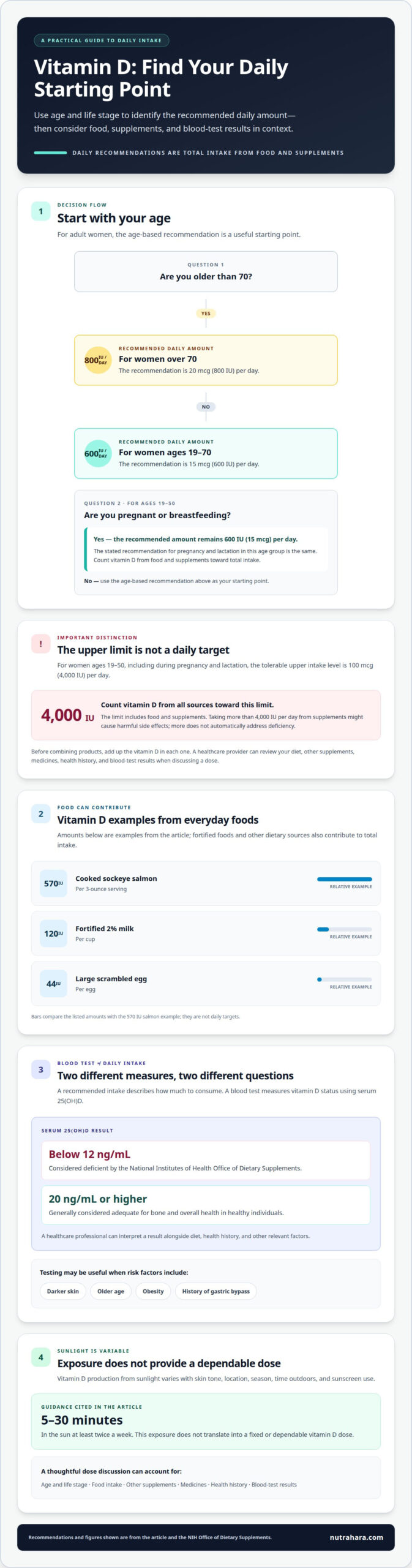
Categories
Articles

Vitamin D dosage for winter: what food and sunlight provide

Winter doesn’t automatically mean you need a higher vitamin D dose. In the United States, the recommended vitamin D dosage for winter months is 600 international units (IU) daily for people ages 1 to 70, according to the National Institutes of Health Office of Dietary Supplements; adults over 70 need 800 IU daily. Vitamin D supports bone and muscle health, so it’s useful to understand how your daily intake adds up.

It can be hard to judge your vitamin D intake in winter: sunlight may contribute little, depending on where you live and your routine, while foods provide varying amounts. This guide explains how recommended daily amounts, age, sunlight, and food affect intake, and why taking more is not always better. It also covers vitamin D’s roles in bone, immune, and muscle health, and what a blood test can tell you about your levels.

Key Takeaways

  • For children up to age 12 months, the recommended amount is 400 international units (IU) daily, according to the National Institutes of Health, Office of Dietary Supplements.
  • Winter sunlight may contribute little vitamin D, and the amount your body makes depends on factors such as location, season, time of day, and skin color.
  • Oily fish, egg yolks, and some fortified foods can add vitamin D to your diet, but food alone may not provide enough for everyone.
  • Taking more isn’t automatically better: learn how excess vitamin D can affect health and which medicines may raise concerns.
  • A blood test can measure vitamin D levels, while understanding its roles in bones and muscles can help you make sense of why adequate intake matters.

Vitamin D production from sunlight in winter

Your skin produces vitamin D when exposed to direct sunlight. In winter, shorter days and the sun’s lower angle can reduce the ultraviolet light available for this process. The effect varies across the United States. Location, time outdoors, skin color, and season all influence how much vitamin D sunlight provides.

Location matters. In northern regions of the United States, people generally can’t rely on winter sunlight to produce enough vitamin D from about September through March. Elsewhere, sunlight may still contribute, but cloud cover, daily routines, and time spent indoors can limit exposure. As a result, two individuals in the same city may get different amounts, even during the same season.

Skin color also affects vitamin D production. People with darker skin need longer in the sun to produce the same amount as people with lighter skin. Sunscreen can reduce the amount the body makes. These factors make sunlight an unreliable way to calculate an exact daily intake, especially in winter when aiming for a consistent vitamin d dosage for winter months.

Guidance commonly describes short, regular exposure rather than prolonged time outdoors: about 15 to 30 minutes of sun onFitz the face and arms two to three times a week when clouds break. That example isn’t a precise dose. The amount produced still depends on season, location, skin color, and time of day. Sun protection also matters; avoid treating unprotected exposure as a guaranteed way to meet your vitamin D needs.

Think of sunlight as one part of the picture, not a winter dosage calculator. A walk outdoors during daylight can support an active routine, but it doesn’t tell you how much vitamin D your skin has made. Yoga or a brisk walk can help you stay active in colder months, but neither replaces vitamin D from food or supplements.

Food can help fill the gap. Salmon and sardines provide vitamin D, as do egg yolks and some fortified foods. Include these in meals when they suit your diet, but keep in mind that relying on food alone to get enough vitamin D can be difficult. If deficiency is a concern, sunlight exposure by itself can’t confirm your vitamin D status. A blood test can measure it, as explained later.

Across many northern parts of the United States, sunlight is simply not strong enough to produce adequate vitamin D during the coldest months. These winter dates mark a strict seasonal limit on sunlight’s role in maintaining healthy vitamin D production.

For adults, the recommended daily amount depends mainly on age, not the winter calendar. According to the National Institutes of Health, Office of Dietary Supplements, children up to age 12 months need 400 international units (IU) daily. People ages 1 to 70 years need 600 international units (IU) daily, and people over 70 years need 800 international units (IU) daily, according to the same organization.

These age-based amounts give women a useful reference through changing life stages. A 35-year-old who menstruates and a 60-year-old after menopause fall within the 1-to-70 age range. Pregnancy and breastfeeding don’t create a different age category in these recommendations. Discussing vitamin D intake during prenatal or postpartum care can help put diet, sunlight exposure, and any supplements into context.

Major U.S. guidance sets daily vitamin D amounts by age, rather than recommending a separate routine winter supplement amount. The age-based daily target remains the reference point. Because winter sunlight may contribute less, food and supplements can play a larger role in a person’s intake.

Food can contribute to your daily amount. Salmon and sardines provide vitamin D, and some milk, plant beverages, cereals, and other foods are fortified. Fortification varies by product, so check the Nutrition Facts label for the amount per serving. For example, compare your usual breakfast cereal’s label with that of a fortified alternative, then consider how a serving fits alongside other sources in your diet.

To make the figures practical, use this simple check:

  • Find the age-based daily amount that applies to you.
  • Look at vitamin D amounts on food and supplement labels, noting serving sizes.
  • Add the listed amounts to understand how your daily intake compares with the recommendation.

This is a way to organize information, not a reason to take several products automatically. A multivitamin and a separate vitamin D supplement may both contain vitamin D. Check their labels together to avoid overlooking duplicate sources. The next section explains why more isn’t always better.

Winter exposure is one part of the picture, but it doesn’t change the age-based figures above. For a woman who spends most daylight hours indoors, fortified foods may contribute vitamin D. A woman who eats salmon may get some from meals, too. Neither example identifies an individual’s vitamin D status; a blood test can measure levels, as explained later.

Safe upper limits and risks of excessive intake

More vitamin D isn’t automatically better, even during a low-sunlight winter. Pay attention to your total intake from supplements, especially when products overlap.

Safe Upper Limits for Vitamin D

An upper limit is the highest daily intake considered unlikely to cause harm for most people. Taking more than 4,000 IU of vitamin D a day from supplements might cause harmful effects. This figure is a safety boundary, not a target. Add up vitamin D from every supplement label before deciding whether another source is needed.

Potential Harms of Excessive Vitamin D

Excess vitamin D can raise calcium in the blood, a condition called hypercalcemia. Toxicity is rare, but symptoms can include nausea, vomiting, a metallic taste, headaches, and body aches. Long-term excess can contribute to calcium buildup, which may weaken bones and damage the kidneys and heart. These effects make unnecessary high-dose use a real concern.

Medication combinations matter, too. Taking vitamin D with thiazide diuretics raises the risk of hypercalcemia. If you take a thiazide for blood pressure, include it when reviewing supplement use with your healthcare professional. The interaction matters whether vitamin D comes from one product or several combined sources.

Start with the labels. Check a multivitamin, a separate vitamin D product, and any calcium supplement, since some formulas contain vitamin D alongside other nutrients. Add the listed amounts rather than judging each bottle on its own. For example, taking a multivitamin and a standalone vitamin D supplement can result in a higher combined intake than either label suggests.

A higher dose can have a place in specific situations. When a healthcare professional identifies vitamin D deficiency, they may recommend more than 4,000 IU per day for a short period, with close monitoring. That supervised approach differs from taking a high dose throughout winter without an identified need. Dose, duration, and monitoring are part of the plan.

For women balancing work, exercise, and changing life stages, a simple routine can help prevent accidental duplication. Keep a list of current supplements and their vitamin D amounts, and update it when a product changes. Don’t add extra capsules just because daylight feels limited. The age-based daily recommendation and your existing intake are more useful starting points than guesswork.

Vitamin D’s roles in bone, immune, and muscle health

Vitamin D matters beyond winter intake because it supports healthy bones and muscles. Understanding these roles connects everyday nutrition with movement, strength, and long-term wellbeing.

Vitamin D and Bone Health

Vitamin D is needed for healthy bones, and getting enough vitamin D and calcium can help slow bone mineral loss and prevent osteoporosis-related fractures. This relationship matters for women through menopause, when protecting bone health becomes especially relevant. Children also need vitamin D: too little can cause rickets, a condition that affects developing bones. Adequate intake is one part of a broader approach to bone health, alongside calcium from food.

Bone mineral loss can occur over time in adults, and osteoporosis-related fractures can affect mobility and daily independence. Vitamin D doesn’t replace calcium or exercise. Think of it as one nutritional part of a routine that includes calcium-rich foods and regular weight-bearing movement. Walking, dancing, and strength exercises are practical ways to make movement part of daily life. Yoga can support balance and flexibility, while meditation offers space to pause and maintain a mindful wellness routine.

Vitamin D in Immune and Muscle Health

Vitamin D is needed for healthy muscles and also plays a role in immune health. Too little vitamin D can cause muscle weakness in adults, which may make ordinary activities feel more demanding. The immune role is distinct from the established effects on bones and muscles: it shouldn’t be treated as proof that taking extra vitamin D prevents illness. Claims about cancer prevention likewise don’t follow from these roles alone.

Muscle weakness can affect how comfortably you climb stairs, carry groceries, or finish a workout. If your strength feels different, consider the full context, including your food, movement, and overall health, rather than assuming vitamin D is the cause. Vitamin D status can be measured with a blood test, discussed in a later section. This can distinguish a measured level from a guess based on symptoms alone.

For a practical, balanced approach, pair awareness of nutrients with movement you can sustain. A walk, yoga session, or strength training can keep activity varied. Include calcium-rich foods in meals, and consider how your usual diet contributes vitamin D. These habits support general health, but they don’t replace identifying a deficiency when one is present.

“Focusing on balanced nutrition and consistent daily movement has helped me maintain my strength and overall vitality throughout the winter months, especially when combined with the right dietary choices recommended by Nutrahara.” — Sarah M.

The key takeaway is simple: vitamin D supports bones and muscles, while calcium and regular movement matter too. Children, adults, and older women can face different concerns, so age and life stage shape the broader conversation. A measured approach supports health without assuming that more vitamin D brings extra benefits.

Vitamin D dosage for winter: what food and sunlight provide

Can a blood test determine whether you need a vitamin D supplement?

Yes. A blood test can check your vitamin D levels, according to the National Library of Medicine. The result offers a measured view of vitamin D status, unlike estimating from winter sunlight or diet alone. It can help put supplement decisions in context, especially when several sources contribute to your daily intake.

A result is most useful when considered alongside your age, health history, and usual routine. For example, an adult who spends little time outdoors may have a different exposure pattern from someone who regularly walks outside. Darker skin, pregnancy, breastfeeding, older age, obesity, gastric bypass surgery, and conditions affecting fat absorption are also associated with a greater risk of not getting enough vitamin D.

Vitamin D levels between 20 and 30 ng/mL are enough to keep most people healthy. A test result within that range can be considered alongside the person’s circumstances, rather than treated as a reason to increase intake automatically. The number alone doesn’t describe every aspect of health or determine which supplement amount is appropriate.

Before discussing a result, get a clear picture of your intake. Note the vitamin D amounts in supplements, multivitamins, and fortified foods, including the serving sizes shown on labels. This matters because two products may both contribute vitamin D, even if each amount seems modest when viewed separately.

A useful conversation connects the measured level with practical details: your age-based daily recommendation, food sources, sunlight routine, and any medicines or health conditions. For instance, a woman after menopause might discuss her result alongside bone-health concerns and calcium intake. Someone who is pregnant or breastfeeding can include that life stage in the discussion, too.

Keep these points together when reviewing your result:

  • Record the test result and its unit exactly as reported.
  • List supplements and fortified foods that contribute vitamin D.
  • Share relevant details, such as pregnancy, breastfeeding, or a condition affecting fat absorption.

A blood test can show whether vitamin D levels are low, but it doesn’t explain the cause by itself. Considering the result alongside diet, sunlight exposure, and health context can help clarify the next step. This measured approach is more informative than adding a high-dose supplement based only on the season or a symptom.

In Ireland, routine recommendations may also apply regardless of an individual test: children aged 1 to 4 need a daily 5-microgram vitamin D supplement from Halloween (31 October) to St Patrick’s Day (17 March), while children aged 5 to 12 need a 10-microgram vitamin D supplement during the winter months, from Halloween (31 October) to St Patrick’s Day (17 March). People who are not often outdoors, usually cover most of their skin outdoors, have black or brown skin, are over 65, are pregnant, or are babies need a daily vitamin D supplement all year round.

In Ireland, vitamin D supplements should be taken with a meal to help the body absorb vitamin D. Vitamin D supplements treat adults with extreme vitamin D deficiency that causes osteomalacia. The page recommends rechecking vitamin D levels three to four months after starting supplementation. This offers additional context when considering a test result: life stage and exposure may shape routine supplementation, while the test measures vitamin D status. Considering both can help prevent a result from being treated as the only relevant factor.

Nutrahara: Women’s Health Supplements

Nutrahara offers Women’s Health Supplements for women building thoughtful wellness routines through changing life stages. Its supplements combine principles of Ayurveda with modern nutritional research and use natural, clean ingredients.

If you’re considering supplements as part of your winter wellness routine, first compare product labels with your existing intake and the age-based recommendations above. Supplements can complement everyday nutrition, but they don’t replace a blood test or treatment for a diagnosed deficiency. A steady approach can include nourishing meals, movement, and practices such as yoga or meditation.

Explore Nutrahara’s offerings or contact the team through nutrahara.com.

Make Your Next Wellness Choice With Confidence

Let your vitamin D routine grow from clear information, not winter guesswork. A vitamin D dosage for winter months should make sense alongside your regular meals, supplement labels, and personal health context. Small habits, such as keeping a simple record of what you take, can make future wellness conversations more focused.

Your needs may shift as life changes, including during pregnancy, breastfeeding, or menopause. Keep your approach steady and thoughtful: nourishment, movement, and restorative practices like yoga or meditation can all have a place in caring for your wellbeing. Nutrahara offers Women’s Health Supplements as part of a broader commitment to women’s wellness.

If you have questions about Nutrahara’s offerings, contact Nutrahara with your questions. Take your next step with care and confidence.

Frequently Asked Questions

How much vitamin D do I need?

It depends mainly on age: the U.S. recommendation is 600 IU daily for ages 1 to 70, and 800 IU over 70. Count food and supplements together.

What is IU?

IU means international unit, a measurement used on vitamin D labels. One microgram equals 40 IU, so compare both units and check the serving size.

What is the recommended daily vitamin D intake for adults in the United States?

Adults ages 1 to 70 need 600 IU daily; adults over 70 need 800 IU daily, according to the National Institutes of Health, Office of Dietary Supplements.

How much vitamin D should adults take during winter months?

The vitamin D dosage for winter months follows the same U.S. age-based daily recommendations. Consider food and supplement intake together rather than automatically adding a high-dose product.

Do vitamin D dosage recommendations vary by age, pregnancy, or health conditions?

Age affects the recommended amount. Pregnancy, breastfeeding, and conditions affecting fat absorption are relevant health context when considering vitamin D intake.

What is the safe upper limit for daily vitamin D intake?

More than 4,000 IU a day from supplements might cause harmful effects. This is a safety boundary, not a target; include overlapping supplements in your total.

How does limited winter sunlight affect vitamin D levels in the United States?

Winter sunlight may contribute less vitamin D, depending on location, time outdoors, season, and skin color. A blood test can measure vitamin D levels.

What are the risks and symptoms of taking too much vitamin D?

Excess vitamin D can raise blood calcium. Rare toxicity may cause nausea, vomiting, a metallic taste, headaches, or body aches; long-term excess can harm the kidneys and heart.

Article by

Nutrahara Team

We are a dedicated collective of nutrition scientists and naturopaths at Nutrahara, committed to advancing women's health through the fusion of ancient Ayurveda science and cutting-edge nutrition research. Our mission is to empower you with clean, simple, and scientifically validated wellness solutions so you can live your healthiest life. Connect with us to stay updated on the latest developments in holistic women's health and nature-based research.

Disclaimer

This article is not a substitute for medical advice. Please consult a healthcare professional before starting any supplement, especially if pregnant, nursing, taking medication, or managing health conditions.

Categories
Articles

Best Vitamin D Supplement: How to Choose the Right One in 2026

The most popular bottle isn’t automatically the best vitamin D supplement for you. A high dose, a familiar form, or a long list of added ingredients may look reassuring, but the right choice depends on your needs, life stage, and what the label actually says.

Serving sizes, vitamin D2 and D3, and quality seals can be difficult to compare. Generic rankings may also leave unanswered questions if you’re pregnant, breastfeeding, approaching menopause, or managing a health condition. A thoughtful choice starts with clear information, not big promises.

This guide explains how to compare supplement forms, serving amounts, ingredients, and quality claims. It also covers when to ask a clinician about testing or supplementation. Use the label to assess the product, and individual guidance to consider whether it suits you. That distinction can make the decision clearer and more relevant to your routine.

Key Takeaways

  • The best vitamin d supplement is a personal fit, not simply the most popular or highest-dose option.
  • Learn how to distinguish a product’s serving amount from the amount that may suit your individual needs.
  • Use a consistent checklist to compare supplement forms, clear labeling, and quality evidence.
  • Consider your life stage and health context, and ask a qualified clinician whether testing or supplementation is appropriate.
  • Nutrahara offers women’s health supplements, but its available product information does not identify a vitamin D-specific product.

What makes the best vitamin D supplement a good fit for you?

The best vitamin D supplement is one that fits your personal needs, has a clear label, and provides quality information you can check. First, separate two decisions: whether to take a supplement and which product to choose. A bottle can tell you what it contains, but it can’t determine whether supplementation is appropriate for you or diagnose a deficiency.

Your food choices, sun exposure, health history, and medications may be useful topics to discuss with a qualified clinician. For example, describing how much time you typically spend outdoors and which foods you regularly eat can help frame the conversation, but those details don’t replace an individual assessment. A product roundup can help compare labels; it can’t provide a diagnosis or personalized medical advice.

Vitamin D supplements: what the label can and cannot tell you

Vitamin D supplements come in different forms, including D2 and D3. For background on these forms and vitamin D’s role in the body, see Vitamin D forms and supplement labels. A label describes the product, not your blood vitamin D level or personal requirement.

Check the full Supplement Facts panel and directions. Note the amount per serving and how many tablets, capsules, or gummies make up that serving. Don’t assume the listed amount is the amount you personally need. Recommended intake can vary by age and life stage, while individual decisions may depend on circumstances a label can’t assess.

Why women’s needs and circumstances are not all the same

Menstruation, perimenopause, and postmenopause are distinct life stages, but none alone determines whether you should supplement. Pregnancy and lactation, certain medications, and health conditions are reasons to seek individualized professional guidance. Bring the product label and a list of medicines or other supplements to help your clinician consider the details in context.

You can ask why supplementation is being suggested, whether testing is relevant to your situation, and how to avoid overlapping products. These are practical questions, not reasons for alarm. Yoga, meditation, balanced meals, and regular movement can support general wellbeing, but they don’t diagnose or treat vitamin D deficiency. Start by considering your own circumstances, then read the label carefully.

Vitamin D forms and supplement labels: what should you compare?

When comparing products, look beyond the front-of-bottle claims. Vitamin D supplements may contain D2 (ergocalciferol) or D3 (cholecalciferol), and they come in formats such as tablets, capsules, softgels, liquids, and gummies. The NIH Office of Dietary Supplements notes that D3 may raise blood vitamin D levels higher and for longer than D2. That comparison alone, however, can’t tell you which product or amount suits you. Its Vitamin D fact sheet offers evidence-based background.

How to read the Supplement Facts panel

Start with the Supplement Facts panel rather than the front label. Find the vitamin D amount per serving, serving size, and directions. Review the other listed ingredients, including the source of vitamin D if it’s stated. A serving may require more than one capsule or gummy, so compare products using the same serving basis rather than assuming one unit equals one serving.

The serving amount tells you what the product provides when used as directed. It is not a personalized recommendation. Don’t select an amount simply because it appears in a popular product or the label calls it “high potency.” If you’re unsure how a product fits with your diet, other supplements, or health circumstances, ask a qualified clinician.

What quality testing and certifications can establish

A quality seal can be useful, but check what it covers. Organizations such as USP and NSF have verification programs. Look up the organization’s current program details and confirm whether the specific product appears in its listings. Verification may address defined quality criteria, but it doesn’t establish that a supplement is right for you or prove every health claim on its packaging.

Don’t assume a product has been independently tested just because its label says “tested” or “verified.” Look for product-specific evidence and check what was assessed. If clear documentation isn’t available, treat the claim as unconfirmed, not as proof of poor quality.

Be cautious about promises to treat or prevent disease, guarantee results, or support a sweeping range of unrelated wellness outcomes. Clear ingredient information and specific, measured claims make comparison easier. The best vitamin d supplement for your shortlist is one whose form, serving details, and quality evidence you can assess. Keep questions about personal dosing separate from product marketing.

How to compare vitamin D supplements without relying on popularity alone

A bestseller label tells you a product is popular, not whether its ingredients, serving information, or quality evidence suit your needs. Apply the same checks to each option, and separate facts on the label from your judgment about whether the format fits your routine. Without current product details and product-specific evidence, it wouldn’t be responsible to name a vitamin D product as a top pick.

A practical checklist for evaluating a supplement

Compare complete labels, not just front-of-bottle claims. Check the vitamin D form, amount per serving, serving size, directions, other ingredients, and manufacturer details. Then verify any quality claim against evidence for that specific product. A capsule may fit one person’s routine better than a liquid or gummy, but convenience alone doesn’t establish effectiveness or quality.

What to compare Objective check How to interpret it
Form Does the label identify D2 or D3 and the delivery format? Consider preference and routine; don’t treat format as proof of superiority.
Serving clarity Are serving size, vitamin D amount, and directions easy to find? Compare amounts on the same serving basis. This is product information, not personal dosing advice.
Quality evidence Can you confirm a stated certification or test for this exact product? Give more weight to verifiable, product-specific information than to broad “tested” claims.
Cautions Are ingredients and warnings disclosed, and are claims specific? Pause over disease-treatment promises or guaranteed results; seek qualified guidance for personal concerns.

How to interpret rankings, reviews, and testimonials

Ask how a ranking was created. Was it based on independent product testing, expert review, label review, or sales popularity? Each method answers a different question, so an editorial pick should explain its criteria and limits. Consumer reviews can describe taste, packaging, or ease of use, but personal experiences aren’t proof of clinical benefits. Women’s testimonials should be authentic, permissioned, and supported; without those safeguards, it’s better to omit them.

For personal safety questions, Mayo Clinic’s guide can help you choose and use vitamin D supplements safely, but it doesn’t replace advice tailored to your circumstances. A useful comparison is transparent about what has been verified and what remains unknown. Nutrahara offers women’s health supplements, but there is no confirmed vitamin D-specific product to present as a vitamin D pick.

How to choose and use vitamin D supplements safely at different life stages

Start with your circumstances, not a one-size-fits-all dose. Use this sequence to prepare for a product comparison or a conversation with a clinician:

  • Review your context. Consider your life stage, diet, sun exposure, health conditions, medications, and any supplements you already take.
  • Check the label. Confirm the vitamin D form, amount per serving, serving size, other ingredients, and directions.
  • Ask a qualified clinician. Discuss whether testing or supplementation makes sense for you, especially if you’re pregnant, breastfeeding, taking medication, or managing a health condition.
  • Follow the guidance you receive. Use a product according to its directions and the clinician’s advice, rather than adding extra servings or combining products without checking.

This process helps you consider the best vitamin d supplement for your situation without assuming a popular product or general recommendation applies to every woman.

When should women ask a clinician about vitamin D?

Pregnancy and lactation bring specific nutritional questions, while medications and some health conditions may affect what’s appropriate. Ask a clinician to review your circumstances and any product label before starting or changing a supplement. Symptoms alone can’t confirm vitamin D deficiency, and a general article can’t determine whether you need a blood test. Testing decisions and timing should be based on your individual situation, not a universal schedule.

How to build a supportive, sustainable wellness routine

Keep your approach simple. If supplementation is recommended, follow the clinician’s instructions and the product label. Check whether other supplements already contain vitamin D before combining them, and ask if you’re unsure. Linking a reminder to an established daily habit, such as breakfast, may make directions easier to follow.

Balanced nutrition and regular movement can support overall wellbeing. Yoga and meditation may also help you make space for mindful, restorative routines. These practices can be part of a broader wellness plan, but they don’t replace vitamin D or treat a deficiency. Aim for a routine that feels realistic and supportive, not like another source of pressure. A clinician can help you adjust it as your needs change through menstruation, perimenopause, menopause, pregnancy, or breastfeeding.

Best Vitamin D Supplement: How to Choose the Right One in 2026

Choosing a vitamin D supplement in 2026: make an evidence-led next move

A confident choice doesn’t require a complicated ranking. It requires clear product details, a transparent label, and professional guidance when your health context calls for it. Before buying, check what’s actually verified instead of relying on popularity or broad wellness promises.

A final checklist before you buy

  • Confirm the current label. Review the vitamin D form, amount per serving, serving size, directions, and full ingredient list. Check the manufacturer’s product information too, so you’re comparing complete details.
  • Verify quality claims. If a product mentions testing or certification, look for current evidence that applies to that specific product. A general claim is not the same as verifiable product-specific information.
  • Consider your circumstances. Pregnancy, breastfeeding, medication use, and health conditions may raise questions that a product label can’t answer. Ask a qualified clinician whether testing or supplementation is appropriate for you.

These checks help distinguish what a product states from what you personally may need. Your shortlist should reflect transparent information and fit your routine, not promise a particular health outcome. The best vitamin d supplement for one woman may not be right for another.

Where Nutrahara fits, and where it does not

Nutrahara is an e-commerce company specializing in women’s health supplements. Its products combine principles of ancient Ayurveda science with modern nutritional research and use natural, clean ingredients. Its offerings include supplements designed to support areas such as skin, hair, nails, digestion, and brain function. No vitamin D-specific product is identified, so Nutrahara can’t be ranked or recommended here as a vitamin D option. Its broader women’s wellness products are not a substitute for vitamin D or individualized clinical guidance.

If you’re exploring Nutrahara’s women’s health supplements, review the available product information with the same care: check the ingredients, serving directions, and evidence behind any claims. This article doesn’t verify a vitamin D product or suggest that another supplement can meet a vitamin D need. Let your health context, clear product information, and clinician guidance shape that decision.

Make your next vitamin D choice with confidence

The best vitamin d supplement isn’t defined by popularity alone. Look for a clear, current label and product-specific quality information, then consider whether the product fits your needs and routine. Serving details describe the product, not your personal requirements.

Your life stage and health history matter. If you’re pregnant or breastfeeding, take medication, or have a health condition, discuss testing or supplementation with a qualified clinician. That conversation can help you make a choice based on your circumstances rather than a generic ranking.

Nutrahara focuses on women’s health supplements and combines Ayurvedic principles with modern nutritional research. No vitamin D-specific product is identified, so Nutrahara shouldn’t be treated as a vitamin D recommendation. For broader women’s wellness resources, explore Nutrahara’s women’s wellness resources.

For your next step, compare labels carefully and ask a clinician about questions specific to your health. If you’re looking for broader women’s wellness support, explore Nutrahara’s women’s wellness resources.

Frequently Asked Questions

What is the best vitamin D supplement to take?

The best vitamin D supplement is one that matches your needs and routine, with a clear label and quality claims you can verify. Compare the form, serving size, amount per serving, ingredients, and directions rather than choosing by popularity or high potency alone. A product label can’t tell you whether you personally need supplementation or what amount is appropriate. Ask a qualified clinician if your health history or life stage raises questions.

Is vitamin D3 better than vitamin D2?

Vitamin D3 may raise and maintain blood vitamin D levels more effectively than D2, but that doesn’t automatically make every D3 product the right choice for you. D2 and D3 are different forms of vitamin D, and labels should identify which form a product contains. Consider serving details, other ingredients, and your circumstances too. If you’re unsure which form to choose, discuss your options with a qualified clinician.

How do I know if I need a vitamin D supplement?

You can’t reliably confirm a vitamin D deficiency from symptoms alone. A clinician can consider your health history, diet, sun exposure, medications, and whether a blood test is appropriate. Testing and supplementation decisions are individualized, so don’t use a general product roundup to diagnose yourself or select a dose. If you have concerns, write down your questions and bring a list of your current supplements and medications to your appointment.

Can I take vitamin D while pregnant or breastfeeding?

Vitamin D is an essential nutrient, and the recommended dietary allowance for pregnant and breastfeeding women is 600 IU (15 mcg) per day, according to the National Academies’ recommendations provided for this article. That figure isn’t a personal prescription or necessarily a supplement dose. Check whether your prenatal or other supplements already contain vitamin D, and ask your pregnancy care clinician what is appropriate for you.

What should I look for on a vitamin D supplement label?

Check the Supplement Facts panel for the vitamin D form, amount per serving, serving size, and directions. Review the full ingredient list, including other active ingredients, and confirm how many tablets, capsules, or gummies make up a serving. Compare products using the same serving basis. The listed amount describes the product, not your individual requirement, so ask a clinician if you need help deciding whether to supplement or how much is suitable.

How can I tell whether a vitamin D supplement has been third-party tested?

Look for a named organization or specific testing claim, then confirm that the exact product appears in the organization’s current verification records. USP and NSF are examples of organizations with programs, but a logo or general “tested” statement isn’t enough to establish what was assessed. Check the program’s scope and current status. Verification can support defined quality claims; it doesn’t prove that a product will deliver a particular health benefit or suit your needs.

Can I take vitamin D with other supplements or medications?

Possibly, but check with a qualified clinician or pharmacist before combining vitamin D with medications or other supplements. Products may overlap in their ingredients, and medicines or health conditions can affect whether supplementation is suitable. Bring the labels or a written list of everything you take, including prenatal vitamins and multivitamins. Don’t add extra servings or change a clinician’s instructions based on advice from a general article or product label alone.

Article by

Nutrahara Team

We are a dedicated collective of nutrition scientists and naturopaths at Nutrahara, committed to advancing women's health through the fusion of ancient Ayurveda science and cutting-edge nutrition research. Our mission is to empower you with clean, simple, and scientifically validated wellness solutions so you can live your healthiest life. Connect with us to stay updated on the latest developments in holistic women's health and nature-based research.

Disclaimer

This article is not a substitute for medical advice. Please consult a healthcare professional before starting any supplement, especially if pregnant, nursing, taking medication, or managing health conditions.