Categories
Articles

Essential Supplements and Vitamins for Women’s Health

A multivitamin isn’t automatically the right choice for every woman. Supplements and vitamins for women can include a mix of nutrients, but needs vary with diet and life stage. Adult women generally need 2.4 mcg of vitamin B12 daily, with different needs during pregnancy and breastfeeding.

It’s understandable to wonder whether a multivitamin is enough, especially when energy, bone health, or changing routines are on your mind. A useful starting point is to identify which nutrients matter to you and when supplements and vitamins for women may be relevant.

Learn how vitamin D supports bone health, what to consider in a multivitamin after 50, and why B12 deserves attention, particularly if you eat a vegetarian diet. You’ll also find practical ways to think about supplements alongside balanced meals, movement, yoga, and meditation, so your wellness choices can feel thoughtful and sustainable.

Key Takeaways

  • Match nutrient priorities to your life stage, from menstrual years and pregnancy to menopause.
  • Learn how vitamin D and calcium work together to support bone health, and why needs can change after menopause.
  • Use a thoughtful checklist to decide whether a multivitamin after 50 fits your diet and health needs.
  • Understand when vitamin B12 may deserve extra attention, especially if you eat a vegetarian diet or take acid-blocking medication.

1. What vitamins and minerals are important for women’s health?

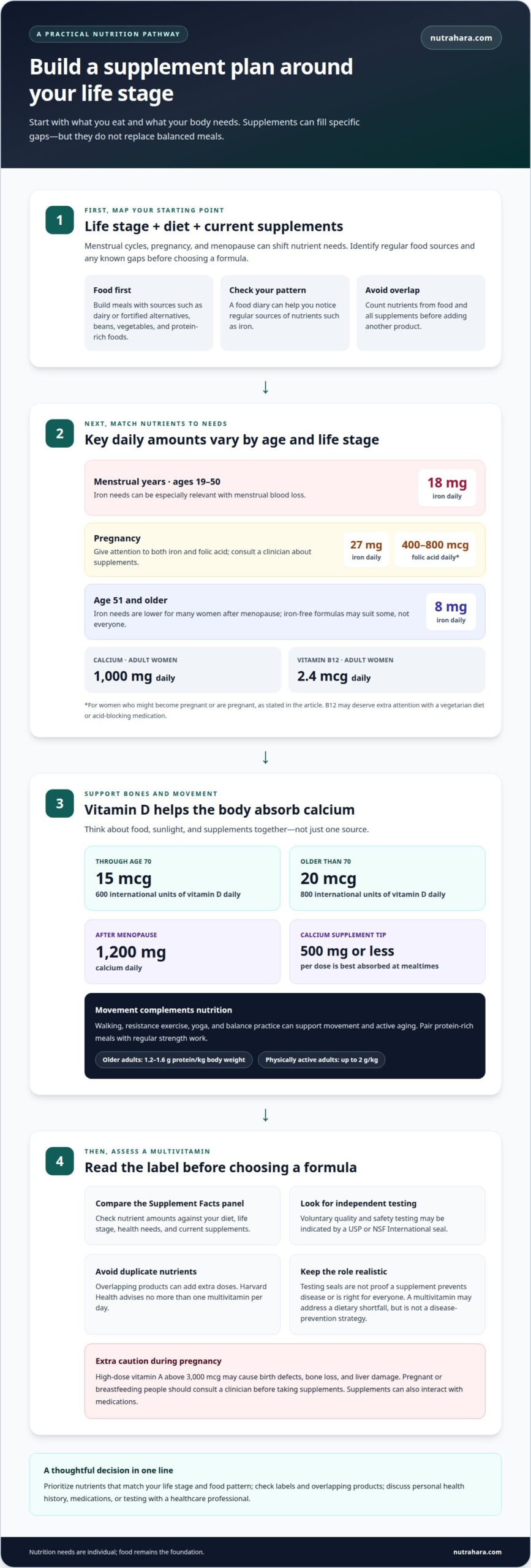
Nutrition needs shift with menstrual cycles, pregnancy, and menopause, so one formula won’t suit every woman. Adult women need 1,000 mg of calcium daily, according to the NIH Office of Dietary Supplements. Food can provide many nutrients; dairy or fortified alternatives, beans, vegetables, and protein-rich foods are practical foundations. Supplements may help fill specific gaps, but they don’t replace balanced meals. For American women, the first step is matching nutrient choices to diet and life stage.

Menstrual blood loss makes iron especially relevant before menopause. Women ages 19 to 50 need 18 mg of iron daily, according to the NIH Office of Dietary Supplements. Women who might become pregnant or are pregnant need 400–800 mcg of folic acid daily, according to the NIH Office of Dietary Supplements. During pregnancy, women need 27 mg of iron daily, according to the NIH Office of Dietary Supplements. These differences explain why an iron-containing multivitamin may fit some menstruating women, while pregnancy calls for attention to both iron and folic acid.

Iron needs change with age, too. Women ages 51 and older need 8 mg of iron daily. Some multivitamins for women over 50 are iron-free, which may suit women whose needs are lower after menopause. Still, iron-free isn’t a universal rule: consider the amount in the label alongside your diet and any known iron needs. A food diary can help identify regular sources, such as beans, leafy greens, meat, or fortified cereals.

Vitamin D and omega-3s may also factor into a woman’s nutrition plan. Women in their 20s and 30s may consider vitamin D for bone health and omega-3s for heart health. For a wider nutrient check, including vitamin B12, ask whether diet and life stage leave a likely gap; adult women generally need 2.4 mcg of B12 daily.

Food is the best way to obtain needed nutrients, and supplements are not necessary for every woman. FDA regulation and product certification are separate considerations: look for voluntary independent testing and a USP or NSF International seal. Popular women’s vitamins in the United States don’t have one standard cost; serving count, nutrient blend, and formulation affect the price. A supplement can provide iron, vitamin D, calcium, folate, or B12, but whether it’s needed depends on which nutrients your diet and life stage provide.

2. Vitamin D and bone health

Vitamin D helps the body absorb calcium, linking dietary choices with bone health. Adult women generally need 15 micrograms (600 international units) of vitamin D daily through age 70. Women older than 70 generally need 20 micrograms (800 international units) daily. Food, sunlight, and supplements contribute differently, so consider your overall routine instead of relying on one source. Choosing supplements and vitamins for women starts with your bone and muscle goals.

Calcium needs change after menopause. Women need 1,200 mg of calcium daily after menopause, according to the NIH Office of Dietary Supplements. Dairy products, fortified alternatives, and spinach can contain calcium. If using a calcium supplement, doses of 500 mg or less are best absorbed at mealtimes. Count dietary sources too, since combining products can increase total intake.

Bone and muscle health work together. Walking, resistance exercise, and yoga can build movement into a routine, while balance practice supports confident daily activity. Older adults need 1.2 to 1.6 grams of protein per kilogram of body weight to help preserve muscle mass. Physically active adults may need up to 2 grams per kilogram to support muscle repair and recovery. Pair protein-rich meals with regular strength work for active aging.

A healthcare professional can consider your diet, health history, medications, and relevant test results when discussing vitamin D or calcium. This is especially important if osteoporosis or another condition affects your bone health, or if you’re considering several supplements together. Bring a list of products and note how often you take them. A thoughtful approach to supplements and vitamins for women accounts for nutrients you already get from food and supplements, while keeping your individual health goals in view.

3. Multivitamins for women over 50

After 50, a multivitamin can help cover dietary gaps, but it isn’t a substitute for varied meals. Choose a formula based on your eating pattern, health needs, and current supplements. Compare the Supplement Facts panel for amounts of vitamins and minerals, then avoid overlapping products that duplicate nutrients. A doctor can help you interpret the label alongside medications and relevant testing.

When selecting a product, look for voluntary independent quality and safety testing, such as a USP or NSF International seal. These marks indicate testing, not proof that a supplement prevents disease or is right for everyone. If you choose a multivitamin, Harvard Health advises taking no more than one per day. Follow the label directions, and take it consistently with a meal if that works for you.

Evidence matters, too. The Women’s Health Initiative found that postmenopausal women who took multivitamins did not have a lower death rate than those who did not. They were just as likely to develop cardiovascular disease or several cancers. A multivitamin may still help address a dietary shortfall, but it should not be chosen as a disease-prevention strategy. Strength training, balanced meals, and movement support wellness in ways a pill cannot replace.

During pregnancy, folic acid and iron needs deserve attention. A prenatal supplement may be appropriate, but pregnant or breastfeeding people should consult a clinician before taking any supplement. Recommendations depend on life stage, diet, and health needs, so do not assume one formula suits both pregnancy and breastfeeding.

Extra doses can create problems, especially when products overlap. During pregnancy, high-dose vitamin A above 3,000 mcg may cause birth defects, bone loss, and liver damage. Supplements can also interact with medications. Give your doctor or pharmacist a complete list of vitamins, minerals, and medicines before combining products; report any new symptoms after starting a supplement.
Essential Supplements and Vitamins for Women's Health

4. Vitamin B12 supplementation

Vitamin B12 deserves attention if you eat a vegetarian diet or take acid-blocking medicine daily. These factors can make it harder to get enough through everyday food choices. A medical professional may consider your diet, medication use, symptoms, and test results when assessing possible deficiency. Keep a monthly note of supplements and medicines, so the list is easy to discuss at appointments.

Life stage changes the daily target. Women generally need 2.6 mcg of vitamin B12 daily during pregnancy and 2.8 mcg daily while breastfeeding. These needs can be met through food, fortified products, or supplements, depending on the person’s diet. If pregnancy is planned, include B12 in the conversation about prenatal nutrition rather than assuming every multivitamin contains the amount you need.

For strict vegetarians or people taking a daily acid blocker, Harvard Health says 1,000 micrograms of vitamin B12 per day should be more than enough. That is a specific situation, not a universal dose for every woman. Read the supplement label, note the amount per serving, and avoid stacking several products without accounting for their combined B12. A doctor can interpret test results alongside your diet and medication history.

Choose a practical routine you can follow. Pair a supplement with a regular meal or another daily habit, and record missed doses without doubling up automatically. If you notice persistent changes in energy or wellbeing, document when they began and discuss them with a healthcare professional; symptoms alone don’t establish a B12 deficiency. For women considering a B-complex option, explore the vitamin B-complex supplement as one way to review B vitamins together. The takeaway: vegetarian eating, acid-blocking medicine, pregnancy, and breastfeeding are useful prompts to assess B12 intake thoughtfully.

Nutrahara: Women’s Health Supplements

Nutrahara offers Women’s Health Supplements for women looking to make nutrition part of a thoughtful wellness routine. Its approach combines principles of ancient Ayurveda with modern nutritional research and natural ingredients. This can be a next step when you’ve identified a supplement need and want to explore options that fit your health goals. Consider your diet, life stage, and existing supplements as you decide what may complement your routine. Supplements work best as part of a broader foundation that includes nourishing meals, regular movement, and practices such as yoga or meditation. For questions about Nutrahara’s Women’s Health Supplements, contact Nutrahara.

Make your next wellness choice with intention

Your health priorities can shift as your routines, diet, and life stage change. Treat supplement choices as one part of a broader approach that includes nourishing meals, strength-building movement, and time to restore through yoga or meditation. To stay intentional, write down what you take and what you hope it supports, then revisit the list as your needs evolve.

Choosing supplements and vitamins for women is most useful when it reflects your own goals, rather than a one-size-fits-all routine. If you’re exploring options for your wellness journey, contact Nutrahara with your questions. Keep moving forward with curiosity and confidence, one thoughtful choice at a time.

Frequently Asked Questions

What are multivitamins for women?

Multivitamins combine several vitamins and minerals in one product. Formulas differ in the nutrients and amounts they contain, so “for women” does not mean a product suits everyone. Before choosing one, consider your regular meals, dietary preferences, and any other products you take. A multivitamin offers convenience, but it cannot replace a varied eating pattern.

What vitamins and minerals are important for women’s health?

Important nutrients include calcium, vitamin D, iron, folate, and vitamin B12, though priorities depend on life stage and diet. For a practical starting point, write down a typical day of meals and note fortified foods, such as enriched cereals or plant-based drinks. This can help reveal patterns in your intake and make a conversation about nutrition more specific and useful.

Are dietary supplements safe?

Safety depends on the supplement, its amount, your health, and any other products or medicines you use. Read the full label, including serving directions and all listed ingredients, rather than relying on claims on the front of the package. Keep containers or clear photos of labels available for a healthcare professional. During pregnancy or breastfeeding, discuss supplements with a clinician before starting them, since needs and safety considerations can differ.

Should you take supplements during perimenopause and menopause?

Some women may benefit from a supplement, but a life transition does not mean everyone needs the same product. Consider changes in eating habits, health history, and nutrient concerns instead of choosing based only on age. A food and supplement diary can help you notice routine changes, while a healthcare professional can interpret symptoms and relevant test results in context.

What do multivitamins help with?

Multivitamins provide several nutrients in one product, which can be convenient when addressing dietary gaps. They do not replace meals or treat health conditions. Check whether the nutrients match your needs and whether another product already provides the same ingredients. Comparing labels can help you avoid unnecessary duplication.

What’s the most effective form for supplements: capsules, tablets, chew or gummies?

No single format works best for everyone. The right choice depends on the product and whether you can comfortably follow its directions. Compare serving sizes and nutrient amounts on the labels, not just the format. If taste, texture, or swallowing affects consistency, choose an option that fits your routine. Review added ingredients, especially if you avoid particular foods or sweeteners.

Article by

Nutrahara Team

We are a dedicated collective of nutrition scientists and naturopaths at Nutrahara, committed to advancing women's health through the fusion of ancient Ayurveda science and cutting-edge nutrition research. Our mission is to empower you with clean, simple, and scientifically validated wellness solutions so you can live your healthiest life. Connect with us to stay updated on the latest developments in holistic women's health and nature-based research.

Disclaimer

This article is not a substitute for medical advice. Please consult a healthcare professional before starting any supplement, especially if pregnant, nursing, taking medication, or managing health conditions.

Categories
Articles

Natural Supplements for Women: A Guide to Wellness

What if the most helpful supplement choice isn’t the one making the biggest promise, but the one that fits your needs and has evidence behind it? If conflicting claims have left you unsure about the benefits of natural supplements for women, you’re not alone. Your priorities may also shift through menstruation, pregnancy, lactation, perimenopause, and post-menopause, making safety and relevance just as important as the ingredient list.

This guide explains how supplements may fit into everyday wellness without being mistaken for treatment. You’ll learn how to weigh research, product labels, and uncertainty, and how to discuss your choices with a partner in a way that respects both of your perspectives. You’ll also explore how Nutrahara brings Ayurvedic principles together with modern nutritional research, alongside practical ways to build a balanced routine with movement, yoga, meditation, and restorative practices. The goal isn’t to find a perfect formula. It’s to make informed choices that support your wellbeing over time.

Key Takeaways

  • Consider where the benefits of natural supplements for women may support everyday wellness, and remember that supplements aren’t a substitute for treatment.
  • Assess evidence for digestion, skin, hair, nails, and cognitive wellness without confusing traditional use with established findings.
  • Compare labels by ingredient, amount, purpose, and evidence. “Natural” doesn’t automatically mean safer or more effective.
  • Use thoughtful prompts to share your wellness goals with your partner, listen to concerns, and agree on next steps without pressure.
  • Explore how Nutrahara’s Ayurvedic principles and modern nutritional research can inform choices grounded in your goals and life stage.

Why women consider natural supplements for everyday wellness

Women may consider supplements as one part of a broader approach to wellbeing, alongside varied meals, regular movement, rest, and practices such as yoga or meditation. Natural supplements for women contain ingredients from natural sources and are intended to add nutrients or other dietary ingredients. But “natural” doesn’t mean risk-free, proven effective, or suitable for everyone. A supplement may support dietary intake, but it isn’t a guaranteed result or a substitute for care when a health concern needs attention.

Health goals also depend on individual circumstances. The broad field of women’s health includes physical and mental wellbeing across different ages and life stages, rather than one shared set of needs. Keeping that in mind can make supplement decisions more personal and less influenced by sweeping promises.

What women may hope supplements will support

Goals vary. One woman may want to review her overall nutrient intake; another may be interested in digestion, skin, hair, nails, or cognitive wellness. These are areas to explore, not outcomes a product can promise. Feeling tired or noticing a change in digestion, for example, doesn’t by itself show that you need a supplement or that one will address the cause.

Start with a clear question: What am I hoping to support, and what else is part of my routine? Consider your usual eating pattern, activity, sleep, and any ongoing health concerns. A simple wellness note can help you track what you experience and what changes in your routine, without assuming a product caused every difference. If a symptom is persistent or worrying, treat it as a health question rather than trying to manage it with supplements alone.

Why life stage matters when considering supplements

Needs and priorities can shift during menstruation, pregnancy, lactation, and the years before or after menopause. Diet, health context, and life stage may all influence whether a particular nutrient or ingredient is relevant. A transition can prompt useful questions, but it doesn’t automatically mean supplementation is necessary. Consider what you already get from food and other supplements, then identify a specific goal before adding anything.

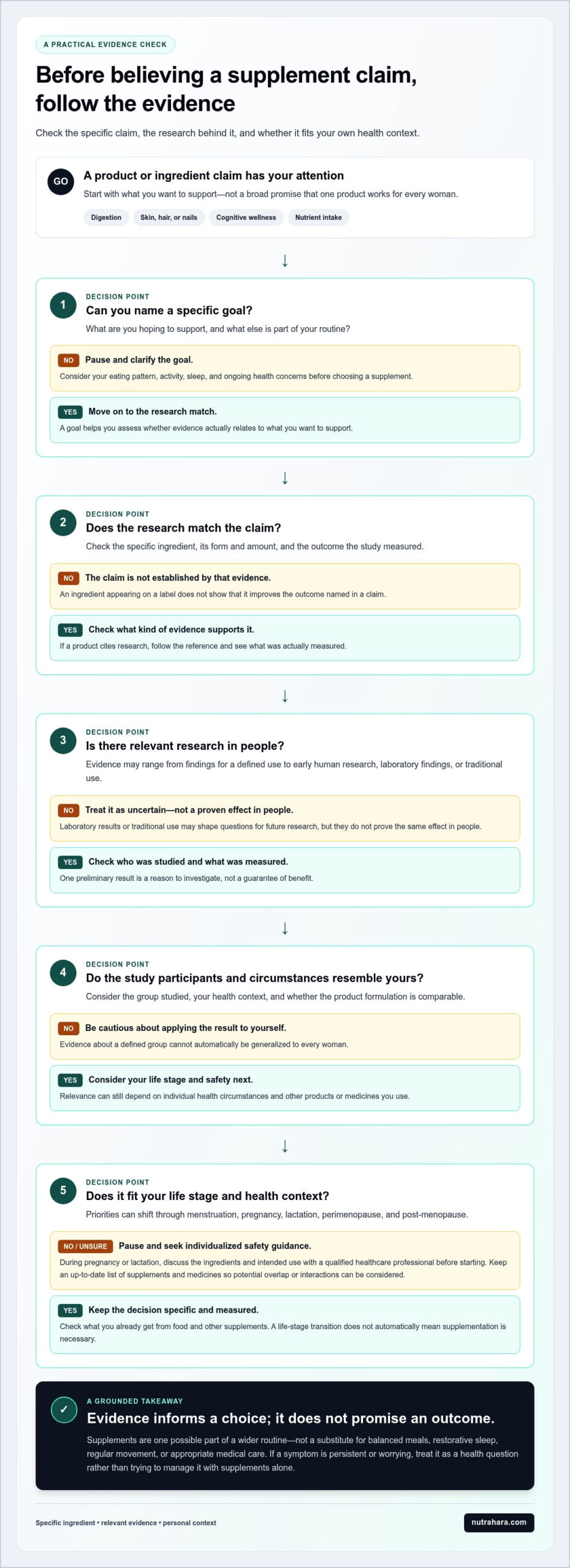
Pregnancy and lactation call for especially careful, individualized safety guidance. Ingredients that seem familiar or “natural” aren’t automatically appropriate during these stages, and personal circumstances matter. Discuss a supplement’s ingredients and intended use with a qualified healthcare professional before starting it. At any life stage, keep an up-to-date list of supplements and medicines so potential overlap or interactions can be considered.

The benefits of natural supplements for women are possibilities shaped by individual needs, not universal promises. Define your goal, account for your life stage, and keep nutrition and restorative habits at the heart of your routine.

What benefits can natural supplements offer women, and what does evidence say?

Consider potential support by health goal, not by a broad promise that one product works for every woman. Digestion, skin, hair, nails, and cognitive wellness are common areas of interest, but an ingredient’s presence on a label doesn’t establish that it improves any of them. To assess the benefits of natural supplements for women, look for research on the specific ingredient, its form and amount, the people studied, and the outcome measured.

Evidence can range from well-supported findings for a defined use to early human research, laboratory findings, or traditional use. These categories aren’t interchangeable. A result seen in cells or described in traditional practice may help shape questions for future research, but it doesn’t prove that a supplement produces the same effect in people. Similarly, an association between a nutrient and an outcome doesn’t show that taking a supplement causes that outcome.

How to read claims about ingredients and research

Match the research to the claim. Check whether it concerns the same ingredient and form, a comparable amount, and the intended outcome. Look for human studies, and consider whether participants resemble you in relevant ways. If a product claim cites research, follow the reference and see what was actually measured. One preliminary result is a reason to investigate, not a guarantee of benefit.

Evidence about a particular ingredient, amount, and outcome in a defined group can’t automatically be generalized to every woman. Individual health context and product formulation may differ. This matters across menstruation, pregnancy, lactation, and menopause, and for anyone taking medicines or managing a health concern.

  • Digestion: Check whether research measures the digestive outcome named in the claim. Different digestive concerns aren’t interchangeable.
  • Skin, hair, and nails: Distinguish studies of a specific nutrient or ingredient from broad promises about appearance or growth.
  • Cognitive wellness: Look for evidence tied to the particular mental function being discussed. A general “brain support” phrase may not describe a measured result.

These categories are questions to investigate, not established benefits of any product. Without relevant, reliable citations, a specific benefit claim should remain unasserted.

Supplements as one part of a wider wellness routine

A supplement is one possible part of a thoughtful routine, not a stand-in for balanced meals, restorative sleep, regular movement, or appropriate medical care. Build a practical foundation: eat varied foods, choose activity you can sustain, and consider yoga or meditation as ways to support a calmer daily rhythm. Then ask whether a supplement addresses a clearly identified dietary goal. For an example to assess, Nutrahara’s vitamin B complex supplement can be reviewed by its ingredients, stated purpose, and available evidence, rather than by promises alone.

Natural versus synthetic supplements: compare the label, not the promise

“Natural” and “synthetic” describe how an ingredient is sourced or produced. Neither word, by itself, tells you whether a supplement is safe, effective, or right for you. Source alone cannot establish a supplement’s safety or benefit. A naturally derived ingredient can still be unsuitable in some circumstances, while a synthetically produced ingredient isn’t automatically ineffective. The ingredient’s identity, amount, purpose, evidence, and your personal context matter more than a reassuring-sounding label.

Use the label as a starting point for questions, not as proof of a promise. Compare products by checking details you can assess:

Ingredient identity: Is each ingredient clearly named, or described only in broad terms? A recognizable source can be useful context, but it doesn’t prove a benefit.

Amount and serving information: Can you tell how much of each ingredient is included per serving and how the serving is defined? If the amount isn’t clear, it’s harder to compare a label with relevant research.

Stated purpose: Does the product explain its intended dietary role? Don’t infer additional benefits from an ingredient’s name or claims that aren’t explained on the label.

Evidence: Is there credible research on the same ingredient, form, amount, and intended outcome? A source claim or “natural” positioning isn’t a substitute for evidence.

Which label details help make an informed choice?

Read the full ingredient list and serving information, then compare them with the reason you’re considering a supplement. If a proprietary blend or broad description makes the contents or amounts difficult to understand, seek clearer information rather than assuming the product is harmful. Transparent details make it easier to assess your options. For example, when considering women’s health supplements, examine the listed information and stated purpose instead of assuming unlisted effects.

Safety questions to consider across life stages

Your health history, medicines, and other supplements can affect whether an ingredient is suitable; combinations may also matter. Keep a current list of what you take and discuss potential interactions with a qualified healthcare professional if you have questions. If you’re pregnant or breastfeeding, seek qualified guidance before using supplements. “Natural” doesn’t guarantee that an ingredient is appropriate for every person or life stage.

You don’t need to choose a product simply because it sounds more natural or more advanced. A careful label review helps you ask better questions and consider the potential benefits of natural supplements for women without treating a source label as a promise. Let clear information and your own wellness priorities guide your next step.

Natural Supplements for Women: A Guide to Wellness

How to talk with your partner about natural health choices

Different views on supplements don’t have to become a contest. A calm conversation can help you explain what matters to you, hear your partner’s concerns, and decide what information or next steps would be useful. The aim isn’t to secure automatic agreement. It’s to discuss your choices with respect while keeping your health and autonomy central.

A simple framework for a supportive conversation

Begin with your goal, such as understanding whether a supplement fits your nutrition priorities or current life stage. Explain why that goal matters to you, then share what you’ve learned, including limits or unanswered questions. Invite your partner’s perspective without assuming skepticism means they don’t care. Asking, “What would help you feel comfortable discussing this?” can open a more curious exchange.

Try this sequence:

  1. Share your aim. “I’m looking into ways to support my everyday wellbeing, and I want to make an informed choice.”
  2. Explain what you know. Summarize the evidence you found and what it doesn’t establish. Be clear if research is limited or doesn’t match your exact situation.
  3. Listen for the concern. Ask, “Is your main concern safety, cost, or whether it’s likely to help?” Reflect back what you hear before responding.
  4. Agree on a next step. You might review reliable information together, pause to learn more, or talk with a qualified healthcare professional if you have personal safety questions.

This approach keeps the discussion focused on shared understanding rather than pressure. It also makes room for uncertainty: the potential benefits of natural supplements for women depend on the specific choice and individual circumstances, so there’s no need to pretend every answer is settled.

Turn shared intentions into realistic habits

Choose one manageable practice you can enjoy together, such as a walk, gentle yoga, or a brief meditation. Agree on when it fits your routine, then notice how the habit feels without treating a change as proof that a supplement caused it. Simple personal notes about energy, sleep, or other observations can help you spot patterns, while remembering that daily wellbeing has many influences.

Shared routines can support connection, but you don’t need your partner to adopt every wellness choice you make. You might ask, “Would you like to try a short walk with me?” or, “Can we set aside time to compare what we’ve each read?” If you disagree, pause and return to the conversation later. Your partner can offer perspective, but your health decisions remain yours to make with appropriate guidance.

For example, if you’re considering a supplement because your eating habits have changed, you could explain what you hope to understand, share the label and research you’ve reviewed, and invite your partner to help you think through any questions. That keeps the conversation specific without assuming a product is necessary or that it will produce a particular result.

Thoughtful choices begin with honest questions and steady habits. If you’d like to explore options as part of your own research, explore women’s health supplements with your goals and priorities in mind.

A thoughtful path from natural wellness research to Nutrahara

Good supplement decisions start with your needs, not a trend or a promise. Nutrahara brings Ayurvedic principles together with modern nutritional research, using natural, clean ingredients in its women’s health supplements. This approach connects traditional wellness ideas with contemporary nutrition, but it isn’t proof that a supplement has been clinically shown to produce a particular outcome. Ask whether an option fits your goal, what evidence supports its use, and whether it suits your circumstances.

What a balanced supplement decision can look like

Before deciding, write down what you hope to support and what would help you assess the choice clearly.

  • State your goal: Describe the wellness priority in your own words, such as reviewing your nutrition or focusing on a specific area of wellbeing.
  • Review the evidence and label: Check whether research relates to the ingredient, form, amount, and outcome you’re considering. Compare that information with the ingredients, serving details, and stated purpose on the label.
  • Consider your context: Your life stage, health history, medicines, and other supplements may affect whether an option is suitable. Seek qualified guidance if you have personal safety questions, especially during pregnancy or breastfeeding.

A supplement is optional. It doesn’t replace nourishing food, movement, restorative sleep, yoga or meditation, or appropriate medical care. For a sustainable routine, choose manageable habits you can return to: plan movement that fits your week, make time for restful practices, and review your routine when your needs change. Small, repeatable choices can help you care for your wellbeing over time, without treating any single product or habit as a guarantee of longevity.

Nutrahara’s women’s health supplements focus on areas such as skin, hair, nails, digestion, and brain function. These are areas of focus, not guaranteed results or treatment claims. Let your goals and life stage guide what you consider, and weigh specific claims against relevant evidence rather than popularity or persuasive language.

Continue exploring women’s wellness

If this approach resonates with you, explore Nutrahara’s women’s health supplements as part of your own research. Consider the listed ingredients, stated purpose, and evidence, then decide whether an option fits alongside the habits that support your day-to-day wellbeing. You don’t need to choose something simply because it’s popular or labeled natural. Your wellness is a personal progression, shaped by changing needs and the practices you can sustain. It isn’t a test of commitment, discipline, or confidence. Choose what feels informed and appropriate for you, one considered step at a time.

Let your next wellness step be your own

Your wellness needs may shift with your routines, priorities, and life stage. Give yourself room to revisit your choices as they change. The potential benefits of natural supplements for women are worth considering with curiosity, but your choices don’t need to follow a trend or meet anyone else’s expectations. A steady practice, a thoughtful question, or deciding to wait can each be a meaningful next step.

Nutrahara combines Ayurvedic principles with modern nutritional research and focuses on women’s health supplements made with natural, clean ingredients. This philosophy can be one lens for exploring options, alongside your own goals and the evidence for any specific ingredient. Explore Nutrahara’s approach to women’s wellness, and choose only what feels relevant to your informed wellness journey. You deserve to make those choices with confidence, care, and kindness toward yourself.

Frequently Asked Questions

Do natural supplements work for women’s health?

Some supplements may help meet a specific nutritional need, but effects depend on the ingredient and the person. The benefits of natural supplements for women aren’t guaranteed, and “natural” alone doesn’t show that a product works. If you’re considering a supplement because your diet has changed, first identify the nutrient or goal you’re concerned about. A qualified healthcare professional can help you decide whether supplementation makes sense for your circumstances.

Are natural supplements safer than synthetic supplements?

Not necessarily. “Natural” and “synthetic” refer to source or production, not a safety ranking. Safety can depend on the ingredient, amount, product quality, your health, and what else you take. A botanical product, for example, can still be unsuitable for someone with a particular health condition. Compare the full ingredient information and serving directions, and seek qualified guidance if you’re uncertain about a product’s relevance to you.

Can women take supplements while pregnant or breastfeeding?

Some supplements may be appropriate during pregnancy or breastfeeding, but don’t assume a product is suitable just because it’s natural or commonly used. Before starting one, show a qualified healthcare professional the exact product label, including all ingredients and serving directions. This gives them a clearer basis to consider your individual circumstances. If you already take supplements, include those in the conversation rather than reviewing a new product in isolation.

Can natural supplements interact with medications?

Yes, some supplement ingredients can affect how medicines work or add to their effects, so check before combining them. Make a list of prescription medicines, over-the-counter products, and supplements, including how often you take each. Share it with a qualified healthcare professional or pharmacist when considering a new ingredient. Don’t stop or change a prescribed medicine to make room for a supplement without guidance from the professional who manages your care.

Do women need supplements if they eat a balanced diet?

Not always. A balanced diet may provide many nutrients, but whether it meets your needs depends on your individual health context and circumstances. A food and supplement record can help you spot patterns, such as routinely missing a food group, without diagnosing a deficiency. If you’re concerned about a possible gap, discuss it with a qualified healthcare professional. Supplements are a choice to consider, not a measure of how well you care for yourself.

How can I tell whether a supplement claim is supported by research?

Look for a clear reference to human research and check whether it studied the same ingredient, form, amount, and outcome described in the claim. Read beyond the headline: a small or early study may not establish a dependable effect. Be cautious if the claim uses sweeping language but offers no specific evidence to assess. You can take the reference or product label to a qualified healthcare professional and ask what conclusions the research supports.

Can women take more than one supplement at the same time?

Sometimes, but combining products can lead to overlapping ingredients or interactions. Before taking several, compare their labels and note ingredients that appear more than once, including those in blends. Keep the labels or clear photos together so a qualified healthcare professional or pharmacist can review the full combination, particularly if you use medicines or have a health condition. Adding products one at a time can also make it easier to notice changes or unwanted effects.

Article by

Nutrahara Team

We are a dedicated collective of nutrition scientists and naturopaths at Nutrahara, committed to advancing women's health through the fusion of ancient Ayurveda science and cutting-edge nutrition research. Our mission is to empower you with clean, simple, and scientifically validated wellness solutions so you can live your healthiest life. Connect with us to stay updated on the latest developments in holistic women's health and nature-based research.

Disclaimer

This article is not a substitute for medical advice. Please consult a healthcare professional before starting any supplement, especially if pregnant, nursing, taking medication, or managing health conditions.

Categories
Articles

The Ultimate Guide to Women’s Wellness Supplements

Embarking on your wellness journey is a beautiful, personal commitment. Yet, when faced with an endless array of bottles and conflicting advice, that path can quickly feel overwhelming, leaving you more confused than confident. Choosing the right women’s wellness supplements shouldn’t be a source of stress. You deserve to know which nutrients truly support your body’s unique needs, how to separate scientific evidence from marketing hype, and where to find products that are both pure and effective.

This guide is here to be your trusted companion. Drawing from both ancient wisdom and cutting-edge research, we will cut through the noise to bring you clarity. You will gain the confidence to understand the essential supplements that support you at every stage of life-from hormonal balance and bone health to vibrant energy. Consider this your roadmap to making informed, proactive choices for your health. Let’s begin your journey to a more balanced and radiant well-being, together.

Why Women’s Nutritional Needs Are Unique: A Foundation for Wellness

A woman’s body is a dynamic ecosystem, continually adapting through intricate cycles and life stages. From the first menstrual cycle to the transformative journey of menopause, these biological rhythms create nutritional requirements that are fundamentally different from men’s. Understanding this uniqueness is the first step toward building a foundation for lasting well-being and vitality.

The monthly ebb and flow of hormones, the profound demands of pregnancy and breastfeeding, and the significant shifts during perimenopause and menopause all alter your body’s need for specific nutrients. This is why certain deficiencies are more prevalent in women, including:

  • Iron: Essential for energy, yet often depleted due to monthly blood loss.
  • Calcium: Crucial for bone density, which can decline as estrogen levels change with age.
  • Vitamin D: A partner to calcium, vital for bone health and immune function, yet many women have insufficient levels.

The Role of Hormones in Women’s Health

Hormones like estrogen and progesterone are the master conductors of a woman’s health. They influence everything from mood and energy levels to skin elasticity and bone strength. When in harmony, they support a state of balance and vitality. However, fluctuations can lead to challenges. Thoughtfully formulated women’s wellness supplements, featuring clinically studied botanicals and micronutrients, can help support a healthy hormonal response and promote overall equilibrium on your wellness journey.

Beyond Diet: When Supplements Become Essential

A whole-foods diet is the cornerstone of health, but it may not always be enough. Modern food supplies can have nutrient gaps, and the demands of a high-stress lifestyle can increase your body’s needs. This is where a high-quality dietary supplement can play a vital, supportive role. Rather than a replacement for a healthy diet, think of supplements as a proactive tool to bridge nutritional gaps, ensuring your body has the resources it needs to thrive.

Core Supplement Categories for Women’s Health Goals

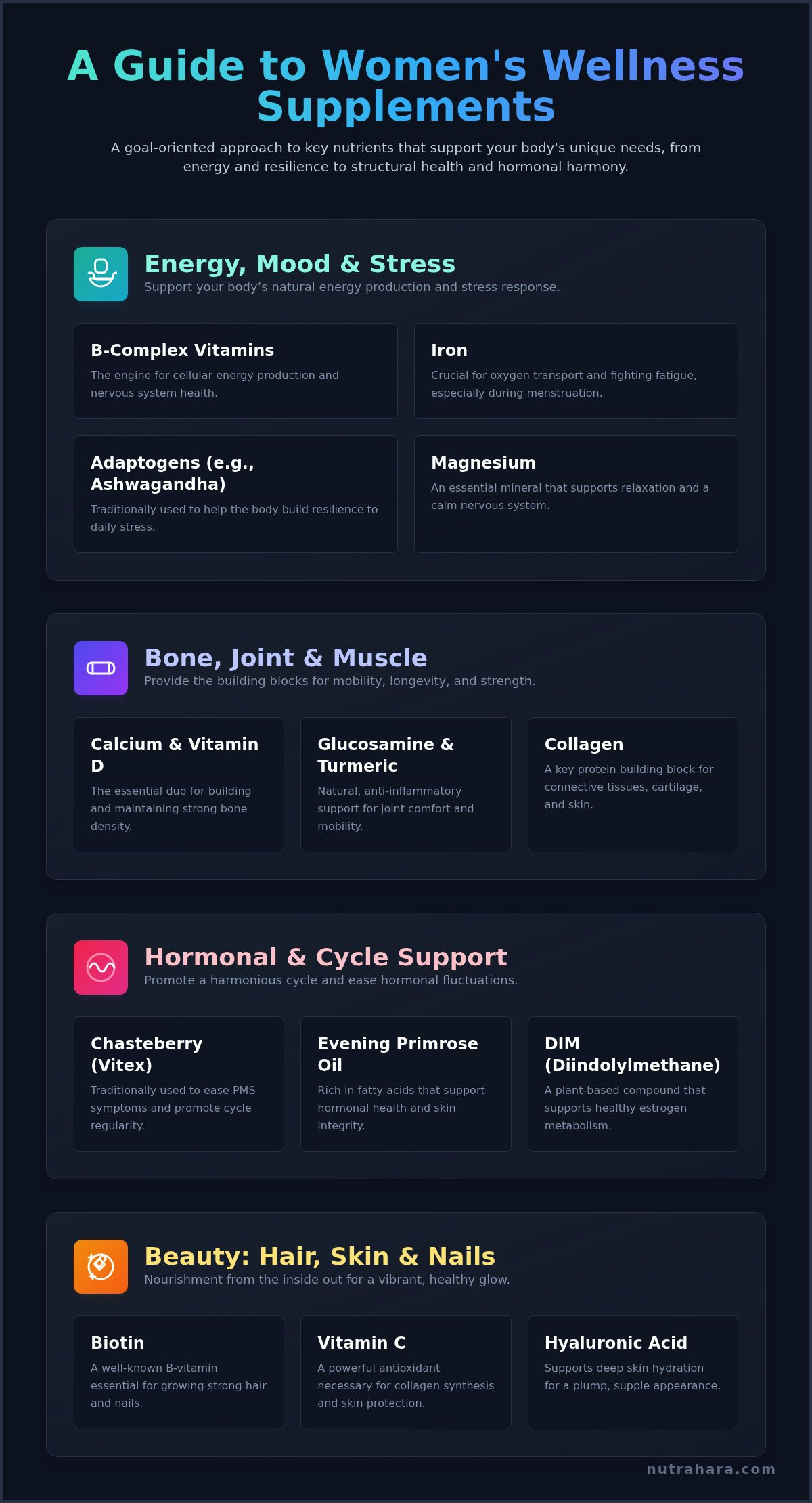
Navigating the world of women’s wellness supplements can feel overwhelming, but a goal-oriented approach brings clarity to your personal wellness journey. To help you make empowered choices, we’ve grouped key nutrients by the health goals they support. Understanding the research behind these ingredients is a crucial first step, and expert resources for evaluating common dietary supplements can provide a strong foundation. Let’s explore the core categories that address women’s unique needs.

Energy, Mood, and Stress Support

Modern life demands resilience. Supporting your body’s natural energy production and stress response system is foundational to a balanced lifestyle. These clinically-studied nutrients and time-honored botanicals work synergistically to help you feel calm, centered, and revitalized from within.

  • B-Complex Vitamins: The engine for cellular energy production and nervous system health.
  • Iron: Crucial for oxygen transport and fighting fatigue, especially during menstruation.
  • Adaptogens (e.g., Ashwagandha): Traditionally used in Ayurveda to help the body build resilience to daily stress.
  • Magnesium: An essential mineral that supports relaxation and a calm nervous system.

Bone, Joint, and Muscle Health

A strong, flexible body is the vessel for a vibrant life. Maintaining the health of your structural system is essential for mobility and longevity. These foundational nutrients provide the building blocks your body needs to stay active and move with comfort and ease through every stage of life.

  • Calcium & Vitamin D: The essential duo for building and maintaining strong bone density.
  • Glucosamine & Turmeric: Natural, anti-inflammatory support for joint comfort and mobility.
  • Collagen: A key protein that serves as a building block for connective tissues, cartilage, and skin.

Hormonal Balance and Cycle Support

A woman’s body moves in beautiful, natural rhythms. Supporting your endocrine system can help promote a more harmonious menstrual cycle and ease discomforts associated with hormonal fluctuations. These gentle botanicals are rooted in traditional wisdom to support your body’s innate balance.

  • Chasteberry (Vitex): Traditionally used to ease PMS symptoms and promote cycle regularity.
  • Evening Primrose Oil: Rich in fatty acids that support hormonal health and skin integrity.
  • DIM (Diindolylmethane): A plant-based compound that supports healthy estrogen metabolism.

Beauty from Within: Hair, Skin, and Nails

True radiance begins with nourishment from the inside out. Your hair, skin, and nails are often a direct reflection of your internal health. Providing your body with specific vitamins and compounds for cellular repair and hydration can unlock a vibrant, healthy glow.

  • Biotin: A well-known B-vitamin essential for growing strong hair and nails.
  • Vitamin C: A powerful antioxidant necessary for collagen synthesis and skin protection.
  • Hyaluronic Acid: Supports deep skin hydration for a plump, supple appearance.

A woman’s body is in a constant state of beautiful evolution, and her nutritional needs shift with each new decade. Your wellness journey is uniquely yours, and the women’s wellness supplements that support you should reflect your specific life stage. By understanding these changing requirements, you can proactively nurture your body and mind. Scientific reviews on Nutritional Ingredients to Support Health and Wellness confirm that targeted supplementation is a key strategy for thriving through every chapter of life. This personalized approach empowers you to find precisely what you need, right when you need it.

In Your 20s and 30s: Building a Strong Foundation

These decades are about building a resilient foundation for lifelong health. Your lifestyle is often busy and demanding, so focusing on core nutrients is essential for energy, hormonal balance, and future well-being. Key priorities include:

  • A Quality Multivitamin: To fill any nutritional gaps in a hectic schedule.
  • Iron: To support energy levels and replenish stores lost during menstruation.
  • Folate (Folic Acid): Crucial for reproductive health, whether you are planning a family or not.

In Your 40s: Navigating Perimenopause

As your body begins the natural transition toward menopause, you may notice changes in your cycle, mood, and energy. This is a time to offer your system gentle, targeted support to manage hormonal fluctuations and protect long-term health. Consider focusing on:

  • Bone Density Support: Proactively support your skeletal system with Calcium and Vitamin D.
  • Mood & Sleep: Magnesium can help calm the nervous system, support restful sleep, and ease mood swings.
  • Metabolism & Energy: Address changes in energy with B-vitamins and CoQ10.

In Your 50s and Beyond: Embracing Menopause with Grace

Post-menopause brings a new sense of freedom and wisdom. Supporting your body during this stage is about maintaining strength, vitality, and comfort. The focus shifts to protecting bone, heart, and joint health for an active and vibrant future. Essential supplements include:

  • Comprehensive Bone Health: The trio of Calcium, Vitamin D3, and Vitamin K2 work synergistically to direct calcium to your bones.
  • Cardiovascular Support: Heart-healthy Omega-3 fatty acids support healthy cholesterol and circulation.
  • Joint & Tissue Comfort: Address concerns like joint stiffness and vaginal dryness with targeted botanicals and hydration support.

Your path to well-being is a personal one, grounded in the wisdom of your own body. Find supplements tailored for your life stage.

How to Choose High-Quality Supplements: A Smart Buyer’s Checklist

Your wellness journey is a deeply personal path, and choosing the right support is paramount. The market for women’s wellness supplements can feel overwhelming, but not all products are created with the same integrity. Becoming a discerning consumer is the most empowering step you can take for your health. This simple checklist, grounded in our ethos of transparency and purity, will help you select safe and effective supplements with confidence.

Decoding the Supplement Label

The “Supplement Facts” panel is your window into a product’s true quality. Look past the front-of-bottle claims and learn to read the fine print. A clean, transparent label is the first sign of a trustworthy brand.

  • Active Ingredients: Look for specific, bioavailable forms of nutrients that your body can easily absorb and utilize, such as folate as L-methylfolate instead of synthetic folic acid.
  • “Other Ingredients”: A shorter list is often better. Scan for unnecessary fillers, binders, artificial colors, or common allergens that don’t contribute to your well-being.
  • Serving Size and Daily Value (%DV): Pay close attention to the serving size to ensure you are taking the correct amount to meet the nutritional values listed.

The Importance of Purity, Potency, and Testing

Reputable brands voluntarily seek third-party verification to guarantee their products are safe and potent. This commitment to external review is a non-negotiable sign of quality. Look for these seals of approval to ensure what’s on the label is exactly what’s in the bottle.

  • Third-Party Testing: Certifications from organizations like NSF or USP confirm that a product contains the ingredients it claims and is free from harmful contaminants.
  • GMP Certified: This seal ensures the supplement was manufactured in a facility following Good Manufacturing Practices, a system of strict quality control.

Red Flags to Watch Out For

A truly beneficial supplement doesn’t need to hide behind confusing language or impossible promises. Be wary of these common red flags:

  • Proprietary Blends: These formulas hide the exact amount of each ingredient, making it impossible to know if you are getting a clinically effective dose. Transparency is key.
  • Exaggerated Claims: Be skeptical of products that promise a “miracle cure” or instant results. True health is a gradual, holistic journey.
  • Excessive Additives: High-quality women’s wellness supplements do not need artificial sweeteners, dyes, or flavors to be effective.

By applying these principles, you can confidently select pure, potent supplements that truly align with your health goals. At Nutrahara, we believe this transparency is the foundation of a trusted wellness partnership.

The Ultimate Guide to Women's Wellness Supplements

The Nutrahara Approach: Ancient Wisdom Meets Modern Science

Your wellness journey is deeply personal, and the supplements you choose should honor that. At Nutrahara, we believe the most effective path to well-being is found where ancient wisdom and modern science converge. Our philosophy is built on a foundation of trust, transparency, and a profound respect for nature’s intelligence. We formulate our women’s wellness supplements not just to address symptoms, but to nurture a state of holistic balance, empowering you to feel your best from the inside out.

What is Ayurveda? A Holistic View of Health

Ayurveda is a 5,000-year-old system of natural healing originating from India, often called the “science of life.” Its core principle is achieving harmony between the body, mind, and spirit. Rather than a one-size-fits-all approach, Ayurveda uses powerful botanicals and time-tested herbs to provide targeted support, gently guiding your body back to its natural state of equilibrium and vitality.

We honor this ancient tradition by grounding our formulas in its wisdom. But we also recognize that in today’s world, trust is built on evidence. That is why every ingredient we select must also meet the rigorous standards of modern scientific validation.

Our Commitment to Clean, Clinically-Studied Ingredients

Our promise is simple: to bridge the gap between tradition and research. We meticulously select natural ingredients that are not only revered in Ayurveda but are also backed by clinical studies for their safety and efficacy. This dual-validation process ensures that every Nutrahara formula is both pure and potent. Our commitment to “clean and simple” means you will never find unnecessary fillers or artificial additives-only the targeted support your body deserves.

This unique fusion of time-honored knowledge and cutting-edge research is the Nutrahara difference. We are more than a supplement company; we are your partner in cultivating a balanced, vibrant life. We invite you to experience a new standard in natural health.

Discover the Nutrahara difference and start your journey.

Embrace Your Wellness Journey with Confidence

Your path to vibrant health is deeply personal. As we’ve explored, a woman’s nutritional needs are unique and shift beautifully through every life stage, from menstruation to menopause and beyond. Understanding this foundation and learning how to choose pure, effective formulas are the most empowering steps you can take toward lasting well-being.

This is where ancient wisdom meets modern clarity. At Nutrahara, we bridge this gap, honoring your body’s innate intelligence. Backed by 40 years of formulation expertise, we meticulously combine the holistic principles of Ayurveda with cutting-edge nutritional science. Our commitment is to create clean, simple, and natural women’s wellness supplements that provide targeted support you can trust on your path to balance and vitality.

Begin your wellness journey with our expertly formulated supplements.

Remember, your well-being is a beautiful, ongoing journey. Taking the next intentional step with a trusted partner is a powerful act of self-care and nourishment.

Frequently Asked Questions

How long does it take for women’s wellness supplements to work?

The timeline for experiencing benefits varies. While some individuals may notice subtle changes within a few weeks, it typically takes 4 to 12 weeks of consistent use for nutrient levels to build up and create noticeable effects. Factors like your individual metabolism, diet, and the specific formula all play a role. Patience is a key part of any wellness journey; consistency is what allows these natural ingredients to support your body’s balance and long-term well-being.

Is it safe to take multiple supplements at the same time?

Combining multiple supplements can be beneficial, but it requires a thoughtful approach. Many nutrients work synergistically, meaning they enhance each other’s effects. However, some can compete for absorption or be taken in excess. We recommend consulting a healthcare professional to help you create a safe and effective regimen tailored to your unique needs, ensuring your body receives a harmonious blend of support without being overwhelmed on its wellness journey.

Should I talk to my doctor before starting a new supplement regimen?

Absolutely. We always recommend speaking with your doctor or a qualified healthcare provider before beginning any new supplement routine. Your doctor understands your personal health history and can run tests to identify specific nutrient deficiencies. They can also ensure that new supplements will not interact with any medications you may be taking. This collaborative approach is the safest and most effective way to support your body’s unique needs and well-being.

What is the difference between whole-food supplements and synthetic vitamins?

Whole-food supplements are derived from concentrated whole foods, retaining the natural co-factors that help your body recognize and absorb nutrients. Synthetic vitamins are isolated nutrients created in a laboratory. While effective for specific deficiencies, they lack the holistic synergy of whole-food sources. Our philosophy, which bridges ancient wisdom and modern research, honors the complex intelligence of nature by prioritizing ingredients that work in harmony with your body.

Are more expensive supplements always better quality?

A higher price doesn’t automatically guarantee better quality, but it can often reflect superior sourcing, purity, and scientific validation. Premium supplements may invest in third-party testing to verify potency and the absence of contaminants, or utilize clinically studied ingredients. Instead of focusing on price alone, look for transparency from the brand regarding their sourcing and quality certifications. These are the true markers of a trustworthy and effective product.

Can I get all the nutrients I need from my diet alone?

A nutrient-rich, balanced diet is the cornerstone of good health. However, modern farming practices, soil depletion, and lifestyle demands can make it challenging to get everything from food alone. High-quality women’s wellness supplements are formulated to bridge these potential nutritional gaps. They provide targeted, holistic support for specific health goals, acting as a valuable partner to your diet to help you achieve optimal vitality and well-being. If you’ve ever wondered whether digestive enzymes help you lose weight by improving nutrient absorption and metabolic efficiency, exploring their role alongside a balanced diet may offer valuable insights for your wellness journey.

Article by

Nutrahara Team

We are a dedicated collective of nutrition scientists and naturopaths at Nutrahara, committed to advancing women's health through the fusion of ancient Ayurveda science and cutting-edge nutrition research. Our mission is to empower you with clean, simple, and scientifically validated wellness solutions so you can live your healthiest life. Connect with us to stay updated on the latest developments in holistic women's health and nature-based research.

Disclaimer

This article is not a substitute for medical advice. Please consult a healthcare professional before starting any supplement, especially if pregnant, nursing, taking medication, or managing health conditions.