
What if the word “probiotic” tells you less than the strain, the study, and the health question behind it? It’s understandable to consider probiotics for vaginal health when wellness claims conflict and symptoms are uncomfortable or hard to discuss. But a supplement’s promise isn’t proof, and vaginal symptoms can have different causes.
The evidence is nuanced. Research explores specific strains and outcomes, but it doesn’t establish that every supplement can prevent or treat vaginal conditions. This guide explains what studies can and can’t show, why strain and context matter, and when symptoms call for clinical evaluation instead of self-treatment. You’ll also find gentle ways to support overall wellbeing, including movement, yoga, and mindfulness, while making informed choices for your health and life stage.
Probiotics are live microorganisms that may provide a health benefit when used in a suitable amount, but their effects depend on the specific strain and the outcome being studied. That means “probiotic” on a label isn’t proof that a product will benefit the vagina. Research on one strain or formulation can’t automatically be applied to every supplement.
The vaginal microbiome is the community of microorganisms living in and around the vagina. It is distinct from the gut microbiome, even though some probiotics are taken by mouth and researchers study how they may relate to vaginal bacteria. Evidence about digestive health alone doesn’t establish a vaginal benefit. A probiotic supplement also can’t diagnose or treat an infection. Symptoms need appropriate clinical evaluation.
Lactobacillus species are commonly discussed in vaginal-microbiome research. These bacteria are associated with vaginal environments, but a person’s microbiome can vary, including across menstrual cycles and life stages such as pregnancy or menopause. Learn more about Lactobacillus in the vaginal microbiota. A microbiome test offers a snapshot, not a complete assessment of someone’s health or an explanation for every symptom.
Strain names matter. Two probiotics may contain bacteria from the same species but different strains, and findings about one strain don’t prove that another works the same way. Look for research that matches the product’s strain and intended outcome, rather than relying on broad claims about “women’s health.”
Route matters, too. Oral probiotics are swallowed; products designed for vaginal use are a different formulation and aren’t interchangeable. Studies of one route don’t automatically support claims for the other. Neither route should replace evaluation or established care when symptoms suggest infection.
Vaginal pH is one part of the picture, not a stand-alone measure of vaginal health. It can vary, and a pH result alone can’t identify the cause of symptoms. For foundational context, a vaginal pH balance guide can help explain what pH does and why it shouldn’t be used to self-diagnose. A clear, strain-specific claim is more informative than a promise to “balance” the entire microbiome.
The evidence is not a blanket endorsement of probiotics. Results depend on the strain, who took part in a study, whether the probiotic was oral or vaginal, and what researchers measured. A finding about bacterial vaginosis (BV) recurrence, for example, doesn’t establish a benefit for yeast infections or everyday vaginal wellness.
A 2025 systematic review of 16 trials identified Lactobacillus rhamnosus TOM 22.8 among the strains studied for vaginal pH, microbiota composition, and BV recurrence. The review reported a promising regimen, but its findings apply to that strain and research context, not to probiotics generally. A separate clinical trial of vaginally delivered Lactobacillus crispatus CTV-05, known as Lactin-V, examined recurrence after standard antibiotic treatment and reported lower recurrence than placebo.
These studies explore specific approaches, often alongside or after standard care. They don’t show that a supplement can replace evaluation or prescribed treatment for active BV. The American College of Obstetricians and Gynecologists’ Practice Bulletin No. 215, published in 2019, states that probiotics aren’t recommended to treat or prevent vaginitis, including BV. Differences in strains, delivery, study populations, and protocols also limit how confidently results can be applied to other products.
Yeast infections involve Candida, commonly Candida albicans, rather than the bacterial imbalance studied in BV research. Findings about a probiotic’s effect on BV therefore can’t be used to claim it prevents or cures yeast infections. Evidence for probiotics as a reliable yeast-infection treatment or preventive approach remains insufficient to support that promise. If symptoms are new, persistent, or recurring, seek clinical evaluation rather than trying to identify the cause with a supplement.
In brief: Research offers strain-specific signals, particularly around BV recurrence and use alongside standard care, but it doesn’t establish that probiotics for vaginal health broadly prevent or treat infections. For context on vaginal pH, see the vaginal health and pH balance guide. Remember that pH alone can’t diagnose the cause of symptoms.
A confident label can sound persuasive, but a useful claim should be traceable to research on the same strain, formulation, route, and intended outcome. A study result is evidence to consider, not a promise that you’ll get the same result. This distinction matters because vaginal odor, discharge, irritation, and pH can change for different reasons. A probiotic can’t correct every change or identify its cause.
Strain-specific evidence matters more than a broad probiotic claim because research findings apply to the exact microbes, product format, and outcome studied, not automatically to a whole category. Use this framework to assess claims about probiotics for vaginal health:
| What to check | What to look for | Evidence limit |
|---|---|---|
| Strain | Is the full strain name given, not just the species? | Another strain of the same species may not have the same effect. |
| Outcome | Did the study assess BV recurrence, symptoms, or another specific measure? | One measured outcome doesn’t prove broad vaginal-health benefits. |
| Population | Who took part, and does the group resemble your life stage or circumstances? | Findings may not apply equally across pregnancy, menopause, or other contexts. |
| Formulation and route | Was the studied product oral or intended for vaginal use? | A study of one product or route doesn’t validate another. |
Before trusting a claim, look for the study it cites and ask: Which exact strain was studied? What outcome did researchers measure? Who participated, and how was the probiotic used? Then compare those details with the product claim. A result from a defined study group can inform your understanding, but it can’t guarantee an individual response.
Be cautious if a claim promises to “balance” the microbiome, eliminate odor, or normalize pH without explaining what was measured. A pH reading alone can’t diagnose the cause of symptoms, and a broad promise doesn’t establish prevention or treatment of infection.
Unusual or persistent odor or discharge, irritation, and pain can have several causes that need different care. Seek clinical evaluation if symptoms are persistent, recurring, severe, or concerning. If you’re pregnant and develop symptoms, or have fever or pelvic pain, contact a healthcare professional promptly. Supplements shouldn’t delay assessment or replace care for a suspected infection.
Wellbeing is built through steady, sustainable choices, not a perfect routine. Everyday habits can support how you feel overall, but they shouldn’t be treated as ways to prevent or cure vaginal infections. Choose comfortable clothing and gentle external cleansing that suits you, and avoid products that cause irritation. Vaginal symptoms aren’t a sign that you’ve failed to keep yourself clean.
Choose habits that fit your energy, schedule, and body. A walk, stretching, or another comfortable form of movement can help you stay active. Drink fluids according to your needs, and make room for rest when possible. Yoga or meditation may offer a calming pause, but neither is a treatment for vaginal symptoms.
Try a brief reset: sit comfortably, relax your shoulders, and take a few slow, unforced breaths. If a pose or movement feels uncomfortable, skip it. You can also keep a private note of symptoms, when they occur, and any changes you notice. That record may help you describe concerns clearly during a clinical conversation.
Menstruation, pregnancy, lactation, and menopause can bring different questions about body changes and supplement use. There’s no single routine that fits every woman. If you’re pregnant or lactating, take medication, or have a health condition, discuss supplements with a qualified healthcare professional before starting them. This can help you consider the specific product and your personal circumstances.
Changes in discharge, comfort, or other symptoms can feel personal, but they’re valid reasons to seek guidance. You don’t need to diagnose yourself or blame your hygiene habits. Note what you’ve noticed and ask a healthcare professional about appropriate next steps. A steady wellness practice can include informed choices and support when you need it.
For a research-informed perspective on women’s wellness, explore Nutrahara’s approach to women’s health.
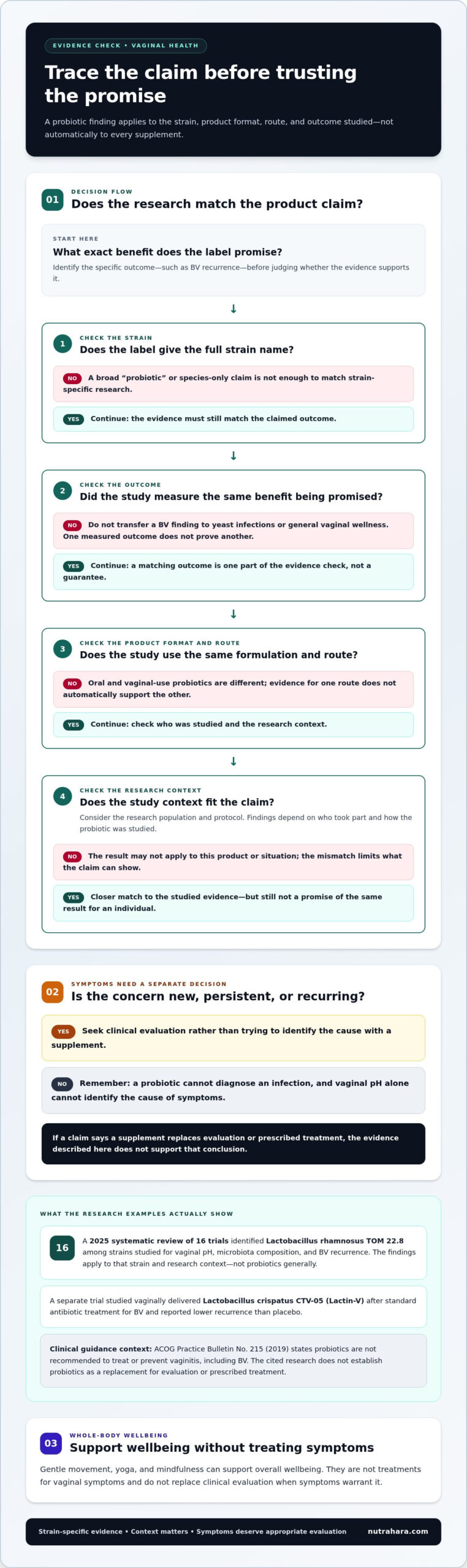
The clearest takeaway is simple: probiotic evidence is strain-specific, and no supplement should be used to self-diagnose an infection. Research on a particular strain or outcome doesn’t establish that every product will help, or that a change in odor, discharge, or comfort has the same cause for every woman.
Use this short sequence to turn uncertainty into a practical plan:
General wellness learning can help you ask informed questions, but it isn’t a substitute for care when symptoms are active or keep returning. For broader supplement-literacy context, a women’s wellness supplements guide can help you think through evidence and product claims beyond probiotics for vaginal health. If you’re pregnant or lactating, take medication, or have a health condition, discuss supplement use with a qualified healthcare professional.
It’s reasonable to ask questions about intimate health. You don’t need to feel embarrassed or blame yourself for symptoms. If you speak with a healthcare professional, share what you’ve noticed, whether symptoms have recurred, and any supplements or medications you use. Pregnancy, lactation, and other health circumstances are useful context for that conversation.
Nutrahara brings Ayurvedic principles into conversation with modern nutritional research as part of a broader perspective on women’s wellness, not as a treatment for vaginal symptoms. Let curiosity guide your next step while keeping evidence and appropriate care in view.
Explore Nutrahara’s holistic wellness approach.
Research on probiotics for vaginal health depends on the specific strain, how it’s used, and the outcome studied. A promising finding for one formulation doesn’t prove that every probiotic can prevent or treat vaginal symptoms. Read claims with care, and don’t use supplements to self-diagnose. Persistent, recurring, or concerning symptoms deserve clinical evaluation.
Keep your next step simple: note what you’ve noticed, look for evidence that matches a product’s exact strain and intended benefit, and seek professional guidance when symptoms or personal circumstances call for it. Your questions are a practical part of caring for your health, whatever life stage you’re in.
Nutrahara brings Ayurvedic principles together with modern nutritional research, with a focus on women’s health supplements and natural, clean ingredients. Explore that broader approach to wellness at your own pace.
Explore Nutrahara’s women’s wellness supplements and continue building confidence in the choices that support your wellbeing.
Some specific probiotic strains are being studied for particular vaginal-health outcomes, especially in relation to bacterial vaginosis (BV). That doesn’t mean all probiotics for vaginal health have the same effects, or that supplements can resolve every symptom. Research findings depend on the strain, formulation, route, and outcome measured. If you have symptoms, don’t use a supplement to diagnose their cause or as a substitute for appropriate clinical care.
No. The American College of Obstetricians and Gynecologists’ Practice Bulletin No. 215 states that probiotics aren’t recommended to treat or prevent vaginitis, including BV. Researchers have studied certain strains as additions to or after standard treatment, including for recurrence, but those findings don’t establish probiotics as a replacement for evaluation or prescribed care. If BV is suspected or symptoms return, seek clinical advice about appropriate treatment.
Probiotics haven’t been established as a reliable way to prevent or cure yeast infections. Yeast infections involve Candida, while much vaginal-probiotic research focuses on bacterial vaginosis, so findings about BV can’t be assumed to apply to yeast. Itching, irritation, or discharge can have different causes. If symptoms are new, persistent, or recurring, seek clinical evaluation instead of relying on a supplement to identify or treat them.
There isn’t one established timeframe for probiotics to affect vaginal health. Studies examine different strains, routes, populations, and outcomes, so results from one trial can’t predict when or whether a particular person will notice a change. Don’t use a lack of improvement as a reason to keep self-treating symptoms. If you’re concerned or symptoms persist or recur, arrange clinical evaluation rather than waiting for a supplement to work.
No. Oral probiotics are swallowed, while vaginal probiotics are formulated for vaginal use. They differ in route, and research on one type doesn’t automatically show that the other has the same effects. Check whether a study matches the product’s exact strain and route, and don’t assume a general probiotic label establishes vaginal benefit. Don’t use either type instead of clinical evaluation or treatment for suspected infection.
Ask a qualified healthcare professional before starting a probiotic while pregnant or breastfeeding. The appropriate advice can depend on your health, the product’s specific strains and ingredients, and your individual circumstances. Share the product label and mention any medications or health conditions, so you can discuss whether it’s suitable for you. If you have vaginal symptoms during pregnancy or while breastfeeding, seek professional advice rather than self-treating.
This article is not a substitute for medical advice. Please consult a healthcare professional before starting any supplement, especially if pregnant, nursing, taking medication, or managing health conditions.