
What if stopping your multivitamin doesn’t make you feel different at all? It’s natural to wonder what happens when you stop taking multivitamins, especially if you’ve used one for years or your needs are changing through menstruation, pregnancy, breastfeeding, perimenopause, or menopause. In most cases, stopping a routine multivitamin doesn’t cause a withdrawal reaction. It does mean you’re no longer getting the nutrients it supplied.
Whether you notice a change depends on your usual diet, nutrient status, and reason for taking it. Your meals may already provide the nutrients in the supplement, while a diagnosed deficiency or specific need could make stopping more consequential. You don’t need to assume you’ll suddenly develop a deficiency, and not everyone needs to taper.
This guide explains what may change, why people’s experiences differ, and how to review a multivitamin alongside your diet and life stage. You’ll also learn when it may be helpful to discuss your needs with a healthcare professional, so your next step is informed and calm rather than driven by conflicting claims or guesswork.
What happens depends on why you took the multivitamin and what else contributes to your nutrient intake. If you started taking one to fill a dietary gap, stopping removes that supplement as a source of those nutrients. If your meals and other supplements provide them, the change to your overall intake may be small. If it was part of a plan to address a diagnosed deficiency or a particular life-stage need, give that original reason careful consideration. The answer to “what happens when you stop taking multivitamins” is personal, not automatic.
In brief: stopping a multivitamin removes its contribution to your nutrient intake. What you notice depends on the rest of your diet and your individual needs. Missing one dose is different from stopping for the long term. One missed day doesn’t erase the nutrients you’ve eaten or establish that your nutrient status has changed. A sustained break means the supplement no longer contributes to your regular intake.
A routine multivitamin isn’t generally expected to cause a universal withdrawal syndrome when you stop taking it. Feeling tired, foggy, or different after a pause doesn’t prove that withdrawal is the cause. These symptoms can have many explanations, and a multivitamin alone can’t identify them. Formulas vary, so check your own label to see what your supplement provided. The Multivitamin overview describes the category broadly, but the product label is more useful for understanding your specific formula.
It’s also important to distinguish an ordinary multivitamin from supplements with different ingredients or purposes, and from prescribed treatments. They aren’t interchangeable, so the experience of stopping one type shouldn’t be assumed to apply to another. If your multivitamin was recommended as part of care for a specific need, consider that reason before deciding what to do next.
The immediate change is straightforward: the supplement no longer contributes nutrients to your intake. That doesn’t mean your body has suddenly lost every nutrient in the formula. Foods, fortified foods, and other supplements may still supply some or all of them. For example, if the multivitamin provided a nutrient you also get from fortified foods or a varied diet, those sources remain after you stop taking it.
There isn’t one timeline for noticing an effect, and feeling no difference doesn’t prove that stopping is right for everyone. Instead, note what you stopped, why you started, and whether anything else in your routine changed. If you’re unsure what the supplement contained, read the label rather than guessing. This gives you a practical starting point for reviewing your decision without treating one missed dose or a nonspecific symptom as a verdict.
A multivitamin is one source of nutrients, not a complete picture of your nutrient status. Your usual meals, fortified foods, other supplements, digestion and absorption, and any existing deficiency all shape what your body receives. That’s why what happens when you stop taking multivitamins can’t be predicted from the supplement alone. The same change can affect two people differently because their diets, health circumstances, and starting nutrient levels differ.
If your regular diet supplies the nutrients in your multivitamin, stopping it may make little difference to your overall intake. If your eating pattern leaves a particular gap, removing the supplement could matter more. Vitamin B12, folate, iron, and vitamin D may be worth considering as part of a broader intake review, but their presence on this list doesn’t mean you have a deficiency.
A multivitamin label tells you what the product contains, not whether you personally need those nutrients or have absorbed enough. Health factors can affect absorption, and a deficiency can’t be confirmed just by looking at your supplement routine or how you feel. Johns Hopkins Medicine offers a broader discussion in its review of multivitamin benefits.
For a practical snapshot, think about a typical week of meals rather than judging your diet from one day. Include fortified foods and any other supplements in your review. This can help you identify questions to discuss with a healthcare professional, particularly if you started taking a multivitamin for a specific reason.
Nutrients are handled differently by the body. Water-soluble vitamins, such as vitamin C and many B vitamins, generally aren’t stored in the same way as fat-soluble vitamins A, D, E, and K, which can be stored in the body. But these broad categories don’t provide a personal countdown for what you’ll feel after stopping a multivitamin.
A multivitamin contains a combination of nutrients, and your intake from food, existing stores, and individual circumstances all matter. Information about stopping a single nutrient or a different kind of supplement can’t automatically be applied to multivitamins. There’s no reliable day-by-day or week-by-week schedule that fits everyone. A change in energy or mood on its own doesn’t identify the cause.
Keep your review straightforward: check the multivitamin label, consider what you eat and any other supplements, and remember why you began taking it. If you’re exploring women’s health supplements as part of that review, you can browse Nutrahara’s women’s health supplements. Use this as one resource, without assuming a supplement is necessary or a substitute for individualized advice.
The word “withdrawal” can make stopping a routine multivitamin sound like stopping a medicine that causes a predictable reaction. That isn’t an established expectation for standard multivitamins. The clearer distinction is between a change in nutrient intake and symptoms that may have another explanation. The points below separate common claims from what can reasonably be concluded.
Claim: Everyone has an energy crash after stopping. Context: There’s no basis to expect this in everyone. Tiredness has many possible causes.
Claim: Any symptom after stopping is withdrawal. Context: A symptom may have another cause, including the issue that led someone to take a supplement in the first place.
Claim: A multivitamin must be tapered. Context: There’s no established universal taper schedule for routine multivitamins.
Claim: Everyone will notice a change on a set schedule. Context: There’s no exact symptom timeline that applies to every person.
In other words, what happens when you stop taking multivitamins isn’t a guaranteed “crash.” If a symptom you had before taking one seems to return, that may point back to the original reason for supplementation, but it doesn’t confirm the cause. A change in how you feel is worth noticing, not treating as a diagnosis by itself.
You may feel tired after stopping, but timing alone can’t show that the multivitamin caused the change. Sleep, stress, a demanding exercise routine, illness, diet, and many other factors can affect energy. If you had a nutrient concern identified before starting the supplement, consider that separately rather than assuming fatigue is withdrawal. Persistent or concerning tiredness is worth discussing with a healthcare professional.
There’s no established universal taper schedule for routine multivitamins, so an exact step-down plan shouldn’t be treated as necessary for everyone. This applies to ordinary multivitamins, not every product sold as a supplement. Products with different ingredients or purposes may have different considerations. If a clinician recommended your multivitamin for a specific reason, ask them for individualized guidance before changing that plan.
For perspective, briefly note when you stopped and any changes you’ve noticed, along with other shifts in your routine. This can help you describe the situation clearly if you seek advice. Avoid attributing every fluctuation in mood or energy to the supplement, and don’t follow a precise timeline or taper schedule unless it’s appropriate to your circumstances.
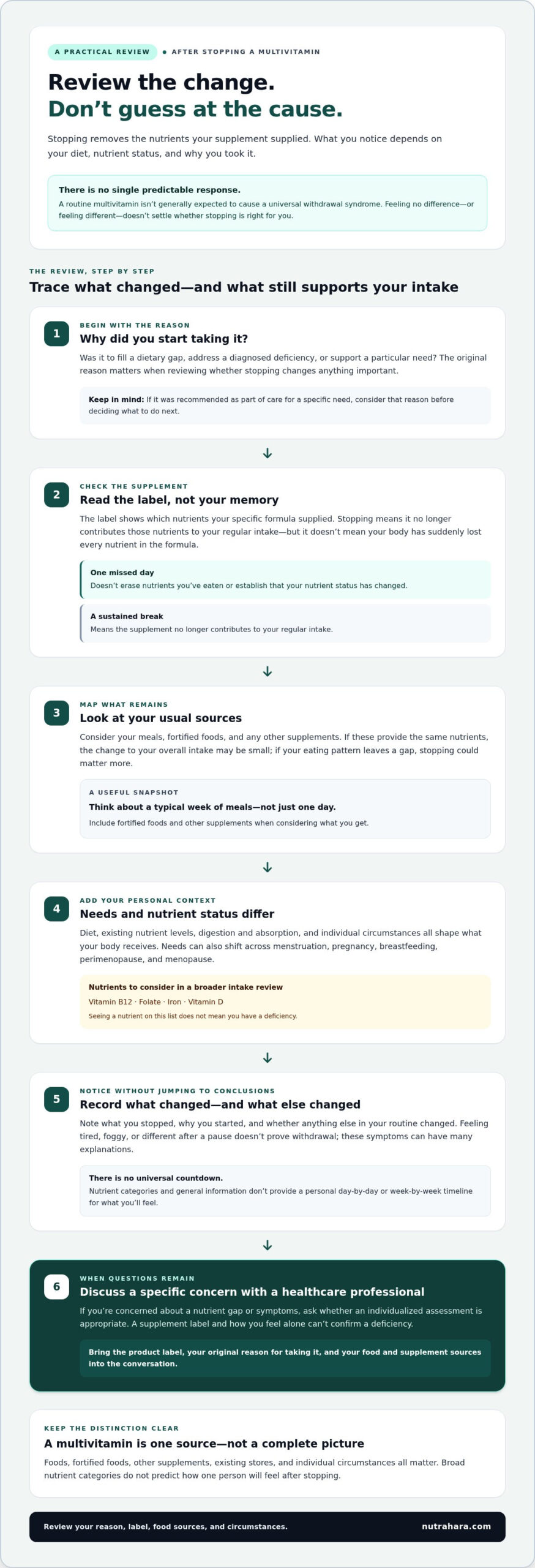
Use a calm, practical review rather than guessing from one day’s energy or mood. To make sense of what happens when you stop taking multivitamins, trace your original reason for taking one, consider what you get from food and other supplements, and note any meaningful changes. This isn’t about judging your routine. It’s a way to make your next choice with more confidence.
Ask yourself: “Was I taking this out of habit, or to address a specific need?” Then consider whether your diet, health, or other supplements have changed since you began. These questions can help you decide whether your original reason still applies, without assuming a multivitamin is essential or unnecessary for everyone. For a broader framework, Nutrahara’s guide, The Ultimate Guide to Women’s Wellness Supplements, can support your reading as you review your options.
Nutrition questions can shift through menstruation, pregnancy, lactation, perimenopause, and postmenopause. Those stages don’t create identical needs for every woman; personal health, diet, and any clinician-identified concern matter too. If you’re pregnant, breastfeeding, experiencing a change in your menstrual cycle, or moving through menopause, consider that context when reviewing why you started the supplement. If you’re taking it for a specific need or on a clinician’s advice, discuss any change with the clinician who advised you.
Support your overall wellbeing with steady, nourishing routines. A varied, balanced eating pattern, regular movement that suits your body, and practices such as yoga or meditation can help make space for physical and mental wellbeing. These are valuable parts of a healthy lifestyle, but they don’t replace a supplement recommended for a specific reason or confirm whether you’re meeting a particular nutrient need.
If you’d like to explore women’s wellness supplements as part of your ongoing review, explore Nutrahara’s women’s health supplements. Let what you’ve learned about your own routine guide the decision, rather than feeling pressured to add or restart a multivitamin.
Stopping changes what you get from the supplement, but its personal effects depend on why you used it, your usual diet, and any identified nutrient need. A useful next step is a calm review, not an automatic restart. To understand what happens when you stop taking multivitamins, revisit your original reason and consider what has changed in your life and routine since then.
If you’ve been diagnosed with a deficiency or a clinician recommended supplementation for a specific reason, get individualized guidance before changing that plan. This can also matter during pregnancy or lactation, when nutrition questions may be specific to your circumstances. You don’t need to assume harm or diagnose yourself. Bring the supplement label and your questions to the clinician who advised you.
Nutrition and wellbeing are shaped by everyday patterns, not one perfect meal or workout. Choose nourishing meals that fit your life, and make movement regular and realistic, such as a walk or a fitness session you enjoy. Yoga can bring mindful movement into your routine, while meditation offers a moment to pause and check in with yourself. These habits support general wellbeing, but they don’t replace advice for a specific nutrient need.
To make your notes useful, record a change alongside its context: for example, whether your sleep, meals, stress, menstrual cycle, or exercise routine also shifted. Look for patterns without assuming the multivitamin caused them. This gentle approach can help you have a clearer conversation with a clinician if questions persist, without the pressure to interpret every fluctuation.
Wellness is a continuing process of noticing, learning, and making choices that suit you. Nutrahara combines Ayurvedic principles with modern nutritional research, and its nutrition is made in New Zealand. If you’d like to explore this nature-informed approach as you reflect on your wellness routine, discover Nutrahara’s approach to women’s wellness. Your next step can be thoughtful and gradual, guided by your own needs rather than alarm or guesswork.
Your supplement routine doesn’t have to be permanent to be worthwhile. It can change as your meals, priorities, and life stage change. Rather than looking for a perfect rule, give yourself permission to make a considered choice, notice how you feel, and revisit it when your circumstances shift.
The question of what happens when you stop taking multivitamins can be a starting point for a more personal approach to wellbeing. Let curiosity guide you: notice what supports your energy and daily life, and seek tailored advice when you have a specific nutrition concern. Small, thoughtful decisions can build trust in your own judgment over time.
If you’re ready to explore a nature-informed approach to women’s wellness, explore Nutrahara’s women’s wellness supplements.
Stopping a routine multivitamin suddenly isn’t generally expected to cause a universal withdrawal reaction. Before deciding, consider why you began taking it and whether it was part of a care plan. If a clinician recommended it for a diagnosed deficiency or another specific concern, discuss a change with them. Having the product label handy can help you explain exactly what you’ve been taking.
Fatigue can’t be confidently attributed to stopping a multivitamin alone. Consider other recent changes, such as sleep, stress, illness, menstrual patterns, or exercise. If you’re concerned, note when the tiredness began and what else changed, then discuss the pattern with a healthcare professional if it persists. Symptoms alone can’t establish whether a particular nutrient is low.
There’s no single timeline that applies to everyone. Your food choices, the supplement’s ingredients, and your individual circumstances all matter. Some people notice no clear difference; others may need to revisit the reason they began taking it. Rather than relying on a specific day or week, keep a brief record of changes and consider other factors that could affect how you feel.
A universal taper schedule for routine multivitamins isn’t established. Don’t assume guidance about a supplement with different ingredients or a distinct purpose applies to your multivitamin. Check the label to understand the formula, especially if it includes ingredients beyond vitamins and minerals. If it was recommended for a specific health concern, get advice from the clinician who recommended it before changing your plan.
Missing a week doesn’t automatically mean you’ll feel different or develop a deficiency. Consider your usual diet and the reason the supplement is part of your routine. Don’t take extra doses to compensate unless the product directions or your clinician specifically advise it. If you take it for an identified concern, use the missed doses as a reminder to revisit your plan rather than making assumptions.
There isn’t one answer for every pregnant or breastfeeding woman. Individual circumstances and existing care plans matter, so don’t base your decision only on another person’s experience. Bring the product label and a list of other supplements you use to the clinician supporting your pregnancy or postpartum care. That helps keep the discussion focused on the specific formula and your needs.
Food can provide many nutrients, but whether your usual eating pattern meets your needs depends on your choices and health circumstances. To prepare for a useful review, jot down the foods and fortified products you typically have over several days. This isn’t a diagnosis, but it can help you discuss your intake with a healthcare professional, particularly if you have a known deficiency or a specific concern.
This article is not a substitute for medical advice. Please consult a healthcare professional before starting any supplement, especially if pregnant, nursing, taking medication, or managing health conditions.