
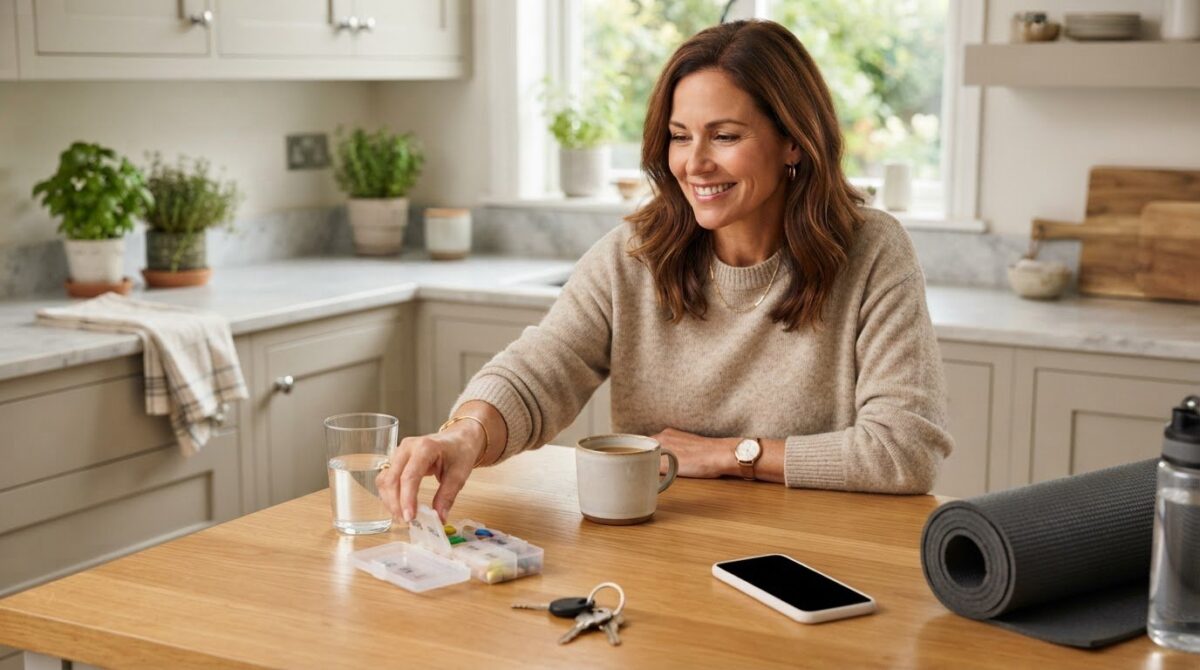
What if the reason your vitamin routine keeps slipping isn’t a lack of willpower, but a reminder that doesn’t fit your real day? Work, family, exercise, and changing mornings can make even a simple habit easy to miss. The most helpful tips for remembering to take vitamins start with a cue that works with your life, not a perfect schedule you have to maintain.
If you’ve forgotten a dose and then found it hard to get back on track, you’re not alone. A routine should be flexible enough to bend when the day changes and forgiving enough to restart after a missed day.
In this guide, you’ll learn how to connect vitamins to an existing habit, choose a reminder you’ll notice, and create a backup for busy or unusual days. You’ll also find simple ways to return to your routine without turning one missed reminder into a reason to give up. Small, repeatable cues can make consistency feel more natural.
Key Takeaways
- Make your vitamin habit easier to remember by attaching it to a steady part of your day.
- Compare alarms, calendar prompts, visual cues, and checklists to find a reminder that suits your routine.
- Use these tips for remembering to take vitamins to create a simple plan with a backup for busy days.
- Fit your reminder around real work, family, and fitness routines instead of aiming for a perfect schedule.
- Let yoga, meditation, or workout preparation become a supportive part of your wellness ritual.
Why is remembering to take vitamins harder than it seems?
Forgetting a vitamin doesn’t mean you lack discipline. Often, it means the routine hasn’t found a dependable place in your day yet. Familiar activities tend to follow recognizable cues, while a new task asks you to pause, remember it, and decide what to do. That extra step can get lost among messages, household needs, work deadlines, or the rush to leave home.
This is why useful tips for remembering to take vitamins focus on the routine around the task, not on blaming yourself. A missed day can offer useful information: perhaps the reminder was tied to a moment that changes often, or it competed with a more urgent responsibility. That’s a detail you can adjust, not a verdict on your motivation.
What makes a new daily habit easy to overlook?
A routine without a clear cue can be hard to recall at the right moment. You might plan to take a vitamin with breakfast, then rush out before eating. Or lunch may shift because of a meeting, so a reminder tied to that meal no longer fits. The intention may still be there, but the situation no longer prompts the action.
Habit overviews describe how cues can prompt a routine, which may then become associated with a familiar outcome. Exploring the science of habit formation can help explain why linking a task to a recognizable moment may be easier than relying on memory alone. Instead of asking, “Why can’t I remember?”, ask, “What was happening when I expected to remember?” That question points to a practical change, such as moving a reminder away from a rushed part of the morning.
How life-stage changes can affect everyday routines
A woman’s schedule may shift across menstruation, pregnancy, lactation, perimenopause, and menopause. Changes in sleep, energy, caregiving, appointments, or daily priorities can reshape the rhythm of a day. A routine that once felt steady may become less predictable when mornings start earlier, meals happen at different times, or evenings are devoted to family responsibilities.
Rather than expecting one fixed schedule to suit every woman, notice which parts of your day remain relatively steady in this season of life. Perhaps you prepare your bag before leaving, take a break after a workout, or wind down at home in the evening. The aim isn’t to make every day identical. It’s to find a realistic moment when a reminder can reach you.
Consistency doesn’t mean maintaining a flawless streak. It means returning to your routine after a disruption and adjusting the cue when it no longer fits. If you forget, take a moment to identify what interrupted the plan, then resume according to your normal routine and the product label. A flexible approach leaves room for real life and helps your habit evolve with you.
How can you connect vitamins to a habit you already have?
A simple cue can make a new routine easier to recall. Instead of asking yourself to remember at an arbitrary point in the day, connect the action to something you already do. Your cue might be breakfast, packing your work bag, or beginning your evening wind-down. Choose a moment that fits your actual schedule and the directions on the vitamin’s label.
Try a three-step approach: choose a stable cue, pair the routine with it, then review whether the pairing works. Give yourself room to adjust. If your mornings vary, an evening routine or another dependable moment may be a better fit. These tips for remembering to take vitamins are prompts to experiment, not rules you have to follow perfectly.
Use habit stacking to create a reliable cue
Habit stacking means pairing a new action with an everyday routine that’s already familiar. For example, you could use finishing breakfast or getting ready for the day as a prompt to follow your vitamin routine, as long as the cue fits the label directions. These examples describe a reminder strategy, not advice about when or how much to take.
Choose a cue you’re likely to encounter even on a busy day. If breakfast happens at different times, preparing your work bag might be more dependable. If evenings are calmer, your wind-down routine could be a better anchor. Keep the pairing clear: After I do this familiar activity, I’ll follow my usual vitamin routine.
Make the reminder visible and easy to act on
A reminder works best when it appears where the cue happens. Put a note near the place where you prepare breakfast, add a calendar prompt around your usual wind-down, or include the routine on a checklist you already use before leaving home. A cue that’s out of sight or buried among unrelated alerts is easy to miss.
To choose a reminder that works in practice, ask yourself:
- Is the cue steady? Pick an activity that happens regularly, even if the exact time shifts.
- Does the reminder fit the setting? A note may suit a kitchen routine, while a calendar prompt may work better around a changing workday.
- Can I act on it easily? Keep the reminder close to the moment and place where you’ll follow your established routine.
After trying the pairing, notice what gets in the way. Maybe you don’t eat breakfast at home, or an evening class changes when you arrive. Move the cue rather than blaming yourself. A short note about what worked can help you choose a more realistic prompt next time.
If you’re exploring women’s wellness supplements, Nutrahara’s nutrition is manufactured in New Zealand, with formulations that combine principles of Ayurvedic science and modern nutrition research. You can explore its vitamin B complex supplement while keeping your reminder routine personal and flexible.
Which vitamin reminder works best: alarms, calendars, or visual cues?
The best reminder isn’t necessarily the most sophisticated. It’s the one you notice at the right moment and can keep using without adding stress. A phone prompt may suit you if you check your device often; a note may work better if you respond to what you see around you. Match the tool to your day, then adjust it if your schedule changes.
Phone alarm
Context: You usually have your phone nearby when you plan to follow your routine. Convenience: It’s quick to set and easy to move. Possible friction: You may dismiss it or lose it among other alerts.
Calendar prompt
Context: Your routine fits a planned point in the day, or you already rely on a calendar. Convenience: You can shift the prompt when appointments change. Possible friction: It may be easy to overlook if you don’t check your calendar regularly.
Visible cue
Context: You notice objects and notes in the place where your routine happens. Convenience: It’s a simple, at-a-glance reminder. Possible friction: A note can blend into its surroundings or get moved.
Written checklist
Context: You already use a list to organize your morning, evening, or workout preparation. Convenience: It makes the routine easy to mark as complete. Possible friction: It only helps if you look at the list.
When a phone alarm or calendar reminder may help
Digital prompts can be useful if checking your phone or calendar is already part of your day. Choose a clear label and a realistic time that fits the product’s directions. If a meeting, school run, or workout shifts your schedule, move the prompt to a more workable moment rather than letting it become background noise.
When a visual cue or portable reminder may fit better
A written note or checklist can be a natural fit if you respond to your surroundings. Place it where you’ll see it as part of your usual routine. For days away from home, plan a portable reminder, such as a checklist on your phone or a note in your bag, and follow the label directions for the supplement you’ve chosen.
If you already take a vitamin B complex, you might use a calendar alert at home and a checklist when travelling. This is an example of choosing a reminder, not a recommendation that this supplement is right for everyone.
Try one tool first. If you keep missing its prompt, work out why: perhaps you silence alarms, skip calendar checks, or don’t see the note. Then choose a different cue. These tips for remembering to take vitamins are most useful when they fit your real routine, including days away from home.
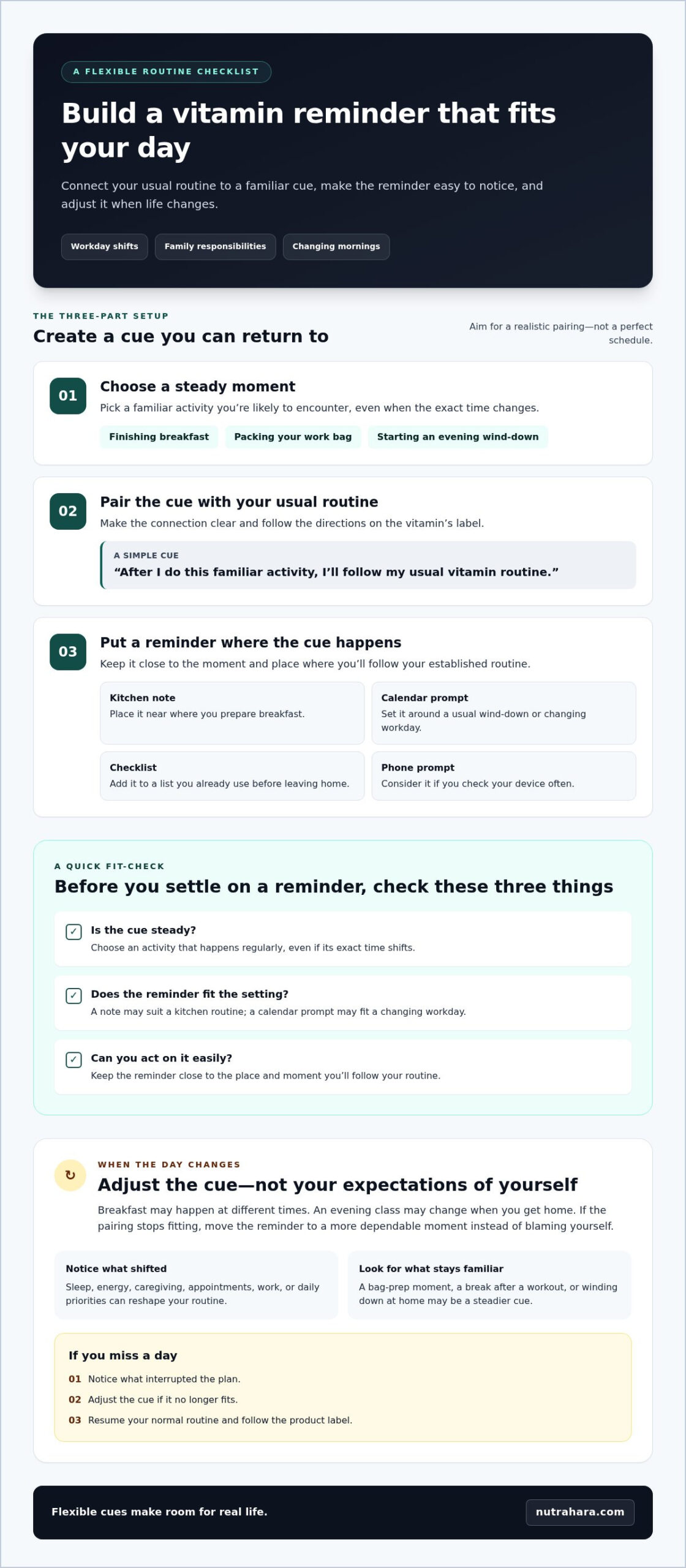
How to build a simple vitamin reminder plan for busy days
A reminder plan should be simple enough to keep using when work runs late, a workout moves, or home life needs your attention. Start with one cue for an ordinary day and one backup for times your usual routine is disrupted. A clear fallback is easier to return to than a string of alarms competing for your attention.
- Choose one main cue. Pick a regular moment that fits the label directions, such as a familiar part of your morning or evening routine.
- Set one reminder. Use a phone prompt, calendar entry, note, or checklist that you’ll notice at that moment.
- Prepare one backup. Decide what will prompt you if the usual cue isn’t available, such as a calendar reminder on a travel day or a checklist for a changed schedule.
Create a routine that can adapt to changing schedules
Test the plan against the week you really have, not an ideal version of it. If you exercise before work, consider whether your routine still fits on early workout days. If caregiving or changing shifts make mornings unpredictable, an evening cue may be steadier. For travel, decide in advance which portable reminder you’ll use while away from home.
Keep the system light. One main cue and one backup are often easier to remember than several prompts scattered through the day. If the routine becomes another source of pressure, simplify it. During a weekly review, ask: Did I notice the cue? Was it easy to act on? Did a particular day disrupt it? Keep what works and change only the part that doesn’t.
Reset gently after you forget
A missed day doesn’t require a new system or a perfect restart. Return to your next planned routine and follow the directions on the product label. Don’t add extra reminders as a form of punishment or change the serving instructions to compensate. If you’re unsure what to do after missing a dose, follow the product’s guidance or seek advice from an appropriate health professional.
Use the interruption as feedback. Perhaps the reminder arrived while you were commuting, or your usual cue shifted because of family responsibilities. Move the cue to a more realistic moment, then continue. Consistency grows from a plan that can bend and resume, not from expecting yourself never to have a busy day.
For a thoughtful, personal approach to wellness, you can explore Nutrahara’s women’s wellness supplements. Nutrahara’s nutrition is manufactured in New Zealand.
Make remembering vitamins part of a supportive wellness ritual
A reminder can support your wellbeing without becoming a measure of your willpower. Let it fit alongside practices that already feel meaningful, such as movement, rest, or a quiet pause. Your routine can be personal and flexible, shaped by the season of life you’re in rather than an idealized schedule.
Keep wellness practices encouraging, not all-or-nothing
Choose a small ritual that feels welcoming. You might unroll your yoga mat, take a few quiet breaths before meditation, or prepare for a workout. If it fits the product’s directions, that familiar moment can help cue your usual routine. Keep the ritual simple enough to adapt on full days. Returning after an interruption is part of caring for yourself, not a reason to judge your progress.
Explore supplement information at your own pace
If you’re considering women’s wellness supplements, take time to explore the information and decide what aligns with your approach. Nutrahara’s nutrition is manufactured in New Zealand, and its formulations combine Ayurvedic principles with modern nutrition research. The brand describes its products as clean and simple, without artificial additives. These details can inform your exploration, but they aren’t a promise of a particular outcome.
Choose a practice that helps you feel supported, and let it evolve as your life does. To explore options, visit Nutrahara’s women’s wellness supplements at your own pace. One gentle, realistic step is enough to begin.
Let your routine grow with you
Your wellness routine doesn’t have to look the same in every season of life. Work, family, movement, and rest all shift, and your reminder can shift with them. Choose one small cue to begin with, then adapt it as your days change. Flexibility is part of building a practice you can return to, not a sign that you’ve failed.
The most useful tips for remembering to take vitamins are the ones that help you feel supported, not judged. Let your routine sit alongside the ways you already care for yourself, whether that means a quiet pause, time on your yoga mat, or getting ready for a workout. Progress can be gentle and still be meaningful.
If you’re exploring women’s wellness supplements as part of your personal approach, explore women’s wellness supplements and find information about Nutrahara’s products. Keep choosing what feels thoughtful and sustainable for you. Your routine can begin with one small step today.
Frequently Asked Questions
What should I do if I forget to take my vitamins one day?
Return to your usual routine and follow the product label. One missed reminder doesn’t erase the effort you’ve already made. Don’t take extra or change the directions to compensate. If you’re unsure what the label says about a missed dose, follow its instructions rather than guessing. You can also note what interrupted your routine, such as an early appointment, and adjust your reminder if that would make it easier to notice next time.
Should I set a reminder to take vitamins in the morning or at night?
Choose the time that fits your day and the product’s label directions. A morning prompt may suit you if you have a steady start, while an evening cue might fit better if mornings are rushed. Try attaching the reminder to an activity you already do at that time. If you repeatedly miss it, move the cue to a more reliable moment instead of assuming one time works best for everyone.
Can I use a pill organizer to remember my vitamins?
Yes, a pill organizer can be a useful visual planning aid if it suits your routine and the product directions. For example, checking it as part of an existing morning checklist may help you see whether you’ve completed that step. An organizer is optional, not a requirement for building a reminder. Choose an approach that feels practical for the products you use, and follow their labels.
How can I remember vitamins when I travel or work irregular hours?
Choose a reminder that can move with you, such as a phone calendar prompt or a brief note in a travel checklist. If your work hours vary, connect the cue to an activity that stays familiar across locations, like preparing for a shift or settling in after exercise. Planning an alternative for travel days can keep your routine flexible. Keep the timing and use aligned with the product directions.
Do I need to take vitamins with food to remember them?
No, food doesn’t have to be your reminder cue unless the product’s directions call for taking it with food. A regular meal can still act as a useful prompt when it fits the label. For instance, you might place a calendar notification near your usual lunch break, then follow the product’s instructions. Keep the memory strategy separate from assumptions about food, absorption, or how a supplement works.
How long does it take to build a habit of taking vitamins?
There isn’t one fixed timeline that applies to every person or routine. Your schedule, the strength of the cue, and changes in daily life can all affect how familiar the habit feels. Start with a repeatable reminder and check whether it works in practice. If it doesn’t, adjust it. These tips for remembering to take vitamins are about creating a routine you can resume, including after a missed day.
Disclaimer
This article is not a substitute for medical advice. Please consult a healthcare professional before starting any supplement, especially if pregnant, nursing, taking medication, or managing health conditions.