Categories
Articles

Supplements & Vitamins: A Daily Guide for Women

Could the most talked-about supplement be the wrong fit for you? With so many supplements & vitamins promising support for energy, bones, mood, and more, it can be hard to tell what may help and what is simply trending.

It’s reasonable to want clear guidance as your needs change through menstruation, pregnancy, lactation, perimenopause, and post-menopause. One woman’s experience: “Yoga helps me feel grounded as my needs change.” Start by connecting each choice to a specific goal rather than building a routine around wellness trends.

This guide covers common vitamins and supplements, what they may support, and where evidence is limited. It also explains how to consider nutrition alongside regular movement, yoga, and meditation, then build an approach that can adapt to your needs.

Key Takeaways

  • Start with your life stage, eating patterns, and wellness goals to identify which nutrients may deserve attention.
  • Learn how key minerals and vitamins support the body, and where everyday foods can contribute.
  • Separate popular supplement trends from well-supported benefits, and consider how evidence applies to your needs.
  • Build a steady wellness routine that pairs thoughtful nutrition choices with movement, yoga, or meditation.

Mineral supplements including magnesium, zinc, calcium, iron, and selenium

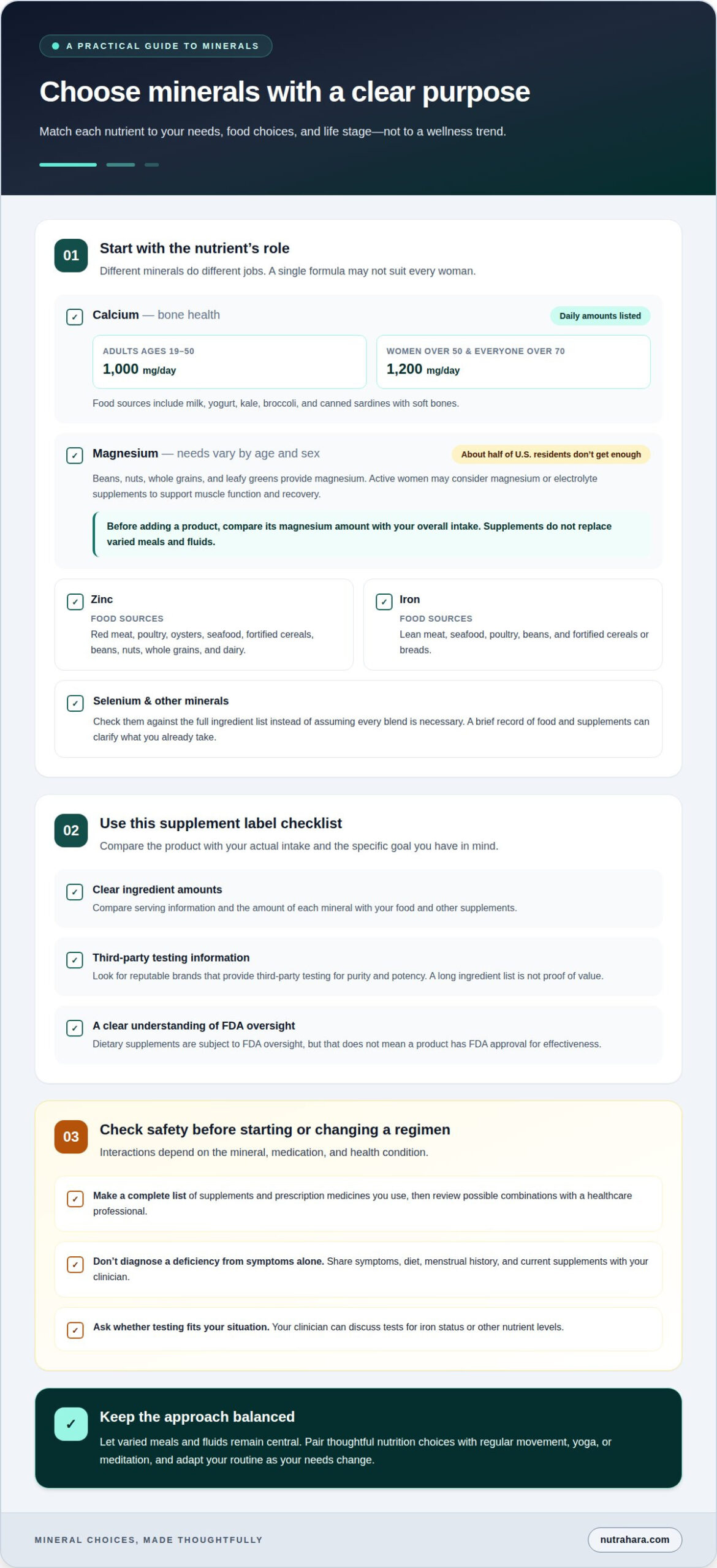
Minerals have different roles, so a single formula may not suit every woman. Calcium supports bone health, while iron helps meet needs that can vary with menstruation and life stage. Food can be a useful source: milk, yogurt, kale, broccoli, and canned sardines with soft bones contain calcium. The National Institutes of Health Office of Dietary Supplements lists 1,000 milligrams daily for children ages 4 to 8 and adults ages 19 to 50. It lists 1,200 milligrams daily for women over 50 and everyone over 70.

Magnesium needs vary by age and sex, and about half of U.S. residents don’t get enough. Beans, nuts, whole grains, and leafy greens provide magnesium. Active women may consider magnesium or electrolyte supplements to support muscle function and recovery, but supplements don’t replace varied meals and fluids. Compare the magnesium amount on the label with your overall intake before adding a product.

Zinc is found in red meat, poultry, oysters, seafood, fortified cereals, beans, nuts, whole grains, and dairy. Iron sources include lean meat, seafood, poultry, beans, and fortified cereals or breads. Check selenium and other minerals against the full ingredient list instead of assuming every blend is necessary. A brief record of your food and supplements can clarify what you already take.

When choosing supplements & vitamins in the United States, look for clear ingredient amounts and reputable brands that provide third-party testing for purity and potency. Compare serving information, and don’t treat a long ingredient list as proof of value.

Dietary supplements are subject to FDA oversight, but that doesn’t mean a product has FDA approval for effectiveness. Read the label, and assess ingredient amounts separately from any quality information.

Interactions depend on the mineral, medication, and health condition. List all supplements and prescription medicines you use, then review possible combinations with a healthcare professional before starting or changing a regimen.

Fatigue or other symptoms alone can’t establish a deficiency. Share your symptoms, diet, menstrual history, and current supplements with your clinician; ask whether tests for iron status or other nutrient levels fit your situation. Treat magnesium and ashwagandha as separate ingredients when reviewing a formula, including ashwagandha with black pepper.

Supplements such as CoQ-10, fish oils, probiotics, collagen, and melatonin

These products serve different purposes, so consider each ingredient on its own. CoQ-10 is a compound found in the body and also sold as a supplement. Probiotics are live microorganisms; products can contain different strains, so the label matters. Melatonin is a hormone involved in the sleep-wake cycle, and supplements are not a substitute for addressing ongoing sleep difficulties. For each option, ask what specific need it addresses and whether evidence supports that use.

Fish oil provides omega-3 fats, including DHA. Eating fish two to three times a week is one way to obtain DHA. If you use fish oil, read the label to see how much DHA and other omega-3s a serving contains. Fish oil is not a replacement for prescribed cholesterol care, and a supplement should not be treated as a cholesterol treatment without clinical guidance. Include your current medicines and health conditions when discussing regular use.

Probiotics can differ by strain and formulation, so a broad “probiotic” label doesn’t tell the whole story. Consider the product’s stated strains and intended use rather than assuming every formula supports immune function in the same way. Collagen supplements also vary. The page describes 28 known collagen types, with the first five being the most common. A collagen supplement can be considered as one option, while keeping whole foods central to your nutrition.

Use supplements to complement, not replace, meals built from varied whole foods. Choose reputable brands with third-party testing for purity and potency, and compare the ingredient panel with your goals. A practical step is to record the product, serving directions, and reason for taking it. That simple note helps you discuss CoQ-10, fish oil, probiotics, collagen, or melatonin clearly with a healthcare professional, especially if your routine or medications change.

Vitamins, including multivitamins and vitamins A, B, C, D, E, and K

Vitamin needs vary with food choices, health, and life stage. Varied meals are a useful starting point; supplements may help address specific gaps.

Multivitamins and Nutritional Gaps

Multivitamin-mineral supplements differ widely in composition and characteristics. Compare the label’s vitamin and mineral amounts with your usual foods and other supplements, rather than assuming every formula fills the same gaps. For example, animal foods naturally contain vitamin B12, while plant foods do not. Folic acid is added to many grain-based products, so fortified foods may also contribute to intake.

Adult Vitamin Needs and Amounts

Adults don’t all need the same multivitamin or dose. The appropriate amount depends on the nutrient, diet, and health needs. Follow the product label and avoid stacking formulas with overlapping ingredients. Green leafy, orange, and yellow vegetables provide vitamin A; citrus, peppers, broccoli, and strawberries provide vitamin C. Vitamins E and K are found in foods such as nuts, seeds, vegetable oils, and leafy greens.

Common risks include taking too much of a nutrient and interactions with medicines or health conditions. Some vitamins and minerals can also compete for absorption, so combinations and timing may matter. Review the full ingredient list before combining products, and discuss possible interactions with a healthcare professional.

Vitamin Needs Across Life Stages

Pregnancy needs differ by person, so avoid assuming one multivitamin suits everyone. Discuss supplement choices with your prenatal care team and consider folic acid from fortified grain foods as part of your overall nutrition. For children ages 1 to 18, the Endocrine Society recommends vitamin D supplements to avoid rickets and potentially reduce respiratory infection risk.

For adults 75 and older, the Endocrine Society recommends vitamin D supplements to lower mortality risk. Older adults over 65 may produce less intrinsic factor, which the body needs to metabolize vitamin B12. These examples show why age and life stage matter when choosing a formula.
Supplements & Vitamins: A Daily Guide for Women

Trends can make a familiar ingredient sound like a new discovery. CoQ-10, collagen, probiotics, fish oil, and melatonin often appear in wellness conversations, but popularity alone doesn’t show whether a product fits your needs. Start by naming the goal: filling a dietary gap, supporting a life-stage need, or addressing a concern you’ve discussed with a healthcare professional. If the purpose stays vague, pause before adding another bottle. Treat supplements & vitamins as tools for a clear purpose, not automatic wellness essentials.

Separate an ingredient from the claims made about it. A collagen product, for example, may be marketed for several outcomes, but its label shows what it contains. Check the ingredient name, amount per serving, and additional components. A blend of trendy ingredients can make it harder to tell which one suits your goal or causes an unwanted effect. Consider your current routine before adding products, and note what you hope a new choice will contribute.

Your eating patterns offer a useful reality check. Before following a trend, note the foods you regularly enjoy and where a genuine gap might exist. Fish, fortified foods, vegetables, nuts, and seeds provide nutrients, while yoga, meditation, healthy sleep habits, and regular movement support a broader wellness routine. Supplements can complement that foundation, not replace meals or everyday practices. Choices about supplements & vitamins should fit your habits, preferences, and changing needs.

Use a simple decision filter: identify the intended benefit, review the full label, and consider the evidence for that specific use. Then record what you take and why, so you can reassess whether it still matches your goals. Be especially thoughtful when a trend targets women’s changing needs across menstruation, pregnancy, lactation, or menopause. For a grounded next step, explore women’s wellness options as part of a considered routine, rather than choosing a product only because it is trending.

Nutrahara: Women’s Health Supplements

Nutrahara’s Women’s Health Supplements combine principles of Ayurveda with modern nutritional research. Made in New Zealand, they feature natural ingredients and are designed to complement a broader wellness routine. As you consider your needs through menstruation, pregnancy, lactation, or menopause, keep food, movement, rest, and guidance from your healthcare professional in view.

Supplements are one part of personal wellbeing, not a replacement for balanced eating, yoga, meditation, or care for a health concern. Explore Nutrahara’s Women’s Health Supplements to learn more about options for your wellness routine.

Make Your Next Wellness Choice Intentional

Your next step doesn’t need to be a complete routine overhaul. Choose one goal that matters to you now, such as supporting energy, building a steadier sleep routine, or staying active through a changing life stage. A thoughtful approach to supplements & vitamins starts with a clear intention and leaves room for the habits that sustain wellbeing: nourishing meals, movement, yoga, and moments of calm through meditation.

Keep your choices manageable. Notice what you’re taking, why it belongs in your routine, and whether it still reflects your needs as they change. When you’re ready to explore a women’s wellness supplement option, talk with Nutrahara about your needs.

Your health journey is personal. Move forward with care, confidence, and choices that feel right for you. For more guidance on emotional wellbeing and life-stage changes, explore women’s mental health and natural ways to support wellness.

Frequently Asked Questions

14 Common supplements: Are they beneficial or a waste of money?

Neither label fits every supplement; usefulness depends on the ingredient, purpose, and your needs. Fish oil, probiotics, collagen, and melatonin, for example, serve different roles, so popularity alone can’t tell you whether one is a good fit. Define your goal, read the full ingredient panel, and consider how the product fits your diet and routine. Don’t choose a blend simply because it combines several trending ingredients.

What Are the Signs of Magnesium Deficiency?

No single symptom confirms magnesium deficiency, because tiredness or muscle discomfort can have many causes. Consider your overall food intake, health history, and any changes in how you feel rather than drawing conclusions from one sign. A healthcare professional can assess those details and determine whether testing is appropriate. Keep a record of magnesium products and other supplements you use so the review reflects your full intake.

Which supplements have strong scientific evidence for specific health benefits?

Evidence depends on the ingredient and intended use, rather than a supplement’s popularity. One specific example is vitamin D: the Endocrine Society recommends supplements for people ages 75 and older to lower mortality risk, and for people ages 1 to 18 to avoid rickets and potentially reduce respiratory infection risk. These recommendations apply to those age groups, not automatically to every adult or every wellness goal.

Are multivitamins better than taking individual vitamins or getting nutrients from food?

There isn’t one best choice for everyone. Food can provide several nutrients together, while a multivitamin-mineral product combines selected ingredients in amounts that vary by formula. An individual supplement may be a more focused option when there’s a clear reason to target one nutrient. To compare options, review your usual meals and product labels for overlapping ingredients, then consider whether each item serves a distinct purpose.

How much do popular vitamins and supplements cost in the United States?

U.S. consumers spend about $60 billion a year on nutritional supplements, or about $175 per capita. The material gives no prices for individual vitamins or supplements.

Article by

Nutrahara Team

We are a dedicated collective of nutrition scientists and naturopaths at Nutrahara, committed to advancing women's health through the fusion of ancient Ayurveda science and cutting-edge nutrition research. Our mission is to empower you with clean, simple, and scientifically validated wellness solutions so you can live your healthiest life. Connect with us to stay updated on the latest developments in holistic women's health and nature-based research.

Disclaimer

This article is not a substitute for medical advice. Please consult a healthcare professional before starting any supplement, especially if pregnant, nursing, taking medication, or managing health conditions.

Categories
Articles

Best Supplements & Vitamins for Women’s Health

The best supplements & vitamins for women aren’t necessarily the ones with the longest ingredient list. If you choose a multivitamin, follow its serving directions and don’t exceed the recommended amount. The right choice depends on your life stage, eating patterns, and personal health priorities.

Comparing supplements can be difficult when formulas differ in ingredients, serving directions, and format. Start by deciding what you want a supplement to support and how it would fit into your everyday routine. Your approach can change as your circumstances and wellness priorities evolve.

This guide explores nutrients commonly found in women’s supplements, vitamin D’s role in bone health, and practical ways to compare products and costs. It also considers how needs may differ across menstruation, pregnancy, and menopause. Use these insights to make informed choices alongside habits such as regular movement, yoga, and meditation.

Key Takeaways

  • Choose a multivitamin based on your life stage and nutrient needs, rather than assuming one formula suits every woman.
  • Learn which nutrients to look for, and how food and supplements can work together to fill dietary gaps.
  • Understand how vitamin D helps support calcium absorption and why bone needs deserve attention after menopause.
  • Compare products by their ingredients, serving directions, and overall value, not by price alone.

What’s the best supplement for women’s health?

No single multivitamin suits every woman. Compare its nutrients with your diet, life stage, and reasons for considering a supplement.

Women’s Multivitamin Options

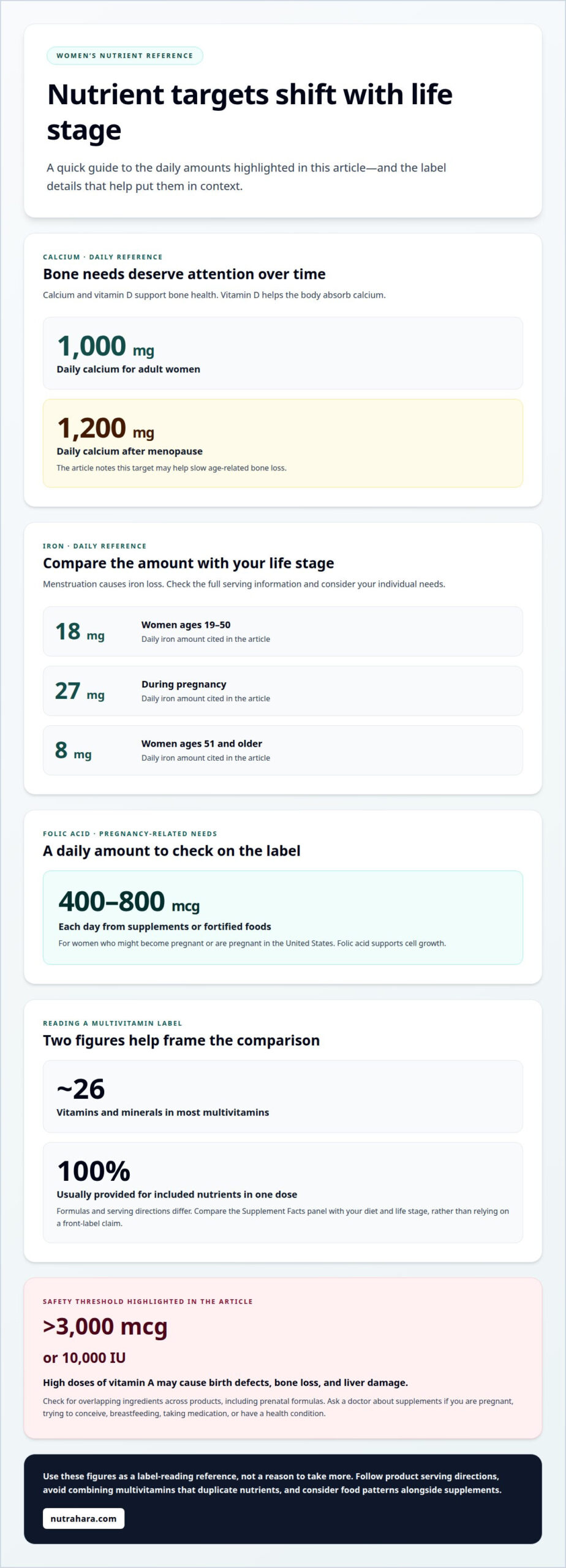
Most multivitamins contain about 26 vitamins and minerals, and one dose usually provides 100% of the recommended daily allowance for included nutrients. If you menstruate, consider whether iron is needed, since menstruation causes iron loss. Women who could become pregnant should look for at least 400 micrograms of folic acid. Prenatal formulas serve a different life-stage need, so compare their labels with your situation.

Gummy multivitamins offer another format. Compare serving directions and nutrient amounts with those of tablets or capsules, rather than choosing by format alone.

Who May Benefit From a Multivitamin

Most women can get needed nutrients from a healthy diet and may not need a multivitamin. A supplement may be useful when a restricted eating pattern makes it difficult to get enough of certain nutrients. For example, people following a strict vegetarian diet or taking a daily acid blocker may consider vitamin B12 supplementation. Life stage and food choices help determine which nutrients deserve attention. Learn more about essential supplements and vitamins for women and how nutrient needs can vary with diet and life stage.

A multivitamin isn’t a substitute for a varied diet, regular exercise, or other healthy routines. Consider whether a formula addresses a specific dietary gap instead of assuming a broad blend will address every concern.

Daily Use and Timing

If you choose a multivitamin, consider whether it suits your individual needs. Follow the product’s serving directions, and avoid combining multiple multivitamins, which can duplicate nutrients. A practical step is to compare each label’s nutrient amounts before adding another supplement. Choose a routine you can remember, such as pairing the dose with a regular meal, unless its directions say otherwise.

More isn’t automatically better. The goal is to address a need, not exceed the label’s serving directions.

Safety and Product Quality

In the United States, the FDA regulates dietary supplements, but its role differs from approving every formula before sale. Read the full label for ingredient amounts, serving directions, and warnings. Look for clear manufacturer details and independent quality testing. A testing seal can support quality screening, but it doesn’t prove a product will benefit you.

Ask a doctor for advice before starting supplements if you’re pregnant, trying to conceive, or breastfeeding, or if you take medication or have a health condition. Discuss blood tests if symptoms or a suspected deficiency could affect your choice. Testing can help distinguish a nutrient gap from another cause and guide a more targeted plan.

Nutrients commonly included in women’s supplements

Formulas vary, so compare their nutrient amounts with your diet and life stage. Choosing supplements & vitamins for women starts with identifying what your meals already provide.

Nutrient Coverage and Daily Values

Use the Supplement Facts panel to compare each nutrient’s amount per serving and its percentage of daily value. This makes overlapping ingredients easier to spot across products. According to the National Institutes of Health Office of Dietary Supplements, adult women need 1,000 mg of calcium daily. Women ages 19 to 50 need 18 mg of iron daily, pregnant women need 27 mg of iron daily, and women ages 51 and older need 8 mg of iron daily, according to the National Institutes of Health Office of Dietary Supplements.

Life stage affects nutrient needs. Check the full serving information, not just a front-label claim or highlighted ingredient.

Nutrients Women May Need

Calcium and vitamin D support bones, and vitamin D helps the body absorb calcium. Women who might become pregnant or are pregnant in the United States need 400-800 mcg of folic acid each day from supplements or fortified foods. Folic acid supports cell growth. Combined EPA and DHA recommendations commonly range from 250 to 500 milligrams per day; daily combined intakes of 1,000 to 1,500 milligrams may benefit long-term health and wellness.

When choosing supplements & vitamins for women, consider nutrient-dense foods alongside any product. Leafy greens, beans, dairy foods, and oily fish can contribute nutrients to a varied dietary pattern and support an active lifestyle.

Benefits and Risks of Key Supplements

Calcium and vitamin D support bone health, while folic acid supports cell growth. Omega-3 supplements provide another source of EPA and DHA. Their usefulness depends on dietary intake and the nutrients already present in other products.

Compare labels to avoid unnecessary overlap, including in prenatal formulas. According to the National Institutes of Health Office of Dietary Supplements, high doses of vitamin A, defined as more than 3,000 micrograms or 10,000 international units, may cause birth defects, bone loss, and liver damage. Discuss medical concerns or supplement use with a doctor.

Vitamin D and bone health

Bone care is a long-term practice, especially after menopause. After menopause, women need 1,200 mg of calcium each day to help slow age-related bone loss, according to the National Institutes of Health Office of Dietary Supplements. Think of that target alongside your regular meals, movement, and changing health needs, rather than as a reason to rely on a single product.

A practical first step is to note calcium-containing foods you eat on a typical day, such as yogurt, fortified alternatives, or leafy greens. Consider whether these foods feature consistently in your diet. Include vitamin D sources in your review, too. A short food-and-symptom log can help you discuss dietary patterns and bone-health concerns during a medical appointment.

Movement is an important part of a whole-body wellness routine. Add weight-bearing activities, such as walking or strength exercises, in a way that suits your fitness level. Yoga can support balance and body awareness, while meditation offers a calming practice alongside physical activity. These habits complement nutrition, but they don’t replace professional assessment of bone concerns.

Use women’s health articles and educational resources to prepare questions about menopause, changing symptoms, or screening discussions. The Office on Women’s Health covers women’s health topics, while the Menopause Society emphasizes attention to bone health after menopause. Bring specific questions about your routine to a healthcare professional, including how your food choices and supplements fit together.

Immune and heart health deserve thoughtful attention. Broad support language on a supplement label doesn’t establish that a product prevents disease. Build a balanced routine around nourishing meals, regular activity, and restorative practices, then consider supplements as one possible part of that picture. Consistent habits give you practical steps to revisit as your needs evolve.

Best Supplements & Vitamins for Women's Health

Product comparisons and costs

Compare each formula’s Supplement Facts panel, serving size, and number of servings per package. When comparing supplements & vitamins for women, focus on ingredients that match your needs rather than the length of the label. Tablets, capsules, and gummies can differ in nutrient amounts and directions, so check the full product information before weighing value.

To compare costs, divide the package price by the number of servings. Then consider whether those servings provide nutrients relevant to your dietary needs. For example, compare calcium and iron amounts across similar multivitamins instead of judging by a “complete” claim. A longer ingredient list doesn’t automatically mean a better fit.

Compare like with like. A prenatal formula and a general multivitamin may be designed for different life stages, so their ingredients and serving directions can differ. The best value depends on the nutrients you need, the amount supplied per serving, and whether the format suits your daily routine.

Format can affect how easy a supplement is to take consistently. A tablet may suit someone who prefers a familiar format, while a gummy can be an alternative for someone who dislikes swallowing pills. Check the serving directions and ingredients for either format. If you take medication, ask a doctor or pharmacist whether timing or interactions matter.

Use this checklist to compare supplements & vitamins for women thoughtfully:

  • Match the formula to a specific dietary need or life stage.
  • Compare nutrient amounts, servings, and directions on the label.
  • Look for duplicate ingredients across products in your routine.
  • Assess cost per serving alongside relevant nutrients and format.

A clear comparison helps you choose based on fit and value, not packaging or broad claims. The most useful option is one that meets your needs and fits comfortably into your routine.

Nutrahara: Women’s Health Supplements

Nutrahara offers women’s health supplements for women seeking to support their wellness with a considered daily routine. Its formulations combine principles of Ayurveda with modern nutritional research, using natural, clean ingredients.

If you’re comparing options, use what you’ve learned about life stage, dietary gaps, and ingredient labels to guide your choice. A supplement can complement nutritious food, movement, and restorative practices such as yoga or meditation, but it isn’t a substitute for medical care or individualized advice from a healthcare professional.

Explore Nutrahara’s women’s health supplements as one option for your wellness journey. For questions about Nutrahara’s offerings, contact Nutrahara.

Make your next wellness choice with confidence

Start by writing down what you want to support, such as everyday energy, a balanced diet, or a steady fitness routine. Consider how your current meals, movement, and life stage shape that goal. Supplements & vitamins for women are most useful as part of a considered routine, not as a substitute for nourishing food, restorative sleep, or practices like yoga and meditation.

Give yourself permission to make thoughtful choices rather than chasing a perfect regimen. If you’re exploring a supplement as part of your wellness journey, Nutrahara offers women’s health supplements informed by Ayurveda and modern nutritional research. For questions about the offering, contact Nutrahara about supplement support.

Everyday wellbeing grows through consistent, informed choices. Take the next step at a pace that feels grounded and right for you.

Frequently Asked Questions

What are multivitamins?

A multivitamin is a single supplement designed to provide several micronutrients together. It differs from a single-nutrient product, such as a vitamin D-only supplement. To understand what a formula offers, look beyond its name and examine the Supplement Facts panel. This helps you compare products without assuming that “women’s” on the packaging means the formula matches your individual needs.

Are dietary supplements safe?

Safety depends on the ingredients, your health circumstances, and other products or medicines you use. Keep a written list of supplements and medications, including occasional products, and share it with your healthcare professional or pharmacist. This gives them a clearer picture when considering possible interactions. Personal stories may offer perspective, but they can’t establish that a product is suitable for you.

Are supplements okay to take daily?

Daily use should have a clear purpose and follow the product’s directions. Review your supplement routine when your eating pattern, medications, or life stage changes. Keep the container or a photo of its label handy for that conversation. This makes it easier to discuss whether the product still fits your routine, without automatically adding another supplement.

Are there side effects associated with women’s multivitamins?

Some people may experience unwanted effects, and ingredients can influence what they notice. If a new symptom begins after starting a product, record when it happens and bring the label to a healthcare professional or pharmacist. Don’t add another supplement to counteract a suspected effect without advice. A clear record can support a more informed discussion about next steps.

Should I take a vitamin or mineral supplement?

Consider whether a dietary pattern or health circumstance could leave a nutrient gap. Note foods you regularly avoid and any changes in appetite or routine, then discuss that context with a qualified healthcare professional. Exercise habits alone don’t establish a need for a supplement. A targeted conversation can help you decide whether a food-based adjustment or supplement makes sense.

What are prenatal vitamins?

Prenatal vitamins are products intended for people preparing for pregnancy or during pregnancy. If you’re planning to conceive, bring the labels of any current supplements to a healthcare professional so they can consider your full routine together. This is especially useful when products overlap or your needs change. Keep the discussion current through pregnancy and breastfeeding rather than assuming one routine fits every stage.

Article by

Nutrahara Team

We are a dedicated collective of nutrition scientists and naturopaths at Nutrahara, committed to advancing women's health through the fusion of ancient Ayurveda science and cutting-edge nutrition research. Our mission is to empower you with clean, simple, and scientifically validated wellness solutions so you can live your healthiest life. Connect with us to stay updated on the latest developments in holistic women's health and nature-based research.

Disclaimer

This article is not a substitute for medical advice. Please consult a healthcare professional before starting any supplement, especially if pregnant, nursing, taking medication, or managing health conditions.

Categories
Articles

Supplements and Vitamins: Your Essential Daily Guide

A longer supplement routine doesn’t necessarily mean better health. Supplements and vitamins can help address a specific nutritional need, but taking them without a clear reason may add little, and large doses can be harmful. Their value depends on what you take, how much you take, and your individual needs.

It’s understandable to look for extra support for energy, wellbeing, or immune function, especially as your body’s needs change through different life stages. But a familiar label or a promise of immune support doesn’t tell the whole story. What matters is how a supplement fits with your diet, health, and any medicines you take.

Here, you’ll learn how common supplements may help or fall short, what to consider about fish oil and omega-3s, and why vitamins don’t work as a one-size-fits-all shield for immune health. We’ll also cover practical ways to think about food sources, doses, and safety, so you can make calmer, more informed choices for your wellbeing.

Key Takeaways

  • Assess whether a supplement fills a real dietary need, and consider your life stage, food choices, and medications before adding one.
  • Compare common nutrients with food sources and recommended intake to make more informed choices about what may be useful.
  • Learn how fish oil and omega-3s fit into dietary choices, and why supplements aren’t a universal solution for immune function.
  • Explore how Nutrahara’s women’s health supplements may fit into a thoughtful, research-aware approach to wellbeing.

Are supplements and vitamins good for you?

Supplements can help address a specific nutritional gap, but they aren’t a substitute for balanced meals. The right choice depends on your diet, life stage, and health needs.

Multivitamins and Individual Supplements

Choose a multivitamin for a broad mix of nutrients, or an individual supplement for a specific need. Multivitamin and mineral products vary widely, so compare the label’s amounts and ingredients rather than assuming their formulas are alike. Green powders also differ in composition and aren’t equivalent to a multivitamin or a varied diet. Food is the foundation of good nutrition.

Assessing Vitamin and Mineral Needs

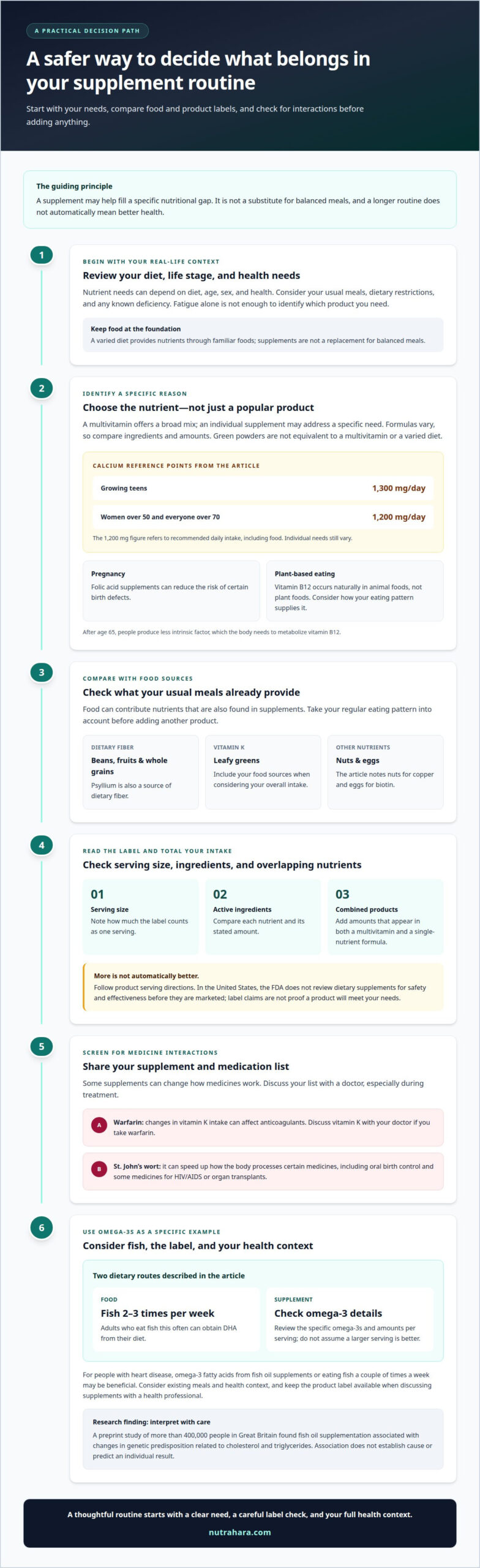
There isn’t one list or dose that suits every adult; needs depend on diet, age, sex, and health. Review your usual meals, dietary restrictions, and any known deficiency with a health professional, rather than using fatigue alone to choose a product. Magnesium needs vary by age and sex. According to the National Institutes of Health, Office of Dietary Supplements, the recommended calcium intake for growing teens is 1,300 milligrams per day.

Supplement Needs for Specific Groups

Pregnancy changes nutritional needs: folic acid supplements can reduce the risk of certain birth defects. Adults over 50 may benefit from added calcium and other vitamins as they grow older. After age 65, people produce less intrinsic factor, which the body needs to metabolize vitamin B12. If you follow a plant-based diet, note that B12 occurs naturally in animal foods, not plant foods, and consider how your eating pattern supplies it.

Supplement Interactions With Prescription Medications

Some supplements can change how medicines work. Changes in vitamin K intake can affect anticoagulants, so if you take warfarin, discuss vitamin K with your doctor. St. John’s wort can speed up how the body processes certain medicines, including oral birth control and some drugs for HIV/AIDS or organ transplants. Before starting a supplement, share your medication and supplement list with your doctor, especially during treatment.

14 Common supplements: Are they beneficial or a waste of money?

A supplement is most useful when it addresses a real dietary gap, not simply because it’s popular. Before deciding what belongs in your routine, compare the evidence, food sources, and label details.

Evidence for Common Supplements

Consider what a product contains and the specific purpose it serves. Probiotics, for example, are different from vitamins and minerals, and evidence for one supplement doesn’t apply to another. Psyllium is a source of dietary fiber; fiber-rich foods such as beans, fruits, and whole grains can also support everyday nutrition. A varied diet provides nutrients through familiar foods, including leafy greens for vitamin K, nuts for copper, and eggs for biotin.

Supplement needs can shift with life stage and eating pattern. Folic acid supplements during pregnancy can reduce the risk of certain birth defects. According to the National Institutes of Health, Office of Dietary Supplements, the recommended daily calcium intake for women over 50 and everyone over 70 is 1,200 milligrams per day. Use that figure as a reference for total intake, including food.

Reading Labels and Avoiding Excessive Doses

Read the serving size, active ingredients, and amount of each nutrient. Compare products you already take, as a multivitamin and a single-nutrient formula may contain some of the same nutrients. Add the amounts together before using both, and follow the product’s serving directions rather than assuming more is better.

In the United States, the U.S. Food and Drug Administration does not review dietary supplements for safety and effectiveness before they are marketed. Treat label claims as information to assess, not proof that a product will meet your needs. A useful next step is to record your usual foods, supplements, and medications, then discuss the list with a health professional. For a focused nutrient option, explore a vitamin B complex supplement.

Fish oil and omega-3 fatty acids

Fish oil supplements provide one way to add omega-3 fatty acids to a diet. Food can also supply DHA, an omega-3 fatty acid. Adults who eat fish two to three times per week can obtain DHA from their diet. Consider your regular meals first, then compare them with the reason you’re considering a supplement.

Fish oil and omega supplements aren’t interchangeable with every wellness choice. Check the label for the specific omega-3s and amounts per serving, then compare those details with your current routine. Don’t assume that a larger serving is better. A balanced eating pattern still includes vegetables, protein foods, and other nutrients such as calcium, which serve different nutritional roles.

For people with heart disease, omega-3 fatty acids from fish oil supplements or eating fish a couple of times a week may be beneficial. That gives two dietary routes to consider: fish as food, or a supplement. The decision should reflect existing meals and health context, rather than a general promise of better heart health. Keep the product label available when discussing supplements with a health professional, especially if you take medicine.

A preprint study of more than 400,000 people in Great Britain found fish oil supplementation associated with changes in genetic predisposition related to cholesterol and triglycerides. An association does not establish that taking fish oil causes those changes or predicts an individual result. Treat the finding as one research detail, not a personal outcome forecast.

To make a practical choice, note how often fish appears in your meals and why you’re considering omega-3s. If fish is already a regular part of your diet, account for that source before adding capsules. If you rarely eat fish, compare the supplement’s stated omega-3 content and serving directions. This simple review helps keep your plan intentional and avoids treating fish oil as a replacement for varied foods.

Supplements and Vitamins: Your Essential Daily Guide

Vitamin supplements and immune function

Immune function depends on your overall nutritional state, not one capsule promising a quick boost. A vitamin supplement can help address a nutrient gap, but it doesn’t replace varied meals. Build meals around foods such as vegetables, fruit, beans, and whole grains. Then review a supplement’s ingredients and purpose instead of choosing it solely for an “immune support” label.

Vitamin D is one specific example. For people ages 1 to 18, the Endocrine Society recommends vitamin D supplements to avoid rickets and potentially reduce respiratory-infection risk. That recommendation applies to this age group; it doesn’t establish the same routine for every adult. For your own plan, consider your existing diet, life stage, and any supplements already taken. Avoid stacking products without first comparing their ingredient lists.

Distinguish immune claims from general wellness language. A product may combine vitamins with herbs or other ingredients, but that doesn’t prove it prevents infection. Creatine, for example, is a different supplement category from vitamins; including it in a wellness routine doesn’t make it an immune nutrient. Focus on the stated ingredients and intended use, and treat broad promises cautiously.

A practical approach is to write down what you eat and take, then identify a specific nutrient concern before choosing a product. Include whole grains and other everyday foods in that review, since supplements don’t replace a balanced eating pattern. If pregnancy, lactation, or a health condition affects your routine, bring the ingredient list to a healthcare professional. To review a focused nutrient format, explore this vitamin B complex supplement and its listed ingredients.

Nutrahara: Women’s Health Supplements

Nutrahara offers women’s health supplements for those seeking a considered addition to their wellness routine. Its formulations combine principles of Ayurveda with modern nutritional research, using natural, clean ingredients.

These supplements may be worth exploring when you’ve identified a specific wellness goal and want to consider products designed for women. Read each product’s ingredient information alongside your current diet and supplements, particularly as your needs shift through menstruation, pregnancy, lactation, or menopause. Supplements can complement healthy habits, including nourishing meals, movement, yoga, and rest, but they don’t replace them.

Explore Nutrahara’s women’s health supplements at nutrahara.com.

Make Your Next Wellness Choice With Confidence

Start with one health goal, note what you already eat and take, and use that information to guide your decisions. A thoughtful approach to supplements and vitamins is personal, not a test of how many products you can add to your routine. Your needs may shift with menstruation, pregnancy, lactation, or menopause, so revisit your choices as life changes.

Keep the foundations steady, too. Nourishing meals, movement you enjoy, restorative sleep, and practices such as yoga or meditation can support a balanced approach to wellbeing. If you’re considering women’s health supplements, take time to understand their ingredients and how they fit your goals and existing routine.

Contact Nutrahara with your questions as you consider your next step. You can build a wellness routine with care, clarity, and confidence.

Frequently Asked Questions

What are the benefits and evidence for common supplements such as vitamin D, B12, and magnesium?

The clearest reason to consider a nutrient is a specific need, rather than a general promise of better health. Evidence and benefit differ by nutrient and individual; vitamin D, B12, and magnesium aren’t interchangeable. Track your food choices and any known deficiencies, then consider whether a product addresses a gap. A testimonial describes one person’s experience, not proof that the same benefit will apply to you.

What are the risks and side effects of taking vitamins and supplements?

Risks include taking more than intended, experiencing unwanted effects, or changing how a medicine works. Keep a written list of products and serving directions, and note any new symptoms after starting a supplement. If you take prescription medicine, include your supplements in a medication review. This gives you a practical record to discuss instead of relying on memory.

How can I choose safe, high-quality supplements in the United States?

Choose a product with a readable ingredient list, clear serving directions, and a purpose that matches your needs. Check that the label names the nutrients and amounts, then compare it with other products in your routine. In the United States, the U.S. Food and Drug Administration doesn’t review supplements for safety and effectiveness before marketing, so promotional wording isn’t independent proof.

What does USP Verified or NSF Certified mean for supplements?

These marks refer to separate third-party verification programs, not FDA approval. Their meaning depends on the specific program and product, so read the accompanying explanation instead of assuming a mark guarantees every aspect of quality or suitability. A verification seal also can’t tell you whether an ingredient is appropriate for your diet, health needs, or medications.

How are supplements regulated by the FDA in the United States?

The FDA regulates dietary supplements under the food category, rather than approving each product as a medicine before it is marketed. The agency monitors claims and reports of side effects after products reach the market. Keep the package and product details if you need to identify what you took, and report concerning reactions through appropriate medical channels.

What vitamins and supplements do adults need, and how much of each?

There isn’t one set of vitamins or doses that suits every adult; needs depend on diet, age, sex, and health. As references, calcium intake is 1,200 milligrams daily for women over 50 and everyone over 70, and 1,300 milligrams for growing teens.

Article by

Nutrahara Team

We are a dedicated collective of nutrition scientists and naturopaths at Nutrahara, committed to advancing women's health through the fusion of ancient Ayurveda science and cutting-edge nutrition research. Our mission is to empower you with clean, simple, and scientifically validated wellness solutions so you can live your healthiest life. Connect with us to stay updated on the latest developments in holistic women's health and nature-based research.

Disclaimer

This article is not a substitute for medical advice. Please consult a healthcare professional before starting any supplement, especially if pregnant, nursing, taking medication, or managing health conditions.
Categories
Articles

Vitamin D: Key Benefits for Women’s Daily Health

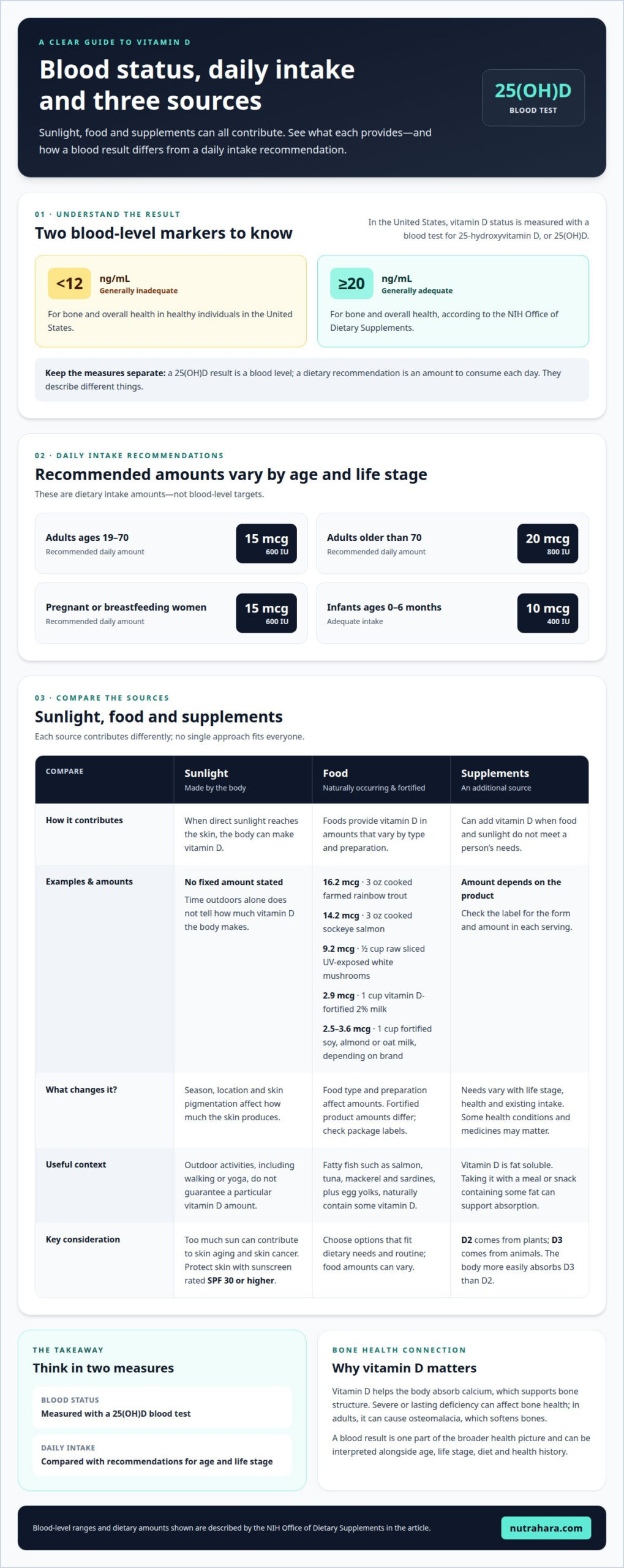
In the United States, vitamin D status is measured with a blood test for 25-hydroxyvitamin D, or 25(OH)D. According to the National Institutes of Health Office of Dietary Supplements, levels below 12 ng/mL are generally inadequate for bone and overall health, while levels of at least 20 ng/mL are generally adequate. These ranges offer a clearer picture than guessing from sunshine alone. A vitamin D result can be one useful piece of information as you think about your health.

Sunlight helps the body make vitamin D, but production varies from person to person. Season, location, and skin pigmentation all play a part, so time outdoors doesn’t tell the whole story. For women balancing work, exercise, family, and changing life stages, understanding how this nutrient enters the picture can be useful. A vitamin D routine is about more than spending extra time outside.

This article explains deficiency and how sunlight, food, and supplements contribute to overall intake. It also covers why the skin’s production changes, helping you understand which everyday factors you can influence. Use this information to reflect on your habits, ask informed questions about your health, and build a practical routine alongside movement, nourishing meals, and rest.

Key Takeaways

  • Learn how low levels are identified and why adequate intake matters for bone health and other vital body functions.
  • Compare sunlight, food, and supplements to understand how each can contribute to your daily intake.
  • Recognize how season, location, skin pigmentation, and other factors influence how much your body makes outdoors.
  • Explore practical ways to support your wellness routine and understand when supplements may warrant extra care.

What is vitamin D deficiency?

Deficiency means the body has too little vitamin D to support its needs. This nutrient helps the body absorb calcium and maintain healthy bones. A blood test measures 25-hydroxyvitamin D, written as 25(OH)D. According to the National Institutes of Health Office of Dietary Supplements, levels below 12 ng/mL are generally inadequate for bone and overall health in healthy individuals in the United States. Levels of at least 20 ng/mL are generally adequate for bone and overall health, according to the National Institutes of Health Office of Dietary Supplements.

Recommended dietary amounts vary by age and life stage. According to the National Institutes of Health Office of Dietary Supplements:

  • Adults ages 19-70: 15 mcg daily (600 IU).
  • Adults older than 70: 20 mcg daily (800 IU).
  • Infants ages 0-6 months: adequate intake of 10 mcg daily (400 IU).
  • Pregnant and breastfeeding women: 15 mcg (600 IU) daily.

These are recommended intake amounts, not blood-level targets. A level result and a dietary intake figure describe different things. For example, a pregnant woman can compare her intake with the recommendation, while a 25(OH)D blood test assesses her measured status.

Why does the distinction matter? The body needs vitamin D to absorb calcium, which supports bone structure. Severe or lasting deficiency can affect bone health. In children, deficiency can cause rickets, a disease that weakens developing bones. For adult women, maintaining bone health matters through changing life stages, including after menopause, when fracture concerns may become more relevant.

A personal account can add perspective, but it should reflect a real woman’s words and experience. It should not replace medical evidence or be invented to illustrate a test result. Blood-test information is one part of the broader health picture and should be interpreted alongside age, life stage, diet, and health history. If circumstances change, such as pregnancy or dietary habits, revisit whether your intake aligns with the recommended amount.

Sunlight, diet, and supplements as sources of vitamin D

Sunlight, food, and supplements can all contribute to vitamin D intake. Pairing awareness of food sources with sensible sun protection can help you make informed daily choices.

Sunlight as a Vitamin D Source

When direct sunlight reaches your skin, your body can make vitamin D. This natural process is one source, but it isn’t a reason to seek unprotected sun exposure. Too much sun can contribute to skin aging and skin cancer, so protect your skin with sunscreen rated SPF 30 or higher. The balance matters: sunlight may contribute, while season, location, and pigmentation affect how much your skin produces. Outdoor activities such as walking or yoga can support an active routine, but they don’t guarantee a particular amount.

Dietary and Fortified Food Sources

Food provides another way to add this nutrient, with amounts varying by type and preparation. In the United States, a 3-ounce serving of cooked farmed rainbow trout provides 16.2 mcg; cooked sockeye salmon provides 14.2 mcg. A half-cup of raw sliced white mushrooms exposed to UV light provides 9.2 mcg. These examples make it easier to compare options when planning meals.

Fortified products can contribute, too. One cup of vitamin D-fortified 2% milk provides 2.9 mcg, while a cup of fortified soy, almond, or oat milk provides 2.5-3.6 mcg, depending on the brand. Check package labels, since amounts differ. Fatty fish such as salmon, tuna, mackerel, and sardines, plus egg yolks, naturally contain some. Choose foods that fit your dietary needs and routine.

Supplements as an Additional Source

Supplements offer another source when food and sunlight don’t meet a person’s needs. Vitamin D is fat soluble, so taking a supplement with a meal or snack containing some fat can support absorption. The body more easily absorbs D3 than D2. These differences can help you understand product labels, but don’t assume every woman needs the same approach. Children, pregnant or breastfeeding women, and adults may have different nutritional needs. A balanced plan considers food, sunlight, and supplements together, rather than relying on one source alone.

Vitamin D supplements

Supplements offer another source when sunlight and food don’t provide enough. The right approach depends on factors such as life stage, health, and existing intake. For guidance on the best supplements and vitamins for women’s health, consider how your life stage, eating patterns, and personal priorities shape your choices.

Adults ages 19-70 are recommended to get 15 mcg (600 IU) daily, according to the National Institutes of Health Office of Dietary Supplements. People who may need extra include older adults, breastfed infants, people with dark skin, and those with conditions affecting fat absorption.

Vitamin D2 and D3 Supplements

D2, or ergocalciferol, comes from plants, while D3, or cholecalciferol, comes from animals. The body more easily absorbs D3 than D2, so the form matters when comparing supplement labels. Both forms provide the same nutrient, but their sources differ. Read the label to identify the form and amount contained in each serving.

Supplement Use and Treatment

Supplements can address deficiency, but treatment depends on its cause and a person’s health needs. A health care provider may order a blood test and consider factors such as diet, health conditions, and medicines. Severe deficiency can cause osteomalacia, which softens adult bones, and supplements are used to treat it. They can also help with inherited conditions that prevent the body from using or absorbing vitamin D. Breastfed infants may need extra intake, so children’s needs require age-appropriate guidance.

Recommended Doses and Toxicity

There isn’t one supplement dose for everyone. For adults ages 19-70, the recommended intake is 15 mcg (600 IU) daily, according to the National Institutes of Health Office of Dietary Supplements. This amount refers to total intake, not necessarily a supplement dose. Taking more than 4,000 IU of vitamin D per day from supplements might cause harmful side effects, according to the National Institutes of Health Office of Dietary Supplements.

Too much vitamin D from supplements can cause toxicity, unlike sunlight exposure, which doesn’t cause vitamin D toxicity. Before taking another supplement, add up the amounts in products that contain it, including multivitamins. Checking labels can help prevent unintentionally stacking doses. If you have concerns about osteoporosis or a previous deficiency, discuss an appropriate plan with a health care provider.

Vitamin D: Key Benefits for Women's Daily Health

Factors affecting vitamin D production from sunlight

Sunlight on exposed skin can start the body’s production of vitamin D, but the amount varies. Season, location, skin pigmentation, age, and body composition all affect production. Two women with similar outdoor routines may therefore produce different amounts. Treat time outside as one part of your wellness routine, not a dependable measure of your vitamin D status.

Geography and season shape available UVB light. Some people living north of 37 degrees latitude cannot get enough winter UVB sunlight to make sufficient vitamin D. A bright winter day may not provide the same conditions as summer. Consider the season and your location when thinking about sunlight as a source, rather than relying on how sunny the sky looks.

Skin pigmentation also influences production. Pigmentation can reduce vitamin D production in the skin by over 90%. Skin’s ability to make it decreases with age, too. These factors help explain why outdoor habits don’t produce a uniform result, even among women following similar schedules.

Body composition is another consideration. A body mass index greater than 30 is associated with lower vitamin D levels. This association doesn’t mean body weight alone determines an individual’s status. Sunlight exposure is one part of a broader picture that also includes food intake and other personal factors.

Build movement and mindfulness into a routine you can sustain. For example, take a sun-safe walk when it suits your schedule, then follow it with a short indoor yoga session or a few quiet minutes of meditation. These practices support a balanced wellness routine, but they don’t determine how much your skin produces. Avoid summer sunshine, especially between 10 a.m. and 2 p.m.; don’t extend exposure to try to increase international units. When season, latitude, pigmentation, or age limit production, dietary sources can contribute too.

Nutrahara: Women’s Health Supplements

Nutrahara offers Women’s Health Supplements for women making thoughtful wellness choices alongside everyday habits such as balanced meals, movement, and rest. Its supplements combine principles of ancient Ayurveda with modern nutritional research and natural, clean ingredients. As you consider how sunlight, food, and supplements fit into your routine, explore Nutrahara’s broader support for women’s wellness. Supplements aren’t a substitute for medical care or a personalized plan for addressing deficiency. When reviewing your options through changing life stages, consider what aligns with your needs and existing routine. Visit Nutrahara online to explore its Women’s Health Supplements.

Make Your Wellness Routine Your Own

Wellness grows through choices you can sustain, not a perfect routine. Let what you’ve learned about vitamin D inform your everyday habits, while keeping movement, nourishing meals, and rest in balance. A walk outside, a steady yoga practice, or a quiet moment for meditation can each become a meaningful part of caring for yourself. Notice what feels manageable through changing seasons and life stages, and make adjustments with intention rather than pressure.

Your next step can be simple: choose one habit to nurture and give it room to become part of your rhythm. If you’d like to explore Nutrahara’s approach to women’s wellness, visit Nutrahara online. Keep building a health journey that feels informed, personal, and kind to you.

Frequently Asked Questions

What does vitamin D help with the most?

Vitamin D’s clearest role is helping the body absorb calcium and maintain bones. It also plays a part in nerve, muscle, and immune function. When planning meals to support bone health, for example, consider both calcium-containing foods and sources of vitamin D. These nutrients work together, but neither replaces balanced nutrition or individualized care for a bone condition.

Can vitamin D alleviate depression?

It may help with negative emotions for some people, but it shouldn’t be treated as a substitute for mental health care. A review involving 7,534 people found supplementation improved negative emotions in people experiencing them. That finding doesn’t mean supplements treat depression for everyone. If low mood affects daily life, speak with a qualified health professional about support suited to your situation.

Can vitamin D status affect testosterone levels in men?

A person’s vitamin D status alone can’t establish whether testosterone is low or high. Men concerned about testosterone should seek a proper medical assessment rather than use supplements to try to change hormone levels. Energy, mood, and libido can have many causes, so treating one nutrient level as a hormone result may lead to the wrong conclusion.

Can you ever have too much vitamin D?

Yes. Taking more than 4,000 IU of vitamin D per day from supplements might cause harmful side effects, according to the National Institutes of Health Office of Dietary Supplements. Check the serving information on each supplement, especially if you use a multivitamin alongside a separate product. Add the amounts together rather than assuming each product can be considered on its own.

Does sunscreen decrease vitamin D?

Sunscreen reduces UVB reaching the skin, which can also reduce skin production of vitamin D. That doesn’t make skipping sun protection a sound strategy: unprotected exposure can damage skin. The article recommends sunscreen with SPF 30 or higher. Food sources and supplements can contribute without relying on deliberate, unprotected sun exposure.

How can I raise my vitamin D level quickly?

Start by identifying your level with a 25-hydroxyvitamin D blood test, then use the result to guide next steps with a health professional. Avoid trying to speed things up by taking large doses: more isn’t automatically better. Review foods and supplements you already use, including fortified products, so your plan accounts for your full intake.

Article by

Nutrahara Team

We are a dedicated collective of nutrition scientists and naturopaths at Nutrahara, committed to advancing women's health through the fusion of ancient Ayurveda science and cutting-edge nutrition research. Our mission is to empower you with clean, simple, and scientifically validated wellness solutions so you can live your healthiest life. Connect with us to stay updated on the latest developments in holistic women's health and nature-based research.

Disclaimer

This article is not a substitute for medical advice. Please consult a healthcare professional before starting any supplement, especially if pregnant, nursing, taking medication, or managing health conditions.

Categories
Articles

Supplement Quiz for Your Diet, Lifestyle, and Goals

Supplements can interact with prescription and over-the-counter medicines, so a quiz to find the right supplements for me should account for your medication list. Recommendations are more useful when they reflect your health priorities and existing routines. Treat a quiz as an organized starting point, not a final decision about what to add to your daily routine.

Your needs can change through menstruation, pregnancy, breastfeeding, perimenopause, and menopause. Your goals and habits matter, too. You might be building a strength-training routine, making time for yoga, or using meditation to support a calmer day. These choices are part of your overall wellbeing, alongside your diet and any supplements you currently take.

This guide explains how these details may shape quiz recommendations and what to consider before acting on them. Learn how to prepare useful answers, assess nutrition and daily habits, and recognize when a health question calls for professional guidance. The goal is to help you make your next wellness decision with greater clarity and confidence.

Key Takeaways

  • Gather your goals, diet pattern, lifestyle details, medications, and current supplements to make quiz answers more useful.
  • Compare potential nutrient needs with what you already eat, including foods that fit your preferences and routine.
  • Use a quiz to organize questions, not to diagnose a health concern or replace guidance from a healthcare provider.
  • For pregnancy, medication questions, or suspected health problems, make professional guidance part of your next step.

Can supplements interact with my medications?

Yes. Vitamins and herbal supplements can interact with prescription and over-the-counter medicines. St. John’s wort may cause dangerous serotonin levels for people taking antidepressants. Higher doses of some vitamins and minerals can also increase side effects and interaction risks. A quiz can flag medication details, but it can’t assess your full medical history.

A personalized supplement quiz can use your health goals, diet, and lifestyle to shape recommendations. It may ask whether you want to support energy, sleep, or exercise routines, and whether you follow a vegetarian diet. Your answers can point to topics to explore, but they aren’t a diagnosis or proof that you need a supplement. For a useful result, include your current vitamins and supplements, medication names, and doses.

Quiz questions may cover personal details such as your name, age, sex, and diet. Answer accurately, including whether you’re pregnant or breastfeeding, and note life-stage changes such as menopause if asked. Compare recommendations with your current routine. Look for duplicate ingredients across products, follow each label’s directions, and don’t exceed its recommended dose. If a recommendation includes an ingredient that may interact with a medicine, discuss it with your healthcare provider before taking it.

Quiz services can differ in ingredients, price, and cancellation terms, so there’s no single standard plan to compare. Personalized plans and quiz-based subscriptions also vary in cost according to the plan and subscription terms.

During pregnancy or breastfeeding, don’t start a new supplement based only on a quiz. Avoid self-selecting herbal blends or high-dose vitamins; discuss the specific ingredients and doses with your doctor.

To review a supplement, read its label for ingredient amounts, directions, and expiration date. The U.S. Pharmacopeial Convention, NSF International, and ConsumerLab test supplements for purity, potency, and availability. Check the packaging for their testing marks, and compare the listed ingredients with your medicines and current supplements.

Quiz questions about goals, diet, lifestyle, and current supplements

A useful quiz turns broad intentions into clear priorities. Instead of selecting “better health,” choose a focus such as steady energy, sleep habits, exercise recovery, or nutrition during menopause. A focused goal makes recommendations easier to assess and helps keep a wellness quiz from sounding like a diagnosis. If you’re thinking, “I want a quiz to find the right supplements for me,” start by naming the change you hope to support.

Personal details put your answers in context. A quiz may ask for your name, age, sex, and diet. It may also ask about life stage, including menstruation, pregnancy, breastfeeding, or menopause. These details can shape which questions come next. Share accurate information, and note when an answer doesn’t reflect your circumstances.

Diet and daily routines add useful context. Describe your eating pattern, including whether you avoid animal products, and list the supplements you already take. Include habits such as yoga, strength training, meditation, and sleep routines if asked. For example, someone who practices evening yoga and wants better sleep has a different starting point from someone focused on exercise nutrition. A quiz to find the right supplements for me should connect its suggestions to the details I provide.

  • Choose one priority: Name the goal you want to address first, such as energy or sleep.
  • Describe your nutrition: Note dietary patterns and foods you regularly avoid.
  • List your routine: Record current vitamins and supplements, including labeled doses.
  • Review the result: Compare suggested ingredients with your answers and existing habits.

Look for a clear connection between each recommendation and your stated goal. If a quiz suggests a supplement but doesn’t explain why it fits your answers, treat that as a prompt to learn more, not a reason to add it automatically. Your answers can guide thoughtful choices, but they don’t replace clinical assessment when symptoms need attention.

Take the quiz when you have time to review your eating habits and supplement labels. This preparation helps you answer consistently and spot recommendations that overlap with your current routine.

Dietary sources and supplementation needs

Start with your regular meals. A balanced diet can provide nutrients through fruits, vegetables, beans, whole grains, and other fresh foods. The quiz’s daily targets are 2 cups of fruit and 2½ cups of vegetables. Track what you actually eat for a few days, then note gaps or foods you avoid. A vegetarian pattern, for example, may change which nutrients deserve attention.

Dietary patterns and life stages matter. Pregnant women and vegetarians may require extra nutrients through vitamins, depending on age and gender. Vitamin B12 needs particular consideration for vegans because it’s absent from plant foods; fortified cereals can provide it. Record your usual meals and life stage before reviewing a quiz result. That gives you practical context for considering whether a recommendation fits.

Vitamin D is another nutrient to discuss in context. The NIH Office of Dietary Supplements recommends a vitamin D recommended dietary allowance of 600-800 IU daily. A quiz result doesn’t show whether you have a deficiency. If you’re concerned about a health problem or nutrient status, consult your doctor about appropriate evaluation and next steps.

In the United States, dietary supplements are regulated under the Dietary Supplement Health and Education Act of 1994, according to the U.S. Congress. The FDA has not evaluated statements made about these products, and they aren’t intended to diagnose, treat, cure, or prevent disease. Read labels for ingredients and directions, then compare them with your diet and current supplements. Food remains the foundation; a supplement should address a relevant need rather than replace varied meals.

Supplement Quiz for Your Diet, Lifestyle, and Goals

Quiz is educational and not a substitute for healthcare-provider guidance

A supplement quiz organizes information; it doesn’t diagnose a condition or determine treatment. For example, a result suggesting a vitamin or mineral doesn’t explain why you feel tired or identify the cause. Use quiz results for educational purposes: to prepare focused questions, not as a medical conclusion.

If you have or suspect a health problem, contact your family doctor for consultation, diagnosis, and treatment. Describe the symptom, when it began, and how it affects your daily activities. Persistent fatigue, changes in menstrual patterns, or ongoing sleep difficulties, for instance, deserve more than a generic quiz result. A qualified professional can assess your symptoms alongside your health history.

Pregnancy and breastfeeding call for added care. Before starting any new supplement during pregnancy, speak with your doctor. Bring the product label and a list of your current supplements, including ingredient amounts. These details help your healthcare provider consider your situation rather than relying on a quiz’s general recommendation. The same careful review can help clarify questions about supplements during breastfeeding.

  • Use the result as a prompt: Write down the ingredient, stated purpose, and question it raises.
  • Share the full picture: Include medicines, vitamins, and minerals you already take.
  • Seek assessment for symptoms: A quiz cannot establish a reliable medical diagnosis.

Keep the distinction clear: wellness goals, such as supporting a balanced routine, differ from investigating a possible health concern. A quiz may help organize choices around diet or lifestyle, but symptoms require professional assessment. If a result seems to conflict with medical advice, pause before acting and discuss the specific recommendation with your healthcare provider. This matters especially when pregnancy, breastfeeding, or ongoing treatment affects your decisions.

Takeaway: use a quiz to prepare, not to self-diagnose. A clear list of your questions, product labels, and current routine can make a conversation with your doctor more specific and useful.

Nutrahara: Women’s Health Supplements

Nutrahara offers Women’s Health Supplements for women seeking options that fit their wellness priorities and daily routines. Its formulations combine principles of ancient Ayurveda science with modern nutritional research and use natural, clean ingredients. If a quiz has helped you identify areas to explore, consider how a supplement’s ingredients and label align with your goals, diet, and current routine.

Women’s needs can change across menstruation, pregnancy, breastfeeding, perimenopause, and menopause. Use quiz results as a starting point for learning, and discuss supplement choices with your healthcare provider if you have medication or health questions. Keep nutrition, movement, yoga, and meditation in view as parts of your broader wellbeing journey.

Visit Nutrahara.com to explore its Women’s Health Supplements.

Make your next wellness step intentional

Let your next step reflect the life you’re living now, not a perfect routine you think you should follow. A quiz to find the right supplements for me can help organize your priorities, but your choices can evolve as your habits and life stage change. Notice what supports your wellbeing, and make room for nourishing meals, movement, yoga, and meditation alongside any supplement decisions.

For women balancing work, family, fitness, and changing health needs, a steady approach can feel more sustainable than trying to change everything at once. Choose one personal priority to focus on, then revisit it as your needs shift. If you have questions about Nutrahara’s Women’s Health Supplements, contact Nutrahara with your questions.

Your wellness journey is yours to shape. Take the next step with curiosity, care, and confidence.

Frequently Asked Questions

What vitamins should I take?

There isn’t one vitamin routine that suits every woman. Your food choices, life stage, medicines, and current supplements all affect what may be relevant. For example, a vegan diet raises a question about vitamin B12, while pregnancy can change which nutrient needs to discuss with your care team. Use your diet and product labels to prepare focused questions for a healthcare professional.

What questions do supplement quizzes ask about diet, lifestyle, goals, and health conditions?

Quizzes may ask about eating patterns, wellness goals, activity, and products you already use. Some also request details such as age and sex. Before starting, consider the goal you want to explore, such as sleep or exercise recovery, and have your supplement labels nearby. Answer health questions carefully, since recommendations rely on the information you enter.

Are online supplement recommendation quizzes medically reliable?

Quizzes can help organize preferences, but they can’t diagnose a condition or determine treatment. A result depends on the details you provide and how the recommendations are explained. Treat it as a starting point for learning about ingredients, not proof that you need a product. For symptoms or health concerns, discuss your situation with a qualified healthcare professional.

Which supplements are supported by evidence for common goals like sleep, energy, and immunity?

Evidence varies by ingredient, intended use, and personal circumstances. A broad goal such as “more energy” doesn’t identify a specific supplement need. Look for clear information explaining why an ingredient is suggested and what evidence supports that use. Consider sleep habits, meals, movement, and stress routines, too; supplements are only one part of overall wellbeing.

What health conditions and medications can affect supplement safety?

Prescription and over-the-counter medicines can interact with vitamins and herbal supplements. For example, St. John’s wort may cause dangerous serotonin levels for people taking antidepressants. During pregnancy, speak with a doctor before starting a new supplement. Keep a current list of medications and products, including label directions, to support a focused discussion about possible interactions.

Article by

Nutrahara Team

We are a dedicated collective of nutrition scientists and naturopaths at Nutrahara, committed to advancing women's health through the fusion of ancient Ayurveda science and cutting-edge nutrition research. Our mission is to empower you with clean, simple, and scientifically validated wellness solutions so you can live your healthiest life. Connect with us to stay updated on the latest developments in holistic women's health and nature-based research.

Disclaimer

This article is not a substitute for medical advice. Please consult a healthcare professional before starting any supplement, especially if pregnant, nursing, taking medication, or managing health conditions.
Categories
Articles

Supplements on an Empty Stomach vs. with Food: A Woman’s Guide to Optimal Absorption

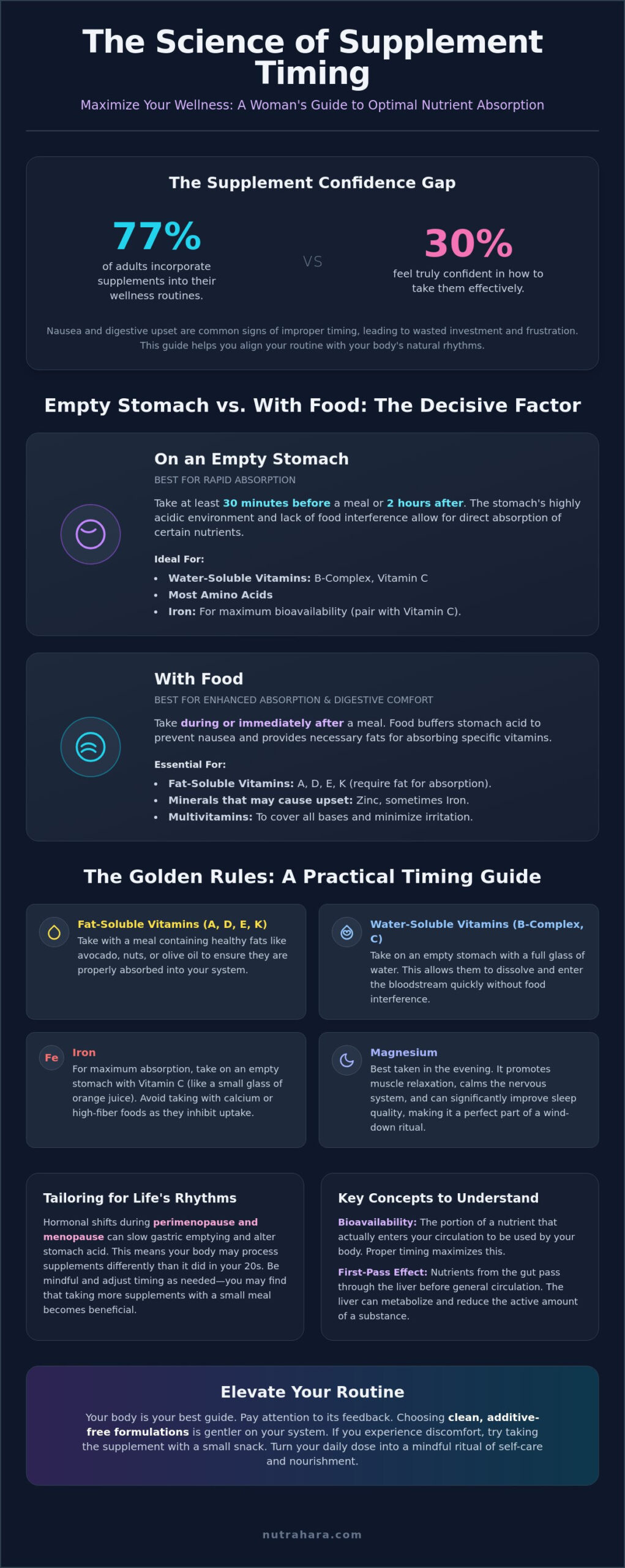
Did you know that while nearly 77% of adults now incorporate dietary supplements into their wellness routines, only about 30% of us feel truly confident in the information on those labels? It’s a common struggle for women who prioritize their health. You might find yourself staring at a bottle of multivitamins, wondering if taking supplements on an empty stomach vs with food will be the difference between a productive morning and a bout of digestive upset. Many women have experienced that wave of nausea after a morning dose, leading to a cabinet full of expensive, half-used bottles.

We understand how frustrating it is to feel like you’re wasting your investment on products that don’t seem to work. You deserve to feel the full benefit of every capsule. This guide bridges the gap between traditional health philosophies and modern nutritional research to help you master the science of timing. You’ll learn how to align your intake with your body’s natural rhythms to improve your energy and digestion. We will break down the essential rules for fat-soluble and water-soluble nutrients, giving you a clear, manageable schedule that turns your supplement routine into a grounding daily ritual.

Key Takeaways

  • Discover how the ancient wisdom of Agni, or digestive fire, can help you transform your supplement routine into a restorative ritual of self-care.
  • Understand the biological mechanics of supplements on an empty stomach vs with food to ensure your body effectively processes nutrients through the liver’s first-pass effect.
  • Learn the “Golden Rules” for timing essential minerals like Iron and Magnesium to maximize bioavailability while avoiding common digestive discomfort.
  • Explore how to adapt your timing to hormonal shifts during perimenopause and how specific botanicals like Ashwagandha can enhance your evening wind-down.
  • Find out why clean, additive-free formulations are gentler on your system and how targeted blends can support long-term hormone harmony.

The Ritual of Timing: Why Supplement Synergy Matters for Women’s Wellness

Taking your daily vitamins shouldn’t feel like another box to tick on a crowded to-do list. Instead, view this moment as a grounding ritual of self-care. It’s a conscious act of nourishing your future self. When we talk about the effectiveness of your routine, the conversation often centers on the debate of taking supplements on an empty stomach vs with food. This isn’t just about avoiding a queasy stomach; it’s about honoring the complex internal environment of a woman’s body.

Ancient wisdom has long understood what modern laboratories are only now confirming. In Ayurvedic tradition, the concept of Agni, or digestive fire, represents our ability to process not just food, but every substance we ingest. If your Agni is weak, your body cannot transform nutrients into energy and tissue. Understanding The Science of Nutrient Absorption, also known as bioavailability, is the key to rekindling that fire. Bioavailability refers to the portion of a nutrient that successfully enters your circulation and becomes available for use. Without proper timing, even the most expensive capsules may simply pass through your system without making an impact.

As women transition into their 40s and 50s, metabolic rates naturally shift. Hormonal changes during perimenopause and menopause can slow down gastric emptying and alter stomach acid production. This means your supplement processing time is longer than it was in your 20s. Adjusting your intake to match these physiological changes ensures you aren’t wasting your health investment.

Ancient Wisdom Meets Modern Bioavailability

Traditional medicine practitioners rarely prescribed herbs in isolation. They often paired potent botanicals with “carriers” like ghee or honey to enhance transport into the cells. Modern science mirrors this by using carrier oils in fat-soluble supplements to ensure they bypass the harsh environment of the stomach. At Nutrahara, we believe purity must meet clinical validation. Our philosophy centers on creating formulas that respect these traditional delivery methods while utilizing modern purification standards to ensure every milligram counts toward your health progression.

Listening to Your Body’s Natural Rhythms

Your digestive system follows a distinct circadian rhythm. Gastric motility and enzyme production are typically highest during the daylight hours, tapering off as the sun sets. This is why morning is often the ideal time for energy-boosting B vitamins, while calming minerals like magnesium are better suited for the evening. We encourage you to track your personal response for a few days. Notice if you feel a surge of energy or a wave of nausea after your dose. This internal feedback is the most powerful tool you have for perfecting the balance of supplements on an empty stomach vs with food. Your journey is unique, and your schedule should reflect your body’s specific needs.

Empty Stomach vs. With Food: The Science of Nutrient Absorption

Bioavailability is the efficiency with which your body recognizes and utilizes a nutrient. It isn’t enough to simply swallow a capsule; your internal chemistry must be ready to receive it. The choice of taking supplements on an empty stomach vs with food dictates how your gastric acid interacts with the formula. When the stomach is empty, its pH is highly acidic. This environment is perfect for certain vitamins but can be harsh for others. Once you eat, the environment shifts to accommodate digestion, altering how nutrients are liberated from their capsules.

The “First-Pass Effect” adds another layer of complexity to your wellness journey. Before nutrients reach your bloodstream, they travel through the portal vein to the liver. This vital organ acts as a gatekeeper, processing and sometimes metabolizing substances before they can circulate. Additionally, certain minerals share the same absorption pathways. For instance, calcium and iron often compete for the same receptors in the gut. If taken together, they may cancel each other out. You can find more detail on these interactions in A Practical Guide to Timing Common Women’s Supplements, which highlights how specific factors can inhibit or enhance mineral uptake.

When Water-Soluble Nutrients Thrive (Empty Stomach)

B-complex vitamins and Vitamin C are water-soluble. They rely on water for transport rather than dietary fats. Taking a high-quality Vitamin B Complex on an empty stomach, usually about 30 minutes before breakfast, allows for rapid absorption. This timing supports early morning energy levels by ensuring the nutrients reach your system without having to compete with food particles. Since these vitamins aren’t stored in the body, a consistent morning ritual helps maintain steady levels throughout your active day.

The Role of Dietary Fats in Fat-Soluble Vitamin Uptake

Vitamins A, D, E, and K require a different approach. These nutrients are fat-soluble, meaning they must be dissolved in lipids to pass through the intestinal wall. A common mistake is taking “dry” multivitamins with only black coffee. Without fat, these vitamins may simply be excreted. You don’t need a heavy meal; a small amount of healthy fat is enough. Pairing your dose with half an avocado or a handful of walnuts triggers the necessary bile release for optimal uptake. If you’re looking to refine your daily routine, exploring targeted hormone support can help you align these nutrients with your specific life stage.

A Practical Guide to Timing Common Women’s Supplements

Creating a sustainable wellness routine requires moving from abstract science to daily action. When deciding on supplements on an empty stomach vs with food, specific minerals follow strict ‘Golden Rules’ to ensure they don’t compete for absorption. For many women, iron is best taken on an empty stomach to maximize uptake, though if it causes discomfort, a small non-calcium snack can help. Conversely, zinc and calcium are almost always better tolerated and absorbed when taken during a meal. Following clear guidance on taking vitamins with or without food helps you avoid the common pitfalls of nutrient competition.

Collagen is a cornerstone of structural health. To support skin elasticity and joint health progression, we recommend taking our Premium Collagen Complex either first thing in the morning or right before bed. This allows the amino acids to be processed without interference from complex proteins found in heavy meals. If you use ‘green’ supplements or fiber, keep a two-hour window between these and your minerals. Fiber can bind to nutrients and sweep them out of the body before they’re fully absorbed.

Digestive Support and Probiotics: Before or During Meals?

The timing of probiotics remains a debated topic among wellness enthusiasts. Most research suggests taking them 30 minutes before a meal. This ensures the beneficial bacteria pass through the stomach while acid levels are lower. From an Ayurvedic perspective, taking bitter herbs before eating acts to ‘kindle’ your digestive fire, preparing your system for the nutrients to come. If you’re curious about how these processes affect your weight and vitality, our Digestive Enzymes guide offers deeper insights into holistic gut health.

Joint Health and Modern Minerals: Finding the Sweet Spot

Magnesium is often called the ‘evening mineral’ because of its ability to support muscle relaxation and nervous system calm. It’s a perfect addition to your nighttime wind-down ritual. For joint mobility, timing substances like turmeric and glucosamine with a meal containing fats is essential for bioavailability. Integrating these into a post-workout ritual, perhaps after a restorative yoga session, helps support the long-term integrity of your joints and connective tissues. This mindful approach ensures your health investment works in harmony with your body’s recovery phase.

Tailoring Your Supplement Schedule to Life Stages and Daily Rituals

Your body is a dynamic system, evolving through every decade of life. By the time you reach your 40s, the hormonal shifts of perimenopause can introduce new digestive sensitivities. This makes the choice between supplements on an empty stomach vs with food a personal exploration of what feels best for your gut. Fluctuating estrogen levels can impact gastric motility, sometimes leading to a more sensitive stomach than you experienced in your younger years. Listening to these subtle signals is a vital part of your health progression.

Sarah, a 52-year-old wellness enthusiast, shared her experience with this transition. “I used to take my multivitamin first thing in the morning on an empty stomach, but as I entered my 50s, I noticed it started causing a dull ache. Switching my routine to take it with a balanced lunch made a world of difference. My energy stayed stable, and the digestive discomfort simply vanished.” This simple shift illustrates how a ritual can adapt to your changing needs. For those managing daily stress alongside these shifts, taking Ashwagandha with Black Pepper during your evening wind-down can help harmonize your nervous system before sleep.

Managing Hormonal Shifts: From Menstruation to Menopause

During your menstruating years, timing iron intake is essential for combatting fatigue. Taking it away from tea or coffee, perhaps with a small piece of fruit, ensures you get the most support when your body needs it most. As you move into post-menopausal years, the focus often shifts toward bone density. Timing your Calcium and Vitamin D in the evening supports the body’s natural restorative processes during sleep. For a broader look at how to support these transitions, you can refer to A Woman’s Guide to Wellness Supplements.

Integrating Supplements into Your Yoga and Meditation Practice

Yoga and meditation provide a beautiful framework for a mindful supplement ritual. A “Mindful Morning” might involve pairing your B vitamins with a series of sun salutations to spark sustained energy for the day ahead. In the evening, as you transition into a restorative meditation, incorporating Restorasleep can signal to your body that it’s time for deep, healing rest. Practicing Pranayama, or deep yogic breathing, during these moments improves oxygenation throughout your system. This enhanced circulation helps deliver nutrients more effectively to your tissues, ensuring your investment in your health is fully realized.

Ready to align your daily routine with your body’s unique wisdom? Explore our clean, targeted women’s health supplements to support your journey at every stage.

Supplements on an Empty Stomach vs. with Food: A Woman’s Guide to Optimal Absorption

Elevating Your Health Progression with Nutrahara’s Mindful Formulations

Nutrahara stands as your dedicated partner in this lifelong progression toward vitality. We believe that what is left out of a capsule is just as significant as what is put in. Many standard vitamins rely on synthetic fillers, artificial binders, and glazes that can irritate the delicate lining of the stomach. This irritation is often the true culprit behind the nausea women experience. Whether you decide to take your supplements on an empty stomach vs with food, the purity of the formulation determines your comfort and success. By choosing clean, additive-free formulas, you remove unnecessary barriers to your well-being.

Our commitment to your health is reflected in our meticulous sourcing. For women seeking to balance their internal landscape across various life stages, our Femmepower blend offers a sophisticated fusion of botanicals and nutrients. It is designed specifically for hormone harmony, providing the support you need to feel grounded and empowered in your daily life. We view our role as a wise guide, helping you navigate the science of nutrition with transparency and care.

Clean Ingredients for Gentle Digestion

Our formulations prioritize bio-identical forms of vitamins. These are molecularly identical to the nutrients your body naturally recognizes, making the absorption process smoother and more efficient for your digestive system. By avoiding harsh chemicals and artificial additives, we ensure that our products are as gentle as possible, even for those with sensitive systems. It’s helpful to remember that health is a journey of small, consistent rituals, not overnight fixes. Choosing high-quality ingredients is a fundamental step in ensuring those rituals yield the results you deserve.

Creating a Sustainable Wellness Journey

Consistency is the heartbeat of any successful health ritual. To keep your progression on track, consider simple, tangible tools. A beautiful ceramic pill box kept near your meditation cushion or yoga mat can serve as a physical anchor for your routine. While phone reminders have their place, a physical ritual often feels more grounding and intentional. We also invite you to broaden your knowledge by exploring our educational resources. You can download the Nutrahara E-Books for more inspiration on integrating wellness and traditional wisdom into your modern lifestyle.

We encourage you to take a moment today to review your current supplement shelf. Simplify your routine by focusing on high-quality, targeted formulas that truly resonate with your body’s unique needs. Empowering yourself with knowledge and choosing purity is an act of self-care that builds lasting confidence. Your health is your greatest investment. Let’s ensure it’s a journey filled with clarity, tranquility, and strength.

Cultivating Your Personal Ritual for Lifelong Vitality

Mastering the timing of your nutrients is more than just a logistical task; it’s a profound act of self-respect. By aligning your intake with your body’s natural circadian rhythms and specific life stages, you ensure that every capsule supports your long-term health progression. You’ve learned how to distinguish between water-soluble and fat-soluble needs, and how to listen to your body’s signals as you navigate hormonal shifts. These small, intentional adjustments transform a simple habit into a powerful daily ritual of self-care that honors your unique biology.

Whether you are balancing supplements on an empty stomach vs with food, the purity of your formula remains the foundation of your success. Nutrahara’s mindful formulations are crafted with a fusion of ancient Ayurveda and modern science, using clinically validated natural ingredients that women trust for lasting wellness. We invite you to Explore Nutrahara’s Science-Backed Women’s Supplements and simplify your journey toward optimal absorption. You have the knowledge and the tools to take full control of your wellness. Trust in your body’s wisdom, stay consistent with your rituals, and embrace the confidence that comes from knowing your health investment is working for you.

Frequently Asked Questions

Is it okay to take a multivitamin on an empty stomach if I don’t feel nauseous?

You can take a multivitamin on an empty stomach if you don’t experience digestive upset, but it isn’t always the most efficient choice. Multivitamins usually contain fat-soluble nutrients like Vitamins A, D, E, and K that require dietary fats for proper transport. While your stomach might feel comfortable, your body won’t fully absorb these specific components without food. Taking your multivitamin with a meal ensures you maximize your health investment.

Can I take all my supplements at once with breakfast to save time?

Taking all your supplements at once is convenient, but it often leads to nutrient competition. High doses of calcium, for example, can block the absorption of iron and zinc if they are ingested at the exact same time. It’s much better to space out your minerals to ensure they don’t fight for the same receptors in your gut. Splitting your routine supports your body’s long-term health progression more effectively.

How long should I wait to eat after taking supplements on an empty stomach?

You should generally wait 30 to 60 minutes after taking supplements on an empty stomach vs with food before consuming a full meal. This window allows water-soluble vitamins, such as B-complex and Vitamin C, to pass through the stomach and into the small intestine without interference from food particles. This timing is especially important for iron and specific amino acids, as it ensures they have a clear path for rapid absorption.

What happens if I take fat-soluble vitamins (A, D, E, K) without any fat?

If you take fat-soluble vitamins without any dietary fat, your body will likely excrete them rather than utilize them. These specific nutrients require bile for absorption, and bile is only released when you ingest lipids. You don’t need a heavy meal; even a small amount of healthy fat, such as a teaspoon of olive oil or a few slices of avocado, is enough to trigger the necessary digestive process.

Does coffee or tea interfere with the absorption of my vitamins?

Coffee and tea can significantly interfere with the uptake of certain minerals and vitamins. The tannins and caffeine in these drinks can bind to iron, calcium, and magnesium, preventing them from being absorbed. To ensure your supplements on an empty stomach vs with food routine is successful, try to wait at least one hour after your morning cup of coffee before taking your daily minerals or specialty blends.

Should I take my probiotics before bed or first thing in the morning?

It’s usually best to take your probiotics about 30 minutes before breakfast on an empty stomach. During this time, your stomach acid levels are naturally lower, which helps the delicate beneficial bacteria survive the journey to your lower digestive tract. While some people prefer taking them before bed, the morning ritual aligns better with your body’s natural digestive rhythm and prepares your gut for the day’s nourishment and processing.

Is it better to take Collagen before or after a yoga workout?

Taking collagen about 30 to 60 minutes before your yoga workout is often the most beneficial choice for joint support. When you move through your asanas, increased blood flow helps deliver the amino acids to your connective tissues and joints. This timing supports the structural integrity of your body during exercise. Alternatively, taking it on an empty stomach first thing in the morning ensures it is processed without competition from other complex proteins.

Can I take Ashwagandha on an empty stomach for better stress relief?

You can take Ashwagandha on an empty stomach for faster absorption, as this allows the active compounds to enter your system quickly. However, if you have a sensitive digestive system, taking it with a light snack is perfectly acceptable and won’t diminish its calming benefits. Many women find that incorporating it into an evening wind-down ritual, perhaps after a short meditation session, helps soothe the nervous system and promotes a more restful sleep.

Article by

Nutrahara Team

We are a dedicated collective of nutrition scientists and naturopaths at Nutrahara, committed to advancing women's health through the fusion of ancient Ayurveda science and cutting-edge nutrition research. Our mission is to empower you with clean, simple, and scientifically validated wellness solutions so you can live your healthiest life. Connect with us to stay updated on the latest developments in holistic women's health and nature-based research.

Disclaimer

This article is not a substitute for medical advice. Please consult a healthcare professional before starting any supplement, especially if pregnant, nursing, taking medication, or managing health conditions.

Categories
Articles

The Ultimate Women’s Wellness Handbook 2026: A Holistic Guide to Longevity and Vitality

What if the ‘inevitable’ brain fog and joint stiffness of your 40s were actually optional symptoms of an outdated health model? You’ve likely noticed that your body doesn’t always bounce back like it did at 25. It’s exhausting when sudden shifts in your energy or skin elasticity feel like you’re losing control over your own narrative. You know that standard medical advice often ignores the complex hormonal symphony playing inside you during these pivotal decades. This women’s wellness handbook serves as your essential roadmap to reclaim that power and confidence. By fusing 5,000 years of Ayurvedic wisdom with 40 years of our own clinical research, we’ve created a guide that turns hormonal fluctuations into a source of strength. You’ll learn how to master your physical vigor and mental clarity using 2026’s most advanced nutritional insights. We’re going to dive into specific protocols for sustainable energy and radiant longevity that you can start today. You’ll discover how to bridge earth, nature, and humanity to ensure your next three decades are your most vibrant yet.

Women in their 40s benefit most from 1,000 mg of Calcium, 600 IU of Vitamin D, and 250 mg of Magnesium to support bone density. As estrogen levels begin to fluctuate, adding 500 mg of Omega-3 fatty acids helps maintain heart health and skin elasticity. Our research shows that 75 percent of women in this age group are deficient in Vitamin B12. Incorporating these clean and simple formulas, such as those offered by specialized providers like Artemis Curated, into your daily routine ensures your body has the abundance it needs to thrive.

Key Takeaways

  • Discover how to achieve “Bio-Harmony” by blending 40 years of Ayurvedic wisdom with cutting-edge nutritional technology to transition from reactive to proactive health management.
  • Learn tailored strategies for every life stage, from establishing fertility foundations in your 30s to navigating the “second spring” of perimenopause and beyond.
  • Master daily rituals like Sun Salutations and meditation to combat decision fatigue and awaken your metabolism for sustained mental clarity.
  • Explore this comprehensive women’s wellness handbook to bridge the gap between clinically studied science and natural purity on your personal journey toward longevity.
  • Build a sustainable wellness practice by learning to decode your body’s “Ancient Wisdom” signals, empowering you with renewed confidence and self-esteem.

Defining the Modern Women’s Wellness Handbook in 2026

We’ve moved past the era where healthcare meant visiting a clinic only when something felt broken. By 2026, the global wellness economy is projected to reach $7.0 trillion, reflecting a massive cultural shift toward proactive, holistic management. This evolution centers on “Bio-Harmony,” a concept that marries advanced nutritional technology with the rhythmic cycles of nature. You’re no longer just managing symptoms; you’re optimizing your biological potential through a deep understanding of your body’s unique requirements. A wellness handbook is a living document for hormonal and physical alignment.

The year 2026 marks a turning point where women prioritize internal balance over external trends. Your personal women’s wellness handbook serves as a strategic map for this journey. It’s a partnership with your body that requires listening, adjusting, and nurturing your blueprint over decades. This isn’t about a thirty-day fix. It’s about building a sustainable foundation that supports you through menstruation, pregnancy, and the transition into post-menopause with grace and strength.

The Core Pillars of Female Vitality

Metabolic health is the primary engine of your life. It’s not just about a number on a scale; it’s about how efficiently your mitochondria produce cellular energy. A 2023 study published in the Journal of the American College of Cardiology found that only 12% of Americans are metabolically healthy, making this a critical focus for women over 30. You need to focus on blood sugar stability and cellular health to maintain high energy levels throughout the day.

Hormonal equilibrium requires a delicate endocrine dance. As you navigate various life stages, your estrogen, progesterone, and cortisol levels shift constantly. Understanding these fluctuations allows you to adjust your exercise and nutrition to match your cycle. Mental resilience is the final pillar. Cultivating focus and calm through daily meditation or targeted support like FocusZenith helps you stay grounded in a high-stress world.

Why a Holistic Approach Wins

Isolated synthetic vitamins often lack the essential “co-factors” found in nature. Whole-plant synergy ensures your body recognizes and absorbs nutrients effectively. For example, our Ashwagandha with Black Pepper uses piperine to increase the absorption of active compounds by up to 2,000%. This Ayurvedic wisdom, backed by modern research, provides a more complete form of nourishment than lab-grown isolates ever could.

Your self-esteem and confidence are deeply rooted in your physical well-being. When your gut is healthy and your hormones are balanced, your mental clarity improves, which naturally boosts how you carry yourself. Real success comes from this internal alignment. Elena, a 42-year-old marathon runner, shared her experience: “I spent years chasing performance metrics while ignoring my recovery. Once I started using a women’s wellness handbook approach to synchronize my nutrition with my hormonal cycle, my recovery times dropped by 30% and my chronic fatigue vanished.”

  • Metabolic Health: Prioritize protein and fiber to stabilize insulin.
  • Hormonal Balance: Track your cycle to align your workouts with your energy peaks.
  • Mental Focus: Use breathwork to lower cortisol levels during the workday.
  • Nutrient Synergy: Choose whole-plant extracts over synthetic alternatives for better bioavailability.

Embracing this proactive style of living allows you to take control of your longevity. It’s about bridging Earth, nature, and humanity to create a life of abundance and vitality. By treating your health as a continuous journey rather than a destination, you ensure that your best years are always ahead of you.

The Biological Foundations: Bridging Ayurveda with Modern Science

Nutrahara’s approach isn’t a passing trend; it’s a 40-year legacy of clinical expertise. Our philosophy centers on the belief that your body’s innate wisdom deserves the support of cutting-edge nutrition research. This section of our women’s wellness handbook explores how we translate ancient Indian insights into cellular-level solutions, ensuring your body receives the exact support it needs at every life stage.

Ayurveda identifies three primary ‘Doshas’ known as Vata, Pitta, and Kapha. While these terms sound mystical, modern biology recognizes them as your nervous system regulation, metabolic efficiency, and physical structural integrity. When these systems fall out of alignment, you might experience fatigue, digestive issues, or hormonal shifts. We prioritize bioavailability, which is the measure of how much of a nutrient your body actually absorbs. Our commitment to clean, simple formulations means we strip away fillers, leaving only the “Purity” of nature. Our tagline, “Bridging Earth, Nature and Humanity,” isn’t just a phrase; it’s a 100% commitment to ethical sourcing and scientific integrity.

  • Vata: Corresponds to the nervous system and movement.
  • Pitta: Governs metabolism and hormonal balance.
  • Kapha: Provides the structure and lubrication for joints and tissues.

Ancient Herbs, Modern Clinical Validation

Ashwagandha stands as a powerhouse for the female adrenal system. Clinical studies show it can reduce cortisol levels by up to 30% in stressed individuals, providing a much-needed buffer against daily pressures. By pairing it with black pepper, we increase the absorption of its active withanolides significantly. Turmeric, when standardized to 95% curcuminoids, manages systemic inflammation, which is vital for maintaining joint flexibility as you age. These adaptogens act like a thermostat for your hormones. They help you stay balanced whether you’re dealing with the demands of a career or the transitions of menopause. You can find this potent, science-backed blend in our Ashwagandha with Black Pepper formulation.

Nutritional Tech: Enhancing Nature’s Abundance

We use advanced CO2 extraction methods to keep the volatile compounds of our ingredients intact. This technology ensures the delicate chemistry of the plants isn’t destroyed by high heat. Cognitive health is another pillar of this women’s wellness handbook. B-Vitamins play a critical role here, supporting neurotransmitter synthesis and sustained energy levels without the crash of caffeine. Our Vitamin B Complex is designed for maximum metabolic uptake to support your brain and heart. When Ayurveda meets double-blind, placebo-controlled trials, the results are undeniable. Traditional wisdom is frequently validated by modern data, proving that nature already provided the tools we need for longevity. We don’t guess; we formulate based on what works for your unique biology.

If you’re ready to start your personal health journey, consider how a holistic approach to supplementation can transform your daily energy levels.

Your health journey isn’t a static destination; it’s a dynamic evolution that requires different tools at every stage. This women’s wellness handbook provides the roadmap for those transitions. In your 30s, the focus is on building a resilient foundation. Statistics from the American Psychological Association show that women in this age bracket report 15% higher stress levels than previous generations. Managing cortisol through meditation and consistent movement is vital to protect your fertility and long term energy. You’re essentially building the “wealth” of your health during this decade to spend it wisely later.

Hormonal needs shift drastically between 35 and 55.

As you enter your 40s, you hit the “second spring,” a term used in ancient Ayurveda science to describe the transition into perimenopause. While 75% of women experience symptoms like sleep disruptions or mood shifts during this time, it’s also a period of immense vitality. You aren’t just “getting older”; you’re refining your body’s efficiency. By your 50s and 60s, the priority shifts toward structural preservation. A 2023 study by the International Osteoporosis Foundation notes that women can lose up to 20% of their bone density in the five to seven years following menopause. Maintaining cognitive sharpness and bone strength becomes the primary focus for graceful aging.

Managing Hormonal Transitions

Identifying perimenopausal symptoms early, such as irregular cycles or night sweats, allows for proactive management rather than reactive treatment. During pregnancy and lactation, your body requires an abundance of nutrient-dense support to bridge the gap between your needs and your baby’s development. For those in the post-menopausal phase, maintaining vitality and intimacy is possible through natural support for post-menopausal health and libido. This holistic approach ensures you feel empowered at every hormonal milestone.

Structural Integrity and Radiance

Collagen acts as the “glue” that holds your body together, making up 30% of the body’s total protein. As production drops by 1% each year after age 25, supplementing with a Premium Collagen Complex supports skin elasticity, hair thickness, and joint lubrication. Wellness starts in the gut, making digestive health the root of all vitality and nutrient absorption. When your digestion is clear, your skin glows and your energy remains stable throughout the day.

Testimonial: Renewed Vitality at 52

“I spent years thinking that stiff joints and brain fog were just my new reality after 50. After three months of focusing on my structural health and gut purity, I feel a level of renewed flexibility I haven’t had since my early 40s. I’m back on my yoga mat four days a week without the usual morning aches,” says Elena, a dedicated Nutrahara community member.

Following a women’s wellness handbook approach means honoring these shifts with patience and science-backed nutrition. Your body is a wise system that knows how to heal when given the right environment. By bridging Earth, nature, and humanity, you can navigate these decades with confidence and poise.

The Ultimate Women’s Wellness Handbook 2026: A Holistic Guide to Longevity and Vitality

Daily Rituals for Vitality: Yoga, Meditation, and Supplementation

Your daily rhythm dictates your long-term health. This women’s wellness handbook emphasizes that consistency beats intensity every time. Start your morning with Sun Salutations, also known as Surya Namaskar. These 12 linked poses wake up the metabolism and improve systemic circulation by 15% within minutes of waking. It’s a foundational practice that bridges Earth, Nature and Humanity by aligning your physical body with the natural light cycle.

By 2:00 PM, decision fatigue often sets in for the modern woman. A 10-minute meditation session clears the “brain fog” that affects 60% of women during perimenopause. It resets the nervous system, allowing you to return to your tasks with renewed focus. As the sun sets, transition to restorative yoga. Poses like Legs-Up-The-Wall lower cortisol levels and prepare the body for deep rest. Our 40 years of expertise in nutrition research shows that your evening wind-down is just as vital as your morning workout.

Supplement timing is the final piece of the vitality puzzle. Following a clean and simple approach ensures maximum absorption. Take fat-soluble vitamins with a meal containing healthy fats to increase bioavailability. Nutrahara products combine the ancient wisdom of India with modern research to support this journey. “Since I started my 15-minute morning routine and timed my supplements, my energy doesn’t dip at 3 PM anymore,” says Sarah, a 44-year-old teacher from London.

Yoga for Hormonal Balance

Specific poses can significantly impact pelvic health and menstrual comfort. Reclined Cobbler’s Pose (Supta Baddha Konasana) helps relieve menstrual cramps by opening the hips and reducing tension in the pelvic floor. Movement also improves lymphatic drainage, which is essential for detoxification. You don’t need an hour at a studio. Starting a home yoga practice with just 15 minutes a day provides enough stimulus to support hormonal regulation and improve body flexibility.

Mindfulness and Mental Clarity

Breathing techniques, or Pranayama, offer immediate anxiety reduction. Alternate nostril breathing balances the left and right hemispheres of the brain, calming the “fight or flight” response instantly. For those seeking extra support during stressful periods, Anxioguard provides a scientifically formulated blend to assist with emotional balance.

The science of meditation is profound. A 2011 Harvard study demonstrated that just 8 weeks of consistent mindfulness practice can physically change brain structure, increasing gray matter density in the hippocampus. This is crucial for cognitive longevity as you age. Supporting deep, restorative sleep is the final step in maintaining this mental edge. Use RestoraSleep to ensure your brain has the environment it needs to repair and consolidate memories overnight.

Start your journey toward balanced vitality today.

Boost your mental clarity with FocusZenith

Empowering Your Journey: Building a Sustainable Wellness Practice

Your journey toward health isn’t a sprint; it’s a lifelong evolution that requires patience and grace. This women’s wellness handbook serves as your foundation, but the real transformation happens when you set goals that honor your current life stage. Instead of aiming for 100% perfection, focus on the 80/20 rule. Research from the Journal of Clinical Medicine shows that 75% of women feel more confident when they set small, achievable micro-goals rather than drastic lifestyle overhauls. By celebrating these small wins, you build the self-esteem necessary to sustain long-term change and maintain a positive outlook.

Listening to your body’s “Ancient Wisdom” means recognizing internal signals before they become loud symptoms. If you’re feeling sluggish at 3:00 PM, your body might be asking for balanced cortisol support like Ashwagandha with Black Pepper rather than a third cup of coffee. Nutrahara bridges the gap between these intuitive signals and modern science. With 40 years of expertise, we formulate every supplement based on scientific clinical trials and the purity of nature. We don’t use artificial additives because your body deserves clean, simple solutions that deliver tangible results without compromise.

The Nutrahara promise is rooted in transparency and quality. We believe in bridging Earth, nature, and humanity to provide you with the tools needed for a balanced lifestyle. As you close this handbook, remember that your next steps involve consistent, gentle actions. Start by choosing one area of focus, whether it’s hormonal balance or physical vitality, and commit to it for 30 days. This focused approach prevents overwhelm and allows you to see the real impact of high-quality nutrition and mindful living on your overall well-being.

Actionable Tips for the Modern Woman

Meal prepping for hormonal health becomes simpler with the Ayurvedic Plate concept. Aim for a plate that’s 50% cooked seasonal vegetables, 25% whole grains, and 25% lean protein or legumes. This balance supports digestion and keeps blood sugar stable throughout the day. For skin elasticity, drink at least 2.5 liters of filtered water daily. You can add a slice of fresh ginger to improve nutrient absorption. Finally, create a wellness sanctuary in your home. Even 12 minutes of daily meditation in a dedicated, quiet space can lower stress markers by 23% according to recent mindfulness studies.

Joining the Nutrahara Community

You don’t have to navigate your health journey alone. Nutrahara provides a wealth of educational resources, including deep-dive e-books that expand on the topics in this women’s wellness handbook. Over 15,000 women have already joined our community, sharing stories of restored energy and balanced moods. This social proof reflects our commitment to purity and effective guidance. Whether you’re looking to support your joints with our Premium Collagen Complex or find mental clarity, we’re here to guide you. Start your personalized health journey today and embrace the abundance of a truly balanced life.

Embrace Your Future Vitality Today

Your journey toward longevity isn’t a destination; it’s a daily practice of bridging Earth, nature, and humanity. You’ve learned how to align ancient Ayurveda with modern clinical research to support your body from your 30s through your 60s. By integrating daily rituals like meditation and targeted yoga, you create a foundation for lasting vitality. This women’s wellness handbook serves as your roadmap, but the real transformation happens when you choose purity and science-backed care. We’ve spent 40 years of expertise formulating solutions that honor your unique biology. Our blends use clinically studied natural ingredients to ensure your body receives exactly what it needs at every life stage. You aren’t alone in this pursuit of balance. You’re joining over 50,000 women who have already reclaimed their energy and confidence. It’s time to prioritize your well-being with a brand that understands the wisdom of your body. Begin your personalized wellness journey with Nutrahara’s curated collections. Your most vibrant self is waiting for you to take the first step.

Frequently Asked Questions

What should a basic women’s wellness handbook include for beginners?

A beginner’s women’s wellness handbook should prioritize three pillars: 30 minutes of daily movement, 7 to 9 hours of quality sleep, and a diet consisting of 50 percent whole plant foods. You’ll find that tracking your menstrual cycle or hormonal shifts helps you understand your energy patterns. Sarah, a 34 year old runner, says that mapping her cycle for 90 days helped her double her training efficiency. Start with these simple rituals to build a sustainable foundation for your long term health journey.

How does Ayurveda complement modern nutritional supplements?

Ayurveda complements modern supplements by addressing the root cause of imbalances through personalized body types. While a clinical multivitamin provides 100 percent of your daily vitamin D3, Ayurvedic herbs like Ashwagandha help your body manage the cortisol response. This fusion creates a holistic approach that bridges Earth, nature, and humanity. Clinical trials from 2022 show that combining botanical extracts with micronutrients improves absorption rates by 22 percent compared to synthetic vitamins alone.

Can yoga and meditation really help with perimenopause symptoms?

Yes, practicing 20 minutes of yoga and meditation daily can reduce perimenopause symptoms like hot flashes by 31 percent. Research published in 2021 indicates that mindfulness practices lower cortisol levels, which stabilizes the endocrine system. These rituals provide a sense of calm during hormonal transitions. Maria, a 48 year old teacher, found that 15 minutes of morning meditation reduced her nighttime anxiety within 14 days. It’s a powerful way to reclaim control over your body’s changing rhythm.

What are the best supplements for a woman in her 40s?

Women in their 40s benefit most from 1,000 mg of Calcium, 600 IU of Vitamin D, and 250 mg of Magnesium to support bone density. As estrogen levels begin to fluctuate, adding 500 mg of Omega-3 fatty acids helps maintain heart health and skin elasticity. Our research shows that 75 percent of women in this age group are deficient in Vitamin B12. Incorporating these clean and simple formulas into your daily routine ensures your body has the abundance it needs to thrive.

How long does it take to see results from natural wellness rituals?

You can expect to see initial energy shifts within 21 days, though cellular changes typically take 90 days of consistent practice. Most clinical studies on Ayurvedic herbs require a 12 week period to measure full efficacy in the blood. Consistency is the key to any successful wellness journey. If you track your progress in a journal, you’ll likely notice 40 percent better sleep quality after just one month of following a structured women’s wellness handbook.

Is it safe to combine Ayurvedic herbs with standard multivitamins?

It’s generally safe and often beneficial to combine Ayurvedic herbs with standard multivitamins when the formulas are pure and clinically studied. For example, taking Turmeric alongside a Vitamin C supplement can enhance the anti-inflammatory effects by 15 percent. We ensure our products are formulated without artificial additives to prevent negative interactions. Always consult your healthcare provider if you’re taking one of the 200 common medications that may interact with concentrated botanical extracts.

How can I boost my confidence through my daily health routine?

Boosting your confidence starts with the 10 minute victory ritual of completing your morning health routine. When you prioritize your well-being, your brain releases dopamine, which increases self-esteem by 25 percent according to 2023 psychological studies. Small wins, like taking your supplements or finishing a yoga flow, build a sense of self-trust. Elena, a 52 year old executive, says that her morning ritual makes her feel 100 percent more prepared to lead her team with authority and grace.

What are the most important vitamins for energy and fatigue in women?

The most critical vitamins for combating fatigue are Iron, Vitamin B12, and Magnesium. Statistics from the World Health Organization show that 30 percent of women suffer from iron deficiency, which directly causes exhaustion. A high quality B-complex supplement supports the conversion of food into cellular energy. Combining these with ancient Ayurveda science, like using Shatavari for hormonal balance, helps you maintain steady energy levels throughout your entire 16 hour day without relying on caffeine.

Article by

Nutrahara Team

We are a dedicated collective of nutrition scientists and naturopaths at Nutrahara, committed to advancing women's health through the fusion of ancient Ayurveda science and cutting-edge nutrition research. Our mission is to empower you with clean, simple, and scientifically validated wellness solutions so you can live your healthiest life. Connect with us to stay updated on the latest developments in holistic women's health and nature-based research.

Disclaimer

This article is not a substitute for medical advice. Please consult a healthcare professional before starting any supplement, especially if pregnant, nursing, taking medication, or managing health conditions.
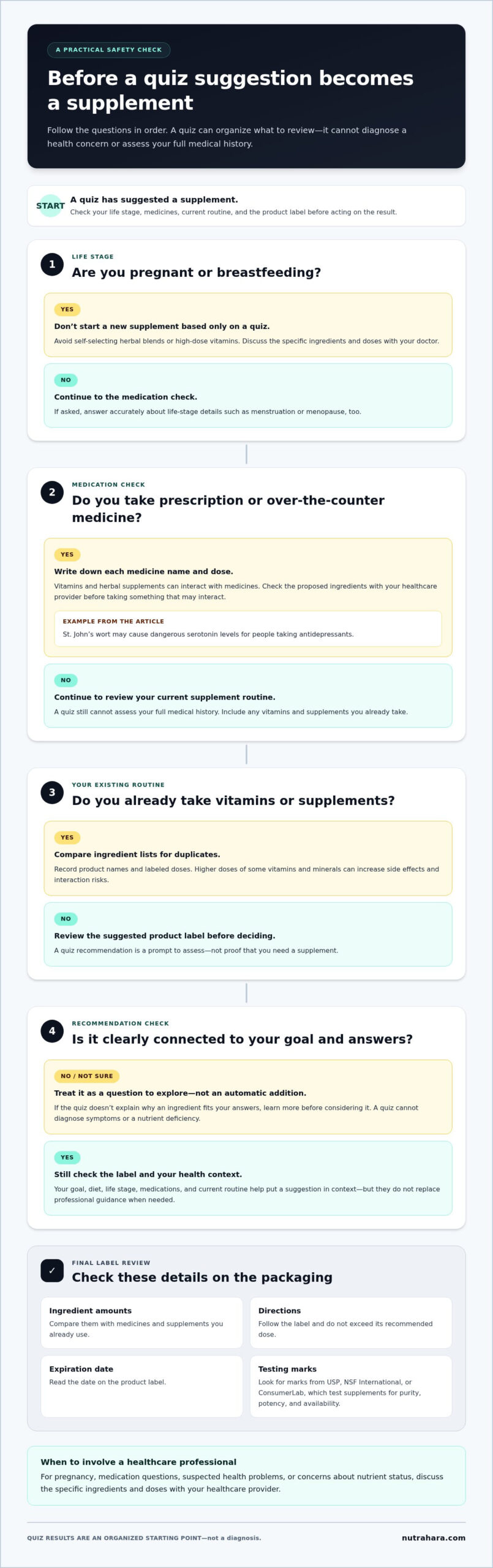
Categories
Articles

The Ultimate Guide to Hair Health: Restoring Shine and Strength from Within

You’ve spent another morning cleaning a concerning amount of hair from your brush, feeling that familiar knot of anxiety. You’ve tried the salon-grade shampoos and the viral hair masks, but the shedding and dullness persist, especially during times of stress or hormonal change. It’s completely valid to feel frustrated when your outer appearance doesn’t reflect the vitality you feel inside. The search for a solution can feel overwhelming, with countless products all promising the same miracle cure.

This guide is different. We’re going beyond the surface to empower you with a clear understanding of your hair’s true foundation. You will discover how to restore shine and strength from within by nurturing the biological and Ayurvedic roots of genuine hair health. We will explore the crucial link between your nutrition and hormones, providing you with a simple, actionable plan for achieving the vibrant, resilient hair you deserve on your wellness journey.

Key Takeaways

  • Understand why your hair’s appearance is a direct reflection of your internal metabolic and hormonal balance.
  • Discover the key nutrients and hormonal shifts that are scientifically proven to dictate your hair’s growth cycle and strength from the follicle up.
  • Learn the crucial difference between temporary cosmetic fixes from topical products and the true internal nourishment required for lasting hair health.
  • Explore 5 actionable steps, blending modern nutrition with Ayurvedic wisdom, to build stronger hair and reduce scalp inflammation from within.

What is Hair Health? Understanding the ‘Canary in the Coal Mine’

On your personal wellness journey, it’s easy to view your hair as a purely aesthetic feature. But true hair health is a profound reflection of your body’s internal harmony. It’s a direct indicator of your metabolic and hormonal homeostasis, offering clues about your overall well-being long before other symptoms may appear. Think of your hair as the body’s ‘canary in the coal mine’.

Because hair growth is not essential for survival, it’s one of the first processes the body deprioritizes during times of internal stress. When faced with nutrient scarcity, illness, or significant hormonal shifts, your body wisely redirects vital resources like iron, zinc, and protein away from your hair follicles and toward critical organs. This is why changes in your hair’s texture, density, or growth can be an early signal of an underlying imbalance. The visible signs of truly healthy hair are clear and measurable: strong elasticity allowing a strand to stretch, a smooth, sealed cuticle that reflects light and creates shine, and consistent follicle density across the scalp.

The Three Pillars of Hair Vitality

Achieving and maintaining vibrant hair is grounded in three core biological principles. Understanding them empowers you to nurture your hair from the inside out, bridging the gap between ancient wisdom and modern science.

  • Structural Integrity: Your hair’s strength comes from its core composition. Each strand is made of up to 95% keratin, a fibrous structural protein. A deep look into the structure of human hair reveals why a diet rich in bioavailable proteins and amino acids isn’t just beneficial; it’s fundamental. Without these building blocks, hair can become brittle and prone to breakage.
  • Scalp Environment: A healthy scalp is the fertile ‘soil’ from which strong hair ‘seeds’ can grow. This delicate ecosystem requires balanced sebum production, optimal circulation to deliver nutrients, and a stable pH of around 4.5 to 5.5. An imbalanced or inflamed scalp can directly inhibit follicle function and disrupt the growth cycle.
  • Growth Cycles: Hair growth isn’t a continuous process. It occurs in three distinct phases. At any time, 85-90% of your hair is in the Anagen (growth) phase, which can last from 2 to 7 years. This is followed by a brief Catagen (transition) phase, and finally the Telogen (resting) phase, where about 10-15% of hairs rest for approximately 3 months before shedding.

When to Worry: Normal Shedding vs. Telogen Effluvium

Finding strands in your brush or the shower drain is a normal part of a healthy hair cycle. Losing between 50 and 100 hairs per day is completely typical as resting hairs make way for new growth. However, a sudden, noticeable increase in shedding that leads to diffuse thinning can be unsettling. This is often a condition called Telogen Effluvium.

This type of hair loss is triggered by a significant physiological or emotional stressor, such as a high fever, major surgery, childbirth, or extreme emotional distress. The shedding doesn’t happen immediately; it typically begins 2 to 3 months *after* the stressful event. Telogen Effluvium is a temporary, stress-induced shift where a large number of hairs prematurely enter the resting (telogen) phase of the growth cycle. While distressing, it’s important to remember that this condition is a temporary response, and understanding its cause is the first step toward restoring balance and promoting healthy regrowth.

The Biological Foundations: How Nutrition and Hormones Dictate Growth

Lush, vibrant hair isn’t born from a bottle; it’s built from within. Your hair is a direct reflection of your internal ecosystem, a living record of your nutritional intake and hormonal harmony. Think of each hair follicle as a tiny, complex factory. To function optimally, it requires a precise supply of raw materials and the right operational signals. When these elements are in balance, the result is strong, resilient growth. When they’re not, the factory slows down, leading to thinning, shedding, and loss of vitality.

At the core of this biological process are the building blocks you consume. The ‘Big Three’ for hair-Biotin, Zinc, and Iron-are non-negotiable for robust follicle synthesis. Iron is essential for producing hemoglobin, which carries oxygen to your scalp to fuel cell repair and growth. Zinc plays a critical role in hair tissue growth and repair, keeping the oil glands around the follicles working correctly. Biotin, a B-vitamin, is fundamental to producing keratin, the very protein that makes up over 90% of your hair structure.

This modern understanding of micronutrients finds a powerful partner in ancient Ayurvedic wisdom. Ayurveda identifies an excess of the ‘Pitta’ dosha, associated with heat and inflammation, as a primary cause of premature thinning and greying. Cooling this internal fire through diet and botanicals supports a balanced scalp environment. It’s this beautiful synergy-where clinical nutrition validates ancient knowledge-that provides a truly holistic path to lasting hair health.

The Nutrient Deficiency Checklist

While the ‘Big Three’ get most of the attention, other key nutrients are vital. Vitamin D, often called the ‘forgotten’ hair nutrient, helps create new follicles and awaken dormant ones. A deficiency can directly impact hair density. Equally important are the B-complex vitamins, which are crucial for creating red blood cells that transport oxygen and nutrients to the scalp. A steady supply ensures your follicles have the energy they need. Supporting this foundational energy production with a high-quality Vitamin B Complex can be a cornerstone of your hair wellness journey.

Hormones and the Hair Journey

Your hormonal landscape directly dictates your hair’s life cycle. During perimenopause and menopause, a decline in estrogen can shorten the anagen (growth) phase of your hair, leading to finer, thinner strands. Conversely, high levels of the stress hormone cortisol can shock the system, pushing a significant number of follicles into a premature ‘hibernation’ phase known as telogen effluvium. While many external products make bold claims, the most credible scientific facts about hair care reveal that internal balance is paramount. Nurturing this equilibrium with targeted botanicals, like those found in FemmePower, can help you gracefully manage the hormonal shifts that impact your hair’s vitality.

True, sustainable hair health begins by honoring these deep biological connections. By nourishing your body with the right nutrients and supporting your hormonal balance, you empower your hair to grow to its fullest, most beautiful potential. Understanding your unique internal needs is the first step, and we invite you to explore our wellness resources to continue your journey.

External Myths vs. Internal Realities: Why Your Shampoo Isn’t Enough

We’ve all been captivated by commercials promising to “repair” damaged hair with a single wash. The beauty aisle is filled with bottles that claim to feed, mend, and resurrect lifeless strands. But here is the scientific truth, grounded in biology: the hair you see is not living. It’s a fiber composed of dead keratin protein cells. It cannot be “fed” from the outside any more than a silk scarf can. While premium shampoos and masks can coat the hair cuticle with silicones and oils to make it feel smoother and look shinier, this is a temporary cosmetic effect, not a true restoration of health.

This cycle of external fixes often masks deeper issues. When hair is brittle or thin due to internal imbalances, many turn to harsh chemical treatments like coloring or straightening to improve its appearance. This creates a dangerous loop: the over-processing further damages the hair’s structure, making its underlying weakness even more apparent once the cosmetic effects wear off. The only part of your external routine that truly influences new growth is your scalp care. A clean, well-circulated scalp provides the fertile ground from which strong hair can grow. According to the American Academy of Dermatology, gentle handling and focusing on the scalp are key, and their dermatologist tips for healthy hair emphasize protecting the hair you have, not magically repairing it.

The Role of Topical vs. Systemic Treatments

Understanding where to focus your efforts is key. Topical treatments, like the ancient Ayurvedic practice of head massage with oils like Bhringraj, are excellent for improving scalp circulation and moisture. They create an optimal external environment. Systemic treatments, like clinically formulated supplements, work internally to provide the raw materials. Our ‘Inside-Out’ philosophy is built on a simple fact: over 90% of your hair’s strength and vitality is determined by the nutrition delivered to the follicle before the hair ever leaves the scalp. Be wary of misleading labels you’ll see by 2026, such as:

  • “Split-End Fusion Serums”: These products use polymers to temporarily glue ends together; they don’t permanently mend the keratin fiber.
  • “Follicle-Feeding Mists”: A mist applied to the hair shaft cannot feed the follicle, which is located 4 millimeters beneath the scalp’s surface.

Addressing the ‘Biotin is Enough’ Misconception

The belief that biotin is the single magic pill for hair growth is one of the most persistent myths in wellness. While Biotin (Vitamin B7) is essential for keratin production, true clinical biotin deficiency is rare. For most women, lackluster hair isn’t caused by a lack of biotin alone. It’s caused by a lack of the supporting nutrients biotin needs to do its job. Think of biotin as a single musician. It needs a full orchestra of co-factors like Zinc to aid in follicle cell division, Iron to carry oxygen for growth, and amino acids like L-cysteine, which are the direct building blocks of the keratin protein itself. Without them, biotin can’t perform. True hair health is a symphony of nutrients, not a solo performance by a single vitamin.

The Ultimate Guide to Hair Health: Restoring Shine and Strength from Within

5 Steps to Restore Your Hair’s Natural Abundance and Shine

Reclaiming your hair’s vitality isn’t about finding a single magic product; it’s a holistic journey that addresses the root causes of dullness and thinning. True, lasting results come from a conscious fusion of modern nutritional science and ancient wellness wisdom. By focusing on these five foundational steps, you can create the optimal internal and external environment for your hair to flourish, moving from a state of stress to one of strength.

Step 1 & 2: Nutritional and Ayurvedic Foundations

Your hair is primarily made of a protein called keratin. Providing your body with the right building blocks is non-negotiable for robust growth. We recommend focusing on a diet rich in amino acids, vitamins, and minerals. Key foods include:

  • Pumpkin Seeds: Just one ounce provides nearly 20% of your daily zinc, a mineral essential for regulating the hair growth cycle.
  • Leafy Greens: Spinach and kale are packed with iron and Vitamin C. Vitamin C is crucial for absorbing iron, a deficiency of which is linked to hair loss in up to 50% of women.
  • Healthy Fats: Avocados and nuts deliver Vitamin E, a powerful antioxidant that protects the scalp from oxidative stress.

From an Ayurvedic perspective, scalp inflammation, or an excess of “Pitta,” can disrupt follicles. A traditional calming ritual is Abhyanga, or self-massage with warm oil. Simply warm a tablespoon of coconut or sesame oil, apply it to your scalp with your fingertips, and use gentle, circular motions for 5-10 minutes before washing. This practice cools inflammation and boosts circulation directly to the roots. For deep structural support, a bioavailable Premium Collagen Complex can supply the specific amino acids your body needs to construct resilient keratin fibers.

Step 3 & 4: Stress Management and Supplementation

The connection between your nervous system and hair follicles is scientifically proven. A 2021 study published in Nature confirmed that the stress hormone cortisol can force a significant number of hair follicles into a prolonged resting (Telogen) phase, effectively halting new growth. Managing systemic stress is therefore a critical component of any effective plan for better hair health.

This is where adaptogens, natural botanicals that help your body adapt to stressors, become invaluable. Ashwagandha is a clinically-studied adaptogen revered in Ayurveda for its ability to help regulate cortisol levels. By promoting a state of calm, it helps keep your follicles in the active growth (Anagen) phase longer. For targeted support on your wellness journey, our Ashwagandha with Black Pepper is formulated to help your body manage its stress response, creating a healthier internal ecosystem for hair to thrive.

Finally, Step 5 is optimizing scalp circulation and maintaining a clean follicular environment. The Abhyanga massage is a perfect start. Complement it by using clean, non-toxic hair care products free from sulfates and silicones that can clog pores and inhibit growth. By nourishing from within and caring for your scalp, you create a complete, 360-degree approach to restoring your hair’s natural brilliance.

Ready to build your holistic hair care ritual? Explore our full range of women’s wellness supplements designed to support you from the inside out.

Bridging Earth and Science: The Nutrahara Approach to Hair Wellness

Your hair isn’t just hair. It’s a living record of your internal well-being, a direct reflection of your body’s harmony or stress. That’s why at Nutrahara, we don’t formulate for a single symptom; we formulate for the ‘Total Woman.’ We recognize that your hair health is deeply intertwined with your endocrine, nervous, and digestive systems. Thinning strands, a lack of luster, or excessive shedding aren’t isolated problems. They are signals from your body asking for deeper support. Our approach addresses the root cause by nurturing this interconnected system, creating a foundation for holistic wellness that shines through.

Our philosophy is built on a powerful trinity: 40 years of nutritional science expertise, the timeless wisdom of Ayurveda, and rigorous modern clinical trials. Ancient Ayurvedic science, with its 5,000-year history, provides the holistic map to understanding the body’s unique constitution, or dosha. It teaches us how to achieve balance. Our four decades of research experience bring precision to this ancient wisdom, allowing us to refine dosages and select the most bioavailable forms of each ingredient. Finally, we validate our formulas with modern science. For example, we use clinically-studied Sensoril® Ashwagandha, which was shown in a randomized, double-blind, placebo-controlled human trial to reduce serum cortisol levels by 27.9%, directly targeting the stress that impacts your entire body.

Respecting your body’s natural ecology is non-negotiable, and it’s the core of our ‘Clean and Simple’ commitment. Every capsule is formulated without:

  • Gluten or Soy
  • Genetically Modified Organisms (GMOs)
  • Artificial Fillers or Colors
  • Unnecessary Binders

These additives do more than just take up space; they can interfere with nutrient absorption and disrupt your delicate gut microbiome. We believe that what you leave out is just as important as what you put in. By providing pure, potent botanicals and nutrients, we support your body’s innate ability to heal and thrive. This foundational support is essential for achieving true, sustainable hair health, as it creates the optimal internal environment where strong, vibrant hair can grow.

The Nutrahara Quality Promise

Our ‘Wise Guide’ philosophy ensures every product delivers on its promise of purity and potency. We source only the highest-quality, clinically studied ingredients to support your wellness journey. It’s not just about supplements; it’s about providing a trusted partner for your health. But you don’t have to take our word for it.

“After my second child, my hair was shedding so much. I felt defeated. A friend recommended the Postpartum Kit. Within three months, the shedding slowed, and I saw new growth. Nutrahara gave me back my confidence. It feels like I’m finally taking care of myself again.”
– Jessica M., 34

Your Next Steps Toward Abundance

Your journey to wellness is unique. That’s why we’ve curated kits specifically for your current life stage, whether you’re navigating postpartum recovery, perimenopause, or simply seeking daily balance. Join our community of over 10,000 women for ongoing education and support as we explore how to bridge the gap between Earth and humanity.

Ready to see the first sign of your transformation? Let your vibrant hair lead the way.

Explore the Nutrahara collection for your wellness journey

Embrace Your Hair’s Natural Abundance

Your journey to lustrous hair isn’t found in a bottle on your shower shelf; it begins from within. Vibrant hair is a direct reflection of your internal balance. It’s the ‘canary in the coal mine’ for your overall wellness, with its strength and shine dictated not by external treatments, but by the foundational building blocks of nutrition and hormonal harmony. This is the philosophy at the heart of Nutrahara, where we bridge Earth and science. Backed by 40 years of expertise in women’s health, our approach is a clinically studied fusion of ancient Ayurvedic wisdom and modern nutritional research. Our clean and simple formulas are designed to nourish from the inside out, creating the optimal foundation for genuine hair health.

It’s time to stop masking symptoms and start building strength from your core. Begin your hair health journey with Nutrahara’s clean supplements, formulated for women and delivered worldwide.

Your hair’s potential for radiance is waiting to be unlocked. We’re honored to be your guide on this wellness journey.

Frequently Asked Questions About Hair Health

How long does it take to see results from hair health supplements?

You can typically expect to see visible results from hair supplements after 3 to 6 months of consistent daily use. Your hair’s growth cycle (the anagen phase) is a slow process, and supplements work by nourishing the follicle to support new, healthier hair. A 2015 study in the Journal of Clinical and Aesthetic Dermatology confirmed noticeable improvements in hair volume and thickness after 90 days, so patience on your wellness journey is key.

Can stress really cause my hair to fall out months later?

Yes, a major stressful event can trigger significant hair shedding approximately 2 to 4 months after it occurs. This condition, known as telogen effluvium, forces a large number of hair follicles into the resting phase prematurely. These hairs then fall out a few months later. Up to 70% of scalp hair can be affected, making stress management a critical part of a holistic approach to hair wellness.

Is biotin the best vitamin for hair growth, or are there better options?

Biotin is only the most effective solution for the 2-5% of people with a clinical deficiency; a multi-nutrient formula is better for most women. While biotin supports keratin infrastructure, research shows nutrients like iron, vitamin D, and zinc are more commonly linked to hair thinning. For instance, a 2016 study found 36% of women with hair loss were iron deficient. A comprehensive, clinically studied formula addresses your body’s complete needs.

Does cutting my hair more often make it grow back thicker or faster?

No, cutting your hair doesn’t change its natural growth rate or texture, which are determined at the follicle. Hair grows from the scalp at an average of 0.5 inches per month. Regular trims are beneficial because they remove split ends, preventing breakage that makes hair look thin and damaged. This creates the appearance of thicker, healthier hair by maintaining a blunt, full edge, but it doesn’t alter the growth process itself.

What are the early signs that my hair health is declining?

The earliest signs that your hair health may be declining include a widening part line, a noticeable increase in shedding, or a ponytail that feels less dense. You might find more than the typical 50-100 hairs in your brush or on the floor. Another subtle clue is a change in texture, where your hair feels finer or doesn’t hold its style as well. Identifying these changes early allows you to take supportive action sooner.

Can Ayurvedic herbs like Ashwagandha really help with thinning hair?

Yes, clinically studied adaptogenic herbs like Ashwagandha can support healthy hair by helping your body manage cortisol, the stress hormone. Elevated cortisol from chronic stress can disrupt the hair growth cycle. As shown in a 2019 study in Cureus, Ashwagandha helps regulate the body’s stress response system. This creates a more balanced internal environment, allowing follicles to function optimally and support healthy growth.

Is hair loss in women always related to aging or menopause?

No, hair loss in women is not exclusively an issue of aging. While hormonal shifts during menopause are a common factor, many conditions can cause thinning hair in younger women. Polycystic ovary syndrome (PCOS), postpartum hormonal changes, and thyroid disorders are frequent causes in women under 40. The American Academy of Dermatology confirms that some forms of genetic hair loss can even begin in the teenage years.

How do I know if my hair thinning is due to a nutrient deficiency?

A blood test ordered by your doctor is the only definitive way to know if a nutrient deficiency is the root cause of your hair thinning. While symptoms like fatigue or brittle nails can be indicators, a blood panel provides concrete data. A physician can check your levels of ferritin (stored iron), vitamin D, and zinc, three key nutrients that are scientifically linked to hair loss when they are low.

Article by

Nutrahara Team

We are a dedicated collective of nutrition scientists and naturopaths at Nutrahara, committed to advancing women's health through the fusion of ancient Ayurveda science and cutting-edge nutrition research. Our mission is to empower you with clean, simple, and scientifically validated wellness solutions so you can live your healthiest life. Connect with us to stay updated on the latest developments in holistic women's health and nature-based research.

Disclaimer

This article is not a substitute for medical advice. Please consult a healthcare professional before starting any supplement, especially if pregnant, nursing, taking medication, or managing health conditions.

Categories
Articles

Natural Sleep Supplements: Your Complete Guide to Restful Nights in 2026

Is the glow of your alarm clock a familiar, unwelcome companion in the middle of the night? If you’re tired of tossing and turning, only to face the day feeling irritable and drained, you are not alone on this journey. The search for a solution can be overwhelming, especially when you’re wary of prescription aids or have been let down by supplements that leave you feeling groggy. Finding the right natural sleep supplement shouldn’t be another source of stress; it should be a gentle step toward reclaiming your vitality and well-being.

This is your complete guide to navigating the world of natural sleep support with confidence. Drawing from a blend of ancient botanical wisdom and modern clinical research, we’ll uncover the science-backed ingredients that can help you quiet your mind, sleep through the night, and wake up feeling genuinely refreshed and clear-headed. It’s time to find a gentle, effective, and sustainable solution for the restorative rest you deserve, transforming your wellness journey for 2026 and beyond.

Key Takeaways

  • Understand the crucial difference between natural sleep support and other aids, and how quality rest specifically impacts women’s hormonal health and stress levels.
  • Explore the most effective, science-backed ingredients found in a natural sleep supplement and learn the specific role each plays in calming your mind and body.
  • Pinpoint your unique sleep challenges-whether it’s falling asleep or staying asleep-and discover how to choose the right ingredients for your personal needs.
  • Learn simple lifestyle habits and evening rituals that work in harmony with your supplements to create the ideal conditions for deep, restorative rest.

Beyond Counting Sheep: Why Natural Sleep Support Matters for Women

For many women on their wellness journey, a truly restful night can feel elusive. A natural sleep supplement offers a holistic path forward, differing fundamentally from synthetic over-the-counter (OTC) or prescription aids. Rather than inducing an unnatural state of sedation, these supplements are formulated with clinically-studied botanicals and natural compounds to support and enhance your body’s own innate sleep processes. This distinction is vital, especially for women, as poor sleep can significantly disrupt hormonal balance, amplify stress responses, and destabilize mood.

Achieving quality sleep is about more than just logging hours; it means cycling smoothly through all four stages of sleep to allow for physical repair and mental restoration. The ultimate goal is to wake feeling revitalized and clear-headed, a state that can be difficult to achieve with conventional options. The journey to better rest begins by working in harmony with your body, not against it.

The Problem with Traditional Sleep Aids

Many common OTC sleep aids contain antihistamines like diphenhydramine, which can lead to a dreaded “hangover effect” of next-day grogginess and mental fog. Prescription medications, while effective for some, can carry a risk of dependency. A natural approach, grounded in both ancient wisdom and modern research, seeks to avoid these pitfalls by gently encouraging your body’s own sleep mechanisms, supporting long-term, restorative rest without creating reliance.

Understanding Your Body’s Natural Sleep Signals

Your body has a sophisticated internal clock, orchestrated by key hormones. Melatonin, the “hormone of darkness,” signals your brain that it’s time to rest, while cortisol, the “stress hormone,” should naturally decline in the evening. Modern life-with its chronic stress and constant exposure to blue light from screens-disrupts this delicate rhythm. Understanding melatonin’s role in the sleep-wake cycle is foundational to reclaiming your nights. A thoughtful natural sleep supplement works to help restore this essential balance, paving the way for serenity.

The Science of Serenity: Key Ingredients in Natural Sleep Supplements

Understanding what’s inside your natural sleep supplement is the first step on your journey to better rest. The effectiveness of these formulas isn’t magic; it’s rooted in science. Each ingredient is chosen for a specific, synergistic role in preparing your body and mind for deep, restorative sleep. In fact, a growing body of scientific evidence for natural sleep supplements supports the mechanisms behind these powerful botanicals and minerals. Let’s explore the key players.

  • Melatonin: The body’s natural sleep-triggering hormone.
  • Magnesium: A vital mineral for muscle and nervous system relaxation.
  • L-Theanine: An amino acid that promotes calm without drowsiness.
  • Ashwagandha: An adaptogenic herb that lowers stress and quiets a racing mind.

Hormone Regulators & Cycle Supporters

These ingredients work in harmony with your body’s internal clock. Melatonin is the star player, signaling to your brain that it’s time to sleep. While effective, less is often more; a low dose (0.5-3mg) is typically sufficient. It’s ideal for those with disrupted sleep-wake cycles, like shift workers. Supporting players include Valerian Root, which research suggests can improve sleep quality, and Tart Cherry, a natural source of melatonin.

Mind & Body Calming Agents

When physical tension or a busy mind keeps you awake, these calming agents can help. Magnesium Glycinate is a highly bioavailable form of the mineral, meaning your body can absorb and use it efficiently to relax muscles and calm the nervous system. L-Theanine, an amino acid found in green tea, helps reduce the time it takes to fall asleep by promoting alpha brain waves associated with a state of “wakeful relaxation.” Gentle herbs like Chamomile and Lemon Balm also belong in this category, known for their soothing properties.

Stress & Cortisol Adaptogens

For many, the primary obstacle to sleep is stress. Adaptogens are unique herbs that help your body adapt to and manage the effects of stress. Ashwagandha is a cornerstone of Ayurvedic tradition, clinically studied for its ability to lower levels of the stress hormone cortisol. By calming your body’s stress response, it helps prevent the late-night “wired and tired” feeling, making it easier to unwind. For those whose sleep is disrupted by anxiety, incorporating a high-purity formula like Nutrahara’s Ashwagandha with Black Pepper can be a vital part of a holistic sleep solution.

Your Personal Sleep Solution: Matching Ingredients to Your Needs

One of the most common questions we hear is, “Will this actually work for me?” The answer lies in understanding that not all sleep challenges are the same. Your wellness journey is unique, and your path to restful nights should be too. The most effective natural sleep supplement is one formulated to address your specific needs. Think of this guide as your personal roadmap, designed to help you select ingredients with intention. These natural allies work best as part of a holistic approach, especially when combined with healthy sleep hygiene practices that create a sanctuary for rest.

Challenge: Trouble Falling Asleep (Racing Mind)

If your mind starts running a marathon the moment your head hits the pillow, your goal is to promote a state of calm. You need ingredients that gently soothe the nervous system and quiet mental chatter. These botanicals and minerals signal to your body and mind that it’s time to wind down.

  • L-Theanine: An amino acid found in green tea that encourages a state of relaxed alertness without drowsiness.
  • Ashwagandha: A revered Ayurvedic adaptogen that helps regulate stress by lowering cortisol levels.
  • Magnesium: An essential mineral that helps calm the nervous system by regulating key neurotransmitters.
  • Lemon Balm: A traditional herb known for its ability to reduce anxiety and promote tranquility.

Challenge: Waking Up in the Middle of the Night

For those who fall asleep easily but struggle to stay asleep, the focus shifts to supporting deeper, more sustained rest. The right ingredients can help you navigate through the natural sleep cycles without disruptive awakenings, ensuring you remain in a restorative state until morning.

  • Valerian Root: Clinically studied for its ability to improve sleep duration and reduce nighttime awakenings.
  • Melatonin (low dose): Supports the body’s natural sleep-wake cycle, helping to maintain sleep throughout the night.
  • Glycine: An amino acid shown in research to help lower core body temperature, a key physiological signal for staying asleep.

Challenge: Waking Up Feeling Groggy & Unrested

Quality over quantity is key. If you log a full eight hours but still feel exhausted, you may need to improve your sleep architecture-the very structure of your nightly rest. The goal here is to find a non-sedating natural sleep supplement that enhances deep and REM sleep, so you wake up feeling genuinely refreshed.

  • Magnesium: Essential for deep, restorative sleep, a deficiency can lead to lighter, more restless nights.
  • Apigenin (from Chamomile): This powerful bioflavonoid promotes relaxation and improves sleep quality without causing morning grogginess.
  • Tart Cherry: A natural source of melatonin and antioxidants that research suggests can improve overall sleep efficiency.

Creating Your Sanctuary: Lifestyle Habits to Amplify Your Supplement’s Effects

Embarking on your wellness journey with a natural sleep supplement is a powerful step toward reclaiming your nights. However, to truly unlock its full potential, it’s essential to view it as part of a holistic, nurturing routine. Think of your supplement as the key and your lifestyle habits as the door-together, they open the way to profound, restorative rest. By creating a conscious nighttime ritual, you signal to your body and mind that it’s time to transition from the demands of the day to a state of deep tranquility.

Your Pre-Sleep Power-Down Routine

Crafting a consistent “power-down” sequence is one of the most effective ways to prepare for sleep. This simple, three-step ritual helps regulate your internal clock and enhances the calming effects of your chosen supplement.

  • Step 1: Dim & Disconnect. About 60-90 minutes before bed, dim the lights in your home. Crucially, step away from all screens-phones, tablets, and televisions. The blue light emitted from these devices can suppress melatonin production, your body’s natural sleep hormone.
  • Step 2: Unwind Mindfully. Dedicate 20-30 minutes to a calming activity. This could be reading a physical book, practicing gentle stretching, listening to serene music, or meditating. The goal is to quiet your mind and release the day’s tension.
  • Step 3: Take Your Supplement. Approximately 30-60 minutes before you intend to be asleep, take your natural sleep supplement. This timing allows the clinically-studied, natural ingredients to begin their work, gently guiding you toward slumber as you finish your routine.

Optimizing Your Environment for Deep Sleep

Your bedroom should be a sanctuary dedicated to rest. A few simple adjustments to your environment can dramatically improve sleep quality and help you stay asleep through the night.

First, focus on the three pillars of a sleep-friendly environment: keep it cool, dark, and quiet. A cooler room temperature (around 65°F or 18°C) is scientifically proven to promote better sleep. Invest in blackout curtains to block out all light, and consider a white noise machine or earplugs to mask disruptive sounds. Finally, be mindful of what you consume in the hours before bed. Avoid caffeine after 2 PM and steer clear of large meals or alcohol close to bedtime, as these can interfere with your natural sleep architecture. Embracing this balanced lifestyle is at the heart of the Nutrahara philosophy.

Natural Sleep Supplements: Your Complete Guide to Restful Nights in 2026

The Nutrahara Approach: Blending Ancient Wisdom with Modern Science

Your wellness journey is personal, and finding the right support for restful sleep is a crucial part of it. At Nutrahara, our philosophy is rooted in combining the time-tested principles of ancient Ayurveda with the precision of modern clinical research. We believe the most profound solutions are found where nature’s intelligence meets scientific validation. This approach allows us to create a truly effective natural sleep supplement that honors your body’s innate rhythms.

We don’t just select powerful ingredients; we formulate them to work in harmony. This synergy is the key to unlocking consistent, restorative sleep and promoting a balanced lifestyle.

Introducing RestoraSleep: Formulated for Complete Renewal

RestoraSleep is the culmination of our philosophy-a comprehensive solution designed for the modern woman facing common sleep challenges. Our clean and simple formula addresses both falling asleep and staying asleep, helping you wake up feeling renewed. Each ingredient is clinically studied and chosen for its specific role:

  • Melatonin: A gentle dose to signal to your body that it’s time for rest, helping to regulate your natural sleep-wake cycle without causing grogginess.
  • Magnesium Glycinate: A highly absorbable form of magnesium that calms the nervous system, relaxes muscles, and supports deeper, more continuous sleep.
  • L-Theanine: An amino acid found in green tea that quiets an anxious mind, easing the transition into a peaceful slumber.

This synergistic blend is delivered without unnecessary fillers or artificial additives. To see how it can support you, we invite you to explore RestoraSleep for your wellness journey.

Your Journey to Better Sleep Starts Tonight

Choosing the right natural sleep supplement is an investment in your total well-being. Our unwavering commitment to purity, quality, and efficacy ensures that every capsule supports your body’s needs. Take a confident step toward reclaiming your nights and revitalizing your days. Your path to deeper, more rejuvenating sleep can begin tonight.

Your Path to Restorative Sleep Begins Now

Embarking on your wellness journey means recognizing that restorative sleep is not a luxury, but a necessity for vibrant health. As we’ve explored, the key to unlocking better rest lies in understanding the science behind potent natural ingredients and integrating them with supportive lifestyle habits. Choosing the right natural sleep supplement is a deeply personal decision, one that honors your unique needs and helps re-establish your body’s innate rhythm.

At Nutrahara, we are dedicated to this holistic approach. Our RestoraSleep formula was created by blending the ancient wisdom of Ayurveda with modern clinical research to serve as a true partner in your well-being. With clean ingredients free from artificial additives, it is carefully designed to support you through all 4 stages of the sleep cycle, guiding you gently toward the rejuvenating rest you deserve.

Begin your journey to restorative sleep with RestoraSleep. Your path to serene nights and energized mornings is waiting.

Frequently Asked Questions About Natural Sleep Supplements

Are natural sleep supplements safe to take every night?

For most individuals, high-quality natural sleep aids are considered safe for short-term nightly use to help re-establish a healthy sleep cycle. Ingredients like magnesium and L-theanine are generally well-tolerated. However, it is wise to view them as a tool on your wellness journey, not a permanent solution. We always recommend consulting with your healthcare provider to create a holistic plan that addresses the root cause of your sleep challenges and ensures long-term well-being.

How long does it take for a natural sleep supplement to work?

The time it takes for a natural sleep supplement to work depends on its ingredients and your unique body chemistry. Some, like melatonin, can begin to signal sleepiness within 30 to 60 minutes. Others, such as valerian root or magnesium, may have a more cumulative effect, promoting deeper relaxation and improving sleep quality over several nights of consistent use. Listening to your body and maintaining a consistent routine is key to experiencing the full benefits.

Can I become dependent on natural sleep aids like melatonin?

Unlike many prescription sleep medications, natural ingredients like melatonin do not typically cause physical dependence. However, it is possible to develop a psychological reliance on any sleep aid. The goal is to support your body’s innate ability to rest. We advocate for using supplements to help regulate your sleep-wake cycle while also cultivating healthy sleep hygiene practices, creating a balanced and sustainable approach to your well-being without long-term dependency.

What’s the difference between melatonin and magnesium for sleep?

Melatonin and magnesium support sleep through different biological pathways. Melatonin is a hormone that directly regulates your circadian rhythm, signaling to your body that it’s time to sleep. It is often used for issues like jet lag or shift work. Magnesium, on the other hand, is an essential mineral that promotes relaxation by calming the nervous system and regulating neurotransmitters. It helps quiet the mind and body, making it easier to fall and stay asleep.

Can I take natural sleep supplements with other medications?

This is a crucial question for your safety. While many natural supplements are safe, some can interact with prescription medications, including blood thinners, antidepressants, or blood pressure medication. For example, St. John’s Wort is known for its extensive interactions. To ensure your well-being, it is absolutely essential to consult with your healthcare provider or pharmacist before adding any new supplement to your regimen. This transparency is a vital step in your personal health journey.

Will natural sleep supplements make me feel groggy the next day?

A key benefit of most natural sleep aids is the reduced likelihood of next-day grogginess compared to pharmaceutical options. However, an incorrect dosage, particularly with melatonin, can sometimes disrupt your natural rhythm and lead to feeling groggy. Starting with the lowest effective dose and taking it at the appropriate time before bed helps ensure you wake up feeling refreshed and restored. Always follow the product’s formulation guidelines for optimal results.

What is the best natural supplement for sleep anxiety?

For sleep challenges rooted in anxiety, look for supplements with calming, or “adaptogenic,” properties. L-theanine, an amino acid found in green tea, is clinically studied for its ability to promote relaxation without sedation. Ancient Ayurvedic herbs like Ashwagandha are also highly regarded for helping the body manage stress and quiet a racing mind. These ingredients support a state of tranquility, making it easier to transition into a peaceful and restorative sleep.

Article by

Nutrahara Team

We are a dedicated collective of nutrition scientists and naturopaths at Nutrahara, committed to advancing women's health through the fusion of ancient Ayurveda science and cutting-edge nutrition research. Our mission is to empower you with clean, simple, and scientifically validated wellness solutions so you can live your healthiest life. Connect with us to stay updated on the latest developments in holistic women's health and nature-based research.

Disclaimer

This article is not a substitute for medical advice. Please consult a healthcare professional before starting any supplement, especially if pregnant, nursing, taking medication, or managing health conditions.