
A longer supplement routine doesn’t necessarily mean better health. Supplements and vitamins can help address a specific nutritional need, but taking them without a clear reason may add little, and large doses can be harmful. Their value depends on what you take, how much you take, and your individual needs.
It’s understandable to look for extra support for energy, wellbeing, or immune function, especially as your body’s needs change through different life stages. But a familiar label or a promise of immune support doesn’t tell the whole story. What matters is how a supplement fits with your diet, health, and any medicines you take.
Here, you’ll learn how common supplements may help or fall short, what to consider about fish oil and omega-3s, and why vitamins don’t work as a one-size-fits-all shield for immune health. We’ll also cover practical ways to think about food sources, doses, and safety, so you can make calmer, more informed choices for your wellbeing.
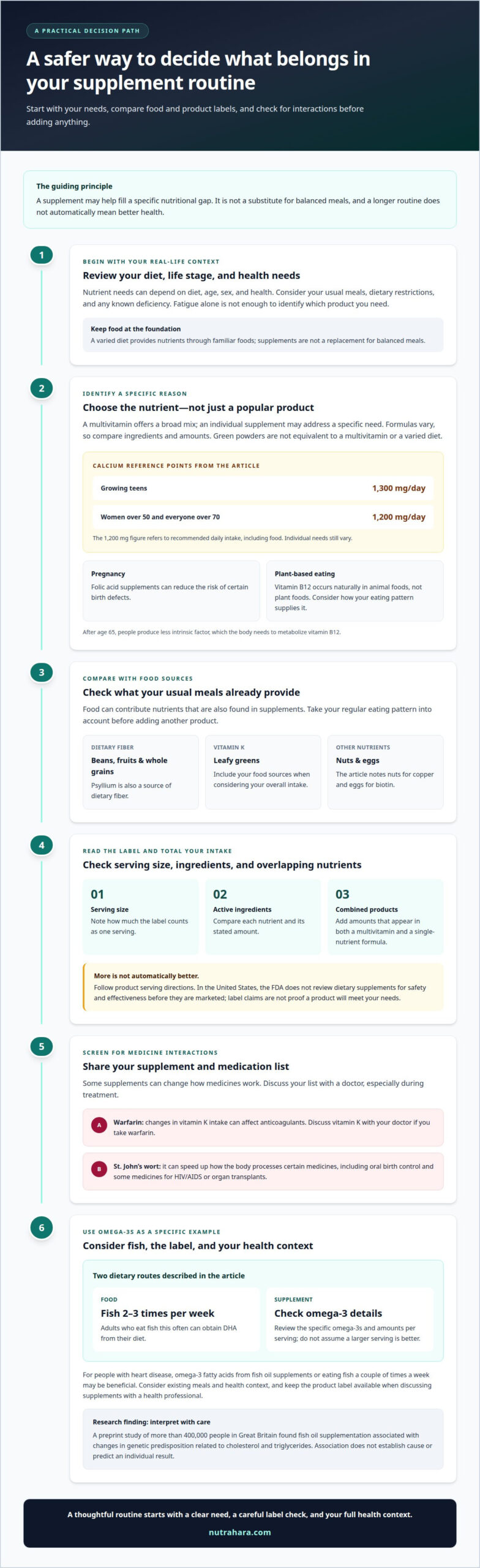
Supplements can help address a specific nutritional gap, but they aren’t a substitute for balanced meals. The right choice depends on your diet, life stage, and health needs.
Choose a multivitamin for a broad mix of nutrients, or an individual supplement for a specific need. Multivitamin and mineral products vary widely, so compare the label’s amounts and ingredients rather than assuming their formulas are alike. Green powders also differ in composition and aren’t equivalent to a multivitamin or a varied diet. Food is the foundation of good nutrition.
There isn’t one list or dose that suits every adult; needs depend on diet, age, sex, and health. Review your usual meals, dietary restrictions, and any known deficiency with a health professional, rather than using fatigue alone to choose a product. Magnesium needs vary by age and sex. According to the National Institutes of Health, Office of Dietary Supplements, the recommended calcium intake for growing teens is 1,300 milligrams per day.
Pregnancy changes nutritional needs: folic acid supplements can reduce the risk of certain birth defects. Adults over 50 may benefit from added calcium and other vitamins as they grow older. After age 65, people produce less intrinsic factor, which the body needs to metabolize vitamin B12. If you follow a plant-based diet, note that B12 occurs naturally in animal foods, not plant foods, and consider how your eating pattern supplies it.
Some supplements can change how medicines work. Changes in vitamin K intake can affect anticoagulants, so if you take warfarin, discuss vitamin K with your doctor. St. John’s wort can speed up how the body processes certain medicines, including oral birth control and some drugs for HIV/AIDS or organ transplants. Before starting a supplement, share your medication and supplement list with your doctor, especially during treatment.
A supplement is most useful when it addresses a real dietary gap, not simply because it’s popular. Before deciding what belongs in your routine, compare the evidence, food sources, and label details.
Consider what a product contains and the specific purpose it serves. Probiotics, for example, are different from vitamins and minerals, and evidence for one supplement doesn’t apply to another. Psyllium is a source of dietary fiber; fiber-rich foods such as beans, fruits, and whole grains can also support everyday nutrition. A varied diet provides nutrients through familiar foods, including leafy greens for vitamin K, nuts for copper, and eggs for biotin.
Supplement needs can shift with life stage and eating pattern. Folic acid supplements during pregnancy can reduce the risk of certain birth defects. According to the National Institutes of Health, Office of Dietary Supplements, the recommended daily calcium intake for women over 50 and everyone over 70 is 1,200 milligrams per day. Use that figure as a reference for total intake, including food.
Read the serving size, active ingredients, and amount of each nutrient. Compare products you already take, as a multivitamin and a single-nutrient formula may contain some of the same nutrients. Add the amounts together before using both, and follow the product’s serving directions rather than assuming more is better.
In the United States, the U.S. Food and Drug Administration does not review dietary supplements for safety and effectiveness before they are marketed. Treat label claims as information to assess, not proof that a product will meet your needs. A useful next step is to record your usual foods, supplements, and medications, then discuss the list with a health professional. For a focused nutrient option, explore a vitamin B complex supplement.
Fish oil supplements provide one way to add omega-3 fatty acids to a diet. Food can also supply DHA, an omega-3 fatty acid. Adults who eat fish two to three times per week can obtain DHA from their diet. Consider your regular meals first, then compare them with the reason you’re considering a supplement.
Fish oil and omega supplements aren’t interchangeable with every wellness choice. Check the label for the specific omega-3s and amounts per serving, then compare those details with your current routine. Don’t assume that a larger serving is better. A balanced eating pattern still includes vegetables, protein foods, and other nutrients such as calcium, which serve different nutritional roles.
For people with heart disease, omega-3 fatty acids from fish oil supplements or eating fish a couple of times a week may be beneficial. That gives two dietary routes to consider: fish as food, or a supplement. The decision should reflect existing meals and health context, rather than a general promise of better heart health. Keep the product label available when discussing supplements with a health professional, especially if you take medicine.
A preprint study of more than 400,000 people in Great Britain found fish oil supplementation associated with changes in genetic predisposition related to cholesterol and triglycerides. An association does not establish that taking fish oil causes those changes or predicts an individual result. Treat the finding as one research detail, not a personal outcome forecast.
To make a practical choice, note how often fish appears in your meals and why you’re considering omega-3s. If fish is already a regular part of your diet, account for that source before adding capsules. If you rarely eat fish, compare the supplement’s stated omega-3 content and serving directions. This simple review helps keep your plan intentional and avoids treating fish oil as a replacement for varied foods.
Immune function depends on your overall nutritional state, not one capsule promising a quick boost. A vitamin supplement can help address a nutrient gap, but it doesn’t replace varied meals. Build meals around foods such as vegetables, fruit, beans, and whole grains. Then review a supplement’s ingredients and purpose instead of choosing it solely for an “immune support” label.
Vitamin D is one specific example. For people ages 1 to 18, the Endocrine Society recommends vitamin D supplements to avoid rickets and potentially reduce respiratory-infection risk. That recommendation applies to this age group; it doesn’t establish the same routine for every adult. For your own plan, consider your existing diet, life stage, and any supplements already taken. Avoid stacking products without first comparing their ingredient lists.
Distinguish immune claims from general wellness language. A product may combine vitamins with herbs or other ingredients, but that doesn’t prove it prevents infection. Creatine, for example, is a different supplement category from vitamins; including it in a wellness routine doesn’t make it an immune nutrient. Focus on the stated ingredients and intended use, and treat broad promises cautiously.
A practical approach is to write down what you eat and take, then identify a specific nutrient concern before choosing a product. Include whole grains and other everyday foods in that review, since supplements don’t replace a balanced eating pattern. If pregnancy, lactation, or a health condition affects your routine, bring the ingredient list to a healthcare professional. To review a focused nutrient format, explore this vitamin B complex supplement and its listed ingredients.
Nutrahara offers women’s health supplements for those seeking a considered addition to their wellness routine. Its formulations combine principles of Ayurveda with modern nutritional research, using natural, clean ingredients.
These supplements may be worth exploring when you’ve identified a specific wellness goal and want to consider products designed for women. Read each product’s ingredient information alongside your current diet and supplements, particularly as your needs shift through menstruation, pregnancy, lactation, or menopause. Supplements can complement healthy habits, including nourishing meals, movement, yoga, and rest, but they don’t replace them.
Explore Nutrahara’s women’s health supplements at nutrahara.com.
Start with one health goal, note what you already eat and take, and use that information to guide your decisions. A thoughtful approach to supplements and vitamins is personal, not a test of how many products you can add to your routine. Your needs may shift with menstruation, pregnancy, lactation, or menopause, so revisit your choices as life changes.
Keep the foundations steady, too. Nourishing meals, movement you enjoy, restorative sleep, and practices such as yoga or meditation can support a balanced approach to wellbeing. If you’re considering women’s health supplements, take time to understand their ingredients and how they fit your goals and existing routine.
Contact Nutrahara with your questions as you consider your next step. You can build a wellness routine with care, clarity, and confidence.
The clearest reason to consider a nutrient is a specific need, rather than a general promise of better health. Evidence and benefit differ by nutrient and individual; vitamin D, B12, and magnesium aren’t interchangeable. Track your food choices and any known deficiencies, then consider whether a product addresses a gap. A testimonial describes one person’s experience, not proof that the same benefit will apply to you.
Risks include taking more than intended, experiencing unwanted effects, or changing how a medicine works. Keep a written list of products and serving directions, and note any new symptoms after starting a supplement. If you take prescription medicine, include your supplements in a medication review. This gives you a practical record to discuss instead of relying on memory.
Choose a product with a readable ingredient list, clear serving directions, and a purpose that matches your needs. Check that the label names the nutrients and amounts, then compare it with other products in your routine. In the United States, the U.S. Food and Drug Administration doesn’t review supplements for safety and effectiveness before marketing, so promotional wording isn’t independent proof.
These marks refer to separate third-party verification programs, not FDA approval. Their meaning depends on the specific program and product, so read the accompanying explanation instead of assuming a mark guarantees every aspect of quality or suitability. A verification seal also can’t tell you whether an ingredient is appropriate for your diet, health needs, or medications.
The FDA regulates dietary supplements under the food category, rather than approving each product as a medicine before it is marketed. The agency monitors claims and reports of side effects after products reach the market. Keep the package and product details if you need to identify what you took, and report concerning reactions through appropriate medical channels.
There isn’t one set of vitamins or doses that suits every adult; needs depend on diet, age, sex, and health. As references, calcium intake is 1,200 milligrams daily for women over 50 and everyone over 70, and 1,300 milligrams for growing teens.
This article is not a substitute for medical advice. Please consult a healthcare professional before starting any supplement, especially if pregnant, nursing, taking medication, or managing health conditions.