What if the best supplement routine is the one that starts with less, not more? If you’re wondering how to start a supplement routine, it’s understandable to feel unsure where to begin. Your needs and questions may shift with your menstrual cycle, pregnancy, breastfeeding, perimenopause, or menopause. A crowded shelf of bottles isn’t a wellness plan. Start instead with a clear personal goal and a routine you can sustain.
This guide will help you identify what matters most, read product information with care, and choose an approach that fits your everyday habits. You’ll also see how supplements can sit alongside balanced meals, movement, yoga, and meditation, rather than replace them. Before starting or changing a supplement, talk with a doctor or registered dietitian, particularly if you’re pregnant, breastfeeding, managing a health condition, or taking medication. A thoughtful, manageable routine can support your wellbeing without adding overwhelm.
Key Takeaways
- Start with one clear wellness priority to keep your routine focused and manageable.
- Consider how your life stage and changing needs shape the questions you want to explore.
- Compare ingredient lists, serving directions, and stated goals before choosing a product.
- Learn how to start a supplement routine by pairing it with a daily cue that already fits your schedule.
- Use your original goal and personal notes to decide whether your routine still feels right.
Start a Supplement Routine by Defining What You Want to Support
You don’t need to begin with several products or a complicated plan. Choose one area you’d like to understand better, then take stock of the habits and questions around it. Supplements are intended to complement everyday food and wellness practices, not replace meals, movement, rest, or professional care.
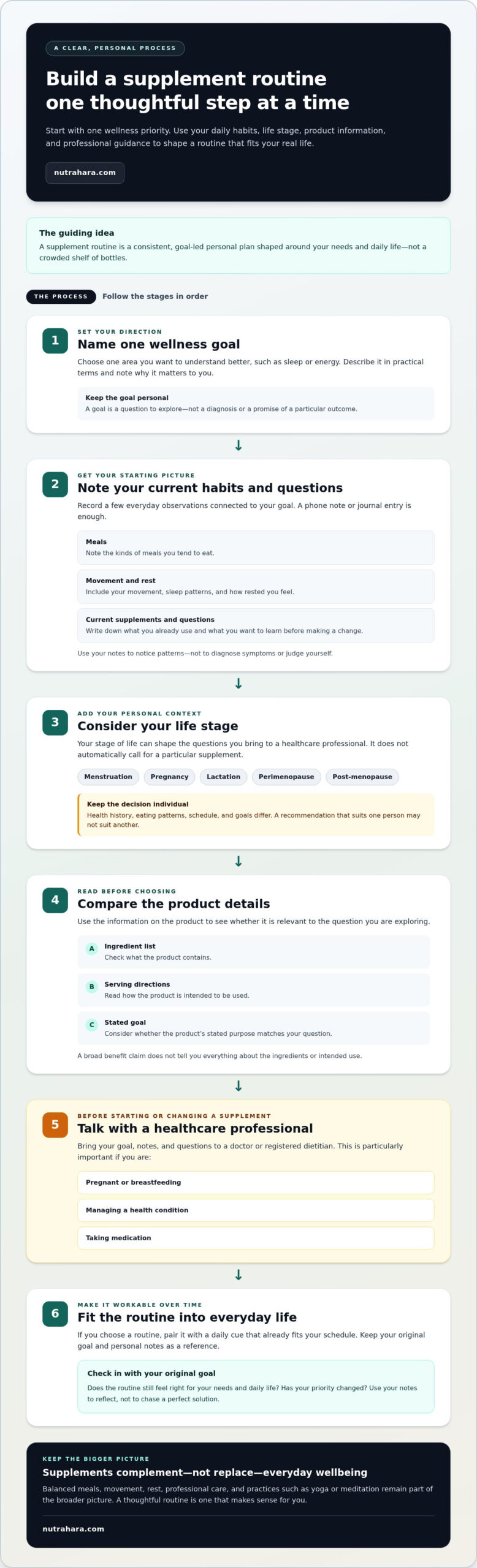
A supplement routine is a consistent, goal-led personal plan shaped around your needs and daily life. This simple sequence can help you get started:
- Name one goal. Choose an area of wellbeing you want to explore, such as sleep or energy.
- Note your current habits. Record your usual meals, movement, sleep patterns, and any supplements you already use.
- Write down your questions. Identify what you need to learn before choosing or changing a product.
These notes give you a clearer basis for considering how to start a supplement routine, without turning wellness into a search for a perfect solution.
Choose one wellness priority before browsing products
Describe your goal in practical terms: “I want to understand what may support my sleep,” or “I’d like to pay closer attention to my energy during the day.” Then add why it matters. Perhaps you want to feel more present during an evening yoga practice or stay focused through a demanding workday. That context can help you assess whether a product’s stated purpose is relevant to you—such as evaluating relaxation-focused options from Vitammies against your evening wind-down routine.
Keep a personal goal distinct from a diagnosis or a promised outcome. Wanting to learn about sleep support doesn’t identify the cause of sleep difficulties, and a product claim can’t guarantee a particular result. If you have a health concern or a question about whether a supplement suits you, discuss it with an appropriate healthcare professional.
Create a simple baseline for your routine
Before making a change, note what your everyday pattern looks like. Include the kinds of meals you tend to eat, movement such as walking or strength training, how rested you feel, and any supplements already in your routine. Focus on a few observations connected to your goal. For example, you might note whether you felt rested on waking or had the energy for your usual activity. Use these notes to notice patterns, not to diagnose symptoms or judge yourself.
Keep the record easy to update. A note on your phone or a journal entry alongside your regular planning can be enough. If hormonal wellbeing is your priority, Nutrahara’s women’s wellness range includes products in the hormones category. Let your own goal and questions guide what you explore next.
Match Your Supplement Goals to Your Life Stage and Wellness Priorities
Your priorities can shift as your body and circumstances change. Menstruation, pregnancy, lactation, perimenopause, and post-menopause each bring a different context to wellness decisions. None automatically calls for a particular supplement. Instead, your life stage can help shape the questions you bring to a healthcare professional and the information you look for before making a change.
Life stage informs the questions to consider, not a universal supplement list. That distinction keeps your routine personal. Two women at the same stage may have different health histories, eating patterns, schedules, and goals, so a recommendation that suits one person may not suit another.
Connect life stage with the questions you bring
Consider whether anything about your current life stage changes your priorities. You might be thinking about menstrual wellbeing, navigating changes associated with perimenopause, or considering supplements during pregnancy or while lactating. Write down what you hope to understand, what you already take, and any relevant health or medication questions. Bring these notes to a doctor, registered dietitian, or another appropriate healthcare professional before choosing or changing a routine.
Rather than assuming that a certain life stage means you need a specific product, ask whether your goal is appropriate to address with a supplement and what factors matter in your individual situation. Clear questions can make a conversation more useful and help you avoid adding something simply because it is marketed for people in a similar stage.
Include movement and mental wellbeing in the bigger picture
Supplements are only one part of a broader picture of wellbeing. Regular movement, nourishing meals, restorative sleep, and stress-management practices all have a place alongside your personal goals. The right balance will vary with your energy, responsibilities, health, and preferences. A steady walk, strength session, or favorite fitness class may already be part of your week. A supplement doesn’t replace those habits.
Yoga can connect movement with mindful attention, while meditation may offer a quiet moment to check in with yourself. Try a brief reflection after a yoga session or at the end of your day: What feels supportive right now? Has your priority changed? These observations can help you keep your plan aligned with real life instead of chasing every new wellness trend.
If hormonal wellbeing is one of your priorities, explore Nutrahara’s women’s wellness supplements alongside your broader research. Keep your life stage, individual needs, and professional guidance at the center of any decision. A thoughtful routine is one that makes sense for you, not one built from assumptions about what every woman should take.
Compare Supplement Labels and Ingredients Before You Choose
Once you have a goal in mind, use the product information to see whether a supplement is relevant to the question you’re exploring. A broad benefit claim may catch your attention, but it doesn’t tell you everything about the ingredients or how the product is intended to be used. Compare the details calmly and note anything you’d like a healthcare professional to clarify.
Use this simple framework to compare options:
| What to compare | What to look for | Question to resolve |
|---|---|---|
| Stated goal | The area of wellness named on the product information | Does this match the priority you’ve chosen? |
| Ingredient list | Each ingredient as listed on the label | Do I recognize what’s included, and are there ingredients I need to discuss? |
| Serving directions | The instructions provided for that product | Can I understand and realistically follow these directions? |
| Questions to resolve | Anything unclear about fit, ingredients, or use | Should I discuss this with a doctor or registered dietitian before deciding? |
Read the label for clear, relevant information
Start with the ingredient list and serving directions. Then compare the product’s stated goal with the priority you identified earlier. If you’re exploring energy support, for instance, look for product information that clearly relates to that area rather than relying on a general promise to support overall wellness. For specialized formulations, such as the functional mushroom and flower essence supplements available at lanori.shop, checking individual ingredient profiles helps ensure they fit your specific intention. If you’re unsure about an ingredient or how a product fits your needs, pause and seek qualified guidance.
An ingredient described as clinically studied doesn’t establish a specific outcome for every finished product that contains it. The product’s full formulation, the evidence available, and your own circumstances all matter. Treat label language as information to assess, not a guarantee. Nutrahara combines principles of ancient Ayurveda science with modern nutrition research, and its ingredients are described as clinically studied. This is useful context about the brand’s approach, not a promise of a particular result.
Keep the first routine focused and easy to understand
Evaluate one product choice at a time instead of assembling a crowded stack. Keep a list of supplements you already take, including their names and serving directions. That record gives you and a healthcare professional a clearer view of what you’re considering and can help you spot overlapping ingredients before making a change.
If you’re reviewing the vitamin B category, Nutrahara’s Vitamin B Complex page is one example of product information to examine alongside your personal goal and questions. It isn’t a recommendation for everyone. The aim is to choose thoughtfully, understand what you’re considering, and keep your routine simple enough to review.
Build a Daily Supplement Habit That Works With Your Real Schedule
A routine is easier to maintain when it fits into a day you already have, rather than relying on a perfect schedule. Keep the process simple: follow the product’s directions, attach the habit to a repeatable cue, and make a brief record. The aim is a steady, understandable practice, not another task competing with work, exercise, or family life.
Use this sequence to set up your routine:
- Follow the product directions. Read the label and follow the serving directions for that specific product. Don’t assume every supplement is taken in the same way.
- Choose a consistent cue. Pair the habit with a daily moment that already happens, such as preparing for a regular meal or setting out items for the next day. Make sure the cue works with the label directions.
- Record the routine. Use a simple note or checklist to see whether the habit is fitting into your life.
Use a cue that fits your day
Look for natural transitions in your day. Perhaps you review your calendar after breakfast, prepare your bag before a workout, or write a short evening to-do list. Pick a cue you can repeat without rearranging your schedule. A calendar reminder can help while the habit is new; a visible note near your usual planning spot can also serve as a gentle prompt.
Keep your checklist brief. You might record whether you followed the product directions and add a note if a change in your schedule made the routine harder. This is information, not a score. A low-pressure record can help you see what works without turning wellness into a test of willpower.
Make the routine supportive, not perfectionistic
Some days look different from others. A changed work schedule, family commitment, or shifted exercise plan may affect the cue you chose. If your routine feels awkward, adjust the reminder or select a more reliable daily moment. Don’t make a missed day a reason to double a serving or change the directions. Follow the product label, and seek guidance from a healthcare professional if you’re uncertain what to do.
Set aside a brief weekly check-in and ask: Is the cue still convenient? Am I following the directions? Does this routine feel manageable alongside the rest of my day? A few honest notes can guide small, practical adjustments. Your broader wellness rhythm can include movement you enjoy, such as a walk or strength training, as well as yoga or meditation. These practices can complement a supplement habit without being replaced by it.
For a considered next step, explore Nutrahara’s women’s wellness supplements and review the product information that fits the questions you’re working through.
Review Your Supplement Routine and Choose a Thoughtful Next Step
A routine doesn’t need to grow to be worthwhile. Before changing anything, return to the goal you originally recorded and compare it with your notes. Did you follow the product directions consistently? Does the routine still fit your day? What have you noticed about your habits or priorities? These questions can help you decide whether to continue, learn more, or discuss a possible change.
Use your notes to decide what deserves another look
Review your notes without expecting them to prove that a supplement is or isn’t working. They can show whether your original goal still matters, whether the routine has been practical, and what questions have come up along the way. A change in work hours, for example, may make a habit harder to keep, while a shift in your priorities may mean your original goal no longer feels central.
Life stages and personal circumstances change, too. If pregnancy, lactation, perimenopause, post-menopause, a new medication, or another change raises questions about your needs, discuss them with a doctor or registered dietitian before adjusting your routine. There’s no universal review schedule or guaranteed result to aim for. Your notes are a useful starting point for a thoughtful conversation, not a substitute for individual guidance.
Explore a product category only when it matches your goal
As you consider what to look into next, stay close to the priority you chose. Nutrahara’s women’s wellness range includes products focused on hormones, sleep, and energy. Its nutrition is made in New Zealand, and its formulations combine Ayurveda principles with modern nutrition research. This describes the brand’s approach, not a promise of a particular health outcome.
If sleep remains your stated priority, explore the RestoraSleep product information as part of your research. Consider the product information alongside your questions and personal circumstances, rather than treating a product page as a personal recommendation. If sleep isn’t your goal, there’s no need to browse that category; keep your attention on what feels relevant to you.
Learning how to start a supplement routine also means knowing when to pause and reassess. Your schedule may shift, your life stage may change, or a different wellness priority may come forward. Let those changes guide the questions you ask rather than prompting you to add products automatically. A calm next step might be to review your notes, seek qualified guidance, or explore Nutrahara’s women’s wellness information when a category aligns with your goal. Let your routine evolve thoughtfully, one informed choice at a time.
Let Your Wellness Routine Grow With You
Your needs and daily rhythms may change, and your wellness routine can change with them. You don’t have to make every decision at once. Keep choosing with care, and give yourself permission to revisit what feels relevant as your priorities shift. A thoughtful approach to how to start a supplement routine is less about following a perfect plan and more about making choices that feel informed, manageable, and personal.
As you explore options, Nutrahara’s women’s wellness supplements offer clean, simple formulations without artificial additives. The nutrition is made in New Zealand, and the capsules are described as easy to swallow. Choose products that align with the questions you’re considering, and remember that a supplement routine should support your wider wellbeing, including the movement, rest, and moments of calm you value.
Explore Nutrahara’s women’s wellness supplements and take the next step at your own pace. You’re building a practice that can move with you, one considered choice at a time.
Frequently Asked Questions
What is a supplement routine?
A supplement routine is a planned way of using one or more dietary supplements in line with their label directions and your personal wellness priorities. It can be as simple as one product rather than a complex schedule. If you’re working out how to start a supplement routine, note what you take and why, so you can explain your choices clearly during a conversation with a healthcare professional.
Can supplements replace a balanced diet?
No. Supplements aren’t a replacement for the variety of foods that make up your usual eating pattern. Think of them as a possible addition to, not a substitute for, everyday meals. Taking a supplement doesn’t mean you need to skip breakfast or stop making food choices that support your energy through a busy day. If you’re concerned about your diet or nutrient needs, discuss them with a qualified healthcare professional.
How should I think about supplements during pregnancy or while breastfeeding?
Discuss any supplement you’re considering with a doctor or registered dietitian who understands your individual circumstances. Pregnancy and breastfeeding can change which questions matter, and a product that suited your routine before may not be the right choice now. Bring the product label and a list of medicines or supplements you already use to the conversation. Avoid relying on a general recommendation simply because it’s intended for women or described as natural.
Should I start several supplements at the same time?
Usually, it’s easier to understand your routine if you consider one new product choice at a time, with guidance from a healthcare professional when appropriate. Starting several together can make it harder to tell which label or ingredient relates to a question you have. Keep a current list of products and their directions. If you’re considering multiple additions, discuss the full list rather than assessing each choice in isolation.
What should I do if I forget a day in my supplement routine?
Check the product directions for advice about a missed serving, and don’t take extra to make up for it unless the label or a healthcare professional specifically directs you to. If the instructions don’t address your situation, ask a pharmacist, doctor, or registered dietitian. Then return to the routine as advised. A missed day is a reason to check the guidance, not to change the serving on your own.
Are natural supplements automatically the right choice for everyone?
No. “Natural” describes how an ingredient may be presented, but it doesn’t establish that a product suits every person or situation. People can have different health needs, allergies, medicines, and life-stage considerations. Read the full ingredient list, not only the front label, and raise any concerns with a healthcare professional. A careful choice depends on your circumstances and the product information, not on a natural claim alone.
Disclaimer
This article is not a substitute for medical advice. Please consult a healthcare professional before starting any supplement, especially if pregnant, nursing, taking medication, or managing health conditions.