The supplement marketed for glowing skin may not be the one that helps acne. Some ingredients have limited evidence, while others, including high doses of vitamin B12, iodine, or whey protein, have been linked to worse breakouts in some people. If you’re considering supplements for clear skin and acne, it’s understandable to want clear answers, especially when breakouts change around menstrual cycles, pregnancy, or menopause.
A supplement may seem like a gentle addition to your routine, but “natural” doesn’t automatically mean effective or safe. The American Academy of Dermatology’s 2024 acne guidelines don’t include supplements among their primary evidence-based treatments. That doesn’t mean every ingredient is useless; it does mean supplement claims deserve a closer look.
This guide compares commonly discussed ingredients and the strength and limits of the evidence. You’ll also learn what to check on labels, how to think about interactions and life-stage safety, and when to ask a healthcare professional before trying something new. The goal is a practical next step for your skin, not another perfect-skin promise.
Recurring acne can be frustrating at any age, but it isn’t a sign that you’re unclean or doing something wrong. Acne is a skin condition, not a measure of how well you care for yourself. It can continue into adulthood or return after years of clearer skin, and the reasons aren’t always obvious. General information can help you ask better questions, but it can’t diagnose the cause of your breakouts.
Acne, also called acne vulgaris, involves blocked hair follicles and can include oil production and inflammation. Hormonal fluctuations may contribute for some women, including around menstrual cycles and during life-stage changes. But a breakout doesn’t prove you have a hormone imbalance. Patterns and triggers differ, and acne alone doesn’t show that you have a nutrient deficiency or digestive problem.
Noting when breakouts appear, where they occur, and whether anything seems to affect them can help you describe the pattern to a clinician. These observations may provide useful context, but they can’t establish the cause on their own.
In this article, “acne supplements” means dietary supplements taken with the aim of supporting skin health or acne management. Evidence and outcomes vary by ingredient and person. A supplement may contribute to general nutrition, but that doesn’t establish it as a proven acne treatment. The phrase “supplements for clear skin and acne” describes an area of interest, not a promise that taking a product will clear breakouts.
Be cautious with claims that a supplement will cure acne, detox the body to clear skin, or guarantee results. Those promises go beyond what general wellness support can establish. Supplements should be considered an adjunct, not a substitute for prescribed care or other treatment recommended by a clinician. If acne is persistent, painful, or leaving scars, seek a clinician’s assessment rather than relying on a supplement alone. A balanced routine that supports overall wellbeing, including movement or calming practices such as yoga and meditation, may be valuable, but it isn’t a guaranteed acne treatment.
Zinc, vitamin D, and omega-3 fatty acids are often discussed in connection with acne. However, evidence that a nutrient has a role in the body isn’t the same as evidence that taking it clears skin. The American Academy of Dermatology’s 2024 acne guidelines don’t include supplements among their recommended acne treatments. The comparison below provides context, not a treatment plan.
| Ingredient | What the evidence suggests | Limits and safety considerations |
|---|---|---|
| Zinc | Some studies have explored zinc supplements for acne, but findings don’t establish a reliable benefit for everyone. | More isn’t necessarily better. The adult upper intake level is 40 mg per day from all sources; long-term intake above it can cause copper deficiency and neurological problems. |
| Vitamin D | Research has examined links between vitamin D status and acne. An association doesn’t show that supplementation improves acne in people who aren’t deficient. | Whether supplementation is appropriate depends on individual health and intake. Ask a clinician before using high amounts or combining products. |
| Omega-3 fatty acids | Early or limited research has explored possible effects related to inflammation, but it doesn’t establish omega-3 supplements as acne treatment. | Check the product label and discuss use with a clinician or pharmacist if you take medication or have health concerns. |
A nutrient level associated with acne in a study doesn’t prove that supplements prevent or treat breakouts. Correcting a confirmed deficiency can support nutritional health, but that isn’t the same as demonstrating an acne benefit. A small or preliminary study may suggest a question worth exploring without proving a dependable result.
If you’re considering supplements for clear skin and acne, check that the label clearly identifies each ingredient and its amount. Multi-ingredient formulas can make it harder to tell what you’re taking, and vague blends may hide the amounts of individual ingredients. Be especially cautious of claims about “balancing hormones,” detoxifying the body, or clearing acne rapidly unless strong evidence supports the specific claim. A natural-sounding promise is not proof.
Keep a list of the supplements and medicines you use, and review it with a qualified clinician or pharmacist before adding anything new. This is particularly useful if you have a diagnosed deficiency, take regular medication, or are pregnant, planning pregnancy, or breastfeeding. Evidence can guide your choice, while your health circumstances help determine whether a supplement is suitable at all.
A supplement may be relevant to someone’s nutrition, but the evidence doesn’t support treating supplements as a reliable quick fix for acne. A possible benefit in one study or for one person doesn’t guarantee the same outcome for you. Supplements also shouldn’t replace prescribed treatment or professional advice.
The American Academy of Dermatology’s 2024 acne guidelines recommend established options such as topical benzoyl peroxide and retinoids, and oral antibiotics such as doxycycline. Other options, including azelaic acid, salicylic acid, and hormonal therapies, are conditionally recommended for some patients. The right approach depends on individual circumstances, so this isn’t a ranking or a reason to start or stop treatment on your own.
In brief: Acne supplements may be considered an adjunct in some situations, but they aren’t guaranteed treatments and shouldn’t take the place of evidence-based care.
For supplements for clear skin and acne, look beyond the front-label promise. Check the full ingredient list and the amount of each ingredient. Then ask whether the evidence relates to that specific ingredient and acne outcome, or only to a broader wellness claim. A proprietary blend that doesn’t disclose individual amounts makes that comparison difficult.
Keep the package or a photo of its label so you can share the ingredients with a clinician or pharmacist. This is especially helpful if you take medication or use several supplements, since a professional can help review possible interactions and overlapping ingredients.
Make an appointment with a qualified clinician if acne is ongoing, painful, leaving scars, or affecting your wellbeing. You don’t need to wait for a supplement to work before asking about care. A clinician can assess your skin, discuss treatment options, and review what you’re already taking.
Don’t stop prescribed medication or delay an assessment to try a supplement first. If you’re considering adding one, bring its label and your current medication and supplement list to the conversation. Nutrition and healthy routines can be part of thoughtful support, but persistent acne deserves care suited to your skin and circumstances.
A supplement that suits one person may not be appropriate for another. Pregnancy, breastfeeding, medications, health conditions, and other products you use can all affect what’s suitable for you. Before considering supplements for clear skin and acne, follow a practical sequence: clarify your goal, review the evidence for the ingredient, check its safety in your circumstances, then ask a qualified clinician or pharmacist whether it’s appropriate.
If you’re pregnant, planning pregnancy, or lactating, consult a qualified clinician before starting a supplement, even if it’s marketed as natural. Ingredient safety can depend on the substance and amount. For example, high intake of preformed vitamin A can cause serious birth defects. Check labels carefully and ask a clinician to review any product you’re considering rather than relying on a skin-focused claim.
Keep your skincare routine gentle and consistent, and avoid starting several new products or supplements at once. Changing one thing at a time can help you notice how your skin responds without assuming a single change caused every fluctuation.
Sleep, balanced meals, and regular movement can support general wellbeing, though they aren’t guaranteed acne treatments. Yoga and meditation may offer useful ways to manage stress and create a steadier daily rhythm, but they shouldn’t be presented as direct acne therapies.
A simple journal can make conversations with a clinician more useful. Note when breakouts occur, changes in your routine, supplements and medications, and relevant life-stage changes such as menstrual-cycle patterns. Treat these as observations, not proof of a cause. For broader context on choosing products thoughtfully, explore women’s wellness supplements as a general topic, while checking each product’s ingredients and suitability for your needs.
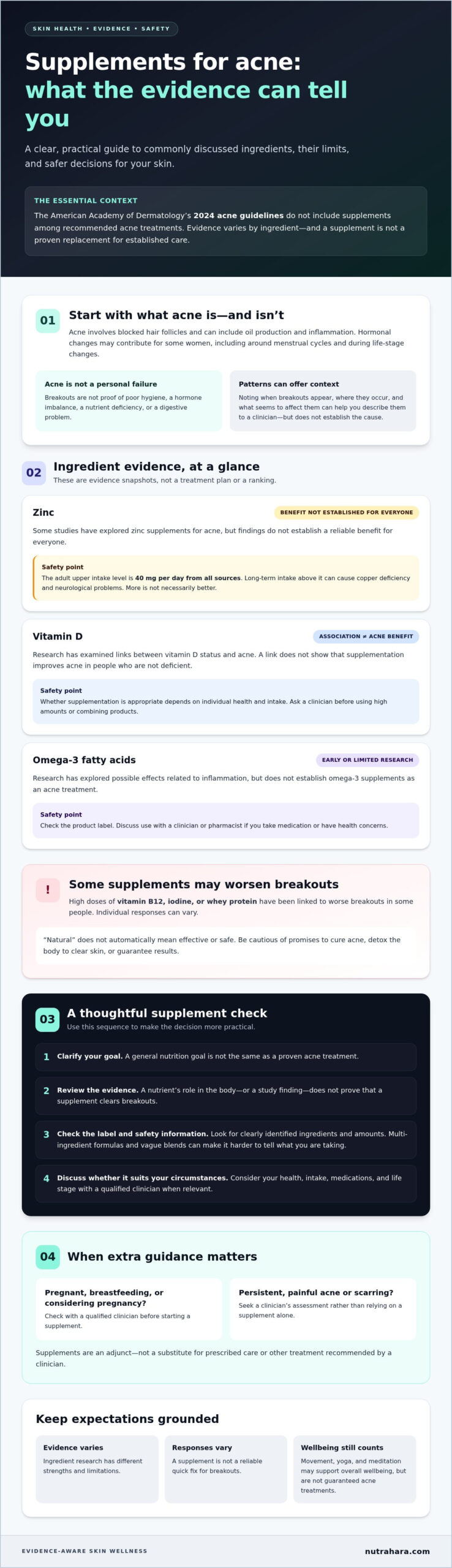
Choosing a supplement thoughtfully means considering four things together: the evidence for the ingredient and intended outcome, clear information about what the product contains, safety for your circumstances, and realistic expectations. This helps distinguish a general wellness product from a proven acne treatment. The phrase supplements for clear skin and acne doesn’t guarantee that a product has been studied for breakouts or will change your skin.
Before considering a product, compare its listed ingredients and stated intended use with your goal. Ask whether the evidence relates to acne specifically, or to broader nutritional or skin-support claims. Clear ingredient information can help you make that distinction and discuss suitability with a clinician, especially if you take medication, have a health condition, or are pregnant or breastfeeding.
Nutrahara describes its approach as combining Ayurvedic principles with modern nutritional research and focuses on women’s health supplements. That is brand context, not proof that any product prevents, treats, or clears acne. No acne-specific Nutrahara product is confirmed here. For general skin-support context only, you can review the collagen supplement information; it should not be interpreted as evidence of an acne benefit.
If you’re interested in the brand’s broader wellness perspective, take time to review its information and decide whether it fits your priorities. Check the full ingredient list, amounts, intended use, and safety details before considering a purchase. You don’t need to choose a product simply because it promises fast results.
Persistent, painful, or scarring acne deserves assessment by a qualified clinician. So do questions about supplement safety during pregnancy, while planning pregnancy, or during lactation. Professional guidance can help you weigh skin concerns alongside your health and life stage.
Skin changes don’t follow one universal path. A measured approach, guided by evidence and your individual needs, can help you make informed choices without expecting a supplement to deliver perfect skin. Acne care can be gradual, and taking thoughtful steps is a way to support your wellbeing.
Acne can have more than one influence, and a supplement isn’t a guaranteed solution. Weigh the evidence for the specific ingredient and skin outcome, check transparent labeling and personal safety, and keep supplements separate from proven acne care. If breakouts persist, cause pain or scarring, or if you’re pregnant or breastfeeding, a qualified clinician can help you consider appropriate next steps.
Nutrahara focuses on women’s health supplements and natural ingredients, combining Ayurvedic principles with modern nutritional research. That describes the brand’s approach, not evidence that a product treats acne. If you’d like to learn more, review the information below and decide whether it aligns with your priorities.
Your skin journey doesn’t need a perfect-skin promise. Take it one informed step at a time, with care that fits your health, life stage, and needs.
No supplement can be promised to clear acne for everyone. Research on individual nutrients is limited or may apply to specific situations, such as correcting a confirmed deficiency, rather than proving a universal acne treatment. Supplements shouldn’t replace appropriate skin care or medical treatment. If acne is persistent, painful, or leaving scars, ask a qualified clinician about options suited to your skin and health needs.
Zinc has been studied in relation to acne, but the strength and relevance of the evidence depend on the study and the individual. It isn’t a guaranteed solution, and taking more isn’t automatically better. Check the amount in any product and consider zinc from other supplements too. Before starting, discuss possible interactions and your personal health needs with a clinician or pharmacist.
Vitamin D and omega-3s are important nutrients, but that doesn’t establish them as acne treatments. Evidence for acne-specific benefits needs careful consideration and may not apply to everyone. If you’re considering supplements for clear skin and acne, ask a clinician whether they fit your circumstances, especially if you have a health condition, use medication, or already take other supplements.
Safety depends on the specific ingredients, amounts, and your health circumstances. A “natural” label or skin-focused marketing doesn’t confirm that a product is suitable during pregnancy or breastfeeding. If you’re pregnant, trying to conceive, or lactating, show the full product label to a qualified clinician before starting or changing a supplement. Include other supplements and medications you use so they can review the whole picture.
There’s no reliable timeline that applies to every supplement or person, and some products may not improve acne at all. Be wary of promises of rapid results. If you and a clinician decide to try a supplement, agree on when to review it and which changes to track, such as breakouts or skin irritation. Seek advice sooner if acne becomes painful, worsens, or leaves scars.
No. Don’t stop or change prescribed acne medication without speaking with the clinician who recommended it. Supplements can interact with medications, and starting several products at once can make it harder to identify what’s helping or causing a reaction. Before making changes, share a complete list of your medications and supplements with a clinician or pharmacist, including the product labels and ingredient amounts.
Yoga and meditation can support relaxation and general wellbeing, but they shouldn’t be treated as acne therapies. If they suit you, include them as part of a balanced routine alongside consistent skin care, not as a replacement for appropriate treatment. For breakouts that persist, hurt, scar, or affect your wellbeing, seek advice from a qualified clinician. You deserve support that considers both your skin and your overall health.
To explore Nutrahara’s approach to women’s wellness, visit Nutrahara and review the product information to decide what fits your priorities.
This article is not a substitute for medical advice. Please consult a healthcare professional before starting any supplement, especially if pregnant, nursing, taking medication, or managing health conditions.