Categories
Articles

Best Collagen Supplements for Women: Buyer’s Guide

What if supporting collagen involves more than adding a powder to a drink? Collagen supplements provide collagen peptides, while collagen itself helps give structure to skin and connective tissues. They’re one option to consider, not a substitute for a balanced approach to wellness.

It’s understandable to want clear guidance when changes in skin, nails, or joint comfort shape how you feel in your body. The useful question isn’t simply whether collagen can help, but what it does, how supplements compare with other ways to support collagen, and what daily amounts mean in practical terms.

This guide explains collagen’s role, the difference between collagen peptides and amino acids, and how to think about suggested serving amounts. You’ll also find ways to support overall wellbeing through nourishing habits and movement, including yoga and meditation, so you can make choices that fit your health goals and daily routine. One woman’s real-life account: “I compare options and choose what suits me.”

Key Takeaways

  • Understand how collagen supports skin and connective tissues, and what research suggests about potential benefits.
  • Explore everyday ways to support collagen production alongside supplements as it changes with age.
  • Learn how collagen peptides relate to protein and amino acids when comparing supplement options.
  • Use the article’s daily-amount guidance to make sense of serving recommendations and choose an approach that fits your routine.

Collagen Benefits: What Does Collagen Do For You?

Collagen is a structural protein associated with skin, hair, nails, bones, and joints. Research explores whether collagen supplements may support some of these tissues.

Claimed Benefits Across the Body

Type I and Type III collagen make up 90% of hair, skin, and nails; collagen accounts for about three-quarters of skin composition. These figures describe tissue structure, not a promise that supplements will change appearance. Proposed benefits include supporting skin, nails, bones, and joints. Compare a supplement’s stated purpose with your priority, rather than assuming every product addresses every concern.

Evidence for Supplement Effectiveness

According to the U.S. Environmental Protection Agency, eight studies used collagen hydrolysate at 2.5-10 g/day for 8-24 weeks to treat several skin conditions. One study found faster nail growth and fewer broken or chipped nails after 4 weeks of daily collagen supplements among women. Tissue structure alone doesn’t prove a supplement will change appearance. Read ingredient and allergen information. If pregnant, lactating, taking medication, or managing a condition, discuss use with a qualified health professional.

Possible Effects on Joints and Muscles

For joint support, studies suggest daily collagen supplementation may improve osteoarthritis pain and joint function after 3 to 5 months. Collagen is a protein, but it isn’t a replacement for strength training or balanced nutrition. In a small study, men taking collagen peptides during a 12-week strength-training program gained more muscle mass and strength than those who did not. That result concerns men, so it doesn’t establish the same outcome for women.

Timeline for Possible Benefits

Timing depends on the outcome being studied. Studies suggest skin health or joint pain may improve in 8 to 12 weeks, while bone-health changes may take a year or more of daily use. These are different measures, so don’t judge a bone-related goal by the same timeline as skin. If tracking your response, choose one priority and note changes consistently alongside your usual routine.

Are supplements the only way to increase collagen?

No. Food and lifestyle habits support overall nutrition, while collagen production changes with age. Supplements are one option, not the only approach.

Age-Related Changes in Collagen Production

The body’s collagen production begins to decline in a person’s 20s. This gradual change may be relevant across menstruating, pre-menopausal, and post-menopausal life stages, but age alone doesn’t determine what support you need. Consider your personal priorities, such as skin care or maintaining an active routine, alongside nourishing food and regular movement.

Comparing Collagen Peptides, Gelatin, and Vegan Boosters

Collagen peptides are collagen-derived ingredients commonly sold as powders, which may be flavored or unflavored. The U.S. Government Publishing Office describes gelatin as collagen converted into a soluble form through combination with water. Vegan boosters don’t contain animal collagen; they provide nutrients intended to support the body’s own production. Compare ingredients and formats with your dietary preferences.

Food choices can support balanced nutrition. Include protein sources such as eggs, beans, or fish, along with vitamin C foods such as peppers, berries, or citrus. To build movement into your routine, pair a yoga session with a brief meditation afterward: sit comfortably and focus on each breath.

In the United States, dietary supplements are not regulated as drugs, so don’t assume a supplement has FDA approval to treat a condition. Review its ingredients and intended use.

To consider possible interactions, review the full formula alongside your medication and supplement list. A pharmacist can help assess ingredients, especially in combination formulas.

Collagen peptide supplements and amino acids

Collagen peptides are short chains of amino acids derived from collagen. Understanding their composition, processing, and digestion can help you assess what a serving contributes.

Amino Acids in Collagen Peptides

Amino acids are the building blocks of protein, and collagen peptides supply them in a collagen-derived pattern. A listed 14-gram serving of collagen peptide powder contains 12 grams of protein and 50 calories. Those figures describe one serving, not a complete picture of your daily protein intake. Compare the serving information with other protein foods in your meals, such as eggs, beans, or fish.

Collagen can contribute protein, but it shouldn’t automatically replace varied protein sources. Consider your overall eating pattern, especially if you exercise regularly or have specific nutritional needs.

How Hydrolysis Produces Collagen Peptides

Hydrolysis breaks larger collagen proteins into smaller peptide chains. That’s why a label may say “collagen peptides” or “hydrolyzed collagen.” The ingredient remains collagen-derived protein; hydrolysis describes its form, not a different food source. When comparing powders, check the ingredient name and serving information together instead of relying on front-label language alone.

For example, a powder listing collagen peptides as its ingredient makes the source easy to identify. Other ingredients can change the overall formula, so review the full label if you want a plain collagen option or need to avoid particular ingredients.

Collagen Peptide Absorption

Digestion breaks dietary proteins into amino acids and smaller peptides, which the body absorbs through the digestive tract. Hydrolysis prepares collagen as smaller chains before consumption, but it doesn’t mean every peptide travels unchanged to the skin, joints, or another target. The body uses absorbed building blocks according to its needs.

For a practical comparison, note the serving size, protein amount, and additional ingredients. Then add the powder to a meal or drink you already enjoy, such as a smoothie after strength training. This can make it easier to use consistently without treating a supplement as a substitute for balanced meals.

There’s no single recommended amount for every woman. Collagen has no specific Dietary Reference Intake because the body produces it, so serving guidance varies by product and purpose.

Adults can safely consume between 2.5 and 15 grams of collagen per day. Many people take 1 to 2 tablespoons of collagen powder per day, but tablespoons measure volume, not weight. Check the product label for its serving size and collagen amount. A comparison table lists 3 Tbsp as the recommended daily amount for a collagen-peptides-with-hyaluronic-acid-and-vitamin-C product. That product-specific serving shouldn’t be treated as a universal target.

For a practical routine, follow the serving directions on the product you choose. If you use powder, stir it into a familiar drink or breakfast, such as a smoothie or oatmeal. Pairing it with an existing habit, like preparing breakfast or finishing a yoga session, can make daily use easier to remember. Keep the serving consistent as you assess whether it suits your routine.

Dosage and timing depend on the goal being studied. Research suggests possible skin-health or joint-pain effects may appear in 8 to 12 weeks, while bone-health changes may take a year or more of daily use. These timelines vary by outcome; they don’t establish a guaranteed result or a universal dose. Follow the label, and consider your full diet and any other supplements you take.

Before adding a collagen product to an established supplement routine, compare its serving with your other products. A simple note in your meal planner can help you track daily use and avoid accidentally doubling a similar ingredient. Explore collagen supplement options to find a format that fits your everyday wellness routine.

Best Collagen Supplements for Women: Buyer's Guide

Nutrahara: Women’s Health Supplements

Nutrahara offers Women’s Health Supplements for women considering nutritional support as part of their broader wellbeing routine. Priorities can differ across menstruation, pregnancy, lactation, perimenopause, and post-menopause. Some women may focus on energy or sleep, while others explore support for hormonal balance. These concerns are personal, so choose products by their ingredients and intended use rather than expecting one supplement to address every need.

Nutrahara’s formulations combine principles of Ayurveda with modern nutritional research. For women balancing work, exercise, family life, or changing routines, supplements can be considered alongside nourishing meals, yoga, meditation, and rest. They don’t replace these daily foundations or individualized care during pregnancy, lactation, or other health circumstances.

If women’s wellness is part of your current health journey, explore Nutrahara’s supplements as one possible addition to your routine. Contact Nutrahara to discuss its Women’s Health Supplements.

Choose a Routine That Fits Your Life

Make your wellness goal practical. Before choosing collagen supplements, decide what matters most: a format you’ll enjoy, ingredients that fit your preferences, or a routine that feels easy to maintain. A clear priority makes product information easier to assess and helps you avoid adding something simply because it’s popular.

Consider how a new habit would fit around your meals, exercise, and rest. Your needs may shift through different life stages, so leave room to reassess what feels useful. A steady, thoughtful approach can build confidence in your choices without making one product the measure of your wellbeing.

If you’d like to explore your next step, contact Nutrahara to discuss collagen. Keep building a wellness routine that feels considered, sustainable, and truly your own.

Frequently Asked Questions

How does it work?

After you consume collagen, digestion breaks it down, and your body uses its components as needed. That process doesn’t direct them to a particular area, such as your skin or knees. Collagen supplements are one source of protein in your overall diet, not a targeted treatment. Keep balanced meals and regular exercise at the center of your routine.

Is taking collagen every day good for you?

Daily use may suit some people’s routines, but it isn’t essential for everyone. Follow the serving directions and consider your overall diet, health needs, and other supplements. If you’re pregnant, lactating, managing a health condition, or taking medication, discuss the ingredients with a qualified health professional. Treat collagen as one possible addition, not a replacement for nourishing meals or movement.

Best Collagen Products: Which Type Should You Choose?

Choose a type based on your dietary preferences, ingredient needs, and preferred format. Collagen peptides suit those who prefer a powder, while gelatin works in recipes where its texture fits. Vegan boosters contain no animal collagen and instead provide nutrients intended to support the body’s own production. Compare ingredients and serving directions, then choose a format that fits your routine.

Got Collagen Questions?

Start by identifying what you want to clarify: ingredients, serving directions, dietary fit, or how a product fits your routine. For example, note whether you want to know if a formula includes ingredients you already take. Clear, specific questions make product information easier to understand. For questions about Nutrahara’s offerings, contact Nutrahara and describe what you’re looking for.

Is there such a thing as too much collagen powder?

Taking more than a product’s serving directions can raise your overall intake without showing that the extra amount is useful. Measure powder according to its label instead of estimating by eye, and account for collagen in other products you use. If you have specific dietary or health needs, discuss the full ingredient list with a qualified health professional before adding another product.

What are collagen supplements, and what types are available?

Collagen supplements provide collagen or collagen-derived ingredients. Common formats include powders and capsules, with formulas based on collagen peptides or combined with other ingredients. Gelatin is another collagen-derived form used in foods, while vegan boosters don’t provide animal collagen. Check the ingredient list and serving directions to understand what a specific product contains.

Article by

Nutrahara Team

We are a dedicated collective of nutrition scientists and naturopaths at Nutrahara, committed to advancing women's health through the fusion of ancient Ayurveda science and cutting-edge nutrition research. Our mission is to empower you with clean, simple, and scientifically validated wellness solutions so you can live your healthiest life. Connect with us to stay updated on the latest developments in holistic women's health and nature-based research.

Disclaimer

This article is not a substitute for medical advice. Please consult a healthcare professional before starting any supplement, especially if pregnant, nursing, taking medication, or managing health conditions.

Categories
Articles

Women’s Collagen Supplements: Complete Buyer’s Guide

Collagen supplements aren’t essential for every woman. When considering women’s collagen supplements, start with your own goals: your health priorities, dietary preferences, and life stage can all shape what feels relevant.

It’s understandable to want practical guidance when wellness advice seems to promise one solution for skin, fitness, and changing health needs. A more useful approach is to separate those goals. Consider what you want to support, what you already get from food and daily habits, and whether a supplement’s ingredients fit your routine. Yoga, meditation, nourishing meals, and regular movement can remain part of that routine, whether or not you choose a supplement.

This guide helps you make that choice thoughtfully. You’ll learn how collagen changes with age, what research says about skin and connective tissue, and how to compare product labels and study doses. It also covers considerations for pregnancy and breastfeeding, when reviewing a complete supplement formula matters. Use this information to ask focused questions and choose an approach that reflects your needs, not a one-size-fits-all idea of women’s health.

Key Takeaways

  • Learn why collagen needs can feel different across life stages, and how age and sun exposure relate to natural production.
  • Understand collagen’s role in skin and connective tissue, while keeping supplement claims in perspective.
  • Use practical label-reading criteria, including collagen source, form, and other ingredients, to assess a supplement.
  • See how study doses vary by intended use, and why pregnancy or breastfeeding calls for extra care when considering supplements.

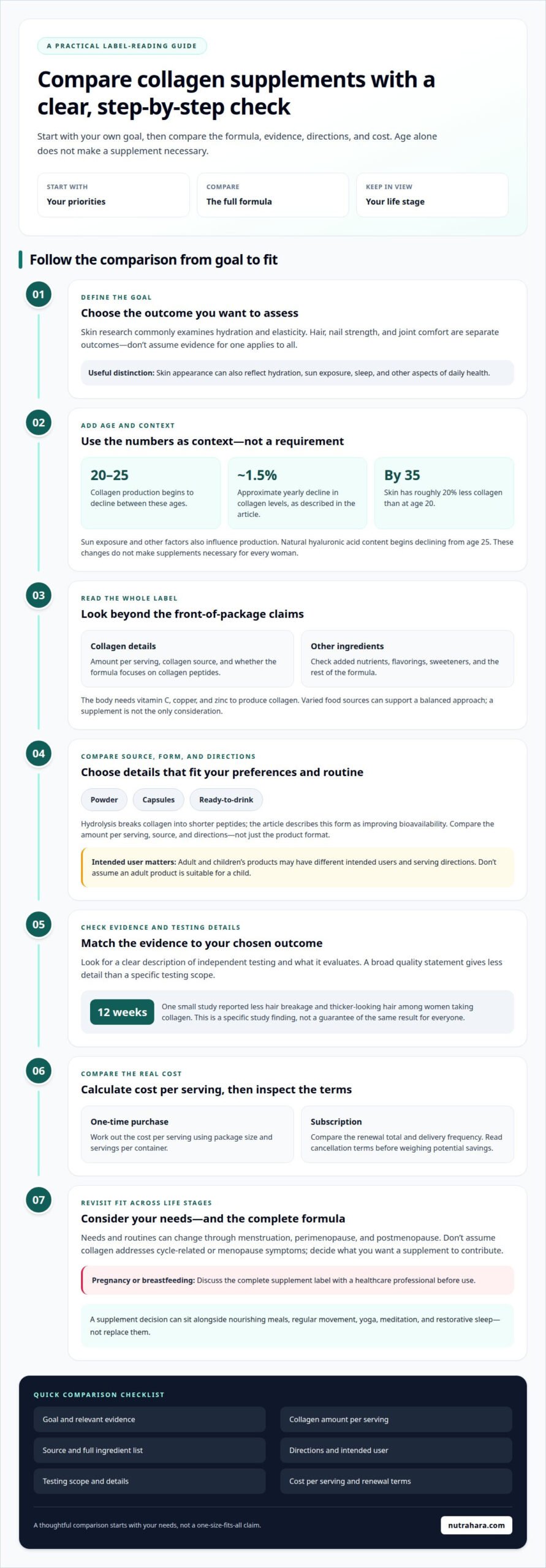
Collagen production begins to decline between ages 20 and 25, with levels falling by approximately 1.5 percent each year. Sun exposure and other factors also influence production, so age is only one part of the picture. Skin has roughly 20 percent less collagen by age 35 than at age 20. Natural hyaluronic acid content also begins declining from age 25. These changes can inform choices, but they don’t make a supplement necessary for every woman.

Collagen makes up roughly 30 percent of the body’s proteins, and Type I is its most prevalent type. The body needs vitamin C, copper, and zinc to produce collagen. Food choices can support a balanced approach: include varied sources of these nutrients rather than relying on a supplement alone. Women comparing women’s collagen supplements can use the ingredient list to see whether a formula adds nutrients or focuses on collagen peptides.

Collagen supplements come in powders, capsules, and ready-to-drink products. Hydrolysis breaks collagen into shorter peptides, a form described as improving bioavailability. Compare the collagen amount per serving, source, and directions, not just the format. Adult and children’s products may have different intended users and serving directions, so don’t assume an adult product is suitable for a child.

For a practical cost comparison, calculate the cost per serving for a one-time purchase and compare it with the subscription renewal total and delivery frequency. Read the cancellation terms, too, to see whether potential subscription savings suit your routine. Package size and servings per container affect value. These details help women compare women’s collagen supplements thoughtfully without letting age alone determine the decision.

What does Collagen do for the skin?

Collagen is a structural protein in skin and connective tissue. Type I and Type III collagen make up 90% of hair, skin, and nails. In skin, collagen fibers help provide structure and firmness. Skin’s appearance also reflects hydration, sun exposure, sleep, and other aspects of daily health. A supplement cannot replace sun protection, nourishing meals, or a balanced wellness routine.

Collagen contributes to tissues beyond the skin. It forms part of cartilage, which cushions joints, and supports tendons and ligaments that connect muscles and bones. Bone contains a collagen framework alongside minerals, giving it a flexible structure. These roles help explain why collagen research examines skin, bones, and joint mobility, not only appearance. Regular movement, including strength exercise and yoga, supports broader physical wellbeing.

Potential benefits depend on the outcome being studied. Research on skin commonly examines hydration and elasticity, while hair and nail claims need separate evidence. One small study reported that women taking collagen for 12 weeks had less hair breakage and thicker-looking hair. That finding describes a specific study outcome; it doesn’t establish that every person will notice the same change. Nail strength and joint comfort also shouldn’t be assumed from a product’s general collagen claims.

Set a clear goal to assess whether a supplement fits your routine. For example, if your focus is skin, look for research measuring skin-related outcomes, not only joint mobility. If exercise is central to your wellness plan, distinguish joint-support claims from demonstrated changes in comfort or function. Track one personal outcome at a time, such as skin dryness or exercise comfort, and keep other habits consistent. This makes it easier to notice whether a change coincides with taking a supplement, without treating collagen as a replacement for nutritious food, movement, or restorative sleep. Women’s experience: No verified first-person testimonial was provided for this section, so none is invented.

Collagen supplements selected for women

Compare a supplement’s ingredients, collagen source, serving directions, and testing details. Choose based on your priorities and life stage, rather than marketing language alone.

Ingredients, Sourcing, and Third-Party Testing

Read the full label, including flavorings, sweeteners, and ingredients beyond collagen. Sourcing information can help you decide whether a product fits your dietary preferences. Look for a clear description of independent testing and what it evaluates. A broad quality statement provides less detail than a specific testing scope.

Your needs and routines may change through menstruation, perimenopause, and postmenopause. Rather than assuming collagen addresses cycle-related or menopause symptoms, decide what you want a supplement to contribute. Note any ingredients that matter to you and keep your wider routine in view. During pregnancy or breastfeeding, discuss the complete label with a healthcare professional before use.

Recommended Collagen Supplement Dose

Use the serving directions and collagen amount on the product label to compare formulas. The amount per serving is more useful than scoop size alone, since a scoop may include other ingredients. Consider whether the directions fit your everyday routine, including meals, exercise, and other supplements.

Start a practical comparison with your purpose. For example, assess skin-focused products by their relevant ingredients and evidence, rather than assuming a formula marketed to women suits every goal. If your priorities shift during perimenopause or after menopause, revisit the label and your reason for taking the supplement. During menstruation, tracking your routine and personal observations can help you make deliberate choices without attributing changes to collagen alone.

At every life stage, favor a formula with clear details and directions you can follow consistently. That makes it easier to assess whether it fits your preferences, diet, and wellness routine.

Women's Collagen Supplements: Complete Buyer's Guide

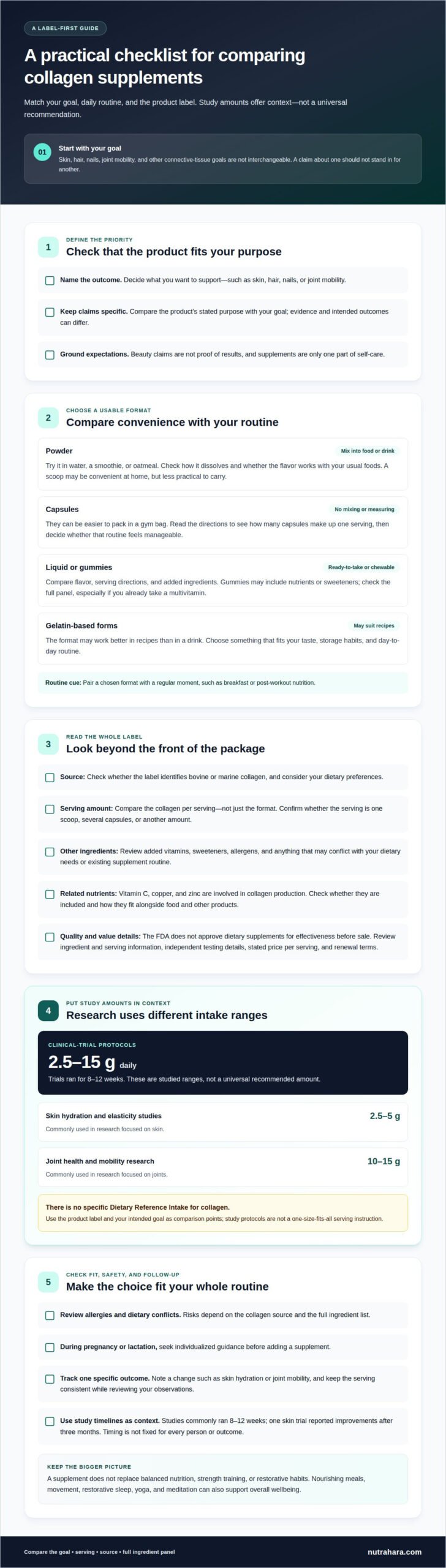
There is no single collagen dose established for every woman. Clinical trials commonly use 2.5 to 15 grams daily for 8 to 12 weeks. These are study protocols, not a Dietary Reference Intake. The dose used depends partly on the outcome researchers examine, so a skin-focused study may use a different amount than a joint-health study.

For skin hydration and elasticity, studies often examine 2.5 to 5 grams daily. Studies of joint health and mobility commonly use 10 to 15 grams. These ranges help explain product labels, but they don’t establish that more collagen is better. Match the serving information to the goal you’re considering, then read the product directions rather than estimating from scoop size.

Check the amount of collagen per serving, not simply the total powder weight. A scoop may include flavorings or other ingredients, so its weight doesn’t necessarily equal its collagen content. If a label lists multiple servings for one daily use, calculate the total collagen amount from the serving directions. Follow those directions consistently while assessing the product.

Collagen is an incomplete protein because it lacks the essential amino acid tryptophan. It shouldn’t replace varied protein foods or be treated as a complete protein serving. For women balancing exercise, meals, and changing wellness priorities, a simple record can help: note the product’s daily collagen amount, your chosen goal, and how consistently you follow the directions. Avoid changing several supplements or routines at once, since that makes personal observations harder to interpret. If you’re comparing a collagen formula with these study ranges, explore this collagen supplement option.

Clinical trials commonly assess collagen use over 8 to 12 weeks, though the study period can vary depending on the outcome being examined.

Nutrahara

Nutrahara offers women’s health supplements for women considering how nutrition fits their wellness routines. If you’re weighing a collagen supplement, use the criteria in this guide to focus on your goal, serving details, ingredients, and sourcing. Compare those details with your wider routine, including nourishing meals, movement, and restorative practices such as yoga or meditation. During pregnancy or breastfeeding, discuss the complete ingredient list with a healthcare professional before use. A thoughtful choice starts with clear priorities and a label you understand, not simply a product marketed specifically to women. To learn more about Nutrahara’s women’s health supplements, contact Nutrahara.

Make Your Next Choice With Confidence

Your wellness routine can evolve with you. Before adding a supplement, name the outcome you care about and decide how it fits alongside meals, movement, and rest. A brief journal note can keep that intention visible without turning self-care into another demanding task.

Let consistency guide your choices, rather than pressure to change everything at once. A calming meditation after exercise or a few minutes of yoga can help you notice what supports your wellbeing. Use that same thoughtful approach when considering women’s collagen supplements: choose based on your priorities and the product details that matter to you.

If collagen feels like a useful part of your next step, contact Nutrahara about collagen supplements. Keep building a routine that respects your changing needs and reflects the care you deserve.

Frequently Asked Questions

Should I Take Collagen Supplements?

Consider collagen only if it fits a specific personal goal and your wider routine. It isn’t essential for every woman. Before choosing, review the label, serving directions, and how the product fits with your meals and other supplements. If you’re pregnant, breastfeeding, taking medication, or managing a health condition, discuss the complete ingredient list with a healthcare professional first.

Can You Take Collagen While Pregnant?

Discuss the complete product label with your prenatal healthcare professional before taking collagen during pregnancy. A supplement may contain ingredients beyond collagen, so review the entire formula, not just its headline ingredient. Bringing the label to your appointment can make the conversation specific and useful. The same careful approach applies while breastfeeding, when your healthcare professional can consider your circumstances and supplement routine.

Collagen Benefits: What Does Collagen Do For You?

Collagen is a structural protein found in tissues including skin, cartilage, tendons, and bone. Supplement research examines different outcomes, so a claim about one area doesn’t automatically apply to another. For instance, skin-focused findings don’t establish joint benefits. Decide which outcome matters to you, then assess whether the product’s ingredients and supporting evidence relate to that specific goal.

Got Collagen Questions?

First, sort your question into product details or personal health. For product details, write down the serving directions and ingredients you want to understand. For individual concerns, such as combining supplements with medication, a healthcare professional can consider your situation. Nutrahara offers women’s health supplements; discuss personal medical questions with a healthcare professional.

How Do You Take Collagen Powder?

Follow the serving directions on the specific product label. If the powder is intended to mix into food or drink, try stirring it into a smoothie or oatmeal and mix thoroughly. Measure the labeled serving rather than estimating with a kitchen spoon. If you take other supplements, compare their ingredient lists so you can keep track of what you’re consuming.

Is There a Vegetarian Collagen?

Collagen is animal-derived, so a product containing collagen peptides isn’t vegetarian. Some vegetarian formulas instead provide other nutrients intended to support the body’s collagen production. Check the ingredient and sourcing details to distinguish those products from actual collagen. If you follow a vegetarian diet, consider whether the complete formula, including flavorings and capsules, suits your preferences.

Article by

Nutrahara Team

We are a dedicated collective of nutrition scientists and naturopaths at Nutrahara, committed to advancing women's health through the fusion of ancient Ayurveda science and cutting-edge nutrition research. Our mission is to empower you with clean, simple, and scientifically validated wellness solutions so you can live your healthiest life. Connect with us to stay updated on the latest developments in holistic women's health and nature-based research.

Disclaimer

This article is not a substitute for medical advice. Please consult a healthcare professional before starting any supplement, especially if pregnant, nursing, taking medication, or managing health conditions.

Categories
Articles

Collagen Supplements for Women: Benefits & Top Picks

The best collagen choice is the one that fits your goals and routine, not the one with the boldest beauty claims. Collagen supplements for women vary in format, serving size, source, and added ingredients, so start by deciding what you want from a supplement.

If you’re considering support for skin, hair, nails, or joints, look for clear information before adding a supplement to your routine. Supplements are just one part of self-care. Nourishing meals, movement, restorative sleep, yoga, and meditation can also support overall wellbeing.

This guide explains what collagen may do, how formats and studied intake ranges differ, and which label details can help you compare options. Use these practical criteria to weigh a product against your priorities and daily habits, without relying on sweeping promises.

Key Takeaways

  • Learn what collagen may support, and how to keep expectations grounded in the available evidence.
  • Compare powders, capsules, and other formats by convenience and fit with your daily routine.
  • Understand how studied intake ranges vary by wellness goal, and what to consider before choosing a serving.
  • Use a simple comparison checklist to narrow down options that align with your priorities and life stage.

Collagen Benefits: What Does Collagen Do For You?

Collagen makes up roughly 30% of the body’s proteins, supporting connective tissues. Supplements are marketed for hair, skin, nails, bones, and joints, but benefits depend on the goal and evidence.

Hair, Skin, and Nail Products

Hair, skin, and nail formulas often feature collagen peptides, a form made by breaking longer protein chains into shorter peptides. Type I and Type III collagen make up 90% of hair, skin, and nails. A small study found women taking collagen for 12 weeks experienced less hair breakage and thicker-looking hair. Compare the collagen source, serving size, and other ingredients, including whether gummies add nutrients or sweeteners.

Age-Related Collagen Decline

The body’s collagen production starts to decline in a person’s 20s. That gradual change can make collagen an appealing part of a wellness routine, but supplements aren’t a replacement for balanced nutrition, strength training, or restorative habits. Collagen also supports bones and joints as connective tissues; product claims in those areas should be considered separately from hair or skin claims, since the intended outcome matters.

Collagen production requires vitamin C, copper, and zinc. Check the ingredient panel to see whether these nutrients are included, and consider how a supplement fits alongside your food and other products. Common formats include powders, capsules, and gummies; labels may also identify sources such as bovine collagen. For a useful comparison, focus on the amount of collagen per serving, not the format alone.

The FDA doesn’t approve dietary supplements for effectiveness before they’re sold. To assess a product, review its ingredient label, collagen source, serving information, and any independent testing details. Prices and subscription savings vary, so compare the stated price per serving and renewal terms. These checks help you weigh convenience, formulation, and value without treating beauty claims as proof of results.

Collagen supplement formats

Risks and contraindications depend on the collagen source and the full ingredient list. Check for ingredients that conflict with your allergies, dietary needs, or existing supplement routine. During pregnancy or lactation, get individualized guidance before adding a supplement.

Powder can suit a routine built around a drink or meal. Stir it into water, a smoothie, or oatmeal, then check how well it dissolves and whether the flavor works with your usual foods. A scoop may be convenient at home but less practical to carry during a workday or after yoga.

Capsules avoid mixing and measuring, which can make them easier to pack in a gym bag. Check the serving directions to see how many capsules make up one serving. This helps you decide whether the daily routine feels manageable, rather than choosing by capsule count alone.

Liquid collagen comes ready to take, while gummies offer a chewable option. Formats can differ in flavor, added ingredients, and serving instructions. Read the full panel, not just the front label: a product may contain vitamins or other ingredients alongside collagen. This matters if you already take a multivitamin or prefer a simpler formula.

Source is another useful point of comparison. Labels may identify bovine or marine collagen, helping you match the product to your dietary preferences and avoid ingredients of concern. Collagen also appears in gelatin-based forms, which may work better in recipes than in a drink. Choose a format you’ll use, then pair it with a daily cue, such as breakfast or post-workout nutrition. Consistency is easier when the format fits your routine, taste, and storage habits.

Risks depend on the collagen source and other ingredients, so check the full label for allergens, dietary conflicts, or ingredients that may not fit your existing supplement routine. During pregnancy or lactation, seek individualized guidance before use.

Daily collagen intake and supplement guidance

Collagen has no specific Dietary Reference Intake. Choose an intake based on your goal and the serving details on the product label.

Daily Intake Guidance

Clinical trials have used 2.5 to 15 grams of collagen daily for 8 to 12 weeks. Studies focused on skin hydration and elasticity often use 2.5 to 5 grams. Research on joint health and mobility commonly uses 10 to 15 grams. These ranges describe study protocols, not a universal recommended amount.

Start by matching the serving to your goal, then follow the label directions. Check whether the listed amount refers to one scoop, several capsules, or a full daily serving. If a formula includes biotin or other nutrients, account for them in your overall supplement routine. “Collagen peptides” is another label term to recognize, not a separate intake target.

Time to See Results

Results depend on the intended outcome and study period. In a trial, skin improvements were reported after three months of intake, according to the National Center for Biotechnology Information. That timeline provides context for skin-focused research, not a fixed schedule for every person or benefit.

Set a practical review point that reflects the evidence: studies commonly run for 8 to 12 weeks, while the skin trial reported findings after three months. Keep your serving consistent during that period and note the specific change you’re tracking, such as skin hydration or joint mobility. A simple wellness journal can help separate routine observations from day-to-day variation.

Food still matters. Vitamin C, copper, and zinc are involved in collagen production, so include varied sources in your meals as part of your nutrition routine. Supplements can add to that foundation, but don’t replace it.

Collagen supplement picks for women

Choose a product based on your goal, not a beauty headline. Match its stated purpose, collagen source, and serving information to what you want to support. Skin, joint mobility, and connective tissues such as tendons are different goals, so a claim about one shouldn’t stand in for another.

Pregnancy and breastfeeding considerations for collagen supplements call for extra care with supplements. Discuss a collagen product and its complete ingredient list with your prenatal or postpartum healthcare professional before using it.

Use this shortlist to compare collagen options:

  • For a simple routine: Choose a format you’ll use consistently, such as powder mixed into breakfast or capsules packed with your daily essentials.
  • For a specific goal: Look for a formula that clearly identifies its intended use, rather than relying on broad claims about every tissue.
  • For dietary preferences: Read the source statement. Collagen may be derived from different animal sources, which can affect whether it suits your needs.

Read the full panel, not just the front label. Check how much collagen protein the serving contains, which sources the formula uses, and whether added ingredients such as biotin fit your existing supplements. “Collagen peptides” describes a processed form, but the term alone doesn’t show whether a product matches your priorities. A clear ingredient list makes comparisons more practical.

Use a short decision check: name your main goal, choose a manageable format, then compare the serving and ingredients. When comparing collagen peptides, focus on those details rather than packaging or a long list of benefits. For women balancing workouts, yoga, and busy schedules, a simple routine can be easier to maintain than a complicated stack.

Explore a collagen formula for your routine as one option to consider alongside these label checks.

Collagen Supplements for Women: Benefits & Top Picks

Nutrahara: Women’s Health Supplements

Nutrahara offers women’s health supplements for women seeking to make thoughtful choices about everyday wellness. Its formulas combine principles of Ayurveda with modern nutritional research and use natural, clean ingredients.

After learning about collagen, consider how any supplement fits your broader wellbeing goals and daily routine. Nutrition, regular movement, yoga, and meditation can all support a balanced approach to health through changing life stages. A supplement can be one part of that routine, not a replacement for these foundations.

Explore Nutrahara’s women’s health supplements when you’re ready to consider options grounded in this blend of traditional principles and contemporary research. For questions about Nutrahara’s offerings, contact Nutrahara.

Make Your Next Wellness Choice With Intention

Your wellness priorities can shift as routines and life stages change. Let them guide your next step: choose one supportive, practical habit and build from there. A short yoga sequence can bring gentle movement into your day, while meditation offers a quiet pause to notice how you’re feeling.

Try linking the two: after a few gentle poses, sit comfortably and focus on your breathing. Keep the practice simple enough to return to, whether it’s a morning stretch or a calming pause before bed. These habits can complement a routine that includes nourishing meals, movement, and rest.

For a next step rooted in women’s wellness, contact Nutrahara for guidance. Keep choosing habits that reflect your needs and help you feel steady and confident.

Frequently Asked Questions

What does Collagen do for the skin?

Collagen is a structural protein associated with the skin’s framework. Research has examined whether supplements may affect skin hydration and elasticity. In a trial, skin improvements were reported after three months of intake, according to the National Center for Biotechnology Information. No verified, clearly attributed account from a woman was provided, so this section can’t share a genuine personal experience or suggest what another person might notice.

Got Collagen Questions?

Start by naming the outcome you care about, such as skin comfort or joint mobility. Then consider the source, serving directions, and full ingredient list. If you read a personal account, look for details about the person’s routine and what they noticed. Treat it as one person’s experience, not proof that you’ll have the same result.

Q: How Do You Take Collagen Powder?

Follow the serving directions on the product, since scoop sizes and instructions can vary. For a smoother drink, add the powder gradually while stirring, then adjust the liquid to your taste. You can also use it in a recipe that suits its texture and flavor. Keep the scoop with the container to avoid mixing it up with other supplements.

Q: Is There a Vegetarian Collagen?

Collagen is animal-derived, so a product made entirely from plant ingredients isn’t collagen protein. Some products use terms such as “collagen builder” for blends intended to support the body’s own collagen production. Read the ingredient list and product description closely, especially if you avoid animal-derived ingredients. Clear wording helps distinguish collagen from a plant-based supplement with a different purpose.

Q: What Is Bovine Collagen and Is It Good for You?

Bovine collagen comes from cattle. Whether it suits you depends on your dietary preferences, allergies, and the product’s other ingredients. Check the label for the source and serving directions, and consider whether the format fits your routine. If you avoid cattle-derived ingredients, choose a product with a source that suits your dietary needs.

What are the potential benefits of collagen supplements for women?

Research has explored potential effects on skin hydration and elasticity, hair appearance, and joint health or mobility. This doesn’t establish that every formula supports every goal. To compare options, choose one priority first, then review the product’s source, serving, and stated purpose. A personal testimonial may help you understand someone’s routine, but it can’t predict your own response.

Article by

Nutrahara Team

We are a dedicated collective of nutrition scientists and naturopaths at Nutrahara, committed to advancing women's health through the fusion of ancient Ayurveda science and cutting-edge nutrition research. Our mission is to empower you with clean, simple, and scientifically validated wellness solutions so you can live your healthiest life. Connect with us to stay updated on the latest developments in holistic women's health and nature-based research.

Disclaimer

This article is not a substitute for medical advice. Please consult a healthcare professional before starting any supplement, especially if pregnant, nursing, taking medication, or managing health conditions.
Categories
Articles

The Best Collagen for Hair Growth: A Holistic Guide for Every Life Stage

What if that subtle thinning at your temples isn’t an inevitable part of aging, but a call from your body to bridge the gap between ancient Earth wisdom and modern nutritional science? You likely feel the frustration of seeing more hair in the shower drain or noticing your part line widen as you move through your 30s, 40s, and 50s. It’s a common experience, as nearly 40 percent of women experience visible hair thinning by the time they reach age 50. Finding the best collagen for hair growth is about more than just aesthetics; it’s about restoring the confidence and vitality that define your personal wellness journey.

You deserve a solution that honors your body’s changing needs through every life stage, from postpartum recovery to post-menopausal health. This guide promises to simplify your search by combining 5,000 years of Ayurvedic tradition with the latest clinical research to help you achieve thicker, stronger hair. We’ll explore how specific collagen types interact with your biology, provide actionable tips for daily rituals like scalp massage, and share real-life success stories from women who have reclaimed their glow. Your path to a fuller, more vibrant head of hair starts with understanding the purity and science behind what you put into your body.

Key Takeaways

  • Understand the “Collagen Clock” and why replenishing your body’s structural foundation is essential for maintaining hair density after age 21.
  • Identify the best collagen for hair growth by comparing the bioavailability and specific benefits of Type I and III hydrolyzed peptides.
  • Discover how to stoke your “Agni” or digestive fire through Ayurvedic wisdom to ensure your body effectively absorbs every nutrient in your wellness journey.
  • Learn how to integrate holistic rituals like yoga and meditation to boost scalp circulation and strengthen the emotional link between hair health and confidence.
  • Follow a practical 90-day protocol that outlines the precise dosage and timing needed to see transformative results in hair strength and vitality.

Understanding the Connection Between Collagen and Hair Growth

Collagen isn’t just a buzzword for skin elasticity; it’s the structural scaffolding for your scalp and hair follicles. Think of it as the nutrient-rich soil that nourishes the root of every strand. What is Collagen? It’s the most abundant protein in the human body, acting as the biological glue that maintains the integrity of our connective tissues. For women seeking the best collagen for hair growth, understanding this foundational role is the first step toward reclaiming hair vitality.

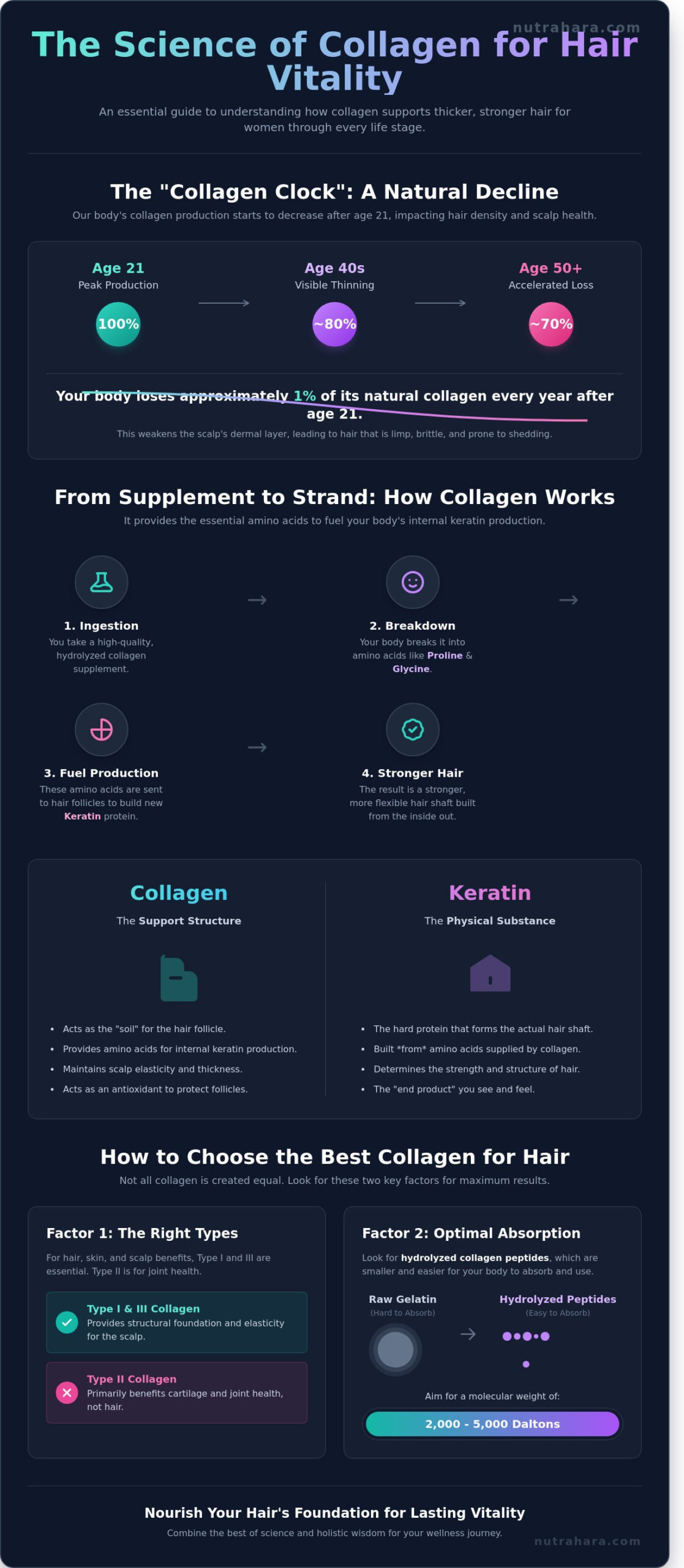
We call the natural decline of this protein the “Collagen Clock.” Scientific data confirms that after age 21, our bodies lose approximately 1% of their natural collagen every single year. By the time you reach your 40s or 50s, the dermal layer of the scalp, which houses hair follicles, becomes thinner and less resilient. This structural weakening often results in hair that looks limp, breaks easily, or lacks its youthful luster.

Collagen provides the specific amino acids your body craves to maintain a healthy mane. It’s particularly rich in proline and glycine. Proline is the primary component of keratin, the hard protein that forms the actual hair shaft. When you ingest high-quality collagen, your body breaks it down into these peptides and redirects them to the follicles to fuel internal keratin production. This process builds stronger, more flexible hair from the inside out.

Hair follicles are also highly sensitive to oxidative stress caused by environmental pollutants and the aging process. Collagen acts as a natural antioxidant shield, neutralizing free radicals that can damage follicle DNA. By protecting these delicate structures, collagen helps maintain the hair’s active growth phase, preventing the premature shedding that often worries women as they age.

Why Hair Changes for Women Aged 30 to 60

During the transition through perimenopause and menopause, hormonal shifts become the primary driver of hair texture changes. Declining oestrogen levels accelerate the breakdown of the collagen matrix within the scalp. Since oestrogen helps maintain skin thickness and moisture, its absence leaves the scalp dry and less capable of anchoring hair follicles securely. Scalp elasticity is the invisible anchor that determines how well your follicles can support thick, healthy hair growth. Nutrahara’s 40 years of expertise shows that supporting this matrix is vital for maintaining density during these life stages.

Keratin vs. Collagen: The Building Blocks of Your Mane

It’s common to confuse keratin and collagen, but they serve distinct purposes in your wellness journey. Keratin is the physical substance of the hair itself, while collagen is the support structure that surrounds the follicle where keratin is born. Supplementing with a targeted formula like the Premium Collagen Complex provides the body with the raw materials needed to boost its own internal keratin production. This holistic approach ensures you aren’t just treating the surface of your hair but nourishing the biological systems that create it. Finding the best collagen for hair growth involves choosing clean, bioavailable sources that bridge the gap between ancient Ayurveda science and modern nutrition research.

Choosing the Best Type of Collagen for Hair Vitality

Finding the best collagen for hair growth starts with understanding that your body is a complex, beautiful ecosystem. Not all collagen is created equal. To see real results in your hair’s thickness and shine, you need to look for Type I and Type III collagen. Type I is the most abundant form in the human body, providing the structural foundation for your skin and hair follicles. Type III often works alongside it to maintain the elasticity of your scalp tissues. While Type II is wonderful for joint health, it doesn’t offer the same targeted benefits for your crowning glory.

Absorption is the bridge between taking a supplement and seeing a difference in the mirror. Raw gelatin has a high molecular weight, which can be difficult for your digestive system to break down efficiently. Instead, look for hydrolyzed collagen peptides. These are proteins that have been broken into smaller chains through a process called enzymatic hydrolysis. Scientists measure these particles in Daltons. For optimal absorption, aim for a molecular weight between 2,000 and 5,000 Daltons. This smaller size allows the peptides to pass through the intestinal wall and enter the bloodstream quickly, where they can begin their work of revitalizing your hair.

Purity is a non-negotiable part of your wellness journey. Choosing grass-fed and pasture-raised sources ensures your supplement is free from the hormones and antibiotics often found in industrial farming. This clean and simple approach mirrors the principles of ancient Ayurveda, where the quality of the source determines the potency of the medicine. Research into how collagen may improve hair suggests that these amino acids provide the raw materials for keratin, the protein that makes up 95% of each hair strand. By providing these building blocks, you nurture your body from the foundation up.

Marine vs. Bovine Collagen: Which Wins for Hair?

Marine collagen is often considered the gold standard for beauty because it’s exceptionally high in Type I collagen. Its smaller particle size means it’s absorbed up to 1.5 times more efficiently than other sources. This makes it a perfect choice for women focusing on scalp health and hair density. Bovine collagen, sourced from cows, provides a robust blend of Types I and III. It’s a fantastic option if you want to support your gut lining and overall body structure while improving your hair. Your choice depends on your dietary path; marine is ideal for pescatarians, while bovine offers a comprehensive approach to structural integrity.

The Role of Co-Factors: Biotin, Vitamin C, and Zinc

Collagen doesn’t work in isolation. It’s part of a synergistic dance within your body. Vitamin C is the essential catalyst; without it, your body cannot physically synthesize new collagen fibers. Think of it as the glue that holds the protein chains together. Biotin, also known as Vitamin B7, works to improve the keratin infrastructure of your hair, leading to increased shaft thickness. Zinc plays a vital role in hair tissue growth and repair, helping the oil glands around the follicles work correctly.

While you can find these in citrus fruits and nuts, many women find that a targeted blend simplifies their routine. Our Premium Collagen Complex combines these essential co-factors with high-quality peptides to support your hair from the inside out. This thoughtful formulation ensures you aren’t just taking a supplement, but providing your body with the complete toolkit it needs for lasting vitality. Taking this step in your health journey can help you feel more confident and empowered every day. When you nourish your body with intention, your natural beauty has the space to flourish.

The Best Collagen for Hair Growth: A Holistic Guide for Every Life Stage

The Ayurvedic Edge: Synergising Science with Ancient Wisdom

Nutrahara stands at a unique intersection of tradition and clinical rigor. Our philosophy focuses on bridging Earth, Nature, and Humanity to guide you through a purposeful wellness journey. When you search for the best collagen for hair growth, you’re looking for more than a simple supplement; you’re seeking a way to restore your body’s natural abundance. We believe that hair health reflects your internal state, requiring a strategy that addresses both the physical and the spiritual.

In Ayurveda, your “Agni,” or digestive fire, is the gatekeeper of your health. It determines how effectively your body breaks down and absorbs the nutrients you consume. If your Agni is weak, even the premium peptides in your supplements may not reach your hair follicles. A 2021 report on nutritional bioavailability suggests that up to 70% of protein absorption efficiency depends on gut health. Strengthening your digestive fire ensures your body utilizes every gram of collagen to support hair density and strength.

We also embrace the concept of “Rasayana,” which refers to rejuvenation therapies that promote longevity and vitality. Rasayana isn’t a quick fix; it’s a commitment to maintaining your “Ojas,” or vital energy. By integrating these ancient rejuvenation practices with modern science, we help women aged 30 to 60 navigate life stages like menopause or postpartum recovery with confidence. A balanced lifestyle, supported by daily meditation and yoga, creates the calm environment your hair needs to thrive without the interference of chronic inflammation.

Botanical Boosters: Amla, Ashwagandha, and Bhringraj

Amla, or Indian Gooseberry, serves as a vitamin C powerhouse. It’s vital for collagen synthesis and helps prevent premature greying by neutralizing oxidative stress. Ashwagandha is equally critical for modern women. It manages cortisol levels to prevent stress-induced hair shedding, a condition known as Telogen Effluvium. When cortisol spikes, it can push up to 30% of your hair into the shedding phase. These botanicals complement collagen by protecting the hair you have while stimulating new growth, creating a holistic wellness journey for your scalp and spirit.

Bridging Modern Research and Traditional Rituals

Nutrahara leverages 40 years of expertise to validate ancient herbal claims through the lens of cutting-edge nutrition research. We prioritize ingredients that have been clinically studied for purity and efficacy. Understanding the benefits and side effects of collagen is essential for any woman who takes her fitness and health seriously. Our formulas are clean and simple, delivered without artificial additives. If you’re struggling with thinning caused by a fast-paced lifestyle, our Ashwagandha with Black Pepper provides the targeted support needed to lower stress and encourage the best collagen for hair growth to work effectively from within.

Holistic Rituals: Yoga, Meditation, and Scalp Health

Taking a daily supplement is a vital step on your wellness journey, but it’s only one part of the equation. Even the best collagen for hair growth requires an efficient delivery system to reach its destination. Your circulatory system acts as the highway for nutrients. If blood flow to the scalp is sluggish, those bioavailable peptides can’t effectively reach the dermal papilla cells that drive hair production. Research published in the Journal of Investigative Dermatology shows that increased blood vessel growth around the follicle is a primary factor in hair thickness and length.

The link between your psychological state and your hair is equally profound. A 2021 study found that 63% of women experiencing hair thinning reported a significant impact on their self-esteem. This creates a cycle where stress-induced thinning leads to more anxiety, further elevating cortisol levels. By shifting your mindset from “taking a pill” to “practicing a beauty ritual,” you engage the parasympathetic nervous system. This transition encourages healing and ensures your body isn’t in a “fight or flight” mode that diverts nutrients away from non-essential functions like hair growth.

Yoga Poses for Enhanced Scalp Circulation

Yoga offers a physical solution to boost microcirculation. Adho Mukha Svanasana, or Downward-Facing Dog, uses gravity to direct oxygenated blood toward the scalp. This inversion helps nourish follicles that may be starved of nutrients. Uttanasana (Forward Fold) serves a dual purpose by stretching the hamstrings and calming the nervous system. Integrating pranayama, or rhythmic breathwork, ensures your blood is highly oxygenated. Scientific trials indicate that deep diaphragmatic breathing can reduce heart rate and improve peripheral circulation within 5 minutes of practice.

Meditation and Cortisol Management

High cortisol is a known enemy of a healthy mane. It can push hair follicles into a premature resting phase, a condition known as telogen effluvium. Dedicating 10 minutes each morning to meditation can lower these stress hormones significantly. During your practice, try a guided meditation focused on bodily gratitude. Instead of viewing your hair as a problem to fix, visualize your body successfully distributing the best collagen for hair growth to every cell. This positive reinforcement builds the confidence needed to stay consistent with your regimen.

“I spent years just swallowing supplements and hoping for the best. It wasn’t until I started a 15-minute daily yoga and meditation practice that I saw a real change. My scalp felt more ‘alive,’ and the thinning around my temples finally started to fill in. It turned my morning routine from a chore into a moment of self-love.” — Elena, 48, Nutrahara Community Member

To support your ritual with the highest quality nutrients, consider how a targeted formula can enhance your results. Our Premium Collagen Complex is designed to work in harmony with your holistic practices, providing the essential building blocks your hair needs to thrive.

Designing Your Personal Hair Growth Protocol

Creating a successful routine requires more than just an occasional supplement. To see the tangible benefits of the best collagen for hair growth, you need a structured approach grounded in daily discipline. Research published in the Journal of Drugs in Dermatology indicates that collagen peptides significantly improve skin elasticity and hydration, which provides the necessary foundation for healthy follicles. Start with a daily dose of 10 to 20 grams of high-quality collagen peptides. Taking your supplement on an empty stomach or with your first meal of the day ensures optimal absorption and sets a positive tone for your morning.

Consistency serves as your most powerful tool. Hair grows at an average rate of 1.25 centimeters per month, so your biological timeline requires patience. You can track your progress using these specific benchmarks:

  • 30 Days: You will likely notice stronger nails and more hydrated skin first.
  • 60 Days: Many women report a 25 percent reduction in daily hair shedding during brushing or washing.
  • 90 Days: Look for “baby hairs” along your hairline and increased overall volume at the roots as new growth reaches the surface.

Your body cannot build new tissue without adequate raw materials. Aim for a daily protein intake of at least 0.8 grams per kilogram of body weight to support keratin synthesis. Hydration is equally vital; drink 2 to 3 liters of filtered water daily to maintain the extracellular matrix of your scalp. Combining these foundations with the Premium Collagen Complex provides the final piece of your wellness puzzle, bridging the gap between nutrition and nature.

Daily Habits for Long-Term Success

Taking your supplement at the same time each day helps regulate your body’s metabolic response. To maximize your results, consider combining your collagen with a Vitamin B Complex. B vitamins, particularly Biotin and B12, act as essential cofactors that support the keratin production process. A practical tip from our community involves mixing your collagen powder into a morning herbal tea or a post-yoga smoothie. This simple ritual anchors your health journey in a moment of morning stillness and intention.

Empowering Your Wellness Journey

True beauty isn’t a destination but a reflection of how you care for yourself through every life stage. Whether you’re managing the demands of motherhood or the transitions of menopause, your body deserves grace. Healing takes time, and self-love is a vital component of the process. If you’re looking for comprehensive support that addresses the hormonal shifts often linked to thinning hair, explore the FemmePower collection. This range is designed to restore balance, helping you embrace your unique radiance with confidence. Trust the wisdom of your body and the purity of ancient Ayurveda as you move forward.

Embrace Your Holistic Hair Transformation

Your journey toward lasting hair vitality bridges the gap between ancient wisdom and modern research. By combining targeted nutrition with daily rituals like scalp massage and yoga, you’re doing more than addressing thinning. You’re nurturing your entire being. Finding the best collagen for hair growth requires a formula that respects your body’s changing needs through every life stage. Nutrahara draws from 40 years of nutritional expertise to ensure your results are grounded in science and tradition. Our formulas feature clinically studied Ayurvedic ingredients that work in harmony with your biology to restore strength from the inside out. You’ve learned how to design a personal protocol that fits your busy lifestyle. Now, it’s time to take that first step. Every wellness bundle includes a free e-book to support your progress. You have the tools to feel confident and empowered today.

Start your hair restoration journey with Nutrahara’s Premium Collagen Complex

Frequently Asked Questions

How long does it take for collagen to help hair growth?

You can typically expect to see visible improvements in hair texture and growth within 8 to 12 weeks of consistent daily use. Clinical research published in the Journal of Cosmetic Dermatology in 2015 indicates that collagen peptides significantly increase hair follicle diameter after 90 days of supplementation. This timeline aligns with the natural hair growth cycle. Patience is a vital part of your health journey as your body integrates these clean and simple nutrients to build stronger strands.

Can collagen reverse hair thinning caused by menopause?

Collagen helps manage and mitigate hair thinning caused by the hormonal shifts of menopause by providing the amino acids necessary for keratin production. During the menopausal transition, a woman’s natural collagen levels can drop by 30% in the first 5 years. Supplementing with the best collagen for hair growth helps replenish these protein stores. When you combine this with stress-reducing practices like meditation, it empowers you to maintain hair density and confidence during this life stage.

Is marine or bovine collagen better for women’s hair?

Marine collagen is generally considered superior for hair growth because it consists primarily of Type I collagen, which is the most abundant form in human hair and skin. Research shows that marine peptides are absorbed up to 1.5 times more efficiently than bovine sources due to their lower molecular weight. We prioritize purity and ancient wisdom by choosing sources that offer the highest bioavailability for your wellness journey. This ensures every dose supports your vibrant well-being and hair strength.

Does taking collagen have any side effects for women over 40?

Collagen is safe for most women over 40, though a small number of individuals, approximately 1% according to clinical trials, might experience mild digestive fullness or a lingering taste. It’s a clean and simple supplement that integrates well with a holistic routine. If you have specific allergies to fish or shellfish, you should choose your source carefully. Consulting with a healthcare provider ensures your supplement choice aligns perfectly with your unique health needs and longevity goals.

Can I take collagen while pregnant or breastfeeding?

Most women can safely consume collagen during pregnancy and breastfeeding to support skin elasticity and postpartum hair health. A 2018 study suggests that a daily intake of 10 grams of collagen peptides is well-tolerated during these life stages. However, you should always discuss new supplements with your midwife or doctor first. Bridging nature and science means ensuring your body has the abundance of nutrients it needs to support both you and your growing baby throughout this sacred journey.

Will collagen help with hair growth if I have a thyroid condition?

Collagen provides the essential building blocks for hair, but it works most effectively when your thyroid hormones are balanced by medical treatment. Thyroid conditions can disrupt the hair’s growth cycle for up to 50% of patients. Using the best collagen for hair growth provides the proline and glycine needed to strengthen new strands as they emerge. Incorporating yoga can also help manage stress levels, which is a crucial component of a holistic approach to thyroid health and hair restoration.

What is the best time of day to take collagen for maximum absorption?

You can take collagen at any time that fits your schedule, though many women prefer taking it on an empty stomach 30 minutes before breakfast for optimal absorption. Taking it in the morning creates a ritual of self-care that sets a positive tone for your day. Alternatively, consuming it before bed supports the body’s natural repair processes that occur during sleep. Consistency is the most important factor in your long-term health journey and achieving the best results for your hair.

Can yoga really help my hair grow back?

Yoga supports hair growth by increasing blood circulation to the scalp and reducing cortisol levels that can trigger shedding. Practicing poses like downward-facing dog for 2 minutes daily encourages nutrient-rich blood to reach the hair follicles. This ancient practice, combined with modern nutrition, creates a harmonious environment for your body to thrive. It’s a powerful tool for boosting self-esteem while nurturing your physical health from the inside out. Yoga empowers you to take control of your well-being through movement.

Article by

Nutrahara Team

We are a dedicated collective of nutrition scientists and naturopaths at Nutrahara, committed to advancing women's health through the fusion of ancient Ayurveda science and cutting-edge nutrition research. Our mission is to empower you with clean, simple, and scientifically validated wellness solutions so you can live your healthiest life. Connect with us to stay updated on the latest developments in holistic women's health and nature-based research.

Disclaimer

This article is not a substitute for medical advice. Please consult a healthcare professional before starting any supplement, especially if pregnant, nursing, taking medication, or managing health conditions.