

The best collagen choice is the one that fits your goals and routine, not the one with the boldest beauty claims. Collagen supplements for women vary in format, serving size, source, and added ingredients, so start by deciding what you want from a supplement.
If you’re considering support for skin, hair, nails, or joints, look for clear information before adding a supplement to your routine. Supplements are just one part of self-care. Nourishing meals, movement, restorative sleep, yoga, and meditation can also support overall wellbeing.
This guide explains what collagen may do, how formats and studied intake ranges differ, and which label details can help you compare options. Use these practical criteria to weigh a product against your priorities and daily habits, without relying on sweeping promises.
Key Takeaways
- Learn what collagen may support, and how to keep expectations grounded in the available evidence.
- Compare powders, capsules, and other formats by convenience and fit with your daily routine.
- Understand how studied intake ranges vary by wellness goal, and what to consider before choosing a serving.
- Use a simple comparison checklist to narrow down options that align with your priorities and life stage.
Collagen Benefits: What Does Collagen Do For You?
Collagen makes up roughly 30% of the body’s proteins, supporting connective tissues. Supplements are marketed for hair, skin, nails, bones, and joints, but benefits depend on the goal and evidence.
Hair, Skin, and Nail Products
Hair, skin, and nail formulas often feature collagen peptides, a form made by breaking longer protein chains into shorter peptides. Type I and Type III collagen make up 90% of hair, skin, and nails. A small study found women taking collagen for 12 weeks experienced less hair breakage and thicker-looking hair. Compare the collagen source, serving size, and other ingredients, including whether gummies add nutrients or sweeteners.
Age-Related Collagen Decline
The body’s collagen production starts to decline in a person’s 20s. That gradual change can make collagen an appealing part of a wellness routine, but supplements aren’t a replacement for balanced nutrition, strength training, or restorative habits. Collagen also supports bones and joints as connective tissues; product claims in those areas should be considered separately from hair or skin claims, since the intended outcome matters.
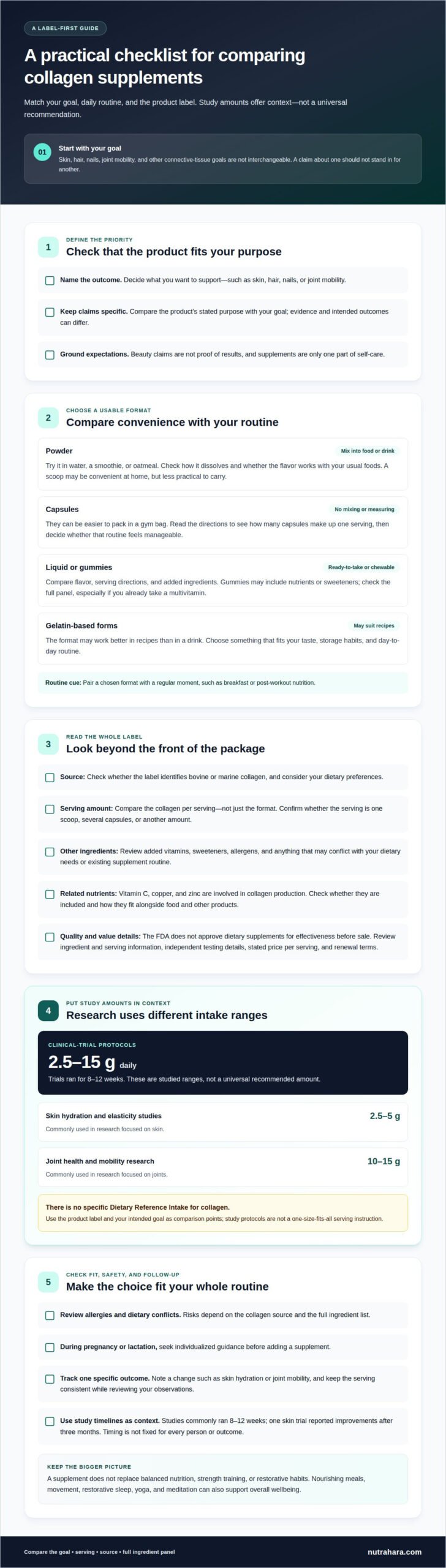
Collagen production requires vitamin C, copper, and zinc. Check the ingredient panel to see whether these nutrients are included, and consider how a supplement fits alongside your food and other products. Common formats include powders, capsules, and gummies; labels may also identify sources such as bovine collagen. For a useful comparison, focus on the amount of collagen per serving, not the format alone.
The FDA doesn’t approve dietary supplements for effectiveness before they’re sold. To assess a product, review its ingredient label, collagen source, serving information, and any independent testing details. Prices and subscription savings vary, so compare the stated price per serving and renewal terms. These checks help you weigh convenience, formulation, and value without treating beauty claims as proof of results.
Collagen supplement formats
Risks and contraindications depend on the collagen source and the full ingredient list. Check for ingredients that conflict with your allergies, dietary needs, or existing supplement routine. During pregnancy or lactation, get individualized guidance before adding a supplement.
Powder can suit a routine built around a drink or meal. Stir it into water, a smoothie, or oatmeal, then check how well it dissolves and whether the flavor works with your usual foods. A scoop may be convenient at home but less practical to carry during a workday or after yoga.
Capsules avoid mixing and measuring, which can make them easier to pack in a gym bag. Check the serving directions to see how many capsules make up one serving. This helps you decide whether the daily routine feels manageable, rather than choosing by capsule count alone.
Liquid collagen comes ready to take, while gummies offer a chewable option. Formats can differ in flavor, added ingredients, and serving instructions. Read the full panel, not just the front label: a product may contain vitamins or other ingredients alongside collagen. This matters if you already take a multivitamin or prefer a simpler formula.
Source is another useful point of comparison. Labels may identify bovine or marine collagen, helping you match the product to your dietary preferences and avoid ingredients of concern. Collagen also appears in gelatin-based forms, which may work better in recipes than in a drink. Choose a format you’ll use, then pair it with a daily cue, such as breakfast or post-workout nutrition. Consistency is easier when the format fits your routine, taste, and storage habits.
Risks depend on the collagen source and other ingredients, so check the full label for allergens, dietary conflicts, or ingredients that may not fit your existing supplement routine. During pregnancy or lactation, seek individualized guidance before use.
Daily collagen intake and supplement guidance
Collagen has no specific Dietary Reference Intake. Choose an intake based on your goal and the serving details on the product label.
Daily Intake Guidance
Clinical trials have used 2.5 to 15 grams of collagen daily for 8 to 12 weeks. Studies focused on skin hydration and elasticity often use 2.5 to 5 grams. Research on joint health and mobility commonly uses 10 to 15 grams. These ranges describe study protocols, not a universal recommended amount.
Start by matching the serving to your goal, then follow the label directions. Check whether the listed amount refers to one scoop, several capsules, or a full daily serving. If a formula includes biotin or other nutrients, account for them in your overall supplement routine. “Collagen peptides” is another label term to recognize, not a separate intake target.
Time to See Results
Results depend on the intended outcome and study period. In a trial, skin improvements were reported after three months of intake, according to the National Center for Biotechnology Information. That timeline provides context for skin-focused research, not a fixed schedule for every person or benefit.
Set a practical review point that reflects the evidence: studies commonly run for 8 to 12 weeks, while the skin trial reported findings after three months. Keep your serving consistent during that period and note the specific change you’re tracking, such as skin hydration or joint mobility. A simple wellness journal can help separate routine observations from day-to-day variation.
Food still matters. Vitamin C, copper, and zinc are involved in collagen production, so include varied sources in your meals as part of your nutrition routine. Supplements can add to that foundation, but don’t replace it.
Collagen supplement picks for women
Choose a product based on your goal, not a beauty headline. Match its stated purpose, collagen source, and serving information to what you want to support. Skin, joint mobility, and connective tissues such as tendons are different goals, so a claim about one shouldn’t stand in for another.
Pregnancy and breastfeeding call for extra care with supplements. Discuss a collagen product and its complete ingredient list with your prenatal or postpartum healthcare professional before using it.
Use this shortlist to compare collagen options:
- For a simple routine: Choose a format you’ll use consistently, such as powder mixed into breakfast or capsules packed with your daily essentials.
- For a specific goal: Look for a formula that clearly identifies its intended use, rather than relying on broad claims about every tissue.
- For dietary preferences: Read the source statement. Collagen may be derived from different animal sources, which can affect whether it suits your needs.
Read the full panel, not just the front label. Check how much collagen protein the serving contains, which sources the formula uses, and whether added ingredients such as biotin fit your existing supplements. “Collagen peptides” describes a processed form, but the term alone doesn’t show whether a product matches your priorities. A clear ingredient list makes comparisons more practical.
Use a short decision check: name your main goal, choose a manageable format, then compare the serving and ingredients. When comparing collagen peptides, focus on those details rather than packaging or a long list of benefits. For women balancing workouts, yoga, and busy schedules, a simple routine can be easier to maintain than a complicated stack.
Explore a collagen formula for your routine as one option to consider alongside these label checks.
Nutrahara: Women’s Health Supplements
Nutrahara offers women’s health supplements for women seeking to make thoughtful choices about everyday wellness. Its formulas combine principles of Ayurveda with modern nutritional research and use natural, clean ingredients.
After learning about collagen, consider how any supplement fits your broader wellbeing goals and daily routine. Nutrition, regular movement, yoga, and meditation can all support a balanced approach to health through changing life stages. A supplement can be one part of that routine, not a replacement for these foundations.
Explore Nutrahara’s women’s health supplements when you’re ready to consider options grounded in this blend of traditional principles and contemporary research. For questions about Nutrahara’s offerings, contact Nutrahara.
Make Your Next Wellness Choice With Intention
Your wellness priorities can shift as routines and life stages change. Let them guide your next step: choose one supportive, practical habit and build from there. A short yoga sequence can bring gentle movement into your day, while meditation offers a quiet pause to notice how you’re feeling.
Try linking the two: after a few gentle poses, sit comfortably and focus on your breathing. Keep the practice simple enough to return to, whether it’s a morning stretch or a calming pause before bed. These habits can complement a routine that includes nourishing meals, movement, and rest.
For a next step rooted in women’s wellness, contact Nutrahara for guidance. Keep choosing habits that reflect your needs and help you feel steady and confident.
Frequently Asked Questions
What does Collagen do for the skin?
Collagen is a structural protein associated with the skin’s framework. Research has examined whether supplements may affect skin hydration and elasticity. In a trial, skin improvements were reported after three months of intake, according to the National Center for Biotechnology Information. No verified, clearly attributed account from a woman was provided, so this section can’t share a genuine personal experience or suggest what another person might notice.
Got Collagen Questions?
Start by naming the outcome you care about, such as skin comfort or joint mobility. Then consider the source, serving directions, and full ingredient list. If you read a personal account, look for details about the person’s routine and what they noticed. Treat it as one person’s experience, not proof that you’ll have the same result.
Q: How Do You Take Collagen Powder?
Follow the serving directions on the product, since scoop sizes and instructions can vary. For a smoother drink, add the powder gradually while stirring, then adjust the liquid to your taste. You can also use it in a recipe that suits its texture and flavor. Keep the scoop with the container to avoid mixing it up with other supplements.
Q: Is There a Vegetarian Collagen?
Collagen is animal-derived, so a product made entirely from plant ingredients isn’t collagen protein. Some products use terms such as “collagen builder” for blends intended to support the body’s own collagen production. Read the ingredient list and product description closely, especially if you avoid animal-derived ingredients. Clear wording helps distinguish collagen from a plant-based supplement with a different purpose.
Q: What Is Bovine Collagen and Is It Good for You?
Bovine collagen comes from cattle. Whether it suits you depends on your dietary preferences, allergies, and the product’s other ingredients. Check the label for the source and serving directions, and consider whether the format fits your routine. If you avoid cattle-derived ingredients, choose a product with a source that suits your dietary needs.
What are the potential benefits of collagen supplements for women?
Research has explored potential effects on skin hydration and elasticity, hair appearance, and joint health or mobility. This doesn’t establish that every formula supports every goal. To compare options, choose one priority first, then review the product’s source, serving, and stated purpose. A personal testimonial may help you understand someone’s routine, but it can’t predict your own response.
Disclaimer
This article is not a substitute for medical advice. Please consult a healthcare professional before starting any supplement, especially if pregnant, nursing, taking medication, or managing health conditions.