

What if supporting your response to stress is less about switching it off and more about helping your body find balance? Ayurvedic adaptogen herbs are botanicals traditionally used to support the body’s response to stress and its return toward a stable state. It makes sense to look for gentle, practical ways to care for your wellbeing, especially when energy, mood and changing life stages can shape how stress feels.
This guide explains what adaptogenic herbs are, how they may support the body’s response to stress, and what research can and cannot tell us about their traditional uses. You’ll learn about Ayurvedic examples such as ashwagandha, tulsi, and shatavari, and how these herbs are used in supplements, teas, and foods. We’ll also consider how to approach them alongside everyday habits such as movement, yoga, meditation, and nourishing meals, so you can make informed choices for your wellbeing.
Key Takeaways
- Understand how adaptogens may interact with the body’s stress response, and why they’re not a substitute for standard care.
- Recognize Ayurvedic examples such as ashwagandha and tulsi, and how their traditional uses differ.
- Explore ways herbs appear in capsules, teas, powders, and everyday foods, while considering medication interactions before using supplements.
- Learn how to distinguish traditional wellness practices from the limits of current research when choosing an approach that suits your needs.
How Do Adaptogens Aid In Stress Relief?
Adaptogens are natural products traditionally used to support the body’s response to stress. Their proposed effects involve systems that regulate physical and hormonal responses.
Adaptogens and the Stress Response
An adaptogen is generally described as nontoxic at normal doses, supportive during stress, and able to help the body return to a stable state. This definition focuses on balance, rather than simply feeling energized or relaxed. In Ayurveda, rasayana refers to restorative preparations, while modern explanations propose that adaptogens interact with the body’s stress-regulation systems.
Stress and the Sympathetic Nervous System
The sympathetic nervous system helps prepare the body to respond to stress, including through physical changes associated with alertness. This response can be useful during an immediate challenge, but ongoing stress can affect how the body feels and functions. Adaptogens are proposed to influence nerve responses, but they aren’t a substitute for care when symptoms persist.
Researchers often describe the hypothalamic-pituitary-adrenal, or HPA, axis as part of the stress response. The hypothalamus, pituitary gland, and adrenal glands coordinate hormonal and physiological changes. Adaptogens may affect this axis and cortisol levels, but proposed effects vary by herb and individual.
Adaptogens may also influence stamina and immune function, but that doesn’t mean every herb works the same way. For example, an herb traditionally used for vitality may not address every cause of fatigue or stress.
Stress is a growing concern: 47% of Americans reported increased stress levels since the pandemic started. Yoga and meditation can complement everyday wellbeing practices, while persistent symptoms call for standard care. Adaptogens and supplements should not replace that care, especially when symptoms continue.
What Are Adaptogenic Herbs?
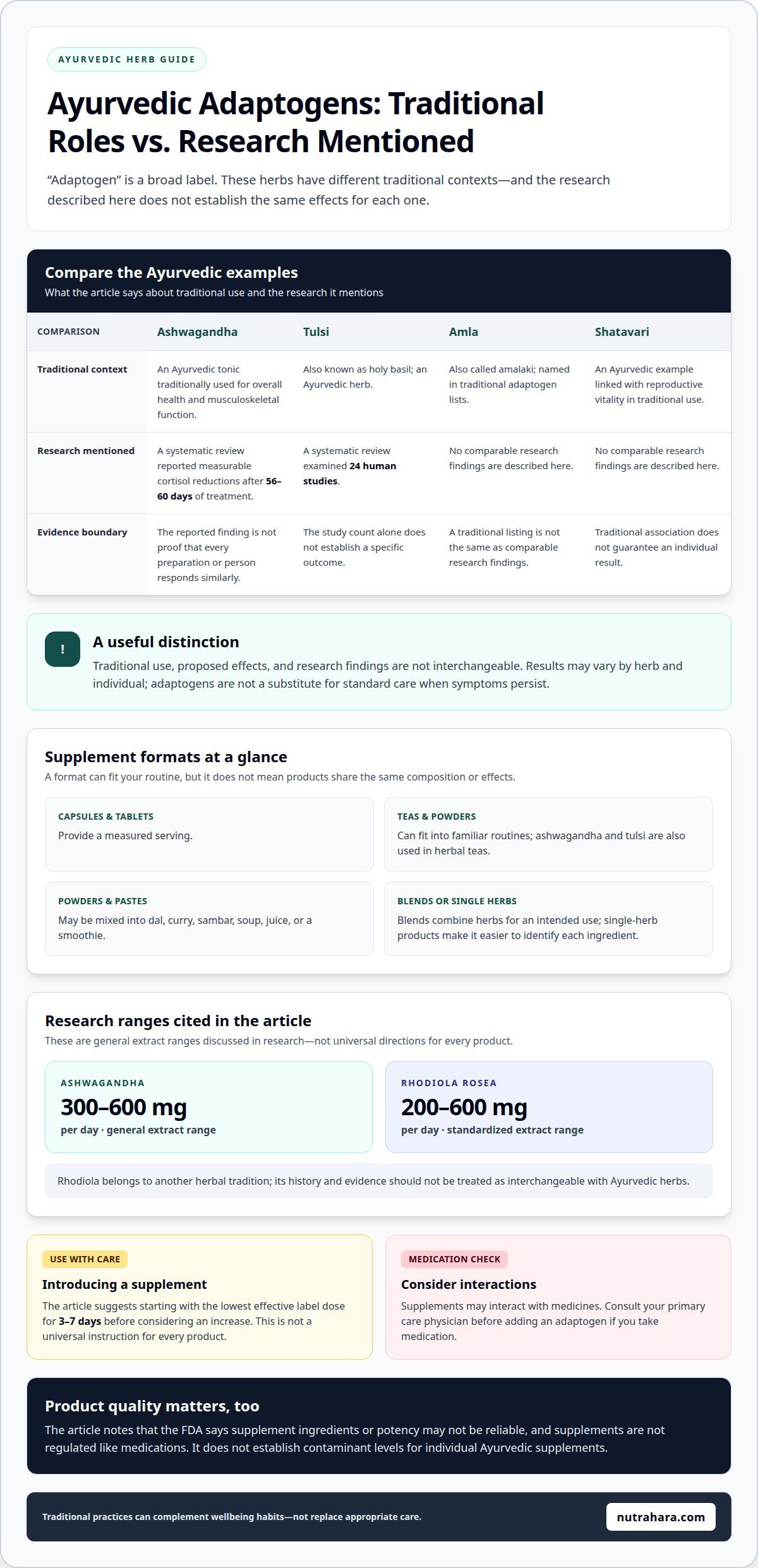
Adaptogenic herbs are plants traditionally used to support the body’s response to stress. Ayurvedic examples include ashwagandha, tulsi, brahmi, amla, and shatavari; ginseng and rhodiola belong to other herbal traditions, so their histories and evidence shouldn’t be treated as interchangeable. Evidence varies: research on tulsi includes a systematic review of 24 human studies, while amla and shatavari are named in traditional adaptogen lists without comparable findings here.
Ashwagandha in Ayurveda
Ashwagandha, also called Indian ginseng, is an Ayurvedic tonic traditionally used for overall health and musculoskeletal function. Ayurvedic discussions may connect it with Vata, energy, and sleep, but these traditional categories don’t guarantee the same result for every woman. Distinguishing a herb’s historical role from what modern research has tested helps set realistic expectations.
Ashwagandha Research on Stress and Anxiety
Research findings on ashwagandha relate more directly to stress than to a guaranteed effect on anxiety or sleep. A systematic review reported measurable cortisol reductions after 56 to 60 days of ashwagandha treatment, while much rasayana research remains preclinical. That offers a reason for scientific interest, not proof that every preparation or person will respond similarly. Licorice also appears in preclinical rasayana research.
Other Ayurvedic Herbs and Adaptogens
Tulsi, or holy basil, has more human-study coverage in the supplied evidence than amla or shatavari. A systematic review examined 24 human studies of tulsi, though that count alone doesn’t establish a specific outcome. Amla is also called amalaki; shatavari is another Ayurvedic example. Brahmi appears in traditional adaptogen lists, while ginseng and rhodiola offer comparisons from other herbal traditions.
Adaptogen supplements and food uses
Adaptogens come in different forms, from concentrated extracts to ingredients mixed into meals. The format can affect how easily you use a product, but it doesn’t mean every product has the same composition or effects.
Capsules and tablets provide a measured serving, while teas and powders can fit into familiar routines. Powders or pastes may be stirred into dal, curry, sambar, soup, juice, or a smoothie. Ashwagandha and tulsi are also used in herbal teas. For a practical starting point, choose one format that fits your routine rather than combining several at once.
General extract ranges in the research include 300-600 mg per day for ashwagandha and 200-600 mg per day for standardized Rhodiola rosea. These are not universal directions for every product. Start with the lowest effective label dose for 3-7 days before considering an increase. If you are considering cycling an adaptogen, follow product-specific guidance and seek professional advice when appropriate.
Adaptogenic blends combine herbs for an intended use, while single-herb products make it easier to identify each ingredient. If you take medication, consult your primary care physician before adding an adaptogen, since supplements may interact with medicines. Yoga, meditation, and balanced meals can support wellbeing alongside appropriate care, not replace it.
Heavy-metal contamination is a product-quality question, separate from whether an herb may affect stress. The information here doesn’t establish contaminant levels for individual Ayurvedic supplements. The U.S. Food and Drug Administration notes that supplement ingredients or potency may not be reliable, and supplements aren’t regulated like medications. For an ashwagandha option, see these ashwagandha supplements with black pepper.
Ayurvedic adaptogenic herbs
Ayurvedic adaptogens are herbs used in traditional formulations, and rasayana describes a restorative category within Ayurveda. Their roles aren’t interchangeable: an herb associated with vitality doesn’t automatically address fatigue, immune function, or reproductive wellness. If you’re exploring these traditions, start by identifying the herb and its traditional context rather than relying on the broad “adaptogen” label.
Shatavari is linked with reproductive vitality in Ayurvedic tradition. Its name is sometimes translated as “the one with 100 husbands,” a cultural expression rather than evidence of a measured effect on fertility or hormones. Mucuna, also called Kapikacchu, is a natural source of L-dopa, a precursor to dopamine. Amalaki is another name for amla, a distinct herb with its own traditional uses.
Licorice contains glycosides structurally similar to endogenous stress hormones and has been used traditionally to support endocrine function. Eleutherococcus senticoccus is used to support stress and energy, although evidence for athletic-performance benefits is weak. Panax ginseng belongs to another herbal tradition. These examples show why a plant’s traditional role and the evidence for a specific outcome should be considered separately.
Reported timelines for adaptogens vary: some people notice subtle effects within a week or two, while others may notice effects within two to eight weeks of consistent daily use. Traditional guidance recommends at least 90 days for best results, but that is not a guaranteed outcome. If you explore an herb, choose one personal wellness goal and keep track of changes alongside practices such as yoga or meditation. No verified woman’s testimonial was provided for this section, so one cannot be included without risking a fabricated account.
For women’s wellness support, explore women’s health supplements as one part of a broader routine.
Nutrahara
Nutrahara offers women’s health supplements that combine principles of Ayurveda with modern nutritional research. If you’re considering supplements as part of your wellness routine, Nutrahara’s range is a natural next step after learning how adaptogens are traditionally used and where evidence varies. The supplements are made with natural ingredients and designed to support women’s overall wellness, energy, and health.
As you consider your options, keep your goal clear, such as supporting a balanced routine alongside nourishing food, movement, yoga, or meditation. Supplements don’t replace standard care, especially if symptoms persist or you have questions about medication interactions. A thoughtful approach can help you make informed choices and keep your wellbeing at the center.
Explore Nutrahara’s women’s health supplements to find an option for your wellness routine.
Make Your Wellness Routine Your Own
Choose a small, sustainable next step. Set one wellbeing goal, such as steadier energy or a calmer evening routine, and notice how your daily habits support it. A brief journal can help you spot patterns in movement, meals, rest, and mood without expecting every day to feel the same.
When considering ayurvedic adaptogen herbs, let curiosity guide you rather than pressure to add more. A thoughtful wellness routine can also include yoga, meditation, and fitness practices that feel supportive through changing life stages. Nutrahara’s women’s health supplements are one option to consider as part of that broader approach.
If you’d like to explore how Nutrahara’s women’s health supplements may fit your wellness goals, contact Nutrahara to learn more. Keep building a routine that respects your needs and helps you feel confident in your choices.
Frequently Asked Questions
How long do adaptogens take to work?
Some people report subtle effects within a week or two, while others describe effects after two to eight weeks of consistent daily use. Individual responses can vary with the herb, preparation, and reason for taking it. To assess a change, note one goal, such as sleep quality or daytime energy, alongside relevant routine changes. This can help you distinguish a pattern from one unusually good or difficult day.
Are Adaptogens Safe?
Being described as an adaptogen doesn’t make a supplement suitable for everyone. Supplements can interact with medication, so people taking medication should consult their primary care physician before use. The U.S. Food and Drug Administration notes that supplements aren’t regulated like medications, and stated ingredients or potency may not be reliable. If you’re pregnant, lactating, or managing a health condition, make supplement decisions with appropriate care in mind.
How do adaptogens help?
Adaptogens are traditionally used to support the body’s response to stress, but proposed effects differ among herbs. They don’t remove the source of stress or replace habits that support wellbeing. Consider how an herb fits into your routine, including sleep, nourishing meals, movement, yoga, or meditation. A clear goal, such as supporting a steadier evening routine, can help you decide whether a supplement is relevant to your needs.
So, What Exactly Are Adaptogens?
Adaptogens are natural products traditionally used to help the body cope with stress and return toward balance. Russian scientist Nikolay Lazarev introduced the concept in the 1950s. The term covers plants from different traditions, including Ayurvedic herbs and ginseng or rhodiola from other herbal systems. It’s a broad category, not a guarantee that different plants share the same traditional role, formulation, or evidence for a particular outcome.
What are adaptogens and should you be taking them?
Adaptogen describes herbs or other natural products traditionally used to support the body’s stress response, but they aren’t essential for everyone. Consider why you might take one and whether it fits your overall approach to wellbeing. Medication use matters because supplements may interact with medicines. Ongoing symptoms call for standard care rather than a supplement-only approach. You can also build stress-supportive habits, such as regular movement and meditation, without taking an adaptogen.
What is the difference between adaptogens and rasayanas?
Adaptogen describes a proposed role in supporting the body’s response to stress, while rasayana is a traditional Ayurvedic category of restorative preparations. Some rasayana products are discussed as adaptogens, so the terms can overlap without meaning the same thing. When reading about an herb, this distinction is useful: rasayana places it within an Ayurvedic framework, while adaptogen describes a stress-related concept. Neither label alone establishes a specific effect for an individual.
Disclaimer
This article is not a substitute for medical advice. Please consult a healthcare professional before starting any supplement, especially if pregnant, nursing, taking medication, or managing health conditions.