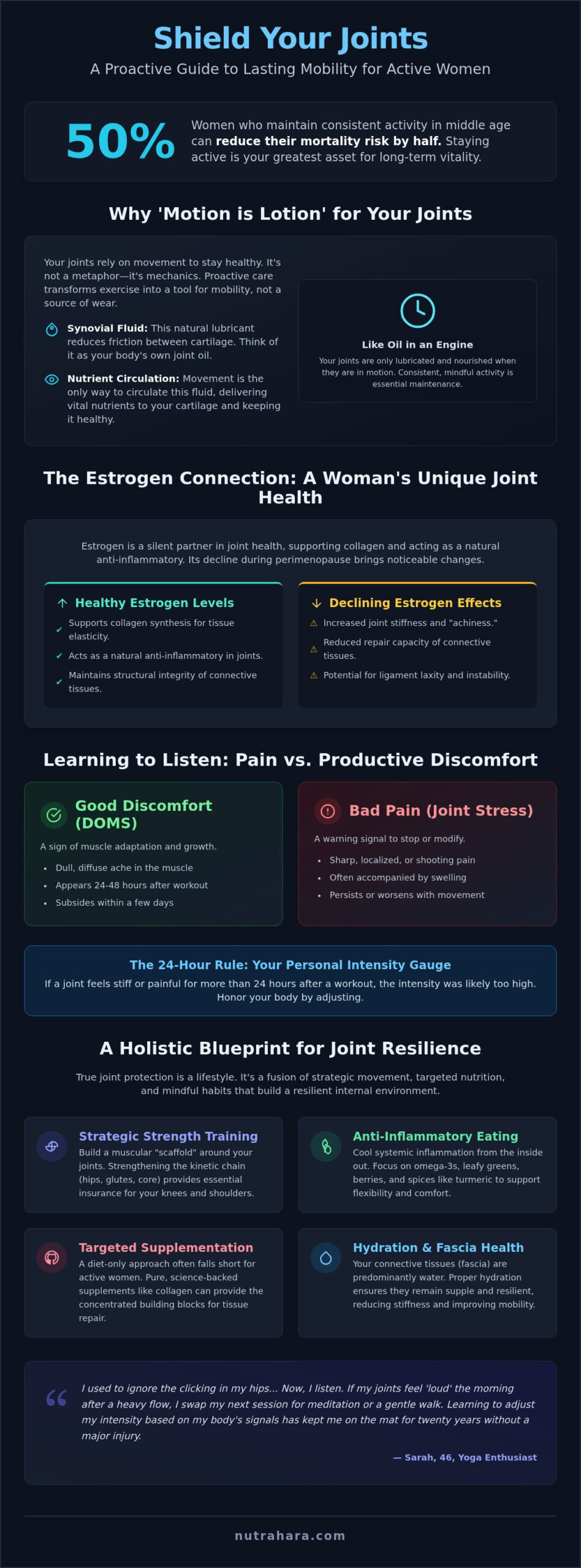
Could supplements help you move more comfortably, or are they being asked to promise more than they can deliver? If stiffness is making workouts, yoga, or everyday movement feel harder, it’s understandable to look for support. Supplements for joint flexibility in women may be one part of a thoughtful care routine, but they can’t guarantee that surgery will be avoided.
What matters is understanding what the evidence suggests, what a supplement may support, and where its limits are. This guide compares common options, explains why movement and strength work remain important, and offers practical ways to assess product claims and safety. If you’re pregnant, breastfeeding, managing a health condition, or taking medication, check with a qualified healthcare professional before starting a supplement. A steady, informed approach can help you make choices that support confidence and mobility through every life stage.
Key Takeaways
- Supplements may support comfort, but they can’t guarantee you’ll avoid surgery or replace medical care.
- Assess supplements for joint flexibility in women by looking at ingredient-specific evidence and realistic outcomes.
- Compare supplements with movement and strength work, choosing activities that suit your comfort and any clinical guidance.
- Use a simple process to clarify your goal, review product labels, consider safety, and track changes in daily movement.
- Learn how Nutrahara’s Joints & Knees Kit may fit into a broader, evidence-aware joint-care plan.
Can supplements for joint flexibility in women help avoid surgery?
If a sore or stiff joint makes it harder to walk, exercise, or enjoy everyday movement, it’s natural to wonder whether a supplement could change the need for surgery. Supplements for joint flexibility in women may be considered as one part of a wider joint-care plan, but they can’t guarantee surgery avoidance or replace a diagnosis and clinician-directed treatment.
Whether surgery is appropriate depends on the specific joint condition, symptoms, the effect on function, and an individual clinical assessment. A supplement intended to support general joint health isn’t a substitute for understanding what’s causing your symptoms or discussing treatment options with a qualified clinician.
What does joint flexibility mean in everyday life?
Flexibility describes how comfortably a joint moves through its available range. In everyday life, that could mean bending to tie your shoes, walking up stairs, reaching overhead, or moving through a yoga pose without undue restriction.
Flexibility is related to, but different from, mobility, strength, and pain. Mobility is your ability to move through a task; strength is the force your muscles can produce; pain is a sensation that can affect movement. These experiences can overlap, but stiffness alone doesn’t identify a particular condition.
Can a supplement determine whether surgery is needed?
No supplement should be presented as a reliable way to prevent or replace surgery. Supplements may be considered for potential support, but a clinician assesses the joint, symptoms, function, and available care options before advising on treatment. If you’re pregnant, breastfeeding, or taking medication, discuss supplement safety with an appropriate healthcare professional before use.
Joint-support claims are not promises about surgery outcomes. Evidence also needs careful interpretation: studies can differ in the ingredients, formulations, participants, and outcomes they examine. An overview of major clinical trials illustrates why findings for specific supplements should be considered in context, not treated as a prediction of what will happen for an individual woman.
Focus on what matters in your own life: which movements feel difficult, how symptoms affect daily activities, and whether your function is changing. Sharing these observations with a clinician can support a clearer conversation about next steps. Supplements may have a place in a considered routine alongside appropriate care, but they shouldn’t delay assessment or determine a surgery decision on their own.
How joint supplements may affect comfort, movement, and flexibility
Research on joint supplements doesn’t point to one effect that applies to every woman or every product. Findings depend on the ingredient, the people studied, the outcome measured, and the formulation used. Some studies, for example, look at pain or stiffness in people with osteoarthritis. A claim about everyday flexibility may not have been tested in the same way.
Evidence for one ingredient, dose, or formulation can’t validate every joint supplement or every claim made about it. Even if a study finds symptom support, that doesn’t show a supplement repairs cartilage, reverses joint disease, or prevents a procedure. When considering supplements for joint flexibility, ask what the research measured and whether that outcome matches your goal.
What should women know about collagen and joint support?
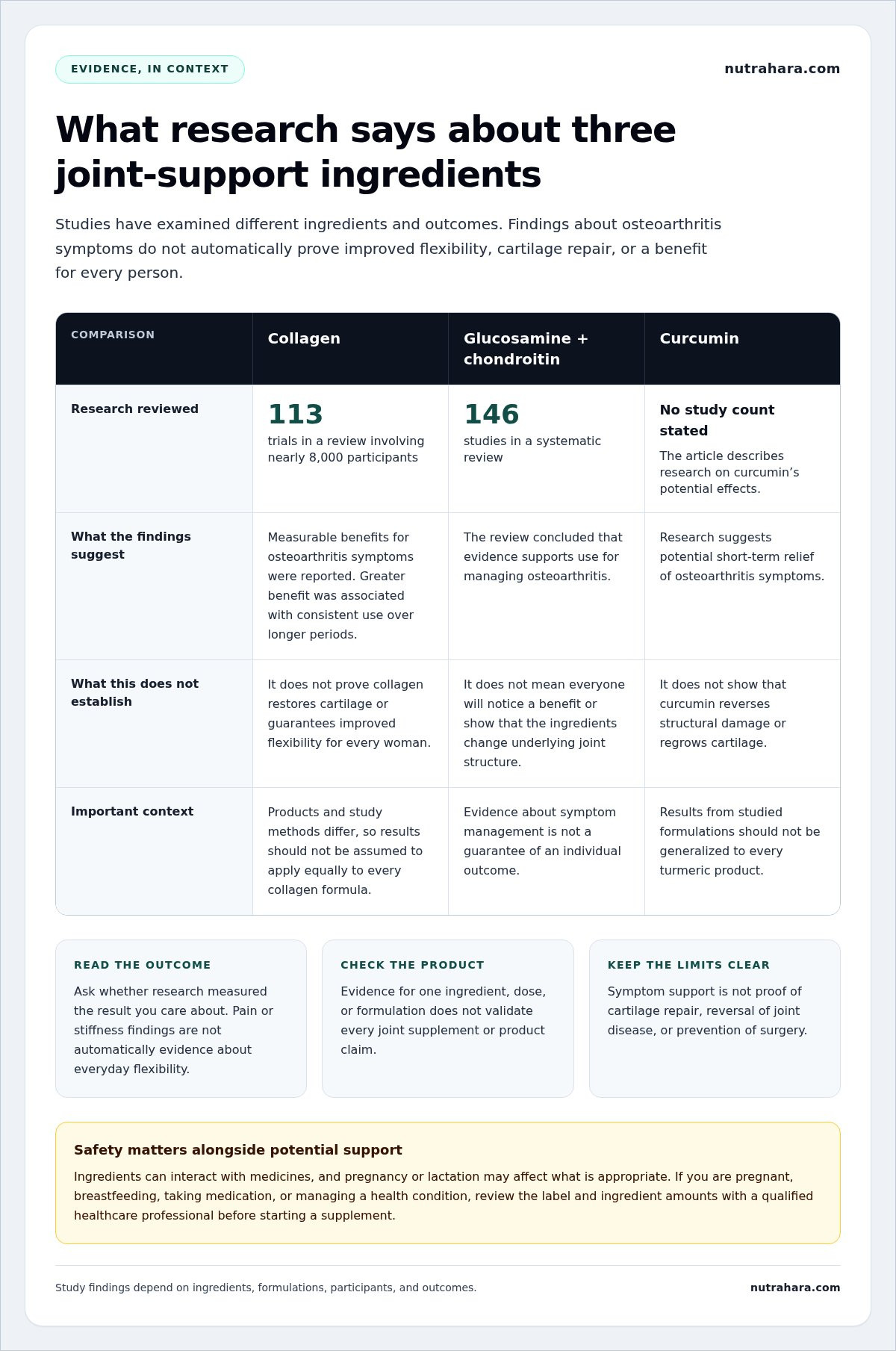
A 2026 review of 113 trials involving nearly 8,000 participants reported measurable benefits from collagen supplementation for osteoarthritis symptoms, with greater benefit associated with consistent use over longer periods. That finding relates to symptoms studied in people with osteoarthritis. It isn’t proof that collagen restores cartilage or guarantees improved flexibility for every woman. Products and study methods can differ, so results shouldn’t be assumed to apply equally to every collagen formula.
Nutrahara’s Premium Collagen Complex is one product to consider as part of a wider wellness routine. Review its current label and discuss the ingredients with a healthcare professional if you’re pregnant, breastfeeding, or taking medication.
How do turmeric and other commonly discussed ingredients compare?
Glucosamine and chondroitin have been examined in a 2025 systematic review covering 146 studies. The review concluded that evidence supports their use for managing osteoarthritis, but that doesn’t mean every person will notice a benefit or that these ingredients affect the underlying joint structure. Research on curcumin, turmeric’s active compound, suggests potential short-term relief of osteoarthritis symptoms. It doesn’t show that curcumin reverses structural damage or regrows cartilage, and results from studied formulations shouldn’t be generalized to every turmeric product.
“Natural” or traditional use alone doesn’t establish effectiveness or safety. Ingredients can interact with medicines, and pregnancy or lactation may affect what’s appropriate. Before starting a supplement, review its label and ingredient amounts with a qualified healthcare professional, especially if you take medication or have a health condition. This step helps keep potential symptom support in perspective.
Supplements versus movement and other joint-care approaches
Joint care isn’t an either-or choice between supplements and movement. Each has a different role, and the right mix depends on your diagnosis, symptoms, abilities, and circumstances. Supplements for joint flexibility in women may be considered for potential support, while movement and clinical care address other parts of a joint-care plan.
| Approach | Possible role | Keep in mind |
|---|---|---|
| Supplements | May offer ingredient-specific support for comfort. | Evidence and safety vary by ingredient and product. They don’t replace diagnosis or treatment. |
| Movement | Helps you practise everyday actions and maintain activity at a level that suits you. | Choose forms and ranges that feel manageable and follow any clinician-provided restrictions. |
| Strength work | Builds muscle capacity for tasks such as standing from a chair or climbing stairs. | Adapt exercise to your current ability and symptoms. |
| Clinical care | Supports diagnosis and guidance on treatment options. | Your qualified care team can tailor recommendations to your condition and needs. |
Where can yoga, strength, and gentle movement fit?
Begin with movements that feel comfortable, such as slowly bending and straightening a joint within an easy range, or practising a supported chair rise if it suits your ability. Strength-building can be adapted with a clinician or qualified exercise professional, especially if you have restrictions. Yoga may offer a mindful way to explore movement. Modify or skip poses that cause discomfort. Stop and seek guidance if activity brings concerning or worsening symptoms.
Meditation can create a pause, settle your attention, and support general wellbeing. It doesn’t change joint structure or replace care. A few quiet minutes focused on steady breathing may help you notice what feels comfortable as you approach movement.
When should a clinician guide the next step?
Arrange professional assessment for persistent, worsening, or function-limiting symptoms, such as difficulty with routine walking or household tasks. Diagnosis and treatment decisions belong with your qualified care team, who can consider your health history and goals. If a procedure has been recommended, don’t delay or cancel it in favour of supplements. Ask your care team how movement and any supplement you’re considering fit with their guidance.
There’s no universal ranking of these approaches. A thoughtful plan gives supplements, movement, strength work, and clinical care clear roles based on your needs.
A safe way to assess joint supplements for your life stage
Start with your needs, not a promise on a bottle. Use this sequence to assess supplements for joint flexibility in women:
- Clarify your goal. Name the daily activity you hope to support, such as walking comfortably or bending with less difficulty.
- Review the evidence. Look for research on the specific ingredient, amount, and outcome, rather than relying on broad claims about joint health.
- Consider safety. Review the exact product label with an appropriate healthcare professional, especially if your life stage, health, or medicines could affect what’s suitable.
- Track a realistic outcome. Note how the chosen activity feels over time, along with any unwanted effects. A supplement can’t guarantee a particular result.
For menstruating women, those approaching menopause, and post-menopausal women, supplement suitability still depends on individual health, medicines, and the product’s ingredients. Don’t assume that a change in life stage means a supplement is needed or that the same choice is right for everyone.
How can you evaluate a joint supplement label?
Read the current label for the full ingredient list, serving information, and amount of each ingredient. Compare those details with research on the specific ingredient, dose, and outcome. Evidence for one ingredient or dose doesn’t automatically apply to a different formula. Be cautious of vague proprietary descriptions that make amounts difficult to assess, guarantees, or promises to prevent surgery. If anything is unclear, review the label with a healthcare professional.
What should women consider during pregnancy or lactation?
If you’re pregnant, trying to conceive, or breastfeeding, get individualized professional guidance before starting a supplement. The same care applies if you take medication or manage a diagnosed condition. “Natural” doesn’t mean suitable for everyone, and needs can differ through menstruation, perimenopause, and after menopause. Share the product label and ingredient amounts with your healthcare professional so they can consider your circumstances.
A brief note of your goal, the product label, your medicines, and relevant health or life-stage details can make that conversation more useful. Nutrahara combines Ayurvedic principles with modern nutritional research. Explore Nutrahara’s women’s health supplements as you consider options for a safe, realistic routine.
How Nutrahara’s Joints & Knees Kit may fit into a broader plan
A supplement can be one part of a joint-care routine, alongside movement that suits your abilities and appropriate clinical care. Nutrahara’s Joints & Knees Kit is a joint-focused bundle designed to support joint health, knee mobility, and body flexibility. These support goals aren’t a promise of a particular result, and the kit shouldn’t be viewed as a treatment or a way to prevent surgery.
What role can the Joints & Knees Kit play?
The kit is one option among supplements for joint flexibility in women, not a replacement for diagnosis, clinician guidance, or other care. Individual experiences can differ. Before choosing it, review the current product label and consider whether its information and stated support goals align with your needs. If you’re pregnant, breastfeeding, taking medication, or managing a health condition, seek individualized professional guidance before starting any supplement.
Clear expectations matter. A supplement’s stated focus on joint health, knee mobility, or flexibility doesn’t establish that it will change a condition’s course or affect whether a procedure is needed. Keep care decisions grounded in your symptoms and qualified clinical advice.
How can you build a supportive daily routine?
Choose an approach you can sustain and that respects how your body feels. Gentle movement within a comfortable range, gradual strength work suited to your ability, restorative yoga, and meditation may all have a place in general wellbeing. Follow any movement restrictions provided by your clinician, and seek guidance if activity causes concerning or worsening symptoms.
To understand how your routine feels, note a specific activity, such as walking or getting up from a chair, and whether comfort or ease changes over time. A short-term change alone doesn’t prove that a supplement caused it. Consider the whole picture, including activity, rest, symptoms, and any care you’re receiving.
Nutrahara combines Ayurvedic principles with modern nutritional research. The Joints & Knees Kit is designed to support joint health, knee mobility, and body flexibility. Review its current information and consider personal suitability before deciding. It can be part of a broader plan, with realistic expectations and your wellbeing at the centre.
Build a joint-care plan that supports your next steps
Supplements for joint flexibility in women may be one part of a broader routine, but they can’t guarantee surgery prevention or replace diagnosis and clinician-guided care. Evidence differs across ingredients and products, so focus on realistic support rather than promises. Movement and strength work suited to your comfort, alongside appropriate clinical guidance, can also play distinct roles in caring for your joints.
Before trying a supplement, clarify what you hope to support, review the product label, and consider your life stage, health conditions, and medicines with a qualified healthcare professional. This is especially important during pregnancy or lactation. Nutrahara’s Joints & Knees Kit is designed to support joint health, knee mobility, and body flexibility. Nutrahara brings Ayurvedic principles together with modern nutritional research, with thoughtful choices at the heart of its approach.
Take the next step at your own pace. Explore Nutrahara’s Joints & Knees Kit as you consider what may fit your broader joint-care plan. Your path to confident movement can be steady, informed, and shaped around you.
Frequently Asked Questions
Can supplements prevent joint surgery?
No supplement can reliably prevent or replace joint surgery. Whether surgery is appropriate depends on the diagnosis, symptoms, how joint function is affected, and an individual assessment by a qualified clinician. Supplements may be considered for potential symptom support, but they shouldn’t delay assessment or change a recommended treatment plan on their own. Discuss concerns and options with your care team, especially if pain or reduced function is affecting daily activities.
What supplements may support joint flexibility in women?
Research has examined ingredients such as collagen, glucosamine, chondroitin, and curcumin for joint-related outcomes. Findings vary by ingredient, formulation, studied population, and outcome, so evidence for one doesn’t validate every product. Some research suggests potential symptom support, particularly for osteoarthritis, but that isn’t proof of cartilage repair or improved flexibility for every person. Review the exact label and discuss suitability with a healthcare professional before starting.
Can collagen supplements improve joint mobility?
Collagen may support some osteoarthritis symptoms, but the evidence doesn’t guarantee improved mobility for an individual or show that collagen repairs cartilage. A 2026 review of 113 trials involving nearly 8,000 participants reported measurable benefits for osteoarthritis symptoms, particularly with consistent use over longer periods. The findings apply to the studies reviewed, not automatically to every collagen product or woman. Check the product label and seek professional advice if you have health concerns.
Is it safe to take joint supplements during pregnancy or while breastfeeding?
Ask a qualified healthcare professional before taking joint supplements during pregnancy or breastfeeding. Safety can depend on the specific ingredients, amounts, health circumstances, and other products or medicines you use. The same individualized review is sensible if you’re trying to conceive, managing a diagnosed condition, or taking medication. Don’t assume an ingredient is suitable simply because it’s described as natural. Bring the complete product label to your healthcare professional for review.
Can yoga and exercise help joint flexibility?
Gentle movement, suitable strength work, and adapted yoga can help you practise comfortable movement and support general wellbeing. Choose activities that match your ability, symptoms, and any restrictions from your clinician. For example, explore an easy range of motion rather than forcing a deep stretch. Meditation may support relaxation and body awareness, but it doesn’t change joint structure or replace treatment. Stop and seek guidance if movement causes concerning or worsening symptoms.
How long should I try a joint supplement before deciding whether it helps?
There isn’t one evidence-based trial period that applies to every supplement or person. Study durations and formulations differ, and some collagen research reports benefits with consistent use over longer periods, but that doesn’t establish a universal timeline. Before starting, choose a realistic activity to track, such as walking or climbing stairs, and follow professional guidance about use. Stop and seek advice if you experience unwanted effects, or if symptoms worsen or limit function.
Disclaimer
This article is not a substitute for medical advice. Please consult a healthcare professional before starting any supplement, especially if pregnant, nursing, taking medication, or managing health conditions.