

What if a few brief notes could make confusing perimenopause changes easier to explain? Symptoms can shift from day to day, and it isn’t always easy to remember when they started or what else was happening. If you’re exploring natural supplements for perimenopause symptoms, recording what you take alongside how you feel can help you keep the details clear, without assuming one caused the other.
A wellness journal doesn’t need to become another demanding task. A simple, repeatable routine can help you notice possible connections between symptoms and daily habits while keeping observation separate from diagnosis. Your notes can also help you describe changes clearly to a healthcare professional.
In this guide, you’ll learn what to track, how to keep entries short, and how to review them for useful patterns. We’ll also cover how to bring your observations into a care conversation. Nutrahara combines Ayurvedic principles with modern nutrition research, and its nutrition is made in New Zealand.
Key Takeaways
- Use a brief daily note to capture symptoms and context while the details are fresh.
- Track only details that help you, such as sleep, movement, meals, stress, or cycle changes.
- Look for repeated timing and context in your entries, but treat patterns as observations, not proof of cause.
- Anchor a short journaling habit to an existing routine, such as meditation, yoga, or a walk.
- Bring a clear summary of your changes and questions to a healthcare professional, including any questions about natural supplements for perimenopause symptoms.
Why Keep a Wellness Journal for Perimenopause Symptoms?
A wellness journal is a brief record of symptoms, daily routines, and relevant context. It could be a notebook, a note on your phone, or a simple document. The goal isn’t to capture every detail of your day. It’s to make changes easier to remember when your experience shifts or you want to discuss it with a healthcare professional.
Perimenopause can involve changes in menstrual cycles, sleep, mood, and other aspects of wellbeing, but no single pattern applies to everyone. Some women notice several changes at once; others experience only a few, or find that symptoms come and go. A general Perimenopause overview can offer background, while dated notes preserve what you’re experiencing.
Your notes can support a clearer conversation, but they can’t identify the medical cause of a symptom or confirm that it’s related to perimenopause. A journal complements, rather than replaces, assessment by a qualified healthcare professional. It can help you describe what changed, when you noticed it, and what you’d like to ask. If you’re also considering natural supplements for perimenopause symptoms, recording what you take and when can help you share that context during a health discussion. It doesn’t show that a supplement caused a change or will address a symptom.
What can a symptom journal help you notice?
Dated entries give you something concrete to refer to instead of relying on memory alone. For example, you might note waking during the night on several occasions, then look back to see whether those nights shared any circumstances. A repeated observation can suggest a question to explore with a clinician. It isn’t proof that a routine, food, or other factor caused the symptom. Treat patterns as clues for discussion, not conclusions.
Keep the wording factual and specific. “Woke twice, felt tired in the morning” may be more useful later than “bad night.” You don’t need to interpret the entry as you write it.
Which changes might be worth recording?
Start with experiences that matter to your day-to-day wellbeing. You might jot down sleep, mood, energy, or hot flashes, adding a few words about how they affected work, exercise, or rest. If you menstruate, you may also choose to note bleeding or cycle timing. If you don’t, leave that out. Your journal should reflect your body and circumstances, not a checklist everyone is expected to follow.
Choose only a few details to begin. If a particular change keeps catching your attention, include it; if a detail feels irrelevant, skip it. A short, honest record is more useful than a demanding log that’s hard to maintain. Over time, your notes can help you explain your experience in your own words and decide what you’d like to ask next.
What to Record in a Perimenopause Wellness Journal
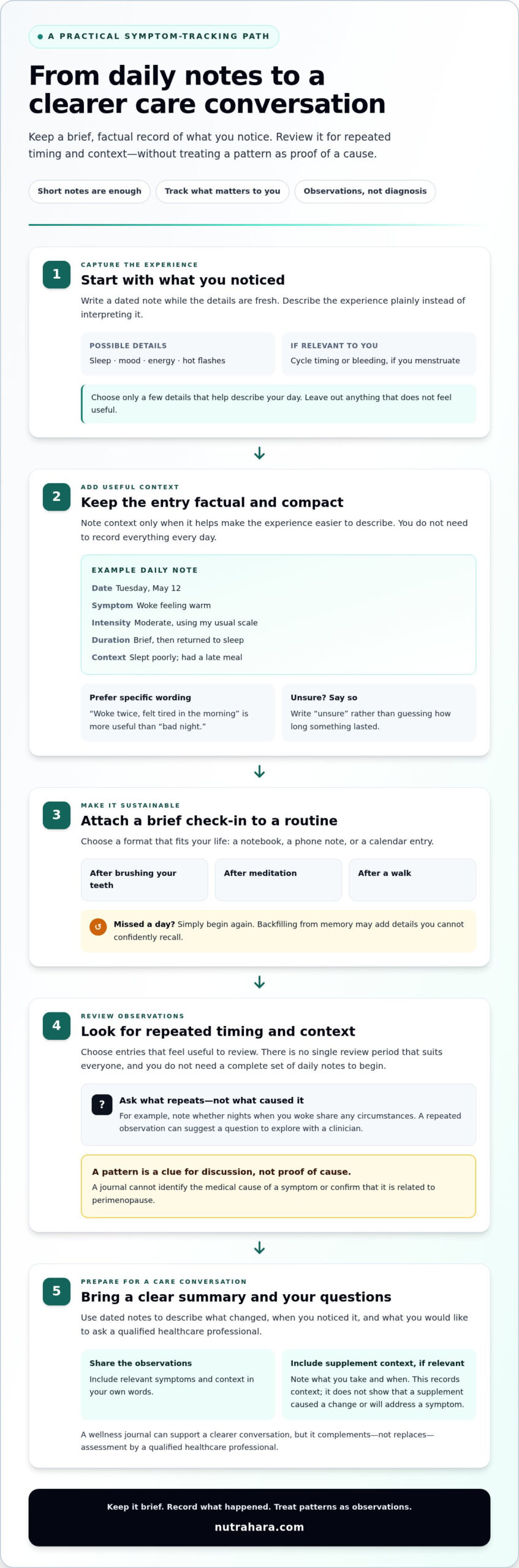
A useful entry captures enough detail to describe what you noticed without turning the journal into a second job. Start with the basics, then add context only when it helps you make sense of the day. Write what happened rather than assigning a cause: “woke warm twice” is more neutral than “stress caused night sweats.”
Experiences differ from person to person, and the details that matter to you may change over time. Harvard Health on Perimenopause Symptoms discusses a range of possible changes and the individual nature of the experience. Use it as background, not as a checklist you need to complete.
A simple daily entry template
Try this compact format. Leave out any field that doesn’t add value to your record.
- Date: Tuesday, May 12
- Symptom: Woke feeling warm
- Intensity: Moderate, using my usual scale
- Duration: Brief, then returned to sleep
- Context: Slept poorly; had a late meal
You can describe intensity in plain language or choose a simple rating scale and use it consistently. A rating is a memory aid, not a clinical measurement. If you can’t remember exactly how long something lasted, write “unsure” rather than guessing. A clear description matters more than a complete-looking entry.
Track symptoms without making the journal a burden
Choose a format that fits your life: paper by the bed, a note on your phone, or a calendar entry. A brief check-in after brushing your teeth, finishing meditation, or returning from a walk can be a gentle reminder. If you miss a day, simply begin again. Backfilling from memory may add details you can’t confidently recall.
Alongside a symptom, note only relevant context. Sleep, movement, meals, stress, and menstrual timing may be useful for some entries, but you don’t need to log everything every day. If you menstruate, record cycle timing or bleeding when it helps describe a change. Otherwise, leave that field blank. Keep the wording observational: “felt low energy after a restless night” records both experiences without claiming that one caused the other.
If you’re considering natural supplements for perimenopause symptoms, you can note what you take and when as part of your personal context, without treating the journal as evidence of an effect. Nutrahara brings Ayurvedic principles together with modern nutrition research. Its nutrition is made in New Zealand, with clean-and-simple formulations free of artificial additives. For a broader look at women’s wellness, explore Nutrahara’s wellness information.
How to Review Journal Entries Without Jumping to Conclusions
Reviewing your notes is a chance to make your experience easier to describe, not to solve its cause on your own. Choose a group of entries that feels useful to look over. There’s no single review period that suits everyone, and you don’t need a full set of daily notes to begin.
Use a calm, repeatable sequence:
- Scan the entries. Read them through once without interpreting each detail.
- Note repetitions. Mark symptoms or circumstances that appear more than once, including changes in how often or how strongly they affect you.
- Add context. Compare surrounding details, such as sleep, stress, activity, or routine, when you recorded them.
- Write questions. Turn anything that stands out into a question to explore, rather than a conclusion about what’s happening.
Timing can show that two things happened around the same time, but it can’t establish cause and effect. A symptom following a particular meal, workout, stressful day, or supplement doesn’t prove that factor caused it. Your body and daily circumstances can change in several ways at once.
Separate observations from interpretations
Start with what you noticed. For example, write “felt restless after an evening workout” rather than “exercise disrupted my sleep,” especially if you didn’t record how you slept afterward. If the reason for a change is unclear, say so: “Energy was lower today; not sure why.” That note is accurate and useful. Avoid attributing a symptom to one food, habit, or item among natural supplements for perimenopause symptoms based on a single entry.
Look for patterns that lead to useful questions
Compare entries that describe similar experiences, then notice what differs. If low energy appears on days after restless sleep, check whether that repeats in your notes and whether other circumstances vary. The journal may suggest a relationship worth discussing, but it can’t confirm that one factor is responsible. Include changes that matter to you, even if they occur only occasionally. The impact on your rest, mood, work, or ability to enjoy movement may matter as much as frequency.
Remember what a journal can and can’t tell you. It can’t measure hormone levels or confirm that you’re in perimenopause. It offers a personal record to support a conversation with a qualified healthcare professional, who can consider your symptoms alongside other relevant information. Bring your observations and questions with an open mind. You’re not expected to diagnose yourself; you’re making it easier to explain what you’ve experienced and seek guidance that fits your circumstances.
How to Build a Sustainable Symptom-Tracking Routine
The best tracking routine is one you can return to without pressure. Keep it small: choose a format, attach it to a familiar cue, then make a short entry. Your notes don’t need to be daily or perfectly complete to help you describe changes over time.
- Choose a format. Pick a notebook, phone note, or calendar that feels convenient.
- Set a cue. Link your check-in to something you already do, such as making tea or getting ready for bed.
- Make a short entry. Record what stood out and any context that feels relevant. Skip the rest.
Choose a format and a reminder that fit your life
A notebook can be easy to keep by your bed, while a phone note is handy when you’re away from home. A calendar can make dates and timing easier to scan. Consider your privacy preferences, too: keep the journal somewhere discreet or use a device setting that suits you. Choose one place so your notes don’t become scattered.
Pair the check-in with a steady morning or evening habit. After brushing your teeth, for example, take a moment to write a phrase about sleep or mood. If you miss a day, let it go and resume at your next cue. A weekly glance can help you stay connected to your notes without making daily logging a requirement.
Make tracking part of a broader wellness practice
If yoga or meditation is already part of your wellbeing routine, use the quiet moment afterward as a gentle reminder to check in. A walk can also provide a natural cue when you return home. These practices are routine anchors, not guaranteed treatments for symptoms. Note movement or rest as context, not as a score of how well you performed.
Let your routine change with your life stage. If menstrual cycles are relevant, record timing when it helps you describe your experience. During pregnancy or lactation, or after menopause, you can focus on changes that matter to your wellbeing without assuming they follow a perimenopause pattern. Keep what is useful and leave the rest; the journal should support you, not judge you.
Try a weekly check-in with a kind, practical question: “What would I like to remember about this week?” Even a few words can preserve details you might otherwise forget. If you’re exploring natural supplements for perimenopause symptoms as part of your broader wellness interests, Nutrahara’s women’s wellness information can offer another point of reference. Nutrahara’s nutrition is made in New Zealand. Explore Nutrahara’s women’s wellness information.
Use Your Wellness Journal to Prepare for Your Next Steps
Your journal can help turn daily notes into a clear starting point for a conversation with a qualified healthcare professional. Before an appointment, choose a few changes that feel recurring, disruptive, or important to you. You don’t need to bring every entry or explain what caused each symptom. A concise summary can help you focus on what you want to understand.
Turn notes into a clear conversation
Use one page to capture the main points. Keep the wording factual and personal, then add questions you’d like to ask.
- What changed: Name the symptoms or wellbeing changes that stand out.
- When you noticed them: Note approximate timing, frequency, or any relevant cycle details.
- How they affect you: Describe any impact on sleep, mood, work, exercise, or daily activities.
- What you want to ask: Write down questions about possible explanations, assessment, and next steps.
For example, you might note that sleep interruptions have been affecting your daytime energy, then ask what information could help clarify the change. If you menstruate, cycle timing may be useful context; include it only if it applies to your experience. Your observations can guide the discussion, but journal patterns aren’t a diagnosis or proof that a particular factor caused a symptom.
Care and wellness choices are personal. A healthcare professional can consider your symptoms and circumstances when discussing appropriate next steps. Share what you’ve noticed and what matters most to you, even if your notes are incomplete. You’re bringing useful context, not expected to arrive with a conclusion.
Explore wellness support thoughtfully
Supplements may be one consideration within a broader approach to wellbeing, alongside questions about symptoms, routines, and other care options. If you’re considering natural supplements for perimenopause symptoms, use your journal to note questions you want to discuss, rather than treating a pattern as evidence that a supplement will help. Decisions should reflect your individual needs and health circumstances.
If sleep is one of the changes you’re tracking, you can explore Nutrahara’s women’s wellness supplements as part of your wider wellness reading. Nutrahara combines Ayurvedic principles with modern nutrition research, using clean-and-simple formulations made with natural ingredients. Its nutrition is made in New Zealand.
Explore Nutrahara’s women’s wellness supplements as a starting point for informed questions. Keep your next step manageable: summarize what you’ve noticed, share it with a qualified healthcare professional, and explore wellness information at your own pace.
Let Your Next Step Be Small and Steady
Your journal can grow with you. Some weeks, a few words may be enough; at other times, you may want to capture more detail or bring a question to a healthcare professional. Let the practice adapt to your energy and circumstances. A missed entry doesn’t erase what you’ve learned, and you can always begin again with the next note.
If you’re weighing natural supplements for perimenopause symptoms, make space for thoughtful questions alongside your personal observations. Wellness choices are individual, and reliable information can help you explore them with care rather than pressure. Take your time, stay curious, and choose next steps that feel right for your needs.
Explore Nutrahara’s women’s wellness resources as you continue your wellness journey. Each small act of self-attention is a meaningful way to move forward with greater confidence.
Frequently Asked Questions
What should I write in a perimenopause symptom journal?
Write what you noticed and how it affected your day. For example, if a headache interrupted a yoga session or made it harder to concentrate at work, note that impact. If you’re considering natural supplements for perimenopause symptoms, record what you take and when so you can include that information in a health conversation. Stick to observations rather than guessing at causes.
How often should I track perimenopause symptoms?
Choose a rhythm that feels manageable. You might jot a short note when a symptom occurs, or check in regularly if that’s easier to remember. A weekly glance at your calendar can help you notice details you may have missed. The routine should serve your needs, not become another standard you feel pressured to meet.
Can a wellness journal tell me if I am in perimenopause?
No. Journal entries can help you describe changes, but they can’t confirm perimenopause or identify another medical cause. A qualified healthcare professional can consider your experience and relevant health history. If you’re unsure what to bring up, choose the changes that concern you most and write down what you hope to understand from the conversation.
How long should I keep a symptom journal before reviewing it?
There’s no set waiting period. Review your notes when you have enough information to reflect on, or sooner if a change is affecting your wellbeing. You can also discuss a new or disruptive concern without waiting to build a long record. Let your questions and circumstances guide when you look back at your entries.
What if my symptoms change from day to day?
Record what feels relevant, even if it varies. You might notice changes in sleep one day and mood or energy another. A note such as “felt unlike myself today” can be a useful starting point if you add a little context. Your experience doesn’t need to be consistent to deserve attention or to be worth discussing.
Can yoga or meditation be included in a perimenopause wellness journal?
Yes. You can note whether you practised yoga or meditation and how you felt around that time, if it’s relevant to you. For instance, record that you felt more settled afterward without assuming the practice caused a symptom change. These notes can help you reflect on how movement and moments of calm fit into your overall wellbeing.
Disclaimer
This article is not a substitute for medical advice. Please consult a healthcare professional before starting any supplement, especially if pregnant, nursing, taking medication, or managing health conditions.