is vitamin D supplementation really necessary for women who eat a balanced diet and get some sunlight in 2026 | Updated October 2026 | 9 min read | Nutrahara Wellness Team
For most women living in the United States, yes, vitamin D supplementation is still necessary in 2026 even with a balanced diet and regular sunlight exposure. Food sources are limited, sunscreen and indoor work block synthesis, and winter at latitudes above roughly the 35th parallel makes skin production nearly impossible for months. Clinical data show that even health-conscious women often fall short of optimal blood levels needed for bone, hormonal, and immune health.
Vitamin D is unusual among nutrients: the body is built to make it from sunlight, yet modern life, indoor work, sunscreen, and northern latitudes have quietly turned a “free” vitamin into one of the most common deficiencies in American women.
Diet and casual sunlight alone are insufficient for most American women to reach optimal vitamin D status, which is why clinicians increasingly recommend supplementation as a baseline. Even women who consider themselves healthy eaters and outdoor enthusiasts frequently have low lab results.
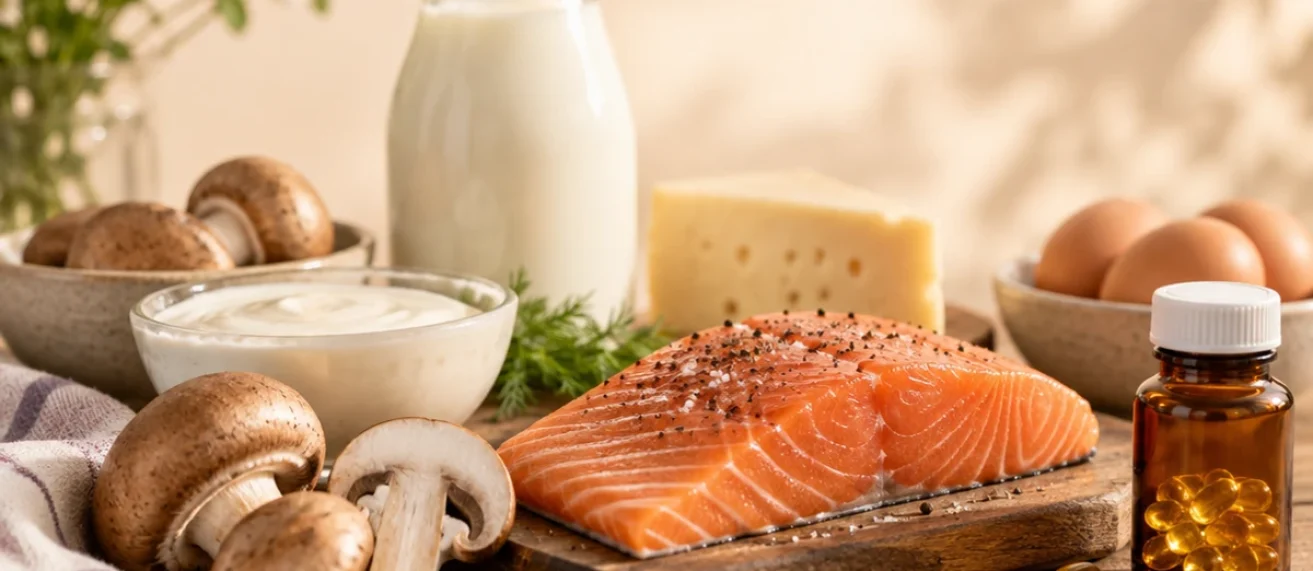
Very few whole foods naturally contain meaningful vitamin D. GoodRx notes that few foods contain significant vitamin D; fatty fish, egg yolks, and liver are among the exceptions.
Sunlight-based synthesis depends heavily on geography and season. At latitudes above 35 degrees north, UVB intensity is too low for meaningful synthesis during winter months, roughly November through February. This latitude line cuts through major U.S. cities like Boston, Chicago, Denver, and Seattle, home to tens of millions of American women. During winter, supplementation is the only reliable strategy regardless of outdoor time.
Key Takeaway: A balanced diet and casual sunlight reduce severe deficiency risk but are not reliably sufficient to reach optimal vitamin D blood levels year-round for most women in the continental United States. For deeper context, see Vitamin D: Do We Need More Than Sunshine? – PMC.
National health data show vitamin D deficiency remains widespread among American women across age groups and demographics, making the case for supplementation clearer.
| Population Group | Reported Finding | Source |
|---|---|---|
| US adults overall | Approximately 35% have vitamin D deficiency | Cleveland Clinic |
| Women of childbearing age (20-44) | 11.1% deficient, 25.7% inadequate | NHANES/CDC analysis |
| Adolescent females | 54% deficiency using a 20 ng/mL cutoff | Utah State University review |
| Women 60 and older | 80.4% use at least one dietary supplement | CDC National Health Statistics Report |
| Pregnant/lactating African American women | 61.4% had daily vitamin D intake below 400 IU | NHANES analysis, 2025 |
Women of childbearing age show an age-adjusted prevalence of 11.1% deficiency and 25.7% inadequacy. Risk increased for women of non-white race/ethnicity and those with obesity, while supplement use, milk consumption, and sunlight exposure during May through October decreased risk. In broader surveys, overall adult deficiency reached 41.6%, with highest rates in Black Americans at 82.1% and Hispanic Americans at 69.2%.
Key Takeaway: National data show a large share of American women across races, ages, and lifestyles are not reaching optimal vitamin D status through diet and sun exposure alone. For supporting data, see Subclass D – World History and History of Europe, Asia, …. For related guidance, see Ashwagandha With Black Pepper.
Early symptoms are often subtle and easily attributed to stress or aging, which is why recognizing the pattern early allows for simple blood testing.
Early signs include fatigue, bone or back pain, muscle weakness or cramps, frequent illness, and hair loss.
A peer-reviewed study on musculoskeletal pain found that women with lower vitamin D levels reported higher frequency of severe premenstrual symptoms including fatigue, headache, irritability, mood swings, anxiety, depression, and social withdrawal compared to controls.
Key Takeaway: If fatigue, hair thinning, low mood, and muscle aches appear together, vitamin D status is worth checking before assuming stress or aging is the cause. For deeper context, see A Periodic Diet that Mimics Fasting Promotes Multi … – PubMed.
Ayurveda frames vitamin D support as part of a broader system involving digestion, sunlight connection, and vital energy, treating low vitamin D as a symptom of deeper imbalance rather than an isolated problem to patch with a pill.
Ayurveda emphasizes absorption, not just intake. Ayurvedic practitioners note that vitamin D supports Ojas, which relates to overall vitality and immunity. An imbalance in Vata may hinder nutrient absorption, including vitamin D, exacerbated by a Kapha imbalance combined with limited sunlight. A woman could consume adequate dietary vitamin D and still show low blood levels if her digestive fire, or Agni, is compromised.
Nutrahara approaches women’s wellness by blending clinically validated Ayurvedic herbs with essential vitamins rather than treating any single nutrient as a silver bullet. Products like FemmePower support hormonal balance holistically.
Key Takeaway: The Ayurvedic perspective adds the insight that absorption, digestion, and overall vitality matter as much as dose. Formulations pairing vitamin D with digestive and adaptogenic support offer a more complete approach.
Official U.S. guidance sets clear numeric targets, but real-world intake data show most women fall well below them without supplementation.
The NIH Office of Dietary Supplements publishes specific life-stage targets:
| Life Stage | Recommended Daily Amount | Upper Limit |
|---|---|---|
| Adults 19-70 years | 600 IU (15 mcg) | 4,000 IU |
| Adults 71+ years | 800 IU (20 mcg) | 4,000 IU |
| Pregnant and breastfeeding women | 600 IU (15 mcg) | 4,000 IU |
Levels of 50 nmol/L (20 ng/mL) or above are adequate for bone and overall health. Levels below 30 nmol/L (12 ng/mL) are too low and weaken bones; levels above 125 nmol/L (50 ng/mL) may cause health problems. Yet Harvard’s Nutrition Source reports median intake of vitamin D from food and supplements in women ages 51 to 71 was only 308 IU daily, with just 140 IU from food alone, far short of the 600 IU target.
Key Takeaway: Most American women need between 600 and 2,000 IU daily, but testing blood levels periodically and choosing a holistic formulation that avoids mega-dosing is the smarter long-term strategy. For deeper context, see Determination of Need (DoN).
Choosing the right vitamin D approach depends on individual factors like latitude, skin tone, age, and health conditions. A thoughtful decision involves testing, form selection, and pairing vitamin D with complementary nutrients rather than treating it in isolation.
Not all vitamin D products are equal. D3 (cholecalciferol) is generally more effective at raising blood levels than D2 (ergocalciferol).
| Approach | Strength | Limitation |
|---|---|---|
| Diet and fortified foods only | No supplement cost; supports overall nutrition | Rarely reaches 600 IU/day without deliberate stacking |
| Sunlight exposure only | Free, supports circadian rhythm and mood | Unreliable in winter above 35°N; skin cancer risk with unprotected exposure |
| Standalone high-dose D3 supplement | Effective at raising blood levels quickly | Ignores absorption, hormonal balance, and whole-body context |
| Vitamin D paired with Ayurvedic herbal support | Addresses digestion, absorption, and hormonal balance alongside the nutrient | Requires choosing a reputable, science-backed formulation |
Nutrahara’s approach integrates Ayurvedic wisdom with modern research. Products like FemmePower for hormonal balance, RestoraSleep for rest and recovery, and AnxioGuard for stress support are designed to support the physiological systems that determine whether a nutrient like vitamin D is actually used in the body.
Key Takeaway: The best strategy for 2026 isn’t maximizing a single vitamin’s dose; it’s choosing a holistic formulation and testing protocol that accounts for latitude, skin tone, life stage, and absorption.
The evidence strongly suggests that for most American women, vitamin D supplementation is necessary. Food sources are limited, northern winters block synthesis, and national deficiency rates remain high even among health-conscious populations. Supplementation is a rational response to measurable biological and geographic realities.
Request a 25(OH)D blood test from a healthcare provider, review daily sun and dietary habits honestly, and consider a holistic, Ayurveda-informed formulation such as those offered by Nutrahara to close the gap in a way that supports the whole body.
For most women in the United States, yes. Even with a balanced diet and regular outdoor time, food sources provide limited vitamin D, winter sunlight above the 35th parallel is too weak for skin synthesis, and roughly 35% of U.S. adults remain deficient. Supplementation functions as practical safeguard.
Yes, in most cases, because a balanced diet typically supplies far less than the 600 IU daily recommendation, and “some sunlight” is often inconsistent enough, especially seasonally, to maintain optimal blood levels. Testing 25(OH)D levels is the most accurate way to confirm individual need.
Vitamin D supports calcium absorption and bone density, immune regulation, mood stabilization through serotonin and dopamine pathways, and emerging research links it to menstrual cycle regularity and reduced PMS severity. It also supports muscle function and may influence hair follicle health, particularly during hormonal transitions.
Ayurveda views vitamin D through the lens of Ojas (vital energy), Agni (digestive fire), and dosha balance, suggesting that absorption and digestive strength matter as much as intake. This perspective often pairs vitamin D with herbs like Ashwagandha, Guduchi, or Shatavari to support overall vitality.
Early signs include persistent fatigue, muscle weakness, bone or back pain, hair thinning, low mood, brain fog, and frequent infections. Research links low vitamin D to worsening PMS, irregular cycles, and early perimenopausal symptoms when several symptoms appear together.
The NIH recommends 600 IU (15 mcg) daily for most adult women ages 19 to 70, rising to 800 IU for women 71 and older, with the same 600 IU target during pregnancy and breastfeeding. The tolerable upper limit is 4,000 IU daily, though individual needs vary based on blood levels, body weight, and sun exposure.
Studies suggest sunscreen has smaller impact on vitamin D status than commonly believed. Some research finds no significant difference or slightly higher levels among regular sunscreen users, likely because they spend more time outdoors safely. Overall time spent outdoors, geographic latitude, season, and skin pigmentation are bigger factors.
Fatty fish like salmon and mackerel, egg yolks, and fortified products such as milk, plant-based milk alternatives, and orange juice are the most common sources. Fortified foods typically provide only 100 to 150 IU per serving, so most women need multiple servings daily to approach the 600 IU recommendation, making supplementation practical for many.
This article is for informational and educational purposes only and does not constitute medical advice. Vitamin D needs vary based on age, skin tone, geographic location, body weight, and existing health conditions. Always consult a licensed healthcare provider and request a 25(OH)D blood test before starting, stopping, or adjusting any supplement regimen. Statistics and recommendations cited reflect publicly available research and U.S. federal guidance current as of 2026.




© Nutrahara– 2026 All Right Reserved