how to read a probiotic supplement label for women | Updated October 2026 | Nutrahara Editorial Team | Beginner
Learning to read a probiotic supplement label for women comes down to five core skills: decode a three-part strain name (genus, species, strain code), understand why CFU “guaranteed through expiration” is stronger than “at time of manufacture,” identify which strains have research for your specific need, spot third-party certification seals, and review the “other ingredients” panel for fillers. You’ll compare products in under five minutes once you know what to look for.
Most women scan the front-of-bottle billion-CFU number and call it a day. That number tells you almost nothing about whether a product will work for hormonal balance, vaginal health, or digestion. This guide walks through the exact label elements to check, in order of importance.
The probiotic market is drowning in pink-packaged “women’s formulas” that lean on hormone-related buzzwords rather than clinically studied strains. In one test of 17 commercial probiotic products, Vital Planet found that 5 had lower live counts than their labels claimed-nearly a third failing to deliver what the front of the bottle promised.
Strain specificity matters just as much as potency. Research consistently points to Lacticaseibacillus rhamnosus GR-1 (formerly Lactobacillus rhamnosus GR-1) as the most researched probiotic strain for women’s urogenital health. Yet many “women’s probiotic” products don’t contain it; instead they use a generic Lactobacillus species chosen for cost rather than evidence, as detailed in peer-reviewed research.
Because the FDA does not verify that a supplement contains what the label says before it reaches shelves, the burden of verification falls on you. Consumer Reports confirms it: the FDA doesn’t verify supplement contents or contamination before products are sold. Understanding how to read a probiotic supplement label is crucial in 2026, not just a nice-to-have. For supporting data, see Women’s health and next-gen probiotics in focus for ….
| Step | Action | Time | Outcome |
|---|---|---|---|
| 1 | Locate and decode the full strain name | 2 minutes | Know exactly which bacteria you’re buying |
| 2 | Check CFU count and expiration guarantee | 2 minutes | Confirm potency lasts until you take it |
| 3 | Match strains to your specific health goal | 3 minutes | Pick strains backed by women’s health research |
| 4 | Verify third-party testing seals | 2 minutes | Confirm label claims are independently verified |
| 5 | Review the “other ingredients” and prebiotic list | 2 minutes | Avoid unwanted fillers, sugars, or allergens |
Total time: about 10-12 minutes the first time; under 5 minutes once the checklist becomes second nature.
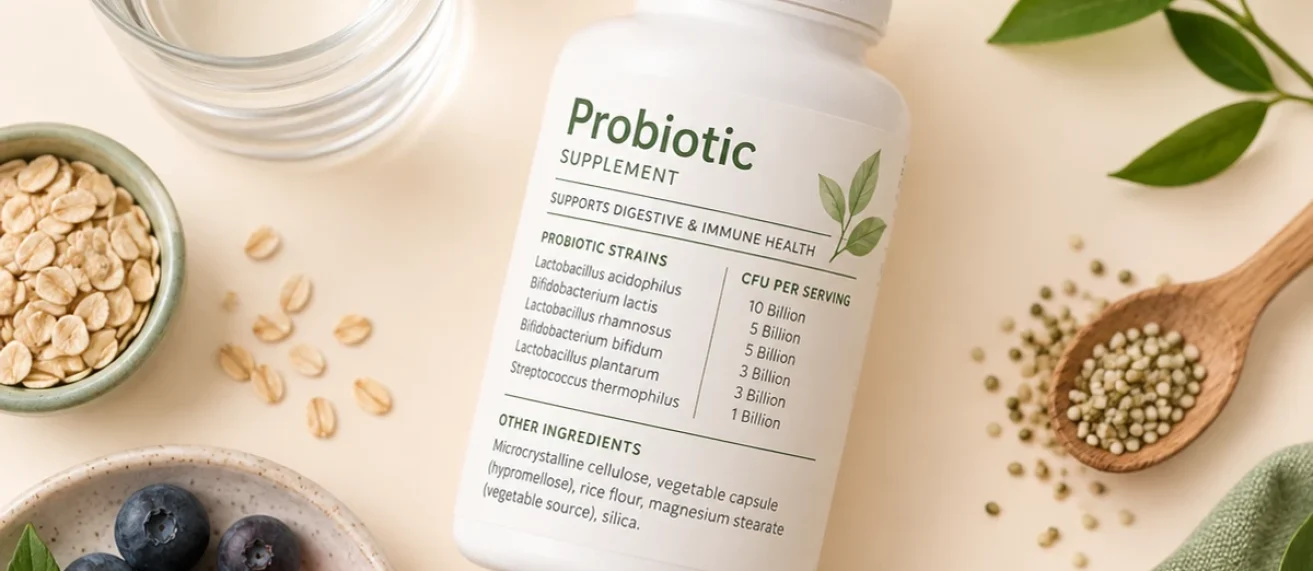
You’re hunting for the complete scientific name for every organism in the product, not just the genus. Different strains within the same species can have completely different effects.
Assuming “Lactobacillus acidophilus” alone tells you anything useful. Without a strain code, a label that only says Lactobacillus rhamnosus or “proprietary blend” leaves you guessing. Perelel Health notes this is a common gap in how women’s probiotics are marketed.
You can point to every organism on the label by its full genus-species-strain name and explain in one sentence what that specific strain is researched for.
| Label wording | Verifiable? | Why |
|---|---|---|
| Bifidobacterium longum BB536 | Yes | Full strain code allows you to search the research |
| Lactobacillus acidophilus | No | Species only, no strain code to verify |
| Probiotic Blend: 20 billion CFU | No | No organism named at all |
Key Takeaway: Always prioritize labels that list the full genus, species, and strain code for each probiotic. This specificity is essential for verifying research-backed benefits. For a more detailed walkthrough, see Free small business counseling & local mentoring.
You’re verifying how many live organisms you’ll actually get, and whether that number holds up by the time you take the capsule, not just the day it left the factory. CFU stands for colony-forming units, representing the number of live bacteria in a serving that can grow into colonies in a lab test, as explained by Vital Planet.
Treating “50 billion CFU” as inherently superior to “10 billion CFU.” A product listing high total CFU without per-strain disclosure may deliver most of that count from a cheap, unresearched filler strain, as highlighted by Supp.co.
You can state the exact CFU count you’ll receive on the day you swallow the capsule, not just the day it was bottled.
Key Takeaway: Prioritize CFU count “guaranteed through expiration” over “at time of manufacture.” Strain-specific research matters more than high, undifferentiated total CFU counts.
You’re connecting the strain names you identified in Step 1 to the health outcome you want. “Probiotic” is not a single effect; it’s a category covering dozens of distinct benefits.
Buying a “women’s probiotic” based on packaging alone. Many products marketed this way don’t contain clinically studied strains. Most “women’s probiotics” don’t contain these strains even when the label implies vaginal health support.
You can name the exact strain on your label and state which specific women’s health outcome (digestive, vaginal, or hormonal) it has published research behind.
| Health goal | Strain to look for | What research shows |
|---|---|---|
| Vaginal/urinary balance | L. rhamnosus GR-1 + L. reuteri RC-14 | Oral colonization of the vaginal tract shown in RCTs |
| General digestion | Bifidobacterium longum (strain-coded) | Supports balanced gut flora composition |
| Fertility-adjacent support | Lactobacillus crispatus | Linked to favorable implantation environments, as discussed by Perelel Health |
Applying this to a real bottle: on a women’s formula like Nutrahara’s Probiotic & Prebiotic Formula, confirm each organism is listed with a full strain designation, the CFU guarantee language, and the formula is framed around a specific goal rather than vague “gut health” claims.
Key Takeaway: Match specific, research-backed probiotic strains to your individual women’s health goals, such as L. rhamnosus GR-1 and L. reuteri RC-14 for vaginal health. Generic “women’s probiotic” claims often lack clinical support.
You’re confirming that an outside organization has verified the label’s claims are accurate. This is your safeguard against mislabeling.
You can identify whether a specific independent organization has verified the product.
Key Takeaway: Always look for third-party testing seals from reputable organizations like NSF International or USP. These provide independent verification of a probiotic’s identity, potency, and purity, going beyond basic cGMP compliance.
You’re reviewing everything beyond the probiotic blend itself. Fillers, added sugars, and allergens often hide in this section while the front focuses on CFU counts. A prebiotic is a type of fiber that feeds beneficial bacteria in the gut.
You’ve read the full ingredient panel and can confirm the product contains no allergens or additives you want to avoid.
Key Takeaway: Carefully examine the “Other Ingredients” list for beneficial prebiotics and to identify and avoid unwanted fillers, allergens, or artificial additives.
Phase 1 (Weeks 1-2): Apply the five-step checklist to your current probiotic and two or three alternatives side by side. The comparison process becomes automatic.
Phase 2 (Weeks 3-8): Track how you feel against the specific strain and goal you selected. Judge whether the product actually matches its research-backed claims for you personally.
Phase 3 (Ongoing): Re-check labels every time you reorder since manufacturers reformulate. Build a habit of checking the NSF or USP verification databases before trying any new women’s health supplement.
| Resource | Role | Cost |
|---|---|---|
| Nutrahara Probiotic & Prebiotic Formula | Women’s-health-focused probiotic formula to apply the checklist to | Paid |
| NIH Office of Dietary Supplements Probiotics Fact Sheet | Reference for strain and CFU terminology | Free |
| USP Verified Products database | Check independent verification status by brand | Free |
| NSF International certified product search | Check NSF Contents Tested or GMP certification | Free |
| ConsumerLab | Independent lab testing reports across probiotic brands | Paid subscription |
See also, see Probiotics for Women (Label).
Likely cause: The manufacturer wants to protect a formula or avoid disclosing that most of the CFU count comes from a cheap, unresearched filler strain.
Fix: Choose a different product, or contact the brand directly to request a per-strain CFU breakdown and Certificate of Analysis before purchasing.
Likely cause: The label states potency “at time of manufacture” with no through-expiration guarantee.
Fix: Look specifically for “guaranteed through expiration” language, and store the product exactly as directed to preserve viability.
Likely cause: The product likely doesn’t contain the clinically studied L. rhamnosus GR-1 and L. reuteri RC-14 combination, since generic Lactobacillus blends don’t reliably colonize the vaginal tract.
Fix: Re-check the full strain names and switch products if they’re absent.
Likely cause: Not all on-package claims are regulated; some “verified” or “approved” stamps carry no independent testing behind them.
Fix: Cross-check the seal against the official USP or NSF product databases directly rather than trusting the logo alone. For more troubleshooting advice, see A calm guide on how to read a probiotic label.
Knowing how to read a probiotic supplement label for women in 2026 means looking past the billion-CFU headline and working through strain names, expiration-guaranteed potency, goal-matched research, third-party verification, and the full ingredient list. This five-step framework turns label reading into a five-minute habit you can apply to any bottle on the shelf.
Work through five checkpoints: confirm the full genus-species-strain name for every organism, check whether the CFU count is guaranteed through expiration, match the named strains to your specific goal, look for a third-party testing seal from NSF, USP, or ConsumerLab, and review the “other ingredients” panel for prebiotics and unwanted fillers. This comprehensive process takes about 10 minutes the first time and under 5 minutes once it becomes routine.
Lacticaseibacillus rhamnosus GR-1 combined with Lactobacillus reuteri RC-14 is the most researched pairing, with multiple randomized controlled trials showing oral supplementation can colonize the vaginal tract and support a healthy microbiota.
CFU stands for colony-forming units, which measures live, viable bacteria in a single serving that are capable of reproducing under lab conditions. Strain match and expiration-date potency matter more than raw quantity.
Live bacteria die off gradually in storage, so a label guaranteeing potency only “at time of manufacture” may contain far fewer live organisms by the time you take the capsule. A label guaranteeing CFU “through expiration” ensures the stated potency until the product’s expiry date.
For digestive concerns, look for strain-coded Bifidobacterium or Lactobacillus species with research specific to digestion. For hormonal support, consider formulas that pair probiotics with complementary ingredients designed for hormonal balance, since gut health and hormonal balance are closely connected.
They’re not legally required, but they’re one of the few ways to confirm a label’s claims have been independently verified, since the FDA does not test supplement contents before products reach shelves. A verified seal substantially reduces the risk of a mismatched CFU count or hidden contaminant.
Watch for vague “proprietary blends” that hide per-strain CFU counts, unnecessary added sugars, artificial colors, and common allergens like dairy or soy if you have sensitivities. A clean label typically pairs a strain-coded probiotic blend with a prebiotic fiber and minimal filler ingredients.
A combined probiotic-and-prebiotic formula adds a fiber source (like inulin or fructooligosaccharides) that feeds the bacterial strains, supporting their survival through digestion. These formulas are often specifically designed to address women’s health goals such as hormonal balance or vaginal health.
This guide was compiled using publicly available research from the National Institutes of Health, peer-reviewed microbiome studies, and independent supplement-testing organizations including NSF International, USP, and ConsumerLab. It is intended for general educational purposes and is not a substitute for individualized medical advice; consult a healthcare provider before starting any new supplement, especially if pregnant, nursing, or managing a health condition.