Could a joint supplement studied for arthritis meaningfully support your training, or is it being asked to do more than the evidence can show? That’s the central question behind chondroitin benefits for female athletes. If you run, lift, cycle, or practice yoga, it’s understandable to want support for comfortable movement while sorting confident supplement claims from research that applies to active women.
Research on chondroitin and osteoarthritis has mixed results, and studies focused specifically on female athletes are limited. Chondroitin isn’t a proven performance booster or injury-prevention strategy. This guide explains what the evidence suggests about joint comfort and function, where it falls short, and how chondroitin compares with practical foundations such as gradual training, strength work, and recovery. You’ll also learn what to consider around pregnancy, lactation, and medication use, and how yoga or meditation can fit into a balanced wellness routine. The goal is a clearer, calmer way to decide what supports your long-term mobility.
Chondroitin sulfate is a substance naturally present in cartilage, the firm, flexible tissue that helps cushion the ends of bones where they meet in a joint. It’s also commonly studied as an ingredient in joint-health supplements. That biological role provides context, but it doesn’t prove that taking chondroitin rebuilds cartilage or improves athletic performance.
Cartilage helps joints move smoothly and absorb some of the forces involved in walking, running, lifting, and jumping. Chondroitin is one of its components; a general overview of its structure and biological context is available in Chondroitin sulfate. Researchers studying oral supplements often assess symptoms or physical function, especially in people with osteoarthritis. Those outcomes are different from proving that a supplement repairs cartilage, prevents sports injuries, or helps an athlete run faster or lift more.
That distinction matters. Feeling more comfortable during everyday movement, if it occurs, isn’t the same as becoming more capable in training. Chondroitin shouldn’t be treated as a substitute for progressive exercise, recovery, or care for a persistent joint problem.
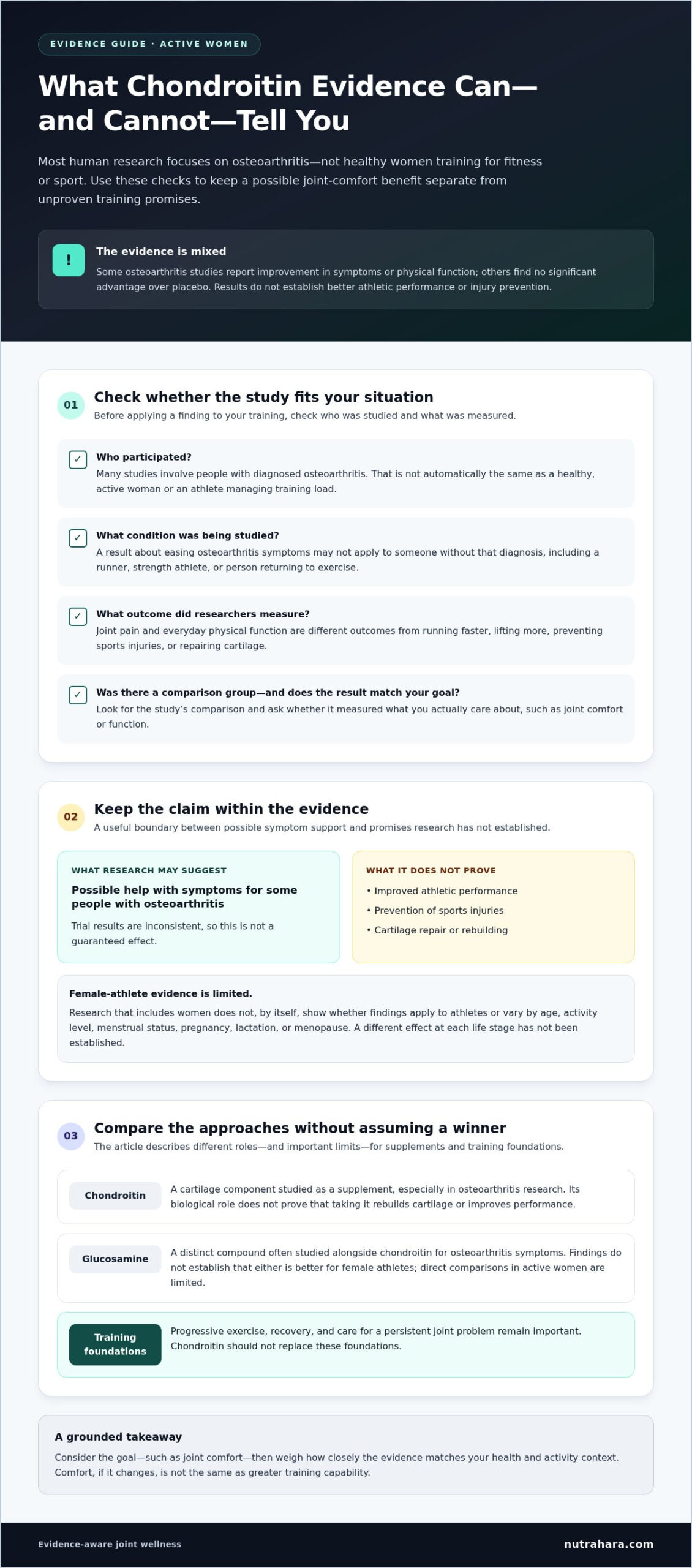
Research involving osteoarthritis doesn’t automatically show what chondroitin may do for a healthy, active woman. The participants, health conditions, and outcomes in those studies may differ from the experiences of women who run, lift weights, cycle, dance, or practice yoga without diagnosed joint disease. Evidence specifically focused on female athletes remains limited, so broad claims about the chondroitin benefits for female athletes can get ahead of what research establishes.
Women aged 30 to 60 aren’t one uniform group. Menstrual cycles, pregnancy, lactation, perimenopause, and menopause can shape a person’s health context and the questions she brings to training or supplement decisions. That doesn’t mean chondroitin has a proven, different effect at each life stage. It means the available evidence needs to be interpreted with care, rather than assuming findings apply equally to everyone.
A useful question is whether the research matches your health and activity context. Consider whether a study looked at people like you and measured the outcome you care about, such as joint comfort or function. Keeping that distinction in mind helps separate a possible joint-health benefit from unproven promises about performance, injury prevention, or cartilage repair.
Most human research on chondroitin has focused on people with osteoarthritis, not healthy women training for fitness or sport. Studies commonly assess symptoms such as joint pain and measures of physical function. Some report improvement, while others find no significant advantage over placebo. These findings can inform questions about joint comfort, but they don’t establish that chondroitin boosts performance or prevents sports injuries.
People with osteoarthritis have a diagnosed joint condition, and research may aim to ease symptoms or improve everyday function. A runner with no diagnosis, a strength athlete managing training load, and someone returning to exercise after a break have different starting points and goals. The National Center for Complementary and Integrative Health summarizes the research on glucosamine and chondroitin, including the mixed results from osteoarthritis trials.
That inconsistency matters. A change in pain or daily function in an osteoarthritis study isn’t proof of improved athletic performance, protection from injury, or cartilage repair. The most supported conclusion is that chondroitin may help some people with osteoarthritis symptoms, but trial results are inconsistent and don’t establish a benefit for healthy, active women.
Evidence directly focused on female athletes is limited. Research on osteoarthritis may include women, but that alone doesn’t show whether findings apply to athletes, or whether outcomes differ by age, activity level, menstrual status, pregnancy, lactation, or menopause. Unless a study reports these details and examines them, it can’t answer every woman’s situation.
When considering the chondroitin benefits for female athletes, look beyond a headline. Note who participated, whether they had osteoarthritis, what outcome researchers measured, and whether there was a comparison group. Then ask whether that outcome matches your goal. Joint comfort is not the same as greater speed, strength, or injury resistance. Careful reading supports informed choices without dismissing the possibility that future research may become more relevant to active women.
Chondroitin and glucosamine are distinct compounds often studied together for osteoarthritis symptoms. The National Center for Complementary and Integrative Health’s resource on glucosamine and chondroitin describes research on both, but findings don’t establish that one is better for female athletes. Direct comparisons in active women are limited, so choosing between them based on an assumed performance or injury-prevention advantage isn’t evidence-led.
| Approach | Intended role | Evidence population | Important limitation |
|---|---|---|---|
| Chondroitin | May support joint comfort or function | Primarily people with osteoarthritis | Results are mixed; athlete-specific benefits aren’t established |
| Glucosamine | Studied for osteoarthritis symptoms, often alongside chondroitin | Primarily people with osteoarthritis | Combination research doesn’t prove it’s superior for athletes |
| Progressive training and strength work | Build capacity for the demands of exercise | Relevant to active people | Training should suit your current ability and health |
| Recovery and clinical care | Support recovery and address persistent or concerning symptoms | Individual needs vary | Supplements can’t replace appropriate assessment or care |
A supplement isn’t a protective shield against training-related injury. Joint wellness is better approached as part of a broader routine: increase training demands gradually, include strength work suited to your activity, and make space for rest and sleep. If discomfort persists or affects daily movement, consider appropriate clinical care rather than relying on a supplement alone.
Mobility work can help you tune in to how your body feels, though it shouldn’t be framed as a substitute for strength training or recovery. Try a gentle yoga sequence, adapting or stopping movements that cause pain. A few quiet minutes of meditation or steady breathing can also offer a calming pause to notice tension and stress. These practices may support awareness and wellbeing, but they don’t guarantee joint protection.
To assess the chondroitin benefits for female athletes, compare the evidence for your goal with the foundations of your training routine. Nutrahara’s Joints & Knees Kit is a general joint-health option positioned to support joint health, knee mobility, and flexibility.
A thoughtful decision starts with your goal and personal health context, not a promise on a supplement label. Use these steps to assess whether chondroitin is worth discussing as part of your wellness routine.
If you’re pregnant, planning for pregnancy, or breastfeeding, seek individualized professional guidance before using chondroitin or another supplement. Don’t rely on general statements about safety to determine what’s right for you. The same careful approach applies if you take medication or manage a health condition: share the ingredient list and ask a healthcare professional to consider your specific situation. There’s no need to make a rushed decision.
The evidence around chondroitin benefits for female athletes doesn’t establish a universal choice for women across different ages, training goals, or life stages. A clear goal, careful label review, and personalized guidance can help you decide with confidence, without treating a supplement as a replacement for appropriate care.
For a separate supplement option as you explore women’s wellness, view Nutrahara’s premium collagen supplement.
Lasting mobility is supported by more than a single ingredient. A thoughtful plan brings together training that suits your current ability, recovery, and evidence-aware supplement choices. Your needs may shift with age, menstrual changes, pregnancy, lactation, or menopause, so let your circumstances guide the pace and support you choose.
Try this training tip: When adding distance, resistance, or intensity, change one aspect of your routine at a time and notice how your body responds. Include strength exercises that match your activity, and allow room for rest. If you’re returning after a break or adapting exercise around a health concern, a qualified professional can help you choose an appropriate starting point.
For a gentle pause, sit comfortably, relax your shoulders, and take a few slow breaths, letting the exhale feel unhurried. Or try a simple yoga pose that feels steady and comfortable, such as a supported seated stretch. There’s no need to push into discomfort. These practices can help you pay attention to your body and settle your mind; they aren’t treatments for joint problems.
Notice everyday changes, such as whether stairs, a walk, or your usual training feel different. A brief note about activity and comfort can help you describe patterns to a healthcare professional. It can’t diagnose the cause, and persistent or concerning symptoms deserve appropriate care.
Chondroitin research primarily concerns osteoarthritis, so consider whether that evidence fits your own goal and health circumstances. It doesn’t establish that chondroitin improves athletic performance or prevents injuries. If you’re considering any supplement, weigh the available evidence alongside your training habits and individualized health guidance.
Nutrahara’s Joints & Knees Kit is a general joint-health option positioned to support joint health, knee mobility, and flexibility. Nutrahara brings principles of ancient Ayurveda science together with modern nutritional research as part of its approach to women’s wellness.
The question of chondroitin benefits for female athletes has no one-size-fits-all answer. Let your goals, life stage, and the quality of evidence shape your next step, and continue building a routine that supports strength, recovery, and confidence over time.
Chondroitin may support joint comfort for some people with osteoarthritis, but research doesn’t establish the same benefits for healthy female athletes or prove improved performance or injury prevention. The most useful question is whether the evidence fits your goal and health circumstances. A sustainable approach also makes room for progressive training, strength, recovery, and appropriate professional guidance.
Pregnancy, lactation, medication use, and other health considerations deserve individualized advice before adding a supplement. Understanding the limits of the chondroitin benefits for female athletes can help you make a decision with confidence, not pressure. Nutrahara’s Joints & Knees Kit is a general option positioned to support joint health, knee mobility, and flexibility, drawing on an approach that combines Ayurvedic principles with modern nutritional research.
Explore Nutrahara’s approach to women’s wellness, and keep building a thoughtful routine that supports your strength and mobility over time. Your wellness journey is yours to shape, one informed choice at a time.
It may help some people with osteoarthritis symptoms, but evidence is mixed and doesn’t establish the same effect in female athletes. Most studies focus on people with osteoarthritis rather than healthy, active women. Research on chondroitin benefits for female athletes is limited, so pain relief can’t be promised. Persistent pain, swelling, or reduced movement deserves individualized professional guidance, rather than relying on a supplement alone.
No reliable evidence establishes chondroitin as a way to improve athletic performance or prevent sports injuries. Research into joint symptoms doesn’t demonstrate benefits for speed, strength, endurance, or injury risk. If you’re working toward a performance goal, build training progressively and make recovery part of your plan. A supplement shouldn’t be treated as protection that allows you to train through pain or increase your workload without care.
It can offer context about symptoms or function in people with osteoarthritis, but it doesn’t directly answer whether chondroitin benefits healthy athletes. The populations and goals differ: a study may assess comfort during daily activities rather than performance during training. Consider who participated and what researchers measured. Without evidence directly relevant to active women, osteoarthritis findings shouldn’t be taken as proof of an athletic benefit.
There isn’t enough information here to assure you that chondroitin is safe during pregnancy or breastfeeding. If you’re pregnant, planning a pregnancy, or lactating, seek individualized guidance from a qualified healthcare professional before using it. Share the full supplement label, including other ingredients, so they can consider your circumstances. Avoid relying on broad claims or assumptions about safety during these life stages.
Chondroitin and glucosamine are often studied together, but that doesn’t show that a combination is suitable for every person or more helpful for athletes. Other supplements can add ingredients and complicate a decision, especially if you take medication or manage a health condition. Review the complete labels with a qualified healthcare professional, who can consider your health context rather than making a general assumption about combining products.
Start by defining your goal, such as joint comfort or mobility, and separate it from goals like performance or injury prevention. Review whether the evidence matches your health and activity context, then consider the product label and personal circumstances. Ask a qualified professional for guidance if you’re pregnant, breastfeeding, taking medication, or managing a condition. If you choose to try it, reassess your experience without replacing progressive training, recovery, or appropriate care.
This article is not a substitute for medical advice. Please consult a healthcare professional before starting any supplement, especially if pregnant, nursing, taking medication, or managing health conditions.