
What if a supplement seems well tolerated in shorter studies, but its safety over years remains uncertain? That’s the question behind the long-term safety of glucosamine. Conflicting claims can make it difficult to decide what to make of the evidence when you’re considering joint support.
It’s reasonable to want a clear answer. Safety, effectiveness, and personal suitability are separate questions, and research may not apply equally across different health circumstances or life stages.
This guide explains what the evidence can show, where its limits lie, and which questions may help you discuss your options with a qualified healthcare professional. The aim is a thoughtful decision, without alarm or false reassurance.
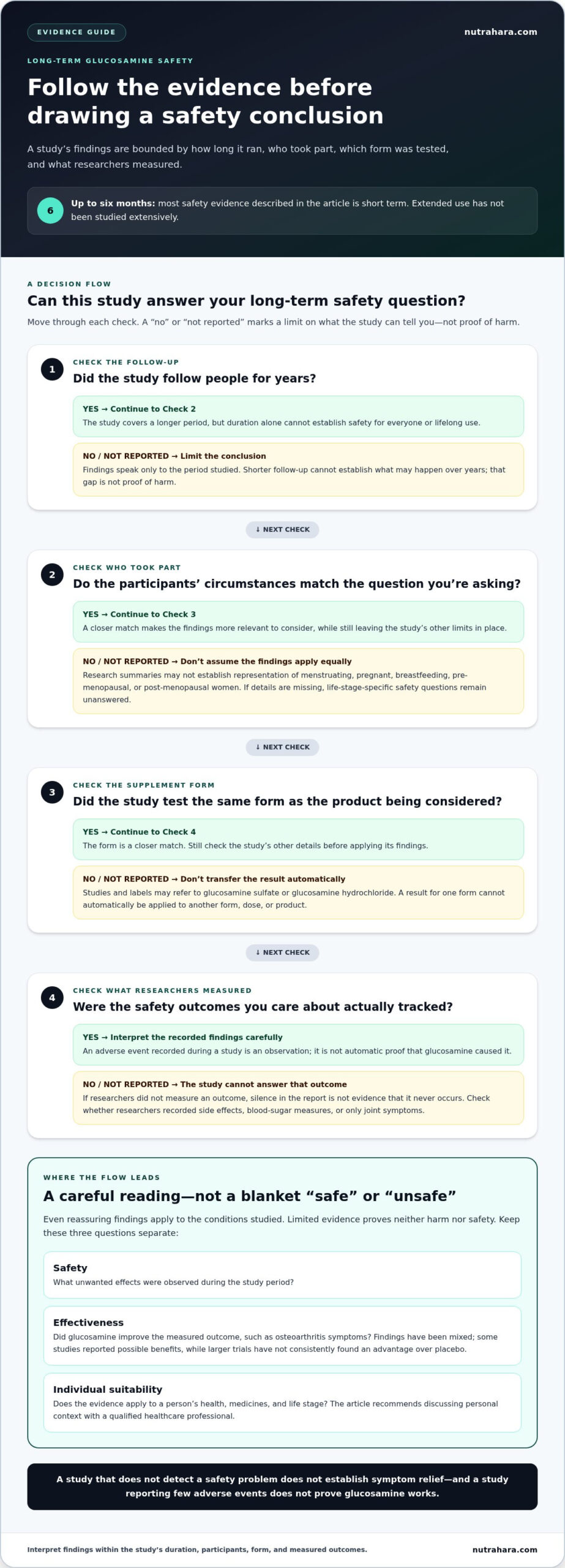
Reassuring findings mean that a study didn’t identify a particular safety concern under the conditions it tested. They don’t prove that a supplement is safe for everyone, in every circumstance, or for lifelong use. That distinction is central to understanding the long-term safety of glucosamine. What a study can tell you depends on what researchers measured, how long they followed participants, and who took part.
Keep three questions separate:
An answer to one question doesn’t settle the others. A study that doesn’t detect a problem cannot establish symptom relief. Similarly, results in one group of adults may not answer personal questions for someone who is pregnant, breastfeeding, or at a particular point in the menstrual cycle or menopause transition. These distinctions call for careful interpretation, not an assumption that findings apply equally to all women.
Glucosamine is a compound found naturally in the body and associated with cartilage, the flexible tissue that cushions joints. Osteoarthritis involves changes to joints and can cause symptoms such as pain and stiffness. This biological connection helps explain why glucosamine is studied and sold for joint support, but it doesn’t show that taking a supplement rebuilds cartilage or restores a joint.
Supplement labels and studies may refer to glucosamine sulfate or glucosamine hydrochloride. These names describe different forms, but they don’t guarantee how well a product works or how safe it is with extended use. A result for one form can’t automatically be applied to another form, dose, or product. For a general overview of its uses and safety topics, see Glucosamine on Wikipedia.
Research on glucosamine for osteoarthritis symptoms has produced mixed findings. Some studies have reported possible symptom benefits, while larger trials have not consistently found an advantage over placebo. That uncertainty concerns effectiveness. It doesn’t, by itself, mean glucosamine is unsafe.
The reverse is also true: a study reporting few adverse events doesn’t prove glucosamine works. Research summaries may not say whether studies recorded menstrual-cycle status, included enough pre-menopausal participants to assess them separately, or examined whether safety findings differed by life stage. Without those details, the evidence can’t answer those specific questions. A measured conclusion identifies what was observed and what remains unknown, leaving room for a personal discussion with a qualified healthcare professional.
To interpret safety research, look beyond the headline. A study’s conclusions are bounded by how long it followed participants, who enrolled, which glucosamine form they used, and what researchers recorded. The available research brief describes most safety evidence as short term, up to six months, while noting that extended use has not been studied extensively. That leaves a meaningful gap between “no concern was identified during follow-up” and knowing what may happen over years.
Study duration sets the boundary of what researchers can observe. Shorter follow-up can offer reassurance about the period studied, but it cannot establish safety during years of use. This is a limit of the evidence, not proof that long-term use is harmful.
Consider four details together: follow-up length, participant numbers, the comparison group, and the outcomes tracked. A controlled study can compare reported effects with those in a similar group not taking glucosamine. Even a well-designed study may miss uncommon effects if few people take part, or delayed effects if follow-up is brief. Noting these limits helps you interpret the findings in proportion.
An adverse event recorded during a study is an observation, not automatic proof that glucosamine caused it. Conversely, if a study didn’t measure a particular outcome, its silence can’t be treated as evidence that the outcome never occurs. Keep both distinctions in mind when reading research summaries.
Research summaries don’t establish whether participants adequately represented menstruating, pregnant, lactating, pre-menopausal, or post-menopausal women. If a study doesn’t report these details, its results can’t answer a life-stage-specific safety question. Don’t replace that uncertainty with a blanket warning or an assumption that the findings apply equally to everyone.
Blood sugar is another area to read carefully. The research brief flags a possible effect on blood-sugar levels, but that alone doesn’t establish that glucosamine causes diabetes or changes diabetes risk. Before drawing a conclusion, the original study would need to be checked for its participants, design, duration, and actual glucose outcomes. A measured takeaway is that people with diabetes or concerns about blood sugar can raise the question with a qualified healthcare professional rather than treating a general summary as individualized advice.
For your own evidence check, note the product form and study duration first. Then ask what researchers measured and whether the participants resemble you. This simple habit helps keep a promising or reassuring result in proportion, without turning missing evidence into certainty.
A claim about a supplement is only as useful as the details behind it. To assess the long-term safety of glucosamine, compare the product described in a study with the one on a label. Then check how long it was used and what researchers monitored. The match matters: evidence applies most directly to the form and product studied, not automatically to every supplement carrying the same ingredient name.
| What to compare | Questions to ask | What it can tell you |
|---|---|---|
| Product identity | Does the study name sulfate, hydrochloride, or another preparation? What else was included? | Whether the study product resembles the one being considered. |
| Study match | Were participants and product use similar to the situation described in the claim? | How closely the results may apply. |
| Duration | How long were participants followed? | Which period of use the findings address. |
| Safety findings | Which adverse events or health measures were recorded? | What researchers observed, not every outcome that could occur. |
| Uncertainty | Were there limits in sample size, follow-up, or reporting? | What remains unanswered. |
Start by noting the named glucosamine form and the other listed ingredients. If a study tested glucosamine alone, its results don’t establish the safety profile of a combination product. The same applies in reverse: research on glucosamine with chondroitin can’t show which ingredient contributed to an observed effect, or whether the same findings apply to glucosamine alone. Label details help identify a product, but don’t independently prove its safety, purity, or clinical benefit.
Keep a simple comparison beside the claim: study form, product ingredients, duration, and safety outcomes. If a key detail is missing, treat the match as uncertain rather than filling the gap with an assumption. Don’t infer a dose from a study summary unless a reliable, current source supports that exact guidance.
In the United States, glucosamine sold as a dietary supplement falls under the Dietary Supplement Health and Education Act of 1994, or DSHEA. Unlike prescription drugs, dietary supplements aren’t approved by the FDA for safety and effectiveness before they’re marketed. The FDA can take action against adulterated or misbranded products after they enter the market. This regulatory distinction is context, not a verdict: supplement status alone proves neither that a product is unsafe nor that it is effective.
For a practical check, separate three things: what the label identifies, what research tested, and what oversight does or doesn’t establish. Nutrahara’s nutrition is made in New Zealand, and its approach combines principles of Ayurveda with modern nutrition research. Explore its women’s wellness supplements as a separate part of a thoughtful wellness routine, not as evidence about glucosamine.
A calm, useful conversation starts with your goal, not a promise about what a supplement might do. The long-term safety of glucosamine depends partly on how evidence fits your circumstances, so bring your questions to a qualified healthcare professional who can consider your health history and medicines. You don’t need to arrive with a decision already made.
Bring the product name or label, the listed glucosamine form, any other ingredients, and your intended use. Ask whether the research discussed matches that form and how the study’s duration affects what can be concluded. Mention other supplements and medicines, along with relevant circumstances such as pregnancy, breastfeeding, or menopause. General information can support a conversation, but it can’t replace personalized guidance.
Don’t use a general article as a reason to start, stop, or change a supplement. Instead, use it to frame clear questions. If you decide with professional guidance to monitor your experience, keep a brief note of the reason for use, when you take it, and any changes you notice. A simple record can help you describe your experience, but it doesn’t prove the supplement caused a change.
Joint wellbeing can sit within a wider routine shaped around your own comfort and goals. If activity is part of your life, reflect on what feels manageable and how you feel afterward. Gentle movement, yoga, restorative habits, or meditation may support a balanced approach to wellbeing, but they aren’t substitutes for individualized care when you have health concerns.
Before your discussion, note a few observations: Which activities feel comfortable? What would you like to keep doing or return to? Have changes in sleep, stress, or your daily routine affected how you feel? These prompts keep the conversation grounded in your life rather than a single product claim. For a broader joint-health option, explore Nutrahara’s joint-health support as one part of your wellness journey.
A measured view of glucosamine doesn’t end with a blanket yes or no. Look at how long a study followed people, who participated, and which product it examined. Then consider how those details relate to your own health and goals. This is especially relevant if you’re navigating pregnancy, breastfeeding, or changes around menopause, since a general research summary may not answer a question specific to your life stage.
Keep the evidence in its proper frame: a brand’s approach to formulation is not the same as clinical evidence about a particular ingredient. Likewise, a joint-health product is not automatically evidence for glucosamine’s long-term safety or effectiveness. Clear distinctions make it easier to weigh information without alarm or false reassurance.
Nutrahara describes its formulations as combining principles of Ayurveda with modern nutrition research, and its nutrition is made in New Zealand. The brand also describes its ingredients as clinically studied. That statement is a general description of ingredients, not proof that glucosamine itself has been clinically studied in Nutrahara products or that a particular product has established long-term safety or outcomes.
Nutrahara’s Joints & Knees Kit is an anti-inflammatory supplement focused on joint health, knee mobility, and body flexibility. Its name alone doesn’t establish that it contains glucosamine, and the existence of a joint-health product doesn’t settle questions about glucosamine research. For any supplement, meaningful evaluation rests on what the product contains, what relevant studies examined, and whether the evidence addresses your question.
If you’re considering a supplement, write down what you hope to support and what you still want to understand. For example: Was the research long enough to inform extended use? Did it involve people with circumstances similar to yours? Does the study product match the form and ingredients you’re considering? A qualified healthcare professional can help you discuss how those questions relate to your health history, medicines, and current life stage.
There’s no need to turn uncertainty into urgency. Take time to review the evidence, reflect on your own experience, and revisit your questions as your needs change. Movement that suits your body, restorative routines, yoga, and meditation may also be part of a broader approach to wellbeing, alongside professional guidance when you need it.
If you’d like to explore a joint-health option as part of that broader learning, take a look at Nutrahara’s Joints & Knees Kit. Consider it on its own terms, without assuming it contains glucosamine or treating it as proof of a glucosamine-specific benefit.
Your next step doesn’t have to be a final answer. Choose one question about the long-term safety of glucosamine that matters most to you, then bring it into a conversation about your health priorities and daily life. Your needs may shift with activity, stress, or changes in your life stage, so it’s reasonable to revisit decisions rather than treat them as permanent.
Give yourself room to weigh evidence alongside the routines that help you feel well. A walk, a yoga practice, or a few quiet minutes of meditation can support a thoughtful approach to wellbeing, while personal supplement questions are best considered with a qualified healthcare professional.
Nutrahara’s wellness approach brings together principles of Ayurveda and modern nutrition research, with nutrition made in New Zealand. If you’d like to learn more about that approach, explore Nutrahara’s approach to wellness supplements.
Trust your ability to ask careful questions and make choices that fit your circumstances. Steady, informed steps can help you move forward with greater confidence.
This article is not a substitute for medical advice. Please consult a healthcare professional before starting any supplement, especially if pregnant, nursing, taking medication, or managing health conditions.