A natural label doesn’t guarantee a useful result. Evidence-based natural supplements may support a specific need, but their benefits depend on the ingredient, health goal, and individual circumstances. A general multivitamin isn’t automatically worthwhile, so start with the purpose behind each choice.
It makes sense to want clear answers before adding a supplement to your routine. This guide explains what research says about herbs, vitamins, minerals, and other natural products, including where evidence is stronger, where it’s limited, and why “natural” doesn’t rule out interactions.
You’ll find a practical way to weigh a supplement’s intended use against the quality of its evidence, with women’s changing needs in mind. Women’s firsthand experiences can offer helpful context, but they are not proof that a supplement works; look for testimonials that are verified, shared with consent, and clear about individual results. Support wellbeing beyond supplements, too: try a brief yoga session to ease into movement, then take a few minutes to meditate and notice how you feel. Small, repeatable habits can help you build a routine that fits your life.
Dietary supplements include vitamins, minerals, herbs, and other ingredients taken by mouth. Research is most useful when it examines a specific ingredient, dose, and health outcome, rather than treating every natural product as equivalent.
Ingredient research tests whether a supplement may support a particular health outcome. Botanical supplements come from plants; other dietary supplements include minerals and vitamins. Look for studies on the same ingredient and preparation you’re considering, then note whether researchers measured a meaningful outcome. For example, evidence about one herbal extract doesn’t automatically apply to every product made from that plant. The NIH National Center for Complementary and Integrative Health offers resources for finding supplement research and clinical trials. This can help distinguish traditional use from benefits supported by clinical research.
FDA regulation sets the federal framework for oversight of dietary supplements and their claims. The Dietary Supplement Health and Education Act of 1994 governs FDA oversight in the United States, according to the United States Congress. It does not require proof of effectiveness before supplements are marketed. So how much do evidence-backed supplements typically cost in the United States? Costs depend on the ingredient, formulation, serving size, and testing, rather than evidence alone. A health claim on packaging is not itself proof that a product works. Consider the stated use and the research behind that specific ingredient, and discuss possible interactions with medicine with healthcare professionals. This is particularly relevant during pregnancy, lactation, or when taking prescription medicine.
Third-party testing is an independent assessment of a supplement’s quality or contents. To assess quality and purity, read the Supplement Facts panel, ingredient list, serving size, and manufacturer’s testing information. Look for clear ingredient names and quantities, and check whether testing details say what was assessed, such as identity or contaminants. A certification mark can provide information about testing, but it doesn’t establish that an ingredient benefits your health goal. Compare the tested product with the exact formulation you plan to use. A vegetable-based diet can support overall nutrition, but it doesn’t replace checking a supplement’s ingredients, evidence, and potential interactions.
Herbal supplements contain plant-based ingredients taken to support health. A traditional remedy’s history doesn’t establish its effectiveness, so assess the specific herb, preparation, and intended use. The National Center for Complementary and Integrative Health offers resources for researching herbs and clinical trials. These can help distinguish traditional use from findings in human studies.
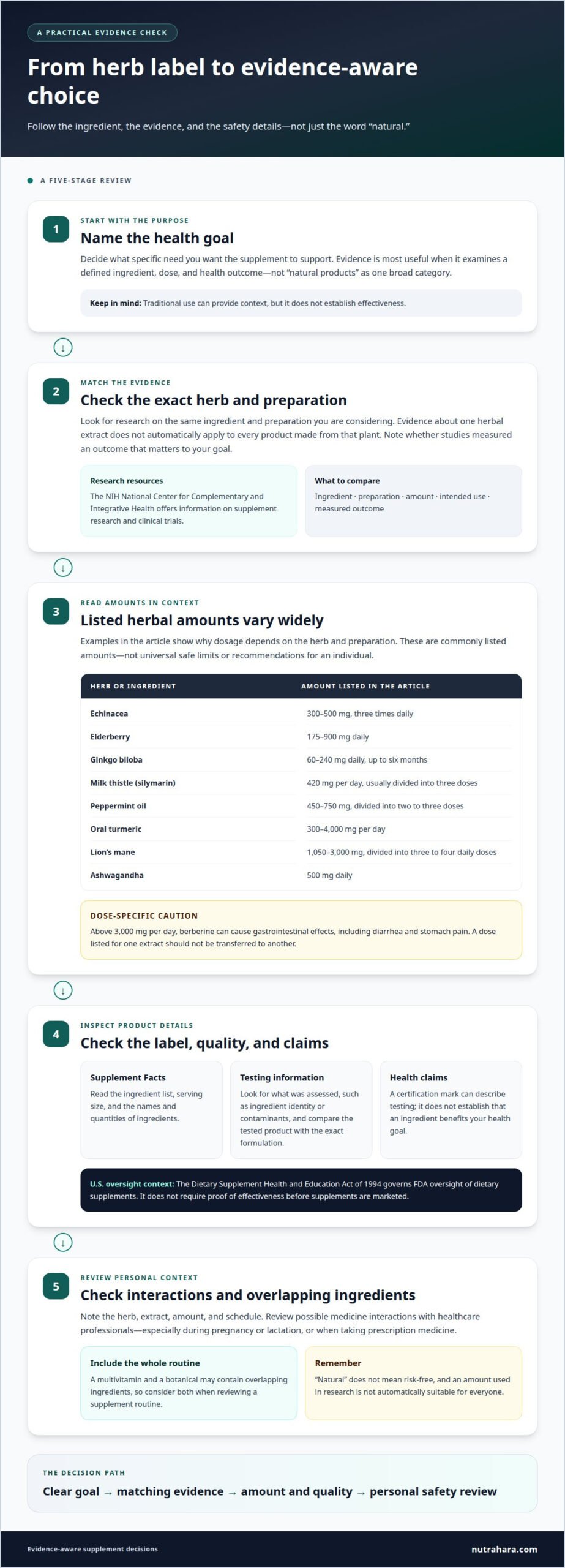
Dosages differ by herb and preparation, and no single upper limit applies to every botanical. Commonly listed amounts include echinacea at 300-500 mg three times daily, elderberry at 175-900 mg daily, and ginkgo biloba at 60 to 240 mg daily up to six months. These are examples, not universal safe limits. Above 3000 mg per day, berberine can cause gastrointestinal effects, including diarrhea and stomach pain.
Other examples show why the plant and dose matter. Milk thistle’s silymarin is commonly listed at 420 mg per day, usually divided into three doses. Peppermint oil is listed at 450-750 mg, divided into two to three doses. Oral turmeric ranges from 300 mg to 4,000 mg per day, while lion’s mane is listed at 1,050-3,000 mg, divided into three to four daily doses. A dose listed for one extract shouldn’t be transferred to another.
For a practical safety check, note the herb, extract, amount, and schedule, then review possible medicine interactions with healthcare professionals. This is especially important during pregnancy or lactation, when an herb’s effects and exposure can differ. A multivitamin and a botanical may also contain overlapping ingredients, so include both when reviewing a supplement routine. “Natural” doesn’t mean risk-free, and an amount used in research isn’t automatically suitable for everyone.
Ashwagandha has a long history in Ayurvedic medicine, and a commonly listed amount is 500 mg daily. If this herb is relevant to your wellness routine, explore the ashwagandha with black pepper supplement as one option to consider.
Multivitamin/mineral supplements combine several vitamins and minerals in one product. Formulas vary, so the label matters as much as the category.
Evidence describes how well a nutrient or combination supports a defined health outcome. High-quality trials haven’t shown clear disease-prevention benefits from general multivitamins for healthy people or people with chronic conditions. That doesn’t mean every nutrient is unnecessary. For adults aged 50 and older, vitamins B12 and D, and calcium, have evidence for use in specific situations. The consumer’s age, diet, and health needs shape whether a nutrient is relevant.
Vitamin D supplements provide this nutrient when food and other sources don’t meet a person’s needs. For people with low vitamin D levels, supplementation can help address the shortfall; the result depends on the cause, amount taken, and absorption. Fatty fish, including salmon, tuna, and mackerel, provide vitamin D. Fortified foods such as milk supply most vitamin D in American diets. The Endocrine Society recommends vitamin D supplements for pregnant women.
Food sources can help build a varied foundation. Citrus fruits, peppers, kiwifruit, broccoli, strawberries, baked potatoes, and tomatoes provide vitamin C. Green leafy vegetables supply vitamin K, while carrots and spinach are rich in vitamin A. Calcium-rich choices include milk, cheese, yogurt, kale, broccoli, and canned sardines or salmon with soft bones. Zinc occurs in red meat, poultry, seafood, and fortified breakfast cereals.
Life stage can affect nutrient needs. During pregnancy, folic acid supplementation is listed as a relevant measure. Breastfed infants are also listed for vitamin D and iron supplementation. The National Institutes of Health Office of Dietary Supplements provides fact sheets on vitamins, minerals, herbs, botanicals, and probiotics. Use them to compare a supplement’s ingredients with food sources and your specific purpose. A multivitamin isn’t a substitute for a balanced diet or a plan tailored to a known need.
A supplement fact sheet summarizes an ingredient’s uses, evidence, and safety considerations. It’s a practical starting point for evaluating a product claim, not proof that every formulation works. The National Institutes of Health Office of Dietary Supplements provides fact sheets covering vitamins, minerals, herbs, botanicals, and probiotics. Start with the ingredient name, then compare the stated use with the evidence and safety information.
For example, the cited calcium recommendation for children ages 4 to 8 and adults ages 19 to 50 is 1,000 milligrams per day, according to the National Institutes of Health Office of Dietary Supplements. The amount of magnesium a person needs depends on age and sex. A useful fact sheet therefore gives context: identify the relevant life stage, note the nutrient form, and distinguish a recommended intake from a supplement dose.
MedlinePlus provides resources for over 100 herbs and supplements, making it a broad database for initial reading. The NIH National Center for Complementary and Integrative Health offers tools for finding research and clinical trials on dietary and herbal supplements. Use those resources to check whether a clinical study examined the same ingredient and purpose. Evidence for one herbal preparation may not apply to another extract or combination.
Safety deserves equal attention. The NIH National Center for Complementary and Integrative Health provides an interactive tool explaining potentially harmful medicine and supplement interactions. Review the ingredient list alongside medicines and other supplements, then discuss possible interactions with healthcare professionals. For pregnancy or breastfeeding, LactMed offers information about drugs and chemicals, breast-milk and infant-blood levels, possible effects in nursing infants, and therapeutic alternatives where appropriate.
A focused reading routine keeps the information useful: identify the ingredient, intended benefit, evidence, dose guidance, and interaction risks. Then decide whether the evidence matches your health goal. A fact sheet can clarify what research supports, but it cannot make a broad claim apply to every person or product.
Nutrahara offers Women’s Health Supplements for women considering support for their wellness priorities. Choosing what fits your routine is personal, and a supplement should complement, not replace, healthy habits. Explore options with your needs in mind, and use the evidence and ingredient information discussed above to guide your decision. For questions about Nutrahara’s Women’s Health Supplements, contact Nutrahara.
Your health priorities can shift with your life stage, energy, and daily routines. Let evidence guide your choices, while leaving room for nourishing meals, movement, yoga, and meditation. A useful next step is to name the goal you want to support, then consider whether evidence-based natural supplements fit alongside the habits already helping you feel well. Give yourself permission to make thoughtful choices rather than chasing every new trend.
For women’s wellness support, Nutrahara offers Women’s Health Supplements. If you have questions about the options, contact Nutrahara with your questions. Keep building a routine that feels sustainable, informed, and true to your needs.
Neither label fits every supplement; value depends on the ingredient, purpose, and evidence for that use. Evidence-based natural supplements are more relevant when they address a defined need than when chosen for a broad wellness promise. During menstruation, for example, iron-containing foods include beans, lean meat, seafood, poultry, and fortified cereals. Start by connecting a product’s intended use to your nutrition and health priorities.
Supplements can interact with medicines, so consider them together as part of your full routine. Make a list of prescription medicines, over-the-counter products, and supplements, including herbs and multivitamins. This gives healthcare professionals a clearer picture when reviewing possible interactions. Be especially thoughtful when your routine changes during pregnancy, lactation, or menopause, or when you start or stop a medicine or supplement.
Evidence is research that tests an ingredient for a defined outcome in people. To assess evidence-based natural supplements, check whether the study’s ingredient and preparation match the product, and whether participants resemble those who might use it. Also distinguish a measured change, such as a blood marker, from an outcome that matters in daily life. Traditional use alone doesn’t answer those questions.
Evidence is most useful when it addresses a specific nutrient and life stage. For women over 50, the cited calcium recommendation is 1,200 milligrams, while calcium needs and food intake can differ across adulthood. During menstruation, consider iron-containing foods as part of overall dietary intake. Pregnancy, lactation, and menopause bring different considerations, so assess the ingredient and intended purpose within your current stage.
Omega-3 research examines different outcomes, so a finding about blood lipids doesn’t automatically show a supplement prevents heart disease. Fish oil research has reported an association with genetic predisposition for producing LDL cholesterol, triglycerides, and HDL cholesterol. That is distinct from proving a direct treatment effect. For a practical dietary context, fatty fish such as salmon, tuna, and mackerel are food sources of vitamin D.
Evidence for exercise supplements depends on the ingredient and performance outcome tested. Research may examine supplement ingredients broadly, but that doesn’t mean every product improves every workout. For a useful comparison, identify whether a study measured strength, endurance, recovery, or another specific result, then consider whether its participants and training context fit your routine. Food, progressive training, rest, yoga, and meditation also contribute to a balanced fitness practice.
This article is not a substitute for medical advice. Please consult a healthcare professional before starting any supplement, especially if pregnant, nursing, taking medication, or managing health conditions.