step by step supplement routine for women's hormone balance | This step by step supplement routine for women’s hormone balance, updated November 29, 2026, was designed by the Nutrahara Wellness Editorial Team. It’s a beginner-friendly guide. Plan on 4-6 weeks to set up the routine and about 3 months to judge whether it’s working.
This guide builds a step by step supplement routine for women’s hormone balance in 2026 in layers, rather than relying on a single “miracle” pill. You’ll learn how to: For related guidance, see Ashwagandha With Black Pepper.
Hormonal symptoms are common. Research compiled by Rupa Health reports that 80% of women have experienced symptoms associated with hormonal imbalances. Yet many women choose supplements by grabbing whatever is trending on social media. A structured plan works far better.
Supplement use is already routine for women. CDC/NHANES data shows that among U.S. adults aged 20 and over, 57.6% took a dietary supplement in the past 30 days. Women were more likely to do so (63.8%) than men (50.8%). A separate market analysis citing HHS data puts the figure even higher, at about 80% of American women who take dietary supplements as part of their daily health habits. Vitamins and minerals held the largest share of the women’s hormonal balance supplement market in 2023, at around 42%.
The bigger shift is the quality of evidence behind botanicals women have relied on for generations. Several 2025 trials on ashwagandha and chasteberry (vitex) have moved these herbs from “traditional remedy” toward “clinically studied ingredient.”
Key Takeaway: Given how common hormonal symptoms are and how much clinical attention traditional botanicals are getting, a structured, evidence-based step by step supplement routine for women’s hormone balance is worth the effort. For supporting data, see Women’s Health Supplements: Trends Shaping Formulation.
| Step | Action | Time | Outcome |
|---|---|---|---|
| 1 | Track symptoms and establish a baseline | 1-2 weeks | Clear picture of your hormone pattern |
| 2 | Build your foundational nutrient layer | 1 week to start, ongoing | Core deficiencies covered daily |
| 3 | Add targeted botanicals for stress and cycle | 1 day to add, 4-12 weeks to assess | Cortisol and cycle support in place |
| 4 | Time doses to your daily and monthly rhythm | Ongoing, 1 cycle to refine | Routine matched to your body’s clock |
| 5 | Monitor, adjust, and check in with a provider | Every 8-12 weeks | Data-backed routine you can trust |
Total time to get a working routine: about 2-4 weeks to set up, with 8-12 weeks needed for a fair read on results.
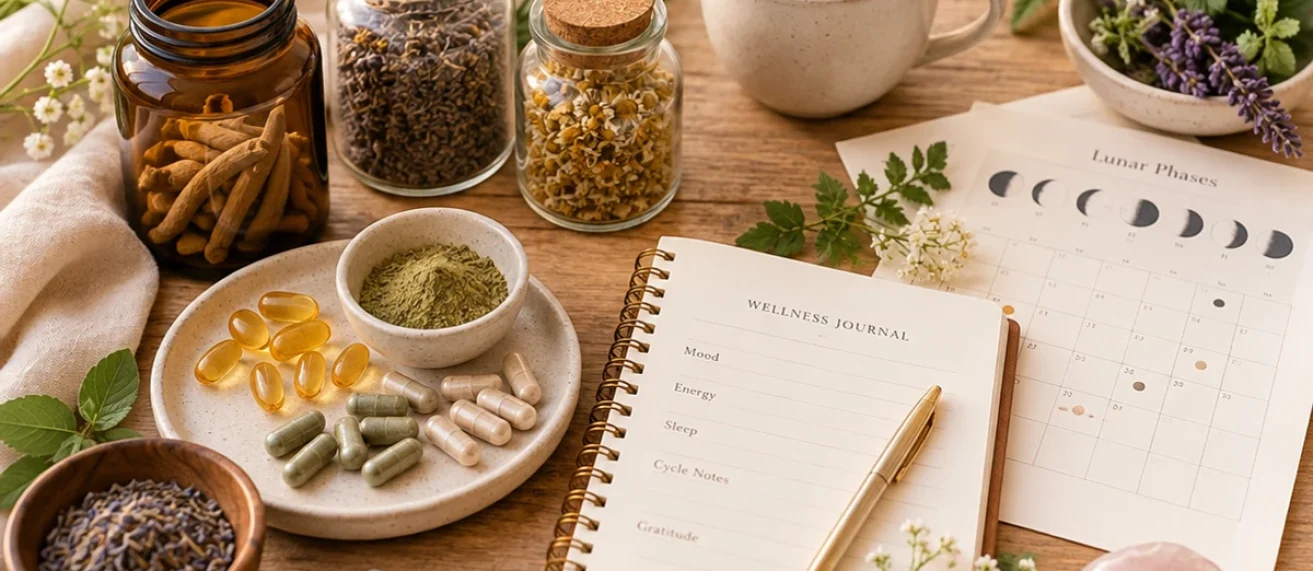
Before you buy supplements, record what your body is doing now, so you can tell later whether anything has changed.
You’re identifying which symptoms are actually hormone-related, such as irregular cycles, PMS mood swings, poor sleep, low energy, or persistent stress. Many of these symptoms have non-hormonal causes too, so this baseline is what lets you measure progress.
You have a one-page summary of your top 2-3 hormone-related symptoms, with notes on when they usually show up in your cycle. For a more detailed walkthrough, see Best Female Hormone Balance Supplements [2026].
Cover the nutrients most women are commonly short on before adding specialty herbs. Low magnesium, B vitamins, or vitamin D can mimic hormonal symptoms or worsen them.
You’re closing common nutrient gaps so your body has the building blocks it needs before you layer in more targeted support.
Mistake: Starting five new supplements on day one, then having no idea which one helped. Fix: Add one layer at a time, beginning with foundational nutrients.
You’re taking a daily multivitamin plus magnesium consistently, and basic symptoms like fatigue, muscle cramps, or trouble falling asleep have started to ease.
| Symptom | Likely Gap | Foundational Fix |
|---|---|---|
| Trouble falling asleep | Low magnesium, inconsistent wind-down | Magnesium glycinate in the evening |
| Low energy, brain fog | B12/D3 insufficiency | B-complex plus D3 with breakfast |
| Muscle cramps before period | Magnesium, calcium | Magnesium daily, especially in the luteal phase |
Key Takeaway: Magnesium, B vitamins, and vitamin D form the foundation of a step by step supplement routine for women’s hormone balance. Address these gaps before moving on to botanicals.
Once your foundation feels steady, add Ayurvedic adaptogens and cycle-support botanicals aimed at cortisol, stress-related hormone disruption, and PMS.
You’re adding herbs that act on specific hormonal pathways to support stress resilience and cycle regularity, layered on top of your nutrient base.
Within 4-8 weeks, stress resilience should feel noticeably better. By the end of a 3-month trial, PMS or cycle symptoms should have measurably softened, as shown in your symptom log.
In a clinical trial on perimenopausal women, ashwagandha supplementation was linked to a notable estradiol shift. Estradiol (E2) rose by 137% over 12 weeks, compared with 26% in the placebo group. Follicle-stimulating hormone (FSH), which tends to climb as estrogen drops, also fell significantly. Adaptogens belong after your foundational nutrients, not in place of them.
Key Takeaway: Ashwagandha for stress and chasteberry for cycle support are central to a step by step supplement routine for women’s hormone balance. Both need a full 3-month window to show their best results.
Many hormone-sensitive nutrients and botanicals work better when they line up with your circadian rhythm (your internal 24-hour clock) and your menstrual cycle.
You’re matching each supplement to the time of day or cycle phase where it makes the most sense.
You have a clear morning stack and evening stack, which makes it much easier to stay consistent.
Key Takeaway: Timing doses around your circadian rhythm and cycle helps each ingredient do its job. For related guidance, see Restorasleep.
Once the routine is in place, compare results against your baseline, adjust based on what you actually see, and bring in a healthcare provider when it matters.
Every 8-12 weeks, compare your symptom log against your original baseline, adjust doses or ingredients, and involve a provider when needed.
You have a stable, personalized routine backed by before-and-after symptom scores, and you know which ingredient drives which improvement.
Key Takeaway: Regular monitoring, data-based adjustments, and professional input keep your step by step supplement routine for women’s hormone balance working over the long run. For related guidance, see Anxioguard.
Phase 1 (Months 1-3): Stabilize. Keep your routine steady and resist adding something new every few weeks. Botanicals like vitex need a full three-month window to show their real effect.
Phase 2 (Months 3-6): Refine. Drop anything that didn’t produce a measurable change in your log. You might add cycle-phase-specific support, such as Nutrahara’s BlossomBliss for comfort during PMS week.
Phase 3 (Month 6 onward): Maintain and reassess. Revisit your routine after major life changes, like a new job, starting or stopping birth control, or approaching perimenopause. If symptoms shift, repeat the baseline tracking from Step 1.
| Resource | Role | Requirement | Price |
|---|---|---|---|
| Nutrahara | Ayurveda-based supplement line (FemmePower, RestoraSleep, AnxioGuard, BlossomBliss) for hormone, sleep, and stress support | Recommended | Varies by product |
| NIH Office of Dietary Supplements, Magnesium fact sheet | Reference for recommended daily intake and safety | Required reading | Free |
| Symptom-tracking app or paper journal | Baseline tracking and progress measurement | Required | Free to low-cost |
| OB-GYN or integrative health provider | Safety check, especially with PCOS, thyroid disease, or medications | Recommended | Varies by insurance |
| ClinicalTrials.gov | Checking current research on specific ingredients | Optional | Free |
See also, see Tips for Hormone Balance for Women at Every Age.
Likely cause: Most hormone-supporting botanicals, vitex included, need 4-12 weeks to show effects. Fix: Stay with your current layer for the full evaluation window, and update your symptom log weekly.
Likely cause: Magnesium helps sleep, but the effect is modest. A 2025 randomized trial found the magnesium group improved on the Insomnia Severity Index by 3.9 points, compared with 2.3 for placebo. That difference was statistically significant but small. Fix: Pair magnesium with sleep basics, like a consistent bedtime and less screen time before bed, or add a dedicated formula like RestoraSleep.
Likely cause: Ashwagandha can shift thyroid hormone levels. Women with hyperthyroidism or Graves’ disease should avoid ashwagandha entirely, since it may make those conditions worse. Fix: Stop the herb and talk with your provider before restarting.
Likely cause: One month is too early. Vitex research shows most women notice initial improvements within four to six weeks, with the best results reported after three months of consistent use. Fix: Keep going to the three-month mark. If you still need more support, consider B6 and zinc, which have direct evidence for PMS mood symptoms. For more troubleshooting advice, see Four nutrients to help your hormone imbalance.
A good step by step supplement routine for women’s hormone balance isn’t about finding one perfect pill. It’s about layering foundational nutrients, targeted Ayurvedic botanicals, and smart timing, then giving the whole thing enough time to work.
Start by tracking your symptoms for 1-2 cycles to set a personal baseline. Build a foundation with essential nutrients like magnesium, B vitamins, and vitamin D. Then add targeted botanicals, such as ashwagandha for stress or chasteberry (vitex) for PMS, one at a time. Time your doses around your daily and monthly rhythms, and reassess every 8-12 weeks with input from a healthcare provider as needed.
The best-supported options include magnesium for sleep and PMS-related symptoms, ashwagandha for cortisol and stress-related hormone disruption, and chasteberry (vitex) for cycle regularity and PMS mood symptoms. The vitex evidence includes a meta-analysis of over 1,000 women.
Expect 4-8 weeks for initial changes, and up to 12 weeks for fuller effects, especially with botanicals like vitex. The best results are reported after three months of consistent use.
Some are, and several Ayurvedic botanicals now have modern clinical backing. A 2025 Frontiers study confirmed that ashwagandha supports hormonal balance and vitality, and helps reduce stress and fatigue. Brands that blend Ayurvedic herbs with nutrition science, like Nutrahara, are increasingly used alongside foundational nutrients.
Generally, yes. Magnesium supports relaxation and sleep, while ashwagandha focuses on cortisol regulation. Still, it’s wise to introduce them one at a time, 2-3 weeks apart, so you can tell which one is responsible for any change.
If you have a diagnosed condition like PCOS or thyroid disease, or take hormonal birth control or other medication, check with your provider first. Ashwagandha can affect thyroid function, and some herbs haven’t been well studied alongside hormonal contraceptives.
The recommended intake for adult women is 310 mg per day from ages 19 to 30, and 320 mg per day from age 31 onward. Most women don’t get enough from diet alone, which is why a daily magnesium glycinate supplement is often recommended as part of a foundational routine.
Vitex works mainly through the pituitary gland to influence prolactin and progesterone, making it most useful for PMS and cycle irregularity. Ashwagandha works on the HPA axis (the hypothalamic-pituitary-adrenal axis, which regulates the stress response) to help lower cortisol, making it more useful for stress-driven hormone disruption and sleep.
This article is based on a synthesis of peer-reviewed clinical research, NIH and CDC data, and current wellness industry reporting as of November 2026. It is intended for general educational purposes and does not replace personalized medical advice. Always consult a licensed healthcare provider before starting any new supplement routine, especially if you have a diagnosed hormonal condition or take prescription medication.