Do you feel like you’re constantly battling your own body? If persistent fatigue, unpredictable mood swings, and a sense of being ‘off’ have left you feeling frustrated and unheard by conventional medicine, you are not alone. This wellness journey can feel isolating, especially when standard solutions offer little relief or come with unwelcome side effects. But what if the path to balance lies not in a prescription, but in the ancient wisdom of nature? Ayurveda offers a profound, holistic perspective, viewing these symptoms as signs of a deeper disharmony. An effective ayurvedic treatment for hormonal imbalance seeks to address the root cause, gently guiding your body back to its natural state of equilibrium.
In this complete guide, we will demystify Ayurveda’s approach, transforming what may seem complex into a clear, actionable plan for your well-being. You will discover powerful, clinically-studied herbs, simple dietary adjustments, and daily practices designed to restore your inner harmony. Prepare to feel empowered as you learn to listen to your body and reclaim your vitality, bridging the gap between ancient science and modern life to begin your journey back to balance.
In modern medicine, we often see hormonal imbalance as a list of symptoms-fatigue, mood swings, or irregular cycles. Ancient Ayurveda science invites us to look deeper, viewing hormones not just as chemical signals, but as messengers of our body’s core metabolic energy, or Agni. This holistic perspective sees the body as an interconnected system where balance is key. By understanding hormonal imbalance through the lens of Ayurveda, we can move beyond managing symptoms and begin to address the root cause, embarking on a true wellness journey.
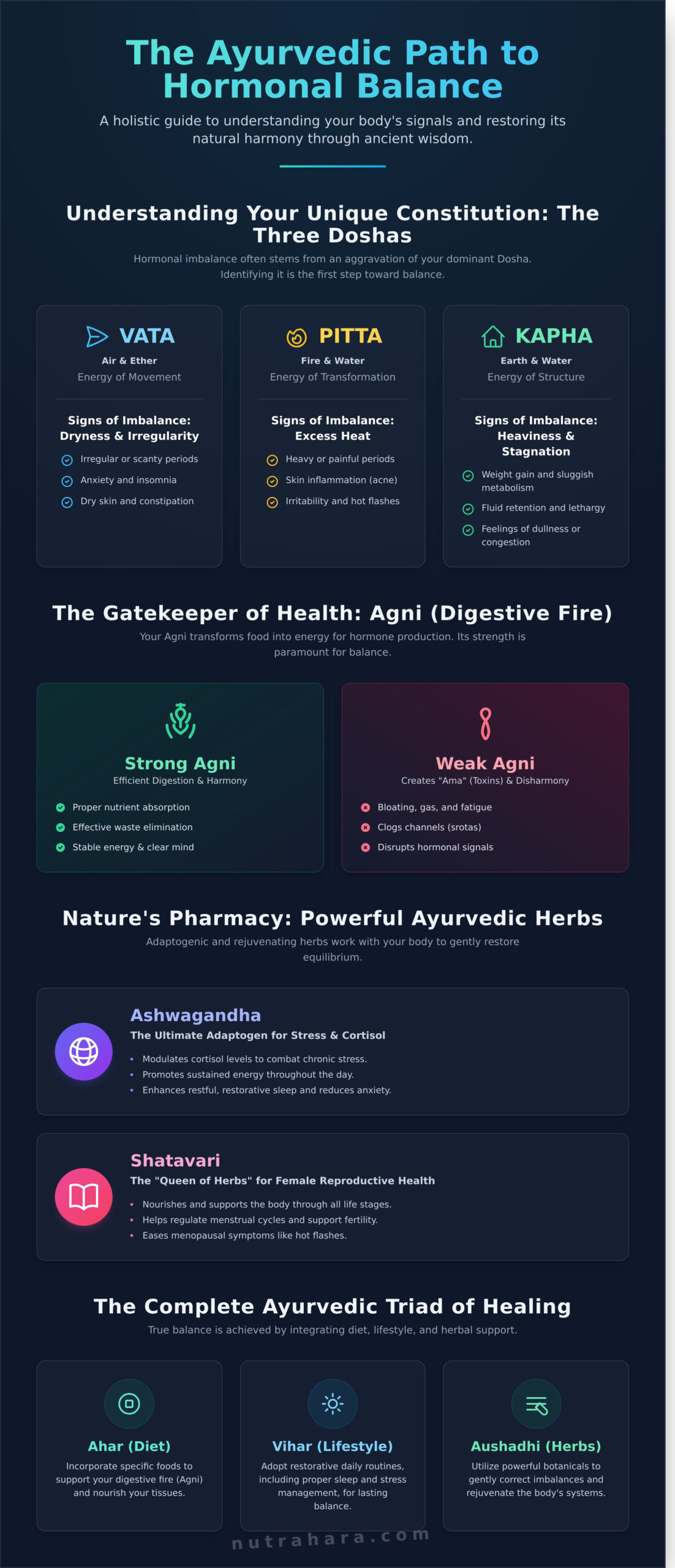
At the heart of this ancient wisdom are the three Doshas-Vata, Pitta, and Kapha. These bio-energetic forces govern all our physiological and psychological functions, including the delicate endocrine system responsible for hormone production. When our dominant Dosha is aggravated by diet, stress, or lifestyle, it creates a ripple effect that disrupts hormonal harmony.
Your unique constitution determines how imbalances manifest. Identifying your dominant Dosha is a foundational step in finding an effective ayurvedic treatment for hormonal imbalance. Here’s how each Dosha aggravation can impact your well-being:
Imagine your digestive system as a fire, or Agni. A strong Agni efficiently digests food, absorbs vital nutrients needed for hormone synthesis, and eliminates waste. However, when Agni is weak, food is not properly metabolized, creating a toxic residue called Ama. This Ama can clog the body’s channels (srotas), obstructing cellular communication and disrupting hormonal signals.
A healthy Agni is marked by a good appetite, feelings of lightness after meals, and consistent energy. Signs of a weak, imbalanced Agni include bloating, gas, fatigue, and a coating on the tongue. Restoring this digestive fire is paramount for lasting hormonal balance.
Ancient Ayurveda science offers a profound understanding of botanical medicine. At the heart of this wisdom are rasayana (rejuvenating) and adaptogenic herbs, which help your body adapt to physical and emotional stressors to restore equilibrium. These powerful botanicals are often combined to create a synergistic effect, forming the foundation of a holistic wellness plan. For your health journey to be both safe and effective, it is essential to select high-quality, pure herbs free from contaminants.
Chronic stress is a primary driver of hormonal disruption, elevating cortisol and throwing your system off balance. Managing cortisol is a foundational step in any ayurvedic treatment for hormonal imbalance. Ashwagandha (Withania somnifera) is Ayurveda’s most revered adaptogen for calming the nervous system. It works to modulate cortisol levels, which can lead to:
To ensure you receive the full benefits of this herb, absorption is key. That’s why Nutrahara’s Ashwagandha with Black Pepper is formulated for enhanced bioavailability, delivering this powerful adaptogen effectively.
Shatavari (Asparagus racemosus), often called the “queen of herbs,” is the foremost tonic for the female reproductive system. It gently nourishes and supports the body through every stage of a woman’s life. As a powerful phytoestrogen, it helps regulate menstrual cycles, support fertility, and ease menopausal symptoms like hot flashes. Modern scientific reviews increasingly validate these traditional uses, with research into powerful Ayurvedic herbs for natural hormone balance highlighting their efficacy in supporting women’s health.
Your liver is a critical organ for hormonal health, responsible for metabolizing and clearing excess hormones from your body. When the liver is overburdened, hormonal imbalances can occur. Turmeric (Curcuma longa) is a celebrated anti-inflammatory herb that supports the liver’s natural detoxification pathways. By promoting healthy liver function, Turmeric ensures that hormones like estrogen are processed efficiently. Other cleansing herbs like Guduchi (Tinospora cordifolia) also play a vital role in this purification process.
In ancient Ayurveda science, a profound principle guides our relationship with food: “You are not what you eat, but what you digest.” This wisdom places the focus on your digestive fire, or Agni, which transforms food into nourishment for your tissues and, crucially, your hormones. A strong Agni ensures nutrients are properly absorbed, while a weak one creates toxins (Ama) that can disrupt the delicate endocrine system. This dietary focus is a cornerstone of any effective ayurvedic treatment for hormonal imbalance. Modern institutions are also recognizing the value of this ancient system, with organizations like the Pituitary Network Association exploring the Ayurvedic approach to endocrinology and its emphasis on diet for hormonal well-being.
To support your body’s natural rhythms, prioritize whole, sattvic (pure) foods that are easy to digest and rich in life force (prana). These clean and simple ingredients form the foundation of a hormone-balancing diet.
Just as important as what you add to your diet is what you limit. Certain foods can weaken Agni, create Ama, and directly interfere with hormonal harmony.
For a truly satisfying and nutritionally complete meal, Ayurveda recommends including all six tastes (Shad Rasa): Sweet, Sour, Salty, Pungent, Bitter, and Astringent. A meal that incorporates this full spectrum of flavors helps prevent cravings and ensures your body receives a wide range of essential nutrients. For example, a simple meal of lentil soup (astringent, sweet), with cooked kale (bitter), a squeeze of lime (sour), a pinch of mineral salt (salty), and spiced with ginger (pungent) creates perfect balance on your plate and in your body.
In the holistic science of Ayurveda, how you live your life is just as vital as what you eat. These lifestyle practices, known as Vihar, create a stable and nurturing environment for your body to heal and thrive. A cornerstone of any effective ayurvedic treatment for hormonal imbalance is establishing a predictable daily routine, or Dinacharya. This rhythm helps regulate your body’s internal clocks, which directly influence hormone production.
Remember, consistency is far more powerful than perfection. Integrating small, mindful habits into your day builds a strong foundation for resilience against modern-day stressors and burnout, which are often at the root of hormonal disruption.
Aligning your body with the natural rhythms of the day provides profound stability. Start by waking early, ideally before sunrise, and drinking a glass of warm water to gently awaken your digestive system. Maintaining a consistent sleep-wake cycle is critical for regulating cortisol and melatonin. Finally, consider incorporating Abhyanga, a self-massage with warm sesame or coconut oil, to calm the nervous system and nourish your entire being.
Ayurveda teaches that the right exercise for you depends on your unique constitution, or dosha. The goal is to create balance, not exhaustion. Tailoring your movement helps pacify your dominant dosha and supports hormonal harmony.
Chronic stress is a primary antagonist to balanced hormones. Simple, daily practices to quiet the mind are non-negotiable. Introduce Pranayama (breathing exercises) like Nadi Shodhana (Alternate Nostril Breathing) for 5-10 minutes to instantly calm your nervous system. Even a short daily meditation can profoundly impact your stress response. While these practices are foundational, sometimes our bodies need extra help winding down. For those on their wellness journey seeking deeper rest, a natural, clinically-formulated supplement like RestoraSleep can support your body’s natural sleep cycle.
Embarking on a new wellness journey can feel like a significant undertaking, but the path to hormonal harmony is paved with small, consistent steps, not giant leaps. The principles of Ayurveda are not about a quick fix; they are about a gentle rediscovery of your body’s innate wisdom and rhythm. As you begin, practice self-compassion. Listen to your body’s signals and choose one or two changes from this guide that feel most accessible and nurturing to you right now. This is your personal journey back to balance.
To build momentum on your journey, we recommend starting with these three simple yet powerful actions. Committing to them for just one week can create a noticeable shift in your energy and well-being, laying the groundwork for deeper healing.
While these foundational steps are empowering, a truly effective ayurvedic treatment for hormonal imbalance is deeply personal. For a comprehensive plan tailored to your unique mind-body constitution (Prakriti) and current imbalances (Vikriti), we strongly recommend consulting a qualified Ayurvedic practitioner.
It is also essential to discuss any new supplements with your healthcare provider, especially if you are pregnant, nursing, or managing existing health conditions. At Nutrahara, we are honored to be a partner on your wellness journey. We bridge ancient Ayurvedic science with modern research to create clean, simple formulas that you can trust. Support your body’s natural vitality with a targeted blend like FemmePower for overall vitality, expertly formulated to nourish and balance from within.
Restoring your body’s natural rhythm is a holistic process. As we’ve explored, true harmony is achieved not through a single fix, but by embracing the wisdom of Ayurveda. By integrating a nourishing diet (Ahar), restorative lifestyle practices (Vihar), and powerful herbs, you create a comprehensive ayurvedic treatment for hormonal imbalance that addresses the root cause. This path is about understanding and honoring your unique constitution to foster lasting well-being.
To support you on your wellness journey, we have meticulously crafted our formulas based on 40 years of expertise. At Nutrahara, we bridge ancient Ayurveda with modern nutrition research, using only clean, natural, and high-quality ingredients to create supplements you can trust. Take the next step with confidence. Explore our range of Ayurvedic supplements for women’s wellness.
Remember, every small, mindful choice is a powerful step toward reclaiming your vitality. Your journey to balance is a beautiful one, and you are fully equipped to walk it with strength and grace.
Your wellness journey is unique. Ayurveda is a holistic system that works to address the root cause of imbalance, not just the symptoms. While some women notice subtle shifts in energy and mood within a few weeks, achieving significant, lasting hormonal balance can take 3-6 months of consistent effort with herbs, diet, and lifestyle adjustments. Patience and dedication are key to allowing your body to gently and naturally restore its harmony.
Your safety is our highest priority. While our ingredients are natural, they are also potent and can interact with certain prescription medications. We strongly advise consulting with your healthcare provider or a qualified Ayurvedic practitioner before combining our supplements with your current treatment plan. This ensures a safe, coordinated, and effective approach to your health, honoring both modern research and ancient wisdom.
While a truly holistic approach is best, one of the most powerful changes you can make is to regulate your sleep cycle. In Ayurveda, this is a core part of Dinacharya (daily routine). Going to bed by 10 PM and waking with the sun helps normalize cortisol rhythms, which profoundly impacts all other hormones. This simple, foundational practice supports your body’s innate intelligence and creates stability for your entire endocrine system.
Yes, Ayurveda offers a comprehensive framework for managing complex conditions like PCOS and endometriosis. A personalized ayurvedic treatment for hormonal imbalance focuses on addressing the root cause by improving digestion (Agni), clearing toxins (Ama), and balancing the affected Doshas. Through specific herbal formulations, dietary plans, and stress management techniques, Ayurveda aims to reduce inflammation, regulate cycles, and restore harmony to the reproductive system.
Observing your symptoms is the first step. For example, excess Vata can manifest as anxiety, dry skin, and irregular periods. A Pitta imbalance may show up as irritability, acne, and heavy bleeding. Kapha imbalance often presents as weight gain, lethargy, and fluid retention. For an accurate diagnosis of your unique constitution (Prakriti) and current imbalance (Vikriti), we recommend consulting a qualified Ayurvedic practitioner.
Absolutely. At Nutrahara, our commitment to quality is unwavering. Every batch of our clinically-formulated supplements undergoes rigorous third-party testing to verify purity, potency, and safety. We ensure our products are free from heavy metals, pesticides, and other contaminants. This fusion of ancient Ayurvedic science with cutting-edge quality control allows us to deliver clean, simple, and trustworthy support for your wellness journey.
This article is not a substitute for medical advice. Please consult a healthcare professional before starting any supplement, especially if pregnant, nursing, taking medication, or managing health conditions.