A scientific formula can be carefully designed without making every health claim meaningful or every dose right for every woman. Supplements formulated by scientists still need to be assessed by the evidence for their ingredients, the amounts provided, and the people they are intended for.
It makes sense to look for research-backed support, especially when your needs shift through menstruation, pregnancy, lactation, perimenopause, or post-menopause. Supplements can also interact with medication, so understanding the label matters as much as understanding the ingredients.
This guide explains how scientific evidence informs supplement development, what health claims can and can’t tell you, and how dosage relates to intended users. You’ll also learn what to consider about medication interactions so you can make a confident choice that fits alongside nourishing food, movement, yoga, and meditation in your wider wellness routine.
Evidence-based product development connects nutrition research with ingredient choices, dosages, and intended purposes. A large trial illustrates why study results deserve attention alongside scientific credentials.
Brands may disclose the scientists or clinicians who contributed to a formula, including their names, professional roles, and specific input. Look for details such as reviewing studies or selecting ingredients, rather than credentials alone. This helps you understand how expertise shaped the formula. If you’re considering support for energy or cholesterol, the evidence for each ingredient still matters. A customer testimonial can offer personal perspective, but it cannot establish that a supplement will work the same way for everyone.
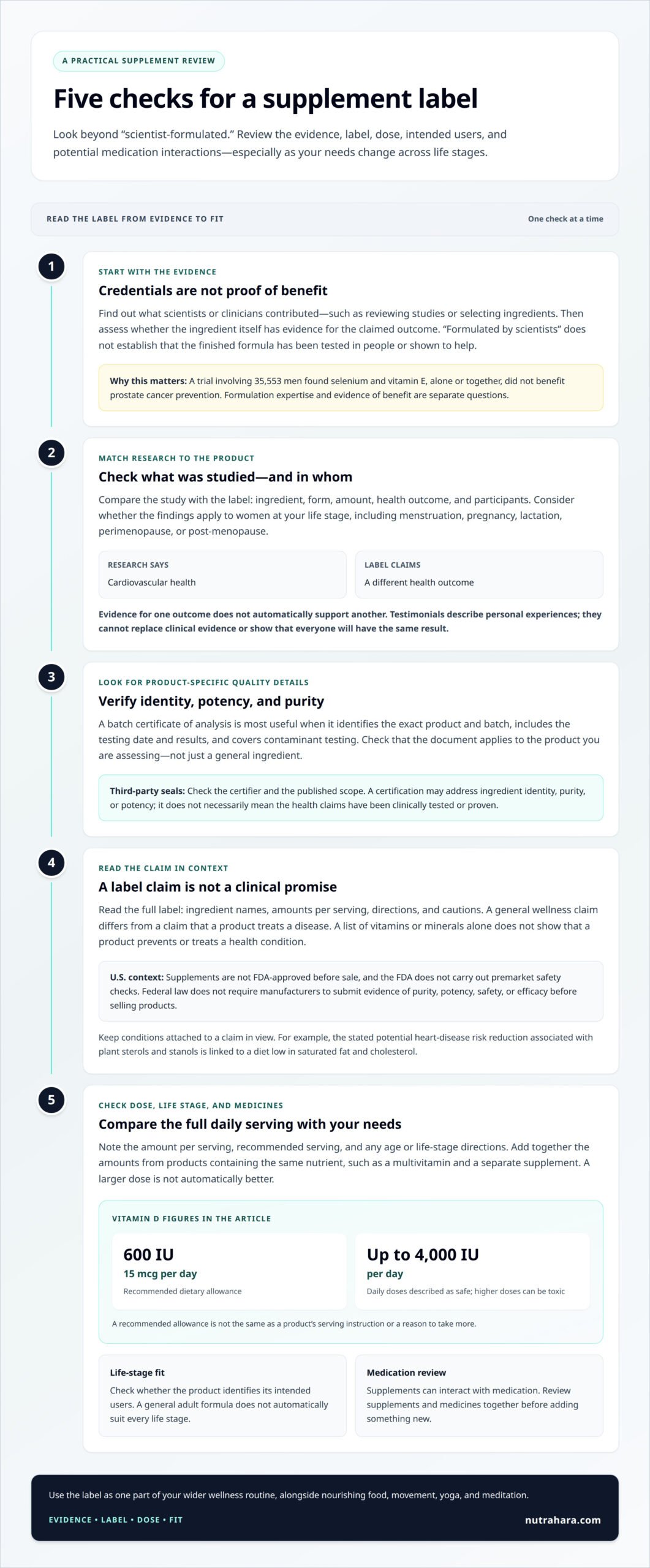
“Formulated by scientists” means scientific expertise informed ingredient selection, amounts, or the combination of ingredients. It doesn’t establish that the finished formula has been tested in people or shown to help with a specific outcome. For example, a multinational trial surveyed 35,553 men and found selenium and vitamin E, alone or together, did not benefit prostate cancer prevention. This illustrates why formulation credentials and evidence of benefit are separate questions.
To assess quality, look for product-specific documentation on ingredient identity, potency, and purity. A batch certificate of analysis is most useful when it identifies the product, batch, testing date, and results, including contaminant testing. Confirm that the document applies to the exact product, not just a general ingredient. Such records provide concrete quality information beyond broad claims. A personal account may describe someone’s experience, but it doesn’t verify a product’s composition.
Assess whether studies tested the same ingredient, form, amount, and health outcome described on the label. Check who participated and whether the findings apply to women at your life stage. Then compare the study dose with the serving information. Research on cardiovascular health, for example, doesn’t automatically support a cancer claim. Keep personal testimonials distinct from study findings: testimonials describe individual experiences but cannot replace clinical evidence.
In the United States, supplements formulated by scientists are not FDA-approved before sale. The Dietary Supplement Health and Education Act limits the FDA’s authority over products marketed as dietary supplements, and the FDA does not carry out premarket safety checks. The Act does not require manufacturers to submit evidence of purity, potency, safety, or efficacy before selling products. Federal law also does not require evidence that most label claims are accurate or truthful.
Treat each claim as something to assess, not proof of a clinical result. A claim about supporting general wellness differs from one that a product treats heart disease. Read the full label: ingredient names, amounts per serving, directions, and cautions help clarify what the product contains. A list of vitamins or a mineral does not, on its own, show that the product prevents or treats a health condition.
For third-party certifications, look for an independent program whose published scope covers the quality feature you care about, such as ingredient identity, purity, or potency. Check the certifier’s name and what its seal represents. A quality-focused certification does not necessarily mean a product’s health claims have been clinically tested or proven. Treat a seal as one piece of information alongside the ingredients and label claims.
Context matters, too. For example, the stated potential heart-disease risk reduction associated with plant sterols and stanols is linked to a diet low in saturated fat and cholesterol. Read the label’s claim with that dietary condition in mind, not as a promise that a capsule replaces vegetables or other nourishing foods. When comparing products, note whether the wording refers to a specific ingredient, a whole formula, or a broader wellness benefit. This distinction helps you judge whether the claim matches your needs and daily routine.
A useful dose depends on the nutrient, serving size, and intended users. For women, needs and routines can differ across menstruation, pregnancy, lactation, perimenopause, and post-menopause. Check whether the label identifies its intended users and gives a clear amount for each ingredient. A formula designed for general adult use doesn’t automatically suit every life stage.
For vitamin D, according to the National Academy of Medicine, the Food and Nutrition Board of the Institutes of Medicine set the recommended dietary allowance at 600 IU per day, or 15 mcg per day. According to the National Institutes of Health Office of Dietary Supplements, daily vitamin D doses up to 4,000 IU are considered safe, while higher doses can be toxic. These figures describe different considerations: a recommended allowance is not the same as a product’s serving instruction or a reason to take more.
Look at the full daily serving, not just the amount in one capsule. If a multivitamin and a separate supplement contain the same nutrient, consider their combined amounts. A product’s intended users and directions help you understand how its serving fits alongside food and other supplements. A larger dose isn’t automatically better or more likely to protect health.
Use this quick label review: identify the amount per serving, the recommended serving, and any age or life-stage directions. Then consider whether your dietary pattern or a known deficiency affects what you need. If you’re pregnant, breastfeeding, or taking a supplement alongside multivitamins, pay close attention to these details. Match the product to its stated users and purpose rather than choosing based on a high-dose claim alone. This makes the label more useful for an informed, consistent wellness routine.
An interaction occurs when a supplement changes how a medicine works, or a medicine changes how the body handles a supplement. The effect can depend on the ingredient, amount, timing, and treatment purpose. A concentrated extract may differ from the same plant consumed as food. This distinction matters for women managing ongoing treatment while planning pregnancy, lactating, or moving through menopause, when health priorities and medication routines may change.
A survey of people ages 57 through 85 found that 81% used at least one prescription medication, while 49% used at least one supplement. Using both makes a complete inventory useful. List prescription medicines, over-the-counter products, vitamins, minerals, herbal products, and label directions. Include occasional tablets and supplements used for sleep or exercise. A complete list gives a clinician or pharmacist context to review combinations, rather than considering one capsule alone.
Timing can matter, too. Keep the label’s serving directions with your medication list, and note when you take each product. If a supplement is described as supporting a disease or symptom, distinguish that marketing claim from the purpose of a prescribed medicine. Don’t change a prescribed dose or stop treatment to accommodate a supplement. A clear record helps a healthcare professional assess ingredients, timing, and your overall routine together.
Before adding a product, note its full ingredient list and serving amount, then compare them with your current medicines. Bring the product label or a clear photo to a medication review. Mention life-stage changes, including pregnancy, breastfeeding, or menopause, as these can affect which health needs are most relevant. If you use several products, record them together rather than relying on memory. This simple habit supports a more informed conversation about possible interactions and helps you make deliberate supplement choices.
Nutrahara offers Women’s Health Supplements for women seeking nutritional support as their needs change across life stages. Its formulations combine principles of ancient Ayurveda science with modern nutrition research, bringing traditional perspectives and contemporary evidence together. Nutrahara’s nutrition is made in New Zealand, and its products use natural ingredients without artificial additives.
If you’re considering a supplement, use the same thoughtful approach described above: consider its ingredients, intended users, serving directions, and how it fits with your current routine. These details matter whether you’re focused on everyday wellness, staying active, or supporting wellbeing through menstruation, pregnancy, lactation, or menopause. Supplements are one part of a broader health routine that can also include nourishing food, movement, yoga, and meditation.
For a calm next step in exploring women’s health support, contact Nutrahara to learn more about its supplements.
Your wellness needs can shift with life stage, activity, and daily routine. Before adding a new product, consider what support you’re seeking and how it fits your approach to health. Note your priorities, supplements, and medicines to help focus a conversation with a healthcare professional.
Think of supplements formulated by scientists as one possible part of a thoughtful routine, not a substitute for nourishing meals, movement, yoga, or meditation. Try a few gentle yoga poses, then sit comfortably for a brief meditation, noticing your breath. Your choices should feel informed and aligned with your needs, whether you’re navigating menstruation, pregnancy, lactation, or menopause.
Nutrahara offers Women’s Health Supplements for women exploring nutritional support. If you have questions, contact Nutrahara with your questions. Keep listening to your body and build your wellness journey with care and confidence.
Scientists don’t share one standard supplement routine; personal choices depend on diet, health needs, and professional guidance. Someone following a vegan diet, for example, may consider how they meet vitamin B12 needs. A scientist’s personal routine isn’t proof that a product suits you. Focus on your own goals, such as supporting energy or filling a dietary gap, and consider how food, sleep, movement, and life stage shape those goals.
Evidence can include controlled human trials, observational research, and laboratory studies, but each type answers different questions. Human trials can examine whether a defined dose affects a measured outcome, while observational studies identify patterns without establishing cause. Consider whether the study measured an outcome relevant to your goal and whether its participants resemble you. Evidence for one ingredient should not be assumed to validate every combination or dose.
Potential concerns include unwanted effects, overlapping ingredients across products, and changes to how a medicine works. Risk depends on the specific supplement, medicine, amount, and personal health circumstances. Keep a current list of prescriptions, nonprescription medicines, herbal products, and supplements, and bring it to a medication review. Pregnancy, breastfeeding, and treatment for a chronic condition are important context to share before changing your routine.
No one supplement is suitable for every health goal or person. Start by defining your aim, such as addressing a diagnosed nutrient deficiency or supporting a broader wellness routine. Then consider whether the ingredient and evidence relate to that aim and whether the product’s intended users match your circumstances. For women, pregnancy, lactation, menstrual changes, and menopause can shape individual needs. A supplement should complement, not replace, nourishing food and healthy habits.
Look for an independent certification program whose published scope covers the quality feature you care about, such as ingredient identity, purity, or potency. Check the certifier’s name and what its seal represents.
This article is not a substitute for medical advice. Please consult a healthcare professional before starting any supplement, especially if pregnant, nursing, taking medication, or managing health conditions.