
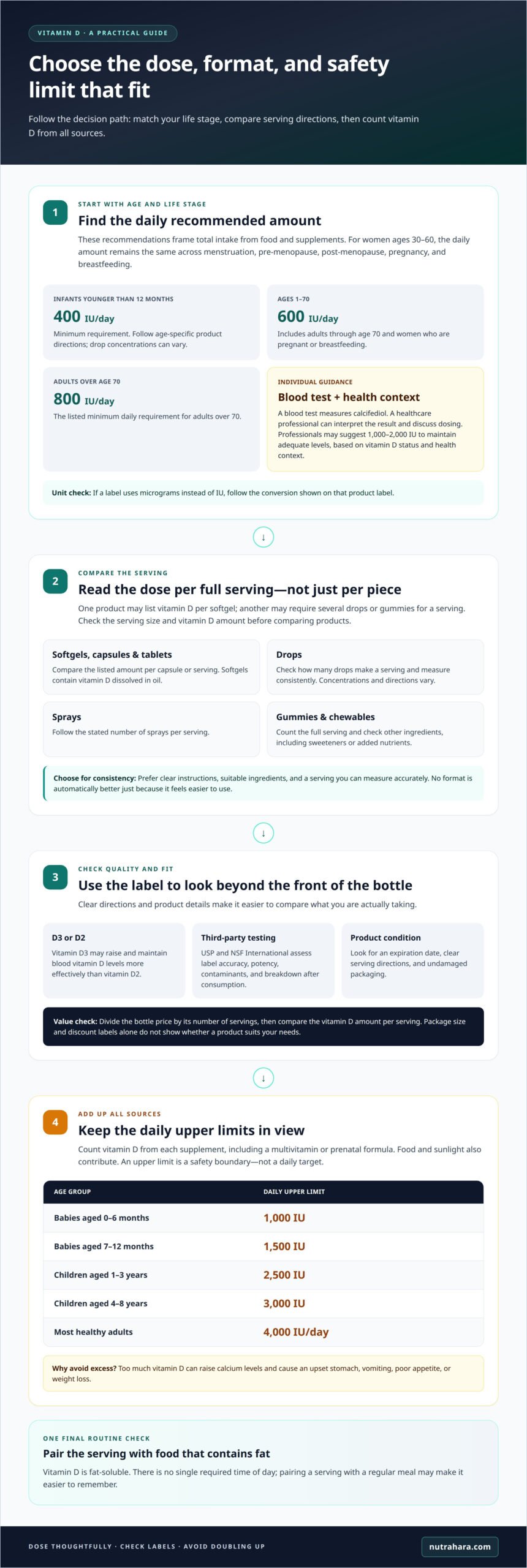
More vitamin D isn’t automatically better. Choosing what vitamin D supplements are best starts with the right dose for your age and life stage: most adults through age 70, including women who are pregnant or breastfeeding, need 600 IU daily. For adults over 70, the National Institutes of Health Office of Dietary Supplements lists 800 IU per day.
It’s understandable to want a simple way to support your well-being, especially when your needs may shift through pregnancy, menopause, or an active fitness routine. But dose and safety matter: the National Institutes of Health Office of Dietary Supplements sets 4,000 IU per day as the upper limit for most healthy adults. A supplement’s format and dose should fit your needs, and a healthcare professional can use a blood test to help guide dosing. This guide explains recommended amounts across ages and life stages, compares common formats, and covers practical safety steps, including avoiding excess vitamin D from multiple supplements. You’ll have a clearer foundation for choosing a supplement with confidence.
To decide what vitamin D supplements are best for you, compare the form, dose, and label clarity. Vitamin D3 may raise and maintain blood vitamin D levels more effectively than vitamin D2. Check whether the serving means one capsule, several drops, or multiple gummies. This matters when comparing products and fitting a supplement into a routine that already includes a multivitamin or prenatal formula.
Third-party testing adds a useful quality check. USP and NSF International assess supplements for label accuracy, potency, contaminants, and breakdown after consumption. Product testers evaluated 21 vitamin D supplements, showing how comparisons can assess more than the front-label claims. Look for clear serving directions and an expiration date, and avoid products with damaged packaging. Testing helps assess product quality; it doesn’t establish that a supplement treats disease.
The best vitamin D supplement for you depends on the amount you need, the format you can use consistently, and the product’s ingredients. To compare value, divide the bottle’s price by its number of servings, then check the vitamin D amount per serving. Package size and discount labels alone don’t show whether a product suits your needs.
A blood test can help determine your vitamin D status and guide dosing. The relevant test measures calcifediol. A doctor can interpret the result alongside your health and current supplements. To decide what vitamin D supplements are best for you, use that information to discuss an appropriate amount, especially if you’re considering a higher dose or managing a health condition.
Vitamin D is fat-soluble, so take it with food that contains fat. There’s no single required time of day. Pairing a serving with a regular meal can make it easier to remember.
Vitamin D recommendations depend on age and life stage, so match the daily target to the person taking it. The National Institutes of Health, Office of Dietary Supplements lists 400 IU daily as the minimum requirement for infants younger than 12 months. Children and adults ages 1 to 70 need 600 IU (15 mcg) per day. These figures help frame intake from food and supplements.
For women ages 30 to 60, 600 IU per day applies across menstruation, pre-menopause, and post-menopause. Pregnancy and breastfeeding also have a 600 IU daily minimum. A new life stage doesn’t automatically call for a higher supplement dosage. Compare the vitamin D in a prenatal or multivitamin with any separate product, then count both toward daily intake. This quick label check can prevent doubling.
For adults age 70 and older, the National Institutes of Health, Office of Dietary Supplements lists 800 IU per day as the minimum vitamin D requirement. Age therefore matters when choosing a supplement, including for women who remain active through strength training, walking, or yoga. If labels use micrograms instead of IU, follow the conversion shown on the product label; comparing unlike units can obscure the actual dose.
Food also contributes: some foods contain vitamin D, and supplements add the amount shown per serving. Healthcare professionals may suggest 1000-2000 IU to maintain adequate levels, based on vitamin D status and health context. For infants, follow the product’s age-specific serving directions because drop concentration can vary.
Softgels contain vitamin D dissolved in oil, while tablets offer a compact solid format. Capsules are another option. Compare serving directions and nutrient amounts rather than choosing by shape alone. Check whether the label lists vitamin D per capsule or per serving, and choose a format that fits your routine and makes the intended amount easy to follow.
Liquid drops allow adjustable dosing for specific needs. Check the label to see how many drops make one serving, then measure consistently. A dropper’s appearance alone doesn’t show how much vitamin D it delivers. Concentrations and serving directions vary between products, so read both before choosing.
Sprays, gummies, and chewable tablets offer alternatives to swallowing a capsule or tablet. Follow the stated number of sprays per serving, or count the full serving of gummies or chews shown on the label. Compare the vitamin D amount and other ingredients, including sweeteners or added nutrients. A familiar, pleasant format may make it easier to stick with a routine.
To compare forms, first identify the daily amount you intend to take, then check how each label defines a serving. One product may list vitamin D per softgel, while another lists it per several gummies or drops. Don’t assume one format works better simply because it feels easier to use. Choose clear instructions, suitable ingredients, and a serving you can measure accurately. Consistency matters more than a trendy format.
Vitamin D is a fat-soluble vitamin, so taking extra can build up rather than offer an automatic alternative to sunlight. The National Institutes of Health, Office of Dietary Supplements sets the tolerable upper intake level at 1,000 IU for babies aged 0-6 months and 1,500 IU for babies aged 7-12 months. For children aged 1-3 years, the level is 2,500 IU; for ages 4-8 years, it is 3,000 IU.
For most healthy adults, the National Institutes of Health, Office of Dietary Supplements gives 4,000 IU per day as the maximum daily dose. This upper limit is not a target for everyday use. Add vitamin D from each serving of multivitamins and other supplements before deciding whether another product fits. Sunlight exposure and food also contribute to overall vitamin D intake.
Excess vitamin D can raise calcium levels and cause symptoms such as an upset stomach, vomiting, poor appetite, or weight loss. Muscle weakness, difficulty thinking clearly, heart rhythm problems, kidney stones, and kidney damage can also occur. A high-dose product may exceed an appropriate amount when combined with other supplements. Claims about bone health or immune support aren’t a reason to exceed the recommended dose.
If you’re pregnant or have a medical condition, discuss vitamin D dosage with a healthcare professional before starting a supplement. This is especially relevant if you take thiazide diuretics, which can raise the risk of hypercalcemia when combined with vitamin D. Bring the supplement label and serving directions to the discussion. A blood test can help inform decisions about vitamin D levels; don’t choose a dose based on symptoms alone.
Nutrahara offers Women’s Health Supplements for women seeking support for overall wellness, energy, and health. Its formulations combine principles of ancient Ayurveda with modern nutritional research and use natural, clean ingredients. Nutrahara’s nutrition is made in New Zealand. These supplements can be one part of a broader routine that includes nourishing meals, restorative sleep, and sustainable movement.
For a manageable wellness habit, pair gentle yoga with a brief meditation. Choose familiar, comfortable poses, then sit quietly and follow your breathing. Adapt movement to how your body feels that day. A short, consistent routine can complement walking, strength work, or other activity without making self-care another demanding task.
Before taking a supplement, read its label and directions, and consider how it fits with products you already use. Needs may change during pregnancy, breastfeeding, perimenopause, or post-menopause. For vitamin D decisions, use the age and life-stage guidance in this article. Don’t assume a women’s health supplement contains vitamin D or a particular amount unless the label says so. A healthcare professional can help with questions about pregnancy, medical conditions, or medication.
Nutrahara combines traditional Ayurvedic principles with contemporary nutritional research in its Women’s Health Supplements. If you’re seeking options for a broader wellness routine while making informed choices about individual nutrients, explore the range and choose habits and products that suit your needs. Your routine can evolve as your health priorities change. Many users report feeling more balanced and supported in their daily energy levels after incorporating these natural formulations into their wellness habits.
Please contact Nutrahara with questions about its Women’s Health Supplements.
Your daily need depends on your age and life stage; use the recommendations section above to find the matching amount. For a practical routine, note when your circumstances change, such as becoming pregnant or breastfeeding, and review your supplement plan with a healthcare professional. This helps keep your choices aligned with your current needs rather than an old routine.
Choose a format you can take comfortably and measure consistently. For liquid drops, keep the original dropper with the bottle and follow its serving directions instead of estimating. For gummies or chewables, consider whether the taste and texture suit your routine. These practical details can make a supplement easier to use without changing the intended amount.
Dosage depends on whether you’re following a routine intake recommendation or a healthcare professional’s specific plan. Keep written instructions with the product, especially if you’ve been given a temporary regimen. Don’t change the plan based on someone else’s experience or a review. If the label and your instructions seem to differ, clarify which direction applies before taking the next serving.
Independent testing and expert reviews can help narrow your options, but rankings may reflect different priorities. Read how a review reached its conclusion, then consider whether its criteria match yours. A highly rated product may not suit your preferred format, dietary needs, or routine. Treat rankings as one comparison tool, not a substitute for choosing a product that fits your circumstances.
Recommendations and upper limits vary by age, so use the age-specific amounts in the section above rather than applying an adult figure to a child. Keep a child’s product separate from adult supplements, and follow the serving instructions for the person taking it. The upper limit is a safety boundary, not a personal target; recommended intake and upper limit serve different purposes.
This article is not a substitute for medical advice. Please consult a healthcare professional before starting any supplement, especially if pregnant, nursing, taking medication, or managing health conditions.