
The gentlest-looking supplement isn’t always the one your stomach tolerates best. If you’re looking for supplements that don’t upset your stomach, the answer may depend on more than the label: ingredient form, serving size, when you take it, and your own sensitivities can all shape how a formula feels. What suits you may also change across menstruation, pregnancy, lactation, perimenopause, or post-menopause.
It makes sense to want wellness support that fits around your life, not something that unsettles your day, workout, or yoga practice. This guide will help you understand common factors that influence digestive comfort and compare formulas with greater confidence, without assuming one format works for everyone. We’ll look at ingredient lists, supplement forms, and everyday routines, including practical ways to notice how a change feels for you. With a considered approach, you can make choices that better reflect your needs, life stage, and wellness goals.
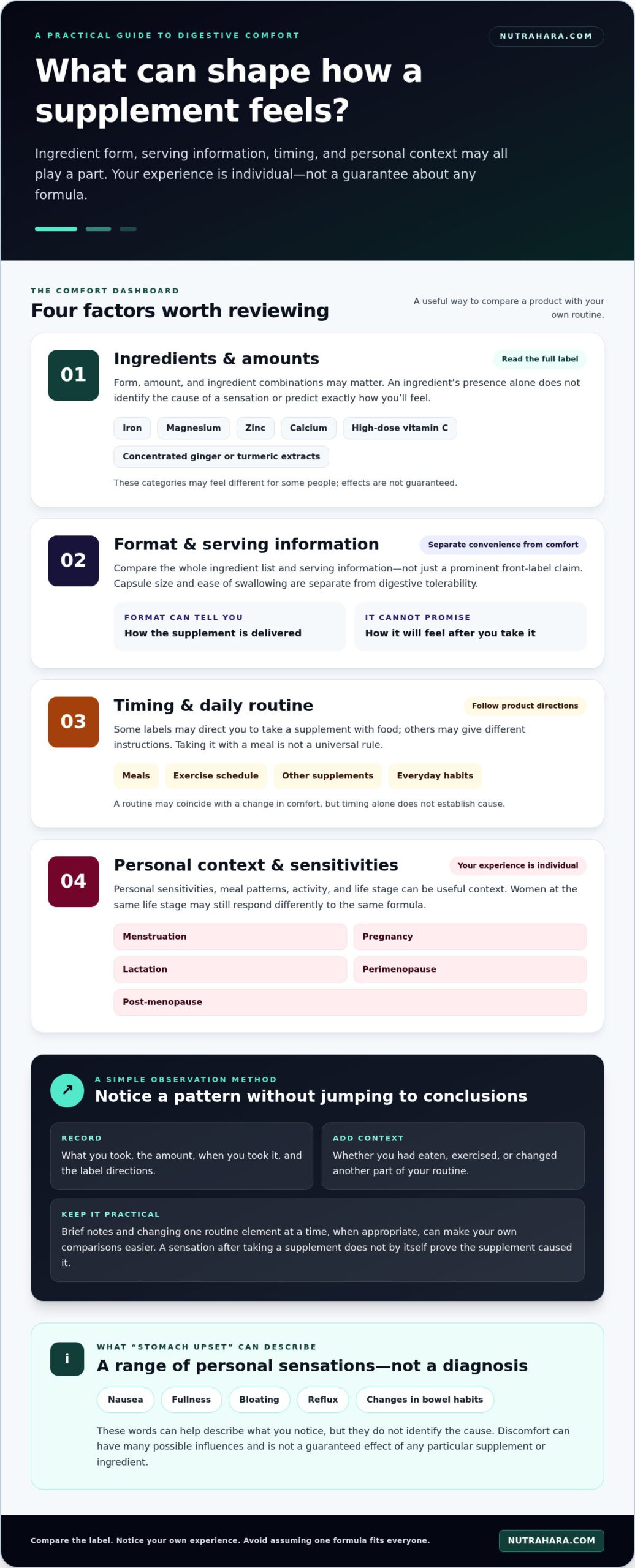
Digestive comfort isn’t identical for everyone, and it can shift with daily routines. A supplement that feels fine alongside breakfast may feel different when taken at another time, while someone else may notice no difference at all. Formula, ingredient amount, timing, and personal context can all influence how a supplement feels.
In this guide, “stomach upset” means a person’s own experience of digestive discomfort, not a diagnosis or proof that a specific ingredient is responsible. The phrase can cover sensations such as nausea, fullness, bloating, reflux, or changes in bowel habits. These experiences can be temporary, and they aren’t a guaranteed effect of any particular supplement or ingredient.
Supplement tolerability differs because each person brings a different formula, routine, and set of sensitivities to the experience.
People use “upset stomach” to describe a range of sensations. One person might notice mild queasiness, while another describes gas or a heavy feeling. These words can help you record what you notice, but they don’t identify the cause. Digestive discomfort can have many possible influences, and a sensation after taking a supplement doesn’t, by itself, prove the supplement caused it.
It can help to observe the pattern without jumping to conclusions. Note what you took, when you took it, whether you’d eaten, and what you felt afterward. A brief note can make it easier to compare experiences over time and separate a one-off uncomfortable moment from a pattern. If you’re looking up terms such as indigestion or heartburn, an Antacid reference explains how antacids neutralize stomach acid; that information doesn’t establish why a supplement-related sensation occurred or mean an antacid is appropriate for you.
Comfort is shaped by more than a product alone. Your usual meal pattern, other supplements, exercise schedule, and personal sensitivities may all be part of the picture. For example, taking a supplement close to a workout may fit one person’s routine but feel uncomfortable to another. This is an observation to consider, not a universal rule about exercise or supplement timing.
Life stage can also be useful context, but it doesn’t define someone’s digestive needs. Menstruation, pregnancy, lactation, perimenopause, and post-menopause are different experiences, and women at the same stage can respond differently to the same formula. If you’re comparing supplements that don’t upset your stomach, focus on your own priorities and observations rather than assuming another woman’s experience will predict yours.
A calm, practical approach is to change one routine element at a time when appropriate and keep notes, rather than making several changes together. That can help you notice what seems to support comfort in your own day, whether you’re balancing work, family, meditation, or fitness. Your experience is useful information, not a reason to blame yourself or conclude that every supplement will feel the same.
There isn’t one formula or set of directions that applies to every supplement. Ingredients, amounts, combinations, and suggested timing differ from product to product, so read the specific label rather than relying on a general rule. A formula’s ingredient list can help you understand what you’re taking, but it can’t predict exactly how you’ll feel.
Some ingredient categories are commonly associated with digestive effects for some people. Iron, magnesium, zinc, and calcium supplements may feel different depending on their form and amount; high-dose vitamin C or concentrated herbal extracts such as ginger and turmeric may also be uncomfortable for some individuals. These are possibilities, not guarantees. An ingredient’s presence alone doesn’t establish that it caused a sensation, and one person’s response doesn’t predict another’s.
Consider the whole formula, too. A product with several ingredients may make it harder to identify which factor matters to you, while the amount of an ingredient can be as relevant as its name. Compare the full ingredient list and serving information, not just a prominent front-label claim. A particular ingredient or delivery format may be a plausible tolerability factor, but it does not prove that a specific product will be comfortable for you.
Capsule size and ease of swallowing are separate considerations. A capsule that’s easy to swallow may be convenient, but that feature alone doesn’t show how it will feel after you take it or establish digestive tolerability.
Follow the directions on the product you’re considering. Some labels may direct you to take a supplement with food, while others may give different instructions. Taking it with a meal isn’t a universal solution, so don’t override the label based on general advice. If the directions are unclear, seek guidance suited to your circumstances, particularly during pregnancy or lactation.
Your routine can offer useful context. A supplement taken near breakfast, a workout, or another daily habit may coincide with changes in comfort, but timing alone doesn’t establish cause. Make brief notes about the product, amount, label directions, meals, exercise, and what you notice. Keeping other routine changes steady, when practical, can make comparisons easier without turning the process into a strict regimen.
Also consider whether discomfort continues when you haven’t taken the supplement. Stomach symptoms can have causes beyond supplements, including some medications; Mayo Clinic’s Gastritis: Symptoms and Causes explains why persistent symptoms shouldn’t automatically be attributed to a formula. If discomfort is ongoing or concerning, seek appropriate medical guidance rather than trying to solve it by switching supplements alone.
For women comparing supplements that don’t upset your stomach, a considered choice starts with clear labels and attention to personal experience. Nutrahara’s women’s wellness supplements are made in New Zealand; explore Nutrahara women’s wellness supplements as one option to consider, without assuming any formula guarantees digestive comfort.
No label can promise how a supplement will feel for you. A clear comparison can still help you assess what’s in a formula, how it’s meant to be taken, and whether its practical details fit your routine. Use the same questions for each option rather than relying on a single phrase such as “gentle” or “easy to take.”
Start with the ingredient list and serving directions. Compare the named ingredients, their amounts where provided, and any instructions about timing or food. Then look at the product’s claims and ask whether they describe a convenience feature, an ingredient, or a specific digestive result. Clean-and-simple language may signal a formulation philosophy, but it can’t predict your individual response.
“Clinically studied” also needs context. It doesn’t, by itself, show that the finished product has been shown to prevent stomach discomfort or will suit every person. Read the claim alongside the full label, not as a substitute for it.
Capsules, powders, tablets, and liquids differ in how they’re taken and what may fit comfortably into a routine. None is automatically gentle for everyone. A capsule’s size or ease of swallowing concerns the act of taking it; that convenience is separate from evidence about how the formula affects digestion.
Comparison point | What to look for | Question to ask yourself
Ingredient transparency | Named ingredients and amounts where provided | Can I understand what the formula contains?
Format | Capsule, powder, tablet, or another form; size and stated swallowing convenience | Does this format fit my preferences and routine?
Label directions | Serving instructions, including any food or timing guidance | Can I follow these directions consistently?
Personal relevance | Whether the formula matches your wellness goal and circumstances | Is this relevant to my needs and life stage?
For a practical comparison, put two labels side by side and note differences without assuming that more ingredients or a particular format is better. Check that any headline claim matches the details: a statement about ease of swallowing is not a stomach-comfort claim, and ingredient research doesn’t establish a guaranteed outcome for a finished formula.
Use the label to narrow your options, then keep your own needs in view. If a product’s directions don’t fit your day, or its ingredient information is hard to interpret, that matters to your decision. This framework can help you compare supplements that don’t upset your stomach thoughtfully, while recognizing that personal tolerability can’t be guaranteed by a label or format.
A calm, considered choice begins with your reason for looking. Use a simple sequence to make the decision personal and easier to revisit:
Check that the ingredients and directions align with the purpose you have in mind. If you choose to begin a routine, keep a simple record of the product, how you took it, relevant context such as meals or exercise, and any comfort changes you noticed. Patterns can guide your questions, but personal observations aren’t clinical proof of cause or effect.
Alongside your usual wellness habits, you might try a gentle sequence of yoga movements after waking, then sit quietly for a few mindful breaths before moving into the day. Adapt the practice to your comfort and schedule. It can be a supportive moment of self-care, not a substitute for supplement directions or individualized health advice.
Your priorities may shift through menstruation, pregnancy, lactation, perimenopause, and post-menopause. These stages don’t define every woman’s needs, so let your goals, circumstances, and product information guide your choices. A broader understanding of women’s wellness supplement categories can help you consider which products may be relevant before comparing their details.
Regular movement, balanced meals, restorative sleep, yoga, and meditation can all have a place in a considered wellness routine. Choose practices that feel manageable and sustainable for you. If you’re ready to explore women’s wellness options, browse Nutrahara supplements and compare product information with your goals and everyday routine.
A careful comparison can help you decide which product details matter to you. Nutrahara brings Ayurvedic principles together with modern nutritional research, using clean-and-simple formulations and natural ingredients. The brand describes its ingredients as clinically studied, but that description doesn’t establish a specific outcome or guarantee stomach comfort.
Nutrahara nutrition is manufactured in New Zealand. The brand emphasizes straightforward formulations without artificial additives, giving women product details to consider alongside their own needs and the label directions. Its capsules are described as easy to swallow, a practical convenience for some routines. Ease of swallowing is not the same as digestive comfort, and it can’t predict how an individual will respond.
That distinction matters when considering supplements for digestive comfort. A brand’s ingredient philosophy, a capsule’s convenience, and a claim about tolerability are different kinds of information. Use product details to understand what you’re considering, without treating them as evidence that a formula will suit your stomach.
Wellness priorities can evolve through menstruation, pregnancy, lactation, perimenopause, and post-menopause. Broad context about supplement categories may help you connect a goal with the product information you want to review, while keeping the decision personal. Consider the ingredients, directions, and relevance to your routine rather than assuming one formula suits every woman or life stage.
Nutrahara’s approach combines traditional Ayurvedic principles with modern nutritional research in women’s wellness supplements. If its clean-and-simple philosophy aligns with what you value, take a considered look at the product details and decide whether an option fits your goals. Explore Nutrahara’s women’s wellness supplements as you choose your next step with care.
Your needs and routines can change, and your wellness choices can change with them. Give yourself room to make considered decisions without expecting one supplement to suit every season of life. The aim isn’t to find a perfect formula or follow someone else’s routine. It’s to make choices that feel informed, personal, and sustainable alongside the habits that support you, from movement to moments of quiet reflection.
Finding supplements that don’t upset your stomach is an individual process, not a promise any label can make. Let your priorities guide what you explore, and give yourself permission to reassess as those priorities shift. Small, thoughtful choices can help you feel more confident in the care you give yourself.
Ready to take your next step? Explore Nutrahara’s women’s wellness supplements and consider which options align with your needs and everyday life.
Yes, some people report digestive discomfort after taking certain supplements, though experiences vary. A multivitamin taken during a rushed morning, for example, may feel different from the same product taken as part of another person’s routine. Ingredients, serving directions, timing, and individual circumstances may all play a part. Compare the product label and note what you experience, but don’t assume that timing alone identifies the cause.
Not always; directions depend on the product. Check the label for specific instructions instead of assuming food is always needed or helpful. If your routine includes breakfast, note whether you take the supplement then and how you feel, while following the stated directions. A brief record can help you notice patterns, but changing timing isn’t guaranteed to resolve discomfort or explain its cause.
No format is guaranteed to suit everyone. Capsules, powders, and other forms can differ in ingredients and directions, so compare the full label rather than choosing by format alone. Consider practical preferences, such as whether you can comfortably swallow a capsule or prefer mixing a powder. Nutrahara describes its capsules as easy to swallow, a convenience feature that doesn’t establish digestive tolerability.
That depends on the specific product, so use its label as your guide. Don’t assume an empty stomach is suitable or unsuitable for every supplement, and avoid creating your own dose or schedule. If you notice discomfort, make a note of the product and context, including whether you’d eaten. Such observations can help you describe your experience, but they don’t prove a clinical effect or cause.
Compare ingredient transparency, serving directions, format, and relevance to your wellness goal. Broad marketing terms can’t guarantee how you’ll respond. A useful approach is to assess one product at a time, read its complete label, and follow its stated directions rather than making several changes together. This can help you choose supplements that don’t upset your stomach with more care, without assuming any formula can prevent discomfort.
Review the product’s directions and write down its name, how you took it, and what you noticed. Consider other routine details that may help you explain the timing of your experience, without deciding on your own that the supplement caused it. Don’t make dose or schedule changes based only on guesswork. If symptoms persist or concern you, seek individualized guidance from an appropriate healthcare professional.
No. A natural origin doesn’t guarantee that a supplement will feel the same for everyone. Ingredient combinations, product directions, and personal circumstances can all be relevant. Read the actual ingredient list and serving instructions rather than relying on broad claims such as “natural” or “gentle.” Treat your own experience as personal information, not proof that a particular ingredient will cause discomfort for others or suit every routine.
This article is not a substitute for medical advice. Please consult a healthcare professional before starting any supplement, especially if pregnant, nursing, taking medication, or managing health conditions.