
What if the most convincing promise on a joint supplement label is the very thing to question first? If you’re considering a joint and knee kit for active women, it’s reasonable to want support for movement without having to trust vague claims or undisclosed ingredients. A bundle may be worth considering, but it isn’t a guaranteed solution or a substitute for medical care.
Before you decide, check what’s inside, how much of each ingredient it provides, what evidence supports its claims, and whether it fits your health needs and life stage. Pregnancy, lactation, medicines, and health conditions are all reasons to ask a qualified healthcare professional about a supplement. This guide also looks at how supplements fit alongside sustainable habits such as strength-building, gentle yoga, and recovery, so you can assess a product as one part of your wider wellness routine.
Active women may be building strength, training for a long walk, practicing yoga, or simply aiming to move comfortably through a busy day. Those routines and health needs vary. Menstrual changes, pregnancy, lactation, perimenopause, and menopause can shape wellness questions, but they don’t explain every ache or make every knee concern the same. Activity level, recovery, past injuries, and health conditions also matter.
Assess a joint and knee kit for active women by its contents and the evidence behind its claims, not by its name alone. Start by identifying what you hope to support, then check whether the product’s label, directions, and available evidence give you enough information to make an informed decision.
Strength training, walking, and yoga can each play a role in a movement routine. Recovery gives your body time to rest between activities. Consider what fits your current ability and goals, and pay attention if discomfort is new, persistent, or affecting daily activities. For background, Osteoarthritis is one condition associated with joint symptoms, but knee discomfort can have different causes and may need individual assessment.
If you’re pregnant or lactating, ask a qualified healthcare professional before using a supplement. Individual guidance is also sensible if you take medicines, have a health condition, or have questions about supplements during other life-stage changes.
A joint and knee kit is a supplement bundle, but its name alone can’t tell you what it contains or what it can do. Confirm the contents on the current label before deciding. Nutrahara describes its Joints & Knees Kit as intended to support joint health, knee mobility, and flexibility. The available materials don’t specify the ingredients, amounts, directions, warnings, or product-specific evidence, so check those details before purchase.
General support language isn’t proof that a product diagnoses, treats, or prevents a health condition. Evidence for an ingredient doesn’t automatically establish that a complete kit provides a particular benefit. Supplements also don’t replace appropriate care or sustainable habits such as movement and recovery.
Personal stories can offer perspective, but they don’t replace clear label information or reliable evidence. Make your decision using details you can verify, and ask a qualified healthcare professional if you have safety questions.
A clear label is the starting point for comparing a joint and knee kit for active women. Locate the complete Supplement Facts panel and confirm that it reflects the product currently being offered. If you can’t see the full label, you can’t reliably assess the formula or compare its claims with relevant research.
Make a simple record of the label details before comparing products. Don’t guess at amounts or assume a blend contains a particular ingredient in a useful quantity.
A proprietary blend or an unclear detail isn’t, by itself, proof of poor quality. It does limit what you can assess. Ask the seller for clarification, and consider pausing your decision if important information remains unavailable. For a bundle, check the label and directions for each included product, rather than treating the kit as one formula.
Assess each ingredient separately, then check whether the research matches the actual product. A study on one ingredient doesn’t establish that a multi-ingredient kit works. Evidence for a particular form or amount may not apply to a different formula. Look for human research relevant to the claimed outcome, and treat early or limited findings as preliminary rather than a promise.
The NIH Office of Dietary Supplements is a useful starting point for general information and fact sheets on ingredients it covers. Then verify the original research and compare its ingredient form and amount with the product label. General information about knee problems can also help frame your questions: Johns Hopkins Medicine outlines common causes of knee pain, which may include different issues requiring different responses.
Keep intended support separate from established guidance and marketing language. If a claim sounds like a guarantee or suggests a supplement can treat a condition, look for credible, product-specific substantiation rather than relying on the wording alone. Nutrahara describes its approach as combining Ayurvedic principles with modern nutritional research, but that philosophy doesn’t establish the ingredients or prove a specific benefit. Apply the same label-first, evidence-conscious approach when reviewing any women’s wellness product.
There’s no universal best choice. A verified kit may be convenient if every included product suits your needs. A single-ingredient supplement may be easier to assess when you have a specific ingredient in mind. Movement support may be the most relevant starting point if your goal is to build a sustainable routine. Compare what you can verify, not what sounds most powerful.
| Option | Transparency | Personal relevance | Convenience | Safety and evidence |
|---|---|---|---|---|
| Verified supplement kit | Check the contents and full labels for every product. | Consider whether each item fits your goals and circumstances. | May group products together, but directions may differ. | Review warnings and evidence for each ingredient and for any kit-specific claim. |
| Single-ingredient supplement | Focus on one listed ingredient and its amount. | May be easier to compare with a specific question or need. | One product to assess, though directions still matter. | Check the exact form, amount, safety details, and relevant research. |
| Movement support | No supplement label to assess; clarify what any program includes. | Can be adapted to your ability, schedule, and preferences. | Requires time and a routine you can maintain. | Choose appropriate activities and seek guidance if symptoms or health needs call for it. |
Convenience only counts after you confirm what the bundle contains, the serving size and directions for each product, and how the instructions fit together. More ingredients don’t automatically mean better support. Ask whether each item has a clear purpose for you and whether its safety information is available. Don’t assume a kit is cost-effective without current, comparable product and pricing details.
If you’re considering collagen separately, Nutrahara lists a Premium Collagen Complex. Its mention here doesn’t mean it’s included in any joint or knee kit, or establish that it’s suitable for your goals.
Supplements are only one possible part of a wellness routine. Build activity gradually, leave room for recovery, and choose movements that feel manageable for your current ability. Strength training, walking, or gentle yoga can each fit differently into a person’s routine. Meditation may support relaxation and mindful recovery, but yoga and meditation aren’t treatments for joint conditions or substitutes for medical care.
When assessing a joint and knee kit for active women, compare its practical fit with the movement habits you can sustain. Consider whether the product’s directions and safety information are clear, and whether the kit addresses a goal that matters to you. Choose an approach that feels informed, realistic, and appropriate for your circumstances.
No supplement kit is automatically suitable or effective for every active woman. A formula may include ingredients that aren’t right for your health circumstances, and a product’s intended support isn’t proof that it will improve your training or resolve discomfort. Use a clear decision process: review the complete label, consider your health and medicines, ask a qualified healthcare professional if anything is unclear, then decide.
Check the verified label for every ingredient, amount, direction, and warning. Then consider whether you have ingredient sensitivities, an existing health condition, or medicines that could affect whether a supplement is appropriate. If you’re pregnant or lactating, speak with a qualified healthcare professional before starting one. Individual guidance is also sensible when you’re managing other health needs or changes related to menstruation, perimenopause, or menopause.
Use only the directions on the current product label. Don’t increase a serving or combine products based on assumptions; ask a professional first. If formula details, warnings, or quality information are missing, ask the manufacturer for clarification before purchasing. If you can’t get the information you need, waiting is a reasonable choice.
A supplement shouldn’t be used to diagnose a problem or justify pushing through pain. New, worsening, persistent, severe, or function-limiting knee symptoms deserve individual clinical assessment, particularly if they interfere with ordinary movement or your training. A qualified professional can help you understand what next steps are appropriate for your situation.
In the meantime, consider adapting your activity rather than forcing a workout through concerning symptoms. Reduce or pause movements that aggravate discomfort, and seek qualified guidance about a suitable return to exercise. Yoga, meditation, and mindful breathing may be part of general wellbeing, but they don’t replace assessment or care. Consider a joint and knee kit for active women only as one possible part of a broader plan, not as injury prevention or a way to make painful exercise safe.
Before deciding, write down questions about ingredients, warnings, or fit for your circumstances and review them with a qualified healthcare professional. Clear information and personal guidance can help you make a choice with confidence.
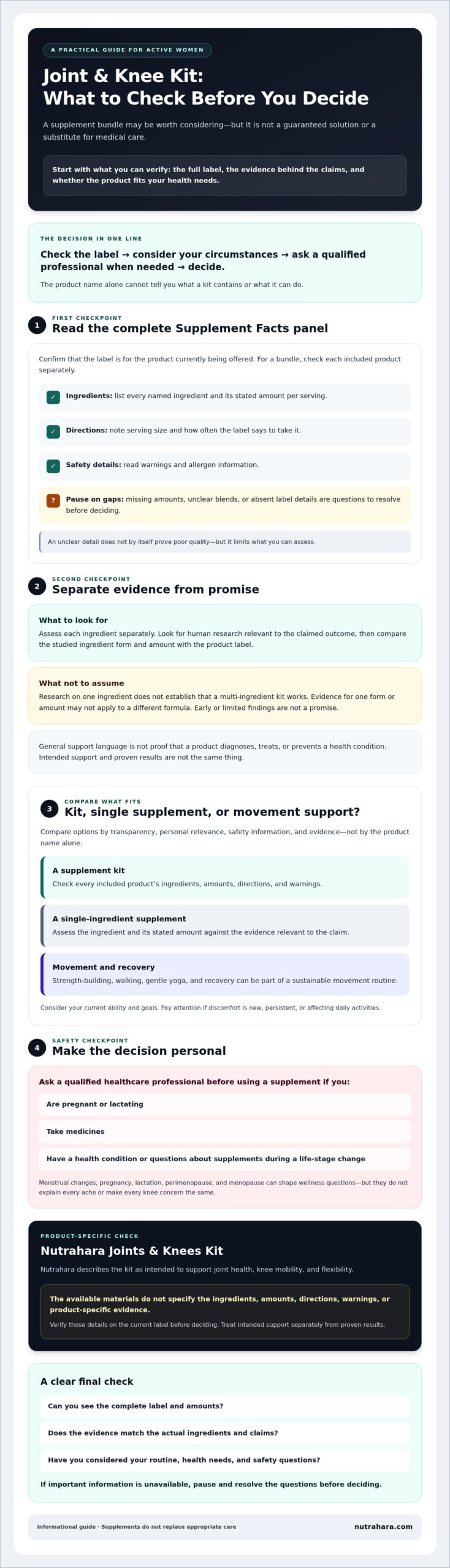
Nutrahara describes its Joints & Knees Kit as a bundle intended to support joint health, knee mobility, and flexibility. Those are intended uses, not proof of specific results. The available product information for this guide doesn’t confirm the kit’s ingredients, amounts, directions, warnings, or product-specific evidence. Review the current product page and label before deciding whether it suits your goals.
Use this go/no-go check to assess the product on its details, not just its name. Pause if key information is missing or if you need professional advice before using supplements.
If you can’t answer these questions from the available information, hold off and seek clarification before ordering. A complete label and clear evidence give you a firmer basis for deciding. It’s reasonable to wait until you can check the details that matter to you.
Nutrahara positions its approach as combining Ayurvedic principles with modern nutritional research. That describes a philosophy; it doesn’t by itself confirm what this kit contains or demonstrate that a particular health benefit has been established. Look for the complete current label, clear safety and use information, and substantiation that matches each product-specific claim. Any quality statements should also be explained clearly. Customer feedback can add personal perspective, but it isn’t a substitute for evidence, and testimonials should be genuine, permissioned, and presented in context.
A joint and knee kit for active women may be worth considering if its verified contents and directions fit your needs, its claims are appropriately supported, and your safety questions are answered. To assess the current offering, review Nutrahara’s wellness products and check the kit details before ordering.
A thoughtful choice starts with the details: confirm the full label, compare each ingredient with relevant evidence, and consider how the formula fits your health needs and life stage. A joint and knee kit for active women is one option to assess, not a guaranteed result or replacement for appropriate care. Sustainable movement, strength work, recovery, and practices such as yoga or meditation can also be part of your wider wellness routine.
Nutrahara describes its approach as combining Ayurvedic principles with modern nutritional research. Its Joints & Knees Kit is described as a bundle intended to support joint health, knee mobility, and flexibility, but those intended benefits aren’t proof of outcomes. Check the current product label and look for substantiation before deciding whether it’s right for you. If safety questions remain, ask a qualified healthcare professional.
For a considered next step, explore Nutrahara’s wellness products and review the current kit information before ordering. Make your choice at your own pace, guided by clear information and what feels right for your health needs.
Look for a complete, current label that names every included product and ingredient, gives amounts and serving directions, and explains relevant warnings. Check whether evidence supports the specific claims for the actual formula, rather than relying on broad promises. Nutrahara describes its Joints & Knees Kit as intended to support joint health, knee mobility, and flexibility, but verify its contents and product-specific evidence before deciding whether it fits your needs.
Some ingredients have been studied for joint symptoms, but research findings vary, and they don’t establish that every supplement or bundle improves mobility or flexibility. Evidence about one ingredient may not apply to a different form, amount, or multi-ingredient formula. Treat a product’s intended support as distinct from a proven outcome, and consider supplements as one possible part of a broader wellness plan, not a replacement for appropriate care.
Ask a qualified healthcare professional before using a joint supplement during pregnancy or breastfeeding. Safety depends on the specific ingredients, amounts, your health circumstances, and other products or medicines you use. Don’t assume a supplement is suitable because it’s described as natural or because its label doesn’t mention pregnancy. Bring the complete product label to your healthcare professional so they can review the actual formula with you.
Choose based on transparency and personal fit, not the number of products in a bundle. A kit may be convenient if you can verify every product, serving direction, warning, and ingredient amount, and each item is relevant to you. A single supplement may be simpler to assess against a specific question. Compare evidence and safety details for either option, and ask a professional if you’re unsure.
Yoga and appropriately tailored exercise can be part of an active wellness routine, while meditation may support relaxation and mindful recovery. Build activity gradually, allow time for recovery, and choose movements that suit your ability. These practices don’t replace medical care, and supplements can’t make it safe to push through concerning pain. If discomfort is persistent, worsening, severe, or limiting daily movement, seek individual clinical assessment.
There’s no reliable timeline to promise for a joint and knee kit. Effects, if any, may depend on the formula, the evidence for its ingredients, and individual circumstances. Nutrahara’s available product information doesn’t establish a product-specific timeframe or outcome. Check the current label and substantiation, follow only verified directions, and ask a healthcare professional about expectations and next steps, especially if knee symptoms persist or affect your activities.
This article is not a substitute for medical advice. Please consult a healthcare professional before starting any supplement, especially if pregnant, nursing, taking medication, or managing health conditions.