Did you know the women’s health and beauty supplement market is projected to reach over $101 billion in 2026? While the options are endless, the clarity behind those labels often feels out of reach. You’ve likely stood in a wellness aisle, squinting at technical terms and realizing that understanding supplement labels and ingredients is the only way to protect your peace of mind. It’s frustrating to feel like you need a chemistry degree just to support your hormonal balance or energy levels during your personal health progression.
We believe your path to wellness should be a journey of confidence, not confusion. This guide will empower you with the clarity you deserve. You’ll learn to distinguish between synthetic fillers and the potent herbal extracts that actually nourish your body. We’ll explore how to decode complex labels, identify clean formulas for your specific life stage, and bridge the gap between clinical science and ancient botanical wisdom. Together, we’ll turn uncertainty into a grounded, intentional ritual for your long-term well-being.
The journey to conscious wellness often begins in the palm of your hand, holding a bottle and wondering what’s actually inside. Understanding supplement labels and ingredients is the first step toward reclaiming your health narrative. Unlike the foods in your pantry, these products are governed by the Dietary Supplement Health and Education Act of 1994 (DSHEA). This legislation ensures that supplements are treated as a special category of food, requiring a “Statement of Identity” that clearly labels the product as a “dietary supplement” or “herbal supplement.” It provides the legal framework that protects your right to access these vital tools while ensuring manufacturers follow specific labeling protocols.
Beyond these regulatory standards, the integrity of your supplements also depends on a secure supply chain; many wellness brands partner with logistics experts like Warenous to connect with reliable 3PL providers that maintain product quality throughout the distribution process.
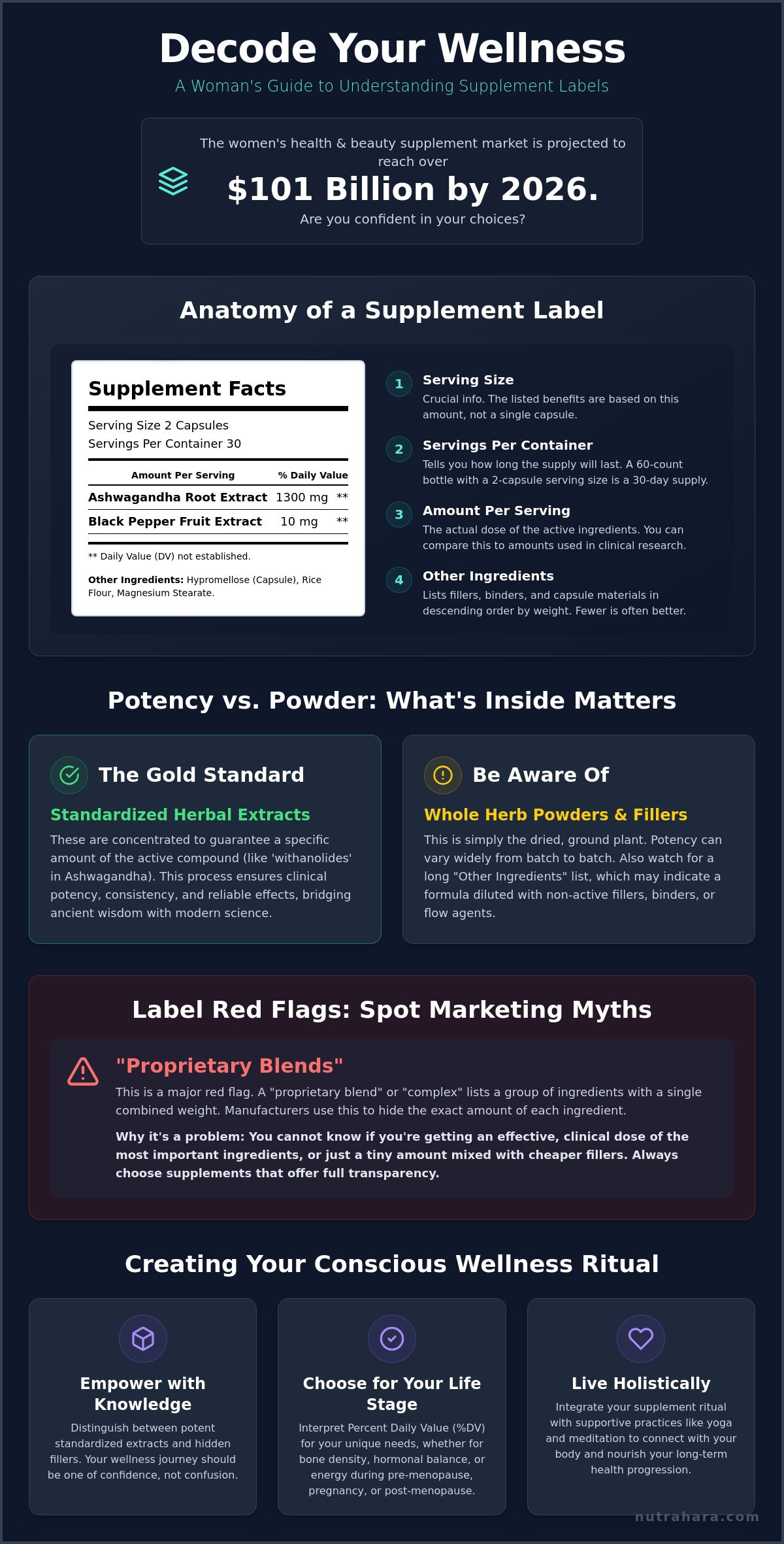
You’ll notice a “Supplement Facts” panel rather than the “Nutrition Facts” you see on a box of crackers. This distinction is vital because it shifts the focus from calories and macronutrients to “Dietary Ingredients.” In this section, you’ll find the active components like vitamins, minerals, or botanicals. The “Amount Per Serving” column tells you exactly how much of each ingredient is present in one full serving. If you’re looking at a product like Ashwagandha with Black Pepper, the panel will list the specific milligram count of the root extract, providing the transparency you need to align with your yoga and meditation practices.
Don’t assume that one capsule equals one serving. This is a common trap that can disrupt your wellness goals. A label might state a serving size of two or three capsules to reach the clinical potency shown in research. If you only take one, you aren’t getting the intended benefit. This detail is essential for understanding supplement labels and ingredients accurately. To manage your ritual effectively, consider these points:
Sarah, a 45-year-old yoga instructor, once shared how she realized her fatigue wasn’t from her practice, but because she was only taking half the intended dose of her iron supplement. She hadn’t realized the serving size was two capsules. Taking the time to read these numbers ensures you’re nourishing your body with the exact levels of support it requires for long-term health progression.
The list of ingredients is where the true story of a supplement unfolds. While the Supplement Facts panel highlights the heroes, the “Other Ingredients” section often reveals the hidden cast. According to the FDA’s Dietary Supplement Labeling Guide, manufacturers must list all components in descending order of weight. This requirement is a powerful tool for understanding supplement labels and ingredients because it allows you to see if the product is mostly active compounds or mostly fillers. It’s your right to know exactly what’s entering your body during your personal health progression.
When you look at a traditional Ayurvedic herb, you’ll often see two types: whole root powder and standardized extract. Whole powders are simply dried, ground plants. Standardized extracts, however, are concentrated to ensure a specific amount of active “markers” like withanolides or ginsenosides. Standardized extracts are the clinical bridge to traditional herbalism. For instance, Ashwagandha with black pepper uses a standardized approach to guarantee potency while the pepper increases bioavailability. This fusion of ancient wisdom and modern clinical safety ensures your body actually absorbs what you’re taking.
Many commercial brands use binders and flow agents to speed up manufacturing. While legal, these “other ingredients” can sometimes interfere with your wellness journey. Understanding supplement labels and ingredients gives you the confidence to spot these red flags before they impact your digestion or absorption. Consider these common additives:
Choosing a “clean” formula means looking for products that prioritize purity above convenience. For example, our Premium Collagen Complex is formulated without unnecessary additives, ensuring that your system isn’t burdened by synthetic baggage. Look for markers like Non-GMO, Vegan, and Gluten-Free. These aren’t just buzzwords; they represent a commitment to sourcing that respects your body. If you’re ready to simplify your routine, exploring a targeted formula for women’s health can help you align your supplements with your holistic lifestyle.
When you look at the Percent Daily Value (%DV) column, you’re seeing a recommendation based on a standard 2,000-calorie diet. For many women, this number is just a starting point rather than a strict limit. Your body’s requirements change as you move through different life stages; what served you in your 20s might not be enough to sustain your energy and bone health in your 40s or 50s. Mastering the nuances of understanding supplement labels and ingredients means recognizing that 100% DV isn’t a “ceiling” for every nutrient. Water-soluble vitamins, like Vitamin C or the B-complex family, are often provided in higher amounts because your body uses them rapidly during times of physical activity or mental stress.
You’ll also notice an asterisk (*) next to certain ingredients, indicating that a Daily Value hasn’t been established. This is common for traditional botanicals and modern compounds that haven’t received a formal DV rating yet. To help you navigate these terms, the FDA guide to supplement claims provides a framework for how companies can legally describe the benefits of these ingredients. Understanding these labels ensures you aren’t just buying a bottle; you’re investing in a formula that actually works for your biology.
During the high-stress years of juggling career, family, and fitness, your demand for specific nutrients spikes. Iron and B-vitamins are essential for maintaining the stamina required for a demanding yoga practice or a busy workday. Our Vitamin B Complex is designed to meet these elevated needs by providing energy support that aligns with an active lifestyle. As you transition into post-menopause, your focus may shift toward calcium and Vitamin D to support bone density. Adjusting your expectations for %DV allows you to tailor your wellness ritual to exactly where you’re in your journey.
The form of an ingredient is often more important than the raw milligram count listed on the label. This concept, known as bioavailability, is a cornerstone of understanding supplement labels and ingredients for the conscious woman. For example, methylated B12 and folate are much easier for the body to process than their synthetic counterparts. Similarly, chelated minerals are bound to amino acids, making them more “recognizable” to your digestive system than simple mineral salts. Traditional medicine often used “activators,” like black pepper or ginger, to boost the absorption of potent herbs. When modern science applies these same principles, it creates a supplement that is both effective and gentle on your system. Maria, a 52-year-old marathon runner, found that switching to a chelated magnesium finally ended the nighttime leg cramps that her previous, cheaper supplement couldn’t touch. Potency is about how much your body can actually use, not just what’s printed on the bottle.
Marketing in the wellness industry can be incredibly seductive, often using beautiful imagery to mask a lack of transparency. Understanding supplement labels and ingredients is your strongest defense against “fairy dusting.” This practice involves listing a popular, high-value ingredient on the front of the bottle while only including a tiny, ineffective amount in the formula. You deserve to know that every milligram you consume is contributing to your personal health progression rather than just filling a marketing quota. True empowerment comes from looking past the bold fonts and examining the fine print with a discerning eye.
A “proprietary blend” is one of the most common traps in the supplement world. It allows manufacturers to list a group of ingredients under a single total weight without disclosing the specific dose of each component. This makes it impossible to know if you’re getting a therapeutic amount of a hero ingredient or just a sprinkle of it. Nutrahara advocates for transparent labeling because we believe your wellness journey should be built on a foundation of trust. Be especially cautious with weight-management blends. These often hide high levels of stimulants under a generic name, which can disrupt the tranquility you seek through your yoga and meditation practice.
The language used on labels is strictly regulated. You’ll often see “structure/function” claims like “supports bone health” or “maintains mental clarity.” These are legally distinct from “disease claims,” which would suggest a product can cure or treat a specific medical condition. While supplements aren’t pharmaceutical drugs, the best formulas are still grounded in modern nutritional research. Look for ingredients that are “clinically studied” to ensure their efficacy is backed by more than just tradition. For example, FocusZenith provides targeted, science-backed support to help you maintain your focus during a demanding workday or a deep mindfulness session.
Finally, remember that the term “natural” is often a vague marketing word with very little regulatory weight. If you want purity, look for “Certified Organic” labels or third-party testing seals. These certifications confirm that the product has been audited for quality and is free from hidden synthetic additives. If you’re tired of second-guessing your choices, explore our transparent women’s health supplements to find a partner that prioritizes your safety and long-term vitality.
Your morning wellness routine is a sacred space, a quiet moment of preparation before the day’s demands begin. Understanding supplement labels and ingredients isn’t just a technical skill; it’s a foundational part of a mindful lifestyle. When you approach your supplement cabinet with the same intentionality you bring to your yoga mat, you transform a simple habit into a powerful ritual. This intentionality ensures that every capsule you take is a deliberate choice made in service of your long-term health progression. It’s about moving from passive consumption to active, empowered participation in your own vitality.
Try setting a specific intention as you reach for your vitamins each morning. If you’re pairing Ashwagandha with Black Pepper with your meditation practice, focus on the grounding energy this ancient botanical provides. This connection between the physical act and the mental intention deepens the benefit of the supplement. Choosing clean, transparent ingredients is a profound act of self-love that builds the confidence you need to lead a vibrant life. It signals to your subconscious that you value your body enough to provide it with only the purest, most effective nutrients available.
Consistency is the heartbeat of a successful wellness ritual. While it’s tempting to look for overnight results, the true magic of understanding supplement labels and ingredients happens over months and years. Listening to your body’s subtle responses is the ultimate “Wise Guide” technique. If a certain formula makes you feel energized and clear, honor that feedback. Conversely, if your needs change as you transition from your 30s into perimenopause, be prepared to adjust your ritual accordingly. Consider these practical steps for maintaining your progress:
Elena, a 58-year-old grandmother and avid hiker, found that her recovery times improved significantly once she started tracking her collagen intake alongside her fitness routine. She realized she wasn’t taking enough based on the serving size we discussed in earlier sections. By staying empowered as your own health advocate, you can curate a supplement plan that evolves with you. For a deeper look at how to tailor your routine, explore The Ultimate Guide to Women’s Wellness Supplements. Your journey is unique, and your ritual should be too.
You now possess the tools to navigate the wellness aisle with clarity and grace. By understanding supplement labels and ingredients, you can distinguish between marketing hype and true clinical potency. Remember that a serving size isn’t just a suggestion; it’s the foundation of your results. Choosing standardized extracts and bioavailable forms ensures your body receives the exact nourishment it deserves for long-term health progression. These small details are what bridge the gap between a simple routine and a transformative wellness ritual.
Your health journey is a personal evolution that requires a trustworthy partner. We invite you to empower your wellness journey with Nutrahara’s transparently labeled, science-backed supplements. Our formulas are a deliberate fusion of Ayurvedic wisdom and modern research, ensuring you never have to choose between tradition and science. Every product is third-party tested for purity and potency, featuring no artificial fillers or synthetic additives. We prioritize the simplicity and quality your body needs to thrive at every life stage.
Step forward with the confidence that your choices are grounded in knowledge. Your commitment to a conscious lifestyle is the greatest gift you can give yourself as you continue to grow, move, and thrive with intention.
Serving size is the specific amount of the product you must take to receive the nutrient levels listed on the panel, while servings per container tells you the total number of doses in the bottle. For example, if a bottle has 60 capsules and the serving size is two capsules, you have a 30-day supply. Checking these numbers ensures you don’t accidentally under-dose your wellness ritual or run out of your supply sooner than expected.
Manufacturers use proprietary blends to protect their unique formulas from competitors, but this practice often hides the exact dosage of individual components. While legal, this lack of transparency makes it difficult for you to know if you’re receiving a clinically effective amount of a hero herb. We advocate for full disclosure so you can make informed decisions about your long-term health progression without guessing the potency of what’s inside.
You must examine the “Other Ingredients” section located directly below the Supplement Facts panel to find hidden additives. Common synthetic fillers include magnesium stearate, silicon dioxide, and titanium dioxide, while artificial colors are often listed by name and number, such as Red 40. Understanding supplement labels and ingredients allows you to filter out these unnecessary chemicals and choose clean, pure formulas that respect your body’s natural sensitivity.
An asterisk typically points to a footnote stating “Daily Value not established,” which means the FDA hasn’t set a specific intake recommendation for that nutrient. This is very common for herbal extracts, enzymes, and specialty botanicals used in traditional medicine. It doesn’t mean the ingredient is ineffective; it simply indicates that a standard percentage hasn’t been formalized for the general population at this time.
No, a higher milligram count doesn’t always translate to better results because bioavailability and concentration are the true markers of potency. A small dose of a highly concentrated, standardized extract is often more effective than a large dose of raw, whole-plant powder that your body can’t easily absorb. Focus on the quality and form of the ingredient rather than just the raw weight to ensure your system can actually use the nutrients.
Look for the word “standardized” on the label, which guarantees a specific percentage of active compounds in every single dose. High-quality brands also provide third-party testing certifications to verify that the product is free from contaminants and meets its potency claims. Understanding supplement labels and ingredients means looking for these markers of clinical validation, ensuring that your Ayurvedic herbs are both safe and effective for your journey.
You should be cautious when combining products to avoid exceeding the “Tolerable Upper Intake Level” for certain vitamins and minerals. Fat-soluble vitamins like A, D, E, and K can build up in your system, potentially leading to toxicity if taken in excessive amounts across multiple formulas. Always tally the total amount of each nutrient you consume daily. Consulting a health professional can help you design a balanced regimen that avoids unnecessary duplication.
Look for life-stage specific terminology and ingredients that target hormonal balance, such as black cohosh or increased levels of Vitamin D and Calcium. Check the % Daily Value to see if the nutrient levels align with the increased requirements often seen in women aged 50 and older. Manufacturers frequently include “intended use” statements or specific warnings that help you determine if the product is appropriate for your current physical and mental health needs.
This article is not a substitute for medical advice. Please consult a healthcare professional before starting any supplement, especially if pregnant, nursing, taking medication, or managing health conditions.