Did you know that your muscle mass begins to decline by up to 8% every decade starting the moment you turn 30, even as your mental load reaches an all-time high? It is the decade where the first whispers of fatigue or subtle hormonal shifts often appear, making the search for balance feel more urgent than ever. You likely recognize that prioritizing preventative health for women in their 30s is essential for your future, yet the flood of conflicting health advice can leave you feeling more overwhelmed than empowered. We understand that you are looking for more than just a checklist; you want a lifestyle that fosters true vitality.
This guide offers a clear, dual-lens roadmap that bridges essential clinical screenings with ancient Ayurvedic wisdom to help you reclaim your energy and stress resilience. We’ll explore how to navigate everything from the latest hrHPV screening guidelines to nervous system-informed yoga practices. By the end of this article, you will have a comprehensive plan to harmonize your internal rhythms and build a resilient foundation, giving you total confidence in your body’s long-term journey.
Your 30s are a bridge. While your 20s may have felt like a time of endless energy and resilience, this new decade invites a deeper, more conscious relationship with your physical and mental self. It’s a period of growth and expansion, but it’s also when the body begins its quietest transitions. At Nutrahara, we view this phase not as a decline, but as a poetic progression. It is a time to honor the wisdom your body has gained while providing it with the specific support it now requires. Embracing Preventive healthcare during this window ensures that you aren’t just reacting to symptoms, but actively cultivating vitality for the decades ahead.
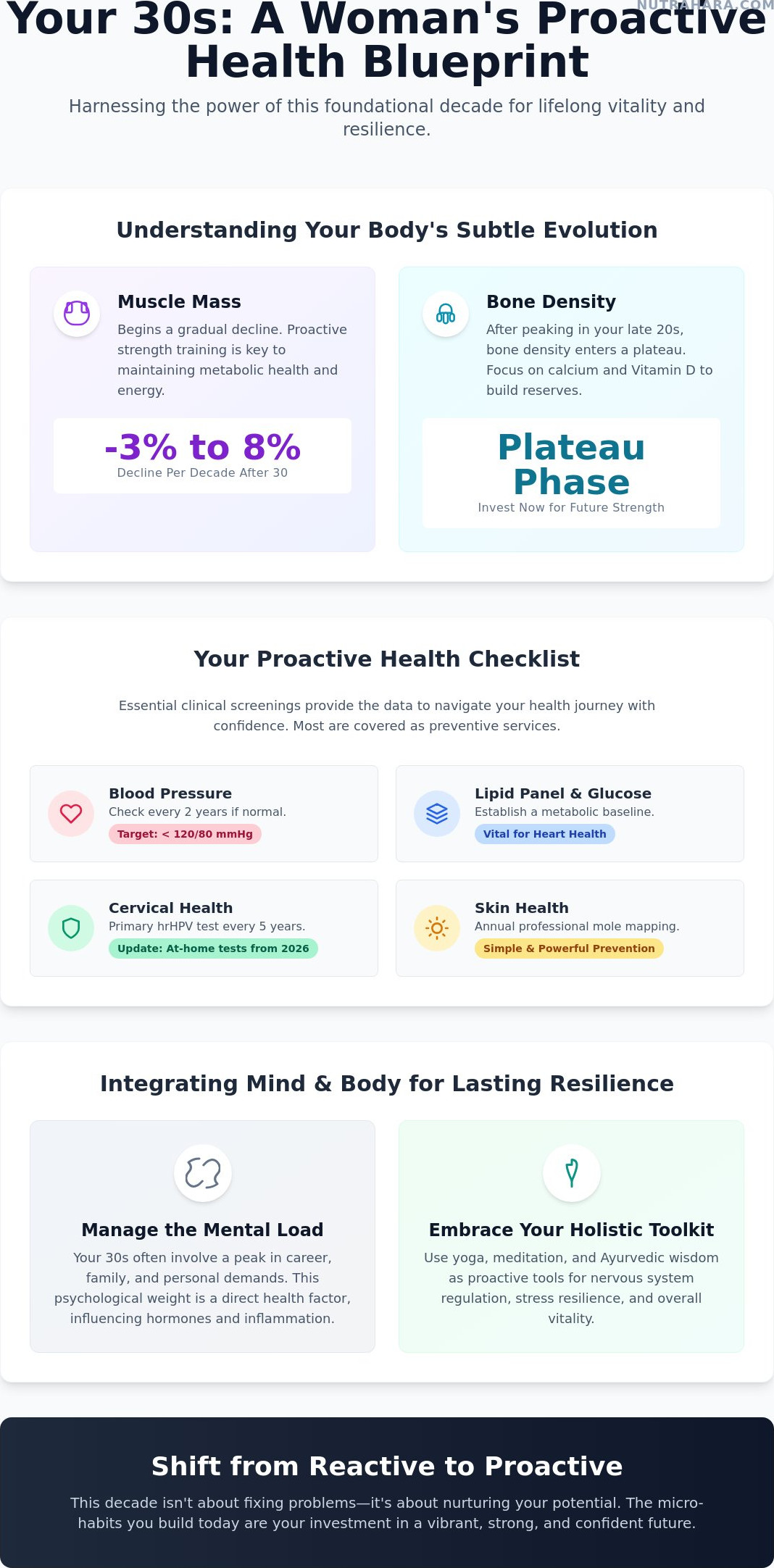
Biologically, the shifts are subtle but significant. Research indicates that muscle mass can begin to decline by 3% to 8% per decade starting at age 30. Similarly, bone density, which peaks in your late 20s, begins a very gradual plateau. These “quiet shifts” often go unnoticed until they manifest as fatigue or a slower recovery time. When you prioritize preventative health for women in their 30s, you acknowledge these changes early. You choose to act before the body sends a louder, more urgent distress signal. This decade is your investment phase; the choices you make now determine the strength and mobility you will enjoy in your 60s and 70s.
We must also validate the immense mental load that defines this decade. You are likely balancing a peak in your career, the complexities of family planning or caregiving, and the pursuit of personal fulfillment. This psychological weight is a direct health factor that influences your hormonal balance and inflammatory markers. To support this mental load, many women find that adaptogens like Ashwagandha with Black Pepper help maintain the equilibrium needed for a high-paced life. Your health is a long-term journey, and every small adjustment is a step toward a more resilient future.
Waiting for symptoms to appear is a late-stage strategy that often leads to burnout. Proactive care is about the power of micro-habits. It’s the daily meditation session, the consistent movement, and the intentional nutrition that prevents chronic inflammation from taking root. By framing your 30s as a foundational period, you shift your perspective from “fixing” yourself to “nurturing” your potential. This mindset allows you to build a health baseline that is robust enough to handle whatever life brings your way.
Your body speaks in whispers before it screams. Early signs of burnout, such as disrupted sleep patterns or a shift in digestive rhythm, are vital data points. Ayurveda views the 30s as a transition of energy where the “Pitta” or fire element is often at its peak. This can lead to drive and achievement, but if left unmanaged, it can result in heat and depletion. Learning to listen to these subtle signals allows you to become the ultimate expert on your unique baseline, ensuring your health progression remains steady and calm.
Clinical vigilance acts as the anchor for your long-term health progression. While the “quiet shifts” mentioned earlier occur beneath the surface, regular screenings provide the data needed to adjust your course. For preventative health for women in their 30s, certain tests are non-negotiable. You should have your blood pressure checked at least every two years if your readings are below 120/80 mmHg. A full lipid panel to monitor cholesterol and a blood glucose test are equally vital to establish your metabolic baseline. These metrics allow you to see how your lifestyle choices translate into internal markers of wellness.
As of 2026, cervical cancer screening guidelines have become more streamlined and accessible. For women aged 30 to 65, the preferred method is now primary high-risk human papillomavirus (hrHPV) testing every five years. A significant update as of January 5, 2026, is the option for patient-collected samples for hrHPV testing, which offers more privacy and convenience. Most of these screenings are classified as covered preventive services under the Affordable Care Act, meaning they are often available without out-of-pocket costs. Don’t overlook annual skin checks either; professional mole mapping is a simple yet powerful tool for early detection.
Standard blood work often misses the nuances of a woman’s endocrine system. Since one in eight women will develop a thyroid disorder in her lifetime, requesting a TSH (Thyroid Stimulating Hormone) test in your 30s is a wise move. We also recommend checking Vitamin D and Ferritin levels. Low iron stores can mimic the fatigue often dismissed as “just being busy.” Understanding these levels helps you identify if you are experiencing early perimenopausal shifts or simple nutrient gaps. Tracking your cycle as a “fifth vital sign” provides invaluable context for these results. To support your natural rhythms during these shifts, a targeted supplement like FemmePower can be a gentle partner in maintaining hormonal equilibrium.
A mental health check-in is just as critical as a physical exam. In our digitally saturated world, it’s easy to confuse chronic stress with a high-achieving lifestyle. Clinical burnout often hides behind the mask of “busy,” but it manifests physically through disrupted sleep and digestive issues. Use your annual visits to discuss sleep hygiene and stress resilience with your provider. Recognizing these patterns early prevents the long-term inflammatory effects of a high-cortisol lifestyle, ensuring your preventative health for women in their 30s addresses the mind and body as one.
Reaching your 30s changes the way your body interacts with nutrients. In your 20s, nutrition often feels like fuel for the immediate moment. By contrast, your 30s require a strategy built on “Nutritional Synergy.” This is the deliberate fusion of modern clinical research with time-honored Ayurvedic wisdom. It isn’t just about taking a list of vitamins; it’s about how these elements work together to support your long-term health progression. Prioritizing preventative health for women in their 30s means moving beyond reactive eating and toward a foundation that nourishes both your physical structure and your energetic balance.
To sustain the high-octane energy required for this decade, B-Complex vitamins are indispensable. They act as the spark plugs for your metabolism, helping convert food into steady energy without the afternoon crashes. A high-quality Vitamin B-Complex helps bridge the gap created by the mental load of career and family. It ensures your nervous system remains resilient under pressure. This modern clinical staple works perfectly alongside Ayurvedic adaptogens to create a comprehensive shield against the depletion that often defines this busy life stage.
Collagen production naturally begins to dip in your mid-20s, but the physical effects often surface during your 30s. You might notice subtle changes in skin elasticity or the first signs of joint stiffness after a morning yoga flow. Integrating a Premium Collagen Complex into your routine is a vital preventative step. It provides the essential amino acids needed to support connective tissues and bone density. By nourishing your joints today, you are directly investing in your mobility for your 60s and 70s. This is proactive care at its most tangible level.
Modern stress demands a solution that addresses the root of the body’s response. Ashwagandha is a premier Ayurvedic botanical that has been clinically validated to lower cortisol levels. From an Ayurvedic perspective, the 30s can be a period of erratic “Vata” energy. This often manifests as feeling ungrounded, scattered, or perpetually “on.” Using Ashwagandha with Black Pepper helps modulate this stress response. It provides the grounding stability needed to navigate a demanding lifestyle. This synergy between tradition and science ensures you aren’t just surviving your 30s, but building a resilient foundation for the future.
Clinical screenings and nutritional synergy provide the structural foundation for your health, but holistic tools manage the daily environment in which your cells live. Integrating these practices is the missing piece in many standard health checklists. While a blood test measures your current state, yoga and meditation regulate the nervous system that influences those results. For preventative health for women in their 30s, these tools are not luxuries; they are essential for toning the Vagus nerve. This cranial nerve acts as your body’s internal reset button. Deep, rhythmic breathwork signals your brain to exit the “fight or flight” mode, preventing the chronic cortisol elevation that leads to systemic inflammation.
Transitioning from a high-pressure workday to a restorative evening requires more than just sitting down. Creating a “Sanctuary Routine” helps your physiology make this shift. This could be a five-minute stretching sequence or a brief period of silence before you start your evening tasks. It serves as a clear signal to your system that the external demands have paused. If you find it difficult to quiet the mental chatter during these transitions, supporting your nervous system with Anxioguard can help you find your center and maintain a steady health progression.
Yoga serves as a vital antidote to the sedentary aging often caused by modern office work. Specific poses like Malasana (Yogi Squat) or Pigeon Pose target hip and joint health, areas where flexibility often begins to tighten during your 30s. A consistent practice acts as a form of moving meditation. It encourages lymphatic drainage and healthy circulation, which are foundational for hormonal balance. By committing to regular, mindful movement now, you ensure your body remains a fluid and capable vessel for the decades to come.
To further support a consistent outdoor practice, many wellness enthusiasts are opting for low-maintenance environments; for instance, EverTurf Inc offers high-performance synthetic turf that provides a clean, comfortable, and always-ready surface for yoga or meditation.
Mental tranquility is a physical necessity that directly impacts your longevity. Research indicates that as little as 10 minutes of daily meditation can have a positive effect on brain aging and cognitive reserve. This practice helps you manage the mental load of your 30s by creating a psychological buffer between a stressor and your physical reaction. It is a direct way to support health markers like blood pressure and heart rate variability. Simple breathwork techniques, such as box breathing, provide immediate stress relief during a busy day, allowing you to reclaim your calm in real time.
True vitality in your 30s is the result of a deliberate, harmonious blend of clinical vigilance, nutritional synergy, and holistic maintenance. You’ve learned that your health is not a static state to be managed only when symptoms arise. Instead, it is a continuous, beautiful progression that requires both scientific evidence and intuitive listening. By bridging the gap between modern screenings and ancient Ayurvedic wisdom, you are doing more than just avoiding illness. You are actively building a resilient foundation that will support your energy, mood, and mobility for decades to come. Viewing this self-care as an act of empowerment allows you to reclaim your narrative and lead with confidence.
Consider the journey of Maya, a 34-year-old professional who felt the “quiet shifts” of fatigue and mental load we explored earlier. “I spent years thinking that being tired was just part of being a woman in her 30s,” she shares. “Once I scheduled my thyroid tests and started a consistent morning meditation, the fog began to lift. Adding targeted nutrients made me feel like I was finally working with my body rather than against it.” Maya’s story is a reminder that your health progression is personal, and even small, intentional changes can yield profound results in your daily quality of life.
Starting your own journey doesn’t have to be overwhelming. Follow these three clear steps to establish your roadmap for preventative health for women in their 30s:
As you move through your 30s, your needs will naturally evolve. What worked at 31 might require adjustment at 38. We encourage you to conduct annual reviews of your routine with both medical providers and wellness guides to ensure your strategy remains aligned with your body’s changing signals. Staying informed is a vital part of this partnership. To deepen your understanding of how high-quality ingredients support your longevity, explore The Ultimate Guide to Women’s Wellness Supplements. Remember, you are the expert on your own body; we are simply here to act as your wise and caring guide on the path to lasting wellness.
Your 30s are a sacred window to align your physical health with your inner wisdom. By integrating clinical vigilance with the restorative power of yoga and meditation, you’ve taken the first steps toward a resilient future. We’ve explored how identifying your hormonal baselines and embracing nutritional synergy can transform your daily experience of energy and focus. Prioritizing preventative health for women in their 30s is the ultimate act of self-respect; it ensures that your body remains a vibrant partner in all your future adventures.
Nutrahara is here to support this journey with formulas where ancient Ayurvedic wisdom meets modern clinical research. Our supplements are crafted with natural, clean ingredients for the conscious woman and are trusted by thousands of women on their personal wellness journey. It’s time to move beyond surviving the mental load. It’s time to thrive in your own strength. Begin your health progression with Nutrahara’s clean, science-backed supplements.
You possess the tools and the knowledge to shape a life of longevity and peace. Trust in your body’s ability to evolve. Every mindful choice you make today is a gift to your future self.
The most critical blood tests include a full lipid panel, blood glucose, TSH for thyroid function, Vitamin D, and Ferritin levels. Since one in eight women will develop a thyroid disorder in her lifetime, establishing this baseline early is vital for your health progression. These tests provide a clear window into your metabolic health and nutrient stores. They allow you to make informed adjustments to your routine before minor gaps become significant issues.
No, you typically don’t need a Pap smear every year if your previous results were normal and you’re following current 2026 guidelines. For women aged 30 to 65, the preferred method is primary high-risk human papillomavirus (hrHPV) testing every five years. Alternatively, you can choose co-testing every five years or a Pap test alone every three years. These intervals provide robust protection while minimizing unnecessary procedures, ensuring your clinical care remains efficient and effective.
Chronic stress triggers sustained cortisol elevation, which can lead to systemic inflammation and impact your cardiovascular and metabolic health over time. In your 30s, the mental load of career and family can keep your nervous system in a “fight or flight” state. This sustained pressure can accelerate cellular aging and disrupt your natural hormonal balance. Using tools like meditation helps tone the Vagus nerve, preventing these long-term physical consequences and protecting your future vitality.
Starting a collagen supplement in your 30s is a wise preventative strategy because your body’s natural production begins to decline in your mid-20s. By your 30s, this decline often manifests as reduced skin elasticity or early joint stiffness after exercise. Integrating a high-quality collagen complex supports the structural integrity of your connective tissues and bones. This proactive step helps maintain your mobility and physical resilience as you progress through the coming decades of your life.
The most effective way to manage hormonal shifts naturally is through a combination of cycle tracking, anti-inflammatory nutrition, and adaptogenic support. Tracking your cycle helps you identify patterns in your energy and mood, acting as a “fifth vital sign” for your wellness. Botanicals like Ashwagandha can help modulate your stress response and stabilize erratic energy. This holistic approach ensures that preventative health for women in their 30s addresses the root causes of imbalance.
Ayurveda provides a personalized framework for preventative health for women in their 30s by focusing on the unique balance of your internal energies. It uses time-tested herbs and lifestyle rituals to ground the body and mind during this high-octane decade. When combined with modern clinical research, Ayurvedic wisdom provides a comprehensive toolkit for longevity. This fusion helps you navigate modern stressors while honoring the ancient, natural rhythms of your physical and mental self.
It is never too late to begin, as the choices you make in your late 30s still serve as a powerful investment in your future vitality. Even if you haven’t prioritized preventative care before, your body is remarkably resilient and responsive to positive changes. Starting now allows you to establish essential clinical baselines and nutritional habits that will support you through perimenopause and beyond. Every small, intentional adjustment contributes to a healthier long-term progression.
Early signs of perimenopause often include subtle changes in your menstrual cycle length, heavier or lighter flow, and disrupted sleep patterns. You might also notice increased anxiety, night sweats, or a shift in how your body responds to daily stress. These symptoms occur as estrogen levels begin to fluctuate more significantly. Recognizing these whispers from your body early allows you to seek supportive care and adjust your lifestyle before the transition becomes more intense.
This article is not a substitute for medical advice. Please consult a healthcare professional before starting any supplement, especially if pregnant, nursing, taking medication, or managing health conditions.