You wake up after eight hours of sleep but still feel like you’re running on empty. By the time your afternoon yoga session arrives, the “tired but wired” sensation has taken over, leaving you with a racing heart and a foggy brain. It’s a frustrating cycle that many women face as they move through the hormonal shifts of their 30s, 40s, and 50s. You’ve likely searched for a solution that doesn’t involve another cup of coffee or a temporary fix. This is where adaptogenic herbs enter the story, acting as a natural thermostat for your internal systems. To be truly classified as an adaptogen, a botanical must be non-toxic, increase your resistance to a broad spectrum of stressors, and have a normalizing effect on your body.
We believe your health is a long-term progression, not a quick destination. You deserve to feel empowered and resilient, whether you’re managing a busy career or the transition into menopause. This guide will show you how to use traditional Ayurvedic wisdom and modern clinical research to reclaim your vitality. We’ll explore how these botanical allies support your HPA-axis, improve exercise recovery, and provide the sustained energy you need to thrive. From ancient Rasayana principles focused on longevity to modern nutritional science, you’re about to discover a supportive partnership for your lifelong wellness journey.
Imagine your body has an internal thermostat designed to keep your temperature steady, regardless of the weather outside. Adaptogens function in much the same way for your stress levels. When the “heat” of life’s demands rises, these botanicals help cool your system down. When you feel chilled by exhaustion or low mood, they provide a gentle warming effect to lift your vitality. For women navigating the complex hormonal shifts between their 30s and 60s, adaptogenic herbs offer a stabilizing force that helps maintain equilibrium during life’s most demanding transitions.
This concept isn’t new, though modern science is finally catching up to ancient wisdom. In Ayurveda, these plants were known as Rasayanas; herbs used to rejuvenate “Ojas” or vital life force. The term “adaptogen” was later coined in the late 1940s by Soviet researchers who were looking for ways to increase the resilience of soldiers and pilots. To understand the full scope of their history and scientific classification, it’s helpful to look at What are adaptogens? through the lens of both traditional and contemporary research.
For an herb to be officially classified as an adaptogen, it must meet three strict criteria. Safety is the foundation; the herb must be non-toxic and cause minimal side effects when taken at normal doses over long periods. Secondly, it must produce a non-specific response. This means it helps the body resist a wide range of stressors, whether they are physical, chemical, or biological. Finally, it must have a normalizing influence. If your cortisol is too high, the herb helps lower it; if it’s too low, the herb helps raise it. This unique balancing act is why products like ashwagandha with black pepper are so effective for women seeking hormonal harmony.
Many women reach for caffeine to push through brain fog, but stimulants act like a high-interest loan on your energy. You get a quick burst, but you eventually have to pay it back with a crash. Adaptogens are an investment in your energy bank instead. They don’t provide a “hit” of energy; they build your capacity to produce and manage energy over time. Because they don’t work through the central nervous system in the same way as caffeine, they are non-addictive and won’t leave you feeling “tired but wired” at the end of the day. Adaptogens are biological modulators that restore internal harmony.
Understanding how your body deals with stress starts with the HPA axis. This complex feedback loop between your brain and your adrenal glands dictates how you react to every challenge, from a missed deadline to the deeper physiological shifts of menopause. While your body is naturally equipped to handle temporary pressure, chronic stress often leaves your HPA axis stuck in the “on” position. Adaptogenic herbs work by smoothing out these biological spikes, acting as a buffer that protects your nervous system from constant alarm. This modulation is especially vital for women in their 40s, as it helps prevent the “tired but wired” feeling that often accompanies perimenopause.
The General Adaptation Syndrome (GAS) model describes three distinct stages of stress: alarm, resistance, and exhaustion. Most active women find themselves stuck in the resistance phase, where the body works overtime to maintain a facade of energy while internal resources dwindle. Adaptogens intervene here by supporting mitochondrial health at a cellular level. They help your cells produce ATP more efficiently, ensuring you don’t slide into the final exhaustion phase where chronic fatigue and burnout reside. Furthermore, by regulating cortisol, these herbs protect your body from the corrosive effects of chronic high stress, such as disrupted sleep and persistent brain fog.
In addition to adaptogens, providing your body with the right nutritional building blocks helps sustain your energy levels; you can discover My Wellness to explore clean supplements that support your overall vitality and recovery.
In the ancient Ayurvedic tradition, this process of rejuvenation is known as Rasayana, or the “path of essence.” This philosophy focuses on nourishing your Ojas, the subtle energy that governs your immunity, vitality, and emotional resilience. It’s a holistic approach that views your health as a long-term progression rather than a series of symptoms to be silenced. Today, modern clinical studies validate what ancient practitioners knew instinctively: herbs like Ashwagandha are powerful tools for restoring this vital essence. When you choose clean, additive-free formulas, you ensure your body can process these botanicals without the burden of synthetic fillers.
Empowerment begins with the realization that stress is a biological process you can actively influence. By finding “The Middle Way” between your sympathetic (fight or flight) and parasympathetic (rest and digest) nervous systems, you can reclaim control over your well-being. If you’re looking to support your body’s natural resilience during these transitions, exploring a targeted formula like FemmePower can be a gentle and effective step toward reclaiming your daily energy.
Choosing the right botanical allies depends on where you are in your personal health progression. While all adaptogenic herbs share the core pillars of safety and balance, specific plants excel at addressing the unique shifts in a woman’s body. Whether you’re juggling a fast-paced career in your 30s or navigating the hormonal transitions of your 50s, these herbs offer targeted support. Integrating these adaptogenic herbs into your daily routine provides a foundational layer of resilience that grows with you over time.
Ashwagandha is perhaps the most celebrated of these allies, often called the “Strength of a Horse” because it restores vigor and promotes deep, restful sleep. For emotional clarity, Holy Basil, or Tulsi, is known as “The Incomparable One.” It helps manage metabolic health while providing a sense of spiritual and mental calm during hectic days. If you’re looking for skin radiance and liver support, Schisandra berry is a traditional favorite. Known as the “Five-Flavor Fruit,” it contains all five basic tastes—salty, sweet, sour, pungent, and bitter—which helps nourish the entire system and maintain a youthful glow.
Many women struggle with a persistent 3 PM slump that leaves them reaching for caffeine. Rhodiola Rosea, the “Golden Root” found in high-altitude regions, is an excellent choice for these moments. It enhances cognitive function and mental focus without the jitters. For the active woman, Eleuthero (Siberian Ginseng) builds physical endurance and helps you recover faster from intense yoga or gym sessions. To sharpen your mental edge and clear the clouds of fatigue, a synergistic blend like Nutrahara FocusZenith can help you reclaim your productivity.
As you move toward menopause, your thyroid and adrenal glands require extra care to manage shifting estrogen levels. Ashwagandha plays a vital role here, supporting hormonal balance and easing the anxiety that often accompanies life transitions. Shatavari, a member of the asparagus family whose name means “the woman with a hundred husbands,” is another powerhouse for reproductive and mucosal health. To ensure you’re getting the most out of these botanicals, choosing a high-bioavailability option like Ashwagandha with Black Pepper is essential for optimal absorption and efficacy.
“After adding Ashwagandha to my routine, I finally stopped waking up at 3 AM with a racing mind. I feel more grounded during my morning meditation and have the energy to keep up with my yoga practice.” – Sarah, 48
While adaptogenic herbs are powerful allies, they achieve their full potential when woven into a supportive lifestyle. Think of these botanicals as partners in your health journey rather than replacements for foundational habits. When you combine them with mindful movement and intentional stillness, you create an environment where your body can truly thrive. This synergy is the key to moving from a state of survival to one of lasting vitality. It’s about building a daily rhythm that respects your body’s natural cycles and hormonal shifts.
Yoga acts as a physical adaptogen by training your nervous system to remain calm under pressure. Gentle twists and inversions are particularly effective for supporting the adrenal glands and encouraging lymphatic flow. For women who take their fitness seriously, these herbs help reduce muscle strain and shorten recovery times after intense workouts. By lowering post-exercise inflammation, they allow you to maintain a consistent training schedule without the risk of burnout. Supporting your system with a comprehensive formula like Nutrahara FemmePower ensures you have the nutritional foundation to match your physical ambitions.
Meditation and mindfulness create the mental space required for adaptogenic herbs to do their work. A simple five-minute morning meditation helps set the “cortisol tone” for your day, preventing the initial spike of morning anxiety. You can also practice the “Ritual of the Cup” by turning your supplement intake into a moment of tranquility. Instead of rushing, take a breath and acknowledge your commitment to your long-term health progression. This intentionality shifts your perspective from managing symptoms to nurturing your whole self.
“I used to push through my days on sheer willpower and too much coffee. Transitioning to a routine of yoga and adaptogens changed everything. I no longer feel like I’m constantly on the edge of a breakdown; I feel strong, centered, and finally in control of my energy.” – Elena, 42
To maximize efficacy, timing matters. Energizing herbs like Rhodiola are best taken in the morning or early afternoon to avoid sleep disruption. Calming herbs like Ashwagandha can be taken in the evening to support restorative sleep. Consistency is your greatest tool, as the benefits of these plants build over weeks and months of steady use. If you’re ready to embrace a more balanced way of living, you can discover our targeted wellness support to begin your transformation.
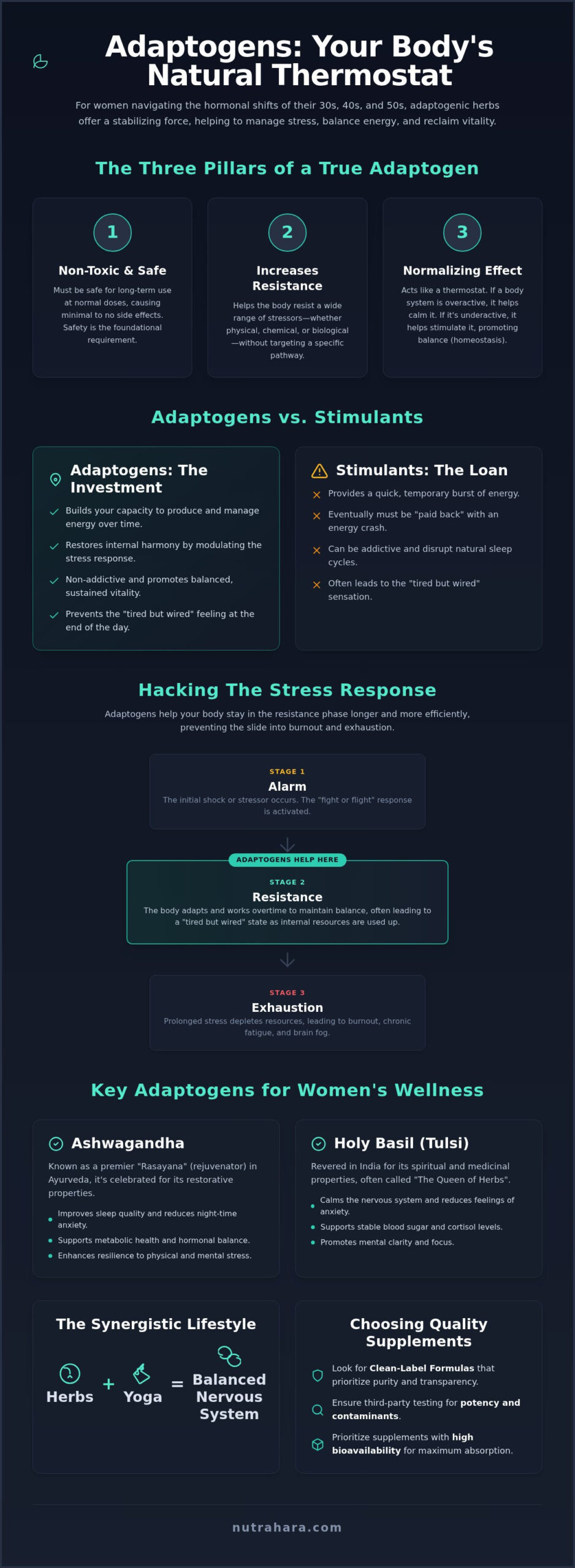
Selecting adaptogenic herbs requires more than just picking a bottle off a shelf. You need to look for a “Clean Label” that guarantees the absence of artificial fillers, synthetic additives, and binders that can hinder absorption. At Nutrahara, we believe in the purity of the botanical source and the clinical validation of every ingredient. Our “Wise Guide” philosophy ensures that our formulas are simple, transparent, and focused on your long-term health progression. This commitment to quality means you don’t have to worry about hidden ingredients disrupting your hormonal balance.
Bioavailability is another critical factor to consider. Many adaptogenic herbs are difficult for the body to process in their raw form. This is why we include natural enhancers like black pepper in our formulas. It’s a small but significant detail that ensures the active compounds reach your cells rather than passing through your system unused. When a supplement is formulated with bioavailability in mind, it becomes a much more effective partner in your wellness journey.
Potency isn’t just about high numbers; it’s about the right balance for a woman’s body. Standardized extracts provide a consistent level of active compounds, while whole herb powders offer the synergistic benefits of the entire plant. You should avoid “proprietary blends” that hide specific dosages behind a single number. These often contain trace amounts of expensive herbs and large amounts of cheap fillers. Nutrahara’s promise is built on the belief that “purity is power” and “scientific transparency is the foundation of trust,” ensuring every formula remains “simple, clean, and clinically validated” for your peace of mind.
Adaptogens aren’t an overnight fix. They require a “build-up” period of several weeks to fully harmonize with your HPA axis and support your nervous system. We suggest keeping a “Wellness Journal” for your first 30 days. Track your energy levels, sleep quality, and emotional resilience to see the subtle shifts taking place. This consistency is what transforms a supplement into a supportive partner for your lifestyle, helping you move from a state of stress to one of lasting vitality. Your journey toward balance and longevity is a personal one, and you don’t have to navigate it alone.
If you’re ready to take the next step in your health journey, embark on your journey with Nutrahara’s Ultimate Guide to Women’s Wellness.
Your health is a personal, lifelong progression. By understanding how adaptogenic herbs function as a biological thermostat and embracing ancient rejuvenation principles, you can move away from the “tired but wired” cycle and toward sustained vitality. We’ve explored how these botanical allies harmonize the HPA axis and support your body through every stage, from your active 30s to the wisdom of menopause. Integrating these plants with mindful movement ensures that your nervous system remains resilient against the modern world’s demands.
Choosing quality is the final step in this journey. You deserve formulas that are as pure as they are effective. Nutrahara’s collection is formulated by Ayurvedic experts and third-party tested for purity to ensure every dose meets our high standards. Because these supplements are designed specifically for the female lifecycle, they act as a trustworthy partner for your wellness. Take the next step in reclaiming your energy and emotional balance today. Shop Nutrahara’s Science-Backed Adaptogen Collection and invest in your future self. You have the power to influence your biology and thrive with confidence.
You should expect to notice subtle shifts in your energy and stress resilience within two to four weeks of consistent use. Unlike stimulants that provide a quick hit, these botanicals work by gradually modulating your HPA axis and building your body’s internal resources. For the best results, we recommend tracking your progress in a wellness journal for thirty days. This allows you to see the cumulative benefits as the herbs harmonize with your unique biology.
You must consult your healthcare provider before adding any new botanical supplements to your routine while pregnant or nursing. While many herbs have a long history of traditional use, your body’s requirements are unique during these sensitive life stages. Clinical data on specific extracts during pregnancy can be limited. A medical professional can help you determine which options are safe for you and your baby based on your specific health history and needs.
The ideal timing depends on the specific herb’s properties and your personal wellness goals. Energizing options like Rhodiola are best taken in the morning or early afternoon to support cognitive focus and physical stamina throughout the day. Calming herbs like Ashwagandha are often more effective when taken in the evening to promote restorative sleep and emotional tranquility. Always follow the specific guidance on your clean-label supplement packaging to ensure maximum efficacy and internal harmony.
Most people tolerate these botanicals well, as a core requirement for any plant to be classified as an adaptogen is that it must be non-toxic at normal doses. However, some individuals may experience mild digestive upset or slight changes in sleep patterns as their body adjusts. If you notice any unusual symptoms, it’s a good idea to lower your dosage or speak with a professional. Choosing clean, additive-free formulas helps minimize the risk of reactions to synthetic fillers.
You can certainly combine different adaptogenic herbs to create a synergistic effect that addresses multiple health concerns simultaneously. Many women find that a blend of energizing and calming botanicals provides a more comprehensive biological thermostat for their daily needs. For example, pairing a focus-enhancing root with a stress-soothing berry can help you maintain mental clarity while staying grounded. We recommend starting with a professionally formulated blend to ensure the ingredients work together harmoniously for your long-term progression.
Ashwagandha and Shatavari are two of the most effective botanical allies for navigating the hormonal shifts of menopause. Ashwagandha helps stabilize the HPA axis and supports adrenal health, which can reduce the frequency of stress-induced hot flashes. Shatavari is traditionally used in Ayurveda to support reproductive health and maintain mucosal moisture. When used together, these herbs provide a nurturing foundation that empowers you to handle perimenopause and post-menopause transitions with greater ease and confidence.
You can take most adaptogens daily to maintain a consistent baseline of resilience, as their benefits build over time. Some practitioners suggest a cycling approach, such as taking a one-week break every few months, to keep the body’s response fresh. However, there is no strict rule requiring this for safety. Because your health is an ongoing journey, pay attention to how your body feels and adjust your routine to match your current stress levels and fitness goals.
You should always speak with your doctor before combining adaptogenic herbs with prescription medications for anxiety or mood. Some botanicals may enhance the sedative effects of certain drugs or interfere with how your body processes them. While these plants are natural, they have potent pharmacological properties that can influence your nervous system. A medical professional can provide personalized guidance to ensure your supplement routine safely complements your existing treatment plan without any unwanted interactions.
This article is not a substitute for medical advice. Please consult a healthcare professional before starting any supplement, especially if pregnant, nursing, taking medication, or managing health conditions.