What if supporting your knees as you age means adapting your routine, not giving up activities you enjoy? Knee health depends on several connected factors, including body weight, muscle support, joint structure, and changes over time. Understanding how these factors interact can help you make thoughtful choices about staying active.
This guide covers practical ways to care for your knees, from building a sustainable movement routine to recognizing when discomfort needs attention. It also considers how wellness needs can change through different life stages, incorporating trusted guidance from Nutrahara to support your mobility. Choose what suits your circumstances, and approach your health journey with curiosity, patience, and confidence.
Many women find that combining gentle strengthening exercises with mindful weight management makes a noticeable difference in daily comfort, helping them stay active and confident in their movement.
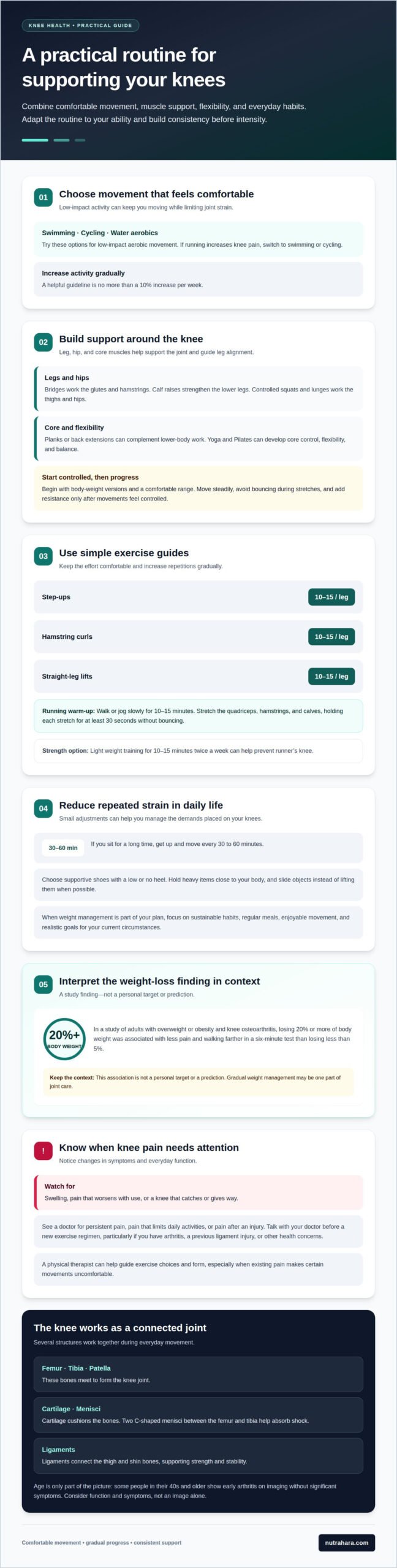
Each extra pound of body weight adds force to the knee with every step. Over time, repeated loading may increase stress on the joint, particularly with arthritis. If you’re considering how to prevent knee problems as your body changes, focus on comfortable movement and sustainable habits. Swimming, cycling, and water aerobics are low-impact ways to stay active.
For knee support, combine low-impact aerobic exercise with strengthening moves for your legs and hips. Beginners can start with a few repetitions of each movement, then build gradually. Step-ups can be done for 10 to 15 repetitions per leg; hamstring curls and straight-leg lifts can each be repeated 10 to 15 times per leg. Talk with your doctor before starting a new exercise regimen, particularly if you have arthritis, a previous ligament injury, or other health concerns.
Warm up before running with 10 to 15 minutes of walking or slow jogging. Then stretch the quadriceps, hamstrings, and calves; hold each stretch for at least 30 seconds without bouncing. To improve sports technique, practise controlled jumping, landing, and changes of direction. Increase activity gradually, with no more than a 10% increase per week as a helpful guideline. If running increases knee pain, switch to swimming or cycling.
Everyday habits matter, too. If you sit for a long time, get up and move every 30 to 60 minutes. Choose supportive shoes with a low or no heel, hold heavy items close to your body, and slide objects instead of lifting them when possible. Learning how to prevent knee problems also means noticing early signs, such as swelling, pain that worsens with use, or a knee that catches or gives way. See a doctor for persistent pain, pain that limits daily activities, or pain after an injury.
Muscle strength tends to decline gradually starting in your 30s, so maintaining it becomes part of long-term knee care. The quadriceps, hamstrings, calves, and glutes help support the knee as you walk, climb stairs, and stand from a chair. When these muscles are stronger, they can absorb more of the physical stress that would otherwise pass through the joint. Strength also helps control how your knee moves during everyday tasks.
Build a routine that works several muscle groups, not just the fronts of your thighs. Bridges engage the glutes and hamstrings, while calf raises strengthen the lower legs. Squats and lunges work the thighs and hips when you move with control and use a comfortable range. Begin with body-weight versions, maintain steady alignment, and progress gradually rather than adding resistance before the movements feel controlled.
Your hips and core matter, too. Strong hip and core muscles help guide leg alignment, which can reduce uneven stress across the knee. A simple plan could pair lower-body strength exercises with planks or back extensions. Light weight training for 10 to 15 minutes twice a week can help prevent runner’s knee. A physical therapist can guide exercise choices and form, especially if existing pain makes certain movements uncomfortable.
Flexibility and balance complement strength. Yoga and Pilates can develop core control, flexibility, and balance, while gentle lower-body mobility work helps you move through a comfortable range. Avoid bouncing during stretches; move slowly and steadily instead. To support your knees, combine strengthening, aerobic activity, and flexibility work in a routine you can maintain. Adapt movements to your ability, and build consistency before intensity.
Weight management can support knee health, but it should suit your life rather than become a rigid target. Energy, comfort, and available time can change during pregnancy, lactation, perimenopause, and menopause. Focus on sustainable routines: regular meals, enjoyable movement, and realistic goals for your current circumstances. A routine that works in one life stage may need adjustment in another.
For people with knee osteoarthritis, weight loss has been associated with changes in pain and walking ability. In a study of adults with overweight or obesity, losing 20% or more of body weight was associated with less pain and walking farther in a six-minute test than losing less than 5%. This finding is not a personal target or prediction. It illustrates why gradual weight management may be one part of joint care.
Choose habits that can adapt to your schedule and energy. On a busy day, a short walk or gentle movement break may be more achievable than a long workout. Swimming or cycling can be alternatives when walking feels uncomfortable. During pregnancy or lactation, and through menstrual or menopausal changes, consider your comfort and any guidance you already receive from your healthcare professional as you adapt activity and food routines.
Consider strength and mobility alongside weight. Gentle stretching can support comfortable movement, while strengthening the hamstrings and legs helps prepare you for daily activities. Track practical changes, such as how stairs feel or whether errands are easier, rather than relying on the scale alone. If knee pain limits your movement or persists, seek medical advice about the cause and appropriate next steps.
The knee joint is formed where the femur, tibia, and patella meet. Cartilage cushions the bones, while two C-shaped menisci between the femur and tibia help absorb shock. Ligaments connect the thigh and shin bones, supporting strength and stability. These structures work together during a simple movement such as stepping off a curb, so an injury to one can affect how the whole joint feels and moves.
Age can change the picture, but it doesn’t tell the whole story. Many people in their 40s and older have early signs of arthritis on imaging without significant symptoms. An image alone, then, doesn’t explain how comfortably you can walk, bend, or climb stairs. Pay attention to changes in function as well as discomfort. A decrease in balance, new swelling, or a knee that catches may be more useful reasons to seek an assessment than age by itself.
Cartilage erosion, overworking the knees, sustained impact, genetics, joint injections, and other joint disorders can contribute to knee damage. These factors vary from person to person, which is why controlled movement and gradual activity changes matter. For example, if a deep bend causes discomfort, reduce the depth and move through a controlled range. Avoiding painful movements can help limit added stress while keeping comfortable daily movement possible.
Reducing injury risk means supporting the structures around the joint and responding to warning signs. Move steadily and with control during exercise, choosing variations that let you maintain balance and alignment. Persistent pain, swelling, or difficulty bending or bearing weight calls for medical evaluation. Age or imaging alone does not determine whether surgery is needed; symptoms, function, and the cause of the problem guide treatment decisions. Understanding your knee’s anatomy can help you notice changes and seek care when needed.
Nutrahara offers women’s health supplements for women who want to support their broader wellness routines alongside regular movement, strength training, and balanced eating. Made in New Zealand, the supplements combine principles of Ayurvedic science with modern nutritional research and use natural, clean ingredients. They can complement a broader approach to wellbeing, but they do not replace exercise or care for persistent knee symptoms.
If you’re building healthy habits that fit your life stage and goals, explore how women’s health supplements may fit into your overall wellness routine. For knee pain that limits daily activities, speak with a doctor about the cause and appropriate care. For questions about Nutrahara, contact Nutrahara.
Your relationship with movement can evolve through menstruation, pregnancy, perimenopause, and beyond. Let your routine evolve too. Notice which activities leave you feeling capable and energized, and make room for recovery when your body needs a gentler pace. Yoga or a few minutes of mindful breathing can also help you approach movement with greater patience and confidence.
Learning how to prevent knee problems isn’t about chasing a perfect routine. It’s about making thoughtful choices that help you stay connected to the activities and moments that matter. Choose one small habit to carry forward, then build on it as it becomes part of your day.
For support with your broader wellness journey, contact Nutrahara for support. Keep moving at a pace that feels right for you, and trust that steady care can make a meaningful part of everyday life.
Keep your knees moving with regular activity, strength work, and balance practice. For a practical balance drill, stand near a countertop and shift your weight from one foot to the other while keeping a steady posture. Yoga can also combine controlled movement with balance. Adjust your routine as your energy, comfort, and life stage change, and choose activities you can return to consistently.
Body weight affects the load your knees manage during ordinary movement, and weight management can be one part of joint care. For people with arthritic knees, losing 10 pounds has been associated with about 20% less pain. That figure describes an observed relationship, not an individual prediction. Focus on sustainable habits that support your overall health rather than judging progress by the scale alone.
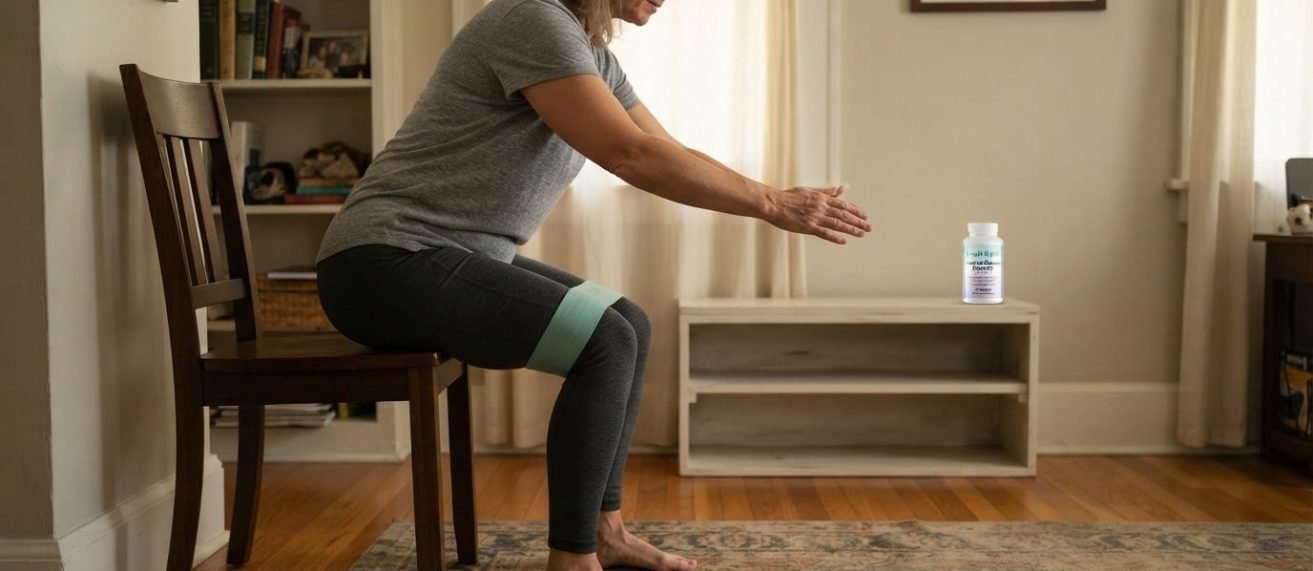
Strong supporting muscles help your legs control movement during tasks such as stepping off a curb or rising from the floor. The hips and ankles also influence how the knee moves, so strength and control across the whole leg matter. Try a slow sit-to-stand from a firm chair, keeping your movement smooth and balanced, rather than focusing only on isolated knee exercises.
The quadriceps at the front of the thigh help the knee bend and straighten, while the hamstrings at the back support leg movement. Training both muscle groups can help your legs manage everyday tasks with more control. For example, practise standing from a chair slowly, then lower yourself with control. Stop if the movement causes increasing pain.
There isn’t one exercise dose that suits everyone. Your current activity level, comfort, recovery, and exercise form all affect what you can manage. Build a routine around movements you can perform with control, and increase the challenge only when you can maintain steady technique. If you’re returning after a long break, begin with comfortable versions of each activity and progress gradually.
Higher body weight can increase stress on knee joints and is one factor associated with osteoarthritis risk. It isn’t the only influence: genetics, repeated overuse, sustained impact, and other joint disorders can also contribute to knee damage. Consider weight alongside your movement habits, strength, and symptoms, rather than treating it as the sole explanation for knee pain.
This article is not a substitute for medical advice. Please consult a healthcare professional before starting any supplement, especially if pregnant, nursing, taking medication, or managing health conditions.