Ayurvedic herbs may complement thyroid care, but they can’t replace thyroid hormone treatment. Among ayurvedic herbs for thyroid support, ashwagandha has human research behind it: a study of 50 women found that taking 600 mg daily was associated with significant improvements in thyroid hormone levels.
If you’re living with thyroid symptoms or Hashimoto’s, it’s understandable to look for gentle, holistic ways to support your well-being. Herbs may have a role, but their effects and safety deserve a clear-eyed look, especially if you’re managing an autoimmune condition or taking medication. This article explains what Ayurvedic medicine may offer, what research says about ashwagandha and black cumin in Hashimoto’s, and why herbs should be considered alongside, not instead of, medical treatment. You’ll also find practical ways to include sleep, movement, and stress care in a balanced approach.
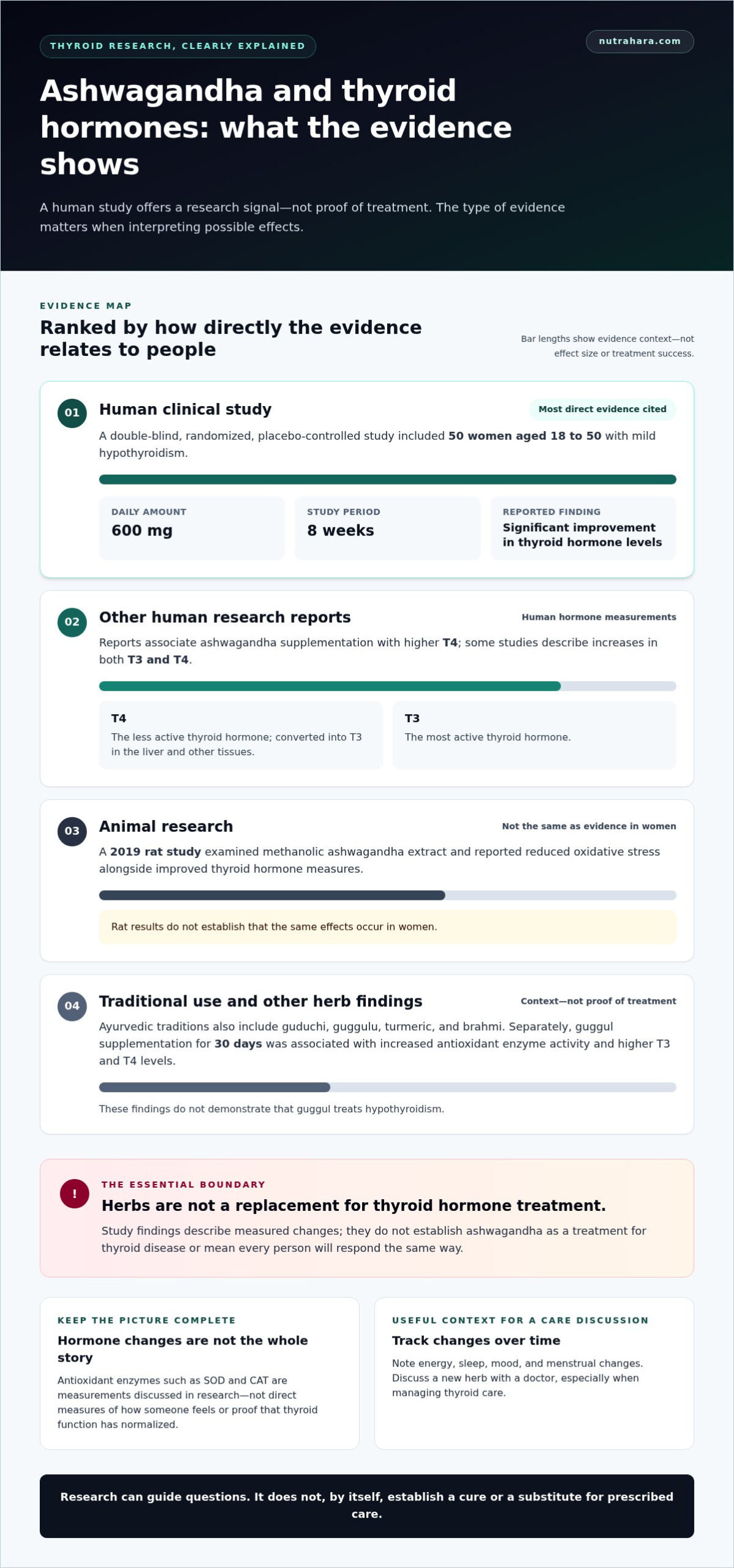
Ashwagandha, also called Withania somnifera, has been studied for thyroid hormone changes in people with mild hypothyroidism. A double-blind, randomized, placebo-controlled study included 50 women aged 18 to 50 years. Participants took 600 mg daily for 8 weeks, and the study reported significant improvements in thyroid hormone levels. Those findings are encouraging, but they don’t establish ashwagandha as a treatment or replacement for thyroid hormone medication.
Other research has examined possible effects on T3 and T4. T4 is the less active hormone, converted into more active T3 in the liver and other tissues; T3 is the most active thyroid hormone. Reports associate ashwagandha supplementation with higher T4, and some studies describe increases in both T3 and T4. One report also noted increased SOD and CAT, antioxidant enzymes involved in the body’s defenses against oxidative stress. These findings describe measured changes, not proof that every person will experience the same response.
Clinical studies have tested ashwagandha in people with mild hypothyroidism, while other thyroid-related findings come from animal research. A 2019 rat study examined methanolic ashwagandha extract and reported reduced oxidative stress alongside improved thyroid hormone measures. Rat results don’t establish the same effect in women. For women managing menstrual changes, perimenopause, or postmenopause, symptoms such as low energy can have several possible causes, so hormone test results and clinical context matter.
Ayurvedic traditions also include guduchi, guggulu, turmeric, and brahmi. Guggul, a resin from Commiphora mukul, has been studied separately: supplementation for 30 days was associated with increased antioxidant enzyme activity and higher T3 and T4 levels. A study in healthy subjects suggested guggul constituents could counter thyroid-dampening agents. These findings don’t demonstrate that guggul treats hypothyroidism. Triphala combines Amalaki, Bibhitaki, and Haritaki and is traditionally used to support digestion; it is not evidence of a thyroid hormone effect.
Some ayurvedic herbs for thyroid support are discussed alongside lifestyle practices such as stress care, restorative sleep, and gentle movement. Before discussing a new herb with a doctor, record changes in your energy, sleep, mood, and menstrual cycle. This gives the conversation concrete details. Ashwagandha research offers a starting point for understanding possible hormone effects, while distinguishing human studies from rat findings and traditional use helps keep expectations grounded.
Ayurveda is a traditional health system that originated in India more than 5,000 years ago. It considers patterns across digestion, energy, sleep, and daily routines, rather than viewing thyroid health as an isolated concern. In Ayurvedic terms, hypothyroidism is associated with Kapha imbalance. Hyperthyroidism is described as Atyagni, linked with Vata and Pitta, and associated with restlessness, tremors, rapid heartbeat, insomnia, heat intolerance, and catabolism. These traditional frameworks differ from medical diagnoses and thyroid tests.
Ayurvedic medicines may include herbs and preparations selected within that broader framework. Kanchanara, or Bauhinia variegata, is used in Ayurvedic management for glandular swelling and Meda metabolism. Shilajatu is described as a Rasayana used for hypothyroidism and endocrine rejuvenation. Guggul, from Commiphora mukul, has also been studied for effects on iodine uptake into the thyroid gland. These traditional uses and study findings do not establish a preparation as a proven treatment for thyroid disease.
Antioxidant enzymes are one area of interest because oxidative stress can be involved in biological processes affecting tissues. SOD and CAT are examples of enzymes discussed in research on herbal supplements. Their activity is a measurement, not a direct measure of how someone feels or proof that thyroid function has normalized. For a more useful record, note energy, sleep, mood, and menstrual changes alongside thyroid test results, rather than relying on a single symptom or laboratory measure.
Can iodine-containing herbs worsen Hashimoto’s disease or hyperthyroidism? Excessive iodine is discouraged in Ayurvedic dietary guidance for hyperthyroidism, and iodine-rich ingredients can contribute to total iodine intake. The information here does not establish that a specific herb worsens Hashimoto’s. Avoid using iodine-containing herbs to self-treat or adjust thyroid function.
A practical way to assess an Ayurvedic approach is to identify the goal first: glandular swelling, digestive discomfort, stress, or another concern. Then list the herbs and preparations being considered, including any iodine-containing ingredients, and compare them with your current thyroid care. A qualified Ayurvedic practitioner can tailor traditional care and help it complement conventional treatment. If you’re experiencing menstrual, perimenopausal, or menopausal changes, tracking symptoms can clarify what support you’re seeking and make discussions about thyroid health more specific.
Monitoring your body’s response helps clarify what support you may need and whether changes coincide with an Ayurvedic preparation or a change in thyroid care. Keep a focused record of timing, symptoms, and the exact preparation to make discussions with a qualified Ayurvedic practitioner and the clinician overseeing your thyroid care more specific. This also helps distinguish a traditional goal, such as digestive or stress support, from a claim that a medicine has corrected thyroid function.
A study cited on the page found that guggul increased iodine uptake into the thyroid gland. That finding describes an observed effect, not proof that guggul treats thyroid disease or is suitable for everyone. If you’re considering it, discuss its iodine content and how it fits with your current thyroid care. Do not use a supplement or preparation to replace prescribed care or change treatment without professional guidance. Interpret symptom notes alongside thyroid test results, since neither alone establishes that an approach is working.
Hashimoto’s thyroiditis is an autoimmune disease, and no particular Ayurvedic medicine has been shown to treat it. Ayurvedic herbs may be considered supportive care alongside conventional treatment, not as a replacement for prescribed thyroid medication. That distinction matters as symptoms, thyroid hormone levels, and treatment needs change over time. An Ayurvedic framework may describe balance differently, but it does not replace medical assessment of thyroid function.
If you’re considering herbs, start by writing down the exact preparation and its intended use. Include the plant’s common and botanical names, every listed ingredient, and the label directions. This is especially useful for formulas combining herbs, since one familiar ingredient may not describe the whole product. Share the details with a doctor before starting, so you can discuss Hashimoto’s treatment and current medicines together.
Atriplex halimus is a plant associated with traditional medicine, but that association alone does not establish it as a treatment for Hashimoto’s or a way to change thyroid hormone levels. Keep traditional use distinct from clinical evidence. The same principle applies to other herbs: a history of use or a proposed effect on metabolism does not show that a plant can control autoimmune disease.
Buying Ayurvedic thyroid medicines online calls for careful label reading, not simply choosing a product based on a thyroid-related claim. Check that the ingredient list clearly identifies the plants, including botanical names where provided. Note whether the product combines several ingredients, and keep the label available when discussing it with a doctor. Do not use online descriptions as a reason to stop or adjust prescribed thyroid treatment.
Medical advice is important before trying herbs for thyroid health, particularly if you have Hashimoto’s or take thyroid medication. If unusual symptoms appear after taking an herb, seek medical advice promptly. Keep a simple record of the herb, when you took it, and the symptoms you noticed. This gives a clinician concrete details to consider rather than relying on memory alone.
Supportive routines can complement appropriate care without being presented as disease treatment. For example, try gentle yoga or quiet meditation to support stress management, and record changes in sleep, energy, and mood. These notes can help you describe your day-to-day experience, while medical tests and clinical assessment guide thyroid treatment decisions. The goal is informed, coordinated care that respects both your personal wellness practices and the needs of an autoimmune condition.
Black cumin, also called Nigella sativa, is discussed as an herbal option for Hashimoto’s thyroiditis. That discussion does not establish that it treats autoimmune disease. It should not replace thyroid hormone medication or prompt someone to change a prescribed dose. If you’re managing fatigue, weight changes, or menstrual symptoms, distinguish personal symptom support from treatment of the underlying condition.
Assess research by asking what was measured and in whom. A change in a laboratory marker, symptom, or thyroid hormone level would not, by itself, prove that black cumin controls Hashimoto’s or improves long-term health. The research details here do not establish a dose, duration, or treatment effect. Do not apply a dose used for another herb or study to black cumin.
A testimonial from a woman using black cumin for Hashimoto’s could describe her individual experience, but it couldn’t show that the herb caused a change or works for others. No authentic, sourced testimonial is available to include here, so inventing a personal story would mislead readers. For decisions about treatment, prioritize research and clinical advice over anecdotal claims, whether shared online or by someone you know.
Safety also matters. People taking blood-thinning medication may need to avoid black cumin because of a potential bleeding risk. Before considering a supplement, write down its name, ingredients, and intended use, then discuss these details with a doctor. This is useful if you take thyroid treatment or other medication, since the full combination matters more than any single ingredient alone.
Use a simple symptom record to make changes easier to discuss. Note energy, sleep, mood, digestion, menstrual patterns, and any new symptoms, along with when you start or stop a supplement. Avoid changing several parts of your routine at once. For example, starting black cumin while also changing exercise and diet makes it harder to identify what may be related to a change in how you feel.
Everyday habits can support general well-being without being presented as Hashimoto’s treatment. Try gentle yoga or a short meditation, and choose activity suited to your energy that day, such as walking instead of an intense workout when fatigue is present. These habits can support a steadier lifestyle, but they do not establish that thyroid hormones or autoimmune activity have changed. Bring supplement details and symptom notes to a medical discussion, and mention blood-thinning medication explicitly.
For hypothyroidism and hyperthyroidism, herbs cannot replace thyroid hormone treatment or other prescribed care. The practical takeaway is to consider Ayurvedic approaches supportive and discuss supplements with a doctor before use. Ayurveda may describe symptoms through ideas such as imbalance, while medical care assesses thyroid function and the individual condition. Changing prescribed treatment on your own is not a safe next step.
What does endocrinology guidance say about herbal supplements? The guidance reflected here is clear: do not use herbs instead of thyroid hormone treatment. If you’re considering an herbal supplement, discuss the specific preparation with your doctor and qualified Ayurvedic practitioner, including how it fits alongside conventional treatment. The conversation should cover the plant, the product’s full ingredient list, your thyroid condition, and current medication.
Can Ayurvedic herbs interact with levothyroxine or antithyroid medications? The effect depends on the herb, preparation, medication, and how they’re used together. Share the supplement label and medication list with your doctor before combining them, rather than assuming an herbal product is automatically compatible. Do not stop or adjust prescribed medication to make room for a supplement.
Risks vary by herb and by the person taking it. Black cumin may pose a potential bleeding risk for people taking blood-thinning medication, and unusual symptoms after taking an herb call for prompt medical advice. Keep the product label and note when symptoms begin; those details can help explain what changed. Pregnancy and breastfeeding also call for particular care before starting herbal supplements.
Food advice should be practical, not extreme. Ayurveda favors whole, unprocessed foods as part of general health, but a restrictive eating plan should not replace assessment of thyroid disease. Before reducing a food group or adding an iodine-containing herb, identify the reason and discuss it with a clinician. This is especially relevant when managing hyperthyroidism, for which excessive iodine is discouraged in Ayurvedic dietary guidance.
For a steady routine, track energy, sleep, mood, and menstrual changes, then bring those notes to a medical appointment. Gentle yoga or meditation can support stress management without being presented as treatment for thyroid imbalance. If ashwagandha is part of your wellness research, explore the ashwagandha supplement as one option to discuss alongside your existing care.
If you experience symptoms linked to thyroid conditions, contact a doctor. Do this even if you’re also exploring Ayurvedic care; symptoms are a reason to seek medical advice, not decide by yourself what is causing them. Describe what you’ve noticed in clear, ordinary language, and mention any Ayurvedic products or practices you’re considering. Ask how to approach those options alongside your care and what information would be useful to share. If you’re unsure whether a change is relevant, raise it rather than relying on self-assessment. Keep the conversation focused on your symptoms and current care so you and your doctor can discuss next steps.
Nutrahara offers women’s health supplements that combine principles of Ayurveda with modern nutritional research. Made in New Zealand with natural ingredients and no artificial additives, they may suit women seeking a wellness routine that complements their broader approach to energy and general health, including movement, restorative sleep, and meditation. These supplements are not thyroid treatments and do not replace prescribed medication or medical advice.
If you’re considering an herbal supplement while managing a thyroid condition, discuss the ingredients with your doctor first, especially if you take medication or are pregnant or breastfeeding. Choosing carefully can help keep your wellness routine aligned with your individual health needs.
Explore Nutrahara’s women’s health supplements at nutrahara.com.
Make your next step deliberate, not rushed. Write down the health goals you want to support, the routines that help you feel steady, and questions for your healthcare team. This can make decisions about ayurvedic herbs for thyroid support part of a broader wellness plan rather than a stand-alone experiment.
Try a gentle yoga sequence with seated breathing, shoulder rolls, and an easy seated twist, moving only within a comfortable range. For meditation, set aside a quiet moment to notice your breath and gently return your attention when your mind wanders. Choose practices that feel sustainable through changing seasons of life. If you’re exploring nutritional support, learn about Nutrahara’s women’s health supplements.
Your health journey belongs to you. Move forward with curiosity, clear questions, and care for the woman you are today.
They are traditional herbal preparations and practices chosen within Ayurveda’s approach to health. Traditional use does not make them proven thyroid treatments.
A human study reported thyroid hormone changes in women with mild hypothyroidism. This does not establish ashwagandha as a treatment.
Read the full ingredient label, record botanical names, and share the product details and medication list with a doctor before use.
This article is not a substitute for medical advice. Please consult a healthcare professional before starting any supplement, especially if pregnant, nursing, taking medication, or managing health conditions.