
What if the best perimenopause vitamins are the ones you actually need, not the longest supplement stack you can find? Changes in sleep, mood, energy, or menstrual patterns can make it tempting to try every vitamin linked to “hormone balance.” It’s understandable to want relief, but these symptoms can have other causes, and more supplements don’t always mean more support.
A thoughtful plan starts with your health, diet, medications, and any nutrient gaps, not a one-size-fits-all formula. In this guide, you’ll learn which nutrients may be worth discussing with a healthcare professional, how to weigh evidence and safety, and what to check before combining products. You’ll also find ways to support well-being beyond supplements, including nourishing meals, regular movement, and practices such as yoga or meditation. With clear information and useful questions, you can make choices that fit your needs.
Perimenopause is the transition leading up to menopause, when menstrual cycles and symptoms may change. Menopause is reached after 12 consecutive months without a menstrual period. The timing and experience differ from woman to woman. You can read more about the stages in this overview of perimenopause.
Changes in sleep, mood, energy, or cycle patterns may occur during the transition, but symptoms alone can’t show whether you have a vitamin deficiency. Perimenopause vitamins may help fill a nutrient gap when there’s a reason to do so, but supplements don’t diagnose or treat perimenopause.
Your nutritional needs reflect your overall health, eating pattern, medications, and life stage. A possible shortfall is not the same as a confirmed deficiency. Fatigue, for example, can have several explanations, including disrupted sleep, stress, changes in health, or a nutrient deficiency. Mood changes can also have more than one cause.
A clinician can help decide whether your symptoms or health history warrant evaluation and what kind. There’s no single set of tests or supplements that suits every woman. Before starting a product, note what you eat, the supplements you already take, and the symptoms you want to address. That information gives you a clearer starting point for a personalized conversation.
Seek professional guidance for symptoms that are new, severe, persistent, or concerning. Don’t assume they’re part of perimenopause or try to correct them with supplements without first getting advice. A qualified healthcare professional can consider hormonal changes alongside non-hormonal factors and help determine appropriate next steps.
Bring a brief symptom record to the conversation. Include when changes began, how they affect daily life, and any medicines or supplements you use. Ask whether a nutrient gap is plausible, whether evaluation is appropriate, and whether a supplement could interact with your medicines or health conditions. A steady approach grounded in your individual needs is more useful than choosing a product based on symptoms alone.
There isn’t one vitamin proven to ease perimenopause for every woman. It helps to distinguish correcting a nutrient shortfall from taking a supplement in hopes of changing symptoms. Calcium and vitamin D are relevant to bone health, but that doesn’t mean they’ve been shown to relieve perimenopause symptoms. Whether supplementation makes sense depends on your diet, life stage, health history, and individual needs.
Meeting nutrient needs supports normal body functions. It isn’t a promise to balance hormones or resolve perimenopause symptoms.
Look closely at what a study actually measured. Research on a nutrient’s role in general health doesn’t automatically show that a supplement improves hot flashes, sleep, mood, or other symptoms. Findings may also depend on who took part, the amount used, and the outcome researchers assessed. An association between nutrient intake and a health measure doesn’t prove the supplement caused a change.
Be cautious with broad claims that a vitamin “balances hormones.” Ask what evidence supports the specific ingredient, dose, and outcome, and whether the research applies to people like you. For many symptom-focused supplement claims, the evidence remains uncertain.
A varied eating pattern can provide a foundation for nutrient intake. Foods such as dairy or fortified alternatives, leafy greens, beans, nuts, seeds, and fish can contribute different nutrients, depending on your choices. Food supports overall nourishment, but it isn’t a guaranteed solution for symptoms or a substitute for evaluation when something feels wrong.
Testing decisions depend on personal history and a clinician’s judgment. Rather than assume you need a particular test or supplement, ask whether your symptoms, diet, or health circumstances point to a specific concern. If you’re reviewing a B-vitamin product, use the vitamin B complex information as a label to examine, not as a recommendation. Check its listed ingredients and amounts, then discuss suitability with a qualified healthcare professional, especially if you take medication or other supplements.
A clear label helps you assess whether a product fits a specific need, but it can’t establish that a supplement will relieve perimenopause symptoms. Compare the product with your goals, current routine, and the evidence for its stated purpose. Use the table as a starting point for that review.
| Intended nutrient | Evidence relevance | Label information to check | Question for your clinician |
|---|---|---|---|
| Calcium or vitamin D | Relevant to bone health and nutrient adequacy. Don’t assume this means relief from perimenopause symptoms. | Amount per serving, serving directions, and amounts also present in other products. | Does my diet or health history suggest a need for more of either nutrient? |
| Another listed vitamin or mineral | Check whether evidence relates to a confirmed shortfall, general health, or a specific symptom claim. | Full ingredient list, amount of each ingredient, warnings, and suggested use. | Is this ingredient relevant to my situation, and is it suitable with my medicines or health conditions? |
Before choosing among perimenopause vitamins, compare the complete ingredient list and amounts with everything else you take, including multivitamins and fortified products. Check the serving size, directions, cautions, and manufacturer contact information. A “natural” description alone doesn’t prove a product is safe or effective, and a product name doesn’t confirm what’s inside. Verify the actual label rather than inferring ingredients or benefits.
Be wary of claims that a supplement replaces individualized medical advice or guarantees hormone balance. Bring the label, or a clear photo of it, to a healthcare professional. Ask about the product’s stated purpose, the evidence, and possible overlap with your existing routine.
If you have a specific concern or a nutrient gap has been identified, a focused discussion may be more useful than adding a broad stack. More ingredients can make it harder to spot duplication or assess what’s appropriate, particularly if you take medicines or have a health condition. Ask a qualified professional to review the full formulation and your personal circumstances before starting.
You can inspect Nutrahara’s women’s supplement option as a product page, not as a treatment recommendation. Review its current label and confirm any details that matter to your decision with a healthcare professional.
A supportive plan can begin with a few clear observations, then build through informed conversations and habits that feel realistic for you. Before adding a supplement, organize what you’re experiencing and what you already take.
Share relevant health history and changes in your routine. Ask whether your symptoms could have another explanation, whether a nutrient shortfall is plausible, and whether a product is suitable alongside your medicines or health conditions. If a supplement is considered, ask how long to use it and when to reassess. Your notes and questions are a useful starting point, even if you don’t have a diagnosis or a product in mind.
Choose movement that suits your current fitness level and health, such as walking, cycling, strength exercises, or a class you enjoy. Gentle yoga can support mindful movement, while a short meditation or breathing practice can create a restorative pause. These practices can be part of well-being, but they aren’t treatments for perimenopause or substitutes for medical care. A steady wind-down routine may also help you make space for rest.
Track sleep, movement, and symptoms in a notebook or phone note if useful. Treat the record as a way to notice patterns and prepare for discussion, not as a diagnosis.
For informed exploration, review women’s health supplements and discuss any product’s suitability with a qualified healthcare professional.
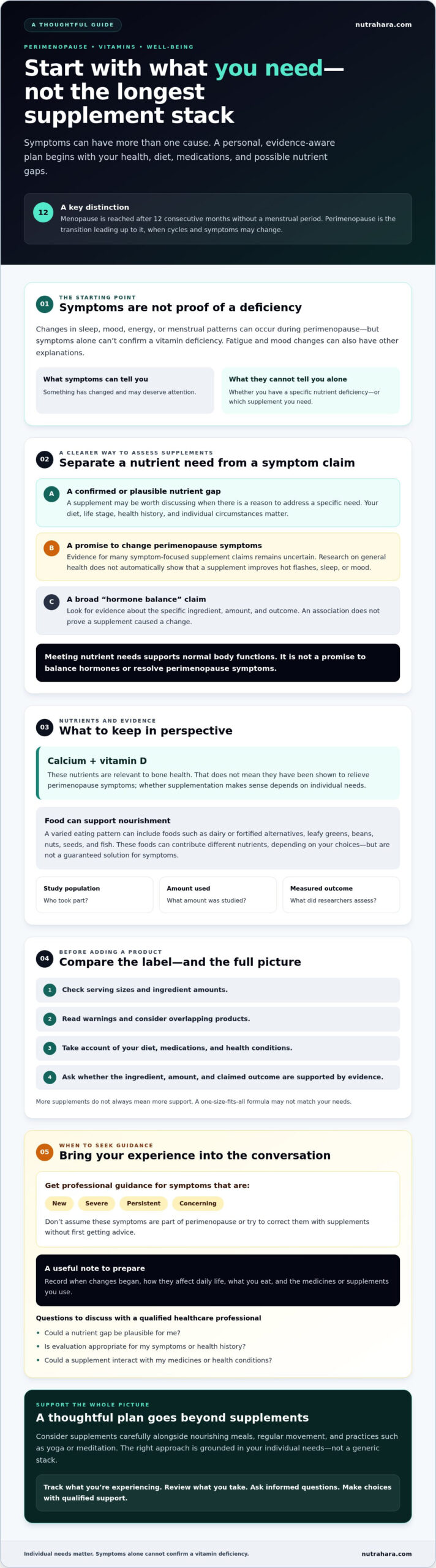
Before choosing perimenopause vitamins, follow a simple sequence: identify a possible need, assess the evidence for addressing it, review safety with a qualified healthcare professional, and then compare product labels. If no clear need emerges, taking a supplement is optional. You might instead focus on food, movement, sleep, or further evaluation of symptoms.
Nutrahara is a women’s health supplements company whose stated approach combines Ayurvedic principles with modern nutritional research. That describes the brand’s philosophy, not proof that a specific product prevents or treats perimenopause symptoms. No perimenopause-specific formulation or outcome is confirmed here. Consider any product page as information to review, and verify the current label rather than assuming its ingredients or suitability.
Look for clear ingredient names and amounts, serving directions, cautions, and a way to contact the manufacturer. Assess the product’s individual health claims separately: a natural-sounding description or traditional philosophy doesn’t establish that a supplement is effective for a particular symptom or safe for every person. Ask what evidence supports the specific ingredient and intended use. If details you need aren’t available, seek clarification before deciding.
If a product seems relevant to a need you’ve identified, compare its full label with your current supplements and medicines, then discuss it with a healthcare professional, especially if you have a health condition. Ask about possible interactions and whether the product fits your circumstances. A supplement isn’t a required part of every woman’s perimenopause routine, and choosing not to add one can be a considered decision.
For broader context on evaluating products and building a personal approach, explore the women’s wellness supplements guide as a related resource. When reviewing any supplement option, keep your needs, evidence, safety, and label details at the center of the decision. Explore Nutrahara’s women’s health supplements as options to assess, not as proven perimenopause remedies.
Choosing perimenopause vitamins doesn’t have to mean following a trending stack or trying to solve every symptom with a supplement. Let your individual needs guide you: weigh the evidence, consider safety, and review product labels carefully. If symptoms are concerning or you’re unsure about a product, bring your questions to a qualified healthcare professional.
Supplements are one possible part of a broader wellness routine, not a requirement. Nourishing food, movement that suits your body, restorative sleep, and practices such as yoga or meditation can also support your well-being through changing life stages.
Nutrahara focuses on women’s health supplements and describes its approach as bringing Ayurvedic principles together with modern nutritional research. Explore its offerings as options to assess, not as proven perimenopause treatments. Explore Nutrahara’s women’s health supplements and take the time you need to choose what fits your personal health journey.
There isn’t one best vitamin for every woman in perimenopause. Calcium and vitamin D are commonly considered for bone health, while other nutrients may be relevant depending on your diet, health history, and individual circumstances. Start by identifying a specific concern rather than choosing a product based on a broad “menopause support” claim. A qualified healthcare professional can help you decide whether a nutrient is worth considering and whether food, evaluation, or a supplement may be appropriate.
Vitamins may help address a nutrient shortfall, but that doesn’t establish that they relieve perimenopause symptoms. Research on a nutrient’s role in general health doesn’t necessarily show that taking it improves hot flashes, sleep, or mood. Check what a study measured and whether its findings apply to your situation. If symptoms affect daily life or seem unusual for you, discuss them with a healthcare professional rather than treating a supplement as a diagnostic tool.
Not automatically. Perimenopause doesn’t mean every woman needs a multivitamin, and a broad formula may include nutrients you already get from food or other products. Before choosing one, check the serving directions and amount of each ingredient, then compare the label with your existing routine. Consider your dietary pattern, health history, and medicines. A clinician or pharmacist can help you assess whether a multivitamin is useful for your circumstances or unnecessary.
Yes. Vitamins, minerals, and herbal supplements can interact with medicines or may not suit certain health conditions. Before starting a product, show a qualified healthcare professional or pharmacist its complete label and share your current medicines and supplements, including occasional-use products. Ask about interactions, how to take it safely if appropriate, and what changes to watch for. Don’t stop or adjust prescribed medication to make room for a supplement without guidance from the professional who manages your care.
Symptoms alone can’t confirm a vitamin deficiency. Consider your usual diet, health history, medicines, and any recent changes, then discuss specific concerns with a healthcare professional. They can use your circumstances to determine whether evaluation or testing is appropriate. Not everyone needs the same tests. Fatigue, for example, can have several possible causes. Keep a brief record of symptoms and relevant routine changes so you can explain what you’ve noticed without trying to diagnose yourself.
No. “Natural” doesn’t guarantee that a product is safe, effective, or suitable for you. Ingredients can have cautions, interact with medicines, or be inappropriate in some health circumstances. Read the full label, including ingredient amounts, directions, and warnings, and be cautious of sweeping promises about hormone balance or symptom relief. If you’re pregnant, lactating, taking medication, or managing a health condition, seek advice from a qualified healthcare professional before using a supplement.
Yoga and meditation can be supportive parts of a wellness routine, though they aren’t treatments for perimenopause. Choose a level of movement that feels manageable and appropriate for your health, such as gentle yoga, walking, or strength activity. A brief meditation or breathing practice can offer a quiet pause in a busy day. Notice how these habits fit alongside sleep and daily activity, and discuss persistent or concerning symptoms with a healthcare professional.
This article is not a substitute for medical advice. Please consult a healthcare professional before starting any supplement, especially if pregnant, nursing, taking medication, or managing health conditions.